
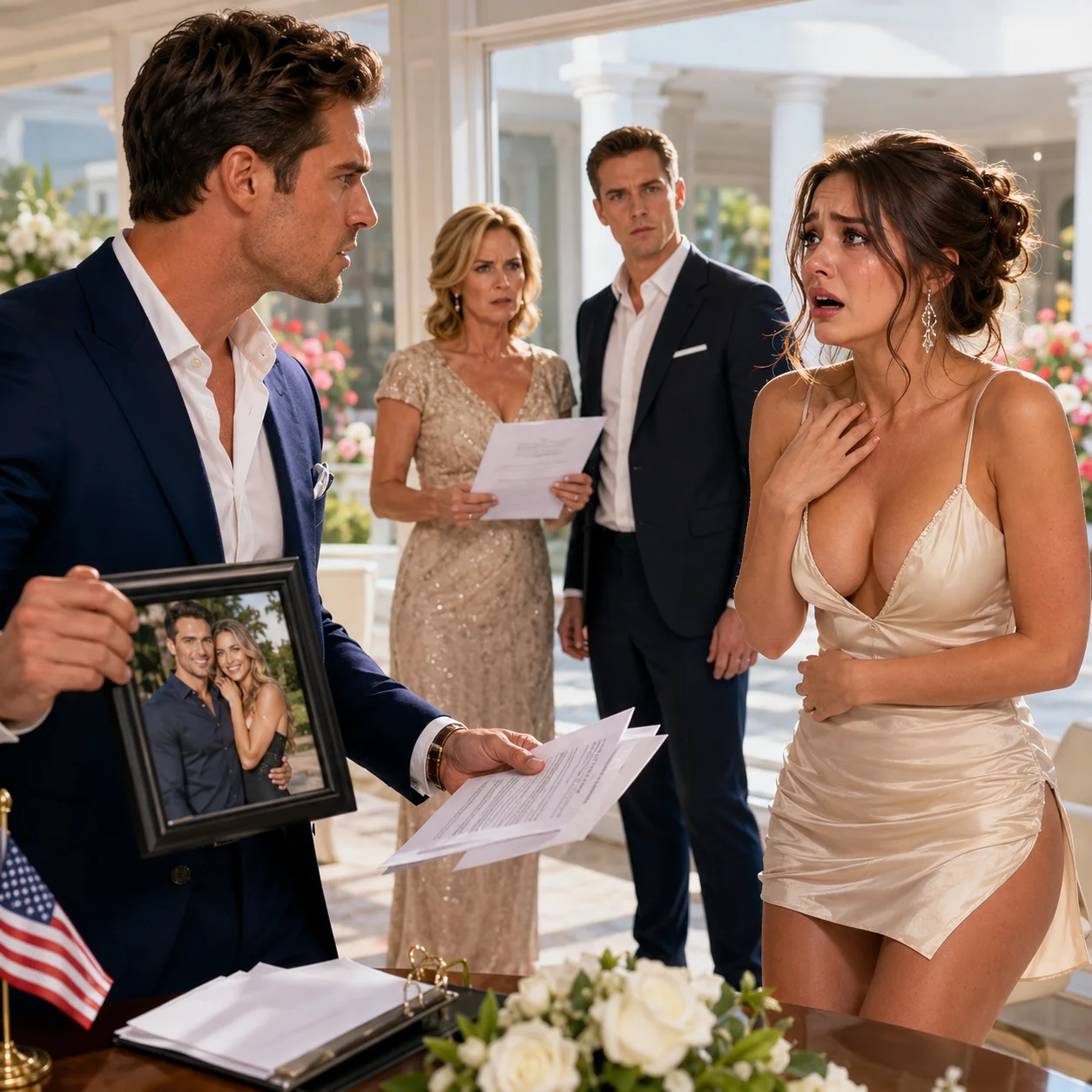
This one told me everything.
“No,” Patricia said quietly. “My son is not her cousin.”
The room seemed to tilt.
I looked at the lavender candle on the counter. It had burned down into a small pool of melted wax. The apartment smelled like home, and somehow that made everything worse.
“What did you call about?” I asked.
Patricia hesitated. “I’m sorry. I thought this number was connected to the wedding venue. Mia gave it to us as the contact number for changes because she said she handled all the planning.”
My throat went dry.
“What wedding venue?”
“The Calloway House,” she said. “For June seventeenth.”
I didn’t speak.
June seventeenth was the date Mia had once told me would be “perfect for a summer wedding.”
Patricia continued, each word making the floor feel less solid beneath me. “My husband and I are paying the cancellation fee. Evan said the wedding is off, but Mia has been avoiding us. I needed to confirm whether she had already canceled the venue, because the contract is still under her name.”
I heard myself ask, “Evan was marrying Mia?”
The woman’s voice cracked slightly.
“Yes,” she said. “At least, that’s what we believed.”
I closed my eyes.
There are moments when pain is so sharp it becomes strangely quiet. I didn’t yell. I didn’t drop the phone. I didn’t punch a wall or collapse like people do in movies. I just stood there, breathing, while three years of my life rearranged itself into something ugly.
“When?” I asked.
“When did they get engaged?”
“Last April,” Patricia said.
Last April.
Mia and I had been together.
Last April, she had cried in my arms after telling me she was overwhelmed by work. Last April, I had driven her to the coast for her birthday. Last April, she had kissed me under a cold gray sky and whispered, “I don’t know what I’d do without you.”
I opened my eyes.
“Does Evan know about me?”
“I don’t think he knew everything,” Patricia said carefully. “He found out enough to end it last week.”
Last week.
That explained the tension. The sudden affection. The way Mia had been watching me like she was waiting for a storm she hoped I wouldn’t notice.
“What did he find?” I asked.
Patricia sighed. “Messages. Receipts. A hotel booking. And photos.”
My hand tightened around the phone.
“Photos of me?”
“I don’t know all the details. Evan didn’t want to tell me everything.”
Of course he didn’t.
Men like us are trained to feel shame when women humiliate us. We think silence is dignity. We think not talking about the wound means no one can see us bleeding.
“Can I speak with him?” I asked.
Patricia was quiet for a moment. “I don’t know if that’s a good idea.”
“I’m not trying to start anything,” I said. “But I need to know the truth.”
“She told us you were her landlord.”
I almost laughed.
Not because it was funny.
Because it was perfect.
My apartment. My furniture. My groceries. My car when hers was in the shop. My credit card on hotel deposits for “work events.” My name quietly removed from the story and replaced with something useful.
Landlord.
“Please,” I said. “Give him my number.”
Patricia exhaled softly.
“I will.”
Then she added, “Daniel?”
“Yes?”
“I’m sorry.”
That almost broke me.
Not Mia’s lies. Not the wedding venue. Not the cousin story.
The kindness of a stranger.
I ended the call and stood in the kitchen for a long time.
Then I did something I am still proud of.
I did not call Mia.
I did not text her.
I did not give her a chance to rehearse.
I made coffee. I opened my laptop. And I started writing everything down.
Dates. Trips. Work excuses. Names she had mentioned. Receipts I remembered. Times she had disappeared for “vendor meetings.” The photo. Patricia’s call. The wedding date. The venue name.
When your heart is breaking, documentation feels cold.
But cold saved me.
At 6:43 p.m., Mia came home carrying a paper bag from the expensive bakery near the river.
“Hi, baby,” she sang, too brightly.
I was sitting at the dining table.
Her phone was in front of me.
The framed photo was beside it.
She stopped in the doorway.
For one second, her face emptied.
Then she smiled.
“What’s this?” she asked.
I looked at her. “Patricia Reed called.”
The bakery bag slipped slightly in her hand.
Not enough to fall.
Enough.
“Who?”
“Evan’s mother.”
Mia blinked fast. “Why would she call you?”
“She thought this was the wedding venue.”
The silence that followed was the loudest thing I had ever heard.
Mia set the bag down slowly.
“Daniel,” she said.
That was it. My name. Soft. Warning. Pleading.
I waited.
She rubbed her forehead. “This is not what you think.”
I laughed once, and it came out dead.
“Then explain it.”
She pulled out the chair across from me but didn’t sit. “Evan and I were complicated.”
“You said he was your cousin.”
“I panicked.”
“You said he was family.”
“He practically was.”
I stared at her.
She looked away first.
“When were you engaged?” I asked.
Her lips parted.
“When, Mia?”
“It wasn’t real.”
“Answer me.”
She crossed her arms. “April.”
I nodded slowly. “While you were with me.”
“We were going through a rough patch.”
“No, we weren’t.”
“In my head, we were.”
I stared at her, stunned by the confidence of that sentence.
In my head, we were.
As if betrayal became reasonable if she narrated it differently inside herself.
“You got engaged to another man while sleeping beside me,” I said.
“It wasn’t like that.”
“Then what was it like?”
Her eyes filled with tears. The speed of it was impressive.
“I felt trapped,” she whispered. “You were so stable, and Evan was exciting, and I didn’t know what I wanted.”
“You wanted both.”
“I was confused.”
“You were engaged.”
“It never got that far.”
“The venue was booked.”
“My job is event planning. Booking things doesn’t mean—”
“Mia.”
She stopped.
I pushed the framed photo across the table. “Was this taken after the engagement?”
She stared at it.
“Yes.”
“Were you wearing my necklace in that photo?”
Her face changed.
That was when I noticed it. A small gold pendant at her throat. The one I had given her on our second anniversary. I had saved for a month to buy it.
She had worn my gift in another man’s engagement photo.
I stood up because if I stayed seated, I thought I might fold in half.
Mia began crying harder.
“I was going to tell you.”
“No, you weren’t.”
“I ended it with him.”
“Patricia said Evan ended it last week.”
Her mouth snapped shut.
There it was.
The first honest thing in the room.
I walked to the window and looked down at the street. Rainwater shimmered on the pavement. A couple crossed under one umbrella, laughing as they ran toward the corner.
I wondered what it felt like to be someone whose life was still intact.
Behind me, Mia said, “I love you.”
I closed my eyes.
Once, those words could have changed the direction of my entire day.
Now they sounded like another tool.
“No,” I said quietly. “You love being loved.”
She flinched.
“You love attention. You love being chosen. You love having a backup plan. But you don’t love me.”
“That’s cruel.”
“So was making me your landlord.”
Her face went pale.
Patricia had been right.
Mia sank into the chair.
“I didn’t mean it like that.”
“How did you mean it?”
“I just needed to explain why I was always here.”
“Why not say I was your boyfriend?”
“Because Evan would have asked questions.”
I turned around. “You mean your fiancé would have asked why you lived with another man.”
Her tears stopped.
That was when the mask slipped.
Just for a moment.
Her expression hardened into irritation, as if my pain had become inconvenient.
“You’re acting like you were perfect,” she said.
I almost smiled. “There it is.”
“What?”
“The part where this becomes my fault.”
She stood up. “You were emotionally unavailable.”
“I was at my father’s hospital bed.”
“You never talked about marriage seriously.”
“I was saving for a ring.”
That stopped her.
For half a second, she looked genuinely shocked.
I walked into the bedroom, opened my nightstand, and took out the small black velvet box I had hidden beneath a stack of warranty papers.
When I returned, Mia’s eyes widened.
I placed it on the table between us.
“I bought it two weeks ago.”
Her hand covered her mouth.
“Oh my God,” she whispered.
I opened the box.
The ring caught the light from the kitchen pendant lamp. Simple. Elegant. Exactly the kind she had once pointed at through a jewelry store window.
For the first time that night, her tears looked real.
“Daniel…”
“I was going to ask you on Christmas Eve.”
She stepped toward me.
I closed the box.
“Don’t.”
She froze.
“I need you to leave tonight,” I said.
Her face twisted. “You can’t be serious.”
“I am.”
“Where am I supposed to go?”
“Call your cousin.”
Her mouth opened.
Nothing came out.
I walked to the closet and pulled out a suitcase. I didn’t throw her clothes. I didn’t scream. I folded enough for a few days and placed them inside because I refused to become the kind of man she could later describe as dangerous.
She watched me from the doorway.
“This is insane,” she said. “You’re throwing away three years because of one mistake?”
I stopped folding.
“One mistake?” I asked.
She looked at the floor.
I continued packing.
“The photo was a mistake. The engagement was a mistake. The venue was a mistake. The lies were mistakes. Calling me your landlord was a mistake. Wearing my necklace in his engagement photo was a mistake. How many mistakes does it take before it becomes a life?”
She didn’t answer.
At 8:12 p.m., she left with one suitcase and a face full of tears.
At 8:31 p.m., my phone started ringing.
First Mia.
Then Mia again.
Then her best friend Lauren.
Then Mia’s mother.
Then a number I didn’t recognize.
I didn’t answer any of them.
At 9:04 p.m., a text arrived from Mia.
Please don’t do this. I know I hurt you but I can fix it.
At 9:07:
You don’t understand everything.
At 9:11:
Evan manipulated me.
At 9:16:
His family is crazy. Please don’t talk to them.
That was the one that made me sit up.
Please don’t talk to them.
So, naturally, I called Evan.
He answered on the second ring.
“Daniel?”
His voice was rough, tired.
“Yeah.”
There was silence.
Then he said, “I’m sorry, man.”
I leaned back against the headboard. “How long?”
He exhaled. “I met her two years ago.”
Two years.
Not April.
Not a few months.
Two years.
“She told me she was single,” he continued. “Then later she said she had a roommate. Then a landlord who was too involved. Then an ex who wouldn’t leave her alone. I started noticing things last winter.”
“What things?”
“She never let me pick her up from home. Always wanted to meet somewhere. She’d disappear on weekends and say she was with clients. I found a picture of you two at Cannon Beach.”
My chest tightened.
“Our anniversary trip,” I said.
“She told me you were her brother.”
I closed my eyes.
Cousin. Landlord. Brother.
I wondered how many versions of me existed in Mia’s world.
“How did you find out?” I asked.
“I hired the photographer for our engagement shoot,” Evan said. “He sent me the full gallery last week because I wanted to make a slideshow for the rehearsal dinner. In the background of one photo, she had her phone on the table. Your name was on the screen. The message said, ‘Can’t wait to come home to you.’”
I remembered that text.
I had sent it while she was supposedly helping her aunt move.
Evan continued. “I went through what I could. Her laptop was open one night. I’m not proud of that. But I found hotel confirmations, shared calendars, messages to you, messages to me. Two lives. Same dates.”
I stared at the wall.
Two lives.
Same dates.
“Did she love you?” I asked.
Evan gave a short, bitter laugh. “I don’t know what that word means to her.”
For some reason, that hurt more than if he had said yes.
We talked for forty minutes.
Not like rivals.
Like survivors of the same accident.
He told me his parents had put down a deposit on The Calloway House, a historic wedding venue outside the city with white columns and a rose garden. Mia had chosen it. Mia had cried when she saw it. Mia had told his mother it felt like destiny.
I almost told him she had shown me the same venue on Instagram months before and said, “Wouldn’t this be beautiful someday?”
But I didn’t.
He had enough ghosts.
Before we hung up, Evan said, “She’ll try to make us hate each other.”
“I know.”
“She’ll say I abused her.”
“She already said you manipulated her.”
He went quiet.
Then he said, “Of course she did.”
The next morning, I woke up after maybe two hours of sleep.
My apartment felt unfamiliar, as if the walls themselves had learned something shameful.
Mia’s hairbrush was still on the bathroom counter. Her mug was in the sink. Her slippers sat beside the couch. Small domestic evidence everywhere. Proof that betrayal doesn’t always look like lipstick on a collar. Sometimes it looks like someone’s favorite cereal still sitting in your pantry after they’ve destroyed you.
I called my landlord and explained that Mia no longer lived there. Her name was not on the lease, but she had received mail at the apartment, so I wanted the locks changed legally and properly. He agreed to send someone the next day.
Then I boxed her things.
Not angrily.
Carefully.
That was worse.
By noon, Lauren showed up pounding on my door.
“Daniel, open up!”
I looked through the peephole. Lauren stood in the hallway with her arms crossed, wearing the expression of someone who had arrived to defend a version of the truth she had not bothered verifying.
I opened the door but kept the chain on.
“She’s devastated,” Lauren snapped.
“So am I.”
“You humiliated her.”
I almost laughed. “By asking her to leave after discovering she was engaged to another man?”
Lauren’s face flickered.
She recovered quickly. “That situation was complicated.”
“Did you know?”
Her silence answered before her mouth did.
My stomach turned.
“Lauren.”
She looked away.
“You knew?”
“She was confused,” Lauren said. “She didn’t want to hurt anyone.”
“That is exactly what people say when they want to hurt everyone and still be forgiven.”
Lauren’s eyes narrowed. “You don’t know what it was like for her.”
“No,” I said. “But I know what it was like for me.”
I closed the door.
By evening, the story had begun mutating.
Mia’s mother texted me a long message saying relationships were complicated and that “a mature man does not punish a woman for being uncertain.” Her sister called me controlling. A mutual friend, Jared, asked if it was true I had “kicked Mia out with nothing.”
I sent him one screenshot.
Patricia Reed’s call log.
The photo.
The venue contract Evan forwarded me, with Mia listed as bride.
Jared replied six minutes later.
I am so sorry. I didn’t know.
That became my policy.
No speeches. No online posts. No emotional essays. Just evidence.
Quiet evidence is powerful because it does not beg to be believed.
Three days later, Mia asked to meet.
I ignored the first request.
Then she sent:
Please. Closure. One conversation. Public place. I won’t make a scene.
I chose a coffee shop near my office with large windows and too many people for theater.
She arrived wearing the beige coat I had bought her last winter.
I hated that I noticed.
She looked thinner already, though I suspected some of it was deliberate. Mia understood presentation. She knew exactly how to look wounded.
She sat across from me and wrapped both hands around her coffee cup.
“I miss you,” she said.
I said nothing.
She swallowed. “I know you don’t believe me.”
“You’re right.”
Her eyes flashed, but she controlled it. “I made terrible choices. I’m not denying that.”
“Good.”
“But Evan was never what you think.”
“I don’t care what Evan was.”
“He pressured me.”
“Into booking a wedding venue?”
She looked down.
I leaned forward slightly. “Mia, I’m not here to debate which lie was your favorite. Say what you asked me here to say.”
Her mouth tightened.
Then she whispered, “I need to come back.”
There it was.
Not I love you.
Not I’m sorry.
I need to come back.
“Why?”
“My mom won’t let me stay long. Lauren’s place is tiny. Evan blocked me. His parents are threatening legal action over the deposit. I just need time.”
I studied her face.
She was still beautiful. That seemed unfair. Pain should make liars look different, but it often doesn’t. Sometimes they look exactly like the person you once wanted to marry.
“No,” I said.
Her eyes filled. “Daniel.”
“No.”
“I have nowhere to go.”
“You had two men ready to build a life with you. Somehow you ended up with nowhere to go. That’s not my emergency.”
She flinched as if I had slapped her.
“Why are you being so cold?”
“Because warm didn’t protect me.”
For a moment, she just stared.
Then the tears disappeared.
Again, the mask slipped.
“You know what?” she said quietly. “Maybe I was right not to choose you.”
I nodded once. “There she is.”
Her face flushed.
“You always needed to feel morally superior,” she snapped. “You think because you pay bills and keep receipts, that makes you a good man?”
“No,” I said. “But not having a secret fiancé helps.”
People at nearby tables glanced over.
Mia lowered her voice. “You will regret treating me like this.”
I stood.
“No,” I said. “I’ll regret not trusting myself sooner.”
I left her sitting there.
That night, I did something I had avoided for days.
I opened the ring box.
For a long time, I looked at the ring I had planned to give her. The future I had imagined was still attached to it like smoke.
Christmas Eve. My parents’ house. Snow if we were lucky. Mia crying happily. My mother hugging her. My father pretending not to cry. A life.
Then I closed the box and placed it in my desk drawer.
Not because I was over her.
Because I was done letting the almost-life hurt more than the real one.
The Calloway House drama exploded the following week.
Evan called me first.
“You should know,” he said, “Mia is telling people you and I teamed up to ruin her.”
I rubbed my eyes. “Of course she is.”
“She’s also refusing to sign the cancellation paperwork unless my parents pay her half of what she claims she spent on planning.”
“Did she spend anything?”
“Not much. My parents paid most deposits. I paid the photographer. She paid for some samples and dress appointments.”
“Dress appointments?”
Silence.
I regretted asking.
“She had a dress?” I said.
“Yeah.”
The word was barely audible.
I sat down.
For three years, I had been trying to figure out when Mia would be ready for marriage.
Meanwhile, she had been trying on wedding dresses for someone else.
Evan continued, “My mother wants to settle quietly. My dad wants to sue. I just want it over.”
I thought about Patricia’s voice on the phone. Kind, embarrassed, heartbroken on behalf of a son she couldn’t protect.
Then I thought about Mia calling me her landlord.
“What do you need from me?” I asked.
“Nothing unless she drags you into it. But… there is one thing.”
“What?”
“The venue manager has a meeting with both families Saturday to finalize cancellation terms. Mia told them she can’t attend unless she has emotional support. She listed you as her support person.”
I stared at the phone.
“She what?”
“She gave them your name.”
I laughed then.
A real laugh, sharp and humorless.
She had cheated on me with her fiancé, lied to her fiancé with me, then tried to bring me as emotional support to cancel their wedding.
There should be a trophy for that level of audacity.
“I’m not going,” I said.
“I figured.”
Then I paused.
Actually paused.
Because something in me shifted.
For days, I had been reacting. Blocking calls. Boxing items. Defending myself privately. But Mia was still moving pieces around a board she believed she controlled. She was still using my name. Still rewriting me.
“No,” I said slowly. “I’ll go.”
Evan was silent.
“You sure?”
“Yes.”
Not for revenge.
At least, that’s what I told myself.
The Calloway House looked exactly like the kind of place Mia would love. White columns, wide steps, ivy curling along brick, rose bushes trimmed into perfect obedience. It sat on a hill overlooking a valley, the kind of place where people paid too much money to pretend love was simple.
I arrived ten minutes early in a navy suit.
Not because I wanted to impress anyone.
Because dignity sometimes needs a uniform.
Inside, a coordinator named Helen led me to a private meeting room. Long table. Pitcher of water. Contracts neatly stacked. Fresh flowers in the center.
Patricia Reed was already there with her husband, Thomas. Evan stood by the window, hands in his pockets. He looked like a man who had not slept in a week.
When Patricia saw me, she stood.
“Daniel.”
We shook hands.
Her eyes were kind and tired.
“I’m sorry we’re meeting like this,” she said.
“Me too.”
Thomas Reed gave me a firm handshake and a look that said he had spent several days wanting to hit something but had chosen not to.
Evan nodded at me.
A strange alliance.
Four people connected by one woman’s lies.
Mia arrived twelve minutes late.
Of course she did.
She walked in wearing a cream-colored dress that looked just bridal enough to be cruel. Her hair was styled softly around her face. Her makeup was delicate. Vulnerable. Strategic.
Behind her came her mother, Diane, and Lauren.
Mia stopped when she saw me.
For the first time since I had known her, she looked genuinely unprepared.
“Daniel?” she said.
I stood. “You listed me as your emotional support.”
Her mouth opened, then closed.
Lauren whispered something under her breath.
Diane glared at me like I had arrived at a funeral wearing red.
Helen, the coordinator, cleared her throat. “Shall we begin?”
We sat.
Mia chose the chair farthest from Evan and closest to me.
I moved one seat away.
Everyone noticed.
Helen reviewed the contract in a professional voice. Deposits. Cancellation dates. Nonrefundable portions. Outstanding balances. Transfer options. Force majeure clauses that did not apply to emotional disasters.
Mia stayed quiet until money came up.
Then she folded her hands.
“I just want to say,” she began softly, “that this situation has been very painful for me.”
No one spoke.
She continued, encouraged by silence. “There has been a lot of misunderstanding. I loved Evan. I cared deeply for Daniel. I was pressured from multiple sides, and I made choices while under emotional stress.”
Evan’s father leaned back in his chair.
Patricia looked down.
I watched Mia carefully.
She was building the bridge. Step by step. Not guilty. Pressured. Confused. Loved everyone. Hurt most.
Then she said it.
“Daniel was aware that my relationship with Evan was complicated.”
I turned my head slowly.
“No,” I said.
Mia’s eyes flickered.
Helen looked between us.
Mia gave a small, wounded laugh. “Daniel, please. This isn’t the time.”
“It is exactly the time,” I said.
Her mother snapped, “Don’t attack her.”
“I’m not attacking her. I’m correcting her.”
Mia’s voice dropped. “You promised you wouldn’t make this ugly.”
“I never promised you anything.”
The room went still.
I reached into my folder and took out three printed pages.
Not dramatic.
Not angry.
Just paper.
“I was told Evan was her cousin,” I said. “Then I was told by Patricia that he was her fiancé. Mia told Evan I was her landlord. She told him at one point I was her brother. She told both of us different versions of her life. I’m not here for money, and I’m not here to punish anyone. I’m here because my name was used without my consent.”
I slid one page toward Helen.
“This is a written statement that I was not aware of the engagement, did not consent to being listed as emotional support, and have no financial responsibility for this venue.”
Helen read it quickly.
Mia’s face had gone white.
“You brought documents?” she whispered.
“Yes.”
“Of course you did,” she said, bitterness leaking through. “You always have to make everything so official.”
“No,” I said. “You made lying administrative.”
Thomas Reed made a sound that might have been a cough or a laugh.
Mia’s mother stood. “This is humiliating.”
Patricia finally looked up.
“With respect, Diane,” she said quietly, “your daughter humiliated everyone at this table.”
Diane froze.
Mia turned to Patricia. “I loved your son.”
Evan spoke for the first time.
“No, you loved the wedding.”
Mia flinched.
He looked at her, and his voice shook, but it did not break.
“You loved the venue. The photos. The attention. My mother calling you daughter. Daniel coming home to you. You loved every role except the honest one.”
Tears spilled down Mia’s face.
For once, nobody moved to comfort her.
That was the consequence she had not expected.
Not anger.
Not screaming.
Just a room full of people refusing to rescue her from the truth.
Helen adjusted the paperwork. “Given the circumstances, the venue will proceed with cancellation under the existing terms. Any dispute over reimbursement will need to be handled privately or legally among the parties. Daniel, your statement will be added to the file confirming you are not a party to this contract.”
“Thank you,” I said.
Mia stared at me.
There was hatred in her eyes now.
Not because I had lied.
Because I had stopped being useful.
After the meeting ended, I walked outside alone.
The air was cold and bright. The rose garden was bare for winter, all thorns and trimmed branches waiting for a season that would not come for this wedding.
I stood near the steps, breathing slowly.
Behind me, I heard heels on stone.
“Daniel.”
I turned.
Mia stood there with her arms wrapped around herself.
For a moment, she looked small.
“I hope you’re happy,” she said.
I studied her.
“No,” I said. “But I’m free.”
Her lips trembled. “I really did love you.”
“I know you believe that.”
“That’s cruel.”
“Maybe. But it’s also the last honest thing I can give you.”
She wiped her cheek angrily.
“What am I supposed to do now?”
I looked past her at The Calloway House, at the white columns and perfect windows, at the beautiful place built to host promises people were supposed to mean.
“Tell the truth,” I said.
She laughed through tears. “To who?”
“To yourself first.”
I walked away before she could answer.
Healing was not cinematic.
No music played when I returned the ring. The jeweler didn’t ask dramatic questions. He just looked at the receipt, inspected the diamond, and processed the return minus a restocking fee. I walked out with money in my account and a hollow ache in my chest.
My apartment stayed quiet for weeks.
Too quiet at first.
I kept expecting Mia to come through the door complaining about traffic, dropping her keys in the blue bowl, asking if I wanted Thai food. I would wake up at 2 a.m. and reach across the bed before remembering.
But slowly, the silence stopped feeling empty.
It started feeling clean.
I changed the furniture around. Bought new sheets. Threw out the lavender candle. Replaced the mugs. Took down the framed print she had chosen for the hallway because she said it made the place feel “ours.”
I learned how much of my life I had arranged around avoiding her disappointment.
I saw friends I had neglected. I visited my father more. I started running again in the mornings, not because I was trying to become a better version of myself for revenge, but because my body needed somewhere to put the anger.
Evan and I spoke twice after the meeting.
The first time, he told me his parents were done pursuing anything beyond the cancellation loss. “My mom says peace is cheaper,” he said.
“She sounds smart.”
“She is.”
The second time, he called to tell me Mia had tried contacting him from a new number.
“What did she say?” I asked.
“That she made the biggest mistake of her life.”
I leaned against my kitchen counter.
“What did you say?”
“Nothing. I blocked the number.”
I smiled faintly. “Good.”
He hesitated.
“You okay?” he asked.
I thought about lying. Men do that too often.
“No,” I said. “But I’m getting there.”
“Same.”
That was the last time we talked.
Not because there was bad blood.
Because some people are meant to stand beside you only long enough to survive the same storm.
Three months later, I ran into Mia at a grocery store.
It was ordinary in the way cruel things often are. I was holding a bag of apples. She was standing near the wine section, thinner, her hair darker, wearing a black coat I didn’t recognize.
For a second, we just looked at each other.
She walked over slowly.
“Hi,” she said.
“Hi.”
She looked tired.
Not performatively tired. Actually tired.
“I heard your dad is doing better,” she said.
“He is.”
“That’s good.”
Silence.
Then she said, “I’m in therapy.”
I nodded. “Good.”
“I know that doesn’t fix anything.”
“No.”
“I just wanted you to know.”
I looked at her then, really looked.
There was no surge of longing. No dramatic anger. No need to hurt her. Just a dull sadness for the person I had been, the one who would have taken even that small sentence and built hope around it.
“I hope it helps,” I said.
Her eyes filled, but she did not cry.
“Daniel,” she whispered. “Did you ever really love me?”
The question surprised me.
Not because I didn’t know the answer.
Because she did.
“Yes,” I said. “That was the problem.”
She looked down.
“I’m sorry.”
This time, the words sounded different.
Not enough.
But different.
I nodded once.
Then I walked away.
A year later, I sold the apartment furniture and moved into a small house on the east side with a porch, a maple tree, and a kitchen that got morning light.
My mother cried when she saw it. My father pretended to inspect the gutters because he was emotional and didn’t want anyone to notice.
I did not become rich from revenge. I did not destroy Mia’s career. I did not expose her online or send the story to every person she knew. Life rarely needs our help punishing people who build homes out of lies. Eventually, they have to live inside them.
What I did do was learn.
I learned that love without honesty is just decoration.
I learned that confusion is not an excuse when it requires other people to bleed.
I learned that when someone gives you a small lie too easily, it is worth asking what larger truth they have been practicing around.
And I learned that closure does not always arrive as an apology.
Sometimes closure is a phone call from a stranger.
Sometimes it is a wedding venue cancellation.
Sometimes it is sitting across from the woman you planned to marry and realizing the future you lost was never real enough to mourn forever.
The last thing I heard about Mia came from Jared, who ran into Lauren at a birthday dinner. Apparently, Mia had moved to another city and started over. She was still doing event design. Still beautiful. Still charming. Maybe changed. Maybe not.
I didn’t ask for details.
That chapter had already ended.
One Saturday in June, almost exactly a year after the wedding that never happened, I drove past The Calloway House on my way to visit a client outside the city.
There was a wedding happening.
White chairs lined the garden. Guests in summer dresses gathered beneath the trees. A bride stood near the steps, laughing as a bridesmaid fixed her veil. A groom watched her from a distance with the nervous, stunned joy of a man who understood he was lucky.
For a moment, I slowed down.
Not because it hurt.
Because it didn’t.
The venue was just a venue again.
The roses were blooming.
The columns were white.
The world had moved on without asking permission.
And for the first time in a long time, so had I.
![[FULL STORY] My Wife Kicked Me Out For Asking For A DNA Test. Six Weeks Later I Returned With Two Envelopes ...](https://social-media.rabedo.com/thumbnails/1776656852_8590b0dd-2735-468c-a062-ddb783a05cee.png)
![[FULL STORY] My Girlfriend Told Me Not to Come to Thanksgiving Because Her Ex Would Feel Awkward](https://social-media.rabedo.com/thumbnails/1777538869_f653a474-98aa-40c1-b3f5-99ee552882dc.png)