
For most of my life, my stepsister Vanessa Holt believed anything I loved was simply something she had not taken yet.
When we were children, it started small. A blue ribbon I won at the county art fair disappeared from my dresser and reappeared pinned to Vanessa’s bulletin board because she said “blue looked better” in her room. A silver bracelet my grandmother left me went missing for three weeks, until I found Vanessa wearing it under the sleeve of her sweater at dinner. The bedroom with the window facing the maple tree somehow became hers because my stepmother said Vanessa needed “more natural light” for her mood.
If I cherished it, Vanessa wanted it. If I earned it, she found a way to make it look like luck. If someone praised me, she smiled sweetly until the conversation turned back to her.
My father called it jealousy. My stepmother called it sibling competition. Vanessa called it winning.
By the time I turned twenty-nine, I had learned to stop bringing home good news.
Then I got engaged to Dr. Preston Walsh.
Preston was the kind of man people automatically respected before he even opened his mouth. He was tall, handsome, and calm in that expensive way successful men often are, like he had never had to raise his voice because the world had always leaned in to hear him. He was a cardiothoracic surgeon at St. Catherine’s Hospital in Boston, drove a black Porsche, and came from a family that treated private schools, country clubs, and summers on Nantucket as normal parts of childhood rather than privileges.
When he proposed to me on the Charles River Esplanade, I cried so hard that strangers clapped.
For one brief, foolish season, I believed I had finally built something Vanessa could not touch.
I was wrong.
The first time Vanessa met Preston, she hugged me too tightly and whispered, “Wow, Lily. You actually did it.”
There was something sharp beneath the compliment, a little hook hidden under the sweetness. I ignored it because I wanted to be happy more than I wanted to be suspicious. I wanted to believe that even Vanessa had limits, that even she would not look at the man I planned to marry and see a trophy waiting to be stolen.
After that, Vanessa began appearing everywhere.
At charity dinners where Preston’s hospital board members gathered. At rooftop cocktail hours she had never cared about before. At my bridal fittings, where she pretended to help but somehow always found a way to ask Preston what he thought of her dress. She started asking medical questions she did not care about, laughing at stories that were not funny, and touching his arm in that light, practiced way women use when they want plausible deniability.
“She’s just excited for you,” my stepmother said whenever I complained.
But excitement did not explain the late-night messages. Or the private jokes. Or the way Vanessa suddenly knew details about Preston’s schedule that even I had not been told.
At first, Preston said I was imagining things. Then he said I was insecure. Then he said my insecurity was exhausting. He said it with that soft clinical disappointment surgeons must use when delivering bad news, as if my pain were a condition he had diagnosed and chosen not to treat.
The end came on a Sunday morning in March.
I walked into our condo carrying coffee and blueberry muffins from the bakery Preston loved. It had been a gray morning, cold enough that my fingers were numb around the paper bag, and I remember thinking maybe breakfast in bed would soften the distance between us. Maybe I had been too tense. Maybe Vanessa was just Vanessa, and Preston was just tired, and I was turning childhood wounds into adult paranoia.
Then I found him standing in the bedroom with his suitcase open on the bed.
Vanessa sat in the armchair by the window, wearing his old Harvard sweatshirt.
Not mine. His.
For a few seconds, my brain refused to understand what my eyes already knew.
Preston looked at me with the expression of a man who had prepared a speech and expected applause for his honesty. “Lily,” he said, “we need to talk.”
I set the coffee down on the dresser. “You’re leaving with her?”
Vanessa lowered her eyes, but I saw the smile she was trying to hide.
Preston sighed. “She understands my world in a way you never really did.”
That was the sentence that broke something cleanly inside me. Not because it was cruel, though it was. Because it was rehearsed. They had discussed this. They had shaped the language together. My heartbreak had been workshopped before I even arrived home with muffins.
Vanessa stood and crossed the room slowly, like a woman accepting a crown.
“I never meant for this to happen,” she said.
“Yes, you did.”
Her eyes flickered. Just for a second. Then she tilted her head and smiled.
“Maybe,” she said. “But can you blame him? Preston needs someone who can stand beside him at galas, hospital fundraisers, donor dinners. You always looked like you wanted to go home.”
I stared at her. “I wanted to go home because people like you were there.”
Preston zipped his suitcase.
He did not defend me. He did not apologize. He simply walked past me toward the door, wearing the watch I had saved six months to buy for him. Vanessa followed, pausing just long enough to deliver the final cut.
“Don’t worry, Lily,” she said. “You’ll find someone more your speed. Maybe a schoolteacher. Or a mechanic. Someone simple.”
Then they left.
Everyone expected me to collapse.
I did not.
For three days, I barely spoke. For two weeks, I avoided calls. For one month, I slept on the left side of the bed because the right side still smelled faintly like Preston’s cologne. There is a particular cruelty in being abandoned by someone who has already rewritten the story before you even know it is ending. Preston told people we had grown apart. Vanessa told people love was complicated. My stepmother said, “Well, these things happen,” as though my fiancé leaving with her daughter was weather.
My father looked ashamed, but shame without action is just silence in a nicer coat.
Grief has a strange way of turning into clarity when the person you lost was never really yours. At first, I missed Preston. Then I missed who I thought he was. Then, little by little, I realized the man I loved had been an audition panel disguised as a partner. I had spent our relationship trying to prove I could belong in his world, while he kept score in a game he never admitted we were playing.
By summer, I felt something I had not expected.
Relief.
Preston was gone before the wedding. Before children. Before a house. Before I legally tied myself to a man whose loyalty could be redirected by a prettier dress and a flatter voice.
Six months later, I met Owen Brooks in the lobby of the Harborline Hotel.
It was raining so hard that afternoon the streets looked silver. I rushed through the revolving doors with a broken umbrella, soaked hair, and a box of ruined client folders clutched to my chest. I had a meeting in one of the hotel conference rooms, and by the time I reached the lobby, I looked like someone who had lost a fight with a storm drain.
Then the bottom of the box gave out.
Papers slid everywhere across the marble floor.
Owen was the one who caught most of them before they reached a puddle near the entrance. He wore a hotel uniform: black jacket, white shirt, name tag. Nothing flashy. No luxury watch. No sports car keys. No stories about family wealth or elite circles. Just kind brown eyes, dark hair damp from helping guests outside, and the calmest voice I had ever heard.
“Rough day?” he asked.
I looked down at the wet papers scattered across the floor and laughed for the first time in weeks. “You could say that.”
He helped me gather every page. Then he asked the front desk for a towel, brought me hot coffee, and somehow made me feel less embarrassed about falling apart in a hotel lobby full of strangers. He did not flirt aggressively. He did not perform rescue. He simply saw that I was overwhelmed and made the next five minutes easier.
I thought I would never see him again.
Two days later, I returned to the hotel for another work meeting, and there he was. Owen remembered my coffee order.
A week later, he asked if I wanted to try the diner around the corner after his shift.
I said yes.
Being with Owen felt nothing like being with Preston.
Preston had performed affection. Owen practiced it quietly. He noticed when I was cold. He remembered stories I mentioned once. He asked about my work and listened to the answer. He never made me feel like I was being interviewed for a role in his life. With Preston, love had felt like wearing shoes half a size too small and pretending they did not hurt because they looked expensive. With Owen, love felt like taking them off.
For months, I knew him as Owen Brooks, a man who worked in guest services at the Harborline. He never talked much about his family, and I did not push because after Preston, I found the absence of bragging almost medicinal. He lived simply. He drove an old Jeep. He liked corner diners and used bookstores. He knew how to calm angry guests and nervous children with the same gentle patience. He made me laugh without making me feel like the joke.
When I introduced him to my family, Vanessa nearly choked on her wine.
It was the first dinner I had attended since she and Preston became official in the family’s eyes, and the cruelty in the room wore perfume and pearls. Vanessa sat beside Preston like she had won a prize at auction. My stepmother fluttered nervously between topics. My father looked at Owen with cautious hope, perhaps because even he was tired of pretending Vanessa’s betrayal had been destiny.
“He works at a hotel?” Vanessa asked.
Owen smiled politely. “Yes.”
“As what?”
“In guest services.”
Vanessa’s eyes lit up with the kind of joy only cruel people feel when they think they have found a weakness. “So… a bellhop?”
“Not exactly,” Owen said.
My stepmother gave a small, embarrassed laugh. “Well, Lily was always very down-to-earth.”
Vanessa leaned back in her chair, satisfied. Across the table, Preston squeezed her hand.
That was the first time I realized she had not taken him because she loved him. She had taken him because she thought he was proof she had beaten me.
So when Owen proposed in the Public Garden under the first snowfall of December, I said yes without hesitation.
There was no orchestra, no rented photographer hidden behind a tree, no applause from strangers this time. Just snow catching in Owen’s dark hair, his hands trembling slightly around the ring box, and his voice thick when he said, “I don’t want to be the man who saves you from what happened. I want to be the man who walks beside you after you saved yourself.”
I cried then too, but differently.
Our wedding was supposed to be small.
A simple ceremony in the ballroom of the Harborline Hotel. White roses. Soft piano music. Forty guests. No drama. I wanted warmth, not spectacle. I wanted vows that meant something, dinner with people who actually loved us, and one day in my life Vanessa could not turn into a competition.
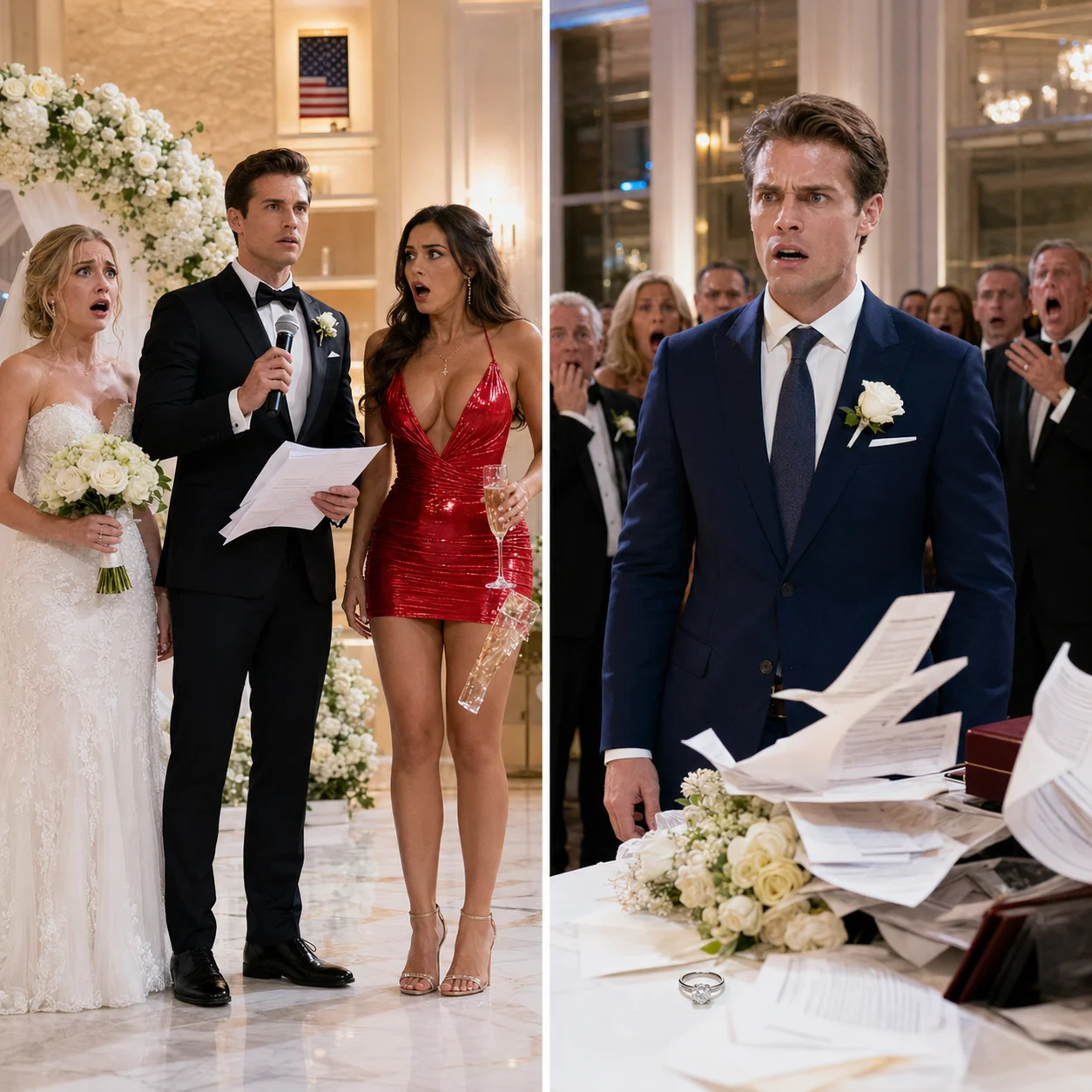
Then Vanessa arrived in a red dress.
With Preston on her arm.
There are women who wear red to weddings because they love the color. Vanessa wore it like a declaration of war. The dress was fitted, glossy, and inappropriate enough that half the room noticed before she reached me. Preston looked immaculate beside her, smug in a navy suit, his hand resting at her lower back in the same possessive way he used to touch mine at hospital events.
Vanessa hugged me in front of everyone, her perfume sharp enough to make my eyes water.
“Oh, Lily,” she said, looking over my shoulder at Owen near the altar. “You really went from a surgeon to a hotel worker?”
Her smile widened.
“A bellhop. Really?”
Several guests went quiet. My father looked at the floor. My stepmother pretended to adjust her necklace. Preston smirked.
For one second, the old humiliation rose in my throat. I was twelve again, standing in the hallway while Vanessa wore my grandmother’s bracelet. I was seventeen, listening as she told people my scholarship had only happened because the judges felt sorry for me. I was twenty-nine, watching her sit in my bedroom in Preston’s sweatshirt.
Then Owen stepped forward.
He did not look angry. That somehow made the room even quieter.
He took the microphone from the officiant, turned toward Vanessa, and said calmly, “Since you brought up my job, maybe this is the right time to clarify something.”
Vanessa laughed. “Oh, please. This should be good.”
Owen smiled.
For the first time since I had met him, I saw something behind his gentleness that looked almost dangerous.
“My name is not Owen Brooks,” he said. “Not legally.”
Preston’s smirk disappeared.
Vanessa’s champagne glass froze halfway to her lips.
Owen looked across the ballroom, then back at my stepsister. “It’s Owen Whitmore. And my family owns this hotel.”
The room went completely silent.
Then Owen turned his gaze to Preston.
“And as of yesterday morning, we also became the largest private donor to St. Catherine’s Hospital.”
Preston went pale.
Vanessa stopped smiling.
Owen held the microphone a little closer. “So before anyone else calls my wife a failure, I think everyone should hear what Dr. Preston Walsh did to get his last promotion.”
The silence that followed felt physical. It pressed against the windows, the white roses, the polished floor. Somewhere near the back, a champagne flute clinked softly against a tray, and the sound seemed too loud.
Preston’s face transformed in stages. First confusion, then irritation, then a quick, animal flash of fear he tried to bury under arrogance.
“Owen,” he said, forcing a laugh. “Or whatever your name is. This is clearly not the place.”
Owen’s expression did not change. “You made Lily’s wedding the place when you walked in with the woman who helped humiliate her and let her insult me in front of our guests.”
Vanessa recovered enough to scoff. “This is pathetic. Are we supposed to be impressed that you’re some spoiled hotel heir pretending to carry luggage?”
“No,” Owen said. “You’re supposed to be quiet.”
A ripple moved through the room. Vanessa’s mouth opened, but for once, no polished insult came out.
I stood near the altar in my wedding dress with my bouquet suddenly heavy in my hands. I had known Owen’s family was complicated. I knew he used his mother’s maiden name, Brooks, because he hated how people changed when they heard Whitmore. I knew his family had money, though he had never given me specifics and I had never cared enough to ask. But I did not know about the donation. I did not know about St. Catherine’s. And I definitely did not know what Preston had done to get his promotion.
Owen looked at me then, and his voice softened. “Lily, I’m sorry. I did not plan to bring this into our ceremony. I only planned to marry you.”
Preston seized on that. “Then don’t. This is absurd.”
Owen ignored him. “But two nights ago, St. Catherine’s sent our foundation additional documents for review before the donor agreement was finalized. My family takes governance seriously. Especially when a hospital wants its largest private donor to fund a new surgical innovation wing named after its rising star.”
He turned back to Preston.
“That rising star was you.”
Preston’s jaw tightened.
Owen continued, calm enough that every word cut cleanly. “The documents included your research history, clinical outcome summaries, recommendation letters, and internal review materials supporting your promotion to chief of cardiothoracic innovation. They also included discrepancies.”
A murmur moved through the guests. My father finally looked up.
Vanessa whispered, “Preston?”
He did not answer her.
Owen reached into his jacket and removed a folded set of papers. “I will not discuss private patient information in this room. Unlike Dr. Walsh, I know the difference between power and entitlement. But I can say this: there is documented evidence that Preston claimed primary credit for a surgical outcomes analysis largely completed by Dr. Maribel Chen, a junior attending under his supervision. When she objected, her fellowship recommendation was delayed. Her complaint was marked informal and buried.”
Preston’s face went white around the mouth.
“That’s a lie,” he said.
Owen looked almost sad. “It is not.”
Vanessa’s eyes darted between them. “What is he talking about?”
Owen did not look at her. “There is also evidence that donor-facing reports exaggerated Preston’s role in several surgical initiatives while minimizing complications that should have been disclosed to the review committee. Again, I’m not going into patient details. But the hospital board will.”
Preston stepped forward. “You have no idea what you’re accusing me of.”
“I know exactly what I’m accusing you of,” Owen said. “Professional misconduct. Retaliation against a colleague. Misrepresentation to donors. And possibly fraud, depending on what the independent audit finds.”
The room erupted into whispers.
One of Preston’s friends near the aisle muttered something under his breath and pulled out his phone. My stepmother whispered, “Oh my God,” but whether in horror over Preston or embarrassment over the scene, I could not tell. Vanessa stood frozen, her red dress suddenly looking less like a weapon and more like a flare over a sinking ship.
Preston turned toward me then, as if I were somehow responsible for the floor opening beneath him.
“Lily,” he said. “You know me.”
The words were so shameless that I almost laughed.
I thought of the morning he left. The suitcase. The Harvard sweatshirt. “She understands my world in a way you never really did.” The watch I had saved six months to buy still gleaming on his wrist as he walked out.
“No,” I said quietly. “I really don’t think I ever did.”
Owen handed the papers to a gray-haired woman seated in the second row. I recognized her vaguely from the rehearsal dinner as his aunt, Margaret Whitmore, the chair of the family foundation. She stood with the composed authority of someone who had ended more than one career without raising her voice.
“The Whitmore Foundation has paused all additional funding pending the hospital’s formal investigation,” Margaret said. “St. Catherine’s board chair was notified this morning. Dr. Chen’s counsel has also been contacted.”
Preston stared at her as if she had slapped him.
Vanessa gripped his arm. “Preston, say something.”
But he had no stage left. No donors to impress. No hierarchy to hide behind. No quiet fiancée to convince herself she was imagining things. Just a wedding room full of people watching the man who had always seemed untouchable become very, very human.
He looked at Owen with open hatred. “You think this makes you better than me? You carried bags in a hotel lobby.”
Owen smiled faintly. “Yes. And while I carried bags, I learned how people treat someone they think has no power. It tells you everything.”
That sentence settled over the room.
I remembered the first day we met, Owen kneeling on the marble floor to help me gather ruined papers while guests rushed around us without looking down. I remembered Vanessa calling him a bellhop like the word itself was dirty. I remembered Preston measuring people by usefulness, status, and shine.
Owen had not hidden who he was because he was ashamed. He had hidden what he owned because he wanted to know who could see him without it.
Vanessa had failed that test before the ceremony even began.
She turned on Preston then, because people like Vanessa do not stand beside a collapsing man if there is still time to step away from the rubble.
“You told me that promotion was yours,” she whispered.
Preston shot her a furious look. “Not now.”
“You told me she was just jealous.” Her voice rose, panic sharpening it. “You said Dr. Chen was unstable.”
Something in Owen’s expression shifted. “You know about Dr. Chen?”
Vanessa realized her mistake too late.
Preston snapped, “Vanessa, stop talking.”
But the room had heard.
Margaret Whitmore’s eyes narrowed. She looked at Vanessa in a way that made my stepsister shrink half an inch. “Ms. Holt, if you have knowledge relevant to an internal retaliation complaint, I strongly suggest you retain counsel before making any further statements in public.”
Vanessa’s face drained of color.
My stepmother finally moved. Not toward me. Toward Vanessa. “Honey, maybe we should go.”
For years, my stepmother had floated toward whichever daughter looked more socially promising in the moment. It should not have hurt anymore, but it did. My father saw it too. His face tightened, and for once, he did something other than look ashamed.
“No,” he said.
My stepmother blinked. “What?”
He stepped into the aisle slowly, his voice rough. “You’re not taking Vanessa out of this room like she’s the injured party. She came here to humiliate Lily at her wedding. Again.”
The word again changed everything.
Vanessa looked at him, offended. “Dad—”
“I’m not your father,” he said, not cruelly, but firmly. “And I should have stopped pretending your cruelty was harmless years ago.”
My throat tightened so suddenly I had to look down at my bouquet.
He turned to me then, and his eyes were wet. “Lily, I’m sorry.”
It was not enough to erase a lifetime of silence. But it was the first honest thing he had said in years, and sometimes first steps are not redemption, but they are still steps.
Preston grabbed Vanessa’s wrist. “We’re leaving.”
She pulled back. “Don’t touch me.”
That was the moment I understood Vanessa’s love for Preston had always been conditional on him being a prize. A surgeon. A status symbol. A man she could display as proof she had taken something valuable from me. Now that his value had become uncertain, fear replaced devotion almost instantly.
Preston looked around and saw no allies. Then he turned and walked out alone.
Vanessa stood there for three more seconds, humiliated by the space he left between them, then followed with my stepmother close behind.
The ballroom doors closed.
No one spoke.
The pianist had stopped playing at some point. The officiant looked like he was reconsidering every wedding he had ever agreed to perform. My guests sat frozen between shock and the terrible etiquette of not knowing whether to clap when a man’s career implodes before the vows.
Owen turned off the microphone and set it down.
Then he faced me, and all the dangerous calm disappeared. What remained was the man from the hotel lobby. Kind eyes. Steady hands. The softness that had never been weakness.
“Lily,” he said quietly, “I am sorry. I should have told you everything sooner.”
A hundred emotions moved through me at once. Shock. Gratitude. Confusion. Anger, not because he had defended me, but because secrets, even protective ones, still had weight. Yet beneath all of it was something clear and warm: Owen had not exposed Preston to prove he owned me or to win some masculine contest. He had done it because Vanessa had tried to make my wedding another room where I had to swallow humiliation politely.
I stepped closer to him. “Were you ever going to tell me about the hospital?”
“Yes,” he said. “After the honeymoon. When it wouldn’t feel like dragging Preston into our marriage.”
“And the Whitmore name?”
His mouth twisted. “I should have told you before today. I just didn’t want to become another man with a last name people bowed to.”
I looked at him for a long moment. Then I said, “You’re not Preston.”
His shoulders dropped, like he had been holding his breath.
“No,” he said. “I’m not.”
I turned to the room.
Everyone was still staring.
For the first time in my life, I had the power to decide whether a family disaster became the end of my joy. Vanessa had stolen enough from me. She had stolen childhood peace, heirlooms, attention, years of confidence, and one surgeon fiancé who turned out to be worth far less than his title. I refused to let her steal this too.
I picked up my bouquet, faced the officiant, and said, “Can we start again?”
A nervous laugh moved through the guests, then another. Someone dabbed their eyes. The pianist, bless him, began playing softly again.
Owen took my hands at the altar.
His palms were warm.
The ceremony that followed was not perfect in the traditional sense. There was a strange electricity in the air. People were still whispering. My stepmother’s seat was empty. Preston and Vanessa were gone. But when Owen spoke his vows, the room became quiet for a different reason.
“I promise,” he said, voice steady, “never to make you audition for a place in my life. I promise never to let my name, my family, or my pride become more important than your peace. I promise to stand beside you in rooms where people know exactly who I am and in rooms where they think I am no one at all. And I promise that if the world ever mistakes your kindness for weakness, I will remind it, respectfully or otherwise, that it is wrong.”
I cried before he finished.
When it was my turn, I did not use the vows I had written. Those felt too neat for what we had just survived.
“I spent a long time thinking love was something I had to earn by becoming easier to choose,” I said. “With you, I learned that real love does not ask me to shrink so someone else can feel tall. You saw me on one of my worst days, soaked and embarrassed in a hotel lobby, and you treated me with more care than people who had known me my whole life. I don’t care what name you use. I don’t care what your family owns. I know who you are when you think no one important is watching. That is the man I’m marrying.”
By the time we kissed, half the room was crying and the other half was pretending not to.
The reception turned out nothing like I had planned and somehow better than I deserved. My father asked me to dance and apologized again, more specifically this time. He admitted he had failed me by keeping peace with Vanessa at my expense. I did not forgive him fully that night. Healing does not work on a wedding schedule. But I let him dance with me, and that was enough for the moment.
Margaret Whitmore hugged me near the cake table and said, “Welcome to the family. We are less dramatic at brunch.”
Owen overheard and said, “That is absolutely not true.”
For the first time all day, I laughed without feeling like I was surviving something.
The fallout came quickly.
By Monday morning, St. Catherine’s Hospital had announced an independent review of Preston’s promotion, research credits, and donor disclosures. They did not name every allegation publicly, but Boston medical circles are smaller than people think, and whispers move faster when they wear credentials. Dr. Maribel Chen’s complaint resurfaced with outside counsel attached. Two other doctors came forward with concerns about credit misappropriation and pressure to stay quiet.
Preston was placed on administrative leave within a week.
Vanessa called me three times the day the news broke. I did not answer. Then she sent a text that said, “I hope you’re happy. You ruined both our lives.”
I stared at it for a while, then wrote back the only thing I ever sent her after my wedding.
“No, Vanessa. You just finally stopped winning quietly.”
Then I blocked her.
My stepmother tried to intervene, of course. She said Vanessa was devastated. She said Preston had lied to her. She said family should not turn its back during hard times. For once, my father took the phone from her and told her Lily had been asked to carry enough. He told me that later, awkwardly, as if he was not sure whether he deserved credit. He did not. But I appreciated knowing he had said it.
Preston’s downfall was not instant, but it was thorough. The investigation confirmed enough misconduct for St. Catherine’s to terminate his leadership appointment and refer parts of the matter to the medical board. His name was removed from the proposed surgical innovation wing. The Whitmore Foundation redirected the donation into a fellowship fund for early-career physicians with strict authorship and ethics protections.
Dr. Chen became the first named fellow.
Owen told me that part over breakfast one morning, sliding the announcement across the table. I read it twice and felt something loosen in my chest. Not because it fixed what Preston had done to me, but because his harm had not ended with me. And finally, for once, someone he had tried to diminish was being named properly.
As for Vanessa, her relationship with Preston did not survive the loss of his shine. The same woman who had once told me he needed someone who could stand beside him at galas discovered that there are fewer galas when the invitations stop coming. Within three months, she moved out of his apartment. Within five, they were done.
I heard she told people he had manipulated her.
Maybe he did. Maybe she manipulated him back. People like that often find each other and mistake mutual ambition for love.
I stopped caring.
My marriage to Owen was not a fairy tale after that, because fairy tales usually end before the complicated parts begin. We had real conversations. Hard ones. I told him that his secret, even if understandable, had scared me because I had already lived through a man deciding what information I deserved to have. He listened without defending himself. He apologized without turning it into a speech about his intentions. Then he showed me, slowly and consistently, that openness mattered to him as much as loyalty.
A month after the wedding, he took me to dinner with his family, not at some intimidating private club, but at the same diner where we had gone after his shift the first time. Margaret came. His younger sister came. His father, who apparently enjoyed pretending not to own half the block, argued with the waitress about baseball for twenty minutes and left a tip large enough to make her cry.
Owen squeezed my hand under the table and whispered, “Still think you married a bellhop?”
I looked at him in his rolled-up sleeves, laughing with powdered sugar on his cuff, and said, “I think I married the only man in the room who knew carrying someone else’s bags was honest work.”
He smiled at that.
A year later, we returned to the Harborline ballroom for our anniversary. Not for a gala. Not for a donor dinner. Just us, after closing, with the lights dimmed and a small cake the pastry chef insisted on making because he claimed our wedding was “the best live theater this hotel ever hosted.”
Owen and I danced barefoot on the same floor where Vanessa had tried to humiliate me.
The room felt different without her voice in it.
I thought about the girl I had been, the one who hid good news because Vanessa might ruin it. I thought about Preston walking out with my watch on his wrist and Vanessa smiling like she had reached the top of some invisible staircase. I thought about Owen kneeling in a rain-slick lobby to gather my ruined papers before he knew my history, before he loved me, before he had any reason to choose me.
Then I realized something simple and almost funny.
Vanessa had spent her whole life stealing things because she thought possession meant victory. But she never understood value. She took the ribbon, but not the talent. The bracelet, but not the love behind it. The room with the maple tree, but not the peace of belonging there. Preston, but not loyalty. Status, but not respect.
And when she laughed at Owen, she mistook humility for failure because she could not recognize worth unless it announced itself loudly.
That was her punishment, really.
Not losing Preston. Not being embarrassed at my wedding. Not watching the “bellhop” become the man whose family could shake the hospital world she wanted so badly to enter.
Her punishment was that she could only see crowns after they were placed on someone else’s head.
I do not hide my good news anymore.
I bring it home. I say it out loud. I let myself be celebrated by people who do not need to turn my joy into a contest. And when I pass through the Harborline lobby on rainy afternoons, I still sometimes look toward the marble floor where my papers scattered and a man in a hotel uniform asked if I was having a rough day.
I was.
But it led me to the life Vanessa could never steal.
Because this time, what I loved was not a thing she could take.
It was a man who knew my worth before he ever revealed his own.
![[FULL STORY] My Fiancée Posted Making Him Take A Polygraph Test Before The Wedding! If He Loves](https://social-media.rabedo.com/thumbnails/1777879331_21-.jpg)

![[FULL STORY] He Locked Me in a Room on the Day I Buried My Mother… Then I Walked Into His Gala Worth $85 Billion](https://social-media.rabedo.com/thumbnails/1776764510_D79.jpeg)