
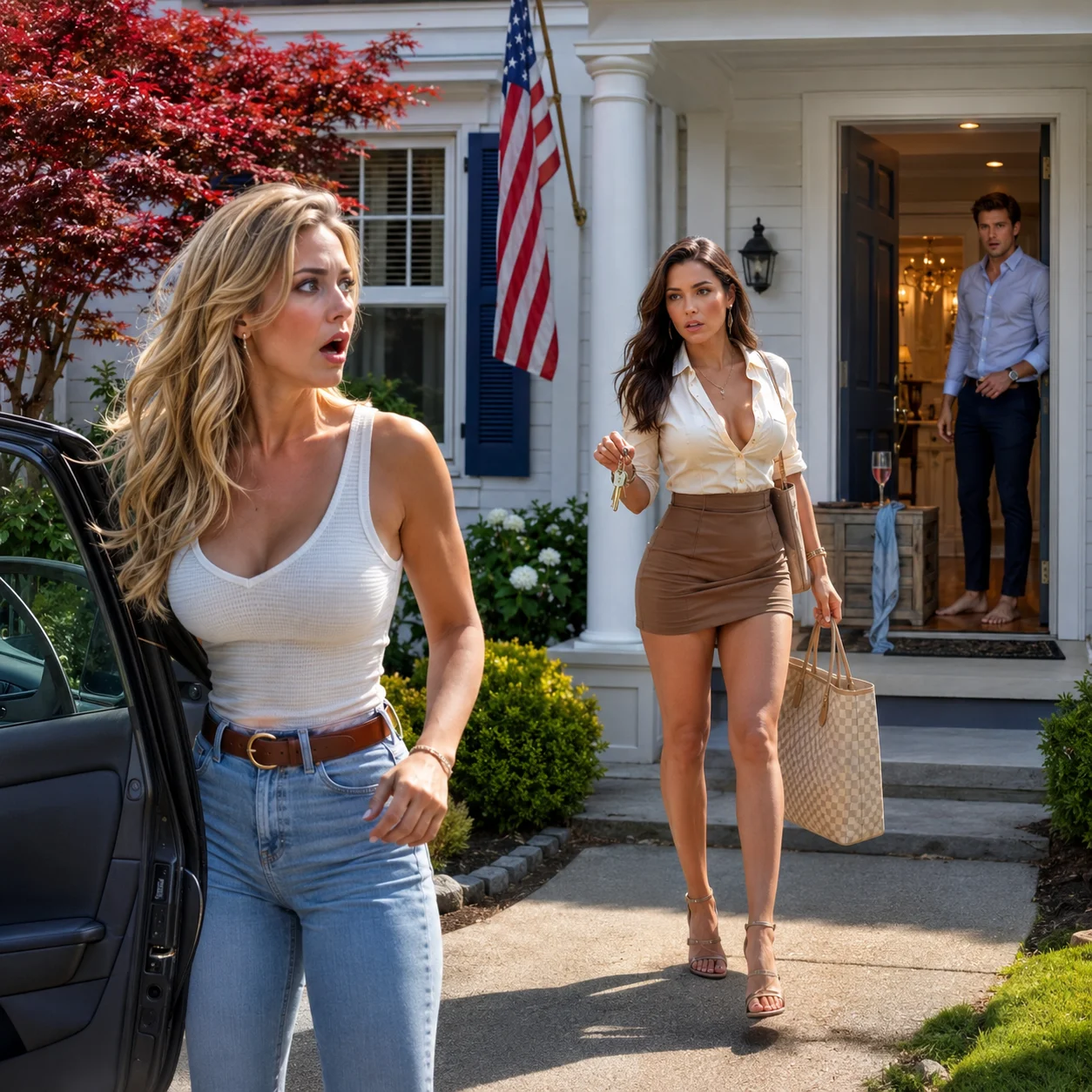
Maybe she was a realtor.
Maybe Daniel had hired someone.
Maybe she was lost.
But she had walked out of my house.
She had locked my door.
And my husband had told me there was only one key.
The woman stepped off the porch and stopped when she saw me sitting in the driveway. Our eyes met through my windshield.
Her face changed.
Not into panic. Into recognition.
That was worse.
She knew who I was.
She recovered quickly, gave me a small polite smile, and walked down the sidewalk toward the silver car. I got out of my car so fast my coffee tipped over in the cup holder.
“Excuse me,” I called.
She kept walking.
“Excuse me!”
This time she turned, still holding that tight smile. “Yes?”
My voice sounded strange. Calm, but not mine. “Why were you in my house?”
Her eyes moved over me, measuring. “You must be Emily.”
The ground felt like it tilted.
“I asked why you were in my house.”
She glanced toward the front door, then back at me. “I think you should talk to Daniel.”
The sound of my husband’s name in her mouth felt like a slap.
“Who are you?”
For the first time, her confidence cracked. She looked tired suddenly, older than I had first thought. “I’m not doing this in your driveway.”
“Then you shouldn’t have come out of my house.”
She inhaled sharply, like she wanted to say something cruel and decided against it. “Ask your husband about the second key.”
Then she got in her car and drove away.
I stood in the driveway until the silver car disappeared around the corner.
I do not remember walking to the front door. I only remember trying my key with shaking fingers and thinking, stupidly, that maybe it would not work anymore. But it did. The door opened into the same hallway I had decorated, the same framed wedding photo on the wall, the same woven basket for shoes near the bench.
Except the house did not feel like mine.
It felt occupied.
I moved through the rooms slowly. Nothing was overturned. Nothing was missing. No drawers were hanging open, no broken glass, no obvious sign that a stranger had been there. But the air smelled faintly of vanilla and amber, a perfume I did not own.
On the kitchen island sat a water glass.
Still half-full.
There was a lipstick mark on the rim.
I stared at it so long my vision blurred.
Then I took a picture.
That was the first smart thing I did.
The second was checking the bedroom.
Our bedroom looked normal at first. The bed was made. The curtains were open. Daniel’s watch sat on his nightstand beside the little dish where he kept cufflinks. My jewelry box was closed.
But the closet door was slightly ajar.
Inside, on the floor beneath Daniel’s hanging shirts, was a white shopping bag from a boutique I had never been to. I crouched and pulled it out.
Inside was a silk scarf, pale blue, folded around a receipt.
The receipt was dated that morning.
The total was $168.
Paid with Daniel’s credit card.
I sat back on my heels, holding the receipt, and waited for myself to cry.
I did not.
Something colder arrived first.
I took another picture. Then another. The glass. The scarf. The receipt. The front door lock. The silver car’s license plate, which I had captured accidentally in the edge of a photo when I first got out of the car.
By the time Daniel came home at six-thirty, the house looked untouched again.
The glass was still on the counter.
The scarf was still in the bag.
I was sitting at the kitchen table with my hands folded around a cup of tea I had not drunk.
Daniel walked in wearing his navy suit, carrying the smell of rain and expensive cologne. “Hey,” he said, loosening his tie. “You’re home early.”
I watched his face carefully.
Not one flicker.
“Meeting got canceled.”
“Lucky you.” He kissed my forehead. I did not move. “Everything okay?”
I looked at him and almost asked right then.
Who is she?
Why does she have a key?
How many times has she been in my home?
But a strange instinct stopped me. Maybe it was all the years of listening to students tell half-truths. Maybe it was the way Daniel’s eyes held mine too easily. Maybe it was the memory of that woman saying, Ask your husband about the second key.
So instead, I said, “Did anyone come by today?”
Daniel opened the fridge. “Come by?”
“To the house.”
“No. Why?”
His back was to me. His voice was relaxed.
I stared at the water glass on the counter. “I thought I saw someone near the porch when I drove up.”
He turned with a bottle of sparkling water in his hand. “Someone?”
“A woman.”
That did it.
It was small, almost nothing. His hand tightened around the bottle. His smile paused a fraction too long before it arrived.
“Probably a solicitor.”
“She walked away from our front door.”
His laugh came lightly. “Em, people leave flyers all the time.”
“She wasn’t holding flyers.”
“Okay. Maybe she had the wrong house.”
“She locked the door.”
Silence.
Not long. Maybe two seconds.
But I heard the truth in it.
Daniel set the bottle down. “What are you talking about?”
“I saw a woman walk out of our front door and lock it with a key.”
His face changed into concern so smoothly I almost admired it. “Emily, that’s impossible.”
“Is it?”
“Yes. It is.” He walked toward me slowly, as if approaching someone fragile. “You have the only key.”
“That’s what you told me.”
“That’s the truth.”
“Then how did she lock the door?”
He sighed, not angry, just tired. That familiar tiredness that made me feel like I was making his life harder by asking questions. “Maybe she pretended to lock it. Maybe the door wasn’t fully closed. Maybe you saw it wrong.”
I stood up. “Don’t do that.”
“Do what?”
“Tell me I didn’t see what I saw.”
His expression hardened for the first time. “I’m not telling you that. I’m trying to understand why you’re accusing me of something based on a woman walking down the street.”
“She knew my name.”
Daniel blinked.
I stepped closer. “She said, ‘You must be Emily.’”
His jaw shifted.
“And she told me to ask you about the second key.”
The room became very still.
Then Daniel laughed.
It was the wrong laugh.
Too loud. Too sudden. Too insulted.
“This is insane.”
“Who is she?”
“I have no idea.”
“Then why did she know my name?”
“Maybe she found it online. Maybe she’s some scammer. Maybe she was trying to break in and got scared when you showed up.”
“With a key?”
“Emily.”
“Stop saying my name like I’m a child.”
His eyes flashed. “Stop acting like one.”
There it was.
The first crack in the gentleman.
The words hung between us, ugly and revealing. Daniel saw my face and immediately softened. “I’m sorry. That was unfair. I had a long day.”
I nodded slowly. “So did I.”
He reached for me, but I stepped back.
His hand dropped.
That night, Daniel slept facing away from me. I did not sleep at all.
At two in the morning, I got out of bed and checked his key ring.
There was no house key.
Just like he said.
Car key. Office key. Small black fob. Gym tag.
No brass key.
For one awful second, I wondered if I really was losing my mind.
Then I remembered the scarf.
The next morning, I called in sick.
Daniel left at eight-fifteen after kissing my cheek and telling me we should “reset” over dinner. I watched him drive away. Then I searched the house.
Not like a wife tidying.
Like a woman trying to survive.
I checked drawers, coat pockets, desk folders, storage bins, old boxes from the move. Nothing. No second key. No love letters. No obvious confession.
Daniel was too careful for that.
Then I remembered the little black fob on his key ring.
It was not for his office. His office building used digital badges. It was not for the gym either; the gym tag was blue.
I had seen fobs like that before.
Storage units.
I went into his home office, where he kept a locked file cabinet. He had once told me the bottom drawer held old tax documents and client files, “boring things that would put you to sleep.” The key to the cabinet was in his desk tray. He did not hide it because he had trained me not to look.
Inside the bottom drawer were folders, just as promised.
Taxes. Insurance. Mortgage papers.
And one folder labeled Maple Services.
My stomach tightened.
Our street was Maple Ridge Lane.
Inside the folder was a rental agreement for a storage unit under Daniel’s name.
The start date was two months before we bought the house.
There were also receipts for locksmith services.
Three copies made.
Not one.
Not two.
Three.
The address listed was our house.
The date was the week after closing.
I sat on the floor of his office and read the receipt until the words stopped making sense.
Three copies made.
Daniel had lied to me from the beginning.
Not because he forgot. Not because the old owner lost a spare. Because he wanted me to believe I controlled access to my home while someone else had been walking in and out of it.
I took pictures of everything.
Then I drove to the storage facility.
My hands shook so badly at the front desk that the woman working there asked if I was okay. I said my husband had left paperwork at home and I needed to confirm our unit number. She told me she could not give information unless my name was on the account.
It wasn’t.
Of course it wasn’t.
So I waited in my car across the street like a detective in a cheap movie, feeling foolish and terrified.
At 12:40 p.m., the silver car pulled into the storage facility.
The same woman got out.
She wore black leggings, a denim jacket, and sunglasses. She walked through the gate using a code.
I followed at a distance on foot before the gate closed.
The facility was quiet, rows of orange doors baking under the sun. I kept behind a parked moving truck as she stopped at Unit C-18 and rolled up the door.
Inside were pieces of furniture I recognized.
Not from my house.
From Daniel’s stories.
A brown leather chair he once said belonged to his father. A framed black-and-white photograph of a beach town. Boxes labeled with kitchen items, books, winter clothes. A crib disassembled and leaned against the wall.
A crib.
The woman stood in the unit for a while, looking at the boxes like they were memories. Then she pulled out one small plastic bin and closed the door.
As she turned, she saw me.
This time, she did not smile.
“You followed me,” she said.
“You were in my house.”
She took off her sunglasses. Her eyes were red, like she had been crying before she arrived. “I told you to ask Daniel.”
“I did. He lied.”
A bitter little laugh left her mouth. “Of course he did.”
“Who are you?”
She looked at the storage unit, then at me. “My name is Lauren.”
The name meant nothing to me, but something about the way she said it made my skin prickle.
“How do you know my husband?”
Her face twisted slightly. “Your husband?”
I hated the pity in her voice. “Yes. My husband.”
Lauren looked away. “Daniel and I were together for nine years.”
The sun was too bright. The concrete seemed to sway under my feet.
“No.”
“I’m sorry.”
“No. He would have told me.”
She looked back at me, and this time the pity was gone. “Did he tell you he bought that house because we picked it out together?”
I could not breathe.
“That’s not true.”
“We toured it two years ago when it first went on the market. The sale fell through back then. He told me it was too expensive. He said we’d wait.” Her voice broke, but she steadied it. “Then last year, he told me his mother was sick and he needed space. Three months later, I found out he was engaged.”
I stepped back as if distance could make her words less real.
“We’ve been married almost a year,” I whispered.
“I know.”
“Then why were you in my house?”
Lauren’s expression hardened. “Because he told me it was still partly mine.”
I laughed once, sharp and humorless. “That’s impossible.”
“He said he bought it with money from an investment account we built together. He said your marriage was temporary. He said you were unstable and he couldn’t leave yet without you doing something dramatic.”
The words landed with a sick familiarity.
Unstable.
Maybe you forgot.
Maybe you saw it wrong.
I pressed a hand to my stomach. “Why would you believe that?”
“Because I wanted to.” Her eyes filled, but she did not look away. “Because he was my whole adult life. Because he kept showing up. Because he gave me a key.”
“When?”
“After you moved in.”
My mouth went dry.
Lauren opened the plastic bin and pulled out a small framed photo.
Daniel stood beside her on a beach, younger, smiling in a way I had seen in our wedding photos. Between them was a little girl with sandy hair and a missing front tooth.
I stared at the child.
Lauren’s voice softened. “Her name is Sophie.”
The world went silent.
I looked at the crib in the storage unit. “He has a daughter?”
Lauren nodded.
“How old?”
“Six.”
I thought of every evening Daniel came home late because of “client dinners.” Every weekend he disappeared for golf trips. Every time he avoided talking about children with me by saying, “Let’s enjoy us first.”
“You let him bring you into my house?” I asked, though my voice had no strength behind it.
Lauren flinched. “I never brought Sophie there.”
“But you went.”
“Yes.”
“Why?”
“Because Daniel told me some of my things were in the house. He said he’d stored them in the attic after the move. He said I could come when you weren’t home because you were emotional about his past.”
“My attic?”
“I know how it sounds.”
“No,” I said. “I don’t think you do.”
Her face crumpled then. Not dramatically. Quietly. Like someone who had been holding herself together for too long. “I didn’t know what was true anymore. He kept telling me you knew about me. Then he told me you didn’t know because you couldn’t handle it. Then he told me he was leaving you. Then he told me if I pushed him, he’d take Sophie from me because he had more money and better lawyers.”
That sentence changed something.
Until then, I had wanted to hate her.
It would have been easier. Cleaner. She had walked out of my house. She had a key to my front door. She had known my name and looked at me like I was the interruption.
But standing there in the heat, looking at a woman my husband had been controlling from another direction, I realized Daniel had not simply cheated.
He had built a hallway between two women and locked both doors from the outside.
“What do we do?” Lauren asked.
The word we hit me strangely.
I did not answer right away.
Then I said, “We stop asking Daniel for the truth.”
That afternoon, Lauren and I sat in my car outside the storage facility and compared timelines.
It was the ugliest conversation of my life.
Daniel had proposed to me in December. He had spent Christmas morning with Lauren and Sophie, telling them he had an emergency business trip later that day. He had married me in May. Two weeks after our honeymoon, he took Sophie to a father-daughter breakfast at her school and told Lauren he was “working on our family.”
He told me he did not want children yet because the market was unstable.
He told Lauren he could not move back in because I was threatening him.
He told me his mother needed help on Sundays.
He told Lauren he was with clients on Sundays and asked her to stop calling because it made things complicated.
He told both of us just enough truth to make the lies survivable.
Lauren showed me messages. Hundreds of them. Some loving. Some threatening. Some manipulative in that soft Daniel way I knew too well.
Be patient.
You know how Emily gets.
I’m protecting Sophie.
Don’t make this harder.
Soon, I promise.
I showed Lauren the locksmith receipt. The scarf receipt. The photos from my kitchen.
She looked at the scarf and went pale. “That’s not mine.”
The air changed again.
“What?”
“I didn’t buy that. I’ve never seen it.”
Neither of us spoke.
Then Lauren whispered, “There’s someone else.”
I almost laughed. Not because it was funny, but because the human brain has a limit. At a certain point, betrayal becomes absurd.
I drove home before Daniel returned. Lauren followed in her car, but parked around the corner. We agreed not to confront him together yet. First, we needed proof. Not emotional proof. Legal proof.
I called my friend Natalie, who was a family attorney. Not my attorney yet, but close enough to answer when I said, “I need you to tell me how stupid I’m about to be.”
After I explained, there was a long silence.
Then Natalie said, “Do not confront him alone. Do not destroy anything. Do not access accounts illegally. Gather documents that are in your home and belong to you or relate to marital property. Photograph everything. Change nothing yet. And Emily?”
“Yeah?”
“Stop sleeping next to him.”
That night, I told Daniel I had a migraine and slept in the guest room.
He stood in the doorway for several minutes, watching me with concern painted carefully across his face. “Are we okay?”
I almost admired the performance.
“No,” I said. “But not tonight.”
His expression tightened. “Are you still upset about yesterday?”
I turned off the lamp. “Goodnight, Daniel.”
He did not move.
For a second, I felt the room shrink.
Then he said, “You’re making this bigger than it is.”
I looked at him in the dark. “I don’t think I am.”
He closed the door a little too hard.
The next morning, I installed a small camera inside the living room window facing the front door. It was legal because it was my house and the camera was inside. Natalie confirmed that. I also bought a new lock and scheduled a locksmith for Friday, claiming the existing lock was sticking.
Daniel noticed the appointment reminder on the fridge.
“Why are we changing the lock?” he asked.
I poured coffee without looking at him. “Because a strange woman had a key.”
His jaw clenched. “We talked about that.”
“No. You talked around it.”
He set his mug down. “Cancel it.”
I finally looked at him. “Why?”
“Because it’s unnecessary.”
“If there’s only one key, it won’t affect anyone.”
He stared at me.
For one moment, I saw the calculation happen behind his eyes.
Then he smiled. “Fine. Do whatever makes you feel safer.”
That Friday, the locksmith changed both locks. Daniel stood in the hallway the whole time, arms crossed, watching as if someone were removing a part of him from the house.
The locksmith handed me three new keys.
I put one on my key ring.
One in my purse.
One in a small envelope that I drove straight to Natalie’s office.
Daniel never got one.
When he came home that evening and realized I had not left a key for him, he laughed under his breath. “Seriously?”
“You said there only needed to be one.”
His smile disappeared.
“Emily, give me a key.”
“I’m not comfortable with that right now.”
“I own this house too.”
“Do you?”
His eyes narrowed. “What does that mean?”
“It means I’ve been reading documents.”
He took one step toward me. “What documents?”
I felt fear rise, but I held my ground. “Mortgage papers. Locksmith receipts. Storage agreements.”
The color drained from his face.
Then he recovered, but not fully.
“You went through my office?”
“Our office is in our house.”
“You had no right.”
“You gave someone else a key to my front door.”
Daniel’s voice dropped. “You don’t understand what you’re getting into.”
There it was again.
Not denial.
Threat.
I folded my arms to hide the shaking in my hands. “Then explain it.”
He looked at me for a long time, and I knew he was deciding which lie could still survive.
Finally, he said, “Lauren is mentally unstable.”
I almost laughed.
He looked relieved, thinking he had found the right door.
“She was part of my past,” he continued. “A difficult part. I tried to help her because of her daughter. She became attached. She must have copied a key somehow.”
“Her daughter?”
He paused.
Too late.
I watched him realize he had admitted something he had never told me.
“Yes,” I said softly. “Let’s talk about Sophie.”
His face changed completely.
The gentle husband vanished.
“What did she tell you?”
“Enough.”
“You have no idea what kind of woman she is.”
“I know what kind of man you are.”
Daniel’s mouth tightened. “Careful.”
The word was quiet.
I had heard students use that tone before fights.
For the first time in my marriage, I was afraid of my husband not because he might leave me, but because he might stay.
So I did exactly what Natalie told me to do.
I picked up my phone and called her on speaker.
Daniel looked confused until Natalie answered. “Emily?”
I kept my eyes on him. “Daniel is here. He’s upset that I changed the locks. I want you to hear this conversation.”
Daniel stepped back like I had slapped him.
Natalie’s voice sharpened. “Daniel, this is Natalie Brooks. I’m advising Emily not to discuss any marital property, access to the home, or third-party keys without counsel present. If you need access arrangements, communicate in writing.”
He stared at the phone, then at me.
“You called a lawyer?”
“You gave another woman a key to my house.”
His face twisted. “You stupid—”
He stopped himself.
But Natalie had already heard it.
“Daniel,” she said calmly, “I suggest you leave the room.”
He grabbed his coat and walked out, slamming the front door behind him.
He did not come home that night.
The camera caught him returning at 1:12 a.m. He tried the old key first. Then another key. Then he stood on the porch for almost five minutes, looking directly at the lock like it had betrayed him.
Finally, he called me.
I did not answer.
He texted: Open the door.
Then: This is my house.
Then: Don’t make me embarrass you.
Then: You’re going to regret listening to Lauren.
I took screenshots of everything.
The next week became a blur of documents, anger, and discoveries that seemed to multiply like mold behind a wall.
Natalie helped me pull property records. The house was in both our names, but the down payment had come partly from an account Daniel had shared with Lauren years earlier. Lauren had records showing contributions she believed were going toward a future home. Daniel had moved the money through two accounts before closing.
That was bad for him.
Then Lauren found something worse.
Daniel had used Sophie’s Social Security number to open a small credit line two years earlier.
He claimed it was for “emergency expenses” related to her care. But Lauren had never authorized it. The statements went to a mailing address at the storage facility.
That was when Lauren stopped crying and started fighting.
She hired her own attorney.
The third woman appeared because of the scarf.
Her name was Marissa.
We found her because Daniel’s credit card statement listed the boutique, and Lauren, who was far better at social media than I was, found a photo the store had posted that morning. In the background, half turned away from the camera, was Daniel buying the scarf for a red-haired woman in a white blazer.
Marissa worked at the same title company Daniel used for some of his real estate deals.
When Lauren messaged her, Marissa blocked her.
When Natalie’s office sent a preservation letter, Marissa suddenly became very available.
She had been seeing Daniel for four months. He had told her he was divorced. He told her the house was his but his “ex-wife” still lived there while she recovered from a breakdown. He had promised Marissa that she could move in “once Emily accepted reality.”
When Natalie told me that, I sat in her office and stared at the wall.
Three women.
One house.
One key.
Except there had never been one key. There had only been one story Daniel told each of us, shaped to fit whatever fear made us easiest to control.
Daniel tried every version of himself after that.
First came the loving husband.
He sent flowers to my school with a card that said, Let’s not let outsiders destroy us.
Then came the victim.
He emailed my mother, saying I was “under extreme stress” and had become paranoid.
Then came the businessman.
He offered me a “generous settlement” if I signed quickly and agreed not to contact Lauren or Marissa again.
Then came the threat.
You don’t want this public.
Think about your job.
People don’t trust unstable school counselors.
That one made me cry, not because I believed him, but because I realized how long he had been studying my soft places.
I had built a life around helping children feel safe, and he knew the quickest way to hurt me was to suggest I was unsafe myself.
So I did what the old Emily would never have done.
I stopped defending my character in private and started documenting his.
Natalie filed for divorce and exclusive use of the home during proceedings. Lauren’s attorney filed for custody protections and financial review. Marissa, terrified of being pulled into fraud, provided messages and transaction records showing Daniel had used her title company login after hours to look up property information.
The hearing happened six weeks later.
Daniel arrived in a charcoal suit, looking calm, handsome, and wounded. The kind of man strangers believed before he opened his mouth. His attorney painted me as emotional and reactive. He said I had locked Daniel out of his own home without cause. He said Lauren was a disgruntled ex. He said Marissa was irrelevant.
Then Natalie stood up.
She did not yell. She did not perform. She simply walked the court through the timeline.
The locksmith receipts.
The three copied keys.
The storage unit.
The text messages.
The camera footage of Daniel trying multiple keys at the new lock.
The messages where he described me as unstable to Lauren while describing Lauren as unstable to me.
The credit line under Sophie’s name.
The boutique receipt.
The threats.
Daniel’s face changed with each exhibit. Not dramatically. Just enough that I could see him losing control of the room for the first time.
The judge was a woman in her sixties with silver hair and a voice that made everyone sit straighter. She listened without interrupting. When Daniel’s attorney tried to dismiss the second key issue as “domestic misunderstanding,” she looked over her glasses and said, “Counsel, a spouse secretly distributing keys to a marital residence while denying their existence is not a misunderstanding.”
I nearly cried right there.
Not because everything was fixed.
Because someone sane had finally said the sane thing out loud.
The judge granted me temporary exclusive use of the house. Daniel was ordered to communicate only through attorneys regarding property access. He was also ordered not to remove, alter, or destroy financial documents. The matter involving Sophie’s credit was referred separately, and Lauren’s attorney looked like she had been waiting all morning for that sentence.
Outside the courtroom, Daniel approached me.
Natalie stepped slightly in front of me.
He ignored her and looked at me with those familiar wounded eyes. “Emily, please. We can still stop this.”
There was a time when that voice would have undone me.
I would have heard pain instead of strategy.
I would have mistaken panic for love.
But the man standing in front of me was not grieving our marriage. He was grieving the loss of access. To the house. To my trust. To Lauren’s hope. To Marissa’s silence. To every door he had kept unlocked for himself.
I said, “No, Daniel. We can’t.”
His expression hardened. “You’ll regret this.”
I looked at him for a long moment.
Then I said, “Maybe. But at least I’ll know the regret is mine.”
The divorce took eight months.
It was not clean. Men like Daniel do not disappear just because the truth arrives. They bargain. Delay. Accuse. Rewrite. He claimed money was missing. It wasn’t. He claimed I destroyed his reputation. I hadn’t. He claimed Lauren manipulated me. She didn’t. He claimed Marissa pursued him. She had the messages proving otherwise.
In the end, the court ordered the sale of the house.
At first, that broke my heart.
I had painted those walls. I had planted lavender by the walkway. I had imagined babies in the guest room and Christmas lights on the porch. Losing the house felt like losing the version of myself who believed love could be proven with a mortgage and matching towels.
But a home is not a building someone can weaponize against you.
A home is a place where you do not have to wonder who has a key.
Lauren and I did not become best friends. Life is not that neat. There was too much pain between us, too much overlap, too many moments where we had unknowingly stood on opposite sides of the same lie. But we became something realer than friends for a while. Witnesses.
She got Sophie’s credit frozen and began repairing the damage Daniel had done. Sophie never learned the full ugliness, only that grown-ups sometimes make bad choices and her mother had protected her. Lauren moved into a smaller apartment near Sophie’s school and sent me one photo months later of Sophie holding a science fair ribbon, grinning with both front teeth grown back.
Marissa left the title company and cooperated enough to keep herself out of deeper trouble. I never hated her either. Not after I saw the messages. Daniel had sold each of us a different mask.
As for Daniel, he lost more than the house.
His firm quietly asked for his resignation after the title company investigation widened. The credit line in Sophie’s name became a legal problem he could not charm away. His carefully polished reputation, the one he had protected like a second skin, cracked in places money could not smooth over.
The day we closed on the sale of the house, I went there one last time alone.
The rooms were empty. Without furniture, the place looked smaller. Less magical. Just walls, floors, windows, dust in the corners where heavy things used to sit.
I stood in the kitchen and remembered the glass with lipstick on the rim.
I stood in the bedroom and remembered finding the scarf.
I stood by the front door and remembered seeing Lauren walk out with a key she never should have had.
Then I stepped onto the porch and locked the door for the last time.
The new owners were a young couple with a toddler. They were waiting in their car while the agent finished paperwork. The woman waved at me, nervous and excited. The man was holding the child’s stuffed rabbit.
For a second, I wanted to warn her.
Not about the house.
The house had never been evil.
But about the danger of handing someone else the entire map to your life and calling it trust.
Instead, I smiled and handed the keys to the agent.
All of them.
A year later, I moved into a small townhouse with yellow kitchen walls and a balcony just big enough for rosemary, lavender, and one chair. My name was the only name on the lease. I changed the locks on the first day, not because I was afraid, but because I liked watching the locksmith hand me the keys.
Two copies.
One for me.
One sealed in an envelope in my desk.
No mystery. No performance. No man telling me what I had or had not seen.
Sometimes people ask if I regret marrying Daniel. It is a strange question because regret suggests you can go back and choose a cleaner road. But I do not think life works that way. I think sometimes the road you choose teaches you exactly how much of yourself you had been trained to give away.
I regret ignoring my instincts.
I regret laughing off the first lie because the day was beautiful.
I regret every time I let “maybe you forgot” become stronger than what I knew.
But I do not regret the afternoon I came home early.
I do not regret following the silver car.
I do not regret changing the locks.
And I definitely do not regret the moment Daniel stood outside the front door with a key that no longer worked, finally understanding what it felt like to be denied entry into a life he thought he owned.
Because that was the day the house stopped being his secret.
And became the place where I found my way out.

![[FULL STORY] My Fiancee Left Me For Her Personal Trainer And His Baby, But When He Kicked Her Out, She Realized I Was Never Her Safety Net.](https://social-media.rabedo.com/thumbnails/1777303280_S1.png)

![[FULL STORY] Girlfriend Invites Her Ex to My House Party — What Happened Next Ended Everything](https://social-media.rabedo.com/thumbnails/1776417735_671150455_1913188989634267_5561232053519203456_n.jpg)
![[FULL STORY] She Got Too Comfortable Cheating — So I Exposed Everything In Front of Everyone](https://social-media.rabedo.com/thumbnails/1777561667_5a7c3664-7aa4-4c09-bb95-2f651c9bcc8a.png)
![[FULL STORY] My Wife Packed Her Bags and Said Not to Stop Her—So I Didn’t](https://social-media.rabedo.com/thumbnails/1777365116_2db43992-c207-43dc-9ca1-ea70331665d3.png)