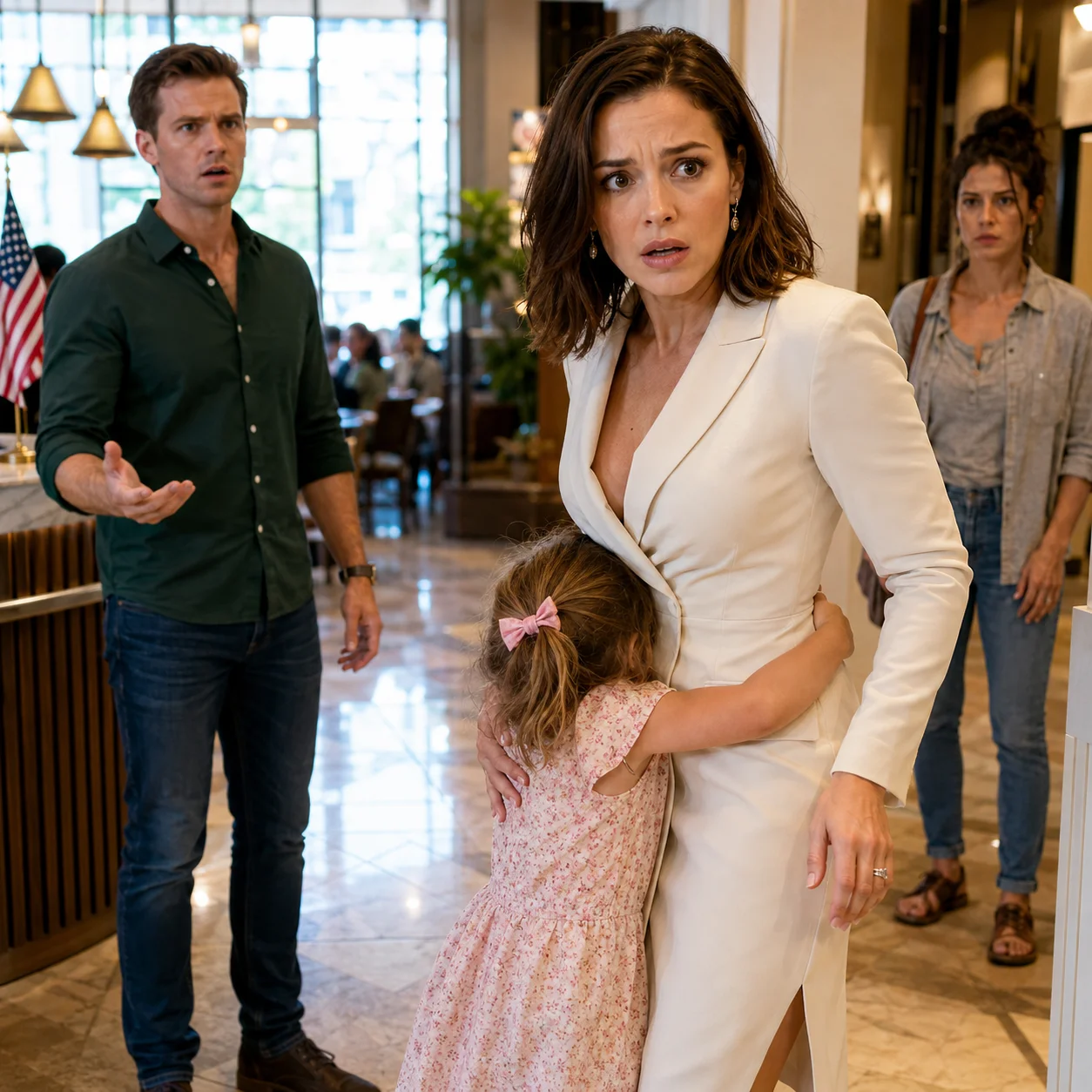
Natalie wiped her face quickly. “I told you. I don’t know.”
“Don’t do that.”
Her head turned toward me. “Do what?”
“Talk to me like I’m stupid.”
She looked wounded, but the expression didn’t reach her eyes. “Daniel, a random child ran up to me. I was shocked. That’s all.”
“And the woman?”
“I don’t know her either.”
“She knew you.”
“No, she thought she knew me.”
“She said, ‘I hope you’re sleeping well.’”
Natalie stared through the windshield. “People say weird things when they’re upset.”
I waited.
She looked at me then, tears shining. “Please don’t make this into something ugly. Please. I’m already embarrassed.”
Embarrassed.
That word didn’t fit either.
A stranger’s child mistaking you for her mother might embarrass someone. It might even upset them. But it did not make them look like their past had just walked into the room and put both arms around their legs.
Still, I drove home.
That was my first mistake.
Not because I should have exploded. Not because I should have demanded answers in the parking lot until she broke. But because I let her frame the moment as something that happened to her instead of something that had been revealed to me.
By the time we got back to our townhouse, Natalie had recovered enough to act fragile. She went straight to the bedroom, changed into sweats, and curled up under a blanket. I stood in the doorway while she stared at the wall.
“I need the truth,” I said.
“You have it.”
“No, I don’t.”
She closed her eyes. “I can’t believe you’d doubt me over a child’s mistake.”
“That child didn’t act mistaken.”
Natalie sat up. “She is two, Daniel.”
“She called you Mama.”
“Toddlers call everyone Mama.”
“Not like that.”
Her face tightened. “So what are you accusing me of?”
I had no answer because the obvious accusation sounded insane.
Were you secretly a mother?
Did you abandon a child?
Have you been living another life while planning a wedding with me?
I didn’t say any of it.
Instead, I asked the simplest question. “Have you ever had a child?”
Natalie’s eyes flashed.
“No.”
The word came fast and clean.
Too clean.
Then she added, softer, “How could you even ask me that?”
There it was. The turn. From question to guilt. From truth to injury.
I knew it. Some part of me knew it right then. But love is a dangerous lawyer. It objects to evidence. It asks for context. It tells you not to convict someone on one moment, one expression, one child’s cry.
So I apologized.
Not fully. Not for asking. But enough for her to lean back into the role of the hurt woman and me into the role of the man who had wounded her by noticing too much.
That night, she fell asleep turned away from me.
I didn’t sleep at all.
At 2:13 a.m., I got out of bed and went to the kitchen. The townhouse was quiet except for the hum of the refrigerator and the occasional car passing outside. My phone sat on the counter, glowing with messages from Emily.
Are you okay?
That was weird, Danny.
Please don’t ignore this.
I typed back: I know.
Three dots appeared, disappeared, appeared again.
Then she wrote: Paul thinks he recognized the woman.
I sat up straighter.
From where?
A minute passed.
Emily replied: His cousin’s daycare. He’s not sure. Her name might be Marissa.
My pulse changed.
I looked toward the dark hallway leading to our bedroom. Natalie was still asleep. Or pretending to be.
What daycare? I typed.
Emily sent a name: Little Harbor Early Learning Center.
I stared at the screen.
The name meant nothing to me. It could have been a coincidence. A woman from a daycare. A toddler named Lily. A fiancée who had gone pale and denied everything.
Coincidences exist.
But they rarely arrive screaming Mama.
The next morning, Natalie was bright.
Not normal. Bright.
She made coffee, kissed my cheek, and asked if I wanted eggs. She wore the soft smile she used when my mother visited, the one that said everything was warm and manageable. But her hands moved too quickly, and she kept checking my face.
“I’m sorry about yesterday,” she said.
I leaned against the counter. “For what?”
“For snapping. I was overwhelmed.”
“That’s understandable.”
Relief flickered across her face.
“But I’m still not okay with it,” I added.
The relief vanished.
She turned back to the stove. “Daniel…”
“I’m not trying to attack you. I just need to understand.”
“There’s nothing to understand.”
“Then help me feel less crazy.”
She put the spatula down. “Fine. What do you want me to say? That I secretly have a toddler hidden somewhere? Does that sound like me?”
“No.”
“Then why are we doing this?”
“Because you looked terrified.”
“I was startled.”
“You cried the whole way home.”
“Because you were looking at me like I had done something wrong.”
I took a slow breath. “Did you know the woman?”
“No.”
“Did you know the child?”
“No.”
“Have you ever used another name?”
Her back stiffened.
It was small. Almost nothing. But I saw it.
She turned slowly. “What?”
“Have you ever used another name?”
“Why would you ask that?”
“Just answer.”
Her eyes narrowed. “This is becoming insulting.”
“That’s not an answer.”
“No, Daniel. I have not used another name.”
I watched her.
She held my gaze.
Then her phone buzzed on the counter.
We both looked at it.
Unknown number.
Natalie grabbed it so fast she nearly knocked over her mug. She declined the call, then slipped the phone into her robe pocket.
“Spam,” she said.
“Spam calls at seven in the morning?”
“They happen.”
“Let me see.”
Her expression changed completely.
“What?”
“Let me see your phone.”
“No.”
The word was not defensive. It was final.
Something in me went cold.
“We’re getting married in four months,” I said. “A child called you Mama yesterday, a woman looked at you like she hated you, and now an unknown number calls you at seven in the morning and you won’t let me see your phone.”
Her eyes filled again, but this time the tears made me tired.
“I can’t live like this,” she whispered.
“Like what?”
“Being interrogated.”
“I’m asking for basic honesty.”
“I have been honest.”
“Then show me the phone.”
She stepped back. “No.”
That was the second crack. Bigger than the first.
I left for work without eating.
All day, I tried to do my job and failed. Emails blurred. Meetings sounded underwater. My assistant, Mark, asked twice if I was sick. I told him I had a headache.
That wasn’t entirely a lie.
By lunch, I had searched Little Harbor Early Learning Center online. It was fifteen minutes from the restaurant, twenty minutes from our house. The staff page listed directors, teachers, and administrators. No Marissa. No Lily, of course. Daycares didn’t post children’s names.
I told myself to stop.
Then I searched Natalie’s name with the daycare.
Nothing.
I searched her old city.
Nothing.
I searched her full name, Natalie Claire Benson, with every word I could think of: child, baby, custody, family court, marriage, birth announcement.
Nothing useful came up.
That should have reassured me.
Instead, it made the whole thing feel more deliberate.
Natalie had almost no digital past before four years ago. I had noticed that before, but she explained it easily. She said she hated social media after an abusive ex stalked her online. She said she deleted everything, changed her number, started over. I admired that. I thought it meant she was strong.
Now it looked like a locked door.
At 3:40 p.m., Emily called.
“I did something,” she said.
I closed my office door. “What?”
“I asked Paul to call his cousin. Her son goes to Little Harbor.”
“Emily.”
“I know. I know. But listen. The woman’s name is Marissa Hale. She’s not staff. She picks up a little girl named Lily sometimes. The cousin thinks Lily’s full name is Lily Grace.”
My hand tightened around the phone. “Last name?”
“She didn’t know.”
I rubbed my forehead. “This is insane.”
“Yes,” Emily said gently. “It is. But not because you’re asking questions.”
I didn’t answer.
She lowered her voice. “Danny, did Natalie ever say where she lived before she moved here?”
“Portland. Then Denver briefly.”
“Did she ever show you photos from that time?”
“No.”
“Friends?”
“She said she lost touch.”
“Family?”
“Dead parents. No siblings.”
Emily was quiet for a moment. “That’s a lot of empty space.”
I hated hearing it because I had defended that empty space for months. To my mother, who thought Natalie seemed too polished. To Emily, who said she sometimes felt like Natalie gave perfect answers instead of real ones. To myself, whenever something about her past felt oddly smooth.
I went home that evening with a decision already forming.
Not a dramatic one. Not yet.
I just needed one undeniable piece of truth.
Natalie was in the living room when I walked in, sitting with her laptop open. The screen snapped shut the second she heard my key.
I stopped in the doorway.
She looked up. “Hi.”
“What were you doing?”
“Wedding stuff.”
“Open it.”
Her mouth tightened. “Are we doing this again?”
“Yes.”
“No.”
I nodded slowly. “Okay.”
That seemed to unsettle her more than anger would have.
I walked to the kitchen, set my keys down, and opened a drawer where we kept documents: insurance papers, lease agreement, appliance warranties. Beneath them was our wedding folder. Venue contract. Photographer deposit. Catering menu. Guest list.
I pulled it out and placed it on the counter.
Natalie watched me. “What are you doing?”
“Pausing the wedding.”
Her face drained. “You’re not serious.”
“I am.”
“Over a child?”
“Over lies.”
“I haven’t lied.”
“Then this should be easy to fix.”
She stood. “You’re punishing me because a toddler was confused.”
“No,” I said. “I’m protecting myself because my fiancée refuses to answer reasonable questions.”
“You asked if I had a secret child!”
“And you said no.”
“Because I don’t!”
“Then why are you scared?”
The room went silent.
For a second, something real appeared on her face. Not anger. Not performance. Fear. Grief. Maybe both.
Then she whispered, “Because you won’t understand.”
My heart started pounding.
“Understand what?”
She shook her head. Tears slipped down her cheeks. “I can’t.”
“Yes, you can.”
“No.” Her voice broke. “I can’t lose everything again.”
Again.
I stepped closer. “Natalie, what does that mean?”
She wiped her face hard. “Nothing.”
“You said again.”
“I misspoke.”
“No, you didn’t.”
Her phone buzzed again.
Unknown number.
This time, she didn’t grab it.
We both stared at it until it stopped.
A message appeared on the lock screen.
Please stop pretending Lily imagined you.
Natalie made a sound like she had been hit.
I picked up the phone before she could.
She lunged for it. “Daniel, don’t.”
I held it away. “Unlock it.”
“No.”
“Unlock it.”
“You have no right.”
“You’re right,” I said, voice shaking. “I don’t. And you don’t have the right to marry me under a false identity.”
Her eyes widened.
The words had come out before I fully knew why I said them.
But I watched them land.
False identity.
Natalie sat down slowly.
The fight left her all at once.
Her face crumpled, and suddenly she looked younger, smaller, stripped of all the careful polish she wore like armor.
“My name is Natalie,” she whispered.
“But?”
She covered her mouth with her hand.
“But it wasn’t always.”
There are moments when you can feel your life dividing itself into before and after. I used to think they came with noise. Screaming. Doors slamming. Tires on wet pavement. But this one was quiet. Just my fiancée sitting on our sofa, crying into her hand, while her phone lay between us with a message from a woman who clearly knew more about my future wife than I did.
Her real name was Nora.
Nora Elise Bennett.
She had changed it three years before I met her.
Not legally at first. Then legally, after moving states. Natalie Claire Benson was not fake exactly, she explained. It was real now. Paperwork, ID, credit history. A new life.
I sat across from her, hands clasped so tightly my knuckles ached, and listened as the woman I planned to marry opened a door she had sealed shut long before me.
She had been married at twenty-three to a man named Aaron Vale. He was older, charming, controlling in ways she said she did not recognize until she was pregnant. Their daughter, Lily Grace Vale, was born when Nora was twenty-five.
I stopped breathing for a second when she said the name.
Their daughter.
“Lily is yours,” I said.
Natalie closed her eyes. “Biologically, yes.”
Biologically.
I stared at her. “Don’t do that.”
Her eyes opened.
“Don’t make her sound like a medical fact.”
Fresh tears spilled down her face. “I don’t know how else to say it.”
“Try saying she’s your daughter.”
She flinched.
For a long moment, she couldn’t.
That told me more than any confession.
Finally, in a voice so quiet I almost didn’t hear it, she said, “She’s my daughter.”
The words changed the room.
I stood up because sitting still had become impossible. “You told me you had no children.”
“I know.”
“You let me propose.”
“I know.”
“You let my mother talk about grandchildren while your actual child existed somewhere else.”
She pressed both hands over her face. “Please stop.”
“No. You don’t get to ask me to stop.”
She dropped her hands. “I lost custody, Daniel.”
The anger in me paused, not gone, but caught.
“What do you mean?”
She told me the story in pieces. Some of it made sense. Some of it felt rehearsed. Aaron, she said, had money and family support. She had postpartum depression. She struggled. There were fights. One night she left Lily with Aaron’s sister Marissa and disappeared for three days. She described it as a breakdown. She said she checked into a motel, turned off her phone, and wanted to vanish.
When she came back, Aaron filed emergency custody.
The court sided with him temporarily. Then permanently, after Natalie—Nora—missed hearings, failed mandated counseling appointments, and moved without notifying the court. She said she had been ashamed. She said Aaron’s family hated her. She said every attempt to return became harder until she convinced herself Lily was better off without her.
I listened, sickened, trying to separate tragedy from choice.
“How old was Lily when you left?” I asked.
Natalie looked down.
“How old?”
“Fourteen months.”
I closed my eyes.
A baby.
Not a child with memories she could explain. Not someone old enough to understand illness or fear or adult failure. A baby whose mother vanished and later built a new life around the lie that she had never existed.
“And Marissa?” I asked.
“Aaron’s sister.”
“She’s raising Lily?”
Natalie nodded. “Aaron died last year.”
The room tilted slightly.
“What?”
“Car accident. Lily lives with Marissa now. She has guardianship.”
“And you knew?”
“Yes.”
“You knew her father died?”
“Yes.”
“And you still didn’t try to see your daughter?”
Pain twisted her face. “I did.”
“When?”
“After the funeral. Marissa told me not to come near them.”
“Did you petition the court?”
“No.”
“Did you get a lawyer?”
“No.”
“Did you send money?”
“I tried once. She sent it back.”
“Once?”
Natalie stood abruptly. “You don’t understand what it was like.”
“You’re right. I don’t.”
“She looked at me like I was a monster.”
“Maybe because you abandoned a baby.”
Her face shattered.
The words were cruel.
They were also true.
I regretted how hard I said them, but not that I said them. Some truths don’t become false because they hurt.
Natalie wrapped her arms around herself. “I was sick.”
“I believe you.”
Her eyes lifted.
“I believe you were sick,” I said. “I believe you were scared. I believe you may have been trapped in a marriage that broke something in you. But then you made choices for years. You changed your name. You hid your daughter. You lied to me every day.”
“I was going to tell you.”
“When?”
She had no answer.
“When, Natalie? Before the wedding? After? When Lily turned eighteen and found us?”
She cried harder. “I wanted to be someone who deserved you.”
That almost broke me.
Because the worst part was that I had loved her. Not a little. Not casually. I had imagined mornings with her, children with her, gray hair, holidays, arguments about paint colors, boring grocery trips, all the small domestic things that make a life.
But the woman I loved was built on a locked room.
And inside that room was a child.
I slept in the guest room that night. Natalie begged me not to. She sat outside the door for nearly an hour, whispering apologies through the wood. I didn’t answer. Not because I wanted to punish her. Because if I opened that door, I knew I might hold her. And if I held her, I might let love blur what truth had finally made sharp.
The next morning, I called in sick.
Natalie was gone when I came downstairs.
Her ring sat on the kitchen counter.
For one irrational second, I thought she had left me.
Then I saw the note beneath it.
I’m going to talk to Marissa. I don’t expect forgiveness. I just can’t run anymore.
I read it three times.
Then my phone rang.
Emily.
“Are you okay?” she asked.
“No.”
“Did she tell you?”
I leaned against the counter. “She has a daughter.”
Emily was silent.
“Lily,” I said.
“Oh, Danny.”
The pity in her voice nearly undid me.
“I don’t know what to do,” I admitted.
“You don’t have to decide today.”
“She lied about something massive.”
“Yes.”
“But she was sick. Maybe abused. Maybe ashamed.”
“Yes.”
“And there’s a child.”
Emily’s voice softened. “That’s the part you can’t fix for her.”
I looked at the ring. “I know.”
Natalie didn’t come home until after dark.
When she walked in, she looked destroyed.
Not dramatic destroyed. Not mascara-running-for-effect destroyed. Real destroyed. Hair messy. Face swollen. Shoulders folded inward like she had been carrying something too heavy for too long and had finally collapsed under it.
“What happened?” I asked.
She placed her purse down carefully.
“Marissa let me talk to her outside,” she said. “Not Lily. Just her.”
“And?”
“She told me Lily asked about me after the restaurant. She remembered me from pictures.”
“Pictures?”
Natalie nodded, lips trembling. “Aaron kept some. He told Lily I was her first mommy but I was sick and far away.”
I sat down slowly.
That single sentence hit harder than I expected.
Aaron, the man Natalie had painted as controlling and cruel, had somehow given his daughter a gentler version of abandonment than Natalie had given anyone else. He had not erased her. He had not taught Lily to hate her. He had preserved a space, however painful, where her mother existed.
Natalie covered her mouth. “She knew my face.”
I didn’t speak.
“Marissa said Lily has been asking when I’m coming back.” Her voice broke completely. “Daniel, she thought I came back.”
The sound she made after that was not crying. It was grief finally finding the right place to land.
I wanted to comfort her.
I also wanted to shake her.
Both feelings lived in me at once, and that was the most exhausting part.
“What did Marissa say?” I asked.
“She said if I ever want contact, I need to do it through court, therapy, and a reunification specialist. No surprises. No showing up. No pretending. She said Lily deserves consistency, not guilt.”
“She’s right.”
Natalie nodded. “I know.”
Then she looked at me.
“I told her about you.”
My stomach tightened. “What did you say?”
“That I lied to you. That we were engaged. That you didn’t know.”
“And?”
“She said she felt sorry for you.”
I looked away.
Natalie stepped closer, then stopped, as if she no longer trusted herself to cross the room. “I don’t expect you to marry me.”
The words hung there.
Four months earlier, that sentence would have been unimaginable. Now it sounded like the first honest thing she had said all week.
“I can’t,” I said.
Her eyes closed.
“I can’t marry you in four months,” I continued. “I can’t marry someone I don’t fully know. And I can’t build a life with you while you’re just beginning to face the one you abandoned.”
She nodded, crying silently.
“I love you,” I said, and my voice cracked because it was true. “But love isn’t enough for this.”
She folded into the chair across from me.
“I know,” she whispered.
We canceled the wedding that week.
Or rather, I canceled it.
Natalie couldn’t make the calls. Every vendor conversation made her spiral into apologies, tears, and shame. So I did the practical things. Venue. Photographer. Caterer. Florist. Hotel block. My mother cried quietly on the phone but didn’t ask many questions. Emily came over with boxes and helped me sort decorations we no longer needed.
Natalie moved into a short-term rental ten days later.
Not because I threw her out. Because staying together inside the ruins of our almost-marriage had become unbearable. Every room held a version of us that didn’t exist anymore.
The kitchen where we had danced while making pasta.
The hallway where she had kissed me after I proposed.
The bedroom where she had slept beside me while hiding the biggest truth of her life.
Before she left, she stood near the door with two suitcases and looked around like she was trying to memorize the place.
“I really did love you,” she said.
“I know.”
“I know that doesn’t fix it.”
“No,” I said. “It doesn’t.”
She nodded.
Then she removed the engagement ring from her pocket and held it out. “I should have left this before.”
I looked at the ring, then at her.
“Keep it for now,” I said.
Her eyes widened.
“Not as a promise,” I added. “As a reminder. Not of me. Of what happens when you hide from the truth until it finds you in public.”
She closed her fingers around it and cried.
After she left, the house felt impossibly quiet.
For weeks, I moved through my life like someone recovering from a car crash no one else could see. Work helped. Emily helped. Running helped. So did therapy, though I resisted it at first because I thought therapy was for people who didn’t already understand their own pain. I was wrong. Understanding pain and surviving it are two different skills.
Natalie and I didn’t speak for a month.
Then one evening, she sent a message.
I started therapy. I also hired a family attorney. I am not asking for anything from you. I just wanted you to know I’m trying to do this the right way.
I stared at it for a long time before replying.
Good. Lily deserves that.
She wrote back almost immediately.
I know.
That became the shape of our contact for a while. Sparse. Careful. Updates that were not invitations.
She was diagnosed, officially this time, with unresolved postpartum depression trauma and avoidant coping patterns. She joined a support group for mothers who had lost custody, though she said some meetings were brutal because not every story was sympathetic, and not every woman wanted accountability. Her therapist made her write a full timeline of her choices, separating what happened to her from what she did to others.
That distinction mattered.
It mattered to me, at least.
Six months after the restaurant incident, Natalie had her first supervised therapeutic session with Lily.
She told me afterward, though I had not asked.
I almost didn’t go through with it. I threw up twice before the appointment. Marissa was there. So was the therapist. Lily was shy at first. Then she asked if I was still far away. I told her I had been, but I was trying to be safe enough to visit. She asked if I brought stickers. I did. We put them on a paper crown. She called me Nora, not Mama. I deserved that. But she smiled once.
I read the message three times.
Then I cried.
Not because I wanted Natalie back.
Because somewhere in the wreckage, a little girl had smiled.
A year passed.
The house changed slowly. I painted the bedroom. Sold the dining table Natalie had picked. Replaced the framed engagement photo with a landscape my father had painted before he died. My life became smaller for a while, then steadier.
I dated once, too soon, and apologized to the woman after realizing I was measuring every silence against a lie she had never told. I stopped dating after that and focused on becoming someone who didn’t confuse suspicion with wisdom.
Natalie continued the reunification process. It was slow, inconsistent, and painful. Lily had good days and bad days. Sometimes she ran to Natalie. Sometimes she refused to speak. Marissa remained cautious, which I respected deeply. Natalie once told me Marissa was the reason Lily still had room in her heart for her mother at all.
I believed that.
Then, fourteen months after the day at the restaurant, I saw them again.
Not by arrangement.
I was at a public park on a Saturday morning, picking up coffee from a cart near the walking trail. The air was warm, bright, full of dogs and strollers and children shrieking around the playground.
I heard Lily before I saw her.
Her laugh was the same. Bright, fearless, impossible to mistake.
She was running across the grass with a kite string in both hands, Marissa walking a few steps behind her. Natalie stood farther back under a maple tree, holding a tote bag and watching with an expression I had never seen on her before.
Not fear.
Not performance.
Patience.
She looked thinner, older in the eyes, but more real somehow. Her hair was shorter. She wore jeans and a simple blue sweater. No polished mask. No perfect smile. Just a woman standing at the edge of a child’s life, grateful for whatever space she was allowed to occupy.
Lily spotted her and ran back with the kite dragging behind.
“Nora!” she yelled.
Natalie crouched before the child reached her. Lily crashed into her arms, laughing.
Not Mama.
Nora.
And Natalie did not flinch.
She wrapped her arms around Lily carefully, like holding something sacred and fragile, and looked over the child’s shoulder.
She saw me.
For a moment, neither of us moved.
Then she gave a small nod.
I nodded back.
That was all.
No dramatic reunion. No conversation. No closure speech under autumn leaves. Just two people acknowledging the place where their lives had broken open, and the child who had deserved truth long before any of us were brave enough to give it to her.
I walked away before Lily could notice me.
A week later, Natalie sent one final message.
I saw you at the park. Thank you for not coming over. I don’t mean that coldly. I just mean thank you for understanding that Lily’s world has to stay calm. I also wanted to say I’m sorry again, not because I expect forgiveness, but because I finally understand that love without truth is just another kind of harm. You deserved truth. Lily deserved truth. I’m going to spend the rest of my life trying not to hide from that again.
I replied the next morning.
I hope you keep showing up for her.
She wrote back:
I will.
That was the last message between us.
People sometimes ask, when they hear the shortened version, whether I think Natalie was a bad person. They want clean categories. Villain. Victim. Liar. Mother. Monster. Survivor.
The truth is harder.
She was a woman who had been hurt and then hurt others. She was sick and still responsible. She was afraid and still dishonest. She loved me, I think, as much as she was capable of loving anyone while hiding from the worst thing she had ever done.
But Lily loved without categories.
That was what broke the lie.
A toddler ran across a restaurant lobby and told the truth with both arms.
And in the end, that was the thing no one could argue with.
![[FULL STORY] He Handed Me Divorce Papers at My Dad’s Funeral While I Was Pregnant… He Didn’t Know I Was About to Inherit $800 Million](https://social-media.rabedo.com/thumbnails/1776757122_D71.jpeg)