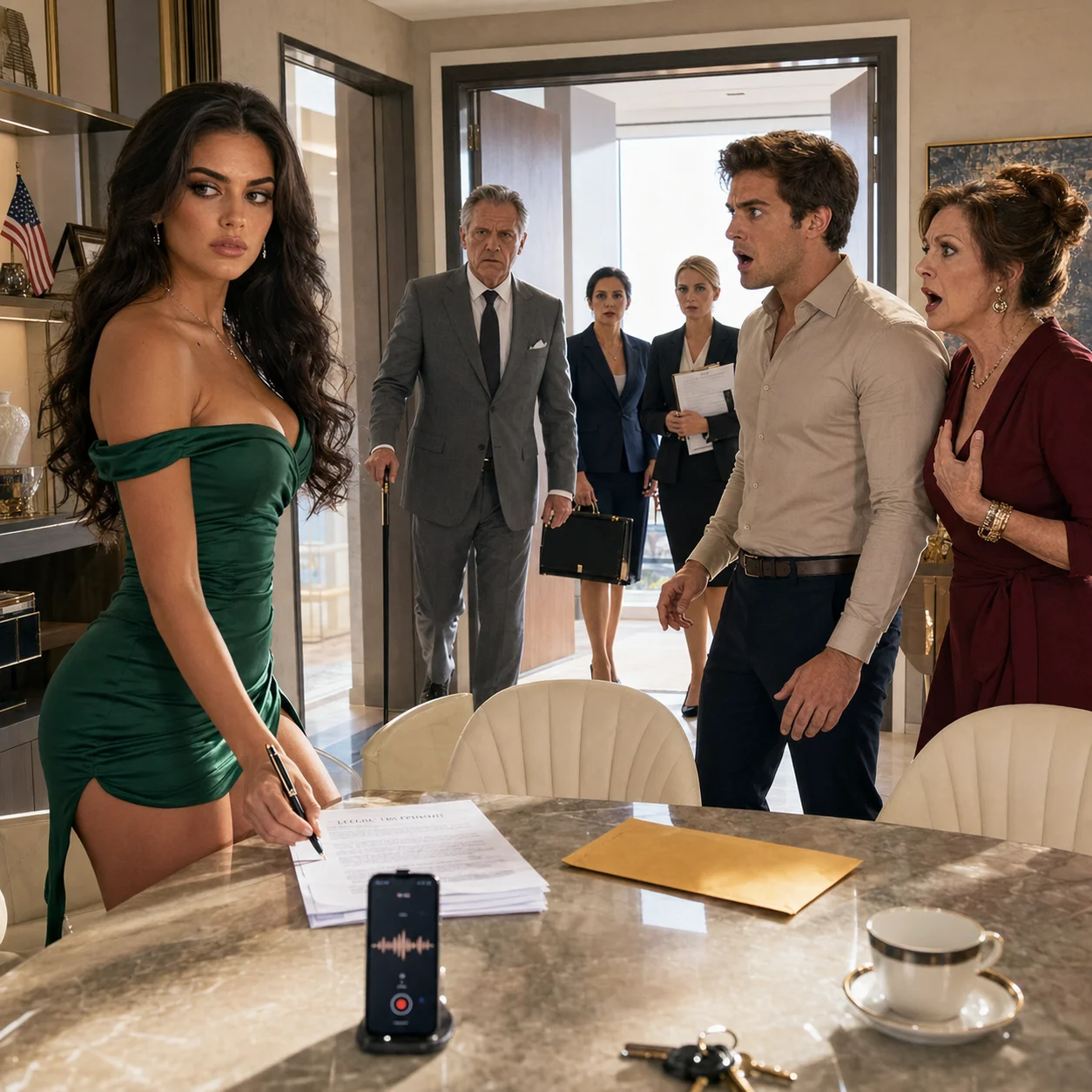
“Señora Mariana,” he said, “we are here to record the facts, revoke any attempted power of attorney, and establish that you did not sign that document freely or with informed consent.”
Darío blinked.
“Revoke what? She hasn’t signed anything.”
“Thank God,” I said. “But I do have a recording of you and your mother planning to make me sign without reading.”
Mireya exploded.
“That’s illegal! You can’t record us in a private conversation!”
Clara looked at her calmly.
“You were in my client’s home discussing how to dispossess her of her property. I would choose my next words very carefully.”
My mother-in-law closed her mouth.
For the first time since I had met her, she had no venom ready.
Darío tried to change his face. I watched him do it. The thief disappeared, and out came the wounded husband, the role his mother had clearly trained him to play.
“Mariana, amor, this is a misunderstanding.”
I almost laughed.
Amor.
How easily that word fell from his mouth when he saw the door closing.
“Last night you said, ‘If she signs this, then everything is ours.’”
His face lost even more color.
My father lifted his chin slightly.
“Is that what you said?”
Darío swallowed.
“It wasn’t like that.”
I tapped my phone screen.
His own voice filled the room.
“And with that, I can sell it?”
Then Mireya’s voice followed.
“With that power, you can do many things.”
Nobody breathed.
Outside, Colonia Del Valle continued living like it was any other morning. Cars passed on the avenue. Someone honked. A vendor shouted about tamales. From a nearby apartment came the smell of fresh coffee.
That ordinary noise made me angry.
The world kept spinning while I stood in my own dining room, discovering that my marriage had been a contract disguised as affection.
Darío dragged both hands down his face.
“My mother pressured me.”
Mireya turned toward him as if he had spit on her.
“Me?”
And that was when the collapse began.
Not with justice.
With cowardice.
“You said Mariana was hiding something,” Darío snapped. “You started checking receipts.”
“Because you told me you wanted to know if she was worth staying with!”
My body went cold.
Clara looked up.
My father closed his eyes for one second.
I didn’t.
I wanted to see all of it.
I wanted to hear every last piece of the lie.
“Worth staying with?” I asked.
Darío looked at me, desperate.
“I didn’t mean it like that.”
“Yes,” I said. “You did.”
Mireya, red with anger now, stood up.
“Oh, please. Don’t act like a victim. You entered this marriage hiding an apartment.”
“No,” I said. “I entered this marriage hiding an inheritance so I could find out whether you loved me or my walls.”
The sentence landed on the table like a verdict.
Darío lowered his eyes.
And with that, he answered me.
My father placed the document in front of the notary.
“This property was transferred to Mariana before her marriage, by public deed, properly registered, and protected with legal clauses. It is not part of any shared marital estate. No power obtained through deception would have changed that cleanly, but it could have caused enormous damage.”
The notary nodded.
“A power of attorney with ownership authority can allow someone to dispose of property if properly granted. That is precisely why no one should sign without reading.”
Mireya tightened her mouth.
“You’re exaggerating. We only wanted security.”
Clara opened her folder.
“Then it should be easy to explain why you already had an appointment with a real estate broker next Tuesday.”
Darío froze.
Something inside me broke for the second time.
“What?”
Clara pulled out a printed page.
“Messages recovered from a conversation Señora Mariana sent me last night. ‘The apartment in Del Valle will sell quickly. With that money, we buy something in Darío’s name and settle your debt.’ Would you like to read it yourself, Señora Mireya?”
My mother-in-law sat down slowly.
Not because she was ashamed.
Because she was calculating.
Darío murmured, “I wasn’t going to sell it immediately.”
My father struck the floor with his cane.
Not loudly.
Just enough.
“You were going to sell my daughter’s home.”
“She is my wife,” Darío said, as if that gave him rights.
My father stepped forward.
“Exactly. That is why you are worse than a stranger.”
That sentence hit him.
It hit me too.
Because until that morning, some part of me was still searching for an explanation that would hurt less. A reason to believe Darío was weak, not cruel. Manipulated, not involved. Foolish, not a thief.
But I had heard him.
I had recorded him.
He was standing in front of me.
“I want you both out,” I said.
Darío lifted his head.
“Mariana, no.”
“Today.”
Mireya let out a harsh laugh.
“Today? My son lives here.”
“He lived here.”
“This is his marital home.”
Clara stepped in.
“That does not give him the right to remain while committing financial abuse or intimidation. If he insists, we will request protective measures.”
Darío came closer.
“Mariana, please. Let’s think.”
I stepped back.
That single step destroyed him more than any scream could have.
“Don’t touch me.”
He stopped.
His eyes filled with tears.
Once, those tears would have softened me. I would have wondered whether I was being too harsh, whether a good wife should listen, whether love deserved one long, painful conversation.
But a woman who hears her husband ask if he can sell her apartment does not need couples therapy.
She needs to change the locks.
“You have two hours to pack your clothes,” I said. “Anything else will be inventoried and verified with Clara.”
“You’re throwing me out?”
“I’m sending you back where you belong.”
Mireya stood sharply.
“Come on, Darío. This woman always thought she was better than us.”
My father smiled without warmth.
“She thought she was the owner. And she was right.”
Darío did not move.
He looked around the dining room, at the paintings, the lamp we had chosen together in a little shop in Narvarte, the chairs we assembled one Saturday while playing music, the plant he watered whenever he wanted to seem tender.
Maybe in that moment he finally understood that he was not losing a property.
He was losing the stage on which he had pretended to be a husband.
He went upstairs to the bedroom with Mireya behind him.
Clara came with me.
The notary stayed in the living room with my father.
I did not trust Darío to pack alone. And I trusted Mireya even less. She moved through my home with the eyes of someone still looking for something to take.
I entered the bedroom.
Darío opened the closet angrily.
“All this over a piece of paper?”
I looked at him.
“Over betrayal.”
“You lied too.”
“I protected something that was mine. You tried to take it from me.”
Mireya folded shirts with violent little movements.
“My son married a snake.”
“No,” I said. “Your son married a woman who read before signing.”
Darío looked at me.
“I loved you.”
What a poor sentence.
What a late sentence.
“No,” I answered. “You liked the way I loved you.”
He went silent.
Because that was the truth.
He liked coming home to dinner.
He liked that I paid the building maintenance without asking questions.
He liked saying “our apartment” in front of his friends.
He liked that my stability made him look successful.
But love?
Love was too heavy for him.
Two hours later, Darío left with two suitcases, one backpack, and a destroyed expression. Mireya carried a bag where she had tried to hide my blender.
Clara stopped her.
“That stays.”
“I bought it,” Mireya lied.
I walked to the kitchen, opened a drawer, and pulled out the folded receipt.
“I bought it. At Liverpool. With my card. The same day you said my kitchen looked like it belonged to a poor single woman.”
Mireya put the blender down so hard she almost broke it.
“You’re going to end up alone,” she spat.
I looked at her.
“No,” I said. “I’m going to end up in peace.”
When the door closed behind them, I did not cry.
Not yet.
I stood in the entryway, staring at the keys hanging by the door, the marks from Darío’s shoes on the floor, Mireya’s half-finished cup of coffee still sitting on my table.
My father came closer.
“Hija.”
Then I broke.
Not because of Darío.
Because of me.
Because of the Mariana who had married believing that hiding her property was distrust, only to discover it had been instinct. Because of the woman who wanted clean love and almost signed a dirty document. Because of the little girl who had lost her father once, and then had to pretend she had lost him again to protect him.
My father held me.
He smelled like soft tobacco, old cologne, and hospital corridors.
“I’m sorry,” he said.
I pulled back slightly.
“For what?”
“For making you carry secrets.”
“You saved me.”
“No,” he said. “I taught you to distrust.”
I looked at the closed door.
“Sometimes distrust saves you too.”
That afternoon, we changed the locks.
We also changed the internet passwords, the building access codes, emergency contacts, and parking authorization. The building administration put in writing that Darío could not enter without my permission. The doorman, Don Julián, looked at me with sorrow.
“Señora Mariana, I thought the young man was very kind.”
“So did I,” I said.
He nodded.
As if that sentence explained the tragedy of many women.
The next day, we went to the Public Registry of Property. It was not glamorous. There were windows, stamps, people carrying folders, legal assistants talking quickly, and that particular Mexican bureaucratic air where everything feels slow until one signature saves your life.
I requested certificates, annotations, copies, and everything Clara recommended.
My apartment became more protected.
My accounts too.
My marriage did not.
I began dismantling that with a divorce petition.
Darío tried calling.
Then he sent messages.
“My mother put ideas in my head.”
“I never would have sold it without telling you.”
“I love you.”
“You’re destroying our home.”
My friend Elena told me something I never forgot.
“The home is not destroyed by the person who closes the door. It is destroyed by the person who tries to sell it.”
I saved screenshots.
I did not respond.
Mireya was worse.
She called my aunts. A cousin. The wife of one of my father’s old friends.
She told everyone I was ambitious, cold, calculating. That I had married her son while hiding assets. That I humiliated him with lawyers. That my father was probably a criminal because “no decent person fakes their death.”
She did not understand that her last sentence applied to her too.
No decent person tries to steal an apartment either.
The divorce hearing came months later.
Darío arrived in a blue shirt, with dark circles under his eyes and freshly ironed humility. Mireya was not allowed inside, but I saw her outside the courtroom, sitting with her purse on her knees, praying to whatever saint protects failed thieves.
The judge listened.
Clara presented the recording, the document, the messages, the real estate appointment, and the notary’s testimony.
Darío tried to talk about love.
The judge asked him to talk about facts.
That was where he ran out of vocabulary.
When we left, he caught up to me in the hallway.
“Mariana.”
I stopped because Clara was beside me.
“What?”
“I did love you.”
I looked at him calmly.
My hands no longer shook.
“Maybe. But you loved what you thought was mine more.”
“We can start over.”
“No.”
“Just like that?”
“It wasn’t just anything,” I said. “It was a yellow envelope.”
His eyes filled with tears.
“I made a mistake.”
“Yes.”
“There’s no forgiveness?”
I thought of that night in the hallway. Mireya saying women in love sign anything. Darío asking if he could sell. My hand nearly placing a signature that would have turned my home into a battlefield.
“Forgiveness does not mean giving you the key again,” I said.
Then I left.
I did not look back.
My father stayed near me for a while. Not in the apartment. He said he needed air, so he rented a small hotel room near Parque Hundido, where he walked in the mornings between jacaranda trees, dogs wearing sweaters, and older women exercising with more discipline than executives.
Sometimes we had breakfast together at a café in Del Valle, with chilaquiles, green juice, and that neighborhood calm that somehow survives between new buildings, traffic, and impossible rent prices.
“I should have told you I was alive sooner,” he confessed one morning.
“Yes,” I said.
He looked surprised.
“I thought you were going to comfort me.”
“I don’t comfort difficult truths anymore.”
He gave me a sad smile.
“You’re like me.”
“I hope I’m less like you.”
We laughed.
It was a small laugh.
But it belonged to us.
My father had faked his death because exposing his former partners had brought threats, surveillance, and two years of living between lawyers, secret addresses, and fear. It was not heroic. It was ugly, sad, and necessary. Before he disappeared, he transferred the apartment to me with every legal protection possible.
“I wanted you to have a place no one could take from you,” he told me.
I looked at my keys on the table.
“They almost did.”
“No,” he said. “You didn’t sign.”
That sentence held me together.
You didn’t sign.
Sometimes life is not saved by a great battle.
Sometimes it is saved by lifting the pen in time.
A year later, the apartment felt different.
Not just because I changed the furniture, though I changed a lot of it. I threw away the sofa where Darío used to sit and talk on the phone with Silvana, his “client,” who turned out to be a broker recommended by Mireya. I changed the curtains my mother-in-law said were “too feminine.” I painted the bedroom a soft color no one else chose for me.
The kitchen smelled like coffee again, without poison.
The dining room became a table again, not a courtroom.
And the hallway where I heard the betrayal stopped frightening me.
One Saturday, I bought flowers at Mercado de Tlacoquemécatl. I walked between fruit stands, food stalls, women asking for avocados ready for today, and vendors who had started recognizing me. I bought bread, cheese, tomatoes, and a bouquet of tiny white flowers.
When I returned, Darío was waiting near the entrance of the building.
Thinner.
Without Mireya.
Without arrogance.
“I’m not going upstairs,” he said quickly. “I just wanted to give you this.”
It was an envelope.
The sight of it made my stomach turn.
“I don’t accept envelopes from you.”
“It’s an apology,” he said. “Written. So you don’t have to talk to me.”
I looked at him.
He seemed tired of himself.
I took the envelope, but I did not open it.
“Thank you.”
He lowered his eyes.
“My mother still says you robbed us.”
“Us?”
He corrected himself.
“That you robbed me.”
“You can’t be robbed of something that was never yours.”
He nodded.
“I know that now.”
I did not ask how he was.
I did not tell him to take care.
I did not invite him inside.
He looked at the building.
“It was beautiful living here.”
“Yes,” I said. “It was.”
“I’m sorry, Mariana.”
That time, it did not sound like a strategy.
It sounded like a man who had finally run out of audience.
But damage does not disappear just because the person who caused it learns how to name it.
“I am too,” I replied.
Then I entered the building.
Don Julián closed the door behind me.
Upstairs, I left the envelope on the table. I opened it that night. The letter was short. Darío wrote that he had confused marriage with access, love with entitlement, trust with opportunity. He wrote that his mother had raised him to believe a wife should help “raise up” her husband, even if that meant pushing her down.
I did not cry.
I put the letter in a box.
Not as a memory of love.
As proof that I had not imagined it.
Today, I still live in my apartment in Del Valle.
Mine.
With deeds, stamps, history, and scars.
My father comes on Sundays. Sometimes he cooks eggs with salsa and leaves the kitchen a disaster. Sometimes he stands at the window, looking out as if he still cannot believe that both of us are alive, each in our own way.
I have not married again.
Not because I do not believe in love.
But because I no longer believe in a love that demands blindness.
If someone enters my life one day, he will know one thing from the beginning: my home is not something I prove by signing papers. It is something he respects every time he crosses the door.
And if he loves me, he will not ask me to hand over what my father left me to protect me.
Sometimes I still think about that night.
My bare feet on the cold hallway floor.
Mireya’s voice saying women in love sign anything.
Maybe she was right.
Women in love sign many things.
Forgiveness.
Excuses.
Silence.
Second chances.
But that night, I did not sign.
I read.
I recorded.
I called a lawyer.
I opened the door when my living father arrived with the truth in his hand.
And I understood that a home is not only walls, windows, and deeds.
A home is also the exact moment a woman decides that love will not cost her roof.
Or her name.
Or her peace.
![[FULL STORY] My Fiancé Controlled My Life So Quietly I Almost Married Him](https://social-media.rabedo.com/thumbnails/1777557623_0a038c71-f4f0-4608-8445-230012af2234.png)

![[FULL STORY] My Girlfriend Said She Didn’t Love Me Anymore… So I Quietly Stopped Doing One Thing, and Everything Collapsed](https://social-media.rabedo.com/thumbnails/1777102013_fa7a0d6a-6a42-42e5-a507-172e01977fdc.png)