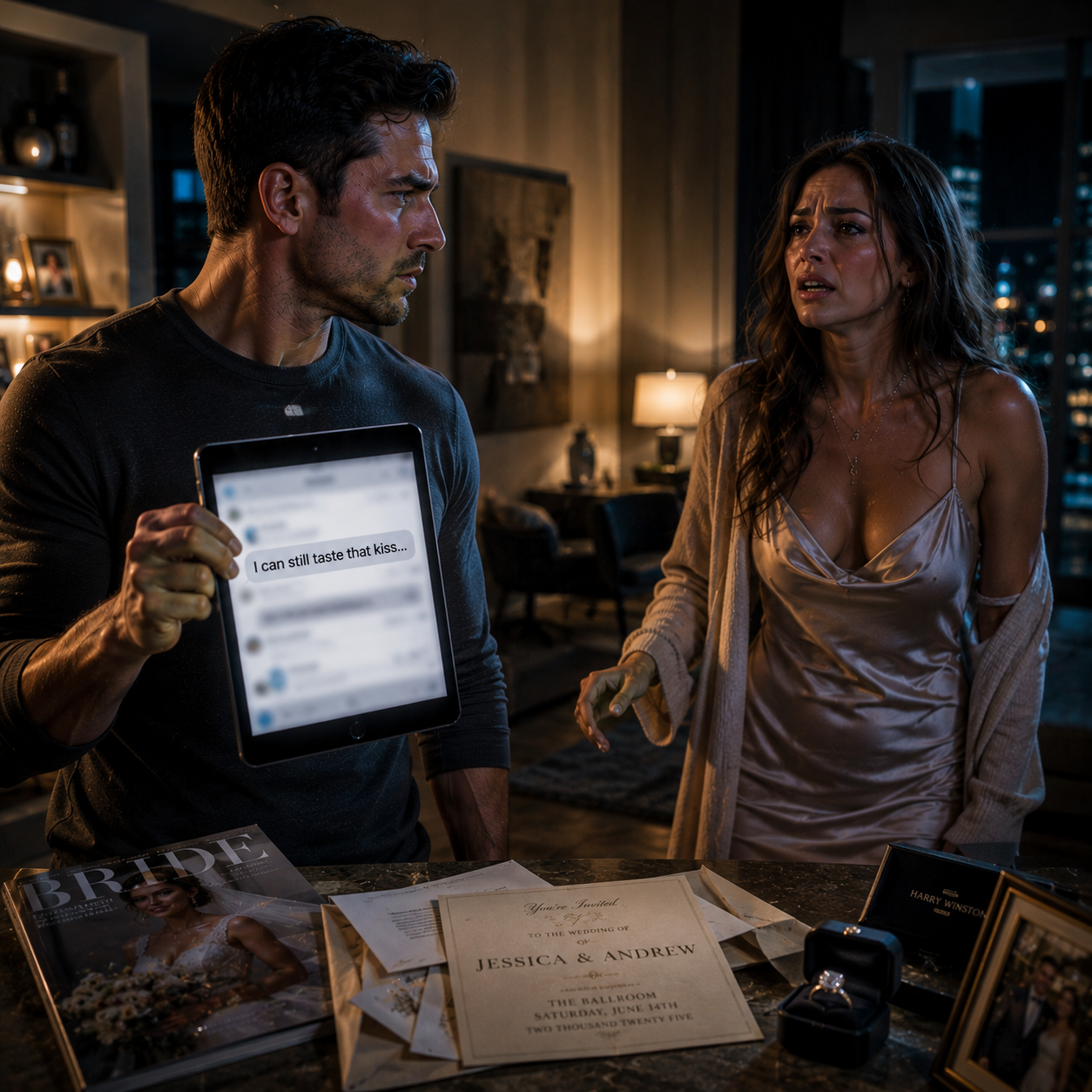
Messages dated months before the conference where I thought I had met Valeria by chance.
“I already investigated,” Diego had written. “Raúl is desperate to have a child.”
“His wife can’t get pregnant,” Valeria replied. “That makes him easy.”
“We only have to make him believe it’s his.”
My hands began to shake.
I turned the page.
There were bank transfers. Deposits I had made to Valeria that she had forwarded to an account connected to Diego. The money for the baby’s room. The money for medical appointments. The deposit for the apartment. All of it had been divided.
I had not been supporting my mistress.
I had been financing my own humiliation.
The final page was worse.
A private contract.
Diego had prepared a transfer of shares in the construction company. I had seen that document weeks earlier and nearly signed it, convinced that I needed liquidity for “my son.”
In the corner, in red ink, Lucía had written one sentence.
“That was the real birth, Raúl. Not the baby. Your company.”
I sat there until dawn.
Guadalajara woke around me with the familiar sounds of my childhood: buses braking, metal shop doors rolling open, a dog barking down the street, the first warm smell of bread from the bakery nearby. I had lost my shame in another city, but I had come home to face it.
There was more inside the envelope.
Lucía’s medical result.
Positive pregnancy.
Six weeks.
Beside it was a small note.
“I do not know if you will ever deserve to hear this from my mouth, but this baby is yours. It happened that night you came home crying about your father. I did not look for you. You looked for me. And for once, you were not the arrogant man who blamed me for everything. You were the Raúl I fell in love with.”
I covered my mouth with my hand.
That night returned to me whole.
My father was in intensive care. I came home destroyed. Lucía opened the door without asking where I had been. She made me coffee with cinnamon. She took off my shoes. She let me cry in her lap like a child.
Then I kissed her.
And she believed me.
God help me.
She still believed me.
I folded over myself and cried.
Not like I had cried in the hospital. I cried the way a man cries when there is no one left to blame.
Lucía’s letter continued.
“I will not ask you to come back. I will not compete with Valeria or her baby. I will not use my child to keep you. I have already filed for divorce. If you want to be a father, you will have to learn how to be a man first.”
I read that sentence until the words blurred.
Then I found a USB drive.
I plugged it into my laptop.
The first file was an audio recording.
Diego’s voice filled the room.
“Raúl thinks he’s smart, but he’s a starving dog. Show him a baby and he’ll sign himself into the grave.”
Then came Valeria’s laugh.
“What if he asks for DNA?”
“He won’t ask for anything,” Diego said. “I know him. His ego signs before his hand does.”
I paused the audio, ran to the bathroom, and vomited.
When I came back, I called my lawyer.
Then I called a notary.
Then I called an accountant.
By the time the sun had fully risen, I was not the same man who had left Santa Fe with his chest full of false pride.
I was broken.
But I was awake.
That same day, I went to the construction company.
Diego arrived at ten, smelling of expensive cologne, wearing a freshly pressed white shirt and the same confident smile I had once trusted.
“Compadre,” he said, spreading his arms. “Did the scare pass?”
I did not answer.
I placed my phone on the table and played the audio.
His smile faded slowly.
Other partners were present. So was my lawyer. So was the outside accountant Lucía had recommended months earlier, though I had not known why.
Diego looked around the room.
“That’s edited,” he said.
“So are the deposits?” I asked. “The emails? The inflated invoices? Your signature?”
His face reddened.
“You don’t know who you’re messing with.”
I laughed once, dry and empty.
“Yes, I do,” I said. “I’m messing with the man who got my mistress pregnant so he could rob me.”
No one spoke.
Outside, traffic roared along López Mateos as if the world had not changed at all.
But mine had split in two.
Diego lunged at me.
He did not reach me.
Security dragged him out while he shouted that I was crazy, that Valeria would testify against me, that he would take everything from me.
All I could think about was the baby.
That tiny boy with the mark under his eye and a debt that did not belong to him.
That afternoon, I returned to Mexico City.
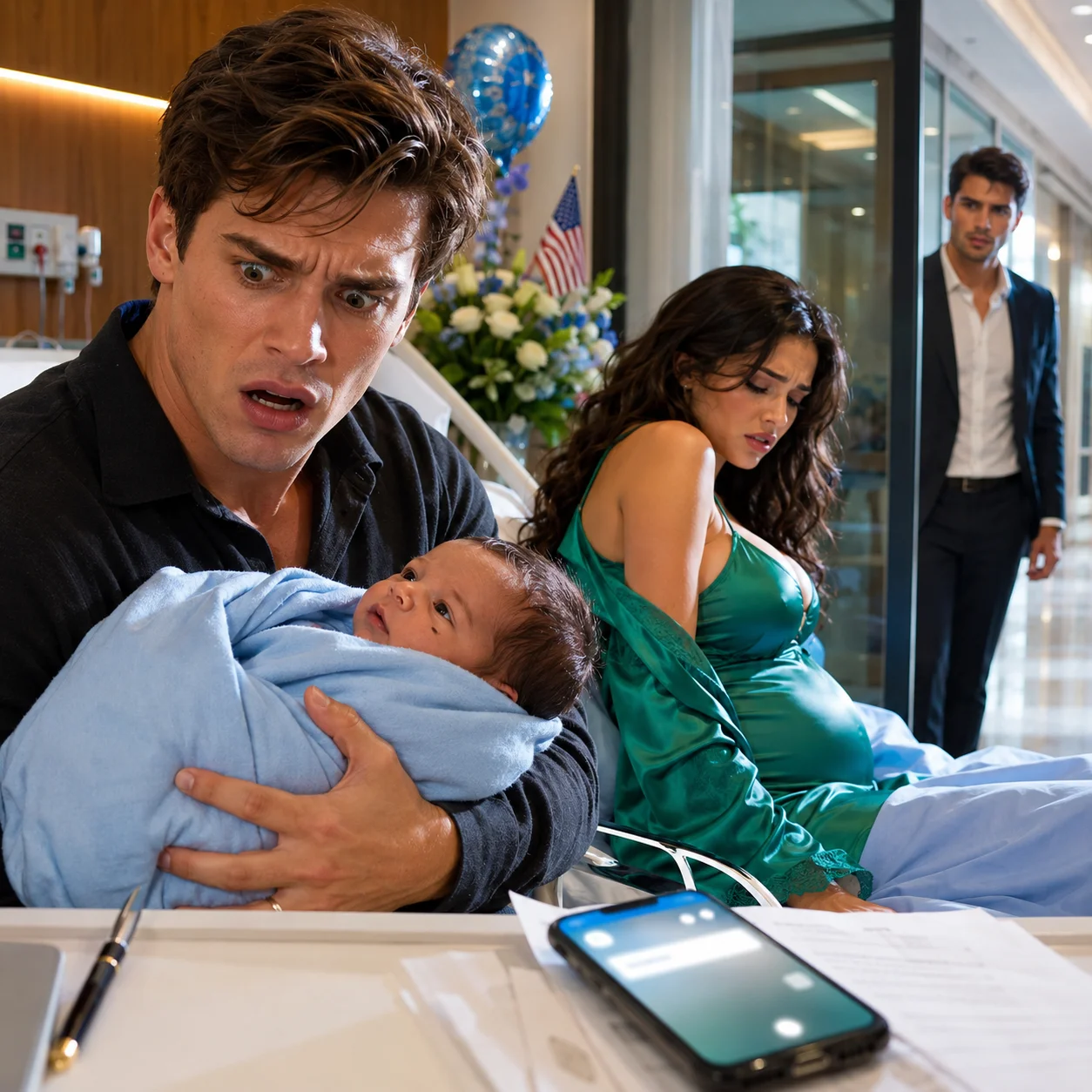
Valeria was still in the hospital room, the baby sleeping beside her.
When she saw me, she struggled to sit up.
“Raúl, I can explain.”
“Don’t explain it to me,” I said. “Explain it to your son when he is old enough to ask why you brought him into the world as part of a trap.”
She began to cry.
For the first time, her tears did not move me.
But I did not hate her either.
Hate would have been easy.
And I had spent too much of my life choosing what was easy.
“Diego promised me he was going to leave everything,” she said. “He said we would go away together. He said you were just… an opportunity.”
“I made Lucía a victim because I felt like less of a man,” I told her. “You made your son into a receipt.”
She pressed one hand to her chest.
“I don’t have money to pay the hospital.”
I looked at the baby.
He slept with his mouth slightly open.
So small.
So innocent.
“I’ll pay it,” I said. “But not for you. For him.”
Valeria lifted her face with sudden hope.
“Then you’ll recognize him?”
“No.”
The word fell heavily between us.
“He deserves the truth,” I said. “Your truth, Diego’s truth, and mine. But I will not put my name on a lie just to protect your shame.”
She gripped the sheet.
“What am I supposed to do?”
“Start by telling the truth.”
Before I left, I walked to the crib.
The baby opened his eyes.
They were not mine.
But I did not feel rage anymore.
Only sadness.
“I’m sorry,” I whispered to him. “I used you too before I even met you. I used you to feel complete.”
The baby moved one tiny hand.
As if he understood nothing.
As if he understood everything.
I returned to Guadalajara with lawsuits beginning, divorce papers waiting, and my name in pieces.
I tried to find Lucía at her mother’s house.
Her mother closed the door in my face.
I tried to find her at the clinic.
She refused to see me.
I tried the church where she sometimes went when she wanted to be alone.
Nothing.
Two weeks passed.
Two weeks of eating without hunger, sleeping badly, and staring at the empty chair at the dining table as if it were a grave.
Then, one Sunday morning, I found her in Zapopan.
It was not an accident. Her cousin told me Lucía liked to walk early near the Basilica, so I arrived before eight. The plaza was damp from a light drizzle. Women sold tamales and atole under plastic covers, as if even grief needed breakfast.
I saw her in front of the atrium.
She wore a simple blue dress.
Her pregnancy did not show yet.
But I saw it anyway.
I saw it in the way she touched her stomach without realizing.
I approached slowly.
“Lucía.”
She closed her eyes.
She did not turn around immediately.
“Don’t follow me, Raúl.”
“I only want to ask your forgiveness.”
Then she looked at me.
She had dark circles under her eyes, but there was no defeat in her face. Something new lived there now. A calm strength.
“Forgiveness is not something you ask for so the other person comes back,” she said. “You ask for it because you finally understand what you did.”
I nodded.
“I understood too late.”
“Late still counts,” she replied. “But it does not erase.”
I knelt right there on the wet stone, in front of people passing with bread bags and flower bouquets.
“I humiliated you,” I said. “I blamed you. I traded you for a lie. And when God put the truth in front of me, I almost signed it.”
Lucía swallowed.
Her eyes filled with tears, but she did not let them fall.
“I loved you very much, Raúl.”
That sentence frightened me more than any insult.
Because it sounded like goodbye.
“Will you let me try?” I asked.
She looked toward the Basilica.
“With your child, yes,” she said. “With me, I don’t know.”
It hurt.
But I accepted it.
For the first time, I did not argue.
“I’ll do whatever you ask.”
“No,” she said. “You will do what is right even when no one asks you.”
That day, I did not hug her.
She did not allow it.
We only walked for a few minutes in silence. I bought her a vanilla atole. She accepted it, but she did not smile.
Still, to me, it felt like more hope than the entire apartment in Santa Fe ever had.
The months that followed were a penance.
Diego fell first inside the company.
Then in court.
Valeria testified.
Not because she became noble.
Because she was afraid.
She admitted the truth: Diego had planned for her to get close to me, convinced her to become pregnant with his child, and used my obsession with fatherhood as the perfect weapon against me.
I sold the SUV.
I lost money.
I lost reputation.
I lost friends who had only been friends when I could pay for expensive steak and tequila in Andares.
But I did not lose my son.
Lucía allowed me to accompany her to some medical appointments. She did not let me hold her hand. But she let me be there.
In one waiting room, while a nurse called names and an elderly woman whispered prayers over a rosary, I heard my child’s heartbeat for the first time.
It was a small gallop.
Fast.
Stubborn.
I cried without making a sound.
Lucía glanced at me.
“Don’t cry so loudly,” she said. “You’ll scare him.”
It was almost a joke.
Almost.
I held onto that almost like a drowning man holding onto wood.
My father survived the heart attack.
When he was strong enough to speak properly, I told him everything.
I thought he would curse me.
Instead, he asked me to come closer.
“Mijo,” he said, his voice weak, “a man is not measured by the children he boasts about. He is measured by the tears he stops causing.”
I kissed his hand.
That day, I understood my father had come closer to dying from my lie than from his heart.
Valeria’s baby was registered without my last name.
Diego denied everything at first. He shouted. He threatened. He claimed everyone was conspiring against him.
Then the DNA test caught him.
I did not go to the baptism. I did not send expensive gifts. I only deposited an anonymous amount for diapers when I heard Valeria had moved in with an aunt in Iztapalapa.
I did not do it because I was a saint.
I did it because that child had become the mirror in which God forced me to see myself.
Six months later, on a rainy night, Lucía called me.
“It’s time,” she said.
I arrived at the hospital with my shirt buttoned wrong and my soul in my throat.
Her mother was there.
She looked at me the way someone looks at a dog that bit the hand feeding it.
But she did not throw me out.
The labor lasted hours.
I waited outside, pacing back and forth, remembering the hallway in Santa Fe, Valeria’s baby, the mark under his eye, and the signature I had refused to give.
At 5:42 in the morning, I heard a cry.
My whole world stopped.
A nurse stepped out.
“Raúl Méndez?”
My knees almost failed.
“Yes.”
“Mrs. Lucía says you may come in.”
I entered.
Lucía was exhausted, pale, and beautiful in a way that broke me.
In her arms was a baby wrapped in a white blanket.
She did not give him to me immediately.
First, she looked at me.
“He is not a prize,” she said.
I shook my head. “I know.”
“He is not a guaranteed second chance.”
“I know.”
“He is a life. And if you ever use him to fill the emptiness inside you, I will close the door forever myself.”
I swallowed hard.
“I know, Lucía.”
Then she let me hold him.
My son opened his eyes.
They were mine.
But this time, I did not cry from pride.
I cried from shame.
From gratitude.
From a good kind of fear.
The kind of fear that does not destroy a man, but teaches him to protect what he has been trusted with.
“His name is Mateo,” Lucía said.
I nodded.
“He’s perfect.”
She looked at the baby.
“No,” she said softly. “He is human. Like you. Like me. That is why we have to care for him so carefully.”
I stood there with Mateo against my chest, feeling his tiny warmth through the blanket.
Outside the window, Guadalajara was waking beneath the rain. Somewhere, people were preparing birria, opening markets, heating tortillas, lifting metal shutters, and beginning again.
I wanted to begin again too.
But not from zero.
From the truth.
Months later, I signed the divorce.
Lucía did not move back in with me.
I rented a small apartment near her house so I could be close to Mateo. I learned to change diapers, warm bottles, arrive on time, and stop promising things I could not keep. I learned that fatherhood was not a trophy. It was repetition. It was presence. It was choosing humility when pride would be easier.
Some Sundays, the three of us walked through the city center. We passed the Teatro Degollado, crossed near the Cathedral, bought nieve de garrafa, and Lucía told me small things about Mateo as if she were lending me pieces of a world I had not yet earned the right to enter fully.
One day, when Mateo was eight months old, he fell asleep in my arms in front of Hospicio Cabañas.
Lucía looked at me for a long time.
“You’re not the same anymore,” she said.
“No,” I answered. “I’m worse than you thought I was. But I’m trying to become better than I was.”
She lowered her eyes.
And for the first time in a very long time, she smiled.
It was not reconciliation.
It was not a movie ending.
It was something more real. More Mexican. More ours.
A wound that no longer bled every day. A table where two coffees could still fit. A life that did not heal all at once, but slowly stopped breaking.
Sometimes I think about that baby in Santa Fe.
I think about the coffee-colored mark under his left eye.
I think God did not place him in my arms to give me a son.
God placed him there to hand me the bill.
And the bill had my name on it.
My pride.
My cruelty.
My lies.
My betrayal.
I paid it by losing almost everything.
But every time Mateo wraps his tiny fingers around mine, I understand something I never understood before.
Sometimes, even when God collects what you owe, He leaves change.
And that change is not meant to be spent.
It is meant to be protected.


![[FULL STORY] My Wife Left Me With The Kids Saying She Didn’t Want To Lose Her Youth. Nine Years Later She...](https://social-media.rabedo.com/thumbnails/1777219209_R9.png)
![[FULL STORY] Her Mother Called Me a Man With No Future. I Asked, “Then Who’s Paying for This Wedding?” The Whole Table Went Silent.](https://social-media.rabedo.com/thumbnails/1777015549_M10.png)