
I don’t know how I knew it was a girl.
Maybe it was Sara’s voice.
A woman does not speak that way to a box of papers. She does not say, “Open your little mouth,” with a mother’s tenderness if she is alone.
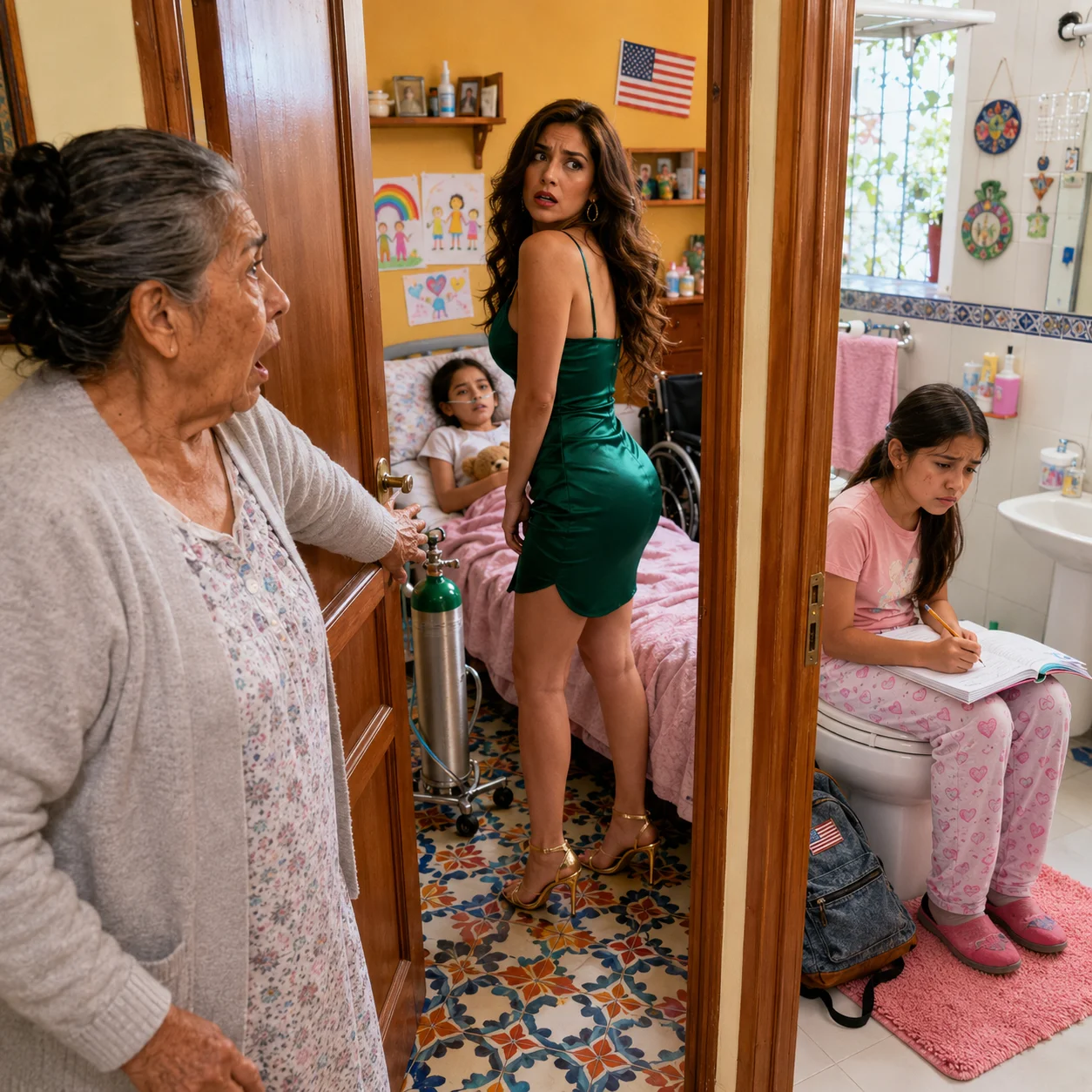
I stood barefoot on the cold tile, listening from outside the room at the end of the hall.
From inside, I heard a soft sound.
A cough.
Then the creak of a bed.
“That’s it, my love,” Sara whispered. “Just a little. Don’t spit it out.”
My blood went cold.
I knocked.
Everything inside went silent.
“Sara,” I said. “Open the door.”
No answer.
“Sara, this is my house.”
I heard quick movement. Something scraping. Then a key turned from inside, but instead of opening the door, she locked it more firmly.
“Doña Carmen,” Sara said, her voice trembling. “Not right now.”
Not right now.
As if I were a visitor.
As if I had not mopped that hallway for thirty years.
As if whatever was behind that door was not the reason my granddaughter was doing homework on a toilet seat.
“Open it,” I said again.
“Please.”
That please stopped me more than a shout would have.
It did not sound guilty.
It sounded afraid.
I walked back to the kitchen with my hands shaking. Emilia was still asleep. Miguel was gone. On the kitchen table sat an empty tray, a plastic spoon, a cup with a straw, and a medication bottle with no label.
I picked it up.
There was a hospital pharmacy mark on it.
I did not understand the name of the medicine, but I understood one thing.
It was not for an office.
When Miguel returned at noon, he had pharmacy bags in one hand and a box of large children’s diapers in the other.
He stopped when he saw me sitting at the table with the bottle in my hand.
“What did you do, Mamá?”
“I was about to ask you the same thing.”
His face changed.
He did not get angry.
He looked exhausted.
“Do not go into that room.”
“Who is in there?”
“Mamá…”
“Who is in there, Miguel?”
He clutched the pharmacy bag against his chest.
“Someone you didn’t want in your family.”
The words hit harder than shouting.
“What are you talking about?”
He laughed once, bitter and humorless.
“You forgot?”
I opened my mouth.
Nothing came out.
Miguel looked toward the hallway as if he feared someone might be listening.
“Six years ago, when Sara and I got married, I told you she had a daughter.”
I froze.
The girl.
I remembered.
Not her face.
The conversation.
Miguel had come over one afternoon with Sara. I made coffee, put sweet bread on a plate, and talked too much, the way lonely mothers do when their children finally sit at their table again.
Near the end, Miguel said, almost carefully, “Mamá, Sara has a little girl from a previous relationship. Her name is Camila.”
I asked, “And where is she?”
Sara looked down.
Miguel answered, “She lives with her maternal grandmother. She has health problems.”
And I, a foolish, hard, widowed woman proud of her orderly life, said something I had considered practical at the time.
“Miguel, marrying a woman is one thing. Taking on other people’s problems is another. I already raised my child. I do not want responsibilities that are not mine being brought to my door later.”
Sara did not cry.
She only got up and washed the cups.
I never knew that sentence had continued living inside them for six years.
“Camila,” I whispered.
Miguel closed his eyes.
“Yes.”
The hallway seemed longer than before.
“She is the girl in the room?”
“Yes.”
I gripped the edge of the table.
“Why is she locked inside?”
“She is not locked in the way you think.”
“There is a locked door between her and the rest of the house.”
“To keep her safe. So she does not hurt herself. So she does not panic. So people don’t go in without knowing how to approach her.”
“Emilia is doing homework in the bathroom.”
He looked down.
For that, he had no defense.
“I didn’t see that.”
“You didn’t want to see it.”
The words left my mouth before I could stop them.
And as soon as I said them, they cut me too.
Because I had not wanted to see either.
For three months, I had seen trays of food, strange laundry, midnight footsteps, Sara’s hollow cheeks, Miguel’s fear, Emilia shrinking into corners.
And I chose to call it marriage trouble.
Miguel set the bags on the table.
“Camila is eleven. She has mild cerebral palsy, seizures, and a respiratory condition that got worse after an infection. The grandmother who cared for her died in Iztapalapa. Her biological father wanted to put her in an institution and collect support money using her documents. Sara got her out.”
“Why didn’t you tell me?”
Miguel’s eyes filled with old anger.
“Because the first time I told you she existed, you called her someone else’s problem.”
It hurt because it was true.
“This was my house,” I murmured.
“And she was a child.”
I had no voice left.
Then a low sound came from the room.
A small moan.
Sara opened the door only a little.
“Miguel.”
My son ran.
I stayed where I was.
The door remained partly open.
Through the gap, I saw part of a bed, a folded wheelchair, a small oxygen tank, drawings taped to the wall, and a thin girl with shoulder-length hair.
Camila.
One of her hands was bent against her chest. Her eyes were huge.
She was looking at me.
Not with fear.
With shame.
As if she were the intruder.
That broke something in me.
Sara tried to close the door, but I placed my hand against it.
“Let me see her.”
“Doña Carmen…”
“Let me see her properly.”
Sara looked at Miguel.
He said nothing.
I entered slowly.
The room smelled of medicine, talcum powder, soup, and confinement. It was not dirty. In fact, it was too carefully kept. Folded gauze. Clean blankets. Diapers stacked neatly. A notebook filled with schedules. A nebulizer box. An old doll missing one shoe.
Camila followed me with her eyes.
“Hello,” I said, like a fool.
She did not answer.
Sara sat beside the bed and gently wiped Camila’s mouth with gauze.
“She speaks very little when she’s nervous.”
I nodded.
I did not know what to do with my hands.
I had carried pots, grocery bags, laundry baskets, sleeping children.
And now I did not know how to touch a child.
“I’m Carmen,” I said.
Camila blinked.
“Emi’s grandmother,” she whispered.
Her voice was thin.
Like paper.
“Yes.”
“She lends me her colors.”
My chest tightened.
Emilia lent her colors while doing homework in the bathroom.
“Do you draw?” I asked.
Camila moved her head slightly.
Sara pulled a folder from under the bed. Inside were pages full of houses, trees, dogs, windows, and a big table with four people sitting around it.
In none of the drawings was there a bathroom.
I swallowed my tears.
“You draw beautifully.”
Camila lowered her eyes.
“I’m sorry for taking the room.”
That was when my hardness finally ended.
I sat in the chair beside her bed.
“No, child,” I said, my voice breaking. “You forgive me.”
Sara closed her eyes.
Miguel left the room.
Maybe he did not want to see me cry.
Or maybe he did not want me to see him cry.
That afternoon, there were no screams.
There was something worse.
Truth.
Sara told me everything in the kitchen while Camila slept and Emilia sat at her side like a little guard.
Camila’s biological father, a man named Óscar, had reappeared after Camila’s maternal grandmother died. He had not come out of love. He came for money. He wanted to use Camila’s documents, apply for benefits, and place her in an institution where no one would ask why he had never taken care of her.
Sara refused.
Óscar threatened her.
“I’ll accuse you of abandoning her,” he had said. “I’ll take her from you. Your husband has nothing to do with this.”
Miguel, afraid and proud, decided to hide Camila in my house for a few days.
A few days became three months.
Not from cruelty.
From chaos.
Medical appointments.
Lost documents.
Legal confusion.
Fear that Óscar would find them.
Fear that I would say, “Not here.”
“And Emilia?” I asked.
Sara covered her face.
“Emilia helped the most.”
“That is not right.”
“I know.”
“A child should not have to make herself smaller so another child can fit.”
Sara cried silently.
“I know, Doña Carmen.”
I wanted to be angry at her.
I wanted to call her unfair.
But I saw myself in her fear.
I too had hurt people because I did not know how to love in time.
That night, I asked Emilia to come to my room.
She sat on the edge of the bed, hugging her backpack.
“Are you mad at me, Abuela?”
“No, my love.”
“I didn’t want to lie to you.”
“I know.”
“Dad said if you asked too much, we might have to leave. And Camila can’t sleep just anywhere.”
I sat beside her.
“Is that why you did homework in the bathroom?”
She shrugged, trying to act like it was nothing.
“The table is for her medicine. And there isn’t room for all of us in the bedroom. And if I make noise, her head hurts.”
I felt ashamed.
The shame of an old woman who thought she had raised a family well and still failed to see a child writing math problems on a toilet seat.
“Starting tomorrow,” I said, “you will have a desk.”
She looked at me as if I had promised her the moon.
“Really?”
“Really.”
“And Camila?”
“Camila will have what she needs too. But you will not disappear so she can be okay.”
Emilia began to cry.
Not loudly.
Like children cry when they have spent too long asking permission to exist.
I held her.
She smelled like chamomile shampoo and pencil shavings.
“I thought if I said something, everyone would fight,” she whispered.
“The adults were already fighting, my love,” I said. “Only silently.”
The next morning, I changed the house.
I dragged the old dining cabinet out of the guest room. I moved boxes. I gave dishes away. I threw out papers I had kept for no reason except widowhood and habit. I opened the windows, and the whole house smelled like dust and decision.
Then I called my neighbor Josefina, who had worked for years as a social worker.
“Jose,” I said, “I need to know how to protect a child.”
She arrived with sweet bread, a notebook, and the face of a woman who did not scare easily.
She explained what we needed to do: organize documents, contact DIF for guidance, report Óscar’s threats, seek protection measures, and stop hiding Camila as if she herself were a crime.
“You do not protect a child by making her invisible,” Josefina said.
Miguel looked down.
Sara did too.
I was the first to speak.
“Then the invisibility ends today.”
That same day, we went to DIF in Mexico City.
I will not pretend it was simple or quick. There were lines, papers, stamps, tired people, mothers with sleeping children on their laps, and officials who sometimes looked more at files than faces.
But there was also a psychologist who crouched down to speak to Camila.
Not to us.
To her.
“Do you feel safe where you are living?” she asked.
Camila looked at Sara.
Then Miguel.
Then me.
“Now I do,” she said.
I broke.
Because that now included me late.
But it included me.
Afterward, we went to the prosecutor’s office to document the threats. Miguel trembled with rage. Sara trembled with fear. I trembled with age and guilt.
When they asked who I was, I answered clearly.
“I am the owner of the house where Camila lives. And I am her grandmother.”
Sara looked at me.
She said nothing.
But her eyes forgave me a little.
Óscar appeared three days later.
He came yelling outside my house in the middle of the afternoon, when corn sellers passed by the corner and schoolchildren walked home with enormous backpacks.
“Sara! Bring out my daughter!”
Emilia hid behind me.
Camila was in the room with headphones on because loud noises upset her.
Miguel went out to the patio.
“Leave,” he said.
Óscar laughed.
“You are nothing to her.”
I opened the gate before Miguel could answer.
Óscar looked me up and down.
“And who are you?”
I adjusted my sweater.
“The old woman of this house.”
“Don’t get involved.”
“You came to my door. You involved me.”
He tried to push the gate.
“That girl is mine.”
“Children are not furniture.”
“I have rights.”
“So does she.”
He pulled out his phone and started recording.
“They’re kidnapping her,” he shouted. “They’re hiding her in a room.”
For a second, guilt tried to bite me.
But this time, I did not lower my eyes.
“We protected her badly,” I said. “That has been corrected. Your threats are registered.”
His face changed.
Just then, a patrol car arrived. Josefina had called them. A lawyer from the support center came too. Óscar shouted, accused, claimed Sara was crazy, claimed Miguel wanted to steal benefits, claimed I was a manipulated old woman.
But when they asked him for identification, medical documents, proof of care, he had nothing.
Only rage.
And rage does not feed a child.
It does not bathe her.
It does not hold a nebulizer at three in the morning.
That night, Camila asked, “Am I leaving?”
Sara hugged her.
Miguel knelt beside the bed.
Emilia sat at her feet.
I approached slowly.
“Not from this house because of fear,” I told her. “If one day you leave, it will be with your backpack, your papers, your mother, and the door open. Not hidden.”
Camila stretched out her unsteady hand.
She touched my fingers.
“Can I draw at the table?”
My throat tightened.
“The table is yours too.”
But promises were not enough.
The house had to change.
So we changed it.
The dining table became a dining table again. I bought a folding table for Camila’s medicine and a rolling cart for supplies. In Emilia’s room, we put a desk by the window with a yellow lamp, a pencil cup, and a chair that did not wobble.
When she saw it, Emilia ran her hand across the wood.
“I’ve never had one.”
“You have one now.”
“What if I’m in the way?”
“You tell me who said that, and I’ll throw them out of my house.”
She laughed.
That laugh cleaned something.
We adapted the room at the end of the hallway for Camila, but there was no lock on the outside anymore. The door could stay partly open. We installed a soft bell she could press if she needed help, bathroom bars, a low shelf for her colors, and light curtains so the Coyoacán sun could enter without hurting her eyes.
On Saturdays, if the weather was kind, we took her to Parque Masayoshi Ohira, where the red bridge and small Japanese garden seemed made for breathing slowly. Camila watched the water as if pain became quieter there. Emilia brought her homework in a folder and did it on a bench, with ice cream afterward.
One afternoon she said, “Abuela, I can write big here.”
“Then write everything,” I told her.
Miguel apologized.
Not with a speech.
With actions.
He asked for time off work to take Camila to therapy. He learned medication schedules. He stopped saying “I’ll fix it” when what he really meant was “I’ll hide it until it explodes.”
One night, he sat with me in the kitchen.
“I punished you with one sentence for six years,” he said.
“I gave you the sentence.”
“But I should have talked to you.”
“And I should have been someone you could talk to.”
We sat in silence.
The wall clock ticked.
The house smelled like noodle soup.
“I’m sorry, Mamá.”
“Forgive me too.”
We did not hug right away.
Sometimes forgiveness needs to walk around the room before sitting down.
Sara took longer to trust me.
I did not blame her.
For years, she had seen me as a closed door. I could not expect her to run through it just because I had finally opened it.
One day, while we washed dishes together, she said, “When you said my daughter was someone else’s problem, I hated you.”
Soap covered my hands.
“You were right to.”
She looked surprised.
“No, Doña Carmen.”
“Yes,” I said. “Sometimes hatred is the only place a mother can keep her child when no one else defends her.”
Sara cried.
So did I.
That afternoon, she let me brush Camila’s hair.
Very slowly.
With a soft brush.
Camila closed her eyes and said, “My Abuela Lucha used to brush it like that.”
“Am I pulling?”
“No.”
“Then I’ll keep going.”
And I did.
As if every strand could undo an old sentence.
The legal process against Óscar was not fast. Nothing involving vulnerable children and missing paperwork ever is. There were evaluations, interviews, medical documents, social worker visits, and hearings where Sara had to say too much in front of strangers.
But she was no longer alone.
Miguel was there.
Josefina was there.
I was there.
And Emilia, though she should not have had to carry anything, made a drawing for the file: four women and one man standing in front of a house with a green door. In the window, a girl with headphones was smiling.
At the bottom, she wrote:
Camila lives here.
The psychologist saved it.
“This speaks too,” she said.
Over time, Óscar stopped coming. Not because he became good. Because he saw Camila was no longer hidden. Cowards grow in darkness, not under documents, witnesses, and neighbors watching.
The house changed its sound.
Before, it was the silence of secrets.
After, it became the noise of life.
A nebulizer in the mornings.
Pencils on the desk.
Miguel making terrible oatmeal.
Sara laughing when Camila spit out medicine with disgust on her face.
Emilia complaining about math at a real table.
Me making pan con lechera on Fridays, because a twelve-year-old girl still deserves to be a child even when there is pain in the house.
One night, months later, I passed the bathroom.
The door was open.
The toilet seat was clean.
The lock unused.
And suddenly I could not breathe.
Not from sadness.
From memory.
I went inside and sat down for a moment in the place where I had found Emilia that afternoon. I imagined her notebook on her knees, her pencil pressed too tightly between her fingers, her voice saying, “I’m used to it.”
What a terrible phrase for a child.
I’m used to it.
Used to taking up no space.
Used to not asking questions.
Used to not bothering anyone.
Used to making herself small so adults would not break.
That night, I wrote a letter.
Not to Miguel.
Not to Sara.
To my two granddaughters.
Yes.
My two.
Emilia and Camila,
This house was mine before it was yours. But for a while, I forgot that a house is useless if it only protects walls. Forgive me for taking so long. Never again will a girl in this family have to hide her homework, her body, her illness, or her name so adults can feel comfortable.
I placed the letter in the drawer with my property documents.
Beside my new will.
Because I changed that too.
When I die, my house cannot be sold immediately. It will be placed in a trust for Emilia and Camila’s housing and care as long as they need it, with clear rules and outside supervision.
Miguel was upset at first.
“You don’t trust me?”
“I trust that you love,” I told him. “I do not always trust that you know how to organize your fear.”
He did not argue.
He had learned.
A year later, we celebrated Camila’s twelfth birthday in the patio. We hung papel picado, made gelatin, sandwiches, agua de jamaica, and a vanilla cake. Emilia made a sign with colored markers:
Happy Birthday, Cam.
Camila blew out the candle with Sara’s help.
Then she waved me closer.
“Abuela Carmen.”
It was the first time she called me that.
Not Emi’s grandmother.
Not Doña Carmen.
Abuela Carmen.
I crouched beside her.
“Yes, my love?”
She handed me a drawing.
It was a house in Coyoacán with bougainvillea, a big table, and an open door. At the table, two girls were doing homework. One had braids. One sat in a wheelchair. In the kitchen, an old woman in an apron held a plate of bread with sweetened milk.
At the top, in crooked letters, Camila had written:
There is room for us here.
I could not speak.
I hugged her carefully.
She smelled like cake, talcum powder, and sunshine.
Miguel watched me from the kitchen.
Sara too.
Emilia rolled her eyes.
“Abuela, you’re going to cry on the cake.”
“Yes,” I said. “And it will taste better.”
Everyone laughed.
That sound filled the house in a new way.
Not perfect.
Never perfect.
But clean.
Today, Emilia no longer does her homework in the bathroom. She has her desk, her pens, her middle-school tantrums, and the right to close her bedroom door only when she wants privacy—not when she needs to hide.
Camila still has good days and hard days. Sometimes she talks a lot. Sometimes she says nothing. Sometimes she gets angry because her body will not obey her, and she throws her colors on the floor.
I pick them up.
Not because I am a saint.
Because I am a grandmother.
And I arrived late, but I arrived.
Sometimes I pass the room at the end of the hallway and remember that breathing behind the door. I remember my hand on the knob. I remember Sara’s voice saying, “Good morning, my love. Did you sleep well?”
I had Emilia asleep in front of me, and I did not understand who Sara was talking to.
Now I do.
She was speaking to a girl all of us had put in the wrong place.
Sara, out of fear.
Miguel, out of shame.
Emilia, out of love.
And me, because of a cruel sentence I once believed was small.
I found my twelve-year-old granddaughter doing homework locked in the bathroom, sitting on the toilet seat with the latch turned.
That day, I thought the mystery was the locked room.
It wasn’t.
The real mystery was how a house could be full of family and still leave a child without a table.
I opened the door late.
But I opened it.
And from that day on, in my house in Coyoacán, no girl ever again learned the word burden while sitting on a toilet seat
![[FULL STORY] Her Mother Called Me a Man With No Future. I Asked, “Then Who’s Paying for This Wedding?” The Whole Table Went Silent.](https://social-media.rabedo.com/thumbnails/1777015549_M10.png)
![[FULL STORY] My Girlfriend Said She Needed a Man With More Ambition. I Said, “I Need a Woman Who Can Recognize Value.” Three Months Later, She Begged to Come Back.](https://social-media.rabedo.com/thumbnails/1776936813_18.png)



![[FULL STORY] She Declared at Dinner: “This Is the Most Time I’ve Spent Staying Faithful ” The Table Erupted](https://social-media.rabedo.com/thumbnails/1777006911_D2.png)