

The sound of my own name in his mouth chilled me more than the coffin had.
I ran to the bedroom and opened Ernesto’s safe. Inside was the small revolver he had kept for years. I had never liked it. I barely knew how to use it. But feeling its weight in my hand gave strength to legs that were ready to collapse.
Another message arrived.
Use the service door. The old driver is still loyal.
My breath caught.
The old driver?
Don Aurelio?
He had worked for Ernesto for twenty years before Carlos fired him two months earlier without explanation.
I moved down the back staircase as quietly as I could. My sons were still pounding on the front door. I heard glass break.
They were coming in.
I crossed the kitchen.
On the counter sat Ernesto’s last coffee cup.
Beside it, half-hidden behind the sugar jar, was a small empty vial I had never seen before.
I picked it up.
It smelled bitter.
Chemical.
Like death.
My phone vibrated again.
You found what they used.
Tears blurred my vision.
I typed:
Where are you?
This time, he took longer to reply.
Footsteps echoed through the house.
“Mom!” Héctor shouted. “We don’t want to scare you, but you’re confused!”
I reached the service door and opened it.
On the dark street, an old taxi waited with its headlights off.
The driver rolled down the window.
It was Don Aurelio.
“Get in, Señora Teresa,” he said. “Don Ernesto told me to come if anything happened.”
The ground seemed to move beneath me.
“Do you know where my husband is?”
Don Aurelio did not answer.
He only looked past me toward the house.
Carlos had just reached the patio.
He saw me.
“Mom! Stop!”
I got into the taxi.
Don Aurelio drove away before Carlos could reach us.
As Las Lomas disappeared behind us, my phone vibrated one last time that night.
If you want to know who died in my place, go to the ranch in Querétaro and ask about the son Carlos and Héctor thought they buried when he was a newborn.
I read the message three times.
I did not understand.
Or maybe I refused to.
Don Aurelio drove without turning on the radio. His hands stayed firm on the wheel. Behind me was my house, my sons, the closed coffin, and forty-three years of marriage reduced to one impossible question.
“Don Aurelio,” I whispered, “is Ernesto alive?”
The old driver looked at me through the mirror.
“Yes, Señora Teresa.”
I covered my mouth.
The sound that came out of me was not clean relief.
It was fear, rage, love, and betrayal all tangled together.
“And the man in the coffin?”
Don Aurelio took too long to answer.
“That is for him to tell you.”
We drove through the night.
We left Mexico City under a thin gray rain. I watched the lights blur across the windshield as we passed empty roads, closed food stands, sleeping neighborhoods, and trucks glowing red in the darkness.
In my purse, I carried Ernesto’s letter, the USB drive, the empty vial, and his revolver.
I had never felt so old.
I had never felt so awake.
At dawn, Querétaro appeared under a pale sky. The land smelled different after the rain—dry earth, stone, mesquite, and dust rising again with the morning warmth. Don Aurelio turned onto a dirt road between nopales and old walls.
The ranch was not grand.
It was a low white house with bougainvillea blooming over one wall and a stone well in the center of the courtyard.
And there was Ernesto.
Alive.
Sitting in a wooden chair, with several days of beard on his face, a bandage around his arm, and guilt written in every line of his body.
I stepped out of the taxi.
For one heartbeat, I did not know whether to run into his arms or strike him.
He stood.
“Teresita.”
I slapped him.
Not hard enough to hurt him.
Hard enough to remind him that a woman does not bury her husband as part of a strategy and then embrace him as if nothing happened.
“I mourned you in front of your sons,” I said. “I stood in front of your coffin.”
He lowered his head.
“Forgive me.”
“Do not start with forgiveness,” I snapped. “Talk.”
We went inside.
A woman from the ranch served coffee, but none of us touched it. Ernesto placed a folder on the kitchen table. His hands trembled.
“Carlos and Héctor were planning to have you declared incompetent,” he said. “They had a doctor willing to say your grief had damaged your mind. They wanted control of your accounts, the house, and the estate. They had a false will ready.”
My stomach turned.
“I heard them.”
“They were drugging me too.”
I thought of the vial in my purse.
“With that?”
He nodded.
“Small doses. Sedatives. Enough to make me seem tired, confused, unsteady. They told me it was age. They told me I was overworking myself. I began to suspect it when Carlos insisted on bringing me coffee every night.”
I remembered Carlos entering the study with that careful smile.
“Dad, you should rest. You can’t handle everything anymore.”
My eyes burned.
“So you faked your death?”
“Not at first,” Ernesto said. “I planned to leave the house, file a report, and protect you quietly. But then Rafael died.”
The name struck me like a hand across the soul.
Rafael.
My first child.
The baby everyone told me had died two days after birth.
They said he had been born weak.
They sedated me.
When I woke, Ernesto was crying beside my bed and his mother was telling me God knew why He did things.
I never saw the body.
Only a small white box.
“No,” I whispered.
Ernesto closed his eyes.
“Rafael did not die then.”
I stood so quickly the chair fell behind me.
“What did you say?”
“My mother gave him away.”
The air turned poisonous.
“Your mother?”
“She said the baby was sick. She said we would spend our lives in hospitals. She said you were too fragile to endure it. I was young. Terrified. I believed he was dead because they told me he was dead too. Eight months ago, Rafael found me.”
I gripped the table.
“You knew him for eight months and did not tell me?”
Ernesto’s eyes filled.
“He asked me not to. He grew up believing we abandoned him. When he learned the truth, he was already sick. His heart was failing. He was afraid of appearing in your life only to die in your arms.”
Something ancient opened inside me.
A wound I had carried so long I had mistaken it for part of my body.
“You had no right.”
“I know.”
“I had the right to hold him.”
“Yes.”
“I had the right to know his voice.”
“Yes.”
“I had the right to say goodbye.”
Ernesto did not defend himself.
That made me angrier.
He led me to a small bedroom.
There was a made bed, a candle, a folded shirt, and a portrait on the table.
Rafael.
Almost forty.
Ernesto’s eyes.
My mouth.
My same way of tilting his head slightly, as if listening to something no one else could hear.
I approached the picture and broke.
“My boy…”
Beside the frame was a letter.
Mamá Teresa.
I opened it with useless hands.
Forgive me for arriving late. They told me you and my father did not want me because I was born sick. When I met Papá Ernesto, I understood that we had all been robbed. I did not want to hurt you, but I needed you to know that I lived. That I was afraid. That I dreamed of your voice even though I could not remember it. If you ever read this, please do not think I died without a mother. I imagined you my whole life.
I folded over the bed and wept.
I cried for the baby I never held.
For the little boy I never watched walk.
For the man who died calling me mother on a sheet of paper.
Ernesto stayed in the doorway.
He was wise enough not to come closer.
If he had touched me, I would have hated him.
If he had walked away, I would have hated him too.
When I could breathe again, I asked, “How did he end up in your coffin?”
Ernesto sat across from me.
“Rafael died here three days ago. The doctor signed his certificate under his real name. But Carlos and Héctor did not know I had already left the house. That night, they came into the study. They found Rafael’s body on the medical bed and believed it was mine because he looked so much like me. Thin, bearded, covered. Don Aurelio allowed them to stay confused.”
“You let them bury our son under your name?”
“They were not going to bury him,” Ernesto said. “They were going to cremate him tomorrow. Quickly. To erase evidence.”
My tears dried into rage.
“We go back today.”
“Yes.”
“And this time,” I said, “you do not send me ghost messages from the shadows. This time, you walk in beside me.”
Ernesto nodded.
By noon, Licenciado Montalvo arrived, an old notary from Querétaro and a trusted friend of Ernesto’s. He carried certified copies, videos, DNA reports, the real will, and a drive filled with recordings.
“Señora Teresa,” he said, “your sons did not merely attempt to alter the succession. There is evidence of drugging, financial coercion, document falsification, and an attempt to control your legal capacity through deception.”
I looked at Ernesto.
“And the will?”
Montalvo opened a folder.
“The family home remains under your full control. The principal accounts as well. Carlos and Héctor were to receive a portion only if they respected your independence and did not attempt to pressure you, sedate you, falsify documents, or have you declared incapable.”
“They did all of that,” I said.
“Then they lost more than money.”
I pressed Rafael’s letter to my chest.
“Let’s go.”
We returned to Mexico City before sunset.
I did not hide.
I sat upright in the back seat, with my black veil folded in my purse and my ruined heart hardening into something steady.
When we arrived at the funeral home, Carlos was arguing with the director.
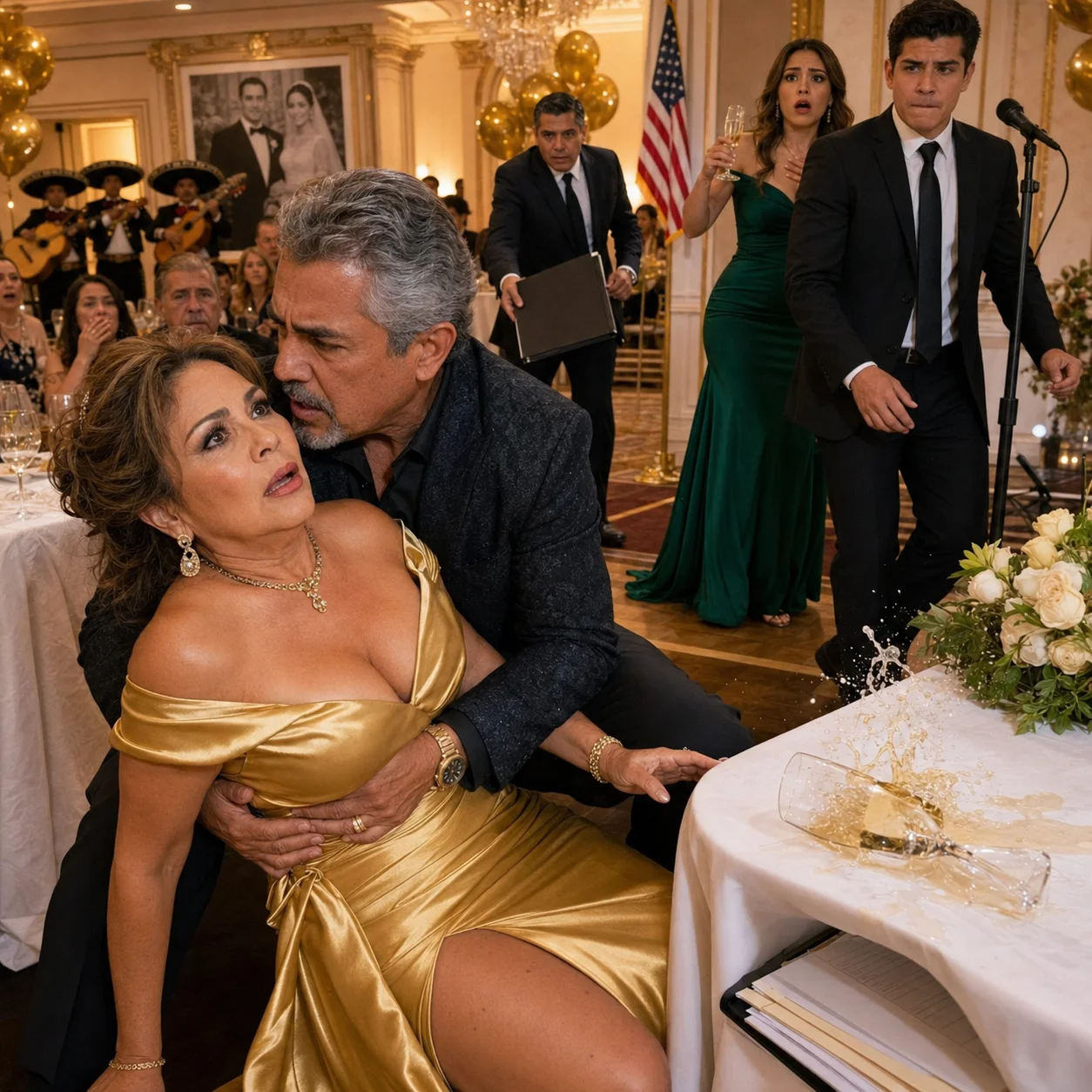
“My father wanted immediate cremation,” he said. “My mother is not in a condition to decide.”
Héctor stood nearby on the phone.
“Yes, doctor,” he said. “As soon as she comes back, we sedate her. She’s delirious.”
I walked in.
“Delirious about what, son?”
Héctor turned.
The color drained from his face.
Carlos stepped toward me with rehearsed concern.
“Mom, where were you? We were worried sick.”
Then Ernesto entered behind me.
Carlos’s face collapsed.
Héctor stumbled backward and nearly knocked over a wreath.
“Dad…”
Ernesto looked at them as if seeing strangers wearing his children’s faces.
“You were in such a hurry to burn me.”
Carlos opened his mouth.
Nothing came out.
Montalvo’s attorney spoke to the funeral director. The cremation was suspended. The same staff who had obeyed my sons all morning now demanded identification, documents, signatures, and authorization.
The police arrived without sirens.
The false doctor tried to leave through a side hallway.
Don Aurelio pointed him out.
In his bag, they found blank prescription forms, pills, and a prepared evaluation with my name on it.
Severe cognitive decline.
Need for permanent supervision.
Risk in administration of personal assets.
I nearly laughed.
Not from humor.
From horror.
“They even tried to forge my old age,” I said.
Carlos moved toward me.
“Mom, you don’t understand. Dad was going to leave us with nothing because of a stranger.”
I slapped him.
The sound silenced the room.
“Rafael was not a stranger,” I said. “He was my son.”
Héctor put both hands on his head.
“That man was dead.”
“No,” I said. “He was hidden. Like the truth.”
Ernesto stepped toward them.
“You chose money over your mother.”
Carlos clenched his jaw.
“You chose a dead man over your living sons.”
Ernesto looked at him with a sadness so cold it no longer needed anger.
“No,” he said. “You chose to become dead to me.”
Rafael was buried in Querétaro under his true name.
There was no grand Mass. No businessmen from Las Lomas. No expensive flowers sent by people who wanted to be seen grieving.
Only mesquite trees, damp earth, the doctor who cared for him, Don Aurelio, Montalvo, Ernesto, and me.
I placed white flowers on his grave.
“Forgive me for arriving late, my son.”
The wind moved through the trees.
Nothing answered.
But at least this time, my child had his mother standing over his earth.
After that, the legal war began.
Carlos and Héctor became files.
Fraud.
Document falsification.
Attempted property theft.
Financial abuse.
Supplying controlled substances.
Attempting to manipulate my legal capacity.
I learned words no mother ever wants to learn about her sons.
The real will was read in a notary’s office in Polanco, with cameras recording, attorneys present, and my two sons sitting across from me like men who still believed truth could be negotiated.
Montalvo read clearly:
“Any act intended to pressure, incapacitate, sedate, relocate, or administer against the will of my wife, Teresa Morales de Ramírez, shall constitute grounds for complete exclusion from all inheritance benefits.”
Carlos’s jaw tightened.
Héctor began to cry.
“Mom, please…”
I did not answer.
The notary continued.
“A portion of the estate shall be used to establish the Rafael Ramírez Morales Foundation, dedicated to medical care for children with heart conditions in rural communities of Querétaro.”
I closed my eyes.
Rafael had not received our help in time.
Perhaps other children would.
When the reading ended, Carlos stood.
“You took everything from us.”
Ernesto, seated beside me, answered, “No. You emptied yourselves.”
Carlos never apologized.
He sent lawyers.
He sent threats.
He sent letters claiming Ernesto was manipulating me.
I kept all of them in a folder and rarely read beyond the second line.
Héctor came back once.
Months later, he appeared in the garden of the house, thinner, unshaven, holding a bouquet of flowers bought by guilt.
I met him outside.
Not in the living room.
“Mom,” he said, “Carlos pressured me.”
“You were an adult long before your brother learned how to lie better.”
He lowered his head.
“Forgive me.”
I looked at him the way a mother looks at a son she still loves but can no longer rescue.
“Forgiveness does not return keys.”
He cried.
“I know.”
“Then start by truly knowing it.”
I did not embrace him.
I did not send him away either.
Sometimes a mother cannot tell whether that is mercy or exhaustion.
Ernesto and I were never the same again.
How could we be?
He saved me from my sons.
He also hid my first son from me.
He made me mourn him alive and let me bury Rafael under another name.
For months, we slept in separate rooms.
The house in Las Lomas, with its high walls and jacaranda trees, no longer felt elegant. It smelled of poisoned coffee, greedy hands, and secrets hidden in drawers.
I changed every lock.
I threw away the cup that had sat beside the vial.
But I kept the mahogany desk.
Every morning, I pressed the molding of the secret compartment, even after it was empty, to remind myself that a woman must know where her truths are kept.
One night, I found Ernesto sitting in the garden.
“I do not deserve for you to stay,” he said.
I sat beside him.
“I did not stay because you deserve it. I stayed because forty-three years do not fit inside one lie. But they do not heal with one truth either.”
He wept quietly.
“Rafael had your mouth.”
“I know.”
“I should have taken you to him.”
“Yes.”
“I should have told you.”
“Yes.”
“Will you ever forgive me?”
I looked at the cold lights of Las Lomas shining behind the trees.
“Maybe the day I stop waking up after burying you twice.”
He said nothing more.
That was wise.
Two years later, the Rafael Foundation opened its first mobile clinic.
We drove to villages in the Sierra Gorda, where mothers walked for hours with babies wrapped in rebozos. I watched a cardiologist listen to a child’s heart while his mother prayed under her breath.
I took her hand.
“We are here,” I told her.
And for the first time, I felt Rafael was there too.
Ernesto died for real five years later.
No closed coffin.
No theater.
No messages from unknown numbers.
No sons pretending to cry beside polished wood.
I said goodbye to him with a grief that was not perfect.
But it was clean.
I placed a flower on his grave and whispered, “This time, I know where you are.”
Then I went to Rafael’s grave and left another.
Mother of a stolen son.
Wife of a man who saved me and wounded me.
Survivor of two living sons who learned too late that a mother is not a trembling signature waiting to be controlled.
Today, I am eighty years old, and I still live in my house.
In the study, the mahogany desk remains where it has always been. Inside the secret compartment, I no longer keep wills.
I keep letters.
Rafael’s.
Ernesto’s apology.
And one of my own, written for the day I am no longer here to speak.
It begins:
To anyone who tries to decide for me when I can no longer answer: Teresa was not a confused widow, not a mother easy to erase, and not an old woman waiting for permission to exist.
Sometimes my phone vibrates in the afternoon and I still feel cold.
I remember the funeral.
The priest praying.
Carlos and Héctor beside the coffin.
The message:
I’m alive. Don’t trust them.
I thought it was a sick joke.
It was a cruel resurrection.
But it was also a door.
I discovered my husband was not inside that coffin.
I discovered my lost son had truly lived.
I discovered my living sons were capable of acting like strangers.
And I discovered something else.
A woman can cry in front of a closed box and still have the strength to open a desk, a will, a lie, and her own life.
Ernesto left me a warning.
Rafael left me a letter.
Carlos and Héctor left me a scar.
But I left myself something far more important.
The decision never again to obey people who called my imprisonment “care.”
So when someone asks how I survived that funeral, I always say the same thing.
It was not because Ernesto was alive.
It was because I woke up too.

![[FULL STORY] She Whispered “Help Me” — And I Only Had 20 Minutes to Save Her](https://social-media.rabedo.com/thumbnails/1777451917_8479f7bd-3ca6-48e3-bcbd-e9429cb87c51.png)

![[FULL STORY] My Wife Said It Was a Harmless Crush — Then I Sent the Texts to His Wife](https://social-media.rabedo.com/thumbnails/1776413404_671145109_980286314523571_8902881394821092906_n.jpg)