
“Not tomorrow,” she said, smiling. “But don’t wait forever.”
That night, I lay awake beside her, staring at the ceiling and thinking about proposals. I imagined a small mountain cabin, snow outside, a ring box in my jacket. I imagined her crying. I imagined calling my mom and hearing her scream with joy.
I did not imagine another man’s name attached to my girlfriend’s bank account.
The call came on a Tuesday afternoon.
I was in my truck outside a job site, eating a sandwich that had gone soggy in its wrapper, when my phone rang from an unfamiliar number.
“Is this Mr. Evan Hale?” a woman asked.
“Yes.”
“This is Marcy calling from Western Plains Credit Union. I’m trying to reach you regarding a joint savings account application connected to Natalie Brooks and a Daniel Mercer.”
I stopped chewing.
“I’m sorry,” I said. “What?”
“A joint savings account application,” she repeated. “Your phone number was listed as a secondary verification contact on the profile. I just need to confirm—”
“Wait. Did you say joint account?”
“Yes, sir.”
“With Natalie Brooks and who?”
“Daniel Mercer.”
My sandwich sat in my hand like wet cardboard.
“I think there’s a mistake,” I said slowly. “I’m Natalie’s boyfriend. My name is Evan Hale.”
There was a pause. A professional pause. The kind people use when they realize they may have just exposed something ugly.
“I apologize, Mr. Hale,” Marcy said carefully. “I can’t discuss account details unless you’re an authorized party.”
“You already called me.”
“Yes, because your number appears on the contact information associated with one of the submitted documents. That may have been entered incorrectly.”
“What kind of document?”
“I’m not able to disclose that.”
My pulse was beating in my ears.
“Is this account open?”
“I can’t provide that information.”
“Is Natalie there? Did she apply today?”
“I’m sorry, sir.”
I looked through my windshield at men in hard hats moving across the site, their breath visible in the cold air. Everything around me seemed too normal.
“Marcy,” I said, trying to keep my voice calm, “I’m not asking for confidential balances. I’m asking why a bank is calling me about my girlfriend opening a joint account with another man.”
“I understand your concern,” she said, softer now. “The best thing to do would be to speak directly with Ms. Brooks.”
Then she ended the call.
For maybe thirty seconds, I did nothing.
I didn’t move. I didn’t blink. I just sat there with my phone in my hand while my brain tried to rearrange reality into a shape that made sense.
Daniel Mercer.
I had never heard that name.
I searched my memory for coworkers, cousins, old friends, clients. Nothing.
Then I searched his name online.
Daniel Mercer Denver.
The first result was a LinkedIn profile. Thirty-two years old. Real estate investor. Founder of Mercer Urban Holdings. Expensive haircut. White smile. Standing in front of a renovated brick building with his arms crossed.
I stared at his face until it blurred.
There are moments when betrayal doesn’t arrive as pain. It arrives as information. Cold, clean information that waits for your heart to catch up.
I called Natalie.
No answer.
I texted: Call me when you can.
Three dots appeared. Disappeared. Appeared again.
Then: In a meeting. Everything okay?
I typed: Who is Daniel Mercer?
The message stayed marked delivered for six minutes.
Then she called.
Her voice came through too bright. “Hey. What’s going on?”
“Who is Daniel Mercer?”
Silence.
Not confusion. Not immediate denial. Silence.
“Natalie.”
“Where did you hear that name?” she asked.
I closed my eyes.
That question told me more than any confession could have.
“The bank called me.”
“What bank?”
“Western Plains Credit Union.”
Another pause.
Then she exhaled sharply. “Oh my God. They weren’t supposed to call you.”
I laughed once, but there was no humor in it. “That’s your reaction?”
“No, Evan, listen. It’s not what it sounds like.”
“Then explain what it is.”
“I can’t do this while I’m at work.”
“You can. You’re choosing not to.”
“I said I can’t do this right now.”
“Are you opening a joint account with him?”
“It’s complicated.”
My hand tightened around the steering wheel.
“No, it isn’t. It’s a yes-or-no question.”
“Evan, please don’t start spiraling.”
That word. Spiraling.
As if my girlfriend secretly linking finances with another man was an emotional overreaction on my part.
I spoke very quietly. “Who is he?”
“He’s someone from a project.”
“What project?”
“A financial project.”
“What does that mean?”
“It means he knows investments. He was helping me grow the money faster.”
“The money for our future?”
She didn’t answer.
I felt something inside me drop through the floor.
“Natalie,” I said, “the money you said you were saving for our house. Is it in an account with him?”
“I was trying to make it bigger for us.”
“With another man?”
“You’re making it sound disgusting.”
“Because it is disgusting.”
“He’s just good with money.”
“Then why didn’t you tell me?”
“Because you would react like this.”
I sat back, stunned by the neatness of it. She had hidden something because I would be upset, and now my being upset was proof she had been right to hide it.
“When did this start?” I asked.
She was quiet.
“When, Natalie?”
“Last summer.”
Last summer.
Almost nine months.
Nine months of her telling me she was saving for us. Nine months of me paying more, sacrificing more, returning things I wanted, while she built a secret financial relationship with a man I had never met.
“How much?” I asked.
“Evan—”
“How much money is in that account?”
“I don’t have the exact number in front of me.”
“Guess.”
“I don’t want to do this.”
“Guess.”
Her voice hardened. “Around forty-eight thousand.”
The world narrowed.
I had expected ten. Maybe fifteen. Enough to hurt, not enough to make my hands go cold.
“Forty-eight thousand dollars,” I repeated.
“That includes gains.”
“Whose money?”
“Mine.”
“Only yours?”
“Mostly.”
“What does mostly mean?”
She sighed like I was being difficult. “Some of it came from things we both saved on because you were covering more.”
I stared at the dashboard.
There it was.
Not theft in the simple, legal sense. Not a hand in my wallet. Something worse in its own way. A slow emotional con. She had convinced me to fund our present so she could secretly fund a future I wasn’t part of.
“Come home,” I said.
“I’m at work.”
“Come home.”
“I have meetings.”
“Then I’ll come there.”
“No,” she snapped.
The panic in her voice was sudden and revealing.
“Why not?”
“Because this is private.”
“It stopped being private when a bank called me about your joint account with Daniel Mercer.”
“I’ll come home at six.”
“You’ll come home now.”
She didn’t speak for a moment.
Then she said, “Fine.”
I left the job site and drove back to the apartment. The whole way home, memories kept hitting me like debris.
Natalie telling me she couldn’t contribute to my cousin’s wedding gift because she was saving for us.
Natalie letting me pay for her dental work because she didn’t want to touch the future fund.
Natalie crying in my arms when I said I wanted to marry her.
Natalie standing in that Maple Ridge kitchen saying, “Imagine Christmas here.”
By the time I reached the apartment, my grief had hardened into something colder.
I wasn’t going to scream. Screaming gives liars something to focus on besides what they did.
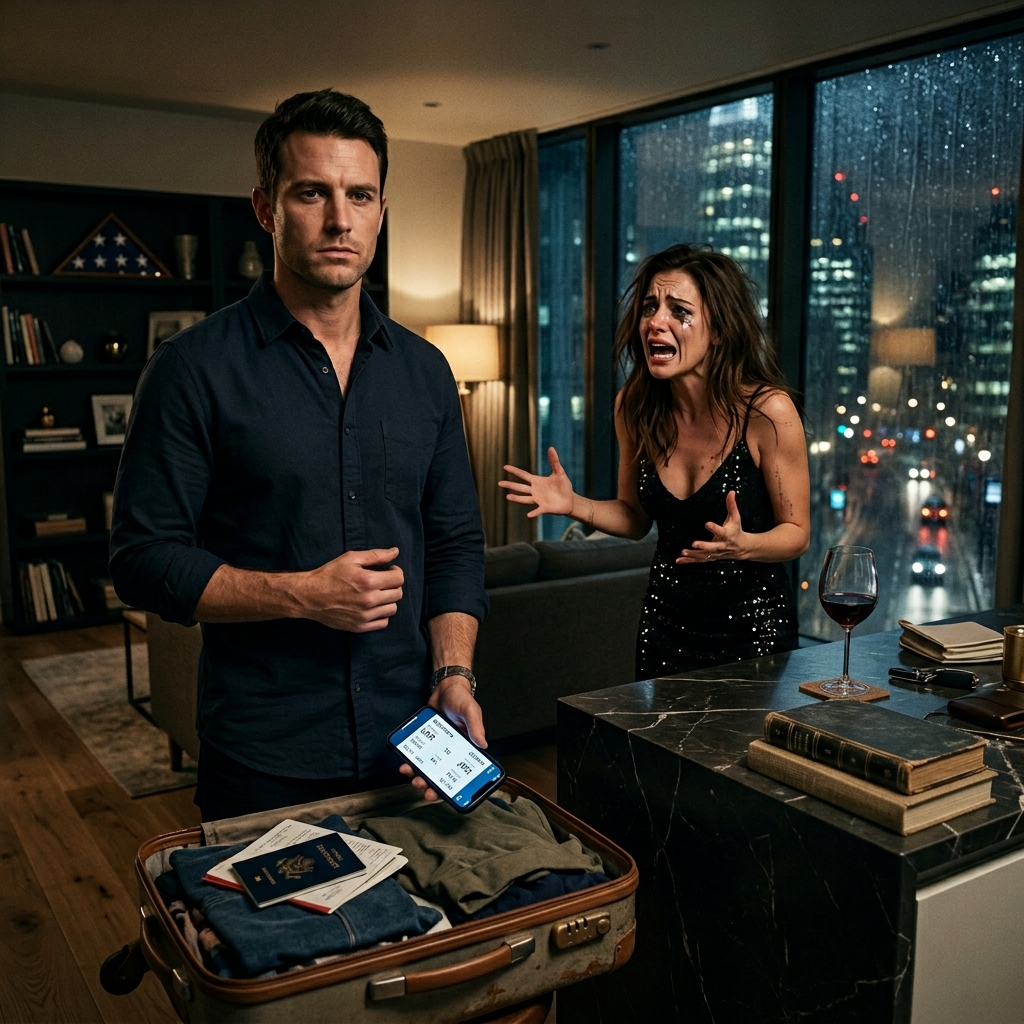
I made coffee I didn’t drink. I sat at the kitchen island. At 3:42 p.m., Natalie walked in wearing a beige coat, black boots, and the expression of someone preparing to manage a difficult client.
Not a devastated girlfriend. Not someone terrified of losing the man she loved.
A strategist.
She put her purse down slowly.
“Can we talk like adults?” she asked.
I nodded toward the stool across from me. “Sit.”
Her mouth tightened, but she sat.
“Start from the beginning,” I said.
She folded her hands. “Daniel works in real estate investment. I met him at a networking event last year. He knew about high-yield accounts, property flips, private lending opportunities. I told him we were saving for a house, and he said regular savings accounts were stupid with inflation.”
“So you opened an account with him.”
“Not immediately.”
“But eventually.”
“Yes.”
“Why joint?”
“Because certain investment opportunities require pooled capital.”
I almost admired how rehearsed it sounded.
“Are you dating him?”
“No.”
“Have you slept with him?”
“No.”
“Have you kissed him?”
Her eyes flicked away.
There are tiny movements that destroy entire futures.
I leaned back.
“Natalie.”
“It was one time,” she said quickly. “And it didn’t mean anything.”
I looked at her, and for the first time in three years, I truly saw the woman sitting across from me. Not the version I loved. Not the future Mrs. Hale. Just a person who could sit in my kitchen and reduce a betrayal to a technicality.
“One time?” I asked.
“Yes.”
“When?”
“December.”
“Before or after we toured houses?”
She looked down.
I nodded slowly. “Before.”
“It was a mistake.”
“Did he know about me?”
“Yes.”
“Did he know the money was supposed to be for our future?”
She swallowed.
“Answer me.”
“Yes.”
The coffee machine hummed behind us. Somewhere outside, a dog barked. Life continued, disrespectfully ordinary.
“Are you in love with him?”
“No,” she said, but too fast.
“Is he in love with you?”
“He thinks he is.”
I laughed quietly. “That must be exhausting for you.”
“Don’t be cruel.”
That made me look at her fully.
“Cruel?”
Her eyes filled with tears then, like she had been waiting for the right cue.
“I know I messed up,” she said. “But I was scared. You’re so steady, Evan. You have everything figured out. Daniel was exciting, and he made me feel like I could be more than just someone’s girlfriend planning a mortgage.”
I stared at her.
“I was planning a life with you.”
“I know.”
“No. You don’t. Because while I was planning, you were auditioning.”
She flinched.
I stood and walked to the bedroom.
“What are you doing?” she asked.
“Getting your things.”
She followed me. “Evan, stop.”
I opened the closet and pulled out a suitcase.
“Stop,” she repeated, louder.
“You’re going to Rachel’s, your mother’s, Daniel’s, a hotel. I don’t care. But you’re not sleeping here tonight.”
“This is my home too.”
“My name is on the lease.”
“I’ve lived here for a year.”
“And for nine months of that year, you lied to my face while I paid most of your living expenses so you could build a secret account with another man.”
“You can’t just throw me out because you’re angry.”
“I’m not throwing you out. I’m asking you to leave tonight. Tomorrow, I’ll talk to the landlord and do this properly if I need to.”
She grabbed my arm. “Please. Don’t do this.”
I looked down at her hand until she let go.
For a second, the mask slipped. Real fear showed up. Not fear of losing me. Fear of consequences.
“What about the money?” I asked.
She blinked.
“The forty-eight thousand. Where is it?”
“I can’t withdraw it without Daniel.”
“Of course you can’t.”
“It’s not like that.”
“It is exactly like that.”
“We were going to transfer it back.”
“When?”
“Soon.”
“When, Natalie?”
She didn’t answer.
I nodded. “You weren’t saving for our future. You were keeping me comfortable until you figured out whether his future was better.”
Her tears spilled over. “That’s not fair.”
“No. Fair was me trusting you. This is what came after.”
She packed badly. People always do when panic packs for them. Dresses twisted around shoes. Makeup thrown in without caps. A framed photo of us face down between sweaters.
At one point, she held the photo and started sobbing.
“This was real,” she whispered.
I wanted to say yes. I wanted to believe that at least some of it had been. But I had learned something in that kitchen: when someone lies long enough, even the true moments become contaminated.
“I don’t know what was real anymore,” I said.
She left at 6:18 p.m. with two suitcases and a purse I had bought her for her birthday.
That night, I didn’t sleep.
By morning, Natalie had shifted strategies.
At 7:04 a.m., I woke to twelve missed calls, eighteen texts, and one long email titled “Please read before you destroy us.”
In it, she explained that Daniel had manipulated her. That she had been insecure about not contributing enough. That she had wanted to surprise me with a larger down payment. That the kiss had happened when she was emotional. That the joint account was “a financial mistake, not an emotional affair.”
Then came the part I expected.
She reminded me of everything she had done for me. How she had supported my stressful work schedule. How she had cooked, cleaned, encouraged me, loved me. She said if I ended things over “one terrible mistake,” then maybe I had never loved her unconditionally.
I read the email twice.
Then I forwarded it to myself, saved it in a folder, and didn’t respond.
At 8:30, I called my landlord, Mr. Alvarez, explained that Natalie was not on the lease and that she had left voluntarily but might try to return. He told me to send written confirmation and change the access code after collecting her remaining property.
At 9:15, I called my bank and removed Natalie as an authorized user from my emergency credit card. She had never abused it, but I wasn’t leaving doors open for someone who had already shown me she liked hidden rooms.
At 10:00, I changed every password I had ever shared or saved on devices in the apartment. Streaming accounts, utilities, grocery delivery, Wi-Fi, laptop, phone backups.
At noon, Rachel arrived with coffee and a face that said she was ready to hide a body if necessary.
I told her everything.
She listened without interrupting. When I got to the joint account, she closed her eyes.
“Oh, Evan.”
That broke me more than Natalie’s crying had.
I leaned over the kitchen island, hands covering my face, and finally let the grief come. Not loud. Not dramatic. Just a deep, humiliating ache.
Rachel rubbed my back like she used to when we were kids and our parents were fighting downstairs.
“You loved who she pretended to be,” she said softly. “That’s not the same as being stupid.”
But I felt stupid.
I felt stupid for every dinner I paid for, every trip I covered, every time I praised her discipline. I felt stupid for imagining a ring on her finger while she had her name next to another man’s on bank paperwork.
Two days later, Daniel Mercer called me.
I didn’t recognize the number, but something told me to answer.
“Evan?” he said.
“Who is this?”
“Daniel Mercer.”
My grip tightened around the phone.
“You have thirty seconds,” I said.
He exhaled. “I think Natalie hasn’t been honest with either of us.”
I almost laughed. “That’s a brave opening.”
“She told me you two were basically over.”
“Basically?”
“She said you lived together for financial convenience but that the relationship had been dead for months.”
I looked around the apartment where her throw blanket still hung over the sofa and her favorite mug still sat in the cabinet.
“She told you that?”
“Yes.”
“And you believed her?”
“I wanted to.”
At least he had the decency to sound ashamed.
“What do you want?” I asked.
“I want out of the account.”
That got my attention.
“Why?”
“Because most of the money is hers, but not all of it. And some of the investment transfers she requested… I’m not comfortable with them anymore.”
“What does that mean?”
He hesitated.
“Daniel.”
“She wanted to use the account to qualify for a property loan,” he said. “A condo downtown. She said once she separated from you, she would move in there. I was supposed to help with the financing at first, but then she started talking like it would be ours.”
My apartment went very still.
“She was buying a condo with you?”
“Trying to.”
“With money she told me was for our house?”
“I didn’t know that part until yesterday.”
I believed him, strangely. Not because he was innocent. He wasn’t. He had kissed a woman with a boyfriend. He had entered a financial arrangement with someone clearly tangled in another life. But he sounded less like a mastermind and more like a man discovering he hadn’t been the hunter.
He had been another fish on the same hook.
“What exactly is in that account?” I asked.
“I can’t legally give you statements.”
“I’m not asking legally. I’m asking man to man.”
He was quiet.
“About fifty-two thousand now,” he said. “Thirty-seven from deposits she made. Ten from me. The rest from returns and interest.”
“Why would you put ten thousand dollars into an account with my girlfriend?”
His silence answered before he did.
“Because I thought we were building something,” he said.
I laughed then. I couldn’t help it.
She had sold both of us the same dream, just with different furniture.
Daniel and I spoke for twenty minutes. By the end, we had both learned enough to feel sick.
Natalie had told him I was controlling with money. She said I forced her to ask permission before spending and made her pay for things she couldn’t afford. In reality, I was subsidizing her life.
She told him she wanted independence. She told me she wanted partnership.
She told him she was afraid to leave. She told me she couldn’t wait to marry me.
She told him the savings account represented her escape. She told me it represented our future.
After we hung up, I sat at my desk and made a list.
Not an emotional list. A factual one.
Dates. Amounts I had paid. Rent difference since she moved in. Car tires. Dental bill. Trips. Messages where she explicitly said she was saving for our future. Her email confession. Bank call time. Daniel’s call summary.
I wasn’t sure what I could legally recover. Maybe nothing. Maybe the law would say I had gifted support to my girlfriend and had no claim over her savings. But I knew documentation mattered, especially if Natalie decided to rewrite the story publicly.
Which, of course, she did.
By Friday, her friends were messaging me.
Jessica, her best friend, sent the first one.
I hope you’re proud of yourself. Kicking a woman out over money is disgusting.
Then another friend, Mia.
Natalie is devastated. She made one mistake trying to build a future and you went nuclear.
Then her mother.
Evan, I thought you were a better man. Whatever happened, abandoning her like this is cruel.
I didn’t answer any of them individually.
Instead, I wrote one calm message and sent it to Natalie.
Do not send people to contact me. You opened a joint savings account with Daniel Mercer while telling me you were saving for our future. You admitted to kissing him. You used my financial support to build hidden savings tied to another man. I have documentation. If harassment continues, I will respond with the facts.
The messages stopped for about four hours.
Then Natalie called from a blocked number.
“You’re threatening me now?” she demanded.
“I’m protecting myself.”
“You’re humiliating me.”
“You did that privately. I’m just refusing to be your villain publicly.”
“You have no idea what you’ve done to me.”
I closed my eyes. “Natalie, where are you?”
“At Jessica’s.”
“Good. Stay there.”
“You’re so cold.”
“No. Cold is lying beside someone every night while planning a different life with someone else.”
She started crying. “I was confused.”
“You were comfortable.”
That silenced her.
“You had me paying for the present,” I said, “Daniel investing in the fantasy, and you standing in the middle deciding which future gave you more.”
“That’s not true.”
“Then prove it. Close the joint account. Return Daniel’s ten thousand. Put the rest wherever you want. But stop pretending it was for us.”
She whispered, “I can’t close it yet.”
“Why not?”
“Because the funds are tied up.”
“In what?”
She didn’t answer.
“Natalie.”
“The condo deposit.”
There it was.
Even after being caught, she had still moved forward.
“When did you make the deposit?”
“Monday.”
The day before the bank called me.
I felt a strange calm settle over me. It was the kind of calm that comes when your heart finally stops arguing with the evidence.
“How much?”
“Twenty thousand.”
“Nonrefundable?”
A small sob.
“Natalie.”
“Yes.”
I looked out the window at the mountains in the distance, blue and indifferent.
“You didn’t make one mistake,” I said. “You made a plan.”
She hung up.
Two weeks passed.
I returned her remaining belongings through a scheduled pickup with Rachel present. Natalie arrived wearing sunglasses even though it was cloudy. Jessica drove her and glared at me from the parking lot like I had personally invented male cruelty.
Natalie walked through the apartment quietly, touching small things as if they might testify for her.
When she reached the kitchen island, she stopped.
“I thought you’d cool down,” she said.
“I did.”
She looked at me.
“That’s why this is organized.”
Her mouth trembled. “Do you hate me?”
I thought about it.
“No,” I said. “Hating you would still be a kind of investment.”
That hurt her. I saw it land.
“Evan, please. I know I destroyed your trust. But people rebuild from worse.”
“People rebuild when the foundation cracks,” I said. “Not when they discover there was another house being built behind theirs.”
She wiped under her sunglasses. “Daniel won’t talk to me now.”
I said nothing.
“He hired a lawyer to separate from the account.”
“Smart man.”
She gave a bitter laugh. “So that’s it? You and Daniel both get to walk away, and I lose everything?”
I stared at her.
“You lost a lie. That’s not everything.”
She looked at me like she wanted to slap me, then like she wanted me to hold her. Neither happened.
After she left, the apartment felt bigger. Not better. Just bigger.
Healing wasn’t cinematic. There was no montage of me working out, smiling at sunsets, becoming instantly stronger. Mostly, it was laundry and silence. It was finding her hair ties in drawers. It was canceling reservations I had made for a proposal trip she never knew about. It was telling my mother and hearing her go quiet in that particular way mothers do when they’re trying not to cry because you already are.
It was also anger.
Anger hit in waves. Sometimes while brushing my teeth. Sometimes while driving. Sometimes in grocery store aisles where I remembered how Natalie used to compare pasta sauce prices and say, “Every dollar counts for our house.”
Our house.
I hated those two words for a while.
About a month later, Daniel emailed me.
He kept it brief. His attorney had helped him exit the joint account. He recovered part of his money, lost some to penalties and the failed condo deposit, and wanted me to know Natalie might try to contact me again because her financing had collapsed.
He ended with: I’m sorry for my part in this. I should have asked harder questions. I hope you get clear of it.
I didn’t respond for three days.
Then I wrote back: Same to you.
That was enough.
Natalie did try to come back.
It happened on a rainy Thursday evening in April. I opened the door to find her standing there soaked, hair damp around her face, mascara smudged under one eye. She looked smaller than I remembered, but I didn’t trust that. Consequences can make selfish people look fragile.
“Can I come in?” she asked.
“No.”
She wrapped her arms around herself. “Just for five minutes.”
I stepped into the hallway and closed the door behind me.
“What do you need?”
She looked at the closed door, and something like disbelief crossed her face. Once, she would have walked right past me into the apartment. Once, she belonged there.
Not anymore.
“I lost the condo,” she said.
“I know.”
Her eyes sharpened. “Daniel told you?”
“He told me enough.”
She laughed weakly. “Of course he did.”
“What do you need, Natalie?”
She swallowed. “I need help.”
“With what?”
“Money.”
The word hung between us, almost impressive in its audacity.
“How much?”
“Eight thousand.”
I stared at her.
“It’s not for me to waste,” she said quickly. “I owe fees. The deposit created problems, and my credit cards—”
“No.”
“You didn’t even let me finish.”
“You asked for money. The answer is no.”
Her face crumpled. “After everything?”
I tilted my head. “After everything?”
“I loved you.”
“I know you loved what I provided.”
“That’s cruel.”
“That’s accurate.”
She stepped closer. “I made mistakes, Evan. Terrible ones. But you’re acting like I’m some monster. I was scared of being trapped. I wanted options.”
“And now you have them.”
“What options?”
“Daniel. Jessica. Your mother. A bank that already knows your name.”
She flinched.
I softened my voice, not because she deserved comfort, but because I didn’t want bitterness to become my permanent language.
“Natalie, I hope you fix your life. I mean that. I hope you learn something from this that doesn’t just make you better at hiding. But I’m not funding your recovery from betraying me.”
Tears slid down her cheeks.
“I thought you were kinder than this,” she whispered.
“I was,” I said. “That’s how you got so far.”
She stood there for a long moment. Then she nodded, turned, and walked toward the elevator.
Before the doors opened, she looked back.
“Did you ever buy the ring?”
I didn’t answer immediately.
“Yes,” I said.
Her face broke in a way I hadn’t expected.
“What did it look like?”
For some reason, I told her.
“Simple. Oval diamond. Gold band. You said once your grandmother had one like it.”
She covered her mouth.
“I would have said yes,” she whispered.
I shook my head. “No, Natalie. You would have said yes while keeping another door unlocked.”
The elevator doors opened. She stepped inside. This time, when they closed, I felt something in me close too.
Six months later, I bought a house.
Not the Maple Ridge one. I couldn’t stand the thought of that kitchen. I found a smaller brick house on the west side with old hardwood floors, a fenced yard, and a porch that caught the evening light. It needed work, which suited me. Broken things that didn’t lie were easier to repair.
Rachel helped me move. My mother brought soup like I was recovering from surgery. In a way, I was.
On the first night, I sat on the floor of the empty living room with a beer in my hand and my dog, Murphy, asleep beside me. I had adopted him two weeks earlier from a shelter. He was a mutt with one floppy ear and absolutely no interest in my emotional complexity.
My phone buzzed.
A message from an unknown number.
I almost ignored it, but something made me open it.
It was a photo.
Natalie.
She was standing in front of a courthouse, wearing a navy dress, holding a folder. She looked tired but composed. Beneath the photo was a message.
This is Daniel. Thought you should know Natalie filed a small claims case against me for the lost deposit. It was dismissed today. She tried to argue we had planned a shared future and I abandoned her financially. The judge asked if there was written proof. There wasn’t. I hope this is the last either of us hears about it.
I stared at the message for a long time.
Then I deleted it.
Not because it didn’t matter, but because it didn’t belong in my new house.
A year after the bank call, I ran into Natalie at a grocery store.
Of course it was the pasta sauce aisle.
Life has a cruel sense of staging.
I was comparing labels when I heard someone say my name.
“Evan?”
I turned.
Natalie stood a few feet away in jeans and a white sweater, her hair shorter now, no makeup except lipstick. She looked healthier than she had in the hallway that night. Less polished, maybe. More real. Or maybe I had finally stopped looking for the version of her I used to love.
“Hi,” I said.
She glanced at my basket. “You still buy the spicy one.”
“Some habits survive.”
She smiled sadly.
For a moment, we were just two people who had once known the inside of each other’s lives.
“I heard you bought a house,” she said.
“Yeah.”
“That’s good. I’m glad.”
“Thank you.”
She looked down at her hands. No ring.
“I wanted to apologize,” she said. “Not the way I did before. Not with excuses.”
I waited.
“What I did was calculated,” she said quietly. “I told myself it was confusion because that sounded softer. But I liked having safety with you and possibility with him. I liked being wanted by both of you. And I used your trust to make myself feel secure while pretending I was the one sacrificing.”
The aisle felt very quiet.
“I’m sorry,” she said. “You didn’t deserve that.”
For a long time, I didn’t speak.
Then I nodded. “Thank you for saying it honestly.”
Her eyes shone. “Do you forgive me?”
I looked at the jars of sauce between us, at the ridiculous normalcy of the moment.
“I’m not angry every day anymore,” I said. “That’s what I have.”
She accepted that like it was more than she expected.
“Are you happy?” she asked.
I thought of my house, my dog, Sunday dinners with Rachel and her kids, the quiet pride of paying my own mortgage alone. I thought of the ring I had sold and the money I had used to build bookshelves in the living room.
“I’m peaceful,” I said. “That’s better.”
She nodded, tears slipping down her face.
“I hope you find someone who deserves you,” she said.
“I hope you become someone who doesn’t need two futures to feel safe.”
That landed, but not cruelly. At least I didn’t mean it that way.
She wiped her cheek and walked away.
I stood there for a minute, holding a jar of pasta sauce, realizing I didn’t want to follow her, didn’t want to punish her, didn’t want to know where she lived or who she loved or whether she ever truly loved me.
That was freedom.
Not the dramatic kind people post about. Just the quiet kind where a name stops controlling your breathing.
Two years later, I met Claire.
She was an architect on a mixed-use project my company managed downtown. Sharp, funny, allergic to nonsense. On our first coffee date, she told me she believed trust was important, but transparency was kinder.
“People act like asking questions means you don’t trust them,” she said, stirring her coffee. “I think hiding behind trust is how cowards avoid accountability.”
I nearly laughed.
“What?” she asked.
“Nothing,” I said. “Just sounds like something I had to learn the expensive way.”
I told her about Natalie eventually. Not on the first date. Not as a trauma dump. But slowly, honestly, when things became serious.
Claire didn’t pity me. She didn’t call me stupid. She just listened and said, “That must have changed how safe love feels.”
It had.
But not forever.
When Claire and I moved in together, we talked about money with boring, beautiful clarity. Separate accounts. Shared household account. Written contributions. No secret debt. No hidden savings tied to “surprises.” Romance, I learned, does not die from transparency. It dies from people who treat honesty like a threat.
Three years after that bank call, I proposed to Claire on the porch of the brick house I had bought after losing the future I thought I wanted.
Murphy wore a bandana. Rachel hid behind a tree with her phone. My mother cried before Claire even answered.
The ring was not the one I had bought for Natalie. That ring belonged to a different man’s dream, and I had no desire to recycle ghosts.
Claire said yes.
Later that night, after everyone left and the porch lights glowed warm against the dark, she sat beside me with her head on my shoulder.
“Are you okay?” she asked.
I looked at the ring on her hand. Then at the house. Then at the life around me that had been built slower, cleaner, without hidden doors.
“Yeah,” I said. “I am.”
And I meant it.
For a long time, I thought Natalie had stolen my future.
She hadn’t.
She had only exposed the weakness in the one I was trying to build with her.
The future I actually needed came later. It came with hard conversations, bank statements both people could see, promises that didn’t need secret accounts to prove them, and a woman who understood that love is not proven by how beautifully someone talks about tomorrow.
It is proven by what they refuse to hide today.
![[FULL STORY] My Brother Secretly Married My Girlfriend — Then My Family Demanded I Forgive Them](https://social-media.rabedo.com/thumbnails/1777386370_21313a5c-8efd-4312-8821-45bc0c70d8c6.png)