
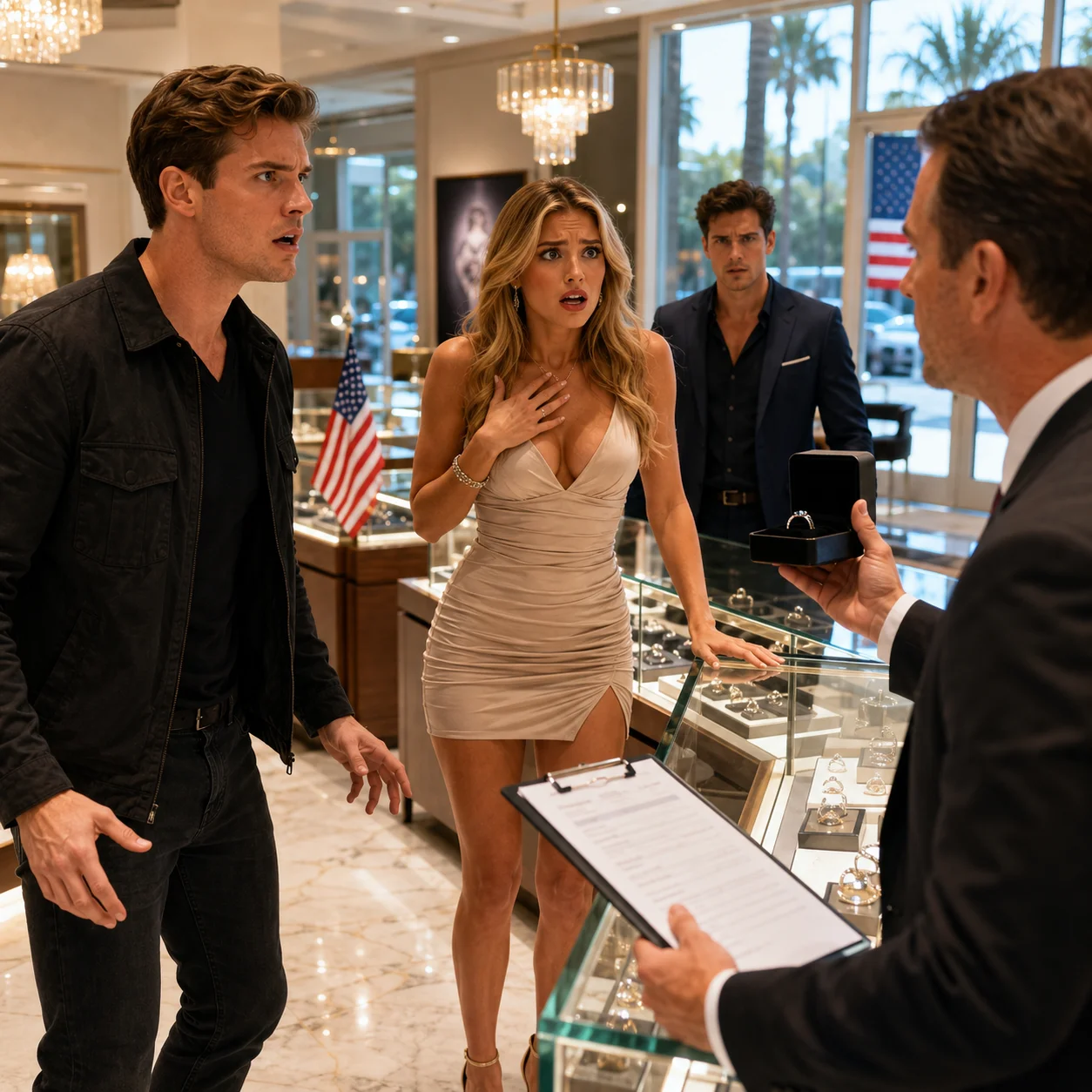
“Would you like me to email the documents?”
“Yes. Please send them.”
“Of course. I have your email as daniel.mercer at Mercer—”
“That’s correct.”
“Perfect. And just to confirm, will you be coming in with Ms. Bennett for pickup, or should we keep Mr. Whitman listed as authorized?”
There are moments in life when your heart breaks loudly, with shouting and crying and slammed doors.
And then there are moments when it breaks silently, like glass cracking inside a wall where no one can see it.
“Keep him listed,” I said. “For now.”
“Wonderful. I’ll send everything over.”
When the call ended, I didn’t move for nearly a full minute.
Then I opened a blank document and wrote down every word I remembered.
Hartwell & Stone. Custom platinum band. Black diamond. Chase Whitman. Always before anyone. Insurance under my name.
I wrote it like a man taking notes at someone else’s funeral.
The email arrived seven minutes later.
It included the insurance form, the appraisal, and a scanned copy of the purchase order. Olivia had paid a deposit of $7,000 using a credit card linked to our shared wedding account.
Our shared wedding account.
The account I had funded almost entirely.
I leaned back in my chair and laughed once.
Not because anything was funny.
Because if I didn’t laugh, I was going to break something.
That night, Olivia came home at 8:40 p.m., smelling faintly of perfume I didn’t recognize and cold air. She said she had been at a final floral consultation.
I was sitting at the kitchen table with my laptop open, a glass of water beside me, and the Hartwell & Stone email minimized in the corner of my screen.
“How were the flowers?” I asked.
“Beautiful,” she said, dropping her purse onto the counter. “I think we’re going to add more white orchids near the aisle. It’ll look more expensive.”
I looked at her.
She didn’t say better.
She said more expensive.
“That’s important,” I said.
She gave me a quick smile. “Don’t start. You said you wanted me to have my dream wedding.”
“I did.”
She came behind me and rubbed my shoulders. “You’ve been tense all week.”
“Have I?”
“Mhm. You need to relax.” Her hands slid down my chest. “In three weeks, we’ll be married, and all this stress will be over.”
I wondered whether Chase knew she said things like that to me.
I wondered whether she went to him afterward and laughed about it.
I wondered how long I had been the idiot in the room.
“Liv,” I said, “who is Chase to you?”
Her hands stopped.
Only for half a second.
Then they continued, softer.
“Chase? Why?”
“Just asking.”
“He’s a friend.”
“What kind of friend?”
She moved away and walked to the refrigerator. “Daniel, please don’t do this tonight.”
“Do what?”
“Get weird.”
I turned slowly in my chair. “Asking about a man who texts my fiancée at midnight is weird?”
She took out a bottle of sparkling water and twisted the cap. “He texts me because he’s helping with wedding stuff.”
“What wedding stuff?”
“Vendor stuff. I told you that.”
“Right.”
She looked at me then, really looked, and I saw the calculation return. Olivia was excellent at reading rooms. It was one of the reasons people liked her. She could sense discomfort and turn herself into whatever version of herself would smooth it over.
With me, that version used softness.
She came back to the table and sat beside me. “Daniel, I know weddings bring up insecurities.”
I almost smiled.
“Insecurities?”
“You’ve been under pressure. You’re paying for a lot. My family can be intense. Maybe Chase makes you feel… I don’t know, compared.”
“Compared how?”
“He’s just more social. He knows that world.”
“That world?”
She sighed as if I were forcing her to say something painful. “The parties, the connections, the kind of people who care about presentation. It doesn’t mean anything. I chose you.”
I chose you.
Not I love you.
Not there’s nothing going on.
I chose you.
Like I was a safe investment.
Like I was the house with better bones.
I nodded slowly. “Thanks for explaining.”
Her face softened with relief. She thought she had handled me.
That was the first time I realized Olivia didn’t know me as well as she thought.
She knew the generous version of me. The patient version. The version who gave people time to become better than their worst choices.
She had never met the version of me who could sit quietly with betrayal and build a plan.
Over the next four days, I said nothing.
I kissed her forehead before work. I answered venue emails. I listened while she complained about bridesmaid dress alterations. I nodded when she said she might need a “self-care weekend” at a spa with her maid of honor, Madison.
Then I began checking records.
Not illegally. Not dramatically. Just carefully.
The wedding account showed three charges I didn’t recognize. Hartwell & Stone. A boutique hotel downtown. A restaurant called Lark & Ivy, where Olivia had told me she was having dinner with her mother.
I called the hotel and asked for an invoice copy for “our event records,” because the booking had used our wedding account card. They emailed it within the hour.
One king suite.
Two nights.
Guest names: Olivia Bennett and Chase Whitman.
I sat at my desk, looking at the invoice, and felt something inside me go very still.
Grief came first. Not anger.
That surprised me.
I grieved the woman I thought I knew. I grieved the mornings when she wore my old college sweatshirt and made terrible coffee. I grieved the night she cried after her grandmother died and told me I was the only person who made her feel safe. I grieved the version of our future where we had children with her eyes and my stubbornness and a house full of ordinary Sunday noise.
Then the anger came.
Not hot.
Cold.
Focused.
I called my attorney, Martin Hale, who had handled contracts for my business for years and had once told me, “The worst time to protect yourself is after you need protection.”
When he answered, I said, “I need advice on canceling a wedding.”
He was silent for half a beat. “Yours?”
“Yes.”
“Are you safe?”
That question almost undid me.
“I’m safe.”
“Is there a prenup?”
“Drafted, not signed.”
“Joint assets?”
“No. Just a wedding account I funded. Her name is on it for vendor access.”
“Good. Don’t confront her yet.”
I looked out the window. “I wasn’t planning to.”
“Email me everything. Receipts, invoices, contracts, vendor agreements, proof of funding. We’ll unwind what we can.”
“What about the ring?”
“Your engagement ring?”
“No,” I said. “Her boyfriend’s ring.”
Martin exhaled slowly. “Send me that first.”
By Friday, I had a folder labeled “Olivia Wedding Documentation” that contained enough evidence to make me feel physically sick. The jewelry receipt. The insurance email. The hotel invoice. Restaurant charges. Screenshots of Chase’s public Instagram, where his story from two weeks earlier showed a woman’s hand holding champagne in the same suite from the hotel’s website.
No face.
But the bracelet was Olivia’s.
I had bought it for her birthday.
I also discovered something else.
The final payment for our wedding venue, $42,000, was due the following Monday.
Olivia had been pushing me all week to send it.
“Just pay it now,” she said Friday morning while fastening diamond earrings in the mirror. “I don’t want to risk any hiccups.”
I stood behind her, tying my tie.
“The contract says Monday.”
“So?”
“So I’ll pay it Monday.”
Her reflection frowned. “Daniel, why are you being difficult?”
“I’m not.”
“You’ve been strange all week.”
I met her eyes in the mirror. “Have I?”
“Yes. Cold.”
“Maybe I’m tired.”
“You’re always tired lately.” She turned around. “Do you even want this wedding?”
There it was.
The opening.
For one second, I considered saying no.
I considered placing the printed invoices on the dresser and watching her face fall apart.
But I thought of the $42,000 payment. I thought of the ring. I thought of the fact that Chase was still listed as authorized pickup. I thought of all the people who would twist this if I gave Olivia time to control the story.
So I walked over and kissed her cheek.
“Of course I do.”
She studied me for a moment, then smiled.
“Good,” she said. “Because I’d hate for you to embarrass me this close to the wedding.”
That sentence stayed with me all day.
Not hurt me.
Not leave me.
Embarrass me.
On Saturday, Olivia went to her “spa weekend.”
She left wearing oversized sunglasses and a cream-colored coat I had given her for Christmas. Madison picked her up in a black SUV, waved at me from the driveway, and looked away too quickly.
I waited twenty minutes after they left.
Then I drove to Hartwell & Stone.
The store sat on Newbury Street, all polished glass, velvet displays, and quiet music designed to make people forget they were spending house money on tiny rocks. A woman in a charcoal suit greeted me near the entrance.
“Welcome to Hartwell & Stone. How may I help you?”
“I’m Daniel Mercer. I spoke with Andrea earlier this week.”
Recognition flashed in her eyes. She lowered her voice slightly. “Of course, Mr. Mercer. Please come with me.”
She led me to a private consultation table in the back.
Andrea was older than I expected, maybe mid-fifties, with silver-blonde hair and the careful expression of someone who had worked with enough engagements to recognize when romance had turned into litigation.
“Mr. Mercer,” she said gently. “Thank you for coming in.”
“Thank you for seeing me.”
She folded her hands. “I want to apologize if our call caused any distress. We were operating under the information provided by Ms. Bennett.”
“You don’t need to apologize. You told the truth by accident. That’s more than I was getting at home.”
Her face softened.
“I need to know what can be done,” I said. “The deposit came from an account I funded. The order is not for me. I did not authorize my funds to purchase a ring for Chase Whitman.”
Andrea nodded carefully. “Because the piece is custom, it complicates cancellation. But if the payment method is disputed and the order involved misrepresentation of authorization, our manager can review it.”
“Is your manager available?”
“She is.”
A few minutes later, a woman named Celeste Moreno joined us. She had the calm, direct manner of someone who had seen rich people behave badly in every possible configuration.
She reviewed the documents I brought. Bank statements. Account records. The email. The purchase order.
Then she looked up.
“Mr. Mercer, I have to ask clearly. Did you give Ms. Bennett permission to use your shared wedding account for this purchase?”
“No.”
“Did you know the ring was for Mr. Whitman?”
“No.”
“Did you agree to insure it?”
“No.”
Celeste closed the folder. “Then we will freeze pickup immediately pending review. Mr. Whitman will not be allowed to collect the item.”
A strange wave of relief passed through me.
Not happiness.
Just the relief of stopping one piece of the humiliation before it reached its destination.
“Thank you,” I said.
“There is one more thing,” Celeste said.
I looked at her.
“Ms. Bennett scheduled a private pickup appointment for tomorrow afternoon. With Mr. Whitman.”
Of course she had.
Sunday afternoon.
Her spa weekend.
I laughed quietly.
Andrea looked uncomfortable. Celeste did not.
“Would you like us to cancel the appointment?” she asked.
I thought about it.
Then I said, “No. Keep it.”
Celeste raised one eyebrow.
“I’ll be here.”
Sunday was clear and bright, the kind of early spring day that made Boston look cleaner than it was. I wore a navy overcoat, parked two blocks away, and arrived at Hartwell & Stone twenty minutes before the appointment.
Celeste met me at the door and brought me to the same consultation room.
“You understand we cannot create a confrontation in the store,” she said.
“I’m not here to make a scene.”
“I’m serious, Mr. Mercer.”
“So am I.”
At 2:06 p.m., Olivia walked in with Chase Whitman.
Seeing them together in daylight hurt more than the receipts.
Chase was tall, tan, and dressed like someone who thought loafers without socks counted as a personality. Olivia looked stunning in a fitted ivory dress under a camel coat, her hair loose around her shoulders, her engagement ring glittering on her left hand.
My ring.
The one I had chosen with trembling hands because I wanted to give her something worthy of forever.
She was laughing when she entered.
Then she saw me.
The laugh died so quickly it was almost violent.
Chase stopped beside her. His eyes moved from me to Celeste to the private room behind me, and even he was smart enough to understand something had gone terribly wrong.
“Daniel,” Olivia said.
I stood. “Hi, Liv.”
Her face shifted through three different masks before settling on outrage. “What are you doing here?”
“I could ask you the same thing.”
Chase cleared his throat. “Maybe I should—”
“No,” I said, looking at him. “Stay.”
Olivia’s hand tightened around her purse strap. “Daniel, this is not what it looks like.”
I almost admired her.
Even standing inside the jewelry store where she had bought another man a ring using my money, she still reached for that sentence.
“What does it look like?” I asked.
Her lips parted.
Nothing came out.
Celeste stepped forward. “Ms. Bennett, as discussed with Mr. Mercer, the custom ring order has been frozen pending payment authorization review.”
Olivia turned toward her. “You had no right to discuss my purchase with him.”
“The funds used came from an account under review for unauthorized use,” Celeste said evenly. “And Mr. Mercer was listed in your notes as the insurance policyholder.”
Chase looked at Olivia.
“You said he knew.”
Olivia went pale.
That was the first honest thing I had seen on her face all week.
I looked at Chase. “She told you I knew?”
He shifted his weight. “She said you two had an arrangement.”
An arrangement.
I stared at Olivia. “What arrangement was that?”
Her eyes filled with tears, sudden and polished. “Daniel, please. Not here.”
“No, here is perfect. You picked the location.”
A couple near the watch display glanced over. Celeste subtly guided her staff away, giving us privacy without leaving us unsupervised.
Olivia lowered her voice. “I was confused.”
“For eighteen thousand dollars?”
“It wasn’t like that.”
“You bought him a ring.”
“It was symbolic.”
“Symbolic of what?”
She flinched.
Chase answered before she could stop him.
“She said she was going to leave you after the wedding.”
The words landed with such blunt force that even Olivia seemed shocked he had said them.
My mouth went dry.
“After the wedding,” I repeated.
Chase looked between us, suddenly less smug. “She said there were family expectations. That the wedding had to happen. That afterward you’d separate quietly.”
I turned to Olivia.
She was crying now, but not the way people cry when they are sorry.
She cried the way people cry when the exit they planned has been blocked.
“Daniel,” she whispered. “I didn’t know how to stop everything.”
“You didn’t know how to stop everything,” I said, “so you were going to marry me?”
“I was under pressure.”
“To take vows?”
“My parents, your family, the deposits, everyone was already coming—”
“And after that?”
She shook her head. “I don’t know.”
“Yes, you do. Chase just told me.”
Chase muttered, “Leave me out of this.”
I looked at him. “You walked into my wedding with your hand out for a ring I paid for. You’re in it.”
His jaw tightened, but he didn’t argue.
Olivia stepped toward me. “I made a mistake.”
“No. A mistake is ordering the wrong flowers. This was a plan.”
Her tears spilled over. “I love you.”
That almost made me angry.
Not because I believed it.
Because she thought I might need to.
“No,” I said quietly. “You loved what I made possible.”
She recoiled as if I had slapped her.
I removed an envelope from inside my coat and placed it on the table.
Her eyes dropped to it.
“What is that?”
“Cancellation notices. The venue hasn’t received the final payment. It won’t. The honeymoon is canceled. The rehearsal dinner is canceled. The florist, photographer, band, and caterer will be contacted by my attorney tomorrow morning.”
Her face drained completely.
“No.”
“Yes.”
“Daniel, we can talk about this.”
“We are talking.”
“You can’t just cancel our wedding.”
I looked at her left hand.
“Take off the ring.”
Her hand closed instinctively.
“Daniel.”
“Take. Off. The. Ring.”
Chase took a step back, suddenly fascinated by a display case.
Olivia’s voice lowered to a hiss. “You are humiliating me.”
“There it is again.”
“What?”
“Humiliation. That’s what you care about.”
Her expression twisted. “After everything, you’re going to make me look like the villain?”
I stared at her.
“Olivia, you are the villain.”
She looked around, aware now that the store was too quiet, that every employee was pretending not to listen.
Then slowly, with trembling fingers, she pulled off the engagement ring.
She did not hand it to me.
She placed it on the table between us like it was a weapon she no longer had the strength to hold.
I picked it up.
It felt heavier than I remembered.
“This is over,” I said.
Her voice broke. “Daniel, please.”
I turned to Celeste. “Thank you for your help.”
Celeste nodded. “Of course.”
I walked out of the jewelry store without looking back.
That was the last dignified moment Olivia allowed either of us to have.
By Sunday night, my phone had forty-seven missed calls.
Olivia.
Her mother.
Madison.
Two bridesmaids.
A number I assumed was Chase, though he only called once.
The messages started with panic.
Daniel, please call me.
Then bargaining.
We can postpone, not cancel.
Then accusation.
You’re destroying me because your ego is hurt.
By midnight, her mother, Patricia Bennett, left a voicemail so theatrical it could have been performed on a stage.
“Daniel, I don’t know what you think you know, but canceling a wedding three weeks out is cruel and financially irresponsible. Olivia is devastated. Good men do not punish women publicly.”
I replayed that last sentence twice.
Good men do not punish women publicly.
I wondered whether good women secretly bought rings for their boyfriends with their fiancé’s money.
On Monday morning, Martin sent formal cancellation notices to every vendor. Because I had been the sole payer on most contracts, refunds came back to my accounts where possible. Some deposits were gone. That hurt, but not as much as marrying someone who planned to leave me after using me as a stage prop.
The venue coordinator called me personally.
“Mr. Mercer,” she said softly, “I’m very sorry.”
“Thank you.”
“Would you like us to simply mark the event canceled?”
I paused.
“What do people usually do?”
“Some cancel completely. Some convert the date into another event if the space is nonrefundable.”
That gave me an idea I probably would not have had if Olivia hadn’t sent her mother after me.
“How much of the venue fee is already nonrefundable?”
She told me.
It was not a small number.
I looked at the framed photo on my desk of my parents, my sister, and me at Christmas two years earlier. My father had his arm around my mother. Emma was making a face. I looked happy.
“Can we use the space for a dinner instead?” I asked. “Same date. No ceremony. Just a private gathering.”
“For your guests?”
“For my family and friends. And I’d like to donate the remaining catering capacity to a local shelter if possible.”
There was a brief silence.
“I think we can help with that,” she said.
By noon, the wedding website was down.
By three, the group chat had exploded.
Olivia posted first.
Due to unforeseen circumstances, Daniel and I have decided to postpone the wedding. Please respect our privacy as we navigate this painful time.
Postpone.
Our.
Privacy.
I stared at the message for a long moment, then did something I almost never did.
I replied publicly.
The wedding is not postponed. It is canceled. I discovered that Olivia used funds from our wedding account to purchase a custom ring for Chase Whitman, with whom she was having an affair. I wish everyone peace, but I will not participate in a false narrative.
Then I muted the chat.
Emma called thirty seconds later.
Her first words were not “Are you okay?”
They were, “I’m coming over.”
She arrived with takeout, a bottle of bourbon, and the expression she used when she wanted to commit a felony but had decided to start with emotional support.
I let her in, and she hugged me so hard I almost dropped the food.
“I’m sorry,” she whispered.
That was when I finally cried.
Not in the jewelry store. Not during the calls. Not when Olivia gave back the ring.
In my entryway, while my little sister held me and said, “You didn’t deserve this,” I broke.
For about ten minutes, I was not calm or strategic or dignified.
I was just a man who had loved the wrong woman.
Emma stayed the night in the guest room. My mother called and cried quietly. My father said, “Come home for dinner tomorrow,” in the gruff voice he used when he was trying not to sound emotional.
By Tuesday, the story had spread beyond our guest list.
Olivia’s version shifted depending on the audience. To some people, I was controlling. To others, emotionally unavailable. To a few, apparently, I had “known about Chase” and changed my mind because I couldn’t handle a modern relationship.
Unfortunately for Olivia, receipts are stubborn things.
I didn’t blast everything online. I didn’t post hotel invoices or jewelry documents. But when someone directly accused me of lying, I sent one calm message:
Please ask Olivia whether the custom black diamond ring engraved “Always before anyone” was for me or Chase.
Most people stopped replying after that.
Chase disappeared faster than I expected.
By Wednesday, his Instagram was private. By Friday, I heard from a mutual acquaintance that he had told people Olivia “misrepresented her situation.” That was a delicate way of saying he had enjoyed the benefits of her lies until they became inconvenient.
Olivia came to the house the following Saturday.
I knew she was coming because the security camera alerted me before she reached the porch. She stood outside in jeans, a beige sweater, and no makeup. For the first time in months, she looked less like a curated image and more like a person running out of places to hide.
I opened the door but did not invite her in.
“Hi,” she said.
“Hi.”
Her eyes moved past me into the house. “Can we talk?”
“We can talk here.”
Pain crossed her face. Maybe real. Maybe practiced. I no longer trusted myself to know the difference.
“I deserve that,” she said.
I said nothing.
She wrapped her arms around herself. “Chase is gone.”
“I’m not surprised.”
“He blocked me.”
“I’m also not surprised.”
She looked down. “I was stupid.”
“Yes.”
Her mouth trembled. “Do you hate me?”
I thought about it.
It would have been easier if I did.
Hate is clean. Hate gives you energy. Hate lets you turn someone into a monster and yourself into a survivor.
But what I felt was sadder than hate.
“I don’t know,” I said honestly. “I don’t think so.”
She looked up quickly, as if that gave her hope.
So I killed the hope before it could grow.
“But I don’t love you the way I did either.”
She began to cry.
“I thought I needed more,” she said. “More excitement. More passion. More of that feeling like someone would choose me over everything.”
I leaned against the doorframe.
“And Chase gave you that?”
“I thought he did.”
“At my expense.”
She flinched. “I know.”
“With my money.”
“I know.”
“Three weeks before our wedding.”
Her tears fell harder. “I know.”
I looked at the woman I had planned to marry and saw, finally, not a mastermind, not a seductress, not some grand villain from a dramatic story.
I saw someone empty.
Someone who mistook attention for love and luxury for worth. Someone who had been so desperate to feel chosen that she had destroyed the one relationship where she already was.
That did not excuse her.
But it made me stop wanting to punish her.
“Olivia,” I said, “you need help.”
She wiped her face. “I need you.”
“No. You need help.”
Her expression crumpled.
“I can’t fix what you broke inside yourself,” I continued. “And I won’t let you use my forgiveness as a way to avoid facing it.”
She stared at me for a long time.
Then she whispered, “Is there any future where you forgive me?”
“I think I’ll forgive you someday.”
A tiny breath left her.
“But not because you ask. And not because it brings us back.”
She closed her eyes.
“I’m sorry,” she said.
This time, I believed her.
Not enough to open the door wider.
But enough to nod.
“I hope you become someone who never does this again.”
She stood there for another moment, waiting for something I could not give her. Then she turned and walked down the steps.
Two weeks later, on what would have been our wedding day, I stood in the same venue where I was supposed to marry Olivia Bennett.
There were no white orchids. No aisle. No altar.
Instead, there were round tables, warm lights, and about forty people who had chosen to show up not for a ceremony, but for me.
My parents were there. Emma was there. My closest friends from college and work were there. Even my old mentor, Graham, came down from New Hampshire and clapped me on the shoulder hard enough to hurt.
The venue had helped transform the evening into a private dinner, and the unused catering went to a women’s shelter across town. When the coordinator told me that, I had to step outside for a minute.
It felt strange that something good could grow out of something so humiliating.
At dinner, my father stood to make a toast.
He was not a speech man. He had spent thirty-five years as a mechanic, believed emotions were best expressed through fixing loose cabinet hinges, and once told me “I’m proud of you” by changing my oil without asking.
So when he raised his glass, the room went quiet.
“My son was supposed to make a vow today,” he said. “Instead, he kept one to himself. He chose dignity when he had every right to choose bitterness. That matters.”
I looked down at my plate.
My mother squeezed my hand.
My father continued, voice rougher now. “Marriage is not the wedding. It’s not the flowers or the dress or who looks important in the photos. It’s whether someone protects your heart when no one else is watching. Daniel, you lost a wedding. You did not lose your future.”
I had to blink several times before I could look up.
Everyone raised their glasses.
For the first time in weeks, I breathed without feeling a weight on my chest.
Later that night, after dinner, Emma dragged me onto the empty dance floor while the band played something soft and old. We danced badly. My mother laughed. My friends joined. Someone spilled champagne. Someone else took photos.
It was not elegant.
It was real.
Near the end of the evening, the venue coordinator approached me with a small envelope.
“This was left with the original wedding materials,” she said. “We found it while clearing the bridal suite. I wasn’t sure whether you wanted it.”
My name was written on the front in Olivia’s handwriting.
For a moment, I considered throwing it away unopened.
Then I stepped into the hallway and opened it.
Daniel,
If you’re reading this, then it’s our wedding day. I know I don’t always say things perfectly, but I want you to know that you gave me the life I always dreamed of. You are steady, generous, patient, and good. I hope someday I become as good at loving you as you are at loving me.
I stared at that last line.
I hope someday I become as good at loving you as you are at loving me.
The letter had been written before everything came out. Maybe months earlier. Maybe during one of the good periods when she still believed she could turn herself into the woman she pretended to be.
I folded it carefully and placed it back in the envelope.
Then I walked outside into the cool night air.
Boston glittered around me, headlights moving over wet pavement, laughter spilling from restaurants, the world continuing with brutal indifference and unexpected mercy.
I pulled out my phone.
For the first time, I unblocked Olivia’s number.
Not to call her.
Not to invite her back.
Just to send one final message.
I found the letter you wrote for the wedding day. I hope you meant it when you wrote it. I hope you become that person someday. Goodbye, Olivia.
She replied twenty minutes later.
I’m so sorry, Daniel. I did mean it. I just didn’t know how to be her.
I read it once.
Then I deleted the thread.
A month passed.
Then two.
The refunds came in slowly. The legal dispute over the jewelry deposit resolved mostly in my favor after Hartwell & Stone confirmed the order had been misrepresented. I sold Olivia’s engagement ring through a private jeweler and donated half the proceeds to the shelter that had received our wedding food. The other half I used for something completely selfish.
I went to Santorini alone.
At first, everyone told me not to.
Emma said it would be depressing. My mother said I should go somewhere with friends. Even Martin, who billed by the hour and rarely offered personal opinions for free, said, “Are we sure that’s emotionally wise?”
Maybe it wasn’t.
But I had paid for the trip. I had imagined that blue water and white stone as the beginning of my married life. I didn’t want Olivia’s betrayal to own the place too.
So I went.
The first morning, I woke before sunrise and walked down narrow steps toward the water. The sky was lavender. The sea was dark glass. Couples stood together along terraces, taking photos, leaning into each other, beginning stories I hoped were kinder than mine.
I thought it would hurt more.
It did hurt.
But beneath the hurt was something else.
Space.
For the first time in two years, I made choices without wondering whether they were elegant enough for Olivia. I ate breakfast slowly. I turned my phone off for six hours. I swam in cold water and laughed when I slipped on the rocks. I bought a cheap linen shirt from a street vendor because I liked it, not because anyone would approve.
On the third evening, I sat alone at a small restaurant overlooking the caldera. The waiter brought grilled fish, lemon potatoes, and a glass of wine I hadn’t ordered.
“From the couple over there,” he said, nodding toward an older man and woman at a corner table.
I looked over, confused.
The woman raised her glass.
I walked over to thank them.
“We saw you here yesterday,” the man said. He had a soft Irish accent and kind eyes. “You looked like a man trying very hard to enjoy paradise.”
I laughed. “That obvious?”
“Only to people who have tried the same thing,” the woman said.
Her name was Maeve. His was Thomas. They had been married forty-one years.
“Anniversary?” I asked.
Maeve smiled. “Second honeymoon. The first one was a disaster. Food poisoning, lost luggage, terrible hotel. We came back to fix the memory.”
Thomas took her hand. “Some places deserve a second chance.”
I looked out at the water.
“Maybe people too,” Maeve said gently. “But not always the same people.”
That sentence stayed with me longer than most advice.
When I returned home, I didn’t feel healed.
Healing, I learned, was not a door you walked through. It was a house you rebuilt slowly, room by room, after someone set fire to the old one and asked why you were coughing.
I went back to work. I saw my family. I started running again. I stopped checking Olivia’s social media after catching myself doing it twice like a fool. I replaced the furniture she had chosen. I painted the bedroom a deep blue she would have called too masculine.
Then, one afternoon in late summer, I received a handwritten envelope with no return address.
Inside was a check.
$7,000.
And a note.
Daniel,
This does not fix anything. I know that. I sold my car and paid back what I could from the ring deposit. I am in therapy. I am not asking for a reply. I just wanted to return something I never should have taken.
Olivia.
I sat with the note for a long time.
Then I deposited the check and sent half of it to the shelter.
I did not reply.
But I hoped she kept going to therapy.
A year after the canceled wedding, Emma convinced me to attend another charity auction, the same kind of event where I had met Olivia.
“I’m not trying to set you up,” she lied badly while adjusting my tie.
“You are absolutely trying to set me up.”
“I am trying to reintroduce you to society.”
“I’ve been in society.”
“You’ve been in your office and Home Depot.”
“Home Depot counts.”
She rolled her eyes. “Just come. Eat the tiny food. Smile at donors. Leave after an hour if you hate it.”
I went because I loved my sister and because, eventually, hiding starts to look too much like letting the person who hurt you keep the keys.
The auction was held in a museum atrium, all glass ceilings and gold light. I made polite conversation, bid on a weekend cabin stay I didn’t need, and was considering my escape when a woman beside me said, “You know, if you bid again, you’re basically paying double for the privilege of pretending you enjoy kayaking.”
I turned.
She was about my age, maybe thirty-one, with dark curls pinned loosely at the back of her neck and amused brown eyes. She wore a simple navy dress and no jewelry except tiny silver earrings.
I smiled despite myself. “Is it that obvious I don’t kayak?”
“You looked at the paddle in the photo like it had personally offended you.”
“That paddle knows what it did.”
She laughed.
Her name was Claire. She worked as a pediatric physical therapist. She was there because the nonprofit funded adaptive equipment for children with mobility challenges. She spoke warmly, listened without performing interest, and when I mentioned my consulting work, she did not ask how much money people in my field made.
We talked for twenty minutes.
Then forty.
When Emma passed behind Claire and gave me two aggressive thumbs up, I pretended not to see her.
Claire did.
“Your sister?” she asked.
“Unfortunately.”
“She seems subtle.”
“Deeply.”
Claire smiled. “I should let you rescue yourself.”
“I don’t need rescuing.”
The words came out before I thought about them.
A year earlier, they would not have been true.
Claire tilted her head slightly, as if she heard the weight beneath the sentence but chose not to pry.
“Good,” she said. “Then maybe you can walk me to the dessert table.”
We dated slowly.
Painfully slowly, according to Emma, who had the patience of a match in gasoline.
Claire knew the broad outline of what had happened with Olivia by our fourth date, not because I dumped the story on her like emotional luggage, but because she asked why I sometimes looked careful when conversations turned to weddings or trust.
I told her enough.
She didn’t say, “I would never do that,” which I appreciated because people often promise who they are before life tests them.
Instead, she said, “That must have made it hard to trust your own judgment.”
That sentence reached deeper than comfort.
“Yes,” I admitted. “That was the worst part.”
She nodded. “Then we’ll go at a pace where your judgment gets to breathe.”
No one had ever offered me that before.
Two years after the jewelry store, I stood in my kitchen again, rain tapping against the windows, sorting mail at the island.
Claire was there, barefoot, wearing one of my old sweatshirts, making tea.
An envelope from Hartwell & Stone sat in the pile.
For a second, my body remembered before my mind did.
Claire noticed.
“You okay?” she asked.
I picked up the envelope.
It was an advertisement. A seasonal catalog.
I laughed softly.
“Yeah,” I said. “Just a ghost.”
She walked over, took the catalog from my hand, and without drama, dropped it into the recycling bin.
“Ghosts don’t get counter space,” she said.
And just like that, the kitchen belonged to the present again.
Six months later, I proposed to Claire.
Not with a huge diamond. Not with a public spectacle. Not with anything designed to impress strangers.
I proposed on a cold morning by the Charles River with a ring we had chosen together because we had talked, honestly and practically, about marriage before I ever bought it.
She cried.
I cried too, which she later claimed was the moment she knew our future children were doomed to be dramatic.
Our wedding was small. Forty people. No orchids. No luxury ballroom. No one used the word elegant.
My father made another toast.
Emma cried before the ceremony even started.
And when Claire walked toward me, I did not feel like I had won after being betrayed.
I felt like I had survived long enough to recognize peace when it arrived.
During the reception, my phone buzzed once.
A message from an unknown number.
I almost ignored it, but something made me look.
Daniel, I heard you got married today. I’m happy for you. I’m sorry for who I was. I hope she loves you the way you deserved to be loved.
There was no name.
There didn’t need to be.
I looked across the room at Claire, who was laughing with my mother, one hand resting lightly over mine whenever I came near, as if touching me had become natural rather than strategic.
I typed one sentence back.
I hope you’re well, Olivia.
Then I blocked the number.
Not out of anger.
Out of completion.
Later that night, Claire and I stepped outside beneath a sky full of stars. The music drifted through the open doors behind us, warm and soft. She leaned her head against my shoulder.
“Happy?” she asked.
I thought about the receipt on the kitchen floor. The jewelry store. The black diamond ring. The woman who said it was for our wedding while planning a future with someone else. I thought about the version of me who had believed trust meant ignoring the small alarms inside his chest.
Then I thought about my father’s words.
You lost a wedding. You did not lose your future.
I kissed Claire’s forehead.
“Yeah,” I said. “I’m happy.”
And for the first time in a long time, happiness did not feel like something I had to protect from a lie.
It felt like something honest had finally found me.
![[FULL STORY] My Lawyer Wife Tried To Use Her Legal Skills Against Me — I Found Her Secret,..](https://social-media.rabedo.com/thumbnails/1777366900_1.png)
![[FULL STORY] My Wife Threw Her Ring At Me Saying She Was Single Tonight And Disappeared. I Took Her ...](https://social-media.rabedo.com/thumbnails/1776418929_e3dfea49-a1dc-49df-9e00-5440f7892bb0.png)
![[FULL STORRY] My cheating girlfriend told me I wasn't "boyfriend material" so I sent all her belongings to her ex and proved her lies with 4K security footage.](https://social-media.rabedo.com/thumbnails/1777004172_S1.png)