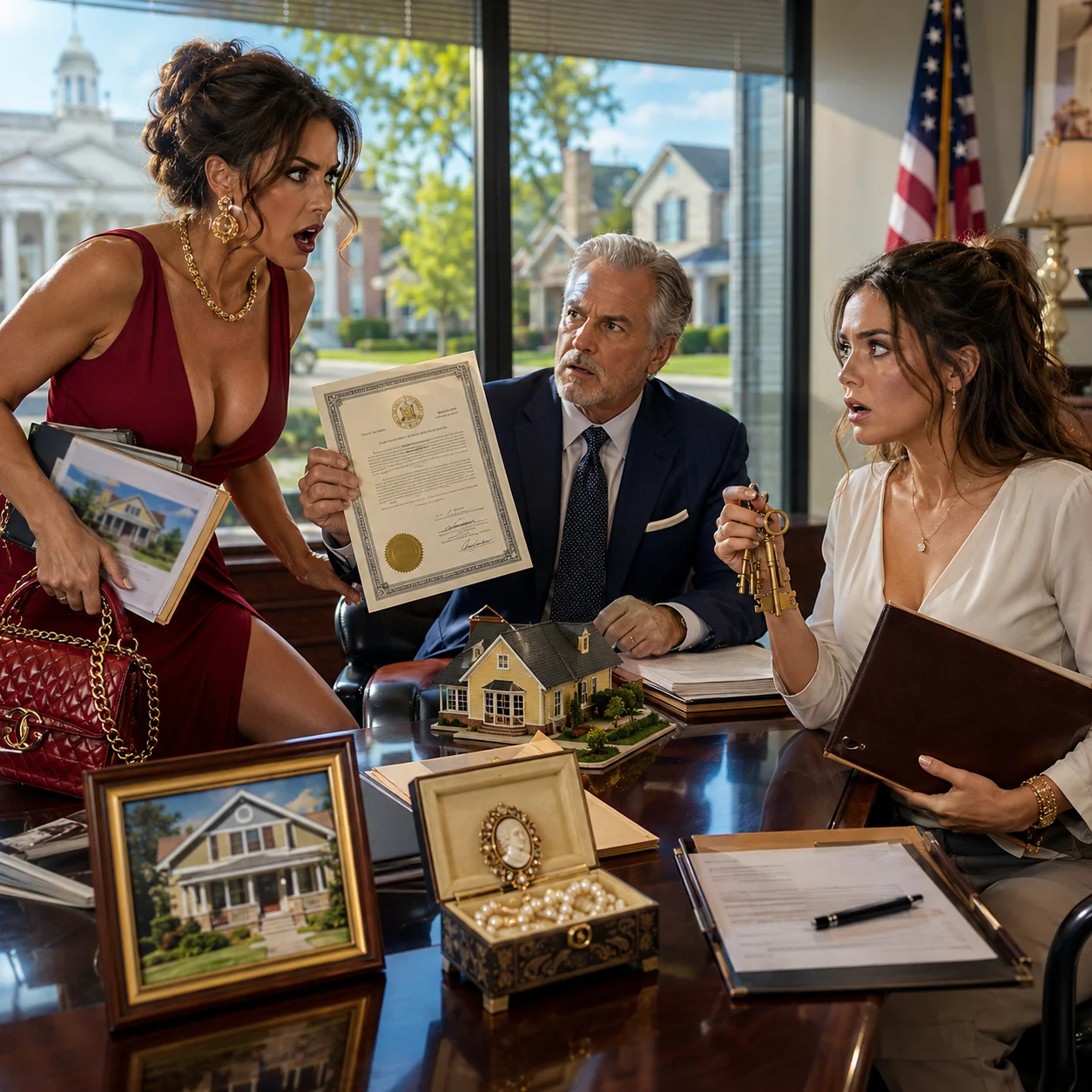
“Grandma loved this house,” I said.
“Your grandmother loved her family more.”
“Then why didn’t you wait for the will?”
Another pause.
This one was thinner.
“Because I am the executor,” she said.
“You don’t know that.”
“I’m the oldest daughter.”
“That doesn’t make you executor.”
“It makes me the only adult in this family willing to make difficult decisions.”
I laughed quietly. “You mean the only one willing to profit before anyone can object.”
Her voice sharpened. “You need to remember your place.”
There it was.
My place.
I had heard that phrase my whole life from Aunt Patricia. When I wanted to sit beside Grandma at Thanksgiving. When I asked questions about family finances after Grandma’s health declined. When I objected to Patricia moving Grandma’s jewelry into her own safe “for security.”
My place was always somewhere smaller than hers.
“Where exactly is my place?” I asked.
“In reality,” she said coldly. “You are not Mother’s child. You are her grandchild. I understand she helped raise you, but that does not put you above her actual daughters.”
I closed my eyes.
Grandma had two daughters.
My mother, Elaine, who died young.
And Patricia, who treated tragedy like an inconvenience that had accidentally improved her inheritance position.
“My mother was her daughter,” I said.
“And your mother is gone.”
The words landed like a slap.
For a moment, I could not speak.
Patricia must have mistaken my silence for surrender because her voice softened into something false.
“Claire, I know you’re emotional. That house means a lot to you. But you’re twenty-six. You rent a small apartment. You’re still paying student loans. You cannot manage an estate. I’m trying to spare you stress.”
“No,” I said. “You’re trying to sell the house before anyone can stop you.”
“The sale is already in motion.”
“Then stop it.”
“I won’t.”
“Then I’ll call Mr. Whitaker.”
That was the name of Grandma’s lawyer.
The silence that followed was different.
It was immediate.
Heavy.
Then Patricia said, very slowly, “There is no need to bother him before Thursday.”
“The will reading is Thursday.”
“Exactly. We will discuss everything then.”
“I’m discussing it now.”
“Claire.”
“No. You don’t get to use that voice with me anymore.”
She inhaled sharply. “You are making a mistake.”
“So are you.”
I hung up before she could answer.
For the next ten minutes, I stood in Grandma’s kitchen shaking so hard I had to sit down.
Then I called Mr. Whitaker’s office.
His receptionist, a calm woman named Denise, answered on the second ring.
“Whitaker and Bell, this is Denise.”
“Hi. My name is Claire Dawson. My grandmother was Margaret Langford. I believe Mr. Whitaker is handling her estate.”
There was a small pause, then Denise’s tone warmed. “Yes, Miss Dawson. I’m sorry for your loss.”
“Thank you. I need to speak to him.”
“Mr. Whitaker is in meetings most of the afternoon. Is this urgent?”
“My aunt sold my grandmother’s house.”
Another pause.
This one was not small.
“Please hold.”
I listened to soft piano music for exactly forty-six seconds.
Then an older male voice came on the line.
“Claire?”
“Mr. Whitaker?”
“Yes. Tell me exactly what happened.”
So I did.
I told him about the contractor. The buyer. The orange sticker. Patricia’s phone call. The claim that she was executor. The sale before the will reading.
He did not interrupt once.
When I finished, he said, “Are you at the property now?”
“Yes.”
“Do not allow anyone inside.”
“I won’t.”
“Do you have your grandmother’s keys?”
“Yes.”
“Good. I want you to lock all doors and windows. Then I want you to photograph the orange sticker, any signs of entry, and any missing items you notice.”
My chest tightened. “Missing items?”
“Claire,” he said gently, “has your aunt removed personal property from the home?”
I looked toward the empty mantel.
“Yes.”
He sighed.
Not surprised. Just tired.
“Document everything you can. Do not confront Patricia again today. Come to my office tomorrow morning at nine.”
“The will reading is Thursday.”
“I know.”
“Then why tomorrow?”
His voice changed slightly.
Became careful.
“Because there are some things your grandmother arranged before she passed. And given what you just told me, you need to understand them before Thursday.”
I gripped the edge of the kitchen table.
“What things?”
“I would rather discuss them in person.”
That night, I barely slept.
Every time I closed my eyes, I saw Grandma’s house stripped bare. I saw strangers tearing down the lemon curtains, ripping out the old cabinets, cutting the maple tree down because it stood too close to the driveway.
I saw Patricia smiling with a check in her hand.
At 3:12 a.m., I opened my laptop and searched county property records.
Grandma had once told me, “Paperwork tells the truth when people won’t.”
I typed in the address.
418 Willowbrook Lane.
The result loaded slowly.
Owner name: Margaret Elaine Langford.
I exhaled.
Then I saw a second line.
Joint tenant with right of survivorship: Claire Marie Dawson.
For several seconds, I thought I was reading it wrong.
I refreshed the page.
Same result.
I opened the scanned deed.
My hands went cold.
There was Grandma’s signature from eight years ago.
There was a notary stamp.
And there was my name.
Claire Marie Dawson.
Joint tenant with right of survivorship.
I did not understand all the legal meaning, not fully. But I understood enough to know one thing.
Grandma had put my name on the title.
Not in the will.
Not as a promise.
Not as a sentimental gesture.
On the title.
I covered my mouth with both hands and sobbed.
Not because of money.
Not because of victory.
Because Grandma had known.
Somehow, years before anyone admitted it out loud, Grandma had known Patricia would try something.
And she had protected me without ever making me carry the burden of knowing.
The next morning, I arrived at Mr. Whitaker’s office at 8:42.
His office sat above an old bank downtown, all dark wood and frosted glass. Denise greeted me with a sad smile and led me into a conference room where Mr. Whitaker was already waiting.
He was in his late sixties, with silver hair, wire-rim glasses, and the exhausted patience of a man who had watched too many families become strangers over property.
“Claire,” he said, standing. “Thank you for coming.”
I sat across from him and placed a folder on the table.
“I looked up the deed,” I said.
He studied my face for a second. “I thought you might.”
“My name is on it.”
“Yes.”
“Why didn’t I know?”
“Because your grandmother asked me not to tell you unless it became necessary.”
“Why?”
He folded his hands. “She didn’t want you treated differently while she was alive. She didn’t want Patricia pressuring you, manipulating you, or making your relationship with her about property.”
I swallowed hard.
“When did she do it?”
“Eight years ago. Shortly after you turned eighteen.”
I stared at him.
That was the year I graduated high school.
The year Patricia told Grandma she should sell the house and move into a retirement condo closer to Patricia’s neighborhood.
The year Grandma said no and Patricia stopped visiting for six months.
Mr. Whitaker opened a file.
“Your grandmother came to me with very specific concerns. She said this home was purchased by her and your grandfather. After your grandfather died, she wanted it to remain a place of security for the person who had actually lived in it, cared for it, and respected it.”
My throat burned.
“She meant me.”
“Yes.”
“But why joint tenancy? Why not just leave it in the will?”
“Because wills can be contested. Probate can be delayed. Executors can create problems.” His expression hardened slightly. “Titles are different.”
“So Patricia can’t sell it?”
“She cannot sell what she does not own.”
“She accepted an offer.”
“She had no legal authority to do so.”
“She said she was executor.”
“She is not.”
I blinked.
“She’s not?”
“No.”
“Then who is?”
Mr. Whitaker slid a document across the table.
My name was printed near the top.
Claire Marie Dawson.
Executor.
My breath left my body.
“She made me executor?”
“She did.”
“I don’t know how to do that.”
“That is why attorneys exist,” he said gently. “Your grandmother did not choose you because you had legal experience. She chose you because she trusted your character.”
I stared down at the document.
Patricia had spent years telling me I was too emotional, too naive, too young, too attached.
Grandma had quietly made me the person in charge.
“When was the will updated?” I asked.
“Four years ago, then reviewed again last year after her hospital stay.”
Last year.
When Patricia had started “helping” with Grandma’s appointments and asking increasingly strange questions about bank accounts, insurance papers, and the jewelry safe.
“What else did Grandma leave?” I asked.
Mr. Whitaker’s eyes softened.
“She left Patricia certain financial assets. Your cousin Natalie received jewelry specifically listed by name. Several charities received donations. You received her personal letters, household contents not otherwise designated, and her interest in the house.”
“But if my name is already on the title…”
“Then the house passed to you automatically upon her death, outside probate.”
I looked out the window.
Downtown traffic moved below us, ordinary and indifferent.
“So the will reading…”
“Will still happen,” he said. “And Patricia will learn then what she should have waited to learn properly.”
I almost laughed.
Not because it was funny.
Because I could already imagine her face.
Mr. Whitaker leaned back. “However, we need to act quickly regarding the attempted sale.”
“What do we do?”
“I will send notice today to the buyer’s agent and title company that Patricia had no authority to sell the property. I will also request all documents she signed.”
“Could she get in legal trouble?”
“That depends on what she represented and whether money changed hands.”
“She removed things from the house.”
“Did you document them?”
I handed him printed photos.
The empty mantel. The missing mirror. The bare china cabinet. The boxes stacked in Patricia’s handwriting.
He reviewed them silently.
Then he said, “Your grandmother suspected this too.”
I looked up.
He opened another envelope.
Inside was a handwritten note.
My name was on the front.
Claire.
My fingers trembled when I touched it.
“Should I read it now?”
“That is your choice.”
I opened it.
Grandma’s handwriting leaned slightly to the right, careful but still strong.
My dearest Claire,
If you are reading this in Mr. Whitaker’s office, then something has likely happened sooner than I hoped and exactly as I feared.
I want you to know first that I did not hide things from you because I doubted you. I hid them because I wanted you to have a few more years of peace. You have carried too much for someone so young.
This house became yours in every way long before any paper said so. You learned to ride your bicycle in the driveway. You cried over algebra at the kitchen table. You slept beside me during thunderstorms even when you were too old to admit you were afraid. You made this house laugh again after your mother died.
Patricia will say I was confused. I was not.
She will say you manipulated me. You did not.
She will say family means blood order, birth order, seniority, and obedience. It does not.
Family is who stays when staying is inconvenient.
You stayed.
So I made sure the house stayed with you.
Do not let anyone shame you for accepting what I freely gave.
Love,
Grandma
I cried harder than I wanted to in front of Mr. Whitaker.
He did not pretend not to notice. He simply pushed a box of tissues across the table and waited.
By Thursday, Patricia had no idea the ground under her feet had already disappeared.
The will reading was scheduled for eleven in the morning.
Patricia arrived at 10:53 wearing cream-colored silk, gold earrings, and the expression of a woman prepared to be admired for her restraint. My cousin Natalie came with her, scrolling on her phone. Uncle Robert, Patricia’s husband, followed behind them with the blank look of a man who had learned survival through silence.
A few other relatives came too. Grandma’s younger brother, Uncle Martin. Two cousins from out of state. Mrs. Keller from next door, whom Grandma had treated like family for thirty years.
Patricia saw me sitting near the end of the conference table and gave me a pitying smile.
“Oh, Claire,” she said. “I’m glad you came.”
I looked at her calmly. “Why wouldn’t I?”
Her smile tightened.
“I just know this may be difficult for you.”
“I’m sure it will be difficult for someone.”
Natalie glanced up.
Mr. Whitaker entered before Patricia could respond.
Everyone settled.
Denise closed the door.
Mr. Whitaker began with the usual formalities. He expressed condolences. He explained that Margaret Langford had signed her final will eighteen months earlier, in sound mind, with witnesses and proper documentation.
Patricia sat very straight.
When Mr. Whitaker announced that I was executor, Patricia made a sound.
Not a word.
A sound.
“Excuse me?” she said.
Mr. Whitaker looked at her over his glasses. “Claire Marie Dawson is named executor of the estate.”
Patricia laughed once. “That can’t be correct.”
“It is.”
“I’m her daughter.”
“Yes.”
“I handled her care.”
Mrs. Keller’s eyebrows rose slightly.
Mr. Whitaker kept his voice even. “The will names Claire.”
Patricia turned to me. “Did you know about this?”
I said nothing.
“Claire,” she snapped.
Mr. Whitaker intervened. “Mrs. Langford, please direct questions through me.”
Patricia’s cheeks flushed. “This is absurd. Mother would never put a child in charge.”
“I’m twenty-six,” I said.
“You are not equipped for this.”
“Grandma disagreed.”
Her eyes narrowed.
Mr. Whitaker continued reading.
Patricia received a brokerage account, smaller than she expected but not insignificant. Natalie received several pieces of jewelry, but not the diamond ring she had already posted about wanting. Uncle Martin received Grandpa’s watch. Mrs. Keller received Grandma’s quilting machine and a small savings bond because, as the will stated, “she was more faithful than most relatives.”
Patricia’s mouth went flat.
Then Mr. Whitaker reached the house.
“My residential property located at 418 Willowbrook Lane…”
Patricia leaned forward.
“…has already been transferred by deed and is not part of my probate estate.”
The room went quiet.
Patricia blinked. “What does that mean?”
Mr. Whitaker looked at me, then back at her.
“It means Margaret Langford’s interest in the property passed automatically upon her death.”
“To whom?” Patricia demanded.
“To the surviving joint tenant.”
Patricia’s face changed.
Slowly.
Like someone hearing footsteps behind her in a dark room.
“What joint tenant?”
Mr. Whitaker opened another folder.
“Claire Marie Dawson.”
Natalie whispered, “Mom?”
Patricia stared at me.
I had imagined this moment a hundred times since seeing my name on the deed. I thought I would feel triumphant. I thought I would want to say something sharp and satisfying.
Instead, I felt sad.
Because Grandma should have been there.
She should have been sitting at the head of the table, wearing her blue cardigan, pretending not to enjoy Patricia being humbled.
Patricia’s voice came out low. “That is impossible.”
“It is recorded with the county,” Mr. Whitaker said.
“I never signed anything.”
“You were not required to.”
“I’m her daughter.”
“You are not an owner of the property.”
Her hands flattened on the table. “Mother was confused.”
“No,” Mr. Whitaker said.
The word was quiet, but it stopped her.
“I represented your mother for many years. She was not confused.”
Patricia turned to the room. “This is manipulation. Claire lived with her. Of course Mother felt obligated.”
I finally spoke.
“I was eleven when I moved in.”
Patricia glared at me.
“I was a child,” I said. “I didn’t manipulate anyone. Grandma raised me because my mother died and you said your house was too full.”
Her mouth opened, then closed.
Uncle Martin looked at Patricia sharply.
That part had never been discussed in family gatherings.
Patricia recovered quickly. “That has nothing to do with legal ownership.”
“You’re right,” I said. “The deed does.”
Mr. Whitaker adjusted the papers in front of him.
“There is another matter.”
Patricia’s face tightened.
“It has come to my attention,” he said, “that Mrs. Langford accepted or attempted to accept an offer for the sale of 418 Willowbrook Lane prior to this meeting.”
All eyes turned to Patricia.
Natalie’s phone lowered completely.
Patricia’s smile returned, brittle and defensive. “I was trying to protect the estate from carrying costs.”
“You had no authority to market or sell that property.”
“I believed I did.”
“On what basis?”
“I am Margaret’s daughter.”
“That does not confer title.”
“I expected the property to be part of the estate.”
“But you did not wait to confirm that.”
Her nostrils flared.
Mr. Whitaker continued. “Did you sign a purchase agreement representing yourself as authorized seller?”
Patricia’s silence answered before she did.
“I signed preliminary documents.”
“Did you receive earnest money?”
Her eyes flicked toward Uncle Robert.
Mr. Whitaker’s voice lowered. “Mrs. Langford.”
“Yes,” she said tightly. “A deposit was wired into an escrow account.”
“Controlled by whom?”
No answer.
I felt cold spread through my chest.
“Patricia,” Uncle Robert said quietly.
She snapped, “Not now.”
Mr. Whitaker removed his glasses. “You need independent legal counsel.”
The room shifted.
Those words were not casual.
Patricia understood that too.
“You’re threatening me?” she asked.
“No. I am advising you. You attempted to sell real property you did not own. If you misrepresented ownership or authority, that may have civil and potentially criminal consequences.”
Natalie whispered, “Mom, what did you do?”
Patricia stood.
“This meeting is over.”
“No,” Mr. Whitaker said. “It is not.”
She froze.
He turned to me. “As executor, Claire has authority to request return of estate property removed from the home.”
Patricia looked at me.
I opened my folder and slid a printed list across the table.
“The mantel photograph. The hallway mirror. The china set. Grandma’s recipe box. The pearl brooch. The quilt from the guest room. The blue vase from the dining room. The silver tea service. The letters from Grandpa.”
Her face went pale at the last item.
“You went through my things?”
“No,” I said. “I went through Grandma’s house and noticed what was missing.”
“You can’t prove—”
“I have photos from three weeks ago,” I said. “Grandma asked me to help catalog items for insurance after the upstairs pipe leak. Every room. Every cabinet.”
Patricia sat back down slowly.
For the first time in my life, she had no clean way out.
Mr. Whitaker said, “You will return all estate property and any property now owned by Claire within seventy-two hours. If items are damaged, sold, or withheld, we will pursue recovery.”
Patricia looked around the room, searching for support.
No one gave it.
Not Uncle Martin.
Not Mrs. Keller.
Not even Natalie.
The will reading ended in silence.
Patricia left without looking at me.
But the consequences did not end there.
By Friday afternoon, Mr. Whitaker received a furious email from the buyer’s attorney demanding clarification. Patricia had signed documents stating she was “authorized representative of the estate” and that probate transfer was pending. She had also accepted a ten-thousand-dollar nonrefundable good-faith deposit, routed through an account Uncle Robert later claimed he did not know she had opened.
The buyer threatened legal action.
Mr. Whitaker responded with recorded deed documents, the will, and a formal notice that Patricia had never held title or authority.
The sale collapsed within hours.
By Saturday morning, Patricia returned the first load of items.
She did not bring them herself.
Uncle Robert did.
He arrived at Grandma’s house in his truck with boxes stacked in the back. He looked older than I remembered, smaller somehow, his shoulders curved under the weight of embarrassment.
“I’m sorry,” he said as I opened the door.
I looked past him at the boxes.
“Is everything there?”
“I think most of it.”
“Most?”
He rubbed the back of his neck. “The mirror is at Natalie’s apartment. The tea service is with a consignment shop, but I called them. They haven’t sold it yet.”
My jaw tightened.
“She consigned Grandma’s silver?”
He looked at the porch floor. “I didn’t know until yesterday.”
I believed him.
Robert had always been quiet, but not cruel. He was the kind of man who disappeared into garages during family conflict and reappeared when it was time to carry chairs.
“Bring it back,” I said.
“I will.”
He nodded toward the house. “Can I help carry these in?”
For a second, I wanted to say no.
Then I stepped aside.
Together, we carried Grandma’s belongings back into the house.
The recipe box went to the kitchen counter. The blue vase went back to the dining room. Grandpa’s letters went into my arms and stayed there longer than necessary.
When we placed the wedding photo back on the mantel, Robert stood quietly beside me.
“She loved that picture,” he said.
“She said Grandpa looked like he was being sentenced.”
Robert smiled faintly. “He always said he was. Best sentence of his life.”
I swallowed.
He looked at me then. “Your aunt is angry.”
“I know.”
“She says you turned everyone against her.”
“No. She did that herself.”
He nodded slowly.
Before he left, he paused at the door.
“Claire, I should have spoken up years ago.”
I didn’t answer.
“I knew Patricia resented how close you and Margaret were. I knew she said things she shouldn’t. I told myself it wasn’t my place.”
I looked at him.
“That phrase has protected a lot of cowards,” I said.
He flinched, but he did not argue.
“You’re right,” he said.
Then he left.
Over the next week, Patricia’s version of events spread through the family.
According to her, I had “taken advantage” of a lonely old woman.
I had “ambushed” her at the will reading.
I had “stolen” a house that rightfully belonged to the daughters, conveniently forgetting that one daughter was my mother and had been gone for fifteen years.
Some relatives believed her at first.
Then Mr. Whitaker sent formal letters.
Facts have a way of making gossip look tired.
The deed had been recorded eight years earlier.
Grandma had reaffirmed her decision multiple times.
I had paid property taxes for the past two years from an account Grandma and I used for house expenses, something Patricia apparently never noticed because she was too busy waiting for ownership to fall into her lap.
The attempted sale documents made Patricia look worse than anything I could have said.
By the second week, people stopped calling me to “hear both sides.”
By the third, they started calling Patricia.
She did not like that.
One evening, she showed up at the house without warning.
I saw her through the front window standing on the porch in a gray coat, arms folded tightly. For a moment, she looked so much like Grandma from a distance that my chest hurt.
Then she knocked like a police officer.
I opened the door but did not invite her in.
Her eyes flicked past me into the hallway.
“You changed the locks.”
“Yes.”
“That was unnecessary.”
“You gave access to contractors.”
Her mouth tightened.
“I came to talk.”
“Then talk.”
She looked offended that I would make her stand outside, but the house no longer belonged to her assumptions.
“I made mistakes,” she said.
It was the kind of apology people give when they want credit for using the word mistake instead of theft.
I waited.
She looked away.
“I was overwhelmed.”
“Were you overwhelmed when you took Grandma’s letters?”
Her eyes snapped back. “Those were family letters.”
“They were Grandpa’s letters to his wife.”
“I am their daughter.”
“And I am their granddaughter.”
“You keep saying that as if it’s the same thing.”
I studied her face.
For the first time, I understood something Grandma probably understood long ago.
Patricia had never hated me because I took anything from her.
She hated me because Grandma gave me what Patricia thought could only be earned by rank.
Time.
Trust.
Tenderness.
A home.
“It’s not the same thing,” I said. “You’re right.”
She seemed relieved for half a second.
Then I continued.
“You were born into this family. I was left in the wreckage of it. Grandma chose to keep me safe. There’s a difference.”
Her eyes glistened, but I did not know if it was grief or rage.
“You think you’re better than me.”
“No,” I said. “I think Grandma trusted me more than you. And I think you know why.”
Her face hardened.
“You don’t understand what it was like being her daughter.”
“Maybe not.”
“She judged me.”
“She saw you.”
Patricia stepped back as if I had struck her.
For a moment, the mask cracked.
“She always preferred your mother,” she whispered.
There it was.
Not the house.
Not probate.
Not money.
A wound older than me.
“My mother died,” I said quietly.
Patricia’s mouth trembled.
“And somehow,” I continued, “you still found a way to compete with her.”
She looked down.
The porch light hummed softly above us.
When she spoke again, her voice was smaller.
“I wanted one thing that proved I mattered.”
I thought of Grandma’s letter.
Family is who stays when staying is inconvenient.
“You had years to matter,” I said. “You chose to count what you could get instead.”
She wiped quickly under one eye, angry at the tear for existing.
“What happens now?”
“With what?”
“The buyer. The deposit. The lawyer letters.”
“That depends on whether you make it right.”
Her laugh was bitter. “You sound like her.”
“Good.”
Patricia looked at the doorframe, at the old brass number visible through the porch rail, at the house she had tried to turn into a transaction.
“I can’t repay ten thousand dollars immediately,” she said.
“Then set up payments.”
“I’ll look humiliated.”
“You are humiliated because you did something humiliating.”
Her jaw clenched.
I expected her to explode.
Instead, she nodded once.
It was not redemption.
Not even close.
But it was the first honest nod I had ever seen from her.
“I’ll have my attorney contact Whitaker,” she said.
“Do that.”
She turned to leave.
Then she stopped.
“Claire.”
I waited.
“Did Mother really say I was not to have the house?”
I could have softened the truth.
But Grandma had not raised me to confuse cruelty with clarity.
“Yes,” I said. “She really did.”
Patricia walked down the steps without another word.
In the months that followed, the legal mess untangled slowly.
The buyer received his deposit back through a payment agreement Patricia had to sign. The title company dropped its complaint after restitution began, though Mr. Whitaker made sure the documentation stayed on record. Patricia returned almost everything she had taken. The silver tea service came back polished but wrapped in shame. The mirror returned with a scratch down one side. Natalie brought it herself and cried on the porch.
“I didn’t know,” she said.
I believed her less than I believed Robert, but more than I believed Patricia.
“You knew enough not to ask questions,” I said.
She nodded through tears.
“I’m sorry.”
“Then learn from it.”
I kept the mirror anyway.
Not because it was perfect.
Because Grandma had loved imperfect things.
The house took months to feel like mine without feeling haunted by the fight.
At first, I left everything exactly where Grandma had placed it. Her cardigan stayed over the kitchen chair. Her slippers stayed near the back door. Her reading glasses stayed beside the lamp.
Then one Sunday, I made coffee and realized I was waiting for permission from someone who had already given it.
So I began slowly.
I repainted the guest room. I repaired the porch rail. I hired a tree specialist to trim the maple instead of cutting it down. I replaced the broken step where Grandma had once warned me, “One day this thing will take me out,” and then refused to let me fix it because “old houses need a little danger.”
Mrs. Keller came over every Wednesday with banana bread and neighborhood updates.
Uncle Martin helped clean the garage and found the coffee tin I had buried as a child. Inside were three marbles, a rusted key, a plastic ring, and a note written in purple marker that said:
Claire’s treasure. Do not steal or ghosts will get you.
I laughed until I cried.
Then I placed the tin on the mantel beside Grandma’s wedding photo.
The first Christmas without her, I almost didn’t decorate.
The thought of opening her ornament boxes felt unbearable. Every piece had a story. Every ribbon held her hands.
But on December 10, Mrs. Keller showed up with Uncle Martin, Robert, Natalie, and three boxes of lights.
Patricia was not with them.
No one mentioned it.
We decorated slowly. Not cheerfully at first, but gently.
Natalie hung Grandma’s glass angel and whispered, “She always let me put this one up.”
I almost said something sharp.
Then I remembered Grandma telling me that grief was not a contest unless you made it one.
So I handed Natalie another ornament.
Robert fixed the outdoor lights. Uncle Martin burned the first batch of cookies. Mrs. Keller cried into the tinsel and pretended she had allergies.
That night, after everyone left, I stood outside on the sidewalk and looked at the house.
Warm light filled the windows.
The maple tree glittered with white bulbs.
The crooked brass number 418 caught the porch light just enough to shine.
For the first time since Grandma died, the house did not look like something I had lost.
It looked like something I had been trusted to carry.
On Christmas Eve, a card arrived with no return address.
I knew Patricia’s handwriting immediately.
Inside was a check for the first repayment installment and a note.
Claire,
I am not ready to say everything I should say.
But I know I was wrong about the house.
I was wrong about Mother.
And I was wrong about you.
Patricia
I read it twice.
Then I placed the check in the estate folder and the card in a drawer.
Not forgiven.
Not thrown away.
Just held somewhere in between.
A year later, Mr. Whitaker invited me back to his office to sign the final estate documents.
The process was done. The accounts had been settled. The property issue was closed. Patricia’s repayment plan was active. The house was fully mine, though in my heart it had never belonged to paper.
When the last signature was finished, Mr. Whitaker leaned back and smiled.
“Your grandmother would be proud of how you handled this.”
I looked at the pen in my hand.
“I was angry.”
“Anger and integrity can coexist.”
“I wanted to hurt Patricia sometimes.”
“But you didn’t let that become your compass.”
I thought of Grandma’s kitchen. Of the orange sticker on the window. Of Patricia’s face when the lawyer asked why my name was on the title.
“What happens to families when someone dies?” I asked quietly.
Mr. Whitaker looked out toward the frosted glass door.
“Usually?” he said. “Whatever was already there gets louder.”
That stayed with me.
Because Patricia had not become greedy when Grandma died. She had been greedy before.
I had not become loved when the deed appeared. I had been loved before.
The paper only made the truth louder.
That spring, I hosted Easter at the house.
Not because everything was healed.
Because healing needs somewhere to sit.
Patricia came.
She arrived late, carrying a lemon cake from a bakery and wearing a navy dress that looked expensive but not performative. She paused at the doorway like she wasn’t sure she was allowed in.
I almost let her stand there longer.
Then Grandma’s voice moved through my memory.
Don’t become hard just because someone else became cruel.
So I opened the door wider.
“Come in,” I said.
Patricia looked around the hallway. Her eyes stopped on the wedding photo, the repaired mirror, the recipe box on the kitchen shelf.
“You kept everything,” she said.
“Not everything.”
She nodded, understanding.
Dinner was awkward in places. Natalie talked too much. Uncle Martin spilled gravy. Robert complimented the porch repair three separate times. Mrs. Keller told a story about Grandma chasing a raccoon off the back steps with a broom and calling it “a furry tax collector.”
Patricia laughed.
A real laugh.
It startled everyone, including her.
After dessert, I found her standing alone in the kitchen, touching the edge of Grandma’s recipe box.
“Did she teach you the lemon pie?” Patricia asked.
“Yes.”
“She never taught me.”
I leaned against the counter.
“Did you ask?”
Her hand stilled.
“No,” she admitted.
The answer hung between us.
Small.
Devastating.
Honest.
I opened the recipe box and pulled out the card.
Grandma’s handwriting filled the lines, with notes in the margins about adding extra zest and never trusting store-bought crust unless “life has defeated you that week.”
I handed it to Patricia.
She stared at it.
“You’re giving me this?”
“I’m letting you copy it.”
Her mouth twitched.
“That sounds fair.”
She copied the recipe slowly at the kitchen table.
No drama. No speech. No grand apology.
Just ink moving across paper.
And somehow, that felt more real than anything she could have performed in a conference room.
When she finished, she slid the card back to me carefully.
“Thank you,” she said.
I nodded.
That night, after everyone left, I washed dishes alone in the kitchen.
The lemon curtains moved slightly in the spring breeze. The old house creaked around me. Somewhere in the walls, pipes clicked like Grandma clearing her throat.
I dried the last plate and looked at the table where she had signed birthday cards, paid bills, folded laundry, and written the letter that saved me from believing I had stolen what she freely gave.
For months, I had thought the great twist of my life was that my name had been on the title.
But that wasn’t the real inheritance.
The real inheritance was not the house.
It was knowing, finally and completely, that I had not imagined being loved.
Grandma had built proof into wood, ink, law, and memory.
Patricia had tried to sell the house before the will reading because she believed possession was the same as belonging.
But belonging had been decided long before she called the realtor.
It was decided in every midnight fever Grandma sat through beside my bed. Every school lunch she packed when I was too sad to eat. Every argument she ended by saying, “This child is not a burden.” Every year she stayed, chose, protected, and planned.
The lawyer’s question exposed Patricia.
But Grandma’s love answered everything.
So I kept the house.
I kept the crooked brass numbers.
I kept the maple tree.
I kept the lemon curtains until the fabric finally gave out, and even then, I folded them into a box instead of throwing them away.
Because some things are not valuable because they can be sold.
Some things are valuable because someone loved you enough to make sure no one could take them from you.



![[FULL STORY] My Girlfriend Said I'm Taking A Girls' Trip To Miami This Weekend You're Not](https://social-media.rabedo.com/thumbnails/1777869192_14-.jpg)