
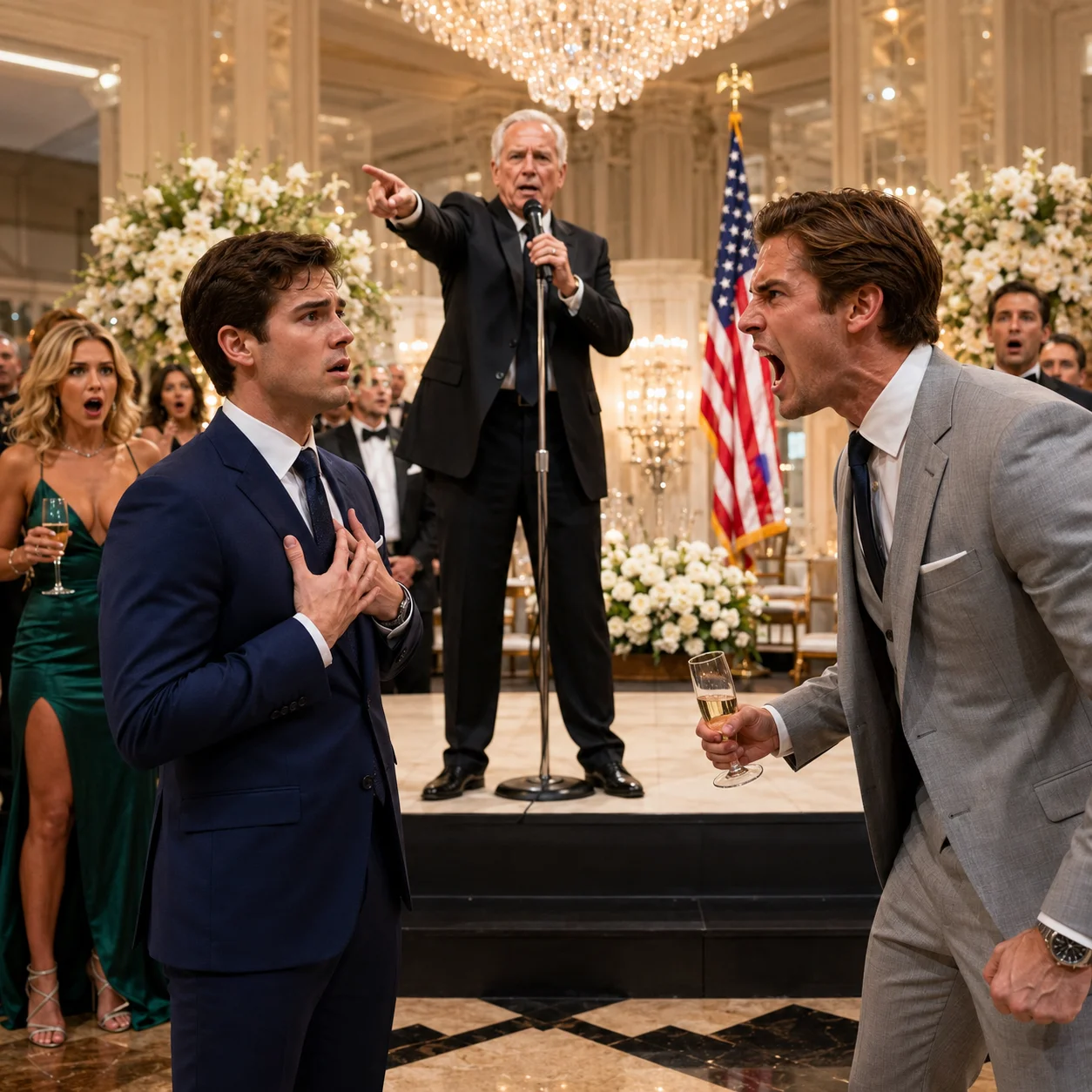
The words seemed to hang over the ballroom like something impossible.
Then Marcus laughed.
Not because it was funny, but because his mind rejected it.
“What?” he said.
Dad didn’t look at him.
“Evan will lead the company.”
My chest tightened so hard I could barely breathe.
Every face turned toward me.
I wanted to disappear.
Marcus stepped closer to Dad, lowering his voice but forgetting the microphone was still live.
“You can’t be serious.”
Dad turned to him.
“I have never been more serious.”
“Evan?” Marcus said, his voice cracking with disbelief. “You’re giving the company to Evan?”
“I am not giving the company to anyone,” Dad said. “I am entrusting leadership to the person who earned it.”
Marcus’s face flushed dark red.
“Earned it? He hides in the warehouse.”
Dad’s jaw tightened.
“No, Marcus. He saved the warehouse after your expansion plan nearly collapsed it.”
A murmur moved through the room.
Marcus blinked.
Dad continued, each sentence calm and devastating.
“When you pushed for the Harrington contract without checking capacity, Evan reorganized the second shift to meet delivery without losing the client. When you promised custom tolerances our machines could not hold, Evan found the retired technician who knew how to recalibrate Line Three. When your new supplier failed two quality audits, Evan had already documented the risk and prepared an alternate vendor.”
Marcus opened his mouth, but Dad didn’t let him speak.
“When payroll almost got delayed because your projected revenue did not arrive on time, Evan was the one who caught the cash flow problem. When two senior machinists were ready to quit because of how your managers treated them, Evan sat with them after hours and convinced them to stay. When our largest hospital client considered leaving, they didn’t call you. They called Evan.”
I stood frozen near the back of the room while my father said things I had never expected him to say aloud.
I hadn’t done those things for recognition.
I had done them because somebody had to.
Because every late shipment had a patient or farmer or firefighter at the end of it. Because every mistake cost someone overtime, sleep, dignity, or a job. Because I had grown up watching my father walk the plant floor and greet machinists by name, and I had understood something Marcus never did.
A company wasn’t the building.
It was the people inside it.
Marcus’s hand curled into a fist.
“You let him spy on me,” he said.
Dad’s eyes hardened.
“No. I watched you ignore warnings.”
The room shifted again.
That sentence landed heavier than all the others.
Marcus looked around, suddenly aware that the audience was no longer his. The admiration he had spent years collecting was slipping through his fingers in real time.
He turned to me.
“You knew?”
I swallowed.
“No.”
My voice came out quieter than I wanted, but the room was so silent everyone heard it.
Marcus sneered. “Don’t lie.”
“I knew Dad was reviewing operations,” I said. “I didn’t know about this.”
He laughed bitterly. “Of course you didn’t. You never know anything until someone hands it to you.”
Dad’s voice cut through the room.
“Enough.”
Marcus spun back toward him.
“No, not enough. You’re making a mistake. I brought in new clients. I modernized the brand. I got us in front of investors.”
“You inflated projections,” Dad said. “You alienated long-term clients. You spent money on image while Evan repaired the damage.”
“That’s not true.”
Dad reached into the inside pocket of his jacket and pulled out a folded paper.
My mother closed her eyes.
I realized then she had known.
Dad unfolded the paper slowly.
“Three weeks ago,” he said, “I received a summary of discretionary spending from the executive accounts. I asked for clarification. Evan did not provide this report. Carla did. Legal reviewed it.”
Carla from accounting lowered her gaze.
Marcus went still.
Dad continued.
“Company funds were used for personal travel labeled as client development. Private club expenses were billed under vendor relations. A consulting agreement was created for a firm owned by one of your college friends, with no deliverables attached.”
The room erupted in whispers.
Marcus’s face changed.
For the first time that night, he looked afraid.
“That’s being handled,” he said quickly.
“It is,” Dad replied. “By legal.”
My brother’s mouth opened, then closed.
Dad lowered the paper.
“I wasn’t going to discuss that tonight. This was supposed to be a dignified transition. I was prepared to let you step down quietly from executive duties and remain in a sales advisory role while we resolved the financial questions privately. But you chose to humiliate your brother in front of this room, so now this room can hear why you are not being trusted with my life’s work.”
My mother’s hand covered her mouth.
Aunt Lydia whispered, “Oh my God.”
Marcus looked at me with hatred so pure it almost felt physical.
“You did this,” he said.
I shook my head. “No.”
“You always hated me.”
“I didn’t.”
“You couldn’t beat me, so you poisoned Dad against me.”
Something in me finally broke—not loudly, not violently, but cleanly.
All the years of being called the quiet one, the backup plan, the disappointment with no ambition. All the family dinners where Marcus turned my job into a joke. All the times relatives asked when I was going to “move up” because they had no idea I was the one keeping the plant from falling apart behind the scenes.
I stepped forward.
“I didn’t have to poison anyone against you, Marcus,” I said. “You did that yourself.”
His eyes narrowed.
I kept walking until I stood close enough that he had to look at me, not through me.
“You think leadership is being seen. Dad taught me leadership is being responsible. You wanted the title. I wanted the company to survive.”
Marcus scoffed, but it sounded weak now.
“You’re not CEO material.”
“Maybe not your version,” I said. “But I know the names of the night-shift supervisors. I know which machine overheats when humidity spikes. I know which clients pay late and which vendors lie. I know who has a kid in the hospital, who’s close to retiring, and who’s been quietly training half the floor without a raise.”
I paused, my voice tightening.
“And I know you haven’t walked through the plant before noon in eight months unless there was a camera or a client tour.”
His face drained.
Someone in the back murmured, “Damn.”
Dad didn’t stop me.
So I finished.
“You called me useless because you never noticed what use actually looks like.”
Marcus stared at me as if he had never seen me before.
Maybe he hadn’t.
The retirement party did not recover after that.
How could it?
The cake stayed mostly untouched. The band packed up early. Guests approached my father with careful handshakes and quiet words. Employees came to me with shocked congratulations, some sincere, some cautious, some emotional enough to make me look away.
Mike Donnelly hugged me so hard my ribs hurt.
“About time,” he muttered.
Carla squeezed my arm and whispered, “You’re the reason half of us stayed.”
I didn’t know what to say.
My whole life, I had thought being unnoticed meant I had failed.
That night, I learned some people had noticed everything.
Marcus disappeared before dessert.
My mother found me near the balcony twenty minutes later, staring out at the parking lot.
The rain had started.
It blurred the lights on the pavement and turned every expensive car into a smear of silver and black.
“Evan,” she said softly.
I didn’t turn around.
“Did you know?”
She was quiet for a moment.
“Not at first.”
I nodded.
“Dad didn’t tell me until last month,” she said. “He wanted to be sure. He didn’t want emotion involved.”
I laughed once, without humor. “That sounds like him.”
Mom stepped beside me.
“Your father loves both of you.”
“Does Marcus know that?”
She sighed.
“Marcus has always believed love is measured by winning.”
“And me?”
She looked at me with tired eyes.
“You believed love was measured by being useful.”
That hit harder than I expected.
I looked away.
Mom touched my sleeve.
“You were never useless, Evan. You were just quiet in a family that rewarded noise.”
I wanted to be angry at her for seeing it so clearly and saying it so late.
But when I looked at her, she seemed smaller than she used to. Not weak, just worn down by decades of trying to keep peace between two sons who had turned childhood patterns into adult wounds.
“Why didn’t Dad tell me before tonight?” I asked.
“Because he knew you would try to talk him out of it.”
I looked at her.
She smiled sadly.
“And because he needed to see whether Marcus could handle disappointment with dignity.”
We both knew the answer.
The next morning, I arrived at Whitaker Manufacturing at 5:47 a.m.
The sun had not risen yet.
The plant sat at the edge of town, low and broad under the pale security lights, with the American flag out front snapping in the early wind. I parked in my usual spot near the side entrance, not the executive lot. For a long moment, I stayed in the truck with my hands on the steering wheel.
President.
The word felt too big.
Too polished.
Too dangerous.
I knew machines. I knew schedules. I knew people. I knew how to find problems before they became disasters.
But running the company?
Being the face of my father’s legacy?
Facing Marcus every day if he decided to fight?
That felt like stepping onto thin ice with everyone watching.
Inside, the plant smelled like steel, coolant, coffee, and cardboard. Familiar sounds greeted me: forklifts beeping, ventilation humming, someone laughing near Receiving, Line Two cycling through its first run.
It steadied me.
This was real.
Not the party.
Not the speeches.
This.
I found Dad in his office.
He was already there, sitting behind his desk with two coffees between us.
“Couldn’t sleep?” he asked.
“No.”
“Good,” he said. “Means you understand the weight.”
I sat across from him.
For a while, neither of us spoke.
His office had barely changed in twenty years. Framed newspaper articles. A photo of him and Mom in front of the original garage. A dented brass nameplate. A shelf full of binders he refused to digitize because, as he always said, paper never crashed.
Finally, I said, “Why me?”
Dad studied me.
“Because you asked that question.”
I frowned.
“Marcus would’ve asked what the salary was, what title he got, and when the press release went out.”
I looked down at the coffee.
Dad leaned back.
“I made mistakes with both of you.”
I wasn’t ready for that.
He continued before I could respond.
“With Marcus, I praised confidence too much and character too little. He was good in rooms. People liked him. Investors listened to him. I mistook that for readiness.”
His gaze softened.
“With you, I mistook silence for contentment. You never complained. You never asked for more. So I let you carry more than I should have.”
My throat tightened.
“I wasn’t carrying that much.”
Dad gave me a look.
“Don’t lie to an old man who built the place.”
I looked away.
He opened a folder and slid it across the desk.
Inside were documents: transition plans, org charts, legal memos, financial summaries, leadership recommendations.
My name was everywhere.
So was Marcus’s, but not in the way he would have wanted.
“What happens to him?” I asked.
Dad’s mouth tightened.
“That depends on him.”
“Legal?”
“Already involved.”
“How bad is it?”
Dad looked older again.
“Bad enough that if he weren’t my son, he’d already be gone.”
I let that settle.
“And because he is?”
“Because he is, he gets one chance to cooperate. Repay what needs to be repaid. Resign from executive authority. Sign a non-disparagement agreement. Accept a temporary advisory sales role with oversight, if you approve it.”
“If I approve it?”
Dad nodded.
“You’ll be president.”
The word still felt like a suit that didn’t fit.
“I don’t want to destroy him,” I said.
Dad’s expression shifted—not approval exactly, but something close.
“That’s why you can lead. But listen carefully, Evan. Mercy without boundaries is just permission.”
I thought of Marcus laughing into a microphone.
Some people inherit pity.
I nodded slowly.
“I need the full reports.”
“You’ll have them.”
“And I need to speak to senior leadership before any announcement goes public.”
“Already scheduled for nine.”
I looked at him sharply.
He almost smiled.
“You didn’t think retirement meant I stopped planning, did you?”
At nine o’clock, I walked into the conference room where the senior leadership team waited.
Some looked relieved.
Some looked nervous.
One or two looked openly skeptical.
I didn’t blame them.
To them, I had been the reliable operations guy. The fixer. The one who sent clear emails at midnight and somehow knew which shipment was missing before anyone admitted it. That was different from sitting at the head of the table.
Dad walked in with me but did not sit at the head.
He sat to the side.
The symbolism was obvious.
My chair was empty.
I stood behind it for a moment, then sat.
The room changed.
Not dramatically.
But enough.
I opened the folder in front of me.
“I’m not going to give a speech about vision,” I said. “Not today. You’ve heard enough speeches. What I’m going to tell you is what happens next.”
Pens lifted.
Eyes sharpened.
“First, no one’s job is being cut because of this transition. Second, we are freezing new discretionary spending until the financial review is complete. Third, all client commitments made in the last ninety days will be audited against actual capacity. Fourth, I want a direct risk report from every department head by Friday. Not polished. Not political. Real.”
Mike Donnelly nodded.
Carla’s shoulders relaxed.
I continued.
“Fifth, we are not chasing growth that breaks the floor. We are going to stabilize, repair trust, protect quality, and then expand where it makes sense.”
One of Marcus’s hires, a marketing director named Nolan, crossed his arms.
“With respect,” he said, “that sounds like retreat.”
I looked at him.
“No. Retreat is pretending numbers are real because the brochure looks good.”
The room went quiet.
Nolan looked down.
I softened my tone.
“I’m not against growth. I’m against lying to ourselves about what growth costs.”
That landed better.
For the next hour, we talked through problems people had apparently been waiting months to say aloud. Maintenance backlogs. Burned-out supervisors. Clients promised impossible timelines. A vendor contract Marcus had pushed despite repeated defects. A morale problem in packaging. A training bottleneck on Line Four.
By the end, my notebook was full.
So was my calendar.
When the meeting ended, Dad stayed behind.
“You did well,” he said.
“I didn’t say anything impressive.”
“That’s why you did well.”
But the hardest meeting came that afternoon.
Marcus arrived at 2:15 p.m., wearing sunglasses indoors and carrying the kind of fury that looks calm only from a distance.
He walked past my assistant, past two closed doors, and into what was now technically my office.
I still hadn’t moved in.
Dad’s old desk looked wrong with me behind it, so I was sitting at the smaller table reviewing vendor files.
Marcus shut the door.
“No secretary outside?” he said. “Or are you still pretending you’re one of the workers?”
I looked up.
“You can sit down.”
“I’m not sitting.”
“Then stand.”
His jaw flexed.
For a second, we were children again. Marcus blocking the doorway to my room. Marcus holding my report card above his head. Marcus telling me Dad only kept me around because every family needed a nice one.
But we weren’t children.
And there was too much at stake.
He tossed a packet onto the table.
“My lawyer says Dad can’t just cut me out.”
“No one cut you out of the family.”
“Don’t do that,” he snapped. “Don’t use that fake calm voice.”
“It’s not fake.”
“It is. You’re loving this.”
I closed the folder in front of me.
“No, Marcus. I hate this.”
He laughed.
“You expect me to believe that?”
“I don’t expect you to believe anything.”
His eyes burned.
“You stole my company.”
That sentence did something strange to me.
It didn’t hurt.
It clarified.
“Your company?” I asked.
“Our company.”
“You said my lane wasn’t leadership.”
“It isn’t.”
“Then why are you so angry I’m driving in it?”
His face twisted.
“Because you’re going to ruin everything.”
“Maybe,” I said honestly. “But not by treating company accounts like personal credit cards.”
He stiffened.
“That’s complicated.”
“It’s documented.”
“Dad told you?”
“Legal did.”
He looked away.
For the first time, the mask cracked enough for me to see panic underneath.
“I was building relationships,” he said.
“With club memberships?”
“You don’t understand how business works.”
“I understand invoices.”
He slammed his hand on the table.
“You always do that. You reduce everything to paper. Receipts. Reports. Procedures. That’s why people don’t follow you.”
I stood slowly.
“People don’t follow you either, Marcus. They perform around you.”
He stared at me.
I didn’t raise my voice.
“You mistake fear for respect and attention for loyalty. But the second Dad named me last night, almost nobody followed you out.”
That hit him.
I saw it.
His mouth opened slightly, then closed.
For one second, I thought he might actually hear me.
Then the anger returned.
“You think employees love you? They love that you’re easy. They love that you’ll listen to their whining. When this place needs a hard decision, they’ll eat you alive.”
“Maybe,” I said. “But I’ll know the decision is hard because it affects people, not because it affects my image.”
He shook his head in disgust.
“You sound just like him.”
“Good.”
That one word ended something between us.
Marcus picked up his packet and turned toward the door.
“You’ll regret humiliating me.”
I almost laughed.
“Marcus, you humiliated yourself.”
He looked back.
His voice dropped.
“This isn’t over.”
“No,” I said. “It isn’t. You need to meet with legal by Friday.”
His eyes narrowed.
“And if I don’t?”
“Then the company proceeds without cooperation.”
He opened the door, then paused.
“Dad chose wrong.”
I met his gaze.
“Then prove it by doing something right.”
He left without answering.
The following weeks were the hardest of my professional life.
Not because of Marcus alone, though he did everything he could to make them harder.
He called old clients and implied the company was unstable. He told relatives Dad had been manipulated. He hinted to investors that I was emotionally unfit. He tried to convince two sales managers to leave with him and start a competing firm, despite non-compete restrictions he had signed years earlier and apparently never read.
But the real difficulty was quieter.
It was discovering how much damage had been hidden under Marcus’s charm.
Contracts with unrealistic margins. Vendor relationships strained by unpaid disputes. Employees promoted because they flattered him, not because they could manage. A “brand modernization” budget that had produced glossy videos while the breakroom refrigerator leaked for five months.
Every day, I uncovered another mess.
Every night, I went home exhausted and wondered whether Marcus was right.
Maybe I wasn’t built for this.
Maybe I was good at fixing pieces, not carrying the whole machine.
Three weeks after the party, I found Dad in the plant before dawn.
He was standing near Line Three, one hand resting on the safety rail, watching the first shift start up.
“You’re supposed to be retired,” I said.
He didn’t look at me.
“I am.”
“You’re in the plant at 6 a.m.”
“I’m retired, not dead.”
I stood beside him.
For a while, we watched in silence.
Then I said, “I don’t know if I can do this.”
Dad nodded as if he had expected it.
“Good.”
I frowned.
“You keep saying that.”
“Because certainty is dangerous.”
I exhaled.
“I’m serious.”
“So am I.”
He turned to me.
“Do you think I knew what I was doing when I started this place?”
“Yes.”
He laughed, a rough sound.
“I was twenty-seven with a pregnant wife, a loan I shouldn’t have qualified for, and a machine that jammed twice a week. I was terrified every morning.”
“You never seemed terrified.”
“That was for everyone else.”
He looked back at the line.
“Leadership isn’t the absence of fear. It’s deciding fear doesn’t get to be in charge.”
I let that sink in.
Dad’s voice softened.
“Marcus wanted the company because he thought it would prove who he was. You’re afraid to lead it because you understand what it is. That’s why I trust you.”
By the end of the first month, the mood inside Whitaker Manufacturing began to change.
Not dramatically.
There were no movie moments.
No thunderous applause.
Just small things.
Supervisors started bringing problems earlier instead of hiding them. Accounting stopped getting last-minute “urgent” reimbursement requests with vague explanations. Clients received revised timelines that were realistic instead of impressive. Two machinists who had been planning to retire early agreed to stay six more months to train replacements.
I moved my desk out of Dad’s old executive office and into a smaller office closer to the production floor.
Nolan from marketing called it “symbolically humble” in a tone that suggested he meant “strategically stupid.”
Two weeks later, he resigned.
I wished him well and promoted Carla’s recommendation, a sharp, practical communications manager named Denise Patel, who understood that trust was better branding than any slogan.
The board transition meeting was scheduled for the last Friday in October.
That was supposed to be the final formal step.
Dad would sign the retirement documents. I would accept the president role officially. Legal would present the completed review. Marcus, if he cooperated, would sign a settlement agreement and exit quietly with a limited severance and repayment schedule.
For a while, it looked like he might actually do it.
Then he brought Aunt Lydia.
I knew something was wrong the moment I walked into the conference room and saw her sitting beside him in pearls and a dramatic black coat, looking like she had come to a funeral where she planned to accuse the corpse.
Mom wasn’t there. Dad had asked her not to attend because he didn’t want her caught between us.
Legal counsel sat near the end of the table. Carla was present as CFO. Two board advisors joined by video. Dad sat beside me, looking tired but composed.
Marcus sat across from us, smiling.
That smile made my stomach tighten.
Aunt Lydia began before legal could.
“I have to say,” she announced, “this entire process feels rushed and deeply unfair.”
Dad closed his eyes briefly.
“Lydia,” he said, “you have no role in this meeting.”
“I have a role in this family.”
“This is a corporate meeting.”
“And this corporation exists because of family sacrifice,” she snapped. “Including Marcus’s.”
Marcus leaned back, letting her perform.
She turned to me.
“I don’t know how you convinced your father to do this, Evan. Maybe you played the wounded younger son. Maybe you made yourself look indispensable by exaggerating Marcus’s mistakes. But everyone knows Marcus was born to lead.”
I folded my hands on the table.
Dad started to speak, but I touched his arm lightly.
For once, I answered first.
“Aunt Lydia, what exactly are you asking for?”
She blinked, thrown off by my calm.
“I’m asking for fairness.”
“Meaning?”
“Meaning Marcus should not be pushed aside because you and your father had some private arrangement.”
“There was no private arrangement.”
Marcus laughed softly.
I looked at him.
“You have something to say?”
He leaned forward.
“Yes. I do.”
Legal counsel straightened.
Marcus slid a folder across the table.
“I have statements from three employees saying Evan created a hostile environment by undermining executive leadership before this transition.”
Carla’s eyebrows rose.
I opened the folder.
Three printed statements.
Two from managers Marcus had hired.
One anonymous.
The accusations were vague. “Negative comments.” “Operational interference.” “Pattern of undermining.” “Created distrust toward senior leadership.”
I read all three in silence.
Then I set them down.
“Is this your plan?” I asked.
Marcus’s smile faded a little.
“My plan is accountability.”
“No,” I said. “Your plan is to make this messy enough that Dad gives you something to make you stop.”
Aunt Lydia gasped.
Marcus’s eyes hardened.
Legal counsel spoke calmly.
“We have already reviewed these statements. Two of the employees referenced are under performance review for documented failures unrelated to Mr. Evan Whitaker. The anonymous statement cannot be verified. None of the claims override the financial findings.”
Marcus’s jaw tightened.
Dad leaned forward.
“Sign the agreement, Marcus.”
Marcus ignored him.
He looked at me instead.
“You think you’re clean?”
I held his gaze.
“I think I’ve made mistakes. I also think I can document my decisions.”
His smile returned, colder this time.
“Can you document why Dad transferred voting control to you before informing the board?”
The room went still.
I looked at Dad.
That was the first I had heard of voting control.
Dad’s expression did not change, but his hand tightened around his pen.
Marcus noticed my reaction and smiled wider.
“Oh,” he said softly. “He didn’t tell you that part?”
Legal counsel cleared his throat.
“Daniel retained the right under the shareholder agreement—”
Marcus cut him off.
“Dad changed the trust structure. Conveniently. Quietly. Right before naming Evan. Maybe the board should ask whether an aging founder was pressured by the son who had access to every operational report.”
Aunt Lydia placed a hand over her chest.
“That is exactly what concerns me.”
Something cold moved through me.
Not fear.
Disgust.
“You’re accusing me of manipulating Dad?”
“I’m saying people should ask questions.”
Dad’s voice turned low.
“Marcus.”
But Marcus had found his stage again.
“Maybe we should ask about capacity. About medication. About whether Dad fully understood what he signed.”
The words sucked the air out of the room.
My father, who had worked seventy-hour weeks for four decades, who had given Marcus chance after chance, who had tried to protect him from public disgrace, sat across from his eldest son while that son suggested he was incompetent to get leverage.
For the first time in my life, I saw my father look truly wounded.
Not angry.
Wounded.
That was when I stopped feeling sorry for Marcus.
I stood.
“Enough.”
Marcus looked pleased. “There he is.”
“No,” I said. “There you are.”
The room went quiet.
I turned to legal counsel.
“Please put on record that I had no knowledge of changes to voting control before this meeting.”
“Noted,” he said.
I turned to Dad.
“Is it true?”
Dad looked at me, then nodded once.
“Yes.”
“Why didn’t you tell me?”
“Because I wanted you to choose the responsibility before you knew how much power came with it.”
That answer was so painfully Dad that I almost smiled.
Then I looked at Marcus.
“You want the board to ask questions? Fine. Let’s ask them.”
His expression flickered.
I picked up the financial review.
“Question one: why did your friend’s consulting firm receive eighty-four thousand dollars over eleven months with no deliverables?”
Marcus stiffened.
“Relationship development.”
“Question two: why were personal travel expenses submitted under client acquisition when no client meetings occurred on those dates?”
His lips pressed together.
“Question three: why did you push the Harrington contract despite three written capacity warnings?”
No answer.
“Question four: why did two managers say you instructed them not to send production risk updates to Dad directly?”
Carla looked sharply at Marcus.
Dad’s face darkened.
Marcus stood.
“This is a setup.”
“No,” I said. “This is documentation.”
I placed one hand on the folder.
“You taught me something, Marcus. You taught me that people who rely on performance usually fall apart when facts enter the room.”
His face flushed again.
Aunt Lydia began, “How dare you—”
I looked at her.
“Aunt Lydia, with respect, you are defending a version of Marcus that even Marcus stopped being years ago.”
She went silent.
Marcus pointed at me.
“You think this makes you strong?”
“No,” I said. “I think it makes me done.”
The room held its breath.
I turned to legal.
“What are the company’s options if Marcus refuses to sign?”
Legal counsel answered carefully.
“Termination for cause remains available pending board approval. Civil recovery may be pursued for misused funds. Depending on findings, further referral is possible.”
Marcus’s face went pale.
Dad looked at him.
“Don’t make me do that.”
For a moment, nobody spoke.
Then Marcus laughed under his breath, but it sounded broken.
“You’d really choose him over me.”
Dad’s eyes filled with a grief I had never seen before.
“I am choosing the company you nearly damaged beyond repair. I am choosing the employees who trusted our name. I am choosing the truth. I begged you privately to take responsibility. You brought accusations instead.”
Marcus looked away.
Dad’s voice softened.
“You are my son. That has not changed. But you cannot lead what you refuse to respect.”
The fight went out of Marcus slowly.
Not all at once.
It drained from his shoulders, his jaw, his eyes.
For the first time, he looked less like my older brother and more like a man standing in the ruins of an identity he had confused for destiny.
He sat down.
“What happens if I sign?” he asked.
Legal counsel slid the agreement forward.
“You resign from executive duties. You cooperate with the financial review. You agree to a repayment schedule for disallowed expenses. You refrain from contacting clients on behalf of the company unless authorized. You receive six months of severance and access to an executive transition consultant.”
Marcus stared at the papers.
“And if I don’t?”
No one answered.
They didn’t have to.
His hand shook slightly as he picked up the pen.
Aunt Lydia whispered, “Marcus, don’t.”
He looked at her, and something bitter crossed his face.
“Where were you when I needed someone to tell me no?”
She recoiled.
He signed.
The sound of pen on paper was quieter than I expected.
After the meeting, Marcus left without looking at me.
Dad stayed seated long after everyone else had gone.
I stayed too.
The conference room felt too large around us.
Finally, Dad said, “That was ugly.”
“Yes.”
“I’m sorry.”
I looked at him.
“For what?”
“For letting it get this far.”
I didn’t know how to answer.
Dad rubbed his face.
“When Marcus was young, he was so hungry to impress me. I thought pressure would sharpen him. With you, I thought independence would strengthen you. I see now I made one son desperate to win and the other afraid to ask for anything.”
The honesty hurt more than any defense would have.
I sat beside him.
“You weren’t perfect.”
“No.”
“But you built something worth protecting.”
He looked at me.
“So did you.”
Six months later, Whitaker Manufacturing held a very different kind of gathering.
No ballroom.
No champagne tower.
No speeches designed to impress people who didn’t know the difference between revenue and cash flow.
We gathered on the factory floor on a Friday afternoon, after shutting down production an hour early. Folding tables were set up near Receiving. The breakroom team ordered barbecue, salad, and sheet cakes from local businesses. Employees brought their families. Kids ran between stacked pallets while supervisors pretended not to smile.
We weren’t celebrating my father’s retirement anymore.
We were celebrating the company’s forty-second year and the signing of our first major contract under the new leadership structure.
Not the biggest contract in company history.
Not the flashiest.
But profitable, realistic, and aligned with our capacity.
The kind of growth that wouldn’t break people.
Dad came, though he claimed he was only stopping by.
Mom came with him, carrying cookies she had baked herself.
Marcus did not.
I hadn’t seen him in person since the signing.
For months, communication went through lawyers. He completed the repayment plan’s first installments, sold the Mercedes, and moved out of his luxury condo into something smaller across town. I heard from Mom that he was consulting for a regional distributor, not as an executive, not yet, but doing real sales work under someone who apparently didn’t care about his last name.
I didn’t know whether that was justice or mercy.
Maybe both.
Near the end of the factory-floor party, Dad tapped a spoon against a glass.
Everyone turned.
I groaned quietly.
He smiled at me.
“Relax,” he said. “Short speech.”
A few employees laughed.
Dad stood near Line Three, the machine he had once bought used and rebuilt twice. The American flag hung behind him from the rafters, faded at the edges, the same one that had flown outside the original garage before the company moved here.
“I used to think a legacy was something a man built and handed down,” Dad said. “I was wrong.”
The floor quieted.
“A legacy is something people choose to keep building because they believe it’s worth their labor. I spent many years thinking this company had my name on it. But the truth is, it belongs to every person who has ever done honest work under this roof.”
He looked around.
Then his eyes found me.
“When I announced my retirement, I said Evan was the only one I trusted with the company. Some people misunderstood that. Trust is not about perfection. It is not about being the loudest, the most polished, or the most eager to be seen. Trust is built in the hours nobody applauds. In problems solved before they become headlines. In people protected when it would be easier to ignore them.”
My throat tightened.
Dad lifted his glass.
“To the people who do the work. And to the son who reminded me what kind of company I wanted to leave behind.”
This time, when people clapped, I didn’t try to disappear.
I looked at the faces around me.
Mike Donnelly with barbecue sauce on his shirt. Carla wiping her eyes and pretending she wasn’t. Denise holding a clipboard even at a party. My mother smiling like something heavy had finally been set down. My father, proud and tired and human.
For years, I had thought my brother’s voice was the loudest truth in the room.
Useless.
Invisible.
Not leadership material.
But that day, standing on the factory floor with grease marks on the concrete and sunlight pouring through high windows, I finally understood something.
My worth had never depended on Marcus recognizing it.
The company didn’t need a prince.
It needed a steward.
And for the first time in my life, I stopped waiting for someone else to say I belonged there.
I already did.
![[FULL STORY] When She Told Me to Leave My Own Home for Her Ex — I Quietly Ended Everything](https://social-media.rabedo.com/thumbnails/1776420158_672370226_980378417847694_3424335425701953604_n.jpg)
![[FULL STORY] I overheard my girlfriend calling me her "safe placeholder" while waiting for a better man, so I moved on with her sister.](https://social-media.rabedo.com/thumbnails/1777305995_D4.png)
![[FULL STORY] My Fiancée Posted Making Him Take A Polygraph Test Before The Wedding! If He Loves](https://social-media.rabedo.com/thumbnails/1777879331_21-.jpg)