
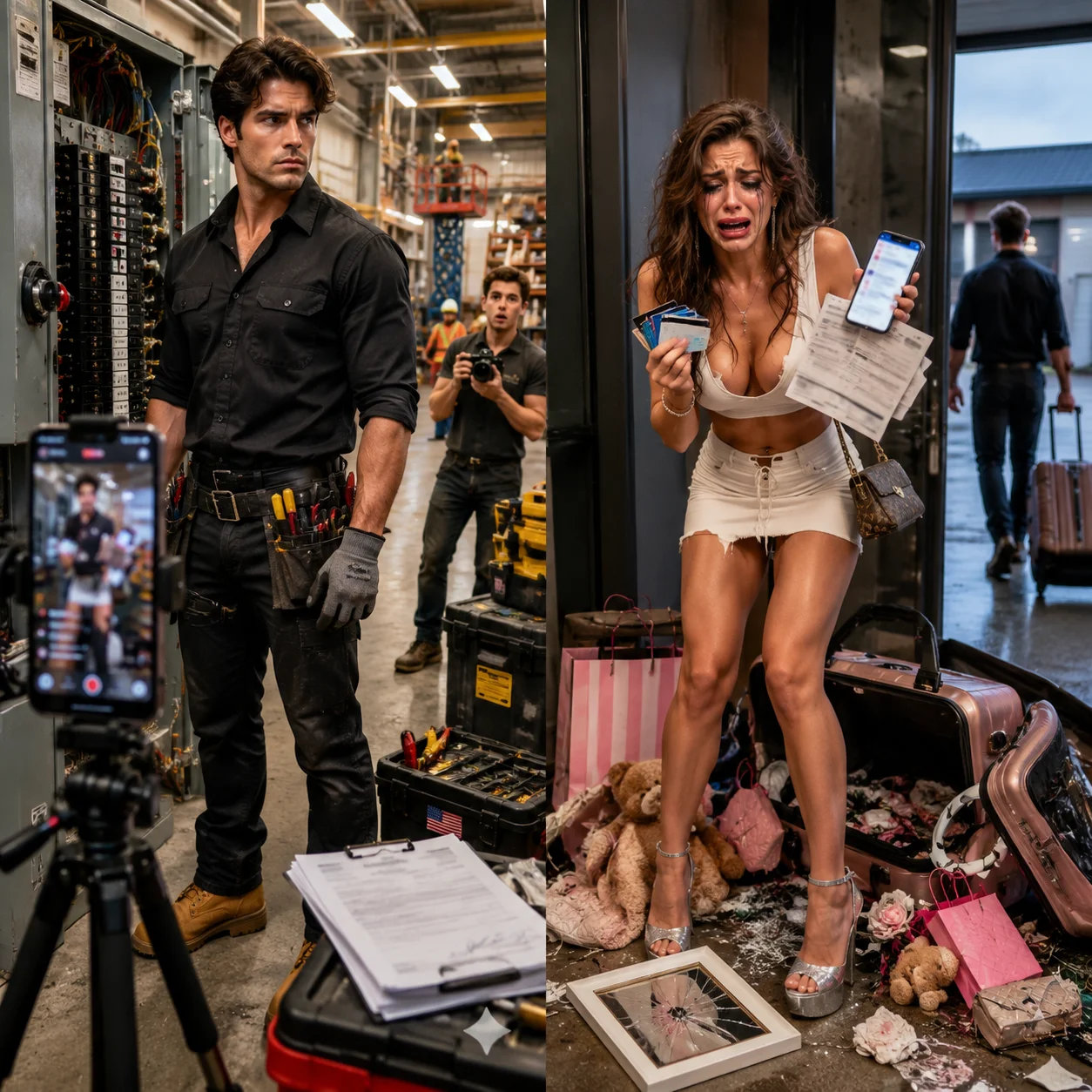
My girlfriend once looked me in the eyes and said, “Are you trying to crush my dreams? Do you want me to end up as average as you?”
So I asked her to leave.
A year later, she came back buried in debt.
She told me I was too mediocre to understand her dreams. Then, one year later, she showed up at my job desperate, broken, and asking for money.
My name is Fernando. I’m twenty-nine, and I work as an independent electrician. No glamorous office. No designer desk setup. No luxury apartment tour. No perfectly edited highlight reel.
Just tools, ladders, dirty hands, early mornings, long days, and clients who call me because something stopped working and they need someone who actually knows how to fix it.
But I earn well. I save carefully. I pay my bills on time. I sleep easy at night knowing everything I have is genuinely mine.
I want you to remember that detail, because this story is about what happens when someone mistakes appearance for achievement.
About two years ago, I was living with my girlfriend, Fernanda.
She was twenty-six when we met. Back then, she was kind, funny, and refreshingly simple. We would go for walks, watch movies, order cheap food, and stay up talking until midnight about nothing important. She worked as a barista at a small coffee shop downtown, and honestly, life was good.
Quiet.
Real.
Then came the Instagram accounts. The TikTok influencers. The women sipping matcha in silk robes, doing Pilates at sunrise, journaling beside massive windows, living inside apartments so perfectly lit they looked more like magazine sets than homes.
At first, Fernanda only watched them.
Then she started posting.
Recipes. Makeup routines. Outfit videos. Little lifestyle clips.
Normal stuff.
I even helped her. I held the phone. I adjusted lamps. I redid takes when the lighting was bad. I repainted one wall in our apartment because she said the background looked “too rental.” I thought it was a hobby, and I was happy she had something that excited her.
Then one evening, we were eating takeout while one of those influencer videos played on her phone. The woman on screen was arranging flowers in a kitchen that looked like no one had ever actually cooked in it.
Fernanda stared at the screen and said, “Someday that’ll be me.”
I smiled. “Well, if it makes you happy, go for it.”
She turned to me, completely serious.
“Fernando, I don’t want to try it. I want to achieve it.”
I laughed it off.
I thought she was motivated.
I did not realize that was the moment the cracks started forming.
She began spending money she did not have.
Clothes she barely wore. Minimalist decor for recording. Expensive mugs. Plants. Candles. Acrylic organizers. A sunrise alarm clock. Imported notebooks. Anything that made our apartment look more aesthetic on camera.
I paid most of the bills, so at first I did not say much. I loved her. I told myself it was a phase, an investment, something she needed to explore.
But something started unsettling me.
In her videos, she talked like she was already living a completely different life.
“Another day living off my content and building the life of my dreams.”
Meanwhile, the reality was that she had spent an hour recording in the morning, then worked an eight-hour shift making coffee for impatient customers.
I asked her about it once.
She said, “It’s marketing. People don’t follow someone normal, Fernando. They follow aspirations.”
That sounded hollow to me, but I let it go.
Then one morning, while I was in the middle of an office electrical job, my phone started vibrating like crazy. Message after message from Fernanda.
I thought something serious had happened.
I called her.
She answered screaming so loudly I had to pull the phone away from my ear.
“Fernando, it blew up. Three million views. Oh my God.”
One of her videos had gone viral overnight.
It was a staged “productive morning routine.” Her waking up at five, writing in a journal, doing Pilates, editing videos, smiling at a laptop while motivational text floated across the screen.
Perfectly curated.
Beautifully fake.
And the internet ate it up.
She went from two thousand followers to fifteen thousand almost overnight.
When I came home that evening, she had ordered expensive food to celebrate. She hugged me, kissed me, and her eyes were absolutely glowing.
“I told you I could achieve it.”
And honestly, in that moment, I was happy for her.
I thought maybe this could become something real.
It did not.
Over the next few weeks, Fernanda became glued to her phone. She stopped talking about the coffee shop. She started wearing a cap and a face mask during her shifts, claiming it was for privacy.
I knew the truth.
She was ashamed.
She wanted her followers to believe she already lived entirely from content creation.
I told her once there was nothing wrong with working.
She snapped, “It’s not shame. It’s brand strategy.”
Then came the day everything shifted.
She came home furious, slamming the door, pacing the apartment, unable to speak. I waited. Eventually, she told me a customer had recognized her at the register.
The girl had excitedly asked for a photo right there in front of everyone, then said, “I didn’t know you still worked here. I thought you lived off social media.”
Other customers had heard.
They stared.
Fernanda felt humiliated.
I tried to reason with her.
“You didn’t do anything wrong. You work there.”
She turned on me instantly.
“You’ve never believed in me.”
I blinked.
I had helped finance the entire project. I bought lights, stands, decorative backdrops. I repainted the wall. I skipped paid jobs to help her film. I had taken hundreds of videos, held reflectors, rearranged furniture, and eaten cold dinners because she needed one more take.
And she looked me in the eye and said I had never believed in her.
“Fernanda, I’ve supported you in everything.”
“Supporting me,” she said coldly, “isn’t saying what a pretty video. It’s understanding that I’m destined for something bigger.”
I did not answer.
I did not know how.
She went into the bedroom and closed the door.
I told myself it was just a bad day. That she would calm down. That she was embarrassed and taking it out on me because I was safe.
I was wrong.
The next evening, she was waiting at the table when I got home. She had that cold expression people wear when they have already made a selfish decision and are preparing to call it brave.
“I decided,” she said. “I quit.”
My stomach dropped.
“What?”
“I quit the coffee shop. I can’t build my brand while I’m still tied to a mediocre job.”
I sat down slowly.
“Fernanda, the platforms aren’t paying you enough yet.”
She shrugged.
“In the meantime, you earn well.”
And there it was.
The first quiet alarm went off somewhere deep inside me.
Not loud. Not dramatic.
Just a cold, silent warning.
I pushed her on the numbers. How much were brands paying her? What contracts did she have? How much was she actually making from views?
She looked away.
That said everything.
Almost nothing.
No real collaborations. No real income. Just an increasingly elaborate fantasy being kept alive on my credit card.
The months that followed were exactly as bad as I feared, and then worse.
Instead of tightening her spending after quitting, she spent more.
An expensive bag to “elevate brand perception.”
High-end makeup because “collaborations come when brands see you already use premium products.”
Designer sportswear for Pilates videos.
New lamps.
An imported coffee machine.
More decor.
More clothes.
More lies in better lighting.
Every purchase had the same justification.
“It’s to grow.”
Small brands started reaching out, but they were not real deals. They sent cheap products in exchange for reviews. Nothing that paid actual bills.
Meanwhile, I covered rent, utilities, food, internet, subscriptions, and more and more of her purchases quietly landed on my credit card with promises that in one or two months she would take off.
One or two months became six.
I came home one night after nearly twelve hours replacing wiring in an old building. My back ached. My shirt was stiff with sweat and dust. I opened my banking app to check a pending payment, and my chest seized.
The card was overdrawn.
Recent charges: a clothing store, a cosmetics brand, a decor delivery.
I walked into the living room.
Fernanda was filming herself arranging artificial flowers by the window.
I waited until she stopped.
“We need to talk.”
I held up my phone.
“What is this?”
She barely glanced at it.
“Oh, I bought some things for content.”
“The card is maxed out.”
She sighed like I was a child having a tantrum.
“Fernando, please.”
“We’re in debt.”
“You’re exaggerating.”
Then she said the line I still hear sometimes when the room gets too quiet.
“One day I’ll pay you back everything I owe you. Stop crying and just trust me.”
Stop crying.
Not, “I’m sorry.”
Not, “I didn’t realize it was that bad.”
Not, “Let’s fix this.”
Stop crying.
The contempt in her voice was unreal. Like worrying about our financial stability was something small and embarrassing. Something beneath her.
We argued for almost an hour. She left and slammed the door. When she returned two hours later, she was unnervingly calm.
She stood in the kitchen doorway and looked at me like I was the obstacle between her and destiny.
“You’re holding back my dreams,” she said. “Do you want me to be as mediocre as you?”
I went still.
She kept going.
She said my “conformist electrician mentality” would never understand what it meant to build something real. She said my fear of failure made me want to drag her into a gray life. She said I would never get far because people like me were built to survive, not grow.
Then she said, “I need to surround myself with people who vibrate higher.”
I did not yell.
I did not plead.
I did not even feel angry.
I felt relief.
I looked at her and said quietly, “Then leave.”
She blinked.
She had not expected that.
She was waiting for the breakdown, the begging, the emotional reaction she could use as leverage.
She got none of it.
“If that’s what you think of me,” I said, “leave.”
She left that same night.
She took her clothes, makeup, laptop, and almost every piece of absurd decor she had accumulated. When the door clicked shut behind her, I sat in the silence.
For the first time in months, I could breathe.
The weeks that followed were strange.
Then good.
Then genuinely excellent.
I paid off the debt. I rebuilt my savings. I slept properly. I worked better. Sometimes I caught glimpses of Fernanda’s account online.
Same matcha.
Same motivational speeches.
Same perfect morning routine.
Same lie.
But it barely registered anymore.
I was focused on my own life again.
Then something unexpected happened.
A colleague of mine named Ivan asked me to help him film a short video.
Ivan was everything I was not. Loud, funny, constantly joking, completely at home in front of a camera. He already had a small social media presence where he shared electrical repair tips and basic tutorials. Nothing massive, but enough that customers sometimes found him through it.
That day, we recorded something simple: how to detect a faulty switch.
Afterward, he grinned at me.
“We should do this together. You explain things really well, and you’ve got good presence.”
I laughed. “I’m not a camera person.”
He would not drop it.
So eventually, I said yes.
We launched a channel called Electro Brothers.
Basic tips. Common installation mistakes. Simple tutorials. Safety reminders. Short videos explaining what homeowners should never try on their own. Nothing fancy. No fake luxury. No rented apartments. No invented lifestyle.
Just two electricians being exactly who we were.
Then one day, we filmed a video where I walked step by step through how to replace a damaged electrical outlet without making the typical beginner mistakes.
Ten million views.
In one week, the account exploded.
Thousands of new followers every day. Messages flooding in from customers. Tool brands reaching out. Companies contacting us for partnerships. Our actual work expanded with it.
No more only small household repairs.
We started landing major projects. Full commercial installations. Corporate contracts.
One of the biggest companies in the city hired us to wire an entire new industrial warehouse.
The money came in ways I had never imagined.
But the better part, the part that actually meant something, was knowing we had not faked a single second of it.
About a year after Fernanda left, Ivan and I were inside that warehouse filming content, showing the industrial installation process. Ivan had the camera. I was mid-explanation of the main distribution panel when I noticed movement near the entrance.
I turned and stopped.
There she was.
Fernanda.
But not the Fernanda I remembered.
Not the woman who left me talking about vibrating higher and surrounding herself with greatness.
This woman looked exhausted. Dangerously thin. Her clothes were trying to look put together, but they did not quite succeed. Her makeup barely covered the shadows under her eyes. Her posture, that practiced confidence she used to carry into every room, was gone.
She looked small.
Unsure.
She stood at the entrance watching me like she did not know whether to walk forward or turn around.
Ivan quietly lowered the camera and looked at me.
Fernanda took one slow step forward.
“Fernando, can we talk?”
Her voice cracked at the edges.
Part of me thought about saying no.
I did not owe her anything.
But something in her face, something genuinely desperate, made me nod.
“Five minutes.”
We moved to a quiet corner of the warehouse. She took a few unsteady breaths. Then, surprisingly, the first thing she said was, “Congratulations.”
She looked around at the space, the team, the work in motion.
“You were always good at this. I just never let myself see it.”
I said nothing.
“I made a mistake,” she whispered.
“What do you want, Fernanda?”
Her eyes filled.
Then it all came out.
After leaving my apartment, she had kept going. Kept recording. Kept pretending. Kept manufacturing the illusion of a life she did not have. She moved in with a friend temporarily and refused to accept that the bet had not paid off.
So instead of recalibrating, she doubled down.
New credit cards.
Personal loans.
Elegant apartments rented by the hour to film in.
Photoshoots.
Short trips staged as self-care retreats.
Expensive breakfasts she barely touched because the photo mattered more than the meal.
She spent thousands building a life that existed only on a screen.
And for a while, the numbers kept growing. Comments poured in. People asked how she had achieved so much so young. People called her inspiring.
But brands still did not pay enough. Most collaborations were product trades, cheap items in exchange for exposure. Nothing that touched her actual expenses.
So she started paying debts with other debts.
One card to cover another.
Loans to cover interest.
Interest to cover lies.
Eventually, no institution would lend to her anymore.
That was when she went to the wrong people.
Informal lenders.
The dangerous kind.
When she said that, something cold moved through me.
Not sympathy exactly.
More like the rational dread you feel when you realize someone has walked into a situation with no clean exit.
“How much?” I asked.
She hesitated.
Then whispered a number.
It was far worse than I imagined.
“Are you serious?”
She nodded, tears spilling over.
“Fernanda, those people don’t wait.”
“I know.” She pressed her hands to her face. “They’ve been to my apartment. They call constantly. I think someone followed me last week.”
And in that moment, I understood exactly why she was standing in front of me.
“How much do you need?”
She looked up slowly.
She did not answer.
The silence did it for her.
I let out a short, humorless laugh.
“So that’s what this is.”
“Fernando, please.”
“You didn’t come because you regret what you did. You came because you’re out of options.”
“It’s not just that.”
“Yes, it is.”
Tears streamed down her face.
“I know I hurt you. I know I was horrible. But I’m scared, Fernando. I’m genuinely scared.”
I looked at her for a long moment.
Then I told her the truest thing I could say.
“You know what the worst part is? If you had come back a year ago just to apologize, nothing else, I probably would have forgiven you.”
Her lips trembled.
“But you’re not here because you miss me. You’re here because you need rescuing. And I can see the difference.”
That was when Ivan stepped in.
He had drifted closer once the conversation turned tense, and he had heard enough.
He looked at Fernanda with flat, unimpressed eyes.
“You really came here to ask him for money.”
“Stay out of this,” she snapped.
“Stay out of it?” He let out a short laugh. “I watched this guy rebuild his entire life from the ground up after what you did to him. So no, I don’t think I will.”
“You don’t know anything about it.”
“I know enough,” Ivan said. “I know you called him mediocre while using his money to cosplay success. I know you left because you thought he was beneath your dreams. And I know the only reason you’re back is because those dreams sent you a bill.”
Something in her snapped.
Her face twisted, and before I could react, she shoved him in the chest. Not hard enough to hurt him, but sharp enough to stun him.
“Shut up.”
Ivan stepped back.
I moved immediately.
“We’re done here.”
Fernanda turned to me, panicked. “Fernando—”
“Leave.”
“Please.”
“Leave, Fernanda.”
She stared at me with eyes full of water, panic, and something that might have been real regret. But it was too late.
We both knew it.
I kept my voice level. Firm. No anger. No cracks.
“I’m not giving you money. I’m not rescuing you from this. You need to call your family, talk to a lawyer, file reports if those lenders are threatening you, and get help from people who are equipped to deal with this. But it won’t be me.”
Her shoulders dropped like something inside her finally gave way.
For a few seconds, she just stood there, looking at the warehouse, at the workers, at the cables, at the camera Ivan had lowered, at the real life I had built while she was staging one.
Then she wiped her face with the back of her hand.
“I really did love you once,” she whispered.
I believed her.
That was the painful part.
“I loved you too,” I said. “But love doesn’t survive contempt.”
She looked at me one last time.
Not with hatred.
Not even with sadness.
With the expression of someone who finally understood, far too late, exactly what she had destroyed.
Then she turned and walked toward the exit without another word.
The warehouse hummed around us. Workers moving. Tools running. Real things being built.
Ivan exhaled slowly.
“What a disaster.”
I did not answer right away.
I looked at the distribution panel, the team, the job, the channel, the life I had rebuilt without pretending to be anything other than what I am.
And I felt the same quiet peace I had felt the night Fernanda walked out.
Not satisfaction at watching her fall.
Not revenge.
Just peace.
Some people do not come back because they miss you.
They come back because they miss what they could take from you.
Fernanda spent years chasing the appearance of success so desperately that she destroyed the only genuinely stable thing in her life. She did not even notice until it was completely gone.
I learned something different.
Real success does not need a filter.
It does not need rented furniture, fake captions, or a luxury apartment booked for two hours.
It does not need to insult the person paying the bills.
Real success is quieter than that.
It is waking up, doing the work, telling the truth, building something that still exists when the camera turns off.
A few months later, Ivan and I finished the warehouse project. The client loved the work so much they referred us to two more companies. Electro Brothers became an actual business, not just a channel. We hired two apprentices. Then a scheduler. Then rented a small office with terrible lighting and great parking.
The first thing Ivan did was put up a sign by the coffee machine.
“No fake lifestyles beyond this point.”
I laughed every time I saw it.
As for Fernanda, I heard through a mutual acquaintance that she eventually moved back in with her aunt and started working again. Not as an influencer. Not at first. Just a regular job at a retail store, trying to pay down debts and get away from the people she owed.
I hope she makes it out.
I mean that.
But I also hope she never forgets what it cost her to confuse being admired with being successful.
Because there is a difference.
Admiration can be rented.
Success has to be built.
And the person she called mediocre ended up building something real.
Not to prove her wrong.
But because that is what I had been doing all along.



![[FULL STORY] My Girlfriend Texted: “I Need Space. Don’t Contact Me.” I Said “Okay.”](https://social-media.rabedo.com/thumbnails/1776661079_650e6df4-e36d-474b-bf01-90e928aa48c6.png)