Evelyn Caldwell Bennett spent thirty-one years protecting her family name, her marriage, and the charitable foundation built by generations before her. Then one cream-colored envelope arrived at her office carrying the scent of another woman’s perfume — and enough evidence to destroy everything she thought she knew about her husband.
What Clayton Bennett believed would be his greatest political victory became the night his entire world collapsed in front of Washington’s most powerful donors. But Evelyn didn’t scream, beg, or break down. She did something far more dangerous. She waited until everyone important was watching.
The envelope arrived on a Thursday morning, the kind of pale cream stationery wealthy people use when they want paper to feel expensive enough to intimidate you before you even open it.
It was sitting neatly in the center of my desk at the Caldwell Family Foundation office in Alexandria, tucked between grant proposals and a handwritten thank-you note from a literacy nonprofit in Roanoke. My assistant, Mrs. Alvarez, had placed it there because my name was written across the front in elegant blue ink.
Mrs. Evelyn Caldwell Bennett.
No return address. No company logo. Just my name, our foundation address, and the faint scent of perfume that absolutely did not belong to me.
At fifty-eight, I had learned to respect small details. Perfume on a business envelope was not an accident. It was either vanity, carelessness, or a message.
I opened it with the silver letter opener my father gave me when I passed the Virginia bar exam thirty-four years earlier.
Inside was the quiet destruction of my marriage.
Not in the dramatic way people imagine. No lipstick on a collar. No text message glowing beside a sleeping husband. No overheard phone call in the middle of the night.
There was paper.
Paper has always been more dangerous than passion.
Passion lies. Paper remembers.
The first page was a typed note.
Clay,
I had to resend the corrected packet because the first version still had Evelyn’s foundation letterhead attached to the wrong pledge summary. Please destroy the old copies. Bellamy’s people want final donor confirmation before the dinner next Friday.
Also, the condo board approved the lease transfer. Once the Caldwell money is committed, you promised we stop hiding.
Don’t make me sit through another one of her charity luncheons pretending I’m just your consultant.
S.
I read it twice.
Then a third time.
My hands did not shake, which surprised me.
After thirty-one years of marriage, you expect betrayal to arrive loudly enough to honor the size of the wound. A crash. A scream. Some cinematic collapse dramatic enough to justify all the years you gave someone.
But betrayal entered my life quietly.
It smelled like another woman’s perfume and sat folded inside my family foundation stationery.
The second document was worse.
A donor pledge summary for something called the American Civic Renewal Initiative. Seven million dollars in political commitments. Names I recognized instantly. Families I had known for decades. Men who shook my father’s hand at charity galas. Women who attended my children’s christenings. People who trusted the Caldwell name because it had never been associated with scandal.
At the bottom of the page was a sentence that made my vision narrow.
Confirmed through Evelyn Caldwell Bennett and the Caldwell Legacy Circle.
I had confirmed nothing.
The next page carried my foundation letterhead. My digital signature. My name attached to language suggesting the Caldwell Family Foundation supported a Senate donor operation connected to Senator Jonathan Bellamy’s reelection network.
I sat back slowly in my chair.
Senator Bellamy himself was polished, disciplined, and careful enough to keep his hands technically clean. My husband, Clayton Bennett, had spent months orbiting his donor world like a man desperate to become indispensable.
Clayton had always been brilliant in rooms full of wealthy people. He could make millionaires feel wise, powerful, and morally necessary all at once. He knew how to flatter without sounding desperate and manipulate without sounding dishonest.
It was a talent.
Apparently, so was fraud.
I kept reading.
There were donor schedules. Seating arrangements for a private dinner at the Hay-Adams Hotel in Washington. Internal strategy notes. Private communications. Then finally, the thing that removed any remaining possibility of denial.
A Georgetown condo lease.
Clayton Bennett and Sabrina Vale.
Twelve months.
Two parking spaces.
Private entrance.
I knew Sabrina Vale.
Not intimately, but enough.
She was younger than me by nearly two decades and moved through Washington with the polished confidence of women who understand proximity to powerful men is its own form of currency. Blonde hair. Sharp eyes. Elegant dresses that looked effortless but probably cost more than my first car.
I had met her twice.
Once at a donor reception where she told me she admired “women of legacy.”
The second time at a charity breakfast where she touched my husband’s sleeve while laughing too hard at something that was not remotely funny.
I remembered that laugh now.
Memory becomes evidence very quickly once betrayal introduces itself.
At the back of the packet were photographs.
Clayton entering a Georgetown building with Sabrina.
Clayton kissing Sabrina in a hotel hallway.
Clayton holding her face in his hands with an intimacy that did not belong to consultants or colleagues or friends.
There was no room for interpretation.
Some betrayals at least offer you the mercy of uncertainty.
This one arrived notarized by reality itself.
I closed my office door and sat there listening to ordinary life continue around me. Phones ringing. Mrs. Alvarez speaking softly to a donor. Someone laughing near the conference room.
The world had not changed.
Mine simply split in half without disturbing anyone else’s Thursday morning.
For several minutes, I did absolutely nothing.
Then I photographed every page.
My father used to say, “Never react while the facts are still introducing themselves.”
So I let the facts continue speaking.
By lunch, every document had been scanned and secured.
By two o’clock, I had called Marianne Ellison, the only divorce attorney in Northern Virginia intimidating enough to earn my trust.
By four, our foundation’s compliance counsel had opened an urgent internal review regarding unauthorized use of foundation identity and donor communications.
I did not mention Clayton yet.
There would be time.
At six-thirty that evening, I drove home to McLean.
Our house sat behind old oak trees and discreet lighting, the kind of Virginia property designed to look inherited even when portions of it were purchased through strategic trusts and careful accounting. It was too large for two people and too full of memories for me to look at directly.
That was the first ache that reached me completely.
Not the affair.
The children.
Andrew at age eight asleep on Clayton’s chest during football games. Claire sitting between us during thunderstorms because she thought her father’s voice sounded calmer than rain.
Betrayal stains backward. It contaminates old photographs and Christmas mornings and every memory you once trusted without question.
When I walked into the kitchen, Clayton was pouring bourbon into a crystal glass.
He looked handsome in the dangerous way aging powerful men often do. Silver hair. Tailored navy suit. Expensive watch. Wedding ring still on his finger.
“Evie,” he said warmly. “You’re late.”
Evie.
He had called me that since I was twenty-six.
For one absurd second, I wondered what nickname he used for Sabrina.
Instead, I set down my handbag calmly.
“Foundation meeting ran long.”
He nodded sympathetically without asking why.
That had become our marriage in miniature. He enjoyed the image of being married to me far more than the reality of paying attention to me.
“Bellamy’s donor dinner is next Friday,” he said. “I need you there.”
Not Would you come?
Not I’d appreciate it.
I need you there.
I removed my earrings slowly.
“Do you?”
He smiled over the rim of his glass. “Don’t start. It’s important.”
“For whom?”
“For us.”
That almost made me laugh.
Men like Clayton use the word us when they need another person’s sacrifice to sound noble.
“What exactly is this dinner?” I asked carefully.
He sighed with practiced patience.
“Civic engagement. Donor alignment. Serious people investing in serious leadership.”
“Political money.”
“Responsible money,” he corrected.
“There’s usually less difference than people pretend.”
His jaw tightened slightly.
This was not a new argument. I had spent years reminding him charitable foundations and political ambition should remain separated by more than creative paperwork.
“Evie,” he said softly, “I need you to trust me.”
There it was.
The oldest sentence in the vocabulary of guilty men.
Not because trust has been earned.
Because trust prevents inspection.
I opened the refrigerator and poured myself water.
“What do you need me to do?”
His posture relaxed immediately.
He thought he had won.
“Just attend. Speak to the Virginia donors. Let them know the initiative has your confidence.”
“My confidence,” I repeated.
“You know how these people are,” he said. “They need continuity. Familiar names.”
Familiar names.
That part, at least, was true.
I looked at my husband carefully then.
Thirty-one years together, and he still underestimated the woman sitting across from him. He had forgotten I knew every donor worth protecting, every lawyer worth fearing, every board member who read footnotes before signing checks.
He thought I was useful because I was familiar.
He forgot I was dangerous for the exact same reason.
“I’ll be there,” I said.
He kissed my cheek.
I felt absolutely nothing.
That frightened me more than the envelope.
Over the next week, I became exactly the wife Clayton needed me to be.
Polite. Calm. Attentive.
At breakfast, I listened while he spoke about donor psychology and Senate strategy. At dinner, I asked questions just naive enough to lower his guard further.
Meanwhile, I prepared quietly.
Marianne Ellison reviewed the packet in silence before removing her glasses.
“How angry are you?” she asked.
“Less than I expected.”
“That may change.”
“I know.”
“Do you want a divorce?”
I looked toward the gray Potomac through her office windows.
“I want the foundation protected first. I want the truth documented before he rewrites it. Then yes. I want a divorce.”
Marianne nodded once.
“Good. Clarity saves money.”
We activated every safeguard available.
Foundation access was restricted. Internal systems audited. A forensic accountant named Leonard Price traced consulting payments tied to donor influence operations and politically connected nonprofits.
The numbers were ugly.
Clayton stood to make more than a million dollars once donor commitments cleared.
Not because he believed in public service.
Because he had monetized my reputation.
That realization changed something inside me permanently.
He had not merely cheated.
He had converted our marriage into collateral.
Three days before the donor dinner, Sabrina called me.
Her voice was controlled, but fear sat underneath every word.
“I believe a packet was delivered to your office by mistake,” she said carefully.
I stared at the cream envelope locked inside my desk drawer.
“Was it yours?”
“It was meant for Clayton.”
“Then why was my name on it?”
Silence.
That silence told me almost everything.
Eventually she admitted the truth in fragments. Clayton told her our marriage was emotionally over. Clayton promised the Georgetown condo would become theirs after the donor commitments finalized. Clayton assured her the foundation support was legitimate.
Then she discovered he planned to keep using me publicly far longer than he promised her privately.
So she saw the courier labels.
And she allowed the wrong envelope to continue toward my office.
Not an accident.
A calculation.
A younger woman trying to force a powerful man into choosing sides by detonating another woman’s life.
“You sent me a bomb,” I told her quietly, “and hoped the explosion would benefit you.”
“I panicked.”
“No,” I said. “You calculated poorly.”
She asked what I intended to do.
I looked down at the donor names spread across my desk. Families who trusted me. Organizations built carefully over decades.
Then I answered honestly.
“I’m going to do what I should have done years ago.”
The night before the donor dinner, Andrew flew in from Denver and Claire arrived from Boston.
Clayton was thrilled.
“A full family evening,” he said proudly. “Perfect timing.”
Neither child believed him.
After dinner, I told them the truth.
Not every detail. No child deserves photographs of their father kissing another woman in hotel hallways.
But enough.
The affair. The forged documents. The political scheme. The donor dinner. The divorce.
Andrew walked to the sink and stood gripping the counter with both hands.
Claire cried quietly without making a sound.
“Mom,” Andrew finally said, “why are you apologizing?”
“Because this will hurt you too.”
“Dad did this,” he said sharply.
“Yes,” I answered softly. “He did.”
Claire wiped her eyes.
“What are you going to do tomorrow?”
I thought of my father then.
“What your grandfather would have done.”
Andrew laughed bitterly.
“Destroy him politely?”
“Exactly.”
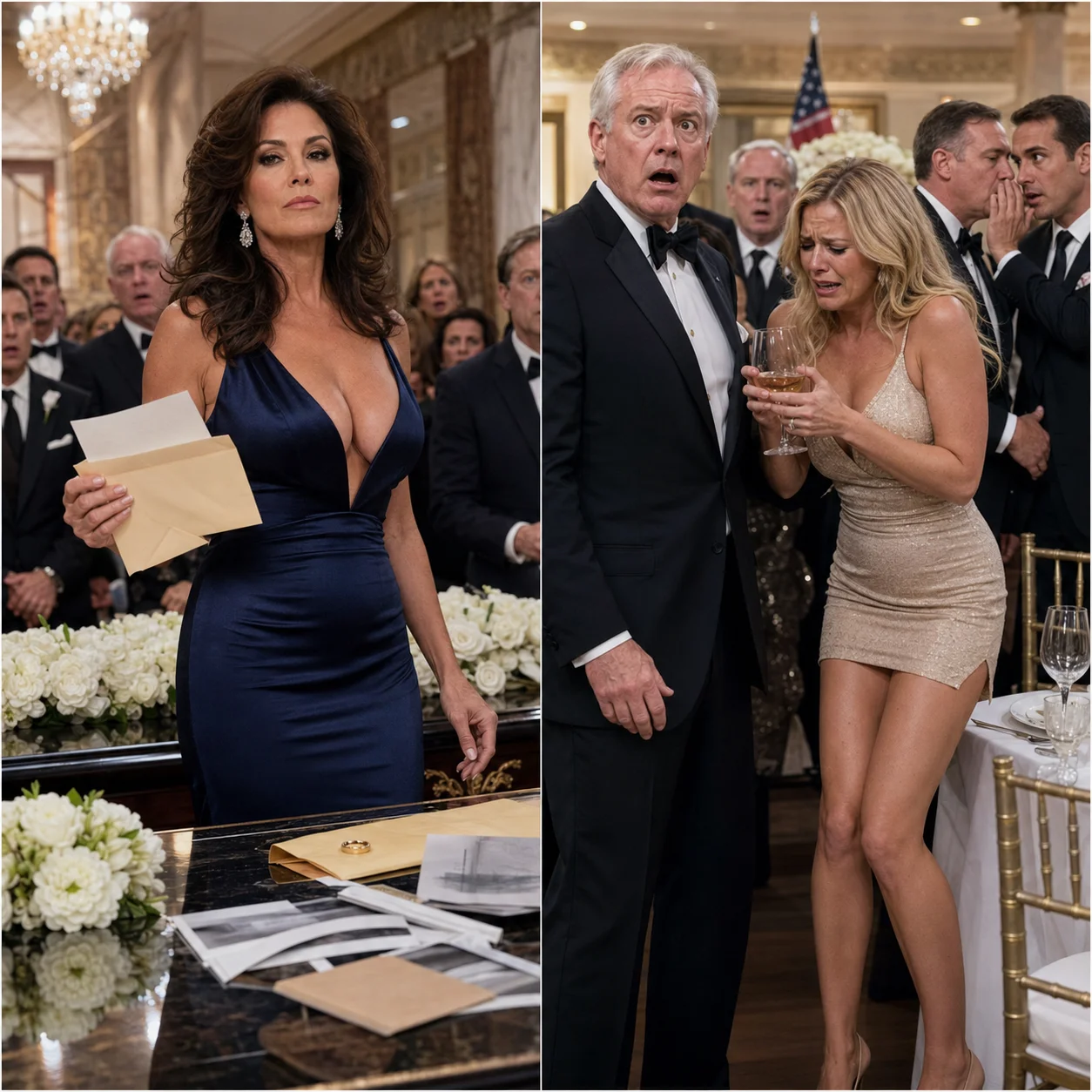
The donor dinner took place in a private room overlooking Lafayette Square.
Washington glowed outside in that deceptive way it does when powerful people want the city to look elegant instead of hungry.
The room itself was filled with polished wood, low candlelight, expensive flowers, and people speaking softly about influence disguised as patriotism.
Clayton wore a black tuxedo.
I wore navy silk and my mother’s pearls.
When I came downstairs, he actually looked moved.
“You look extraordinary,” he said quietly.
For one dangerous second, I saw the young man I married. Ambitious. Brilliant. Charming enough to make me believe his hunger would never consume us both.
Then his phone lit up.
He smiled at a message that was not from me.
The illusion disappeared.
By dessert, the room belonged entirely to Clayton. He moved between donors effortlessly, making greed sound responsible and power sound civic-minded.
Then Malcolm Reeves tapped a glass for attention.
“I’d like to recognize Clayton Bennett,” he announced warmly, “for bringing together individuals deeply committed to the future of this country.”
Applause filled the room.
“And of course,” Malcolm continued, “Mrs. Evelyn Caldwell Bennett, whose family legacy gives this effort such extraordinary credibility.”
More applause.
My name moved through the room like a key turning inside expensive locks.
Clayton stood to speak. He was magnificent at it. Warm. Controlled. Convincing.
Then he made his mistake.
He invoked my father.
“Whit Caldwell believed privilege should serve the public good,” Clayton said proudly. “Evelyn carries that legacy every day.”
Then he smiled toward me.
“My dear, would you say a few words?”
There it was.
The blessing he needed.
I stood slowly and walked toward the lectern while the room smiled expectantly around me.
“My father did believe privilege should serve the public good,” I began calmly. “He also believed the fastest way to corrupt good intentions was hiding private profit inside public language.”
The room shifted immediately.
Not dramatically.
Political rooms do not gasp.
They recalculate.
Clayton’s smile froze.
I continued.
“For that reason, the Caldwell Family Foundation has always maintained strict separation from partisan fundraising, donor bundling, and political consulting operations.”
Several donors straightened in their chairs.
“Unfortunately,” I said, “documents came into my possession this week suggesting my name, my foundation’s identity, and my digital signature were used without authorization to imply support for this initiative.”
Absolute silence.
Malcolm Reeves turned pale.
Senator Bellamy’s legal counsel immediately leaned toward an aide.
Clayton stepped toward me quickly.
“Evie,” he whispered sharply, “not here.”
I finally looked at him.
“No, Clayton. Here is exactly where you wanted my credibility.”
Then I opened the blue folder.
Marianne Ellison entered the room from the rear alongside foundation counsel and forensic auditors carrying donor packets.
The room did not explode.
It froze.
Which was worse.
Wealthy people fear scandal.
But they fear documentation far more.
“Each donor here will receive materials clarifying that neither I nor the Caldwell Family Foundation authorized any political representation involving our institution,” I said calmly.
Clayton’s face lost color.
“What have you done?” he hissed.
“What you taught me,” I replied quietly. “I made sure the right people were present.”
Then Sabrina stood abruptly from across the room.
“I was told Mrs. Bennett knew,” she blurted out.
Every head turned toward her.
Clayton looked genuinely terrified for the first time all evening.
“Sabrina,” he warned.
But panic had already overtaken her.
“No,” she snapped. “I’m not taking the fall for this.”
And just like that, the mistress became a witness.
I removed the original cream envelope from my folder, sealed inside a clear evidence sleeve.
Her handwriting remained visible across the front.
Mrs. Evelyn Caldwell Bennett.
“I received this last Thursday,” I said. “Inside were forged foundation documents, donor summaries, a Georgetown condo lease bearing both my husband’s name and Ms. Vale’s, and communications indicating my attendance tonight was considered critical to securing donor commitments.”
Clayton said nothing.
For the first time in our entire marriage, my husband had no language available to save himself.
Senator Bellamy stood carefully.
“Mrs. Bennett,” he said, “my campaign has no interest in donor commitments obtained through misrepresentation. Counsel will review this immediately.”
“I expected nothing less, Senator.”
Generosity, properly timed, can feel very similar to a knife.
Around the room, donors opened packets. Pages turned. Quiet whispers spread like smoke.
Then Dorothy Haines looked directly at Clayton and said with terrifying calm:
“You used her father’s name.”
Not a question.
A conviction.
Clayton tried once more.
“Evelyn, please. We can discuss this privately.”
I stepped away from the lectern.
“No. Our marriage will be discussed privately. Your misuse of my name will not.”
His eyes hardened.
“You have no idea what you’re destroying.”
I looked around the room at donors I had protected for decades. At lawyers collecting evidence. At Sabrina trembling beside her chair.
Then I looked back at my husband.
“I know exactly what I’m preserving.”
That ended the dinner.
Not officially.
Official endings involve announcements.
This one ended through instinct. Donors quietly closed folders. Staff began making urgent calls. Senator Bellamy exited with legal counsel. Sabrina disappeared with Marianne’s associates, eager to cooperate before someone positioned her differently.
Clayton and I stood near the windows while the room emptied around us.
“You humiliated me,” he said quietly.
“No,” I answered. “I documented you.”
The aftermath arrived slowly.
Like winter.
By Monday morning, Clayton’s consulting firm lost three major clients. By Wednesday, the Bellamy campaign publicly severed ties with every outside consultant connected to unauthorized donor representations.
They never mentioned Clayton by name.
They did not need to.
Washington ruins people very efficiently when it wants distance without spectacle.
The Georgetown condo lease became evidence. Sabrina retained counsel and cooperated aggressively. Bennett Strategic Partners collapsed within months.
Clayton moved into a furnished Arlington apartment with rented artwork and a view of traffic.
Our divorce became administrative after that.
Painful, yes.
But orderly.
Our postnuptial agreement handled most of the work. Infidelity clauses. Reputational harm provisions. Unauthorized use of family-controlled institutions.
Clayton challenged it briefly.
Then Marianne’s evidence packages arrived.
He settled quickly afterward.
One afternoon, several months later, Sabrina asked to meet me.
Against Marianne’s advice, I agreed.
She looked different without the Washington polish surrounding her. Still beautiful. Just frightened now.
“I loved him,” she admitted quietly over coffee.
I studied her for a long moment.
“I’m sure you believed that.”
“He said your marriage was dead.”
“My marriage was damaged,” I corrected. “That is not the same thing.”
She lowered her eyes.
“I sent the envelope because I wanted him forced into choosing.”
“No,” I said calmly. “You sent it because you discovered men willing to betray wives are usually willing to betray mistresses too.”
That landed hard.
Before leaving, she handed me another envelope containing additional messages from Clayton discussing divorce timing, donor money, and plans to “keep Evelyn calm until after commitments cleared.”
I took it.
Not because I needed revenge anymore.
Because truth deserves complete records.
Nearly a year after the donor dinner, the divorce became final.
The hearing lasted less than half an hour.
Outside the courthouse, Clayton stopped me.
“I’m sorry,” he said quietly.
This time, I believed he meant it.
It also no longer mattered.
“I know,” I answered.
Then I walked away.
The strange thing about surviving betrayal is realizing peace arrives long before forgiveness does.
The foundation recovered completely. Donations actually increased after new transparency measures were announced. Several donors privately told me they trusted the institution more because I refused to protect corruption simply because it shared my last name.
Andrew rebuilt his relationship with me carefully. Claire redesigned my library after the divorce because she said the room “still looked emotionally married.”
She was right.
The silence inside the house changed slowly too.
At first it echoed.
Then eventually it belonged to me.
Almost a year after the envelope arrived, I found it again inside my office safe.
The cream paper had faded slightly. Most of the perfume was gone.
For months I believed that envelope destroyed my marriage.
But it hadn’t.
Clayton destroyed the marriage.
The envelope simply turned on the lights.
People misunderstand revenge. They imagine screaming, public humiliation, shattered glasses, dramatic exits.
But the real revenge was much quieter than that.
It was waking up one morning and realizing I no longer cared whether Clayton regretted losing me.
His understanding was no longer required for my peace.
That afternoon, I fed the envelope into the foundation shredder while Mrs. Alvarez watched from the copier.
“Bad memories?” she asked gently.
I smiled faintly.
“Useful ones.”
The machine pulled the cream paper inward slowly until my name disappeared into thin unreadable strips.
Not erased.
Just transformed.
That evening I drove home through the Virginia dusk while golden light settled across the oak trees lining the driveway. The house glowed warmly through the windows.
For the first time in years, it no longer felt too large.
It felt safe.
Inside, I made tea and carried it onto the back porch. My mother’s pearls rested in a dish by the stairs. My father’s letter opener sat on my desk upstairs. Photographs of my children still lined the hallway exactly where they always had.
My name was still mine.
My father’s legacy remained clean.
And my life, finally, belonged entirely to me again.
Clayton Bennett used our marriage to secure a Senate donor deal.
Sabrina Vale sent me the wrong envelope.
But in the end, the only thing truly delivered to my door was the truth.
And unlike my husband, the truth arrived with evidence.

![[FULL STORY] She Said I Just Asked Him To Zip My Dress If Youre Jealous, Just Shut Up And Go Home Then She](https://social-media.rabedo.com/thumbnails/1776656995_fdc9d288-6500-4afe-8026-741c3b1c6493.png)

![[FULL STORY] The Rooftop Goodbye She Planned for Me](https://social-media.rabedo.com/thumbnails/1777148491_bd8bb0d7-2958-4eda-a028-d2a72d8dfaa9.png)


![[FULL STORY] My greedy wife tried to sell my late grandmother’s estate to fund her brother’s failing lifestyle, so I served her divorce papers at her family’s dinner party.](https://social-media.rabedo.com/thumbnails/1777352384_B18.png)