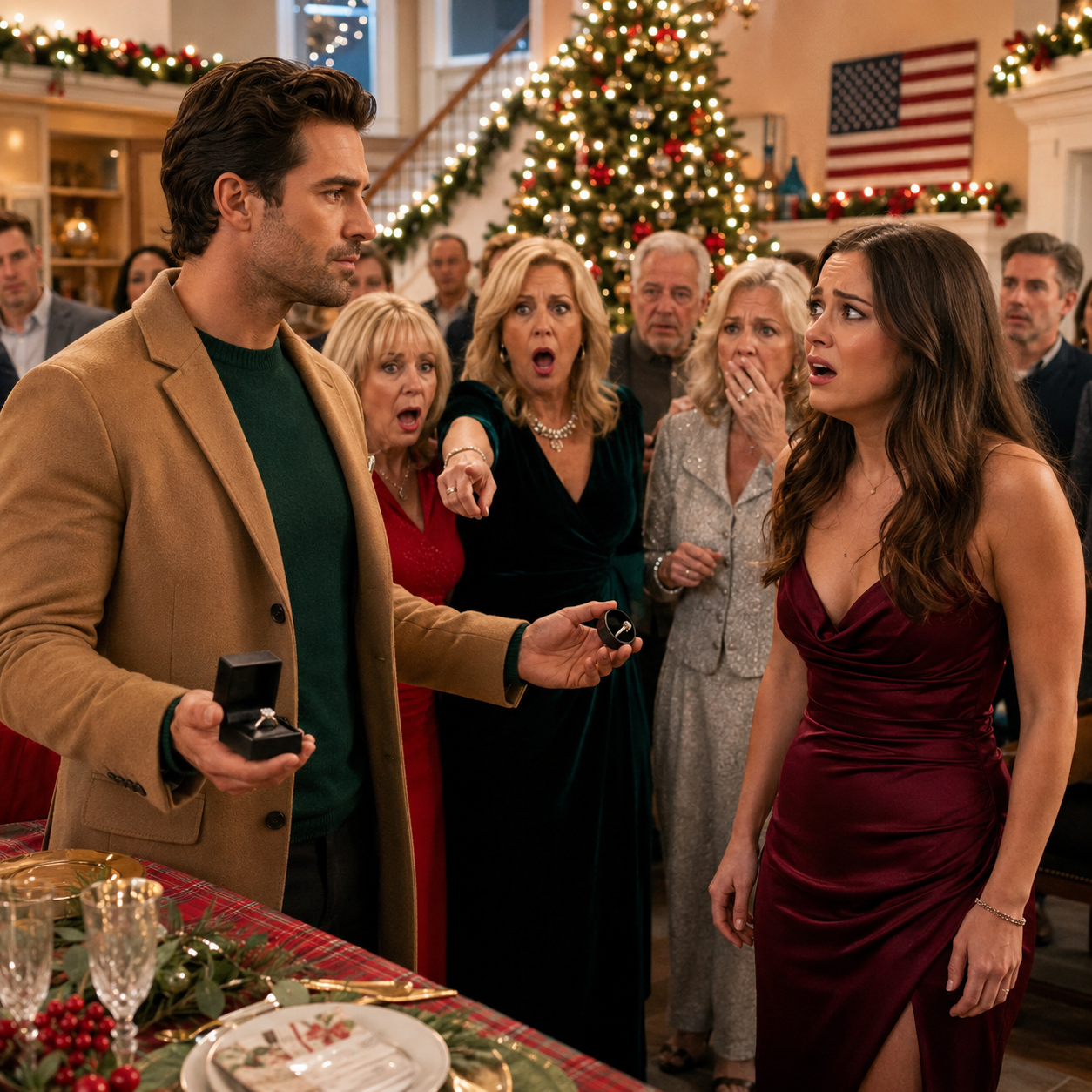

“That didn’t sound like drama.”
“Mason.” Her voice cracked on my name. “Please. That part of my life almost destroyed me. I told you the truth that matters.”
“The truth that matters?”
“He’s gone.” She grabbed my hand under the blanket. “That’s what matters.”
I wanted to ask gone where. Gone how. Gone from her life, or gone from the world? But she looked terrified, and I loved her, so once again I chose mercy over suspicion.
The engagement party was Diane’s idea.
“We need a proper celebration before the wedding chaos begins,” she declared. “Something elegant. Something people will remember.”
I should have been suspicious of that sentence.
Natalie wanted something small at first. Dinner with both families, a few close friends. But Diane insisted on renting a private room at The Bellweather House, a restored mansion outside the city that people used for weddings, fundraisers, and parties where everyone pretended not to care how much the flowers cost.
My parents drove in from Spokane. My younger sister Claire flew from Denver. Natalie invited coworkers, college friends, and a few relatives I had only heard about in fragments.
The night of the party, The Bellweather House looked like something from a magazine. Warm chandeliers. White roses. Champagne towers. A string quartet near the windows. Outside, December wind moved through bare trees, but inside everything glowed gold.
Natalie wore an emerald satin dress that made people stop mid-sentence when they saw her. Her hair was swept to one side, diamond earrings catching the light. She looked expensive and untouchable, but when I took her hand, her palm was cold.
“You okay?” I whispered.
She smiled for the room. “Just nervous.”
“This is just a party.”
“No,” she said quietly. “It’s never just a party with my mother.”
Diane was already commanding the room near the bar, introducing herself to my relatives as if she had arranged their existence. My father, a patient man who had survived thirty-eight years of marriage and two teenagers, leaned toward me and murmured, “Your future mother-in-law has the energy of a real estate agent selling a haunted house.”
I nearly choked on my drink.
For the first hour, everything went smoothly. Toasts. Laughter. My mother crying over Natalie. Claire teasing me about how I used to make spreadsheets for road trips. Natalie relaxed gradually, her fingers loosening around mine.
Then I saw the first sign that something was wrong.
Diane was near the entrance, speaking to one of the event staff. Her face had changed. Not anger. Not confusion. Fear.
Real fear.
She glanced across the room at Natalie, then quickly looked away.
I followed her gaze toward the front doors.
A man stood just inside them.
He was tall, maybe mid-thirties, with dark hair cut close at the sides and a face that looked like it had been rebuilt after too many hard years. He wore a charcoal suit, no tie, and held himself with the stillness of someone who had walked into a room knowing every person there would eventually turn toward him.
At first, I thought he was at the wrong event.
Then Natalie saw him.
Her champagne flute slipped from her hand and shattered on the hardwood.
The string quartet kept playing for two more seconds before the room fell into a silence so complete I could hear someone gasp near the dessert table.
The man looked at Natalie.
“Hello, Nat.”
Her face emptied.
Not paled. Not shocked. Emptied, like every version of herself she had built for me had suddenly stepped out of her body.
Diane moved first.
“You need to leave,” she hissed, crossing the room.
The man did not look at her. “I tried doing this privately.”
Natalie whispered, “Adrian.”
The name moved through the room like a dropped match.
I turned to her slowly.
Adrian.
The dead ex-boyfriend.
The car accident.
The closed door.
The man who was supposed to be buried in her past was standing ten feet away from us with wet snow melting on the shoulders of his suit.
My mother looked at me. My sister’s mouth opened slightly. Diane’s fingers curled like claws.
I could not feel my hands.
“Natalie,” I said, and my own voice sounded unfamiliar. “Who is that?”
She looked at me, and for the first time since I had known her, there was no performance left in her face. No careful wording. No controlled expression. Just panic.
“Mason, I can explain.”
Those four words are famous for a reason. Nobody says them before anything simple.
Adrian finally turned his eyes to me.
“You must be the fiancé.”
I did not answer.
He gave a humorless smile. “Congratulations.”
Diane stepped between him and Natalie. “This is harassment. I told you if you came near her again—”
“You told me a lot of things,” Adrian said. “Most of them were lies.”
Natalie grabbed my sleeve. “Please don’t do this here.”
Adrian’s jaw tightened. “You picked here when you ignored every message.”
“I didn’t get messages.”
“Yes, you did.” He looked at Diane. “Unless your mother is still checking your phone like she used to.”
The room seemed to tilt slightly.
My father put a hand on my mother’s arm. The event manager approached from the side, unsure whether this was a family argument or a security problem.
I finally found my voice.
“Everyone stop.”
The authority in my tone surprised even me.
I looked at Adrian. “Who are you?”
He held my gaze.
“My name is Adrian Vale. And until four years ago, Natalie and I were engaged.”
A sound moved through the guests. Shock, whispers, the little rustle of people realizing they were witnessing something they would talk about for years.
Natalie shook her head. “No.”
Adrian’s face hardened. “No? You’re denying that too?”
“Mason, listen to me,” she said.
But I could not look away from him.
“You were engaged?” I asked.
He nodded.
“She told me you were dead.”
The words left my mouth flat and cold.
Adrian blinked once, and the anger in his face shifted into something worse.
“She told you I was dead?”
No one moved.
Diane said, “Adrian, you need to leave before I call the police.”
He laughed once, bitterly. “Call them. Please. I’d love to explain why I’m here.”
Natalie whispered, “Mom, don’t.”
That one word—Mom—was not a warning. It was a plea.
I looked at Natalie. “What is going on?”
She opened her mouth, but nothing came out.
Adrian reached into his jacket.
My body tensed.
He noticed and raised his other hand. “Relax. It’s paper.”
He pulled out an envelope.
Diane lunged for it.
My father moved faster than I had ever seen him move and stepped between them. “Ma’am. Don’t.”
Diane froze, furious.
Adrian handed the envelope to me.
Natalie whispered, “Mason, please.”
I opened it.
Inside were photocopies. A marriage license application. A hospital discharge summary. A police incident report. A letter from an attorney. And a photograph.
The photograph showed Natalie younger, maybe twenty-five, standing beside Adrian in front of a courthouse. She wore a white dress. Not a wedding gown exactly, but close enough that no one could mistake what the day meant. Adrian had his arm around her waist. They were both smiling.
On her left hand was a ring.
My throat closed.
The marriage license application had both their names printed at the top.
Natalie Mercer.
Adrian Vale.
Date issued: four years ago.
I looked at her. “You told me you had never been engaged before.”
Her lips trembled. “We didn’t get married.”
“That’s your defense?”
“No. Mason, it wasn’t like this.”
Adrian said, “We were supposed to get married that Friday. She disappeared Wednesday night.”
Natalie turned on him. “Because I had to.”
“You left a note.”
“I was scared.”
“You emptied our account.”
“I didn’t know what else to do.”
“You let your mother tell everyone I threatened you.”
“Because you wouldn’t let me leave!”
The room erupted in whispers.
Adrian flinched as if she had slapped him.
“I wouldn’t let you leave?” he said softly. “Natalie, I came home and found your ring on the table. Your closet empty. My name frozen on every account. Then your mother told me if I contacted you again, she’d make sure I went to prison.”
Diane snapped, “Because you were dangerous.”
Adrian finally looked at her fully.
“No,” he said. “I was inconvenient.”
That sentence landed hard.
Natalie was crying now, but silently, tears falling without expression.
I looked at the papers again. “Why is there a hospital discharge summary?”
Adrian’s eyes moved to Natalie. Something in his face shifted from anger into grief.
She closed her eyes.
Diane said sharply, “That has nothing to do with Mason.”
“It has everything to do with him if he’s about to marry into this,” Adrian replied.
My stomach dropped.
I read the document.
Three and a half years ago, Natalie had been admitted under observation after a single-car accident outside Ridgefield. No major injuries. Mild concussion. Shock.
The emergency contact listed was Adrian Vale.
Relationship: fiancé.
But that was not what froze me.
At the bottom, under notes, someone had written: patient declined to discuss pregnancy loss with family present.
I read it twice because my brain refused to understand it the first time.
Pregnancy loss.
I looked up.
Natalie’s face crumpled.
“Mason,” she whispered.
The room blurred around the edges.
“You were pregnant?”
She covered her mouth with both hands.
Adrian looked down. “She never told me until after.”
Diane’s voice cut in. “This is disgusting. You don’t get to bring that up here.”
Adrian turned on her. “You brought it up when you told her I was the reason it happened.”
Natalie sobbed once.
Every guest in that room became irrelevant. The roses, the music, the champagne, the ring on her finger—everything faded until there was only the three of us and the secret standing between us like a fourth person.
I lowered the papers.
“Natalie,” I said carefully, “did he hurt you?”
She looked at me, and I knew she understood what I was asking.
For one long second, she had the chance to say yes.
If she had, I would have believed her until evidence forced me not to.
But she broke.
“No,” she whispered.
Diane’s head whipped toward her. “Natalie.”
Natalie stepped back from her mother. “No. He didn’t hit me. He didn’t hurt me like that.”
The silence after those words was brutal.
Adrian closed his eyes briefly, like he had been waiting years to hear that sentence and hated that it had taken this long.
I asked, “Then why did you tell me he died?”
Natalie’s shoulders shook. “Because it was easier.”
I almost laughed because the answer was so small compared to the damage.
“Easier?”
“I didn’t know how to explain it,” she said. “I didn’t know how to tell you that I had almost married someone else, that I had lost a baby, that I ran away instead of ending things like a decent person. I thought if I said he was dead, it would stay dead.”
Adrian’s voice was low. “I spent two years thinking you hated me enough to erase me. I didn’t know you were telling people I was buried.”
Natalie looked at him then. “I didn’t tell people. I told Mason.”
“That makes it better?”
“No.”
Her voice collapsed.
My sister Claire appeared beside me. “Mason, maybe we should take this somewhere private.”
She was right, of course. But embarrassment has strange gravity. Once your life starts falling apart in public, moving to another room feels like pretending the explosion is not visible from the street.
I looked at the guests. My coworkers. My parents. Natalie’s relatives. People holding tiny plates of food while watching my engagement die in real time.
“The party’s over,” I said.
Diane immediately protested. “Mason, don’t be dramatic.”
My father looked at her with quiet disgust. “I think dramatic walked in about five minutes ago.”
The event manager began guiding people toward the coatroom. Murmurs filled the room. Some guests avoided my eyes. Others looked hungry for more.
Natalie stood frozen beside me, her engagement ring shining under the chandelier.
When the room had mostly cleared, only my immediate family, Diane, Adrian, Natalie, and the event manager remained.
I asked the manager for a private sitting room.
She took one look at my face and nodded.
We moved into a smaller room off the hallway, lined with old books no one probably ever read. A fire burned in the marble fireplace. The room smelled like wood polish and smoke.
Nobody sat down except my mother, who looked like she might faint from rage.
I stood near the window, still holding the envelope.
“Start from the beginning,” I said.
Natalie wiped her face. “Mason, not with him here.”
“He walked into my engagement party after you told me he was dead. He stays until I understand why.”
Diane crossed her arms. “You owe this man nothing, Natalie.”
I looked at her. “I’m not asking you.”
For once, Diane shut up.
Natalie took a breath.
“I met Adrian when I was twenty-three,” she began. “I was working for a nonprofit then. He was doing photography for one of our events. He was kind, funny, ambitious. We fell hard. Too hard. Everything happened fast. Moved in together after eight months. Got engaged after a year and a half.”
Adrian watched her without speaking.
“I got pregnant,” she said, voice barely audible. “We weren’t planning it, but Adrian was happy. I was terrified. My mother told me it would ruin my life. She said I’d become dependent on him, that I’d disappear into motherhood, that men always use babies to trap women.”
Diane’s mouth tightened, but she did not deny it.
Natalie continued. “Adrian and I started fighting. Not because he was cruel. Because I was scared and he couldn’t understand why I kept pulling away. Then I lost the baby after the accident.”
Her hands curled around nothing.
“I don’t remember much from that night. I was driving back from my mother’s house. We had argued. I was crying. I hit black ice. The car spun out. I woke up in the hospital.”
Adrian said quietly, “Your mother told me not to come.”
Natalie looked at him. “I didn’t know that.”
“I was in the waiting room for six hours.”
She stared at him.
Diane said, “You were hysterical. You needed space.”
Adrian laughed without humor. “She needed her fiancé.”
Natalie turned away, crying again.
“She told me Adrian blamed me,” Natalie said. “She said he told the nurse he couldn’t even look at me. She said he wanted the ring back. I believed her.”
Adrian’s face changed completely.
“I never said that.”
“I know that now.”
“You never asked me.”
“I couldn’t.”
“Why?”
“Because if it was true, I would have died.”
The words hit the room with quiet force.
For the first time, I saw the tragedy beneath the lie. It did not excuse what Natalie had done. But it explained the wound she had built the lie around.
Diane had used grief like a crowbar. She had pried two broken people apart, then stood back and called the wreckage protection.
Natalie continued. “Mom told me to leave before you came home. She said if I stayed, you’d punish me forever for losing the baby. I was not thinking clearly. I was grieving. I was ashamed. I packed a bag. She helped me empty the savings account because she said I’d need money to start over.”
Adrian’s jaw clenched. “That was our wedding fund.”
“I know.”
“No. You don’t know. I thought you stole it because you never loved me.”
Natalie flinched.
Diane snapped, “You were unstable, Adrian.”
He looked at her. “I was mourning my child and trying to find my fiancée.”
My mother covered her mouth.
That was the first time anyone had said my child.
Not the pregnancy. Not the loss. My child.
Natalie looked like the words had physically struck her.
I asked, “Where did the death story come from?”
Natalie looked at me.
“After I left, I moved twice. Changed my number. Mom handled everything. She told people Adrian had become dangerous. Then one day she told me he had died in a crash.”
Adrian stared at Diane.
“What?”
Diane’s eyes flickered.
Natalie’s voice shook. “She said one of his friends called and told her. She said it was better this way. That he was finally gone. I didn’t go to a funeral. I didn’t search online. I couldn’t. I just… accepted it.”
I looked at Diane.
“You told your daughter he was dead?”
Diane lifted her chin. “I told her what she needed to hear to move on.”
Adrian took one step toward her, and my father immediately moved slightly in front of my mother.
“You let her mourn me?” Adrian said.
Diane’s expression hardened. “You were destroying her.”
“No,” he said. “You were controlling her.”
Natalie whispered, “Mom, tell me that isn’t true.”
Diane said nothing.
It was answer enough.
Natalie sat down suddenly, like her legs had stopped working.
I should have felt only sympathy then. Some part of me did. She had been manipulated by her mother at the lowest point of her life. She had been grieving, misled, cornered by a woman who seemed to confuse possession with love.
But another part of me—the part wearing the ring she had accepted—could not ignore the fact that years later, when she met me, when she loved me, when she agreed to marry me, she still chose to build our life on a grave that was empty.
She could have told me she had been engaged before.
She could have told me she lost a pregnancy.
She could have told me she had run from a painful past.
Instead, she told me a man was dead because it made the story easier to manage.
I asked Adrian, “Why come tonight?”
He looked exhausted suddenly.
“Because I found out about the engagement two months ago. A mutual acquaintance sent me a photo from Natalie’s announcement online. I didn’t plan to contact her at first. Then I saw a comment from Diane saying something about how happy she was that Natalie had found ‘a good man after tragedy.’”
Diane looked away.
“I messaged Natalie,” he said. “No response. I emailed. No response. I sent a letter to her office asking for one conversation—not to get her back, not to ruin her life, just to understand why I had been erased.”
Natalie looked confused. “I never saw a letter.”
Diane said, “Because I intercepted it.”
The room went silent again.
Natalie stood up slowly.
“You what?”
Diane’s voice was calm, almost bored. “It came to your office reception. I picked it up when I stopped by.”
Natalie stared at her mother as if seeing a stranger wearing her face.
“You opened my mail?”
“I protected you.”
“You keep saying that,” Natalie whispered. “But every time you say protected, you mean controlled.”
Diane’s mouth twitched. “Don’t be naive. You would have gone back to him.”
“No,” Natalie said. “I might have apologized.”
That seemed to wound Diane more than anger would have.
Adrian looked at me. “I didn’t come here to take her from you. I came because I didn’t want another man building his future without knowing there were buried wires under the house.”
The engineer in me almost laughed at the metaphor. Buried wires. Hidden faults. Load-bearing lies.
That was exactly what this felt like.
I turned to Natalie.
“Did you know he was alive before tonight?”
She shook her head quickly. “No. Mason, I swear. I thought he was dead.”
I believed her.
That was the worst part.
I believed she had been shocked. I believed Diane had lied to her. I believed Natalie had been a victim of something cruel.
But I also believed she had lied to me.
Both things could be true. That is what people never tell you about heartbreak. It rarely gives you one clean villain. Sometimes the person who hurt you was also hurt by someone else. Sometimes betrayal arrives carrying evidence of its own trauma. And you still have to decide whether the wound they gave you is one you can live with.
I looked down at the engagement ring on her hand.
“I need space,” I said.
Natalie’s face collapsed. “Mason.”
“I’m not making a decision tonight.”
“Please don’t leave me with this.”
“You left me with it in front of everyone.”
She recoiled.
I regretted the cruelty immediately, but I did not take it back because it was true.
My father stepped beside me. “Come on, son.”
Natalie grabbed my hand. “I love you.”
I looked at her fingers around mine. I thought about the bridge, the cold air, the way she had said yes like she meant it. I thought about every dinner, every laugh, every morning she stole my coffee and pretended she hadn’t. I thought about the dead man who was not dead, the child never spoken of, the mother who treated truth like a weapon to be hidden until useful.
“I love you too,” I said.
Hope flashed in her eyes.
Then I gently removed her hand.
“But love is not enough to marry a lie.”
I left The Bellweather House with my family.
Outside, snow had started falling harder. My suit jacket was not warm enough, but I barely felt the cold. Claire drove because my hands were shaking too badly to hold the steering wheel. Nobody spoke for the first fifteen minutes.
Finally, my mother said from the back seat, “I’m so sorry, Mason.”
I stared out the window.
The city lights smeared through the glass.
“So am I.”
Natalie called thirty-six times that night. She sent fifteen texts. Then one long email at 3:14 a.m.
I did not read it until morning.
She wrote everything. Not beautifully. Not defensively. Just desperately. She told me about the pregnancy, the accident, the grief, the way Diane had convinced her Adrian hated her. She admitted that saying he died had been cowardly. She said at first she had believed it, but later, when she started to suspect Diane’s version of events did not fully make sense, she chose not to investigate because the truth scared her.
That line mattered most.
I chose not to investigate.
It was the first honest thing she had said about the lie.
The next week was a slow collapse.
I moved into my parents’ guest room temporarily because Natalie and I had been living together in my apartment. She offered to leave instead, but I told her I needed time to think before making decisions about practical things. My life had become a list of uncomfortable logistics. Lease. Wedding deposits. Joint purchases. Family questions. Friends pretending not to ask for details while obviously starving for them.
Diane tried calling me once.
I answered only because I wanted to hear what kind of story she would tell.
“Mason,” she said warmly, like we had merely disagreed over seating arrangements. “I know emotions were high, but I hope you understand Natalie has been through more than you know.”
“I understand you lied to her for years.”
A pause.
“I made difficult choices as a mother.”
“You told your daughter her ex-fiancé was dead.”
“I saved her.”
“You isolated her.”
“She is fragile.”
“No,” I said. “You worked very hard to make her believe she was.”
Her voice sharpened. “Be careful. You don’t know the whole story.”
“I know enough to never take your version of one again.”
I hung up.
Two days later, Adrian emailed me.
The subject line was simple: I’m sorry.
He wrote that he regretted the public nature of what happened, but not the truth coming out. He said he had no intention of pursuing Natalie romantically. He was engaged once to the woman she had been, but that woman did not exist anymore. He had spent years in therapy trying to stop hating someone he still loved in fragments. Seeing her again had not revived anything. It had only confirmed how much damage silence could do.
At the bottom, he added one sentence that stayed with me.
“I hope you make the choice that protects your future, not the one that punishes her past.”
I read that line many times.
Natalie and I met eight days after the party at a quiet park near the river. It was brutally cold, the kind of gray morning where even the water looked tired.
She looked different. No makeup. Hair tucked into a wool hat. Her face pale from crying or not sleeping.
She was not wearing the engagement ring.
That hurt more than I expected.
We sat on a bench with a foot of space between us.
“I moved out,” she said. “I’m staying with Leah.”
Leah was one of her coworkers. Sensible. Kind. The kind of friend who did not thrive on chaos.
“I didn’t ask you to do that,” I said.
“I know. But I needed to. Not just for you.”
I looked at her.
She stared at the river. “I cut off my mother.”
I said nothing.
“She came to Leah’s apartment yesterday. Pounded on the door for twenty minutes. Told me I was ungrateful. Said you and Adrian had poisoned me against her.” Natalie laughed once, empty. “For the first time, I heard it. Really heard it. How she turns every consequence into proof that she’s the victim.”
“That must have been hard.”
“It was. But not as hard as realizing I became more like her than I wanted.”
I looked at her then.
She wiped her eyes with her sleeve.
“I lied because I was afraid you’d see me as damaged,” she said. “But that’s still manipulation. I gave you a version of me that was easier to love.”
I wanted to comfort her. I wanted to say she was not damaged. I wanted to take the old familiar role of steady man, safe man, fixer of storms.
But something inside me had changed.
“I did love the real parts,” I said. “That’s what makes this hard.”
She nodded.
“I started therapy,” she said. “An actual trauma therapist. Not the woman my mother picked years ago who told me avoiding triggers was healthy.”
“That’s good.”
“I also met Adrian.”
The words tightened something in my chest.
Natalie saw it and quickly added, “Not like that. Public place. Leah came with me. We talked for two hours.”
“How was it?”
“Awful.” She smiled sadly. “Necessary.”
She told me Adrian had brought a small box. Inside were things from their life together. Photos. A hospital bracelet. A tiny pair of yellow socks they had bought as a joke before they knew whether the baby was a boy or girl. Natalie had broken down when she saw them.
“He didn’t forgive me,” she said. “Not fully. I don’t blame him. But he said he didn’t want to carry hatred anymore.”
“And you?”
“I apologized. Not enough. But honestly.”
The wind moved through the trees.
Then she turned to me.
“Mason, I know I don’t deserve to ask for anything. But I need to know if there is any path back.”
There it was.
The question I had been avoiding because every answer hurt.
I looked at the woman I had planned to marry. I still loved her. That did not disappear because of one night. Love is stubborn. It keeps breathing in rooms where trust has already died.
But marriage is not built only from love. It is built from truth, from the boring daily courage to say the hard thing before it becomes a bomb. Natalie had not just hidden a chapter. She had rewritten it and let me make vows to a false history.
“I don’t think I can marry you,” I said.
Her face tightened, but she did not look surprised.
“At all?” she whispered.
“Not now. Maybe not ever.”
She closed her eyes.
I continued, because if I stopped, I might lose the courage.
“I believe your mother hurt you. I believe she lied to you. I believe what happened with Adrian was traumatic and complicated. But I also know you had chances to tell me the truth. You chose not to. And I can forgive a lot, Natalie, but I don’t know how to build a marriage with someone who made me part of her cover story.”
She began to cry silently.
I wanted to reach for her hand.
I did not.
“I’m sorry,” she whispered.
“I know.”
“I really did love you.”
“I know that too.”
And I did. That was the tragedy. Her love had been real. So had the lie.
We canceled the wedding the next day.
My mother handled some calls because I could not say the words more than twice without feeling like I was swallowing glass. My father helped me deal with vendors. We lost deposits. Diane sent me one venomous email accusing me of abandoning an emotionally vulnerable woman. I forwarded it to Natalie without comment.
She replied ten minutes later.
I’m sorry. I blocked her.
For the next few months, life became quiet in a way that felt both peaceful and unbearable. I moved back into my apartment after Natalie collected her things. She left the keys on the kitchen counter with a handwritten note.
Mason,
I am sorry for the home I let you build on a foundation I knew was cracked. You deserved truth before love, not after disaster. I hope one day I become someone who would have told you everything.
—Natalie
I kept the note in a drawer for reasons I could not explain.
Adrian and I never became friends, exactly, but we spoke once more. He asked if I wanted the original papers or if copies were enough. I told him copies were enough. Then, after an awkward pause, I asked how he was.
He said, “Lighter.”
I understood.
Six months later, Claire sent me a screenshot. Natalie had posted a simple photo of a hiking trail at sunrise. No dramatic caption. No hidden message. Just: Learning how to keep walking.
I stared at it longer than I should have.
Then I closed the app.
A year passed before I saw her again.
It happened at a bookstore downtown. I was buying a gift for my mother when I turned a corner and found Natalie standing in the memoir section, holding a book against her chest.
For a second, neither of us moved.
She looked healthier. Softer. Her hair was shorter. There was no panic in her face, only surprise and something like caution.
“Hi, Mason,” she said.
“Hi.”
We spoke like people approaching a scar carefully. She told me she had moved to Portland for several months, kept seeing her therapist, and started working for a smaller nonprofit instead of corporate events. She said she was still no-contact with Diane, though her mother occasionally tried reaching her through relatives.
“Adrian got married,” she said.
That surprised me.
“He sent me a message before the wedding. Just said he hoped I was healing.”
“How did that feel?”
She smiled sadly. “Like the door finally closed without slamming.”
I nodded.
Then she looked at me.
“And you?”
“I’m okay.”
It was the truth, mostly.
There was a woman I had been seeing casually named Elise, a landscape architect with a dry sense of humor and a habit of asking direct questions without apology. I had told her about Natalie on our fourth date. Not every detail, but enough. She listened, then said, “I don’t do mystery boxes. If we keep seeing each other, we tell the truth even when it makes us look bad.”
I liked her immediately for that.
Natalie noticed something in my face.
“You met someone,” she said.
I did not deny it.
“I’m glad,” she said, and her voice only broke a little.
We stood there between shelves of other people’s stories, both of us holding the remains of one we never finished.
“I never stopped being sorry,” she said.
“I know.”
“And I know sorry doesn’t change what happened.”
“No,” I said. “But it matters that you became someone who understands that.”
Her eyes filled, but she smiled.
“Thank you for saying that.”
We said goodbye without touching.
As I walked out of the bookstore, I felt something I had not expected.
Not grief.
Not anger.
Release.
For a long time, I had thought the worst thing that happened to me was that a dead man walked into my engagement party. But the truth was, Adrian did not ruin my life. He interrupted a lie before it became a marriage, a mortgage, children, and years of me wondering why certain doors in my own home were always locked.
He did not steal Natalie from me.
He gave me back the right to choose with my eyes open.
That night, I called Elise and told her the whole story. Not the edited version. Not the version that made me look perfectly calm or wise. I told her about the party, the humiliation, the grief, the part of me that had wanted to forgive Natalie just to avoid losing the future I had imagined.
When I finished, there was a long silence.
Then Elise said, “That must have been devastating.”
“It was.”
“And you’re telling me now because?”
“Because I don’t want to build anything with hidden rooms.”
She was quiet for another second.
Then she said, “Good. I don’t like hidden rooms.”
Two years later, when I proposed to Elise, I did it in our kitchen on a Sunday morning while she was wearing one of my old sweatshirts and arguing with a crooked cabinet handle. There were no chandeliers, no champagne towers, no room full of people waiting to applaud.
Just sunlight on the floor.
Just honesty.
Just a ring I offered with steady hands.
Before I asked, I told her, “There are things in my past that still hurt sometimes.”
She smiled gently. “I know. There are things in mine too.”
“That doesn’t scare you?”
“No,” she said. “Secrets scare me. Scars don’t.”
So I asked.
She said yes.
And this time, when I looked at the woman in front of me, I did not feel like I was standing on buried wires.
I felt the ground hold.
![[FULL STORY] I Switched My Husband’s Drink After I Heard Him Planning My Death](https://social-media.rabedo.com/thumbnails/1777501289_7aa24349-c107-4152-acd9-140ba0381154.png)
![[FULL STORY] He Threw Me Out of My Own House in Front of 300 Guests… He Didn’t Know I Owned the Land Under It](https://social-media.rabedo.com/thumbnails/1776668946_d53.jpeg)
![[FULL STORY] My Wife Said I Was a Burden — But Her Father’s Question at Sunday Dinner Destroyed Everything](https://social-media.rabedo.com/thumbnails/1776420389_673883898_980389477846588_1087884873175658372_n.jpg)