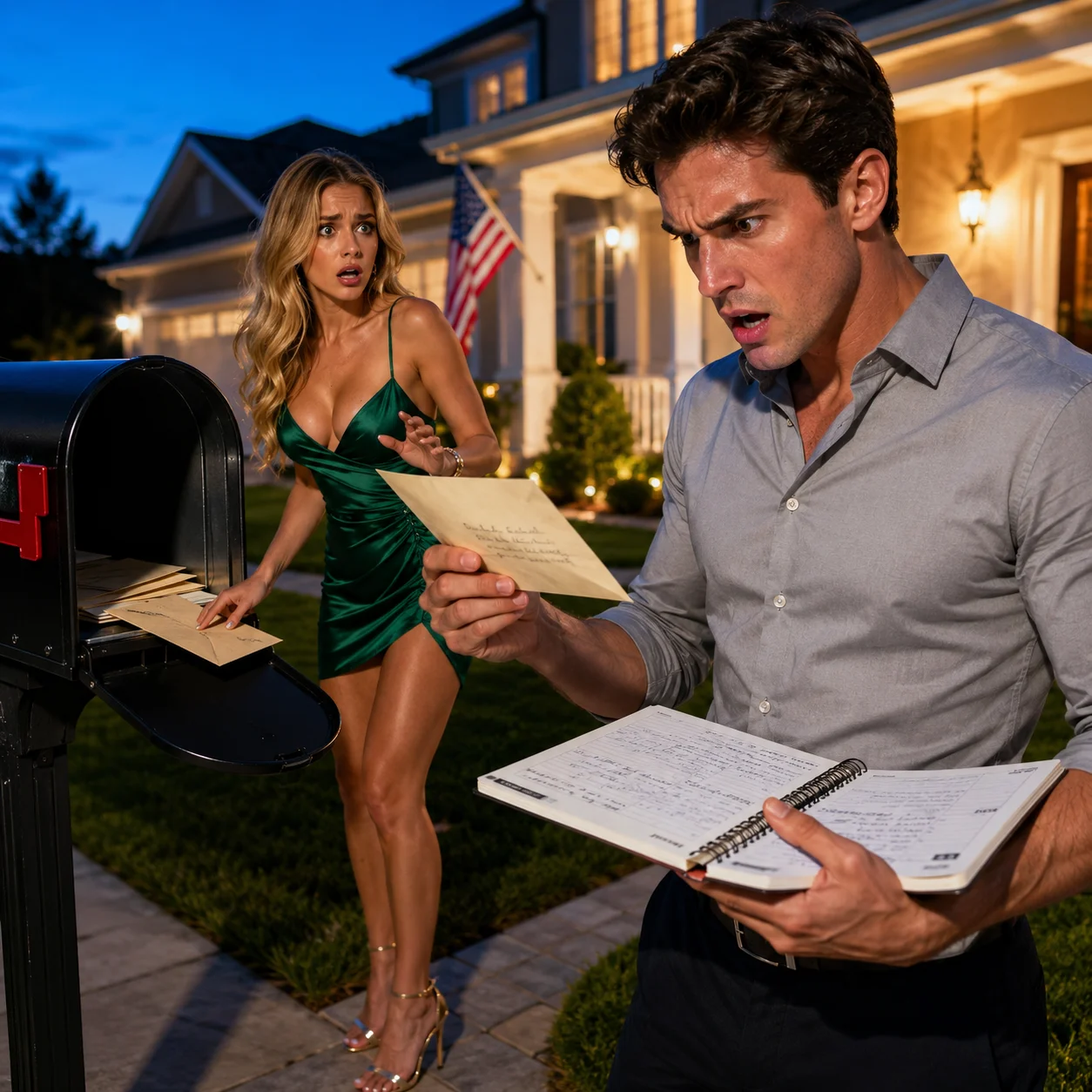
We sat at the kitchen table until after midnight, going through names from her past. Ex-boyfriends. Old coworkers. Men from college. One former supervisor she said had made her uncomfortable years earlier. A guy from the gym who once asked for her number. Someone from a vendor meeting who lingered too long during introductions.
Every name made me angrier. Every possibility made me more determined to protect her.
By the next morning, I had changed the locks, added a second camera near the garage, and ordered a small camera angled toward the mailbox. I also called the local police non-emergency line. The officer I spoke to was polite but not especially concerned.
“Keep the letters,” he said. “Don’t handle them more than necessary. If there’s a direct threat or if you catch someone trespassing, call us.”
Elise sat beside me on the couch while I made the call. She held my hand the whole time.
After I hung up, she leaned into me and whispered, “I hate that this is happening right before the wedding.”
“Hey,” I said, kissing the top of her head. “Nobody is going to ruin this for us.”
She squeezed my hand.
Looking back, I wonder whether that was the moment she almost stopped.
There are memories that change shape after betrayal. At the time, her touch felt grateful. Later, I wondered if it had been guilt.
For two weeks, nothing happened.
Life returned to its usual pre-wedding chaos. We tasted cake. We argued gently over whether my cousin’s new girlfriend needed a plus-one. We met with the photographer. Elise went to final fittings, and I pretended not to panic every time another invoice landed in my inbox.
But the letters had changed the air in our house.
Elise became jumpy. She asked me to walk her to her car in the morning. She wanted me to check the locks at night. She stopped going for evening runs. She looked over her shoulder in parking lots.
And I became exactly the man she needed me to become.
Protective. Distracted. Focused on the threat outside.
Not once did I look inside.
The third letter came on a Sunday afternoon while Elise’s mother was visiting.
Cynthia Holloway was the kind of woman who could inspect a room without turning her head. She had never disliked me openly, but she had a talent for making approval feel temporary. She loved Elise fiercely and treated our wedding less like a celebration and more like a merger between her daughter’s beauty and my stability.
That afternoon, she was sitting in our living room going over guest list changes with Elise while I grilled chicken in the backyard.
When I came around front to grab a package from the porch, I noticed the mailbox door hanging slightly open.
My stomach tightened.
I walked to the curb.
There it was.
Cream envelope. Blue ink. For Elise.
I stood in the driveway holding it, suddenly aware of the quiet street, the empty sidewalks, the trimmed lawns, the normalness of everything around me.
Whoever was doing this was either very careful or very close.
Inside, Elise’s mother was laughing about some cousin who had apparently offended half the family by requesting vegan options. Elise looked up when I entered, and the laugh died in her throat.
Cynthia noticed.
“What is it?” she asked.
I placed the envelope on the coffee table.
Elise stood so quickly that one of the guest list pages slid to the floor.
“Again?” she whispered.
Cynthia looked from her daughter to me. “Again?”
Elise closed her eyes. “Mom, please don’t.”
But Cynthia was already reaching for the envelope. “What is this?”
I stopped her gently. “We should avoid touching it too much.”
That got her attention.
“Elise,” Cynthia said slowly, “what is going on?”
Elise broke.
Or performed breaking.
I still don’t know which.
She sat down and covered her face while I explained the letters. Cynthia’s expression hardened with each sentence. By the time I finished, she looked at me like I had personally failed to secure a national border.
“And what are you doing about it?” she asked.
I swallowed my irritation. “Cameras. Police report. We’re keeping everything documented.”
“Clearly not enough if someone is still putting things in your mailbox.”
I wanted to snap back. Instead, I opened the envelope using a clean paper towel while Elise watched through wet eyes.
This one said:
He can put a ring on your finger, but he cannot erase what you promised me. I know the real you. I know what you want when no one is watching.
Cynthia made a sound of disgust.
Elise whispered, “I’m going to be sick,” and rushed upstairs.
Her mother followed.
I stayed in the living room with that letter on the table, staring at one phrase.
What you promised me.
It implied history. Intimacy. A secret.
That night, after Cynthia left, I asked Elise the question I had been avoiding.
“Is there anyone you haven’t told me about?”
She sat on the edge of our bed in silk pajamas, face bare, eyes red. “What does that mean?”
“It means these letters sound personal.”
“I know.”
“They sound like someone believes you had something with them.”
Her face tightened. “Believes. That doesn’t mean it happened.”
“I didn’t say it did.”
“You’re looking at me differently.”
“I’m trying to understand.”
“No,” she said, standing. “You’re wondering if I caused this.”
I rubbed both hands over my face. “Elise, someone is leaving letters in our mailbox talking about promises and choosing differently. We’re getting married in three months. I need to know if there’s something I should know.”
She stared at me like I had slapped her.
Then she said, very quietly, “His name was Daniel.”
The room changed.
I sat still.
She looked away. “We dated before you. It was intense and unhealthy. He wanted more than I could give. I ended it before I met you.”
“How long before?”
“A few months.”
I absorbed that. “Why didn’t you mention him when we went through names?”
“Because I didn’t think it was him.”
“Why?”
“Because he moved to Oregon.”
“Are you still in contact?”
“No.”
The answer came quickly. Too quickly, maybe. But I was relieved to have a target for my fear.
“What’s his last name?”
“Voss.”
I searched him online that night after Elise fell asleep.
Daniel Voss existed. He was thirty-four, worked in landscape architecture, and had moved to Portland two years earlier according to a company profile. His social media was mostly private. His profile photo showed a thin man with sandy hair and serious eyes.
I hated him immediately.
Not because I knew he was guilty.
Because I needed him to be.
The next morning, Elise told me she didn’t want me contacting him.
“That could make it worse,” she said.
“It could also make him realize we know.”
“Aaron, please. If this is him, he wants attention.”
That made sense. It also sounded like something she had thought about before.
Still, I listened.
The fourth letter arrived six days later.
By then, the mailbox camera was installed.
I had positioned it from an upstairs window with a clear angle down the driveway. It recorded continuously to a cloud account only I could access. I felt almost embarrassed by how satisfied I was when I set it up. I imagined catching Daniel Voss in the act. I imagined showing the footage to police, to Elise, to Cynthia, to everyone. I imagined ending the nightmare with evidence.
The letter appeared anyway.
I found it at 7:10 a.m. on a Friday.
Cream envelope. Blue ink.
For Elise.
My first reaction was triumph, not fear. Finally, we had footage.
I opened the camera app before I even went inside.
I scrolled backward through the night.
Nothing.
No person. No car stopping. No shadow near the mailbox.
The mailbox was visible the entire time.
At 11:43 p.m., the mailbox was empty.
At 11:44 p.m., a passing car’s headlights washed across the curb.
At 11:45 p.m., the envelope was there.
I watched the clip ten times.
No one approached.
No one walked away.
The envelope simply appeared in the small blind spot created when the headlights flared against the camera lens.
Whoever had done it knew exactly when the camera would be useless.
Or they knew where it was.
I felt cold for the first time.
Not angry.
Cold.
Inside the house, Elise was still asleep. I stood in the kitchen holding the envelope, listening to the hum of the refrigerator.
I opened it alone.
This letter said:
You always loved the game more than the prize. Does he know that yet?
I read the line again.
Then again.
You always loved the game more than the prize.
Something about it scratched at me.
Not the meaning. The shape.
The way the Y in “you” dipped below the line. The way the lowercase “g” curled inward. The way the writer crossed the T in “the” with a short, sharp slash.
I had seen it before.
I told myself that was impossible.
Handwriting can look similar. People exaggerate patterns. Stress creates connections where none exist.
I folded the letter back into the envelope and placed it in a plastic bag with the others.
Then I went upstairs.
Elise was sleeping on her side, one hand under her cheek, the engagement ring glittering faintly in the dim room. On her nightstand sat a notebook.
A wedding notebook.
White cover. Gold corners. Her name and mine embossed on the front.
She used it constantly—for vendor notes, seating charts, vows, little reminders to herself. I had seen it open a hundred times. I had even teased her for writing everything by hand when spreadsheets existed.
I walked to her side of the bed.
My heart began to pound.
I should not have touched it. That was what the decent part of me said.
But another part, the part that had been losing sleep and checking locks and imagining some unstable ex watching our house, reached for the notebook.
I opened it carefully.
The first page had our wedding date written in large letters.
June 14.
Below it, Elise had written:
Remember: soft ivory, not bright white. Ask Dana about garden lights. Tell Aaron he was right about the jazz trio.
My mouth went dry.
The Y dipped below the line.
The lowercase g curled inward.
The T in “the” had that same short, sharp slash.
I stopped breathing for a second.
Then I flipped to another page.
Guest table revisions. Same handwriting.
Vow draft. Same handwriting.
A note that said Don’t forget to breathe. Same handwriting.
I stood there in our bedroom while the woman I planned to marry slept two feet away, and the life I had been building quietly cracked through the center.
At first, I did not feel betrayed.
I felt stupid.
That is the first emotion nobody warns you about. Not heartbreak. Not rage. Stupidity. The humiliating replay of every moment you comforted someone who was lying into your chest. Every time you said, “We’ll get through this,” while they were the one building the fire.
I put the notebook back exactly where it had been.
Then I went downstairs and made coffee I did not drink.
When Elise came into the kitchen twenty minutes later, she looked at the counter.
“Did mail come?”
I studied her face.
There was fear there.
But now I could not tell if it was fear of the letters or fear of being caught.
“Yes,” I said.
Her fingers tightened around the sleeve of her sweatshirt. “Another one?”
I nodded.
She closed her eyes. “What did it say?”
I took the envelope from the plastic bag and set it down.
She reached for it, then stopped. “You read it?”
“Yes.”
She looked wounded. “Without me?”
“You were asleep.”
She picked up the letter and read it. Her face moved through the familiar sequence—confusion, fear, pain. It was a beautiful performance. Subtle. Controlled. Not too much.
I hated that I could see the craft in it now.
“What does that mean?” she whispered.
“I was hoping you could tell me.”
Her eyes snapped to mine.
There it was.
A flicker.
Tiny. Almost invisible.
But I saw it.
“Why would I know?” she asked.
“I don’t know.”
She placed the letter down. “You’re doing it again.”
“Doing what?”
“Looking at me like I’m hiding something.”
“Are you?”
Her mouth parted.
Then tears filled her eyes. “I can’t believe you just asked me that.”
Two weeks earlier, that would have ended the conversation. I would have apologized. I would have held her. I would have cursed the person making her feel unsafe.
This time, I said nothing.
Her tears trembled but did not fall.
“I’m going to shower,” she said.
She left the kitchen quickly.
The second she was upstairs, I took photos of every letter, every envelope, and several pages from her wedding notebook.
Then I called my older brother.
Nathan was a divorce attorney, which was funny in the way life becomes funny when it stops being kind. He had been quietly skeptical of my engagement from the beginning, not because he disliked Elise, but because he believed I mistook intensity for intimacy.
I used to hate when he said things like that.
Now, when he answered, I said, “I need you not to react until I finish.”
He listened.
When I was done, he was quiet for a long moment.
Then he said, “Do not accuse her yet.”
“That’s your advice?”
“My advice is evidence first, emotion second.”
“I have the handwriting.”
“You have suspicion. Strong suspicion, but suspicion. If she’s doing this, she’s not going to admit it because you ask nicely.”
I gripped the phone. “Why would she do this?”
“That is the wrong first question.”
“What’s the right one?”
“What does she gain?”
I wanted to say nothing.
But even as the word formed, my mind started answering.
She gained my attention. My protection. My guilt for ever questioning her. Her mother’s sympathy. A villain from the past to explain any emotional distance. A story.
And maybe, most importantly, control.
Nathan told me to document everything and set a trap.
“Do not do anything illegal,” he said. “No hidden cameras in private spaces. No threats. No dramatic confrontation unless you’re ready for the relationship to end.”
“It might already be over.”
“Then be smart enough not to let her write the ending.”
That sentence stayed with me.
Over the next few days, I became someone Elise did not recognize.
Not cruel. Not distant exactly. Just careful.
I still kissed her goodbye. I still talked about wedding details. I still checked the locks when she asked. But inside, I was watching.
The mailbox camera stayed where it was. I did not mention the blind spot.
I bought a second small camera and placed it inside my car, angled toward the mailbox from the street. It was legal, visible if someone looked closely, and connected to a separate memory card. I did not tell Elise.
I also bought a pack of nearly identical cream envelopes and stationery.
Then I waited.
Nothing happened for nine days.
During those nine days, Elise became more affectionate than she had been in months.
She made dinner twice. She curled against me on the couch. She cried one night and said she was scared the letters meant we should postpone the wedding.
That was new.
“Postpone?” I asked.
“I don’t want to marry you with this hanging over us.”
I looked at her carefully. “Do you want to postpone?”
“No,” she said quickly. “Of course not.”
But something in the room shifted.
Later, when she fell asleep, I checked our wedding vendor contracts.
Most deposits were nonrefundable. The venue had a cancellation clause that would cost me nearly eighteen thousand dollars if we canceled inside ninety days.
Our wedding account was funded almost entirely by me.
Elise had contributed some, but I had covered the venue, catering deposit, photographer, and honeymoon. She had picked the details. I had paid for them.
The next morning, I checked our joint credit card.
There were recent charges I did not recognize.
Not huge ones. Nothing obvious.
A stationery shop downtown. A specialty paper store. A boutique that sold wax seals and calligraphy pens. A parking garage two blocks from Daniel Voss’s old apartment building.
My body went numb.
I downloaded the statements.
Then I searched her laptop.
I am not proud of that. I will not dress it up as noble. But the laptop was on the kitchen island, open, unlocked, and connected to our shared wedding email. I did not go through her private messages at first. I searched the browser history for “Daniel Voss.”
There were results from three weeks earlier.
Before she told me his name.
Searches for his company. His LinkedIn. His old photos. His current address.
Then one search that made my stomach twist:
how to make anonymous letters look like stalking
I stared at the screen until my vision blurred.
There are moments when truth does not arrive like lightning. It arrives like a door opening slowly in a dark hallway. You see one inch of what is behind it, then two, then enough to understand you were safer before you looked.
I took photos with my phone.
Then I closed the laptop exactly as I had found it.
I went to work that day and did almost nothing. I sat through meetings nodding at the wrong times. I answered emails with sentences that barely made sense. At lunch, I walked outside and called Nathan again.
“She searched how to fake anonymous letters,” I said.
He exhaled. “Okay.”
“Okay?”
“That’s evidence.”
“What do I do?”
“Do you want to save the relationship?”
The question felt absurd. Offensive.
Then heartbreaking.
Because some small, dying part of me did.
“I don’t know,” I said.
Nathan’s voice softened. “Aaron, listen to me. Whatever explanation she gives, do not let her convince you that your reaction is the problem. People do not fake stalking because they are healthy and honest.”
“What if she panicked about the wedding? What if she didn’t know how to say it?”
“Then she could have used words. She used fear.”
That was the difference.
She used fear.
The fifth letter arrived that Friday.
But this time, I watched it happen.
Elise told me she was going to Mara’s apartment for wine and bridesmaid drama. She kissed me before leaving, smelling like vanilla perfume, and said she would be home by eleven.
At 8:42 p.m., my car camera captured her white SUV turning onto our street.
She parked two houses down, lights off.
For seven minutes, nothing happened.
Then she got out wearing a dark hoodie over her dress, hair tucked under the hood. She walked along the far side of the sidewalk, keeping low like a teenager sneaking home after curfew.
She approached the mailbox.
She opened it.
She slipped something inside.
Then she turned and hurried back to her SUV.
Watching it later, I felt strangely calm.
I had expected rage, but rage requires surprise. By then, I had already known. The video only buried hope.
I waited until she came home.
She entered at 11:18 p.m., smiling too brightly.
“Hey,” she said, dropping her purse on the entry table. “You’re still awake?”
“Couldn’t sleep.”
She came over and kissed my cheek. “Everything okay?”
“I think another letter came.”
Her body stiffened.
I watched her decide how much fear to show.
“What?”
“I checked the mailbox.”
She swallowed. “And?”
I pointed toward the coffee table.
The cream envelope sat there unopened.
She approached it slowly.
“For me,” she whispered.
“Yes.”
“Did you read it?”
“No.”
That seemed to unsettle her more than if I had.
“Aren’t you going to?” she asked.
“I thought you should.”
Her eyes flicked to mine.
Then she opened it.
I already knew what it said because after she placed it in the mailbox, I had retrieved it, photographed it, and put it back in the envelope.
Still, I watched her read her own words.
You can still stop this. You know you do not belong in the life you are pretending to want.
Her face crumpled.
A single tear rolled down her cheek.
“He wants me to call off the wedding,” she whispered.
“Does he?”
She looked up. “What?”
“Does he want you to call off the wedding?”
“Aaron, what are you asking me?”
“I’m asking whether that’s what Daniel wants.”
“Obviously.”
“Strange,” I said.
Her eyes hardened slightly. “What is?”
“Daniel Voss is in Portland this week. There are photos from his firm’s conference yesterday and today. He spoke on a panel at 6 p.m. Pacific time. Hard to be here putting letters in our mailbox.”
She went silent.
The room became so quiet I could hear the clock ticking above the fireplace.
“I never said it was definitely Daniel,” she said carefully.
“No. You just let me believe it.”
Her face changed. Not into guilt. Into calculation.
That was the moment my heart finally broke.
Because fear, panic, even shame—I might have understood those. But calculation meant she was still playing.
“I don’t know what you mean,” she said.
I took out my phone and placed it on the coffee table.
The video was already queued.
I pressed play.
She watched herself park two houses down, walk to the mailbox, place the letter inside, and leave.
For the first time since the letters began, Elise had no performance ready.
Her face went blank.
Then pale.
Then furious.
“You followed me?”
I almost laughed.
Not because it was funny, but because it was exactly what Nathan had warned me about.
“No,” I said. “I filmed my own mailbox.”
“You put a camera in your car to spy on me?”
“I put a camera in my car because someone was leaving threatening letters in our mailbox.”
“They weren’t threatening.”
The words came out too fast.
I leaned back slightly. “Interesting.”
Her mouth shut.
For several seconds, neither of us spoke.
Then she sat down across from me, suddenly small. “Aaron.”
“No.”
“You don’t understand.”
“You’re right.”
“I can explain.”
“I’m sure you can.”
Her eyes filled again, but this time the tears made me tired.
She pressed her hands together. “I was scared.”
“Of Daniel?”
“Of us.”
The answer landed softly, almost reasonably.
That was the danger of Elise. She could make madness sound like vulnerability.
She wiped her cheek. “The wedding got so close, and everyone expected me to be happy. My mom, your family, our friends. You. And I kept feeling like I couldn’t breathe.”
“So you wrote fake letters from a stalker?”
“I didn’t think of it like that.”
“What did you think of it as?”
“A sign.”
I stared at her.
She rushed on. “I needed to know if you would fight for me. If you would choose me even when things got hard.”
“Things weren’t hard, Elise. You made them hard.”
“I know.”
“No, I don’t think you do. You made me afraid for you. You made me check locks. You made me call the police. You made me think an unstable man from your past was watching our house.”
“I never wanted you to be scared.”
“But you used my fear.”
She looked down.
That silence was the closest thing to honesty I had received.
I stood and walked to the window, because I could not look at her without feeling the urge to say something cruel. Outside, our street was quiet. Same lawns, same mailboxes, same soft porch lights. A peaceful neighborhood where I had been living inside a lie.
Behind me, Elise whispered, “I didn’t know how to tell you I wanted to postpone.”
I turned.
“There it is,” I said.
Her face crumpled again. “I love you.”
“No, you love being loved.”
“That’s not fair.”
“Fair?” My voice sharpened despite myself. “You invented a stalker because you were too afraid to have an adult conversation. You let me spend money on cameras and locks. You let your mother blame me for not protecting you. You let me think some man was obsessed with you.”
“I was confused.”
“You were cruel.”
She flinched.
I had never said anything like that to her before. Not in that tone. Not with that certainty.
Maybe that was why she finally stopped crying.
Her expression hardened. “So what, Aaron? You’re perfect?”
“No.”
“You never made me feel trapped?”
I stared at her. “By loving you?”
“By planning everything like it was already decided.”
“You planned the wedding.”
“Because everyone expected me to.”
“I asked you a hundred times if this was what you wanted.”
“And what was I supposed to say? No? After you bought the ring? After my mom told everyone? After your family started calling me daughter?”
“Yes,” I said. “You were supposed to say no before you turned our home into a crime scene.”
Her lips parted, but no answer came.
That was the thing about truth. Once it becomes simple, manipulation has less room to move.
She tried anyway.
She stood and came toward me slowly. “Aaron, please. I know this was wrong. I’ll go to therapy. We can postpone. We can tell people it was stress. We don’t have to end everything over one terrible mistake.”
“One?”
She stopped.
I walked to the kitchen and returned with a folder.
Inside were printed screenshots. Credit card charges. Browser history. Photos comparing her handwriting. Copies of every letter. The police call reference number. The camera stills.
I placed them on the table.
“This wasn’t one mistake,” I said. “This was a plan.”
She looked at the folder like it was a weapon.
“You printed all this?”
“Yes.”
“Were you building a case against me?”
“No,” I said. “You built it. I just stopped ignoring it.”
Her mouth trembled.
Then came the sentence that ended any chance of mercy.
“You don’t have to humiliate me.”
I stared at her for a long moment.
“You mean the way you humiliated me?”
“I didn’t—”
“You did. You made me your audience. Your guard dog. Your fool. You let me stand in this house and promise no one would ruin our wedding while you were the one doing it.”
She looked away.
I took the ring box from the mantel.
Her engagement ring box. Empty since the night I proposed.
I set it beside the folder.
“I’m calling off the wedding.”
Her head snapped back. “Aaron.”
“I’m calling the venue tomorrow. And Dana. And our families.”
“No. Please don’t do this tonight.”
“It is already done.”
“You can’t just decide that.”
“I can decide not to marry you.”
She covered her mouth.
For a second, I saw the woman I loved. Not the performer. Not the strategist. Just a terrified person watching the future collapse.
And it hurt.
It hurt because love does not vanish just because trust does. It stays there for a while, wounded and confused, still reaching for the person who caused the damage.
But I had learned something by then.
A relationship can survive fear.
It can survive doubt.
It can survive postponed weddings, family pressure, panic, and ugly honesty.
It cannot survive someone turning your love into a tool against you.
Elise slept in the guest room that night.
I did not sleep at all.
By morning, she had called her mother.
Cynthia arrived at 8:30 a.m. in a storm of perfume, designer sunglasses, and maternal fury.
She walked into my house without knocking because Elise still had a key.
“This is absurd,” she said.
I was sitting at the kitchen table with coffee and the folder.
“Good morning, Cynthia.”
“Do not patronize me. Elise told me you’re canceling the wedding because she had a stress response.”
“A stress response?”
Elise stood behind her mother, eyes swollen, wearing leggings and a sweatshirt. She would not look at me.
Cynthia placed both hands on the counter. “My daughter made a mistake.”
“Yes.”
“A private mistake.”
“No.”
Her eyes narrowed. “Excuse me?”
“She involved me, the police, our neighbors, our finances, and a real person named Daniel Voss.”
Cynthia blinked. That part was new to her.
I opened the folder and slid the papers across the island.
She did not want to look.
But she did.
I watched her expression shift as she read. Confusion first. Then denial. Then anger searching for somewhere to land.
Finally, she turned to Elise.
“Elise.”
Elise whispered, “Mom, I was overwhelmed.”
Cynthia said nothing.
That silence did more than anything I could have said.
For the first time, Elise looked truly ashamed.
I stood. “I’m not discussing this as a debate. The wedding is off. Elise needs to move out.”
Cynthia turned back to me. “Move out? This is her home.”
“My name is on the lease.”
“You were building a life together.”
“And she built a lie inside it.”
Elise flinched again.
Cynthia’s face hardened, but her voice lowered. “Aaron, think carefully. Calling off a wedding this close will embarrass both families. People will ask questions.”
“I will answer them honestly if I have to.”
Elise looked up then, panic flashing across her face. “Please don’t.”
I looked at her for a long time.
Despite everything, I did not want to destroy her.
“I won’t volunteer details,” I said. “I’ll say we discovered serious trust issues and decided not to move forward.”
Cynthia exhaled, relieved.
“But if either of you suggests I abandoned her, mistreated her, or caused this, I will correct the record with evidence.”
Cynthia’s mouth tightened.
Elise started crying again, but quietly this time.
There was no performance in it. Just consequence.
The next week was the ugliest week of my life.
Canceling a wedding is not one heartbreak. It is a hundred small ones.
It is calling the venue and hearing a cheerful coordinator say, “Bride or groom?” before your throat closes.
It is emailing relatives who already booked flights.
It is watching your mother cry because she liked the woman who hurt you.
It is standing in a closet filled with unopened wedding gifts and realizing every toaster, wine glass, and embroidered towel belongs to a future that no longer exists.
Dana, the wedding planner, handled most of the vendor calls after I paid her final invoice. She did not ask for details. She only said, “I’m sorry, Aaron. I’ve seen this happen before. It’s better before than after.”
That became a sentence I repeated to myself often.
Better before than after.
Better before vows.
Better before children.
Better before a mortgage.
Better before I spent years wondering why love felt like walking through fog.
Elise moved out eight days after the confrontation.
Her mother hired movers. I stayed in the house while they packed because Nathan told me not to leave during the process. Elise avoided the living room at first, but near the end, she came downstairs carrying a small box.
Inside were wedding things.
The guest book sample. A ribbon from her dress fitting. A packet of vow cards.
And the ring.
She placed the ring box on the kitchen table.
“I don’t know what to say,” she whispered.
I looked at the box but did not touch it. “Then don’t say anything.”
She nodded, tears sliding down her face.
At the door, she turned back.
“I did love you,” she said.
I wanted to answer cruelly. I wanted to say she did not know what love was. I wanted to make her carry something sharp.
Instead, I said, “I know you wanted to.”
That hurt her more.
Maybe because it was true.
After she left, I changed the locks again.
The house felt enormous without her. Not peaceful. Empty.
For weeks, I moved through it like someone living in a museum of his own bad judgment. Her absence was everywhere. The missing robe hook. The empty drawer. The faint smell of her shampoo in the bathroom. The half-used jar of honey she liked in her tea.
People think betrayal kills love instantly.
It does not.
It makes love unsafe.
That is worse.
About a month later, Daniel Voss called me.
I almost did not answer, but Nathan had contacted him to warn him that his name had been used in a false harassment narrative, and Daniel apparently wanted to speak directly.
His voice was cautious. “Aaron?”
“Yes.”
“This is Daniel Voss. I’m sorry to bother you.”
I stepped out onto the back deck. “It’s fine.”
“I just wanted to say I’m sorry you got dragged into… whatever this was.”
That surprised me.
“You didn’t do anything.”
“No, but I knew Elise.”
The way he said it carried weight.
I waited.
“She did something similar to me,” he said.
My hand tightened around the phone.
“Not letters,” he continued. “But near the end, she created situations where I had to prove myself. Emergencies that weren’t emergencies. Jealousy tests. Disappearing for a night and then accusing me of not caring enough because I didn’t panic the right way.”
I closed my eyes.
There it was.
A pattern.
“I should have warned someone, I guess,” he said.
“You didn’t know me.”
“No. But still.”
We were quiet for a moment.
Then he said, “For what it’s worth, I don’t think she does it because she doesn’t feel anything. I think she does it because feeling something normally isn’t enough for her. It has to be dramatic or it doesn’t feel real.”
That sentence stayed with me too.
After the call, I sat on the deck until the sun went down.
For the first time, I felt something close to relief.
Not because I had been right, but because I had not imagined the pattern.
Two months after the canceled wedding, Elise emailed me.
The subject line was simple.
I’m sorry.
I stared at it for almost an hour before opening it.
The email was long. No excuses at first. She said she had started therapy. She said her therapist used words like anxious attachment, emotional testing, and compulsive control. She said none of those words justified what she had done. She admitted she had wanted to postpone the wedding but could not tolerate being seen as the woman who changed her mind. She admitted she liked being protected. She admitted every letter had been written by her.
Then, near the end, she wrote:
I wanted you to fight for me, but I created an enemy so you would have something to fight. I understand now that I made myself impossible to trust. I am sorry I turned your love into proof for my fear.
I read that sentence several times.
Then I closed the email.
I did not reply that day.
Or the next.
A week later, I wrote back.
I said I hoped therapy helped her. I said I accepted the apology, but acceptance did not mean access. I said I wished her well and asked her not to contact me again unless there was a necessary financial or legal matter.
Then I blocked her.
That was the closest thing to closure I could give myself.
Six months later, I moved.
Not because I was afraid of her. Because the house belonged to a version of my life I no longer wanted to visit every day.
The new place was smaller, brighter, and closer to my office. My mailbox was one of those locked metal boxes in a row near the lobby. The first time I opened it, I laughed under my breath at how relieved I felt to see nothing inside except a grocery flyer and an electric bill.
My mother helped me unpack.
She found the wedding folder in a box labeled “documents” and held it up gently. “Do you want to keep this?”
I looked at it.
For months, I had kept the evidence because I was afraid of needing it. Afraid Elise would change the story. Afraid people would ask. Afraid memory would soften the truth until I doubted myself again.
But nobody had come after me. The people who mattered knew enough. Cynthia never contacted me. Elise stayed away.
I took the folder from my mother and opened it one last time.
Cream envelopes. Blue ink. Printed screenshots. Camera stills.
Proof of a nightmare.
Proof I had survived it.
Then I removed the legal documents and shredded the letters.
My mother watched quietly.
When the last piece disappeared into the machine, she said, “How do you feel?”
I thought about lying.
Instead, I said, “Sad. But lighter.”
She nodded, like that was enough.
A year after the wedding that never happened, I received one final piece of mail connected to Elise.
It was not from her.
It was from the jewelry store where I had bought the engagement ring. Some automated anniversary promotion, probably triggered by the purchase date. The envelope had my name printed on it, clean and mechanical, offering a discount on wedding bands.
I stood in the lobby of my building and laughed.
Not bitterly.
Honestly.
Then I dropped it in the recycling bin.
That night, I met Nathan for dinner. He raised a glass and said, “To locked mailboxes.”
I smiled. “To evidence first, emotion second.”
He laughed. “You hated that advice.”
“I still hate it.”
“But?”
“But it saved me.”
For a long time, I thought the worst thing Elise did was lie.
It wasn’t.
People lie for all kinds of reasons. Fear, shame, weakness, selfishness. Lies can destroy trust, but sometimes, with enough honesty afterward, people rebuild.
What Elise did was different.
She created a world where my best qualities worked against me. My patience became a leash. My protectiveness became a blindfold. My loyalty became a stage for her fear. She did not just deceive me. She recruited my love into the deception.
That is the kind of betrayal that teaches you to look carefully at what someone asks your love to become.
Love should not require you to be a detective.
It should not make you prove yourself by surviving manufactured pain.
It should not turn your home into a test you did not know you were taking.
The woman I almost married once told me she didn’t know who kept leaving letters in our mailbox.
For a while, I believed her.
I checked cameras. I changed locks. I stood between her and a ghost she had invented.
Then I recognized her handwriting.
And for the first time in our relationship, I finally read the truth clearly.
![[FULL STORY] My Parents Ignored My Wedding For My Sister’s Flu, But When I Bought A Porsche, They Begged For Money, So I Destroyed Her Career Instead.](https://social-media.rabedo.com/thumbnails/1777223623_C19.png)