
Something inside the house.
The sound came from the attic.
I muted the TV and waited.
Another thud.
Then a sliding noise.
My first thought was that the roof might be leaking and something had shifted. I grabbed a flashlight from the utility drawer and went upstairs.
The shower was running in the master bathroom.
Steam curled beneath the door.
I stood in the hallway, looking at the attic hatch.
For a few seconds, I honestly tried to talk myself out of it.
That box was Laura’s. She had asked me not to open it. Marriage required trust. Privacy wasn’t betrayal.
But trust is not the same thing as blindness.
I pulled down the attic ladder.
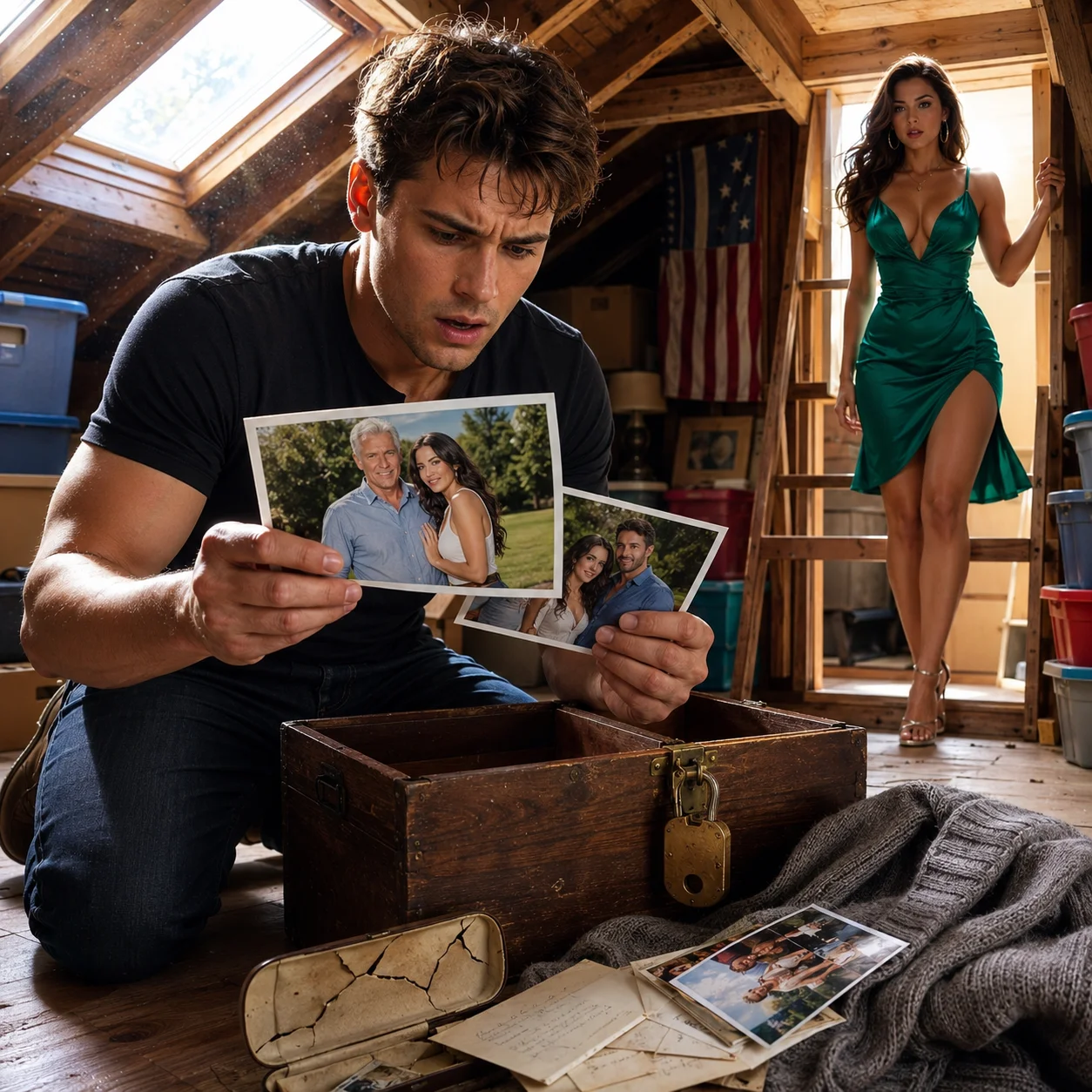
The air above was cold and smelled like insulation, dust, and old wood. Rain hammered the roof inches overhead. I climbed up with the flashlight between my teeth and swept the beam across plastic bins, holiday decorations, old paint cans, and stacks of flattened moving boxes.
The wooden box sat near the far wall.
Except it wasn’t where I remembered it.
I had seen it months earlier beside the chimney stack. Now it was closer to the center, partly hidden behind a blue storage tote.
The little brass lock hung open.
Not broken.
Open.
My heart started beating harder.
I crouched beside it and lifted the lid.
At first, I saw exactly what I expected to see.
Old papers. A folded man’s cardigan. A cracked leather glasses case. A black-and-white photograph of a much younger Laura standing beside a tall man with silver hair.
Her father, I assumed.
I almost closed the box right there.
Then my flashlight caught the glossy edge of something newer.
A stack of photographs sat beneath the cardigan, wrapped in a rubber band.
Not old photographs.
Recent ones.
The paper was bright. The colors were sharp. The edges were clean.
I picked them up.
The first photo showed Laura standing outside a small brick house I didn’t recognize. She was wearing the green coat she had bought last winter. Her hair was shorter in the photo, exactly as it was now.
Behind her, on the porch, stood a man.
Tall. Thin. Silver-haired.
Older, but not frail.
He had one hand on Laura’s shoulder.
They were both smiling.
I stared at the image for several seconds before my brain allowed the impossible thought to form.
That man looked exactly like the man in the old black-and-white photo.
Richard Mallory.
Laura’s dead father.
I flipped to the next photo.
Laura and the same man sitting at a kitchen table. A birthday cake between them. Two candles shaped like the numbers six and eight.
Sixty-eight.
The date printed in the corner of the photo was from last month.
My hands went cold.
The third photo showed Laura hugging him in what looked like a hospital parking lot.
The fourth showed him sitting in a wheelchair, though he looked alert, wearing a baseball cap and holding a small brown dog.
The fifth photo showed Laura standing beside another man I didn’t know. Younger, maybe early forties, wearing a navy jacket. His arm was around her waist in a way that was not brotherly.
On the back of that photo, written in blue ink, were four words.
Thank you for coming.
Underneath that was a date.
October 14.
The same Saturday Laura had said she was visiting her mother.
For a long time, I just knelt there in the attic with rain beating above me and those photos in my hand.
There are moments when betrayal doesn’t feel like anger yet.
It feels like confusion.
Your mind walks around the evidence like an animal circling a trap, refusing to step in because once it does, everything changes.
Laura’s father was alive.
She had lied to me for four years.
Not about something small. Not about an old boyfriend or a debt or a family argument.
Her father. Her grief. The story she had used to explain every silence, every boundary, every moment she shut me out.
And then there was the man with his arm around her.
I heard the shower turn off downstairs.
I put the photos back exactly as I had found them, closed the lid, and climbed down.
My hands were shaking so badly I nearly missed a rung.
Laura came out of the bathroom ten minutes later wearing a robe, her damp hair wrapped in a towel.
“Everything okay?” she asked.
I was standing by the bedroom window, watching rain blur the streetlights.
“Yeah,” I said. “I thought I heard something in the attic. Probably just the storm.”
Her eyes moved to the ceiling.
Only for a second.
“Old houses make noises,” she said.
“Yeah,” I answered. “They do.”
I didn’t sleep that night.
By morning, I had made a decision.
I wasn’t going to confront her yet.
Not because I was calm. Not because I was weak. Because I knew Laura. If I showed her the photos, she would cry. She would explain. She would give me just enough truth to make me doubt the lie.
And I needed to know what I was standing in before I let her pull me deeper.
So I did what I did for a living.
I documented.
The next day, after Laura left for work, I went back into the attic. The lock was closed again, but not latched properly. I photographed the box, the lock, and every picture inside. I didn’t remove anything. I didn’t damage anything. I simply made copies with my phone, then put it all back.
The address was the first problem. None of the photos showed house numbers clearly. But one picture, the one with the birthday cake, had a magnet on the refrigerator behind Laura’s father. It said, “Hendersonville Apple Festival.”
That was three and a half hours away.
I searched public records for Richard Mallory in North Carolina. There were death records for a Richard Allen Mallory from five years earlier, but the age was wrong. That Richard had been eighty-one. Laura’s father would have been sixty-three at the time.
Then I found something strange.
There was a Richard Thomas Mallory listed in property records in Henderson County.
Age sixty-eight.
Owner of a small brick home in Hendersonville.
My wife’s dead father owned a house.
I sat at my desk at work, staring at the screen while my lunch went cold.
That afternoon, I called the cemetery where Laura had once told me her father was buried. I felt insane doing it. Like a villain in my own marriage.
A woman named Denise answered.
I said I was trying to confirm burial information for family records.
She searched for Richard Mallory.
Nothing.
“Are you sure it would be under Mallory?” she asked.
“Yes,” I said. “Richard Mallory. Died around five years ago.”
“I’m sorry,” she said. “We don’t have anyone by that name.”
Laura had taken me to that cemetery once.
Two years into our marriage.
We had stood in front of a grave with no marker, just a temporary metal sign too weathered to read, and she had cried into my coat.
I remembered holding her.
I remembered whispering, “I wish I could’ve met him.”
I remembered her saying, “He would’ve liked you.”
Now that memory felt contaminated, like someone had poured ink into clean water.
For three days, I lived beside my wife like a ghost.
I kissed her good morning. I asked about her work. I took out the trash. I watched her move around our kitchen with the ease of someone who believed her secret was safe.
Every ordinary thing hurt.
Her coffee mug beside mine.
Her hair tie on the bathroom counter.
The way she touched my shoulder when she passed behind me.
I kept thinking, how many times did she do this after seeing him? How many times did she come home from visiting a living father and let me comfort her about a dead one?
On Friday, she told me she had to drive to Durham again.
“My mom’s sink is leaking,” she said. “She refuses to call a plumber.”
I looked at her over my coffee.
“Want me to come?” I asked.
“No,” she said too quickly. Then she smiled. “I mean, no, it’s okay. You hate dealing with my mother.”
That was true.
It was also convenient.
“What time will you be back?”
“Probably late afternoon.”
She left at 10:17 a.m.
At 10:30, I got into my car and followed.
I had never followed my wife before. There is no way to do it without feeling dirty. Every red light felt like an accusation. Every time she changed lanes, I wondered what I would do if she looked in her mirror and saw me.
But she didn’t drive to Durham.
She got on I-40 west.
Toward Greensboro.
Then Winston-Salem.
Then the mountains.
Three hours later, I watched her park outside the same brick house from the photographs.
Richard Mallory came out onto the porch before she reached the door.
He was alive.
There was no mistaking it now.
He walked slowly, one hand braced on the railing, but he walked. Laura rushed up the steps and hugged him hard. Not the careful hug people give fragile old relatives. A desperate hug. Like a daughter trying to keep someone from disappearing.
I parked down the street behind a delivery van and sat there with both hands on the wheel.
I had imagined anger.
What I felt first was grief.
Not for Richard. Not even for Laura.
For myself.
For the version of my marriage that had just died in broad daylight while my wife hugged a man she had buried in front of me.
After ten minutes, the front door opened again.
The younger man from the photo stepped out.
Navy jacket. Dark hair. Same confident posture.
He looked around once, then went inside.
Laura stayed there for five hours.
I didn’t move.
At 4:36 p.m., she came out alone. Her eyes were red. She sat in her car for a while before driving away.
I waited until she was gone, then walked up to the house.
My legs felt strangely calm, like they belonged to somebody else.
I knocked.
A small dog barked inside.
After a moment, the younger man opened the door.
Up close, he was older than I’d thought, maybe forty-three or forty-four. He had tired eyes and the guarded expression of someone who had been expecting trouble for a long time.
“Yes?” he said.
“My name is Daniel Bennett,” I said. “I’m Laura’s husband.”
Everything about his face changed.
Not shock.
Recognition.
He knew who I was.
He looked over his shoulder, then stepped outside and pulled the door partly closed behind him.
“You shouldn’t be here,” he said quietly.
“That seems to be a theme in my life lately.”
His jaw tightened. “Laura doesn’t know you came?”
“No.”
“Then you need to leave.”
“Is Richard Mallory alive?”
He closed his eyes for half a second.
That was answer enough.
“Who are you?” I asked.
“My name is Evan.”
“Evan what?”
“Evan Mallory.”
The name hit me wrong.
Mallory.
“Are you her brother?”
He looked away.
“No,” he said. “I’m her husband.”
For a second, the whole street went silent.
The rain gutters. The dog barking inside. A passing truck somewhere behind me. Everything faded into a high, thin pressure in my ears.
“What did you say?” I asked.
Evan looked like he hated himself for saying it.
“I’m Laura’s husband,” he repeated. “Legally.”
I almost laughed. Not because it was funny, but because the human body sometimes reaches for the wrong reaction when reality becomes too large.
“No,” I said. “That’s not possible.”
“I thought she told you.”
“You thought she told me she was already married?”
His face hardened, but there was pain under it. “I thought she told you we were separated. I thought she told you everything after your wedding.”
“Our wedding?”
That word seemed to break something in him.
He stared at me.
“You married her?”
I pulled out my phone and opened a photo from our wedding day. Laura in a white dress. Me in a navy suit. My mother crying in the front row. Laura smiling like the world had finally become kind.
Evan looked at the screen and went pale.
“She told me you were her partner,” he said. “Not legally married. She said you knew about me but didn’t want involvement with her family.”
I laughed then. Once. Bitterly.
“She told me her father was dead.”
Evan’s mouth parted.
Behind him, the door opened.
Richard Mallory stood there leaning on a cane.
He looked older than in the pictures, his face deeply lined, his silver hair thin, but his eyes were sharp.
“Who is it?” he asked.
Evan turned.
Richard saw me.
For a moment, he looked confused.
Then he looked tired.
“You must be Daniel,” he said.
Hearing my name from a dead man nearly made me step backward.
“You know me too?”
Richard’s gaze dropped.
“I know enough.”
That was how I ended up sitting in the living room of my wife’s living father, across from the man who said he was still legally married to her.
The room smelled like coffee, old books, and cigarette smoke. The small brown dog sat at Richard’s feet. On the wall were framed photos of Laura at different ages—middle school, high school, college. In some of them, Evan stood beside her. Younger. Smiling. His arm around her shoulders.
Richard lowered himself into an armchair with a wince.
“I owe you an apology,” he said.
“You owe me the truth.”
He nodded slowly. “Yes. I suppose I do.”
Evan sat on the edge of the sofa, elbows on his knees.
Richard began.
Laura had married Evan when she was twenty-two. They had grown up together in Hendersonville. Evan’s mother and Laura’s mother had been friends. The marriage had been rushed, emotional, and unstable from the beginning. Laura wanted out after three years, but not cleanly. There were debts. Family resentments. Richard’s declining health. Arguments about property and money.
“She left,” Evan said quietly. “One day she packed two bags and moved east. Said she needed space.”
“I filed for divorce twice,” Evan said. “She refused to sign. Then she’d come back, cry, tell me she was confused, tell her father she wanted to fix things. Then disappear again.”
Richard stared at his hands.
“I was diagnosed with lung disease six years ago,” he said. “Not cancer, but bad enough that Laura convinced people I was dying. Then at some point, apparently, she decided it was easier to tell her new life I had already died.”
My stomach twisted.
“She took me to a cemetery,” I said.
Richard closed his eyes.
Evan whispered, “Jesus.”
“She cried,” I said. “She told me she missed you.”
Richard looked physically pained.
“My daughter has always known how to become what people need her to be,” he said. “With me, she was the devoted child. With Evan, the trapped wife. With you…”
“The grieving daughter,” I finished.
Nobody spoke for a while.
Then I asked the question I was afraid to ask.
“Why keep seeing her?”
Richard’s face changed.
Because underneath all the lies, he was still her father.
“Because she’s my child,” he said. “And because every time I think I’m done letting her hurt people, she sits where you’re sitting and cries like the little girl I raised.”
It was the saddest answer I had ever heard.
Evan went to a drawer and pulled out a folder.
“I kept records,” he said. “Messages. Divorce filings. Letters. Proof that I tried to end it. If you really married her, you need a lawyer immediately.”
I took the folder with numb hands.
“Did she know our marriage wasn’t legal?” I asked.
Evan didn’t answer.
Richard did.
“Yes,” he said.
That one word ended whatever mercy I still had left for her.
When I got home, Laura was in the kitchen making tea.
She turned when I entered, smiling in that soft domestic way I had once trusted with my whole life.
“There you are,” she said. “I was starting to worry.”
I stood in the doorway and looked at her.
Really looked.
At my wife.
At Evan’s wife.
At Richard’s daughter.
At the woman who had built a marriage with me on top of a grave she had invented.
“How’s your mother’s sink?” I asked.
She paused.
“What?”
“Your mother’s sink. Did you fix it?”
“Oh. Yes.” She turned back to the kettle. “It wasn’t too bad. Just loose plumbing.”
I nodded.
“Interesting.”
Something in my voice made her turn around again.
“Daniel?”
“I went to Hendersonville today.”
The kettle began to whistle.
Laura didn’t move.
The sound grew sharper and sharper until I reached past her and turned off the burner.
Her face had gone completely still.
“What did you do?” she whispered.
“I met Richard.”
Her lips parted.
“And Evan.”
For the first time since I had known her, Laura had no immediate answer.
No soft explanation. No tears ready. No wounded silence positioned like a shield.
Just fear.
“Daniel,” she said, “I can explain.”
I almost smiled.
Every liar believes that sentence is a bridge.
Most of the time, it’s a confession.
“Good,” I said. “Start with why you told me your father was dead.”
Her eyes filled instantly. “Because it was easier than explaining.”
“Explaining what? That he was alive? Or that your husband was?”
She flinched.
“Evan and I were over.”
“You were legally married.”
“We were separated.”
“You married me.”
“I loved you.”
“No,” I said, and my voice came out colder than I expected. “You used me.”
She began crying then. Real tears, maybe. Or maybe tears were just another language she spoke fluently.
“You don’t understand what my family was like,” she said. “My father controlled everything. Evan controlled everything. I couldn’t breathe there.”
“So you created a dead father and a fake marriage?”
“Our marriage wasn’t fake to me.”
“It was fake to the state of North Carolina.”
She covered her mouth.
That landed.
I placed the folder Evan had given me on the counter.
Her eyes locked on it.
“You talked to him,” she said.
“Yes.”
“You had no right.”
That sentence almost made me laugh again.
“No right?” I repeated. “Laura, I stood in a cemetery comforting you over a man who was alive. I wrote vows to you while your actual husband was still trying to divorce you. I built a life with you while you kept a locked box of fresh photos in our attic and told me it belonged to your dead father.”
She sobbed my name.
I stepped back.
“Don’t.”
Her expression shifted then. The sadness thinned. Something harder appeared beneath it.
“So what now?” she asked.
There she was.
Not grieving Laura. Not gentle Laura. Not the woman who rearranged lamps and kissed my cheek.
The strategist.
“I’ve already called an attorney,” I said. “I’m filing for annulment if possible. Divorce if not. I’m also giving copies of everything to whoever needs them.”
Her face sharpened.
“You’re going to ruin me?”
“You did that before I found the box.”
She grabbed the edge of the counter. “I made mistakes.”
“A mistake is forgetting to pay a bill. This was four years of fraud.”
“I loved you.”
“Stop using that word like it cleans what you did.”
For a moment, neither of us spoke.
Then she said, very quietly, “You don’t know what Evan did to me.”
I looked at her.
There it was—the next door. The next room of the lie. Maybe Evan had been cruel. Maybe Richard had been controlling. Maybe parts of her pain were real.
That was the worst thing about people like Laura.
They didn’t always lie from nothing.
Sometimes they wrapped lies around a wound until no one could tell where the injury ended and the manipulation began.
“Then tell your lawyer,” I said. “Tell a judge. Tell a therapist. But you don’t get to tell me another story tonight.”
She stared at me like she had never seen me before.
Maybe she hadn’t.
I slept in the guest room with the door locked.
The next morning, Laura was gone.
Her closet was half-empty. Her makeup bag was missing. So was the wooden box.
But she left her wedding ring on the kitchen table.
Beside it was a note.
I never meant to hurt you.
It was such a small sentence for such a large destruction.
I took a photo of the note, put it in a plastic sleeve, and drove to my attorney’s office.
Her name was Margaret Ellis, a divorce lawyer with silver glasses, calm eyes, and the emotional warmth of a locked filing cabinet. She listened without interrupting as I explained everything. The attic box. The photos. Richard. Evan. The legal marriage.
When I finished, she removed her glasses and said, “Mr. Bennett, this is not just a divorce issue.”
“I figured.”
“If she was legally married to another person at the time of your ceremony, your marriage may be void. We’ll need certified records, but based on what you’ve told me, annulment is likely.”
The word annulment felt strange.
Like someone erasing a chapter from a book after I had already memorized every line.
“What happens to the house?” I asked.
“Whose name is on the deed?”
“Mine. I bought it two years before we met.”
“Good.”
“The bank accounts?”
“We’ll separate what we can. If she obtained financial benefit through misrepresentation, that matters.”
Financial benefit.
Such sterile language for shared vacations, health insurance, home renovations, birthday gifts, emergency contacts, Christmas mornings.
“What about criminal charges?” I asked.
Margaret leaned back.
“Bigamy laws exist. Whether prosecutors pursue it depends on evidence and circumstances. But your priority should be protecting yourself legally and financially.”
So that was what I did.
I changed passwords. Froze joint credit cards. Opened a new bank account. Notified my employer’s benefits department. Gathered every document from our wedding, taxes, insurance policies, and mortgage files.
Each task felt like cutting wires before a bomb went off.
Laura called twenty-three times in two days.
I didn’t answer.
She texted constantly.
You’re making this worse.
Please talk to me.
Evan is manipulating you.
My father is sick and you attacked my family.
You promised you would never abandon me.
That last one almost got me.
Because I had promised.
At an altar.
In front of people.
Under a legal illusion she had created.
On the fourth day, Patricia called.
Laura’s mother.
I almost didn’t answer, but some part of me wanted to hear what version of the story had reached her.
“Daniel,” Patricia said coldly. “You need to stop punishing my daughter.”
I closed my eyes.
“Did you know?”
Silence.
That was enough.
“You knew Richard was alive.”
“He is my ex-husband,” she said. “His life is not your business.”
“You watched your daughter tell me he was dead.”
“I watched my daughter survive a family that suffocated her.”
“And Evan?”
Another silence.
“You knew she was still married.”
“She told me it was complicated.”
“No,” I said. “Taxes are complicated. This was illegal.”
Patricia’s voice hardened. “You men always care more about paperwork than pain.”
That sentence told me everything I needed to know about the house Laura had come from.
Not because Patricia was right.
Because she had taught Laura that feelings could be used as weapons against facts.
“I won’t discuss this with you again,” I said.
“You’ll regret humiliating her.”
“I’m not humiliating her. I’m telling the truth. I understand why your family may not recognize it.”
Then I hung up.
The legal process moved faster than I expected in some ways and painfully slow in others. Evan cooperated fully. He sent certified copies of his marriage certificate to Laura, records of prior divorce filings, and messages from Laura refusing to sign.
One message from two years earlier made me sit down when I read it.
Evan had written: Laura, you can’t keep living two lives.
She had replied: Watch me.
Two words.
Cold. Arrogant. Almost bored.
I printed that message and gave it to Margaret.
Richard sent a notarized statement confirming he was alive, that Laura had visited him repeatedly, and that he had not known she had legally married me until I appeared at his house. His statement was short, shaky in places, but devastating.
At the end, he wrote: I love my daughter, but love does not require me to help her lie anymore.
That sentence stayed with me.
Love does not require me to help her lie anymore.
I repeated it to myself more times than I can count.
Because even after everything, I missed her.
I missed the version of her I had known. Or thought I had known.
I missed her laughing from the bedroom while trying on outfits. I missed her hand finding mine in sleep. I missed Sunday mornings when she played old jazz records and made pancakes shaped badly enough that we joked they looked like crime scene evidence.
Grief is strange when the person you’re grieving is still alive.
There’s no funeral. No casserole from neighbors. No clean social script.
People ask, “How’s Laura?” and you have to decide how much truth a grocery store aisle can hold.
For weeks, I told most people we were separated.
Only my closest friend, Marcus, knew everything.
He came over the night after I filed and brought barbecue, beer, and a cardboard box.
“What’s the box for?” I asked.
“For her stuff,” he said. “And for the version of you that thinks this is somehow your fault. We’re packing both.”
Marcus had been my friend since college. He was blunt in the way only people who have earned the right can be.
As we packed Laura’s books, scarves, candles, and decorative objects I never knew the names of, I found myself stopping too often.
“This vase was from Asheville,” I said once.
Marcus took it from my hand, wrapped it in newspaper, and placed it in the box.
“Then Asheville can have it emotionally. But physically, it goes to storage.”
I laughed for the first time in days.
Not because anything was funny.
Because sometimes survival starts as a reflex.
Laura returned to the house two weeks after leaving.
I saw her on the doorbell camera before she rang. She looked thinner, paler, wrapped in a beige coat with her hair tucked under a scarf. She looked like the woman from the cemetery again. Fragile. Wounded. Designed to make me open the door.
I didn’t.
I spoke through the camera.
“What do you need?”
She looked up, startled by my voice.
“Daniel, please. I just want to talk.”
“You can talk to my attorney.”
Her eyes filled. “Don’t do this through lawyers. That’s not us.”
“That’s exactly us now.”
She swallowed.
“I’m sorry.”
I said nothing.
“I know you hate me,” she continued. “But you don’t understand how scared I was. Evan wouldn’t let me go. My father kept pulling me back. My mother told me I was selfish. When I met you, I felt like I could finally be someone else.”
“You were someone else,” I said. “That was the problem.”
She flinched.
“I wanted to tell you.”
“When?”
She looked down.
I waited.
No answer.
“Before the wedding?” I asked. “After? When we filed taxes? When I added you to my insurance? When I stood in front of an empty grave with you?”
She started crying.
“I was ashamed.”
“No,” I said. “You were afraid of consequences. Shame came after you got caught.”
Her face changed.
Anger flashed through the tears.
“You think you’re so clean?” she snapped. “You followed me. You invaded my privacy. You opened something that wasn’t yours.”
That was the moment I finally saw the whole shape of it.
To Laura, the betrayal was not the lie.
The betrayal was discovery.
“I didn’t open your past,” I said. “I opened a box in my attic after you lied about what was inside it.”
She wiped her face.
“I can fix this.”
“No.”
“You loved me yesterday.”
“I loved someone who didn’t exist.”
She stood there for a long time.
Then she said, “You’re really going to erase four years?”
I looked through the camera at the woman who had erased her father’s life, her first marriage, and my right to choose the truth.
“No,” I said. “I’m going to stop letting you rewrite them.”
She left after that.
The annulment hearing was scheduled for late January.
By then, winter had settled hard over Raleigh. The trees were bare. The house felt too quiet. Laura’s things were gone. The attic was empty except for holiday bins and dust outlines where the wooden box had been.
I thought seeing her in court would break me.
It didn’t.
She arrived wearing a navy dress and no wedding ring. Evan was there too, seated on the opposite side of the courtroom with his attorney. Richard did not attend because of his health, but his statement was submitted.
Laura avoided looking at me until the judge asked her directly whether she was legally married to Evan Mallory at the time she participated in a marriage ceremony with me.
Her attorney whispered to her.
Laura’s mouth tightened.
“Yes,” she said.
The word moved through me like a blade being removed.
Painful, but relieving.
The judge reviewed the documents. Marriage certificate. Lack of divorce decree. Statements. Financial records. Copies of messages.
In the end, the annulment was granted.
Legally, my marriage had never existed.
That sentence should have felt freeing.
Instead, it felt brutal.
Because I had existed in it.
My love had existed. My vows had existed. My sacrifices, my memories, my trust—all of that had been real, even if the law now placed a red line through the marriage itself.
Outside the courtroom, Laura approached me.
Margaret stepped slightly forward, but I shook my head.
Laura looked exhausted.
“I signed Evan’s divorce papers,” she said.
I didn’t answer.
“I’m going to therapy.”
“Good.”
“I know that doesn’t change anything.”
“No,” I said. “It doesn’t.”
Her eyes shone, but no tears fell this time.
“My father won’t talk to me.”
I thought of Richard’s statement.
Love does not require me to help her lie anymore.
“That’s between you and him,” I said.
She nodded slowly.
“I did love you, Daniel.”
For a while, I didn’t respond.
Then I said the truest thing I could.
“I believe you loved what I gave you. Safety. A clean story. A version of yourself that didn’t have to answer for anything.”
She looked away.
“But love without truth is just possession,” I said. “And I was never yours to keep by lying.”
That was the last full conversation I ever had with Laura.
The house took months to feel like mine again.
Not because her furniture was gone. Not because her clothes no longer hung beside mine.
Because betrayal leaves echoes.
For a long time, I heard her in ordinary sounds. The floorboard near the kitchen. The click of the thermostat. Rain on the roof above the attic.
The attic was the hardest.
I avoided it until spring.
Then one Saturday morning, with sunlight coming through the hallway window and dust floating in the air like tiny ghosts, I pulled down the ladder and climbed up.
The space looked smaller than I remembered.
Less sinister.
Just insulation, beams, boxes, and old heat trapped under the roof.
I brought up a broom, trash bags, and a new plastic storage bin. I cleaned for three hours. I threw away broken decorations, dried paint rollers, dead batteries, things Laura and I had kept for reasons neither of us would ever remember now.
In the far corner, behind a stack of flattened cardboard, I found a small object I hadn’t noticed before.
A brass key.
Not to the house.
Not to anything I owned.
Probably to the wooden box.
Laura must have dropped it the night of the storm.
I sat back on my heels and held it in my palm.
A few months earlier, that key would have felt like evidence.
Now it felt like a relic from a country I no longer lived in.
I climbed down, walked outside, and stood by the trash bin.
For a moment, I considered keeping it. Proof. Symbol. Warning.
Then I dropped it into the garbage.
It made a small sound against the bottom.
Almost nothing.
That summer, Richard Mallory died.
For real this time.
Evan called to tell me. I hadn’t expected to hear from him again after the legal process ended, but he said Richard had asked him to contact me.
“He left you something,” Evan said.
I almost refused.
But two weeks later, an envelope arrived.
Inside was a letter written in careful, trembling handwriting.
Daniel,
I am sorry that my daughter made you mourn me while I was still alive. No father wants to admit his child is capable of such cruelty, but denial is its own kind of cowardice, and I have been guilty of it for too long.
You came to my door looking for the truth. I should have helped you sooner, before you had to find it in an attic. I cannot undo what Laura did. I cannot undo what I allowed by staying silent in the name of family.
But I want you to know this: the shame belongs to the person who lied, not the person who believed.
You did not fail because you trusted your wife.
She failed because she used that trust as a hiding place.
I hope one day your house feels peaceful again.
Richard Mallory
I read the letter three times.
Then I sat at the kitchen table and cried.
Not loudly. Not dramatically.
Just the kind of quiet crying that comes when something inside you finally receives permission to stop carrying weight that was never yours.
I framed the letter, not because I wanted to remember Laura, but because I wanted to remember the sentence.
The shame belongs to the person who lied, not the person who believed.
A year later, I sold the house.
Not because I was running.
Because I was ready to stop living under the attic where my old life had collapsed.
I bought a smaller place near a lake outside Cary. One story. No attic. Big windows. Too much sunlight for secrets.
On moving day, Marcus showed up with coffee and the same blunt mercy he had offered from the beginning.
“No mysterious boxes?” he asked, carrying in a lamp.
“No attic,” I said.
“Good. Character development.”
I laughed.
For the first time in a long time, it didn’t hurt.
I don’t know where Laura is now. Last I heard, she had moved to Charlotte and was working under her mother’s last name. Evan finally got his divorce. Richard is buried in Hendersonville under a simple stone that actually has his name on it.
Sometimes I think about visiting.
Not often.
Just sometimes.
But I never do.
There are some graves you visit to honor the dead.
And some you leave alone because the living have already taken enough from you.
People ask me if I regret opening the box.
I don’t.
I regret that it had to be opened.
I regret that truth sometimes waits in dark places while you sleep beside the person hiding it.
But I don’t regret finding it.
Because the truth destroyed my marriage, yes.
But the lie had built it.
And there is a strange mercy in finally knowing the difference.
![[FULL STORY] My "Gold-Digger" Fiancée Mocked My Construction Job At Her Best Friend’s Wedding, So I Quietly Ended Our Relationship And Left Her Homeless.](https://social-media.rabedo.com/thumbnails/1777004902_S3.png)

![[FULL STORY] She Said I Wasn’t Classy Enough to Stand Beside Her at the Gala. I Walked Out. By the End of the Night, She Learned I Was the Main Sponsor.](https://social-media.rabedo.com/thumbnails/1777015704_M11.png)
![[FULL STORY] At Her Friend’s Wedding, Someone Asked When I’d Pop the Question She Chuckled and Said, “Him](https://social-media.rabedo.com/thumbnails/1777004759_T3.png)
![[FULL STORY] My Wife Told Me To Leave Before I Lost My Dignity While Plotting To Ruin Me, So I Used My Tech Skills To Systematically Dismantle Her Life.](https://social-media.rabedo.com/thumbnails/1777004545_T2.png)