
I slammed the brakes in front of a closed shop.
How did he know?
I looked back.
A white Tsuru was stopped half a block behind me, its lights off.
I swallowed, turned without signaling, and slipped into a side street.
The Tsuru moved two seconds later.
I was being followed.
I hit the gas.
I reached Mar de Plata 118 at 11:34. It was a small, unpainted house with an old curtain in the window and a rusted gate. The street was nearly empty. Dogs barked from dark rooftops.
Iván was waiting by the door.
When he saw me, he ran toward the car.
“Get inside. Now.”
“What is happening?”
“Caro, please.”
He pulled me by the arm before I could even close the car door properly.
Inside, the house smelled of damp walls, old coffee, and fear. There was a table covered in papers, a backpack, a phone with no SIM card, and a photograph of my mother taken from a distance as she left the cemetery with flowers in her hand.
My knees almost gave way.
“Were you watching her?”
Iván shook his head desperately.
“I was protecting her.”
“From who?”
He did not answer.
Then we heard a car stop outside.
Iván killed the light.
His hand clamped over my mouth.
He covered my mouth so tightly I could feel his fingers trembling against my skin.
Outside, the engine stayed on for a few seconds before shutting off. The house sank into thick darkness. Through the window, only a weak yellow streetlight cut through the filthy curtain.
“Don’t breathe loudly,” my brother whispered.
I wanted to rip his hand away and demand eight years of answers. I wanted to scream that Mom had withered while grieving him, that his room still looked the same, that every Day of the Dead we set out a plate of enchiladas mineras and a candle as if he could really come back to eat.
But someone was outside.
And that someone was looking for us.
Three knocks sounded against the gate.
Slow.
Certain.
“Iván,” a rough voice called. “We know she’s with you.”
My brother closed his eyes.
I knew that voice.
It was not my father, but it had always been close to him. Ciro. The man who drove the truck for Ramiro’s shoe factory. When I was little, I used to see him carrying boxes at the workshop in El Coecillo, surrounded by the smell of glue, hot soles, and cured leather. My father always said Ciro was “trustworthy.”
Now I understood that in our family, that word meant something else.
“The back,” Iván murmured.
He pulled me toward the kitchen. There was a metal door leading to a tiny patio filled with buckets, a rusted bicycle, and dry flowerpots. Iván lifted a loose board beside the wash sink and pulled out a black bag.
“Put this on.”
It was an old hoodie.
“What are you doing?” I whispered.
“Saving you too late.”
The gate rattled again.
“Carolina,” Ciro called. “Your father just wants to talk. Don’t make this bigger than it has to be.”
The way he said my name froze me.
Iván opened the back door without making a sound. Behind the house was a narrow alley filled with trash and barking dogs. We ran crouched low, pressed against the walls, while behind us the front door burst open.
Someone turned on the light.
“Iván!”
My brother did not stop.
We climbed over a low wall and landed in a neighbor’s patio. A woman screamed from inside, but Iván raised his hand.
“It’s Mateo, Doña Lupita! I’m sorry!”
Mateo.
That was the name he was living under.
The woman did not open the door, but she did not call anyone either. We kept going until we reached a wider street where an old combi was passing. Iván pushed me inside. The driver did not ask questions. In Las Joyas, people learn when to look and when to keep moving.
We got off ten minutes later near an empty lot. From there, we could see León spread out below us, the lights of downtown glowing like embers, the boulevards filled with late cars, and beyond them, the dark shape of the hill. My throat burned.
“Talk,” I said.
Iván dragged both hands over his face. The scar on his chin looked deeper beneath the light from a closed shop.
“There was no accident that night.”
“Don’t start lying to me.”
“There was a fire, yes. But the dead man wasn’t me.”
The ground seemed to shift even though I was standing still.
“Then who was it?”
Iván looked toward the street.
“Samuel. A kid from Dad’s workshop. He was nineteen. He cut leather in one of the warehouses in El Coecillo. No one claimed him, Caro. No one, according to them.”
The air left my lungs.
I remembered the closed coffin. The rushed Mass. My father signing papers while my sedated mother cried on a pew.
“Did Dad kill him?”
Iván swallowed.
“Samuel died in the factory. A press crushed his chest because they were working at dawn, no insurance, no registration, preparing a shipment. Dad didn’t want problems. I saw it. I heard him say the boy was ‘more useful dead than alive.’”
I pressed a hand to my stomach.
“No.”
“Yes.”
Iván clenched his teeth.
“I was going to report him. I had photos, fake invoices, payment lists. Dad was using shoe boxes to move money and documents. Everything went out with merchandise toward Silao, Irapuato, Celaya. In León, nobody checks twice when they see a box of boots.”
The wind smelled like damp soil and old fried food.
“And then?”
“He drugged me.”
The words fell between us like a stone.
“That afternoon, we argued. I told him I was going to talk to Mom and then go to the prosecutor’s office. He handed me a beer. I woke up tied in the back seat of my own car near the road to Silao. Samuel’s body was in the front with my watch and my chain. Ciro poured gasoline.”
I covered my mouth to keep from vomiting.
“How did you get out?”
“A truck driver stopped before the fire reached everything. I kicked the window until he heard me. He pulled me out, but my arm was burned, and I was half unconscious. When I tried to come back, Dad got to the hospital first.”
“He saw you?”
Iván nodded.
“He told me if I opened my mouth, Mom would have an accident too. He said he had already buried one son and could bury a wife. Then he showed me a photo of you leaving high school.”
Tears slipped down my face before I could stop them.
“And you left us?”
His face broke.
“I was twenty, Caro. I was burned, terrified, undocumented, legally dead. Every time I tried to get close, he sent me pictures of you. Mom at the market. You at university. The house. I thought if I stayed away, you both stayed alive.”
I slapped him.
The sound bounced down the empty street.
Iván did not defend himself. He only lowered his eyes.
“I owed you that,” he said.
I was crying with rage.
“Mom died with you every month.”
“I know.”
“No, you don’t. I watched her talk to a stone in Panteón San Nicolás. I watched her bring flowers in the rain, when she was sick, when Dad shouted that she looked crazy. You don’t know that.”
Iván took an old phone from his pocket and opened a folder. There were photos of my mother at the cemetery, at the market, at the bus stop. There were also videos of Ciro following her.
“That’s why I came back,” he said. “Dad wasn’t just watching her anymore. He was preparing her.”
“Preparing her for what?”
My phone vibrated.
It was my mother.
I answered with frozen hands.
“Mom?”
She did not respond.
My father did.
“Carolina.”
His voice was calm.
That made it worse.
“Where are you?”
I looked at Iván.
He shook his head.
“With some friends,” I lied.
Dad gave a dry laugh.
“You were never good at lying. Listen carefully. Your mother is with me. She’s upset. She says she wants to go to the cemetery at midnight because she dreamed about Iván. What a coincidence, isn’t it?”
My knees weakened.
“Leave her alone.”
“I have always taken care of her. You are the ones who make her sick.”
In the background, I heard my mother crying.
“Caro…”
“Mom!”
The call ended.
Iván closed his eyes.
“He’s going to the cemetery.”
“Why?”
“Because that’s where the evidence that can destroy him is hidden.”
I did not understand until Iván opened the black bag. Inside was a plastic-covered folder, several USB drives, and a rusty key with a tag.
The tag read:
“Niche 42. San Nicolás.”
“Before I escaped, I hid copies inside our grandfather’s family crypt,” Iván said. “Evidence from the workshop, photos of Samuel’s body, a recording of Dad talking to the examiner who signed my identification report. I couldn’t retrieve it without him knowing.”
“And now?”
“Now I found you.”
There was no time to think.
We took a taxi in silence. The driver was listening to soft banda music and eating Japanese peanuts from an open bag. We passed Bulevar Hidalgo, then headed toward the center, where the Templo Expiatorio rose dark and beautiful, its stained-glass windows unlit like closed eyes. León was still alive on the corners: guacamaya stands, young people leaving bars, couples walking along Calzada de los Héroes toward the illuminated arch.
I watched it all as if I were seeing the city for the last time.
Beside me, Iván looked like a ghost trying to become human again.
“Does Mom know anything?” I asked.
“She suspects. Mothers always suspect before they know. Two months ago, she found an old insurance policy in Dad’s study with my name on it, and a receipt from the medical examiner’s office. After that, he started giving her pills.”
I remembered her dull eyes, her clumsy hands, her silences over bowls of soup.
My father had not been caring for a widow.
He had been silencing a witness.
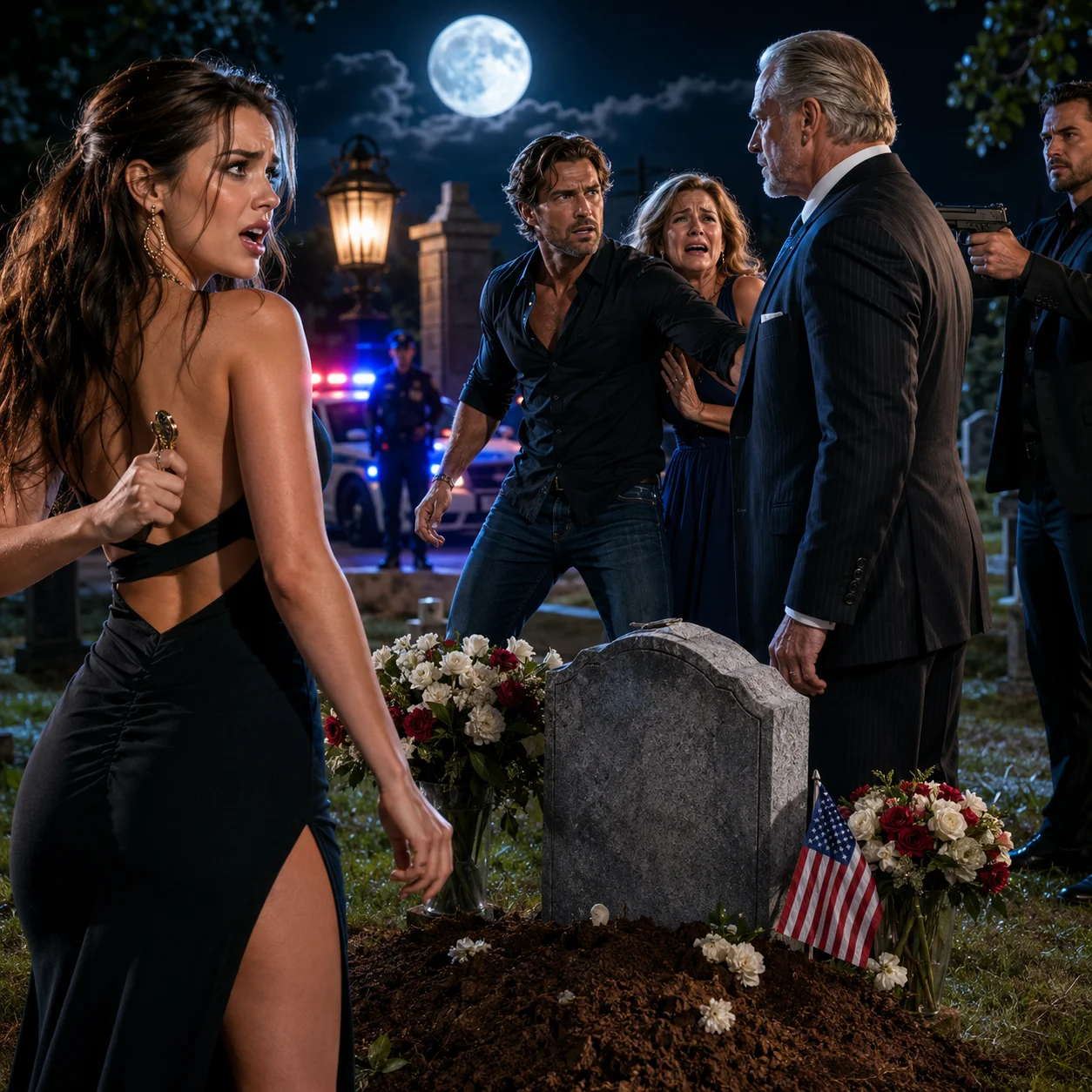
We reached Panteón San Nicolás near midnight. The old entrance seemed to breathe dampness. As a child, I had been afraid of that place because my grandmother said footsteps could be heard among the old graves when the wind came down. That night, there was no wind.
Only fear.
Iván paid the driver, and we entered through a side gate he knew by memory. We walked between headstones, stained angels, crooked crosses, and wilted flowers. Far ahead, a phone light moved in the darkness.
My father was there.
Standing beside Iván’s grave.
My mother was sitting in front of the headstone, her hair loose, her sweater put on wrong. Her hands rested on the white flowers. She looked like a lost child.
Ciro stood behind her.
“Don’t go closer,” Iván whispered.
But my body was no longer obeying fear.
“Mom!”
She lifted her head.
When she saw me, she tried to stand, but Ciro placed one hand on her shoulder.
My father turned slowly.
“Carolina,” he said. “Always so stubborn.”
Then he saw Iván.
He was not surprised.
That was the worst part.
He only sighed, like a man finding a rat he had always known was hiding somewhere.
“I told you not to come back.”
My mother looked where he was looking.
And she saw her dead son.
For one second, she did nothing. Then she brought one hand to her chest. I thought she would fall. I thought the pain would kill her right there in front of the fake grave.
But Esperanza stood.
She took one step.
Then another.
“Ivancito,” she whispered.
My brother shattered.
He ran to her and hugged her with a sound that was not a cry and not a word. My mother touched his face, his hair, his shoulders, as if she had to count his bones to believe he was real.
“You’re warm,” she kept saying. “You’re alive. My God, you’re alive.”
I cried too.
Until my father spoke.
“What a touching scene,” he said. “Too bad it changes nothing.”
Ciro pulled out a gun.
The embrace froze.
“Ramiro,” my mother said, in a voice I had never heard from her before. “What did you do?”
My father adjusted his jacket. Even in a cemetery at midnight, he wanted to look like he owned everything.
“What was necessary,” he said. “For this family. For the business. For all of you, who never understood what it costs to build something in this city.”
Iván released Mom and stepped in front of her.
“You killed Samuel.”
“Samuel was already dead when I made decisions.”
“You buried him under my name.”
“I gave him a better grave than he would have had.”
My mother let out a wounded sound.
I slipped my phone from my pocket without Ciro noticing. I had turned on the recorder in the taxi. Iván had asked me to before we got out. He said my father would not be able to resist justifying himself.
He was right.
“And your son?” I asked, trembling. “Was he also a decision?”
My father looked at me with contempt.
“Iván was weak. Like you. Like your mother. Weak people drag down those who know how to command.”
“You were not commanding,” my mother said. “You were afraid of us.”
Ramiro went still.
That sentence wounded him more than any accusation could have.
“Be quiet, Esperanza.”
“No.”
The word came out small.
But it opened the night.
My mother walked to Iván’s headstone and ripped the white flowers from it.
“For eight years, I came here to cry over a lie,” she said. “For eight years, you let me kiss a stone. For eight years, you called me crazy when you were the monster standing in my kitchen.”
Ciro lifted the gun a little higher.
“Don Ramiro…”
“Bring me the key,” my father ordered.
Iván looked at me.
The key to the niche.
I had it.
And Dad knew.
“Carolina,” he said. “Give me the key, and everyone leaves alive.”
I reached into my purse. My fingers touched the key. They also touched the small alarm Iván had given me, connected to the phone of a local journalist who had once worked on missing-person cases and was waiting outside with a municipal patrol.
Iván had not come back alone.
He had learned how to survive.
I pressed the button.
At first, nothing happened.
Ramiro smiled.
“You still believe in miracles.”
“No,” I said. “I believe in evidence.”
I threw the key toward the tomb, away from Ciro.
He glanced at it for barely a second.
That was enough.
Iván lunged at him.
The gun went off.
The shot shattered a clay flowerpot beside the crypt.
My mother screamed.
I ran to her, pulled her to the ground, and covered her with my body. Iván and Ciro rolled between the graves. Ramiro tried to reach the key, but my mother—my sedated mother, my broken mother, my mother of white flowers and eight years of grief—grabbed his ankle with a strength I did not know she still had.
“No more,” she said.
The lights arrived like lightning.
First one patrol car.
Then another.
Then voices, radios, footsteps running over gravel. Ciro dropped the gun when a police officer aimed directly at him. Iván lay on the ground with blood near his eyebrow, but he was alive.
Alive.
My father still tried to stand.
“I am Ramiro Aranda!” he shouted. “I know Commander Rivera. This is a mistake.”
A woman in a dark jacket approached with a folder in her hand.
“State Prosecutor’s Office,” she said. “The mistake was believing no one would ever open that grave.”
Ramiro looked at me.
For the first time in my life, I saw fear in his eyes.
Not fear of losing his family.
Fear of losing control.
They opened the niche that same night with witnesses and cameras present. Among the old urns belonging to my grandparents was Iván’s metal box, wrapped in plastic and dust. Inside were USB drives, photographs, receipts, names, transfers, a copy of the false accident report, and a recording where my father’s voice said clearly:
“The dead man will be Iván. The living one learns to obey.”
My mother heard that sentence while sitting on a stone bench.
She did not cry.
She had no tears left for my father.
By dawn, the cemetery smelled of wet earth and crushed flowers. Birds began singing above the walls as if they did not know a false life had ended there. Ramiro was handcuffed beside Ciro. My mother did not look away when they took him.
Iván walked over to the grave that carried his name.
He ran his fingers across the cold letters.
IVÁN ARANDA MORALES.
Beloved son.
Unforgettable brother.
“I’m sorry,” he whispered.
I stood beside him.
“I don’t know if I can forgive you today.”
He nodded.
“I understand.”
“But Mom needs to hold you today. So don’t disappear again.”
Iván closed his eyes.
“I won’t.”
Hours later, the three of us left the cemetery together. The city was waking up. Somewhere nearby, someone was selling cebadina in large cups. Farther away, workshops were beginning to open, and in the Zona Piel, the first merchants were lifting metal shutters to sell bags, boots, and belts like it was any other day.
But for us, it was not any other day.
My mother walked between Iván and me, holding both our hands as if she feared one of us might vanish. When we reached the gate, she turned back toward the false grave.
“I’ll come tomorrow,” she said.
A knot tightened in my throat.
“To see him?”
She slowly shook her head.
“To remove the flowers. My son doesn’t live there anymore.”
Iván broke again.
And I understood that some lies are buried with Masses, marble, and prayers, but they keep breathing beneath the earth until someone finally dares to open the grave.
That morning, León smelled of fresh bread, cured leather, and old rain.
My dead brother walked alive beside us.
And my mother, after eight years of crying over a closed box, finally held his hand without fear that he would slip through her fingers again.
![[FULL STORY] My family skipped my wedding for my sister’s engagement party and stole my grandmother’s heirloom, so I destroyed their reputation on her wedding day.](https://social-media.rabedo.com/thumbnails/1776998299_C9.png)