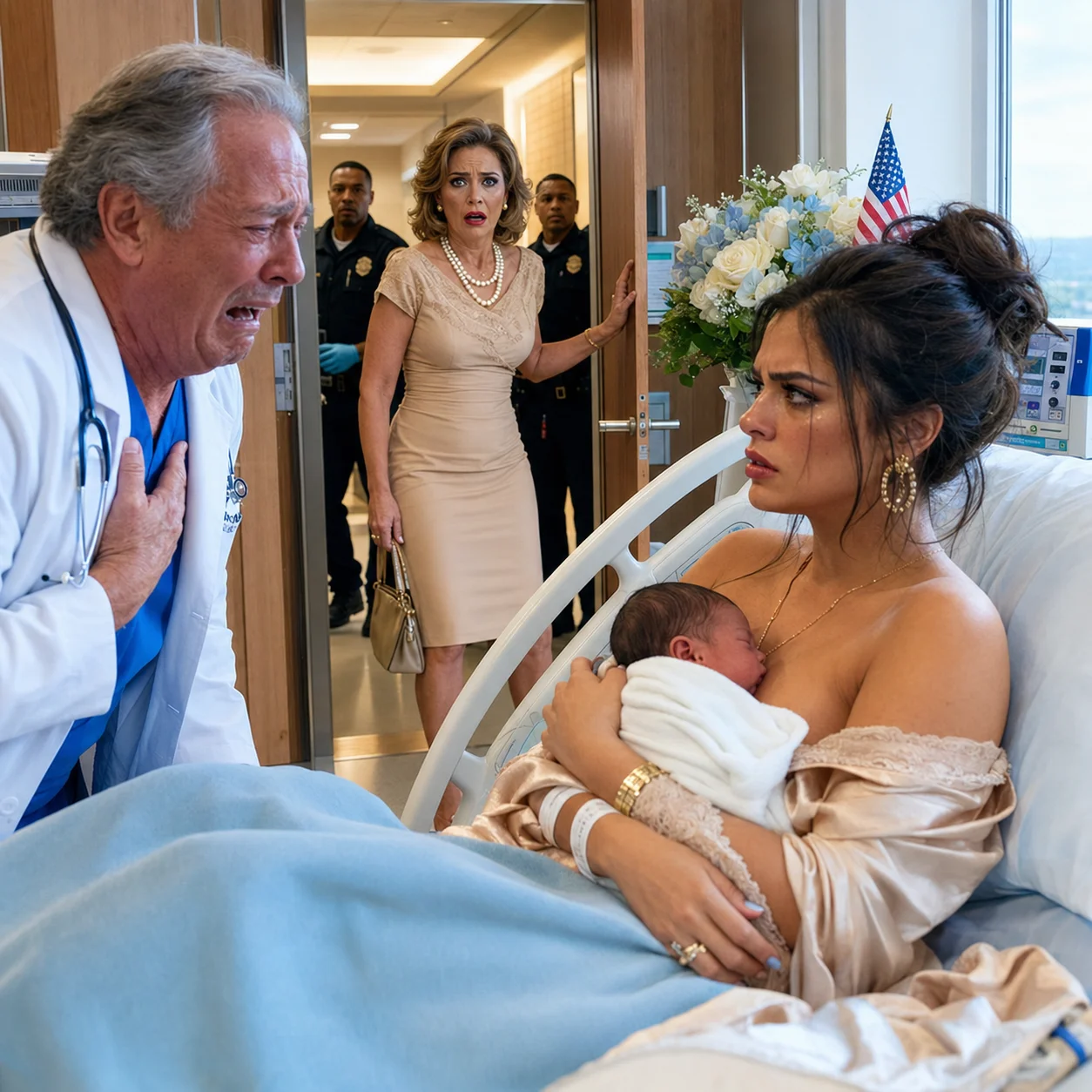
“My wife.”
The exhaustion of childbirth turned into ice inside me.
“Your wife?”
“Beatriz. Emilio’s mother.”
My baby cried again, loud and hungry, demanding warmth, milk, life. That sound dragged me back into my body.
I stretched out my arms.
“Give him to me.”
The nurse looked at the doctor.
“Give him to me,” I repeated. “Whatever is happening with your family, he is mine.”
They placed him on my chest.
My son pressed against me as if he had known me forever. His skin was warm, his smell sweet and animal, his tiny hands searching blindly. I cried without sound. I held him with a strength I did not know I still had.
The doctor lowered his voice.
“Clara, I need to know something. Did Emilio know you were going to have this baby?”
“Of course he knew. I told him that night. He left saying he needed to think.”
“He didn’t return to you because he couldn’t.”
I stared at him with rage.
“Do not ask me to pity him. I was alone. I paid rent alone. I fainted while washing dishes and no one came to pick me up. I gave birth alone.”
Ricardo nodded as if every word struck him across the face.
“You’re right. I’m not asking for pity. I’m asking for five minutes to explain why my son has been missing for seven months.”
The senior nurse closed the door.
The room became smaller, quieter, more dangerous. Outside, stretchers rolled, shoes hurried, doctors called instructions, and the hospital continued as if life had not just cracked open in front of us. Inside, my baby breathed against my chest while a man cried for the son I had believed was a coward.
“That same night,” Ricardo said, “Emilio came to my house upset. He told me you were pregnant and that he wanted to marry you. I told him to think carefully, not because you weren’t worthy, but because I saw he was terrified. Beatriz heard everything.”
He swallowed.
“They argued. She always wanted another life for him. Another woman. Another family. I was called back to the hospital for an emergency. When I returned home, Emilio was gone.”
“And you didn’t look for him?”
His eyes filled with pain.
“I looked for him like a madman. I went to his apartment, his friends, the authorities, hospitals, highways. Then Beatriz told me she had received a call. She said you had died from pregnancy complications in a rented room. She said Emilio had found out and left the country, destroyed, refusing to speak to anyone.”
I stared at him.
“And you believed her?”
“I tried not to. I went looking for you.”
My body tensed.
“You never came.”
“I went to the address Beatriz gave me. An empty room in Santa Tere. A neighbor said a pregnant girl had moved out in the middle of the night. She didn’t know her name. Beatriz showed me a message from Emilio’s phone. It said, ‘Don’t look for me. Clara died because of me.’”
A hole opened inside my chest.
“I never lived in Santa Tere.”
“I know that now.”
I looked down at my son.
The crescent mark beneath his ear was small and perfect, like an ancient signature written onto new skin.
“Where is Emilio?” I asked.
Ricardo did not answer immediately.
He took out his phone with shaking hands and opened a photo. Then he showed it to me.
It was Emilio.
Thinner.
With a grown beard.
Sitting on a bench, staring at the ground.
“This photo came to me two weeks ago from an unknown number,” Ricardo said. “The message said, ‘Stop looking, doctor. Your son is alive, but he no longer remembers what he lost.’”
I could not breathe.
“Is he sick?”
“I don’t know. But I think they kept him somewhere. Maybe drugged. Maybe locked in an illegal clinic or one of those private places no one investigates until something terrible happens. In Jalisco, there are too many families searching for someone and too many locked doors.”
The nurse crossed herself.
I tightened my arms around my son.
“Your wife did this?”
Ricardo did not answer like a doctor.
He answered like a father.
“I’m afraid she did.”
At that exact moment, a woman entered without knocking.
Elegant. Beige dress. Pearls. Hair set stiffly around her face like a helmet. She smelled of expensive perfume, cold flowers, and lies.
I did not have to ask who she was.
Beatriz Duarte de Salazar looked first at the doctor, then at me, and finally at the baby.
Her face froze.
“Ricardo,” she said. “What are you doing here?”
The doctor stood.
“I’m working.”
She smiled with her mouth, not her eyes.
“They told me you were upset.”
Then she looked at me.
Her expression changed only slightly.
Recognition.
Not surprise.
Recognition.
“You,” she whispered.
I felt fire fill my chest.
“So you do know who I am.”
Beatriz adjusted her purse.
“I don’t know what you’re talking about.”
The baby whimpered.
Her eyes dropped to the birthmark.
For one second, all the color drained from her face.
That was when I understood that the truth did not need a judge yet. I had already seen it tremble across her face.
Ricardo spoke with a coldness I had not heard before.
“Beatriz, leave this room.”
“That child has no reason to be here.”
“That child is my grandson.”
The sentence landed like a bell.
My son opened his eyes for a brief moment, as if the world had just handed him a last name and he did not know what to do with it.
Beatriz clenched her jaw.
“You don’t know that.”
“I know. And I will prove it.”
She looked at me with contempt.
“You should have gone away.”
“I left many places,” I replied. “But I did not leave my son.”
Beatriz took one step toward me.
“You have no idea what you’re getting yourself into, girl.”
The senior nurse stepped into the hallway.
“Security,” she called loudly.
Beatriz stopped.
Ricardo lifted his phone.
“I’m calling the authorities.”
“Don’t be ridiculous,” Beatriz snapped. “You’re going to destroy your family over a waitress?”
I laughed.
I don’t know where the laugh came from. I had just given birth. I was bleeding, broken, exhausted, with a baby on my chest. But that woman, with her pearls and her poison, had called me a waitress as if working to eat was something shameful.
“Ma’am,” I said, “I washed dishes so your grandson could be born. You hid your son so he wouldn’t build a life with me. If anyone destroyed your family, it wasn’t me.”
Beatriz raised her hand.
She did not reach me.
Ricardo caught her wrist.
“Don’t you dare.”
She stared at him as if he had betrayed her too.
“I did everything for Emilio.”
“No,” Ricardo said. “You did it for your last name.”
Security arrived.
Beatriz left without screaming, but before she crossed the doorway, she turned back to me.
“You won’t keep anything.”
I looked down at my baby.
“I already kept the only thing that matters.”
When she was gone, the doctor sat down and covered his face.
The most serious man in the hospital had fallen apart in front of me, and still I could not comfort him. Not yet. His pain was real, but so was mine. Mine had carried nine months of hunger, fear, labor, and abandonment.
“I need to file a report,” he said.
“So do I.”
He looked at me.
“Clara, I want to request a DNA test. Not to take anything from you. To protect you and the child.”
“My son’s name is Gabriel,” I said.
Ricardo closed his eyes.
“Gabriel Salazar Mendoza.”
“Mendoza first,” I corrected.
He opened his eyes.
“Gabriel Mendoza. However you decide.”
That made me trust him by one millimeter.
Only one.
That night, I did not sleep.
Gabriel did, sometimes, pressed against my chest. The nurse helped me bathe, changed the sheets, and brought me broth and gelatin. Outside, Guadalajara smelled of warm rain and traffic. From the window, I could see lights scattered over the city, and somewhere in the distance, maybe near downtown, a mariachi sang for someone who actually had something to celebrate.
I watched my son sleeping.
“You stay calm,” I whispered. “I’m staying.”
The next day, investigators arrived.
Not with sirens. Not with drama. With folders, questions, and tired faces.
Ricardo handed over messages, photos, screenshots, and the missing person report he had filed for Emilio. I told my story. The night I told Emilio I was pregnant. His disappearance. The room I rented near the market. The fonda. The calls that never came.
When I said Beatriz had recognized me, one female investigator looked up.
“Are you sure?”
“A woman does not forget the face of someone who tried to erase her.”
The DNA test was done that same day.
They barely touched Gabriel’s tiny foot and he cried with offended rage. I cried too. Not because of the test, but because my son was two days old and already trapped inside an adult war.
Ricardo was present, but he did not hold him.
He asked first.
“May I look at him more closely?”
I thought about it.
Then I nodded.
He approached Gabriel the way someone approaches a church after losing faith. He did not touch him. He only looked at the mark beneath his ear.
“Emilio had one just like it,” he said. “So do I. So did my father.”
“Then find your son,” I answered. “But don’t turn mine into a replacement.”
Ricardo swallowed.
“I won’t.”
The search moved quickly because there was money, a name, and guilt behind it.
That made me angry.
I thought of all the mothers who waited months, years, in front of offices where people told them to come back tomorrow. I thought of women taping missing-person posters near the Hospital Civil, on street posts, on walls, in plazas. They believed me because an important doctor had cried in a delivery room.
Justice has social classes too.
Still, I used what I had.
Two days later, they found the first trace: one of Emilio’s bank cards had been used months earlier in Tepatitlán. Then came a witness. A dismissed nurse from a private clinic near Chapala said he had seen a man matching Emilio’s description admitted without a complete file, under the initials E.S.D.
A “voluntary” patient who was always sedated.
Ricardo aged with every phone call.
Beatriz disappeared from the family home.
But she did not run far. They arrested her in an apartment in Zapopan, near La Minerva, with a suitcase, jewelry, and false documents.
She did not cry.
She did not apologize.
She asked for her lawyer.
That told me everything.
They found Emilio one week later.
Not in Chapala.
At a property outside Tlajomulco, where he had been moved after the clinic came under investigation.
He was alive.
Thin.
Confused.
With scars on his wrists and the eyes of someone who had spent too long being told his own memory was lying.
When Ricardo called me, I was breastfeeding Gabriel.
“We found him,” he said.
My voice disappeared.
“Alive?”
“Alive.”
I looked down at my son.
I did not feel pure joy.
I felt fear.
Because the man I had hated for seven months had just become a victim.
And that did not erase my loneliness. It did not give back the nights I cried until my throat hurt. It did not pay for the double shifts or the meals I skipped or the fear that lived under my skin.
But it did change the shape of the wound.
Emilio asked to see me three days later.
I said no.
Then I said yes.
I went to the hospital with Gabriel in my arms and my Aunt Marta beside me. She was a hard woman from Tonalá who sold clay dishes and refused to be impressed by last names.
“If he looks at you wrong,” she told me, “I’ll throw the diaper bag at his head.”
I almost smiled.
Emilio was in a white room.
He was thinner than in my memory, with a beard and hollow eyes. When I entered, he tried to stand.
“Clara.”
My name in his mouth made me tremble.
Not from love.
From everything.
“Don’t get up.”
He looked at me as if I were the only real thing after a long nightmare.
“They told me you were dead.”
“You left me alive.”
The words hit him.
He lowered his gaze.
“That night, I went to my parents’ house. I wanted help. I wanted to come back to you the next day. My mother told me to rest first. She gave me something. After that, I woke up somewhere else.”
He covered his face with both hands.
“They showed me messages. They told me you died. That the baby died too. That it was my fault. I didn’t know what was real anymore. Sometimes I remembered your voice and thought I was losing my mind.”
I did not cry.
I had already cried too much over his absence.
“I thought you abandoned me.”
“I know.”
“No,” I said. “You don’t. You don’t know what it feels like to walk into a delivery room alone and lie by saying your husband is on his way.”
Emilio cried.
But he did not come closer.
That was the only correct thing he did.
“I’m sorry,” he whispered.
“I can’t give you forgiveness today.”
“I understand.”
I lifted Gabriel slightly.
“His name is Gabriel Mendoza.”
Emilio looked at him.
The world broke across his face.
He saw the mark.
He saw his blood.
He saw his son.
He did not reach out.
He asked, “Can I know him when you decide?”
For one second, something inside me stopped defending itself.
“That has to be earned,” I said.
“I will earn it.”
I did not believe him.
But I did not hate him the same way either.
The following months were hard.
Beatriz faced charges for illegal deprivation of liberty, falsification, threats, and everything else the investigation uncovered. Doctors had been paid. Records had been altered. There was a network of favors that smelled like old money and fear.
Ricardo testified against his own wife.
Every time he left the prosecutor’s office, he looked like he was carrying an invisible sack of stones.
Emilio went through therapy, medical exams, nights of terror, and broken memory.
I went back to work little by little, but I no longer washed dishes until dawn.
Ricardo offered money at first. I refused. Then I understood that pride was not rejecting support for my child. Pride was setting conditions.
“Nothing in my name without paperwork,” I told him. “No gifts that later become authority.”
The doctor accepted.
He helped me rent a small apartment near Colonia Americana. Not because it was luxurious, but because it was close to the hospital and closer to the new life I had to build.
Aunt Marta checked every window before allowing me to move in.
“It’s small,” she said, looking around. “But at least there’s no room here for a rich mother-in-law with bad intentions.”
Gabriel grew strong.
Loud.
Hungry.
Stubborn.
At three months, he smiled for the first time while staring at a shadow on the wall. At four months, Emilio held him for the first time.
I stood beside him with my arms ready, watching every movement.
Emilio cried silently.
“Hello, son,” he whispered. “I’m sorry I took so long.”
I looked out the window.
Rain was falling over Guadalajara, over the trees along the avenue, over the torta ahogada stands, over crowded buses and people running with bags over their heads. The city remained alive, noisy, beautiful, and brutal.
I did not know whether Emilio and I would have a future.
I did not know whether one day I would be able to love without remembering the empty space beside my hospital bed.
But I did know one thing.
My son was not born abandoned.
He was born surrounded by a truth that arrived late, yes, but still arrived.
And I, who had entered the hospital alone, left that story understanding that loneliness does not always mean having no one.
Sometimes it means being the first one who stays.
The first one who believes.
The first one who holds the child when everyone else gets lost.
Gabriel slept against my chest.
The crescent moon beneath his ear was small and clear.
Not as the mark of a powerful family.
As a promise.
That no lie, no matter how large, would ever decide for him who was loved and who deserved to return.

![[FULL STORY] I Was About to Propose… Then I Heard Her Plan to Take the Ring and Ghost Me](https://social-media.rabedo.com/thumbnails/1776937687_0b312432-e5c4-4742-940c-45fd725e0573.png)
![[FULL STORY] My Girlfriend Said, You Have No Right To Stop Me From Liking My Ex's Photos We Aren't Even That](https://social-media.rabedo.com/thumbnails/1776759718_3.png)