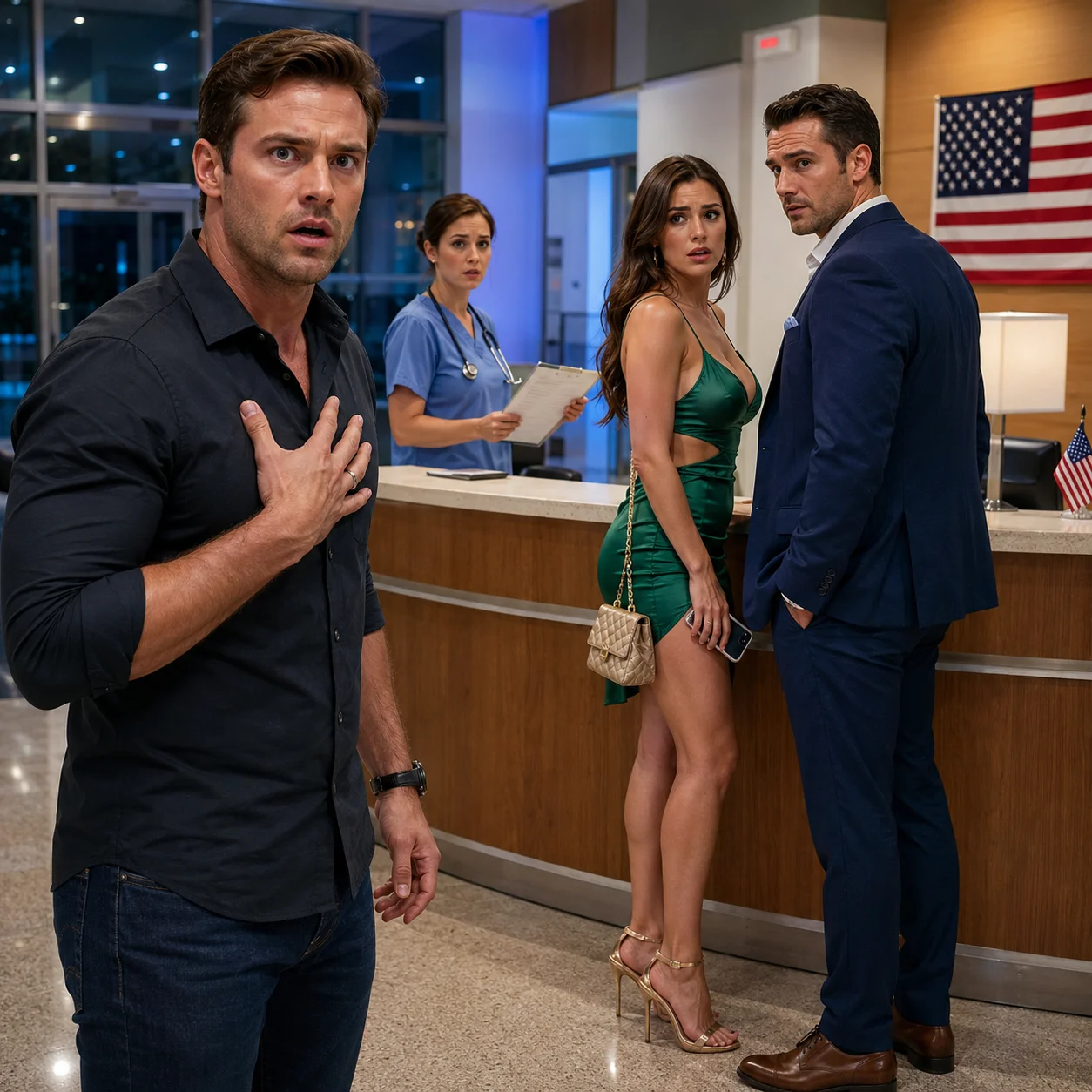
Her expression stayed professional, but I saw the answer before she spoke.
“I’m sorry, sir. I don’t have a patient by that name.”
“Could she be under Linda Harper?”
More typing.
“No, sir.”
“Maybe she was transferred? Kidney failure. Possibly ICU.”
The receptionist gave me a careful look.
“I can’t discuss private medical information beyond confirming patient directory status, but there is no current patient here by either name.”
I gripped the stuffed bear tighter.
“Thank you,” I said.
I walked back toward the parking garage with my ears ringing.
Emily was not visiting Linda.
Linda was not at Riverside Memorial.
Maybe Linda was at another hospital. Maybe Emily had said Riverside and I misunderstood. Maybe I wanted so badly for there to be an innocent explanation that I kept offering one to myself like a fool feeding crumbs to a bird that was already dead.
I sat in my car for ten minutes before starting the engine.
Then my phone rang.
Unknown number.
I almost ignored it, but something made me answer.
“Hello?”
“Hi, is this Daniel Mercer?”
“Yes.”
“This is Rachel calling from Riverside Memorial Hospital. I’m sorry to bother you. I’m reaching out regarding Emily Mercer.”
The world narrowed to the sound of that woman’s voice.
“My wife?” I asked.
“Yes, sir. She listed you as an emergency contact on one form, but there seems to be a discrepancy in our system. I’m trying to clarify something before we update the record.”
My mouth went dry.
“What discrepancy?”
There was a pause, the kind of pause people use when they realize they have stepped into something personal by accident.
“She was here earlier for a minor outpatient procedure,” Rachel said carefully. “Nothing life-threatening. But her intake paperwork lists a Mark Donovan as her spouse.”
I did not understand the sentence at first.
It entered my ear, but my brain refused to arrange it into meaning.
“I’m sorry,” I said. “What did you say?”
“Her paperwork lists Mark Donovan as her husband,” the nurse repeated, softer this time. “But your name appears as an emergency contact in an older file. We just need to confirm—”
“She listed another man as her husband?”
Silence.
“I’m sorry, sir,” Rachel said. “I may have reached you at a bad time.”
“What kind of procedure?”
“I can’t disclose details without authorization.”
“Was she admitted?”
“No, sir. She was discharged earlier today.”
“Was Mark Donovan with her?”
Another pause.
“I can’t provide that information.”
But she already had.
Not with words. With hesitation.
I thanked her because I did not know what else to do. Then I ended the call and sat in the parking garage with both hands on the steering wheel, staring at the concrete wall in front of me.
Emily was not with her sick aunt.
Emily was at the hospital for herself.
And on the paperwork, where my name should have been, she had written another man’s name as husband.
The first emotion was not anger.
It was humiliation.
A deep, hot humiliation that crawled up my neck and settled behind my eyes. I thought about all the cups of tea I had made. All the whispered questions I had swallowed. All the nights I had eaten dinner alone so she could “be there for family.” I thought about the text from Dr. Keller. I thought about the lipstick, the perfume, the phone under the pillow.
Mark Donovan.
I said the name out loud in my car.
It sounded like a stranger breaking into my house.
I did not drive home immediately. I drove to a grocery store parking lot five miles away and searched the name.
There were plenty of Mark Donovans. But one lived in Columbus. A real estate developer. Forty-one. Divorced. His company renovated historic properties and boutique medical offices. His profile picture showed him in a navy suit, leaning against a glass railing with the confidence of a man who had never been told no.
I found his Instagram.
Private.
Then I found his LinkedIn.
There, in his connections, was Emily Mercer.
My wife.
Her profile picture was one I had taken of her two years earlier in Charleston, standing on a pier at sunset. She had cropped me out.
I kept scrolling.
Mark had liked her recent professional post about “new beginnings” and “making brave decisions.” Emily had replied with a heart.
My hands felt numb.
I called my brother.
Nathan answered on the second ring. “Hey, man.”
“I need you to listen and not react too hard,” I said.
That made him quiet immediately.
“What happened?”
I told him everything. Linda. The flowers. The hospital. The nurse. Mark Donovan.
Nathan did not interrupt once.
When I finished, he said, “Do not confront her tonight.”
“I have to.”
“No,” he said firmly. “You want to. That’s different.”
“Nathan—”
“Listen to me. If she is lying this deeply, you don’t know what else she’s prepared to do. Don’t give her time to rewrite the story first. Document everything. Call a lawyer tomorrow morning. Screenshot what you found. Save the call log. And sleep in another room if you can.”
“She listed him as her husband.”
“I heard you.”
“At a hospital.”
“I heard you, Daniel.”
Something broke in my chest then.
I leaned forward in the driver’s seat and pressed my fist against my mouth.
“I feel like an idiot,” I whispered.
“You’re not an idiot,” Nathan said. “You’re a husband who trusted his wife.”
That made it worse somehow.
Because trusting her had felt like love. Now it felt like evidence.
I went home at 8:15 p.m. Emily was not there. Her tote bag was gone. The house was quiet except for Milo’s nails clicking across the hardwood.
I fed him. I showered. I changed into sweatpants. Then I sat at the kitchen island with my laptop open and started collecting facts.
The flower delivery failure.
Screenshots of Emily and Mark connected online.
Phone bill records showing repeated late-night calls to one number. I had access because the family plan was in my name. I typed the number into a search engine. It belonged to Donovan Property Group.
Not Dr. Keller.
Not the hospital.
Mark Donovan.
The contact in her phone was fake.
By 11:48 p.m., Emily walked in.
She froze when she saw me sitting there awake.
“Why are you up?” she asked.
“I could ask you the same.”
She sighed, already irritated. “Daniel, please don’t start.”
“Start what?”
“I am exhausted.”
“From the hospital?”
Her jaw tightened.
“Yes. From the hospital.”
“How’s Linda?”
She dropped her tote bag onto the floor. “Bad.”
“That’s unfortunate.”
She stared at me. “What is that supposed to mean?”
“Nothing. Just unfortunate.”
“You’re being passive-aggressive.”
“No,” I said calmly. “I’m being patient.”
Her eyes flicked to my laptop.
“What are you doing?”
“Working.”
“At midnight?”
“I had some numbers to check.”
She stood there another second, trying to read me. Emily had always been good at reading tone. She knew something was off, but she did not know how much I knew, and for the first time all night, I felt a small piece of control return to me.
“I’m going to bed,” she said.
“Okay.”
She took two steps, then turned.
“Aren’t you coming?”
I looked at her.
“No.”
The word landed between us like a glass dropped on tile.
Her expression changed.
“Excuse me?”
“I’m sleeping in the guest room tonight.”
“Why?”
“Because I want to.”
Her face hardened. “Is this because I’ve been gone helping my aunt? Are you seriously punishing me for taking care of family?”
There it was again. The shield. Sick aunt. Good niece. Cruel husband.
But now I knew the shield was cardboard.
I closed my laptop.
“Goodnight, Emily.”
She stared at me like she expected me to crack.
I did not.
The next morning, I called a divorce attorney named Rebecca Sloan. Nathan had used her firm for a custody issue after his own divorce, and he said she was terrifying in the best possible way.
Her assistant got me a consultation that afternoon.
I brought everything.
Rebecca was in her early fifties, silver hair cut neatly at her chin, eyes sharp enough to make lies feel unsafe. She listened without dramatic reactions, taking notes on a yellow legal pad.
When I mentioned the hospital paperwork, she stopped writing.
“She listed another man as her spouse?”
“That’s what the nurse said.”
“Do you have a recording?”
“No.”
“Follow-up email?”
“No.”
“Can you request your own records as emergency contact?”
“I don’t know.”
“You can’t access her medical records without authorization, but we may be able to subpoena relevant administrative records if this proceeds. For now, write a dated memo of the call while it’s fresh. Exact time, number, name of nurse if you remember it, wording as close as possible.”
I nodded.
“Do you have joint accounts?” she asked.
“Yes. Checking and savings. Most deposits are mine. She works part-time.”
“Any large recent withdrawals?”
“I haven’t checked.”
“Check today.”
I did.
In Rebecca’s office, on my phone, I logged into our bank account.
Two weeks earlier, Emily had transferred $8,000 from savings into an account ending in 4421.
I did not recognize it.
Three days later, another $3,500.
Then $1,200.
Then $900.
My throat tightened.
Rebecca watched my face.
“How much?” she asked.
“Thirteen thousand six hundred.”
“To whom?”
“I don’t know.”
She leaned back. “Now we know why you didn’t confront her last night.”
By the time I left Rebecca’s office, I had a plan.
Open an individual account. Redirect my direct deposit. Freeze joint credit cards where legally permissible. Secure important documents. Photograph valuables. Do not remove marital assets improperly. Do not threaten. Do not scream. Do not give Emily a reason to claim instability.
Rebecca said, “The person who stays calm usually wins the paper trail.”
So I stayed calm.
It was the hardest thing I had ever done.
Over the next forty-eight hours, Emily continued performing grief over a woman who was not in the hospital.
She came home late. She took whispered calls in the laundry room. She flinched when I entered the kitchen unexpectedly. She smiled too brightly when I asked simple questions.
On Thursday, she told me Linda might need surgery.
“Which surgeon?” I asked.
She looked up from her salad.
“What?”
“Which surgeon is handling it?”
“I don’t know, Daniel. I’m not interrogating the doctors.”
“I just thought you’d know after spending so much time there.”
Her fork paused.
“Why are you acting like this?”
“Like what?”
“Cold. Suspicious.”
I took a sip of water.
“I’m just asking about your aunt.”
“My aunt could die, and you’re sitting here making me feel like a criminal.”
A month earlier, that sentence would have destroyed me. I would have rushed to comfort her. I would have apologized until she forgave me for noticing what she wanted hidden.
This time, I only said, “I hope Linda recovers.”
Emily pushed back from the table.
“I can’t do this tonight.”
“Do what?”
“Be around this energy.”
She grabbed her purse and left.
I watched through the front window as she got into her car and pulled away.
Then I opened the phone bill.
She called Mark three minutes later.
The call lasted forty-two minutes.
On Friday morning, Rebecca’s investigator sent me the first useful piece of information. Mark Donovan owned a condo downtown in a luxury building attached to a private wellness clinic. Riverside Memorial leased space two floors below for outpatient services.
That explained the hospital smell.
That explained the half-truth.
Emily had likely been visiting Mark in the same complex as the outpatient clinic, using the hospital as camouflage.
But the procedure still bothered me.
Why would she list Mark as her husband?
Why would she need outpatient care at all?
The answer came Sunday afternoon.
Emily was in the shower when her phone buzzed on the bathroom counter. She had become careless because I had become quiet.
I did not unlock it. I did not need to.
The preview showed enough.
Mark: Don’t panic. The pregnancy test at the clinic could be wrong. We’ll talk tomorrow.
For a moment, I could not breathe.
Pregnancy test.
Clinic.
Mark.
Husband.
The room tilted.
Emily and I had talked about trying for a baby for years. We had delayed because of money, then work, then her uncertainty, then my long hours. But we had never fully closed the door. Just two months earlier, she cried during a friend’s baby shower and told me she felt like time was slipping away from us.
I held her that night.
I told her we could start trying whenever she was ready.
She said, “Soon.”
Now I understood what soon meant.
Not with me.
I walked out of the bedroom before she finished showering because if I stayed, I would have shattered. I went downstairs, opened the back door, and stood on the deck while Milo wandered into the yard.
My phone was in my hand.
I called Rebecca.
She answered even though it was Sunday.
“I found out why she was at the clinic,” I said.
There was a pause. “Tell me.”
I told her about the message preview.
Rebecca exhaled slowly.
“Do not confront her yet.”
“I can’t keep pretending.”
“You don’t have to pretend forever. But you need to be strategic. If pregnancy is involved, this could affect timing, claims, financial behavior, everything. You need documentation before she has time to accuse you of abandonment or abuse.”
“She’s carrying another man’s child.”
“We don’t know that for certain.”
“She listed him as her husband.”
“That tells us plenty emotionally,” Rebecca said. “Legally, we need more.”
I laughed once, but there was no humor in it.
“Legally, I’m still her husband. Emotionally, I’m the idiot making tea.”
Rebecca’s voice softened for the first time.
“Daniel, listen to me carefully. Betrayal makes people desperate to act. But discipline is what protects your future.”
So I waited.
Not because I was weak.
Because I was done being careless with my own life.
On Monday, Emily told me she had to stay overnight with Linda again.
I said, “Of course.”
She looked relieved.
That hurt more than I expected.
At 9:00 p.m., Nathan drove me downtown. We parked across from Mark’s condo building. I hated feeling like a man spying on his own wife, but Rebecca had arranged for a licensed investigator to be present, so everything stayed clean.
At 9:43, Emily’s car pulled into the building garage.
At 10:02, Mark Donovan walked through the lobby doors with Emily beside him.
She was not crying. She was not stressed. She was wearing a red dress I had never seen before and holding his hand.
They stopped near the entrance.
Mark leaned down and kissed her.
Not a quick kiss.
Not a mistake.
A familiar kiss. The kind of kiss people share when they have been doing it long enough to stop worrying about being seen.
Nathan sat beside me in silence.
The investigator photographed everything.
I did not cry.
I thought I would. But something inside me went still.
Almost peaceful.
The uncertainty was gone.
The woman crossing that lobby was not the woman I had married, or maybe she was and I had simply never known her clearly. Either way, my job was no longer to save the marriage.
My job was to survive it.
The next morning, I filed.
Rebecca moved fast. Temporary orders. Financial protections. Documentation of unexplained withdrawals. Evidence of affair. Evidence of misrepresentation. We could not use medical details we did not legally have, but we did not need them yet.
The confrontation happened three nights later.
Emily came home smiling.
That was the part I still remember most. Not the screaming later. Not the tears. The smile.
She walked into the kitchen at 8:20 p.m. with a paper shopping bag from an expensive boutique and said, “I think Linda is finally improving.”
I was standing by the island.
Rebecca’s process server had delivered the papers to the house earlier that day, but I had not left them out. I wanted one conversation. Not for closure. Not for revenge. Just to hear what she would say when lying no longer worked.
“That’s good,” I said. “Where is she?”
Emily frowned. “What?”
“Linda. Which hospital is she in?”
She blinked. “Riverside. You know that.”
“No, she isn’t.”
Her face emptied.
For half a second, there was no performance. No anger. No grief. Just the naked shock of a liar hearing the lock click behind her.
Then she recovered.
“What are you talking about?”
“I went there. No Linda Harper. No Melinda Harper. No aunt in ICU. No kidney failure.”
Her mouth tightened.
“How dare you check up on me?”
I almost smiled.
That was her first instinct. Not explanation. Not confusion. Accusation.
“You listed Mark Donovan as your husband at the hospital,” I said.
Her face went white.
Silence filled the kitchen.
Even Milo, lying near the back door, lifted his head.
Emily gripped the edge of the island. “Who told you that?”
“A nurse called me because your paperwork contradicted itself.”
“That was a mistake.”
“Was Mark a mistake too?”
She looked away.
“Emily.”
She said nothing.
“Was he a mistake when you transferred thirteen thousand dollars out of our savings? Was he a mistake when you saved his number as Dr. Keller? Was he a mistake when you kissed him in the lobby Monday night?”
Her eyes snapped back to mine.
There it was.
Fear.
Not remorse. Not yet.
Fear of being caught.
“You followed me?” she whispered.
“No. I documented you.”
“That’s sick.”
“No,” I said quietly. “Sick is inventing a dying aunt so you can spend nights with another man.”
She flinched.
Then the tears came.
I had seen Emily cry before. She cried during movies, arguments, family events, commercials about shelter dogs. But these tears were different. They arrived only after facts cornered her.
“I didn’t mean for it to happen,” she said.
I laughed once under my breath.
“That sentence should be illegal.”
“Daniel, please.”
“Is Linda sick?”
She wiped her face. “No.”
“Was she ever sick?”
“No.”
“Are you pregnant?”
The question hit harder than I expected. Her hand moved slightly toward her stomach before she stopped it.
I saw the answer before she spoke.
“I don’t know,” she whispered.
“With whose child?”
“I don’t know.”
There are moments in life when pain becomes so large that it stops feeling sharp. It becomes weather. It surrounds you completely.
I nodded slowly.
“Thank you for finally telling the truth.”
“Daniel, listen to me. Mark and I… it got complicated.”
“Complicated?”
“I was lonely.”
That word almost broke my calm.
Lonely.
In the house where I waited up for her. In the marriage where I packed her hospital bag. In the life where I asked every night what she needed and got punished for caring wrong.
“You were lonely,” I repeated.
“You were always working. Always tired. You stopped seeing me.”
“I stopped seeing you?” I said. “Emily, I was looking at you every night across this kitchen while you lied to my face.”
She began crying harder.
“I made a mistake.”
“No. A mistake is forgetting an appointment. You built a schedule. You built a cover story. You moved money. You listed him as your husband.”
Her expression changed when I said that. Something defensive sharpened under the tears.
“You don’t understand what I was going through.”
“You’re right. I don’t understand fraud as a coping mechanism.”
“Don’t call it fraud.”
“What should I call it?”
She slammed her palm onto the island. “I was unhappy!”
The shout echoed through the room.
For the first time, I saw the real shape of it. Not a tragic woman trapped in an empty marriage. Not someone swept away by emotions she could not control. Emily wanted her betrayal to be both passionate and excusable. She wanted to be the victim of the damage she caused.
I reached into the drawer beside me and took out the envelope.
Her eyes dropped to it.
“What is that?”
“Divorce papers.”
The tears stopped.
Completely.
“What?”
“You’ll receive official copies. This is just so you know.”
She stared at the envelope like it was alive.
“No.”
“Yes.”
“No, Daniel. You can’t just—”
“I can.”
“This is our marriage.”
“It was.”
She pushed away from the island. “You’re overreacting.”
That was when I knew there was nothing left to save.
Not because of the affair. Not even because of the pregnancy uncertainty.
Because she still believed my pain was an inconvenience.
“You have until Sunday to arrange somewhere else to stay,” I said. “Rebecca will send communication guidelines. From now on, anything important goes through attorneys.”
Her mouth opened.
“Sunday? This is my home.”
“The house was mine before marriage. Your attorney can discuss possession with mine. For now, I’m not forcing you onto the street tonight. But I’m done sharing a bed with someone who replaced me on hospital paperwork.”
She stepped closer.
“Daniel, please. I don’t have anywhere to go.”
“Mark is your husband, isn’t he?”
Her face twisted.
“That’s cruel.”
“No,” I said. “Cruel was making me mourn a woman who was perfectly healthy while you were in another man’s condo.”
She sank onto a barstool and covered her face.
I wanted to feel powerful. I wanted some cinematic satisfaction.
Instead, I felt exhausted.
That is the thing nobody tells you about catching someone. The truth does not always feel like victory. Sometimes it just confirms the death certificate.
Emily moved into the guest room that night. I locked the primary bedroom door and slept for four hours, waking up every time the floor creaked.
The next days were ugly.
She swung between apology and rage with terrifying speed. In the morning, she left handwritten notes on the counter saying she loved me and had been confused. By afternoon, she accused me through text of emotional abandonment. At night, she cried loudly on the phone to someone, making sure I could hear pieces of her story.
“He’s throwing me out.”
“He’s punishing me.”
“He tracked me like a criminal.”
She never said what she had done.
Not once.
On Saturday, her mother called me.
I expected screaming.
Instead, Karen sounded small.
“Daniel, is it true Linda was never sick?”
“Yes.”
A long silence.
“My sister called me furious,” Karen said. “Emily told half the family Linda was in kidney failure. People were praying for her.”
I closed my eyes.
“I’m sorry.”
“You’re sorry?” Karen said, and her voice cracked. “My daughter used my sister’s health to cover an affair?”
I did not answer.
There was nothing useful to say.
Karen came over Sunday morning with Emily’s brother, Ryan. They helped her pack. Emily would not look at me while they carried boxes to the car.
But just before she left, she stopped in the doorway.
“You’re really going to let me go?” she asked.
It was such a strange question.
As if she had not already gone a hundred times before I opened the door.
“I’m not letting you,” I said. “I’m accepting that you already did.”
Her eyes filled again.
“I loved you.”
I nodded.
“Maybe. But you loved yourself more when it mattered.”
She left without another word.
The house felt enormous after that.
For weeks, I moved through it like a ghost haunting my own life. Milo followed me from room to room, confused by the missing voice, the missing perfume, the missing chaos. At night, I found myself listening for the garage door even though I knew she would not come home.
Divorce is not one event. It is a thousand small amputations.
Her mug in the cabinet. Her shampoo in the shower. Her handwriting on an old grocery list. The dent in the sofa cushion where she used to sit with her legs tucked under her.
Even betrayal does not erase memory cleanly.
Sometimes I hated her.
Sometimes I missed her.
Sometimes I hated myself for missing her.
Rebecca kept me focused. The financial records grew worse. Emily had used joint money for hotel rooms, boutique purchases, and payments tied to Mark’s renovation company. She claimed the withdrawals were for “family medical support,” but when asked to provide receipts, she produced nothing.
Then Mark disappeared.
Not literally. He was still in Columbus. Still posting polished photos of ribbon cuttings and charity events. But he stopped answering Emily’s calls.
I learned this because she started calling me.
I did not pick up.
She emailed instead.
At first, the emails were angry.
You’re ruining my life.
Then desperate.
Please just talk to me.
Then practical.
I need access to the savings until this is resolved.
Rebecca replied to that one.
No.
Three weeks after Emily left, Karen called again.
“I thought you should know,” she said carefully. “Emily is not pregnant.”
I sat down on the edge of the bed.
I did not know what I felt.
Relief, yes.
Grief too, strangely. Not because I wanted a child born from that mess, but because for a brief terrible window, my future had been held hostage by uncertainty. Now the hostage was released, but the room was still burned.
“Thank you for telling me,” I said.
Karen started crying.
“I don’t know who she became.”
I looked at the framed wedding photo still sitting face-down on the dresser.
“Neither do I.”
The divorce took seven months.
Emily fought harder than I expected. Not because she wanted me back, but because she wanted the story softened. She wanted financial support framed around sacrifice. She wanted the affair called an emotional connection that developed after years of neglect. She wanted the missing money described as marital spending.
Rebecca did not allow poetry where documents existed.
Bank transfers. Phone logs. Building photos. Witness statement from the investigator. Screenshots. Contradictions in her own written messages. Evidence that Linda had never been hospitalized. Evidence that Emily had lied to multiple family members.
In mediation, Emily sat across from me wearing a cream blazer I recognized because I had bought it for her birthday the year before.
She looked thinner. Harder.
Mark was not there.
Of course he was not.
Men like that do not sit in the wreckage. They visit, take what flatters them, and leave before the bill arrives.
Emily’s attorney argued that she had been emotionally distressed. Rebecca replied that emotional distress did not explain listing another man as spouse on medical paperwork or transferring marital funds under false pretenses.
Emily looked at me then.
For the first time in months, there was no anger in her face.
Just embarrassment.
Not shame for hurting me.
Embarrassment that the room knew.
That distinction helped me let go.
The settlement was fair. I kept the house. Emily received limited funds after accounting for the unauthorized withdrawals. No spousal support beyond a short transitional period. We split remaining marital property cleanly. She signed a repayment agreement for part of the money moved to accounts connected with Mark’s company.
When she signed the final papers, her hand trembled.
Mine did not.
Outside the courthouse, she caught up to me near the steps.
“Daniel.”
I turned.
She stood there with the wind moving her hair across her face. For a second, I could almost see the woman from our wedding day, smiling at me under string lights, promising forever with tears in her eyes.
“I’m sorry,” she said.
It was the first apology that did not have a defense attached.
No but.
No because.
No you made me.
Just sorry.
I studied her face.
“I believe you’re sorry now,” I said.
Her eyes shone.
“But I needed you to be sorry when I was making tea at midnight.”
She looked down.
“I know.”
“No,” I said gently. “You know consequences. That’s different.”
She absorbed that like a physical blow.
I did not say it to hurt her. I said it because it was true, and truth had already cost me too much to start diluting it now.
She whispered, “Do you hate me?”
I thought about it.
Really thought.
“No,” I said. “But I don’t protect the version of you I loved anymore.”
Then I walked away.
A year later, I still live in the same house.
For a while, I considered selling it. Every room had a ghost. The kitchen island, especially, felt like a courtroom. But eventually I repainted the walls, replaced the bedroom furniture, donated the dishes Emily chose, and turned the guest room into an office with big windows and shelves full of books I had meant to read for years.
Milo adjusted faster than I did.
Dogs are wise that way. They grieve what is missing, then eventually accept whoever still comes home.
Nathan comes over on Sundays now. We grill, watch football, and talk about everything except the divorce unless I bring it up first. Karen sends a Christmas card every year. Linda does too, usually with one sharp sentence written at the bottom.
Last year it said: Still alive, despite rumors.
I laughed for the first time about the whole thing when I read it.
As for Emily, I hear pieces through people who think they are being careful. Mark never stayed with her. His company ran into lawsuits over misused investor money. Emily moved into a smaller apartment across town and went back to full-time work. Her relationship with her family is strained but not destroyed. Karen told me once that Emily started therapy.
I hope that is true.
Not because I want her back.
Because I do not want anyone to remain the worst thing they ever did.
But I also learned something I wish I had known earlier.
Trust is not proven by how much you ignore.
Love is not measured by how many lies you can survive.
And loyalty does not mean standing still while someone quietly replaces you in the paperwork of their life.
Sometimes the sentence that saves you is not shouted in anger. Sometimes it comes from a stranger on the phone, spoken gently by someone who has no idea they are handing you the truth.
A nurse called me to fix a discrepancy.
She thought she was updating a hospital record.
Instead, she gave me back my life.

![[FULL STORY] I Found My Wife’s Secret Group Mocking Me — Then Realized I Was Losing Her](https://social-media.rabedo.com/thumbnails/1777449375_[FULL STORY] I Found My Wife’s Secret Group Mocking Me — Then Realized I Was Losing Her.png)
![[FULL STORY] My Girlfriend Admitted: 'I Faked Your Signature to Co Sign a Car Loan for My Brother You Can](https://social-media.rabedo.com/thumbnails/1777357846_B21.png)
![[FULL STORY] My Wife Said Her Parents Think I’m a Burden – Then Sunday Dinner Exposed Everything | A Quiet Betrayal Story](https://social-media.rabedo.com/thumbnails/1776416605_671810847_1914268542859645_6533352712659064611_n.jpg)