The engine stopped.
The back door opened.
A man stepped out in a dark suit, his face pale, his eyes red, his shirt wrinkled like he had not breathed properly in hours.
Lucía recognized him immediately.
He was the father of the child.
The same man who had paced the hospital hallway while she operated on his son.
The man walked straight toward the entrance.
The nearby conversations died.
Regina stopped smiling.
Sergio released Lucía’s arm.
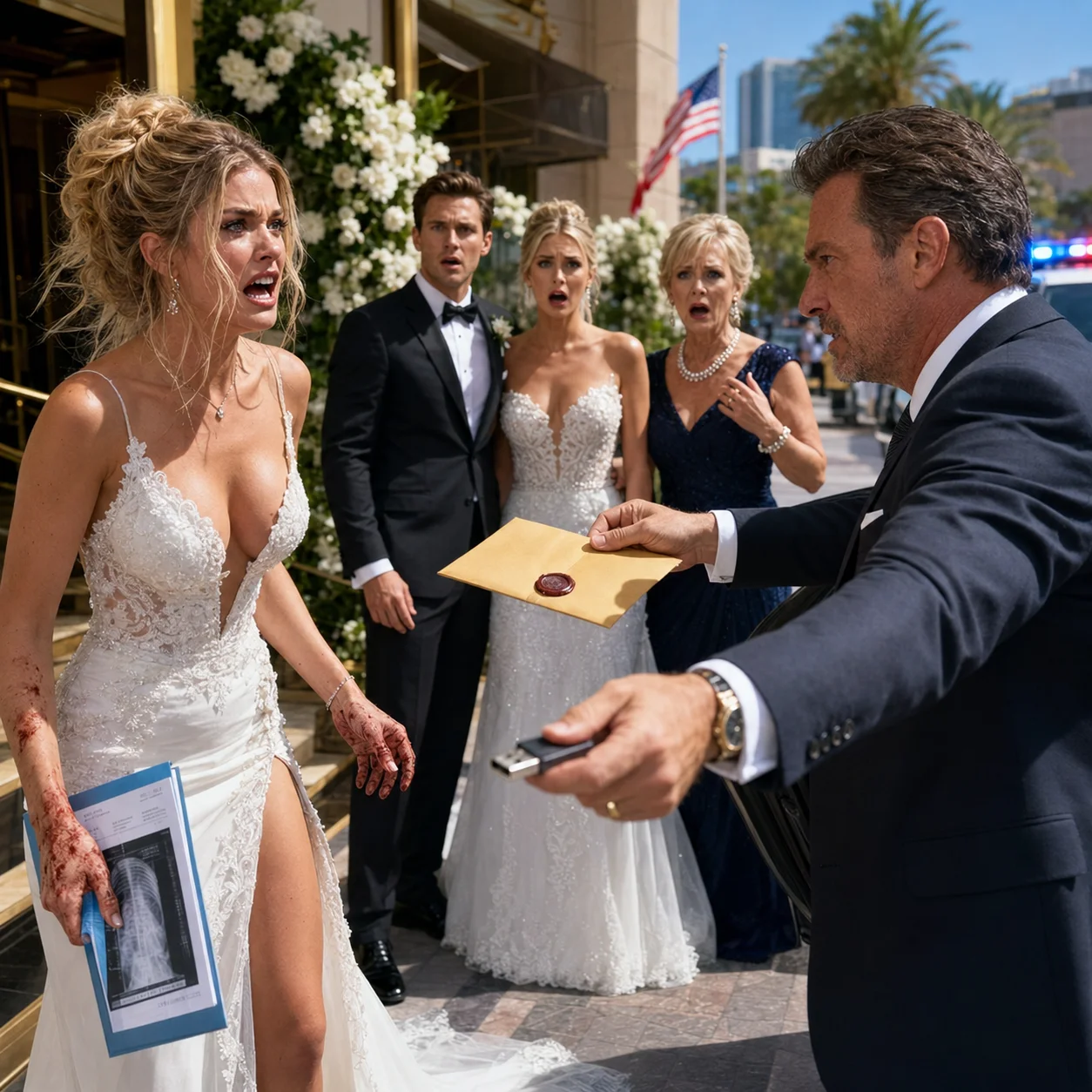
The man stopped in front of everyone and reached for Lucía’s hand with a gratitude so raw it hurt to witness.
“Dr. Herrera,” he said, his voice breaking. “You were not late to your wedding.”
Then he looked at Andrés.
At Inés.
And finally at Regina.
“You arrived exactly in time to discover that this family had already sold your place before you ever entered the operating room.”
Lucía stood frozen.
Regina went pale.
Andrés opened his mouth, but nothing came out.
The man removed a sealed envelope and a USB drive from his pocket.
“And before they keep humiliating her,” he added, “I think everyone here should know who caused my son’s accident this morning.”
The silence that fell outside the ballroom was so heavy even the music seemed ashamed.
Lucía felt the world shrink down to the envelope, the USB drive, and the trembling hand of the boy’s father.
“What did you say?” Andrés asked.
The man did not look at him at first. His eyes stayed on Lucía, as if she were the only clean person standing in an entrance full of expensive flowers and rotten smiles.
“My son’s name is Mateo Santillán,” he said. “He is five years old. This morning he arrived at Hospital Santa María with a ruptured spleen, internal bleeding, and blood pressure almost impossible to hold. Dr. Herrera operated on him for four hours.”
Regina crossed her arms.
“She already said that.”
The man turned to her.
“No. She said it with humility. I’m going to say it with witnesses.”
A murmur moved through the guests.
Lucía could barely breathe.
The man took out his phone and showed a photograph.
Mateo was lying in a hospital bed, pale, bandaged, connected to tubes. Beside him, his mother held one small hand.
Several people lowered their eyes.
Inés tightened her grip on Andrés’s arm.
“I don’t understand what this has to do with us,” she said, trying to sound calm.
The man looked at her for the first time.
His expression changed.
He was no longer only a grateful father.
He was a furious man who had found the right name for his pain.
“It has to do with you because the vehicle that hit my son came from this hotel’s parking lot.”
Regina’s face drained of color.
Sergio stepped back.
Andrés frowned.
“What?”
“At 4:41 this morning,” the man continued, “a white supplier van left through the side entrance, drove onto the sidewalk on Avenida Vallarta, and struck my son while we were getting out of our car to buy medicine for his mother.”
Lucía closed her eyes.
She remembered the mother screaming in the emergency room.
She remembered the blood.
She remembered the child arriving so cold he looked unreal.
“The driver fled,” Mateo’s father said. “But he did not count on the pharmacy camera across the street. He did not count on the hotel’s supplier records. And he definitely did not count on me refusing to sit quietly and wait for traffic police to call me.”
Sergio tried to laugh.
“Sir, this sounds tragic, but you can’t just come here and ruin a wedding because of it.”
The man lifted the USB drive.
“I did not come to ruin a wedding. I came to end a lie.”
Regina moved closer to Andrés.
“Do not listen to him. This is a setup. Lucía probably brought him here to play victim.”
Lucía stared at her in disbelief.
“You really think I would use a child who almost died?”
“You would do anything to look noble,” Regina spat.
The boy’s father stepped toward her.
“Be very careful with what you say.”
Andrés finally spoke with force.
“Who are you?”
The man straightened.
“Emilio Santillán.”
The name moved through the entrance like electricity.
Some guests recognized it immediately.
Businessman. Builder. Hospital donor. Owner of buildings around Andares and Puerta de Hierro. A man used to governors answering his calls and lawyers arriving before the call ended.
Regina recognized him too.
That was why she stopped smiling completely.
“Mr. Santillán,” Andrés said, swallowing hard, “I am deeply sorry about your son, but this does not justify—”
“Be quiet,” Emilio said.
He did not shout.
He did not need to.
Andrés froze.
Emilio pointed toward the ballroom.
“Do you have a screen?”
No one answered.
“Good. Then we’ll use the wedding slideshow screen.”
Inés’ face tightened.
“No. This is absurd.”
Emilio looked at her.
“You are Inés Robledo, correct?”
She blinked.
“Yes.”
“Daughter of Álvaro Robledo, owner of Robledo Events.”
Inés said nothing.
Emilio turned toward the parking lot.
Two men stepped out of another black car. One carried a laptop. The other walked beside a man in a gray uniform, handcuffed to an officer.
The driver.
Lucía recognized him vaguely from the photos Emilio had shown police at the hospital.
His face was not bruised from a fight.
It was bruised by fear.
By guilt.
Regina made a strangled sound.
Sergio muttered, “No…”
Emilio heard him.
“Yes,” he said. “Exactly.”
The guests began moving aside as Emilio entered the ballroom.
Lucía did not want to go in.
She did not want to walk toward the altar decorated with white flowers where Andrés had just promised his life to another woman.
But Emilio stopped and offered her his hand.
“Doctor, you do not have to enter if you don’t want to.”
Lucía looked down at her wrinkled dress.
At the dried blood near the hem.
At her tired hands.
Then she looked at Andrés, standing there with his new ring, unable to hold her gaze.
“I’m going in,” she said. “I’ve been left outside too many times.”
The ballroom was filled with candles, white roses, poured champagne, and plates of elegant birria that no one had touched. In one corner, a dessert table displayed tiny jericallas, mazapanes, and tall glasses of tejuino for out-of-town guests who wanted “something typical from Guadalajara.”
Everything was beautiful.
Everything was false.
On the screen at the back, a photo of Andrés and Inés was frozen from their engagement-style shoot in the historic center near the Cathedral.
Lucía felt nauseous looking at it.
That city, that golden stone light, those streets should have belonged to memories she shared with Andrés.
Now they belonged to betrayal.
The technician connected the USB drive.
Emilio stood beside the screen.
“Before this begins,” he said, “I want to make one thing clear. I am not defending Dr. Herrera because she saved me money or helped me close a contract. I did not know her. I did not know her name until today. I am defending her because while you were toasting, she had her hands inside my son’s abdomen, keeping him alive.”
No one spoke.
“And because I have just discovered that the emergency was not accidental.”
The first video appeared.
The hotel’s side entrance.
Time stamp: 4:32 a.m.
Sergio was standing beside a man in a gray uniform near a white van.
The audio was not perfect, but the important words came through like knives.
“It has to happen early,” Sergio said. “Just a hit, understand? Nothing serious. We need noise, an ambulance, something that gets her out of the way.”
The driver replied, but his words were muffled.
Then Sergio placed money in his hand.
Lucía felt her entire body go cold.
Andrés turned toward his brother.
“What did you do?”
Sergio raised his hands.
“It’s not what it looks like.”
Emilio laughed without humor.
“That is what everyone says when it finally looks exactly like what they did.”
The second video showed the van leaving the hotel.
Then the pharmacy camera footage appeared.
A parked car.
A woman getting out with a little boy holding her hand.
Mateo.
Small.
Wearing a blue sweatshirt.
The van came too fast.
Lucía turned her face away before the impact.
She could not watch that again.
Emilio did not look at the screen either.
He looked at Sergio.
“My son was not part of your plan.”
Sergio’s face was white.
“I didn’t know there would be a child.”
“But you knew there would be someone.”
Regina stood abruptly.
“Sergio, tell me this is a lie.”
But her voice had something strange in it.
Not shock.
Fear.
Lucía noticed.
So did Emilio.
“You knew,” he said to Regina.
Regina opened her mouth.
“No.”
The USB kept playing.
This time, an audio file filled the ballroom.
Regina’s voice came through the speakers.
“Lucía is on call. If something happens in the morning, she will choose the hospital. She always chooses the hospital. Andrés has to understand that woman will never put him first.”
Then Inés’ voice followed.
“And what if she comes anyway?”
Regina answered, cold and certain.
“Then you’ll be dressed and ready. The judge has already been told. Andrés cannot stand being embarrassed in front of everyone. If Lucía is delayed, you walk in.”
The ballroom erupted in whispers.
Lucía felt the folder slip slightly from her hands.
Andrés looked at his mother as if seeing her for the first time.
“Mom…”
Regina shook her head desperately.
“I only wanted to protect you.”
“By causing an accident?”
“We didn’t mean to hurt a child!” Inés cried.
The room fell silent again.
Too late, she realized she had condemned herself.
Andrés stepped away from her.
“You knew?”
Inés began crying.
“I love you.”
“You knew?” he repeated.
She did not answer.
Andrés removed the ring from his finger and dropped it on the table.
The sound was small.
But to Lucía, it sounded like a door closing.
Emilio gestured to the officer.
The driver was brought forward.
“Say what you told me outside,” Emilio ordered.
The man shook.
“They paid me to cause a distraction. Mrs. Regina said the doctor had to arrive late. Mr. Sergio gave me the money. Miss Inés knew. They said nothing serious would happen, that I should hit a post or a planter. But the boy stepped out… I couldn’t stop.”
Mateo’s mother, who had just entered the ballroom with a destroyed face, let out a sob.
Emilio went to her and held her.
Lucía pressed one hand to her chest.
That woman had spent the morning believing life had randomly tried to steal her child.
Now she knew her pain had been the consequence of a wedding.
Of a mother-in-law.
Of a cruel plan.
Of a family that preferred to manufacture an absence rather than accept a woman with a calling.
Regina moved toward Andrés.
“Son, listen to me. This got out of control, but I did it for you. Lucía was never going to be a wife. She was always going to run to the hospital. You were always going to be alone.”
Andrés looked at her with horror in his eyes.
“Then I should have learned to admire her, not replace her.”
Lucía felt the words arrive late.
Far too late.
He walked toward her.
“Lucía…”
She raised a hand.
“No.”
Andrés stopped.
“I didn’t know about the accident.”
“But you knew about Inés.”
He lowered his gaze.
Lucía swallowed the knot in her throat.
“You did not need a video to marry someone else. You only needed forty-seven minutes.”
“My mother told me you weren’t coming.”
“And you believed her because you wanted to believe her.”
Andrés opened his mouth, but there was no defense left.
Lucía looked at Inés.
The other bride was crying beside a table, her dress untouched, her makeup perfect, as if tragedy had merely ruined her party.
“You won my place,” Lucía said quietly. “Keep what it was worth.”
Then she looked at Regina.
“And you were right about one thing. I am not fit to be the wife you wanted.”
Regina, already being approached by an officer, said nothing.
Lucía held the surgical folder against her chest.
“Because I was not born to bow my head before a family that confuses love with obedience.”
The police formally arrived minutes later.
Not as decoration.
Not as a threat.
They came with orders, statements, and the grave expressions of people who understood when a party had turned into a crime scene.
Sergio was detained.
So was the driver.
Regina and Inés were taken in for questioning because of their involvement in the plan.
The civil judge who had performed the rushed ceremony sat sweating in a corner, flipping through papers as if he could hide his shame between the pages.
The guests began leaving in silence.
Some did not say goodbye.
Others looked at Lucía with a mixture of pity and respect that no longer mattered to her.
Andrés remained in the middle of the ballroom, alone, with two rings on the table and no true wife beside him.
“Lucía,” he said one last time. “Forgive me.”
She looked at him.
There stood the man she had loved.
The man who once brought her coffee during overnight shifts.
The man who proposed to her in the rain in Tlaquepaque after dinner at a tiny place where they had both laughed because the salsa from their tortas ahogadas had gotten on their noses.
That man had existed.
But he had not been enough.
“Maybe one day I’ll forgive you,” she said. “But I will never come back.”
She walked out of the ballroom with no bouquet, no husband, and no celebration.
Outside, the Guadalajara air touched her face. The sky was clear, indifferent, filled with the kind of bright white sun that made hotel windows and modern towers shine as if nothing ugly could ever happen beneath them.
Emilio followed her out.
“Doctor.”
Lucía stopped.
His wife was beside him. Her eyes were swollen from crying, but when she saw Lucía, she took both her hands.
“My son woke up twenty minutes ago,” she said. “He asked for the teddy bear he had in the ambulance.”
Lucía closed her eyes.
For the first time that day, she cried.
Not for Andrés.
Not for the wedding.
For Mateo.
For that small life still remaining in the world.
Mateo’s mother hugged her.
She did not care about the wrinkled dress.
She did not care about the dried blood near the hem.
She hugged Lucía the way someone hugs the person who gave them back their entire universe.
“Thank you,” she whispered. “Thank you for choosing him.”
Lucía did not know what to say.
Because no one in that wedding had understood the truth.
She had not chosen to lose Andrés.
She had chosen to save a child.
And if that choice left her alone, then she preferred that loneliness to a home where her worth depended on arriving pretty, obedient, and on time.
Emilio handed her the envelope.
“This is a copy of everything. The videos, the audios, the driver’s information, the hotel records. Your name will be cleared.”
Lucía accepted it.
“My name was already clean.”
Emilio nodded.
“You’re right. Then this is so they can never dirty it again.”
Two days later, Mateo fully opened his eyes.
Lucía was on duty when the nurse called her.
“Doctor, the boy from the wedding is asking for you.”
The phrase moved through the surgery floor like a small light.
Lucía entered the room.
Mateo was weak, his lips dry, a large bandage hidden beneath his hospital gown. But he was awake.
His mother held his hand.
Emilio stood by the window in the same exhausted stillness, as if he had not yet learned how to return to normal life.
Mateo looked at Lucía.
“Did you fix me?”
Lucía smiled through tears.
“We did everything we could.”
Mateo lifted one small hand.
“My mom says you were a bride.”
Lucía swallowed.
“Yes.”
“Did you get married?”
The room went quiet.
Lucía looked out the window.
Far below, Guadalajara kept moving. Ambulances came and went. Vendors outside the hospital sold coffee. Families waited for news with rosaries in their hands and bags of homemade food on their laps.
Then she looked back at the boy.
“No,” she said softly. “I arrived late.”
Mateo frowned.
“But you arrived for me.”
Lucía let out a broken little laugh.
“Yes,” she whispered. “For you, I arrived.”
The child closed his eyes, tired.
“Then it was okay.”
That sentence held her together for months.
The case became a scandal in Guadalajara.
The Robledos denied everything until the audios leaked.
Regina tried to call it “a family misunderstanding.”
Sergio blamed the driver.
Inés blamed Regina.
Andrés publicly blamed no one, but he could not clean his name completely either. In a city where family names carried weight, cowardly silences carried weight too.
Lucía returned to the hospital.
At first, people looked at her with pity.
Then with pride.
Her patients did not ask about the wedding.
The mothers did.
Some brought flowers.
Some brought sweet bread.
One woman from Tonalá left a tiny clay Virgin Mary for Lucía to place in her locker.
Lucía kept it beside Mateo’s surgical report.
Not as a memory of pain.
As proof.
That day, she lost a marriage.
But she did not lose her calling.
And that mattered more than she had ever understood before.
One year later, she received an invitation.
Not to a wedding.
To a birthday party.
Mateo was turning six.
The party was held in a simple garden with a dinosaur piñata, colorful gelatin cups, fresh fruit drinks, and children running across the grass. No elegant ballroom. No pearls. No families pretending perfection.
When Mateo saw her, he ran toward her slowly, because he still had to be careful.
“Dr. Lucía!”
She knelt and hugged him.
Emilio watched from a distance with quiet gratitude.
There was no romance in his eyes.
Not yet.
Maybe never.
And that was fine.
Lucía did not need another man to arrive and rescue her from her own story.
She had already rescued herself when she decided never to go back.
Mateo lifted his shirt slightly and showed her the small scar on his abdomen.
“Look. This is where you fixed me.”
Lucía gently touched the edge of his shirt.
“That doesn’t mean you were broken. It means you survived.”
The boy thought for a moment.
“Do you have one too?”
Lucía looked at her left hand.
At the place where the ring had never stayed.
Then she smiled.
“Yes,” she said. “But mine doesn’t show.”
Mateo hugged her again.
“You survived too.”
Lucía closed her eyes.
In that embrace, she finally understood the real ending of that wedding.
It had not been when Andrés married Inés.
It had not been when Regina told her to leave.
It had not been when the police entered the ballroom.
The ending was this.
A living child laughing under the Guadalajara sun.
A woman standing on her own, without a veil, without a husband, without anyone’s permission.
And one clean certainty in her heart:
Sometimes arriving late to a lie is the most painful way to arrive on time for your own life.

![[FULL STORY] My Girlfriend of Five Years Told Me: 'I'm No Longer Attracted to You, I Want an Alpha Male ' I](https://social-media.rabedo.com/thumbnails/1777359728_B29.png)