I did not realize she had been listening.
She walked over to the phone and said in a small voice that broke something deep inside me.
“Grandma, I cried because you said Mommy was going to lose me.”
There was silence on the other end.
Then my mother used the same heavy breathing she always used before denying the obvious.
“That’s not true, sweetheart.”
Sofía squeezed my fingers.
“Yes, it is. You also said if I made a scene, you would leave me with the police so my mommy would learn.”
I ended the call before my mother could touch my daughter’s mind with another lie.
That afternoon, a child psychologist recommended by Samuel came to see Sofía.
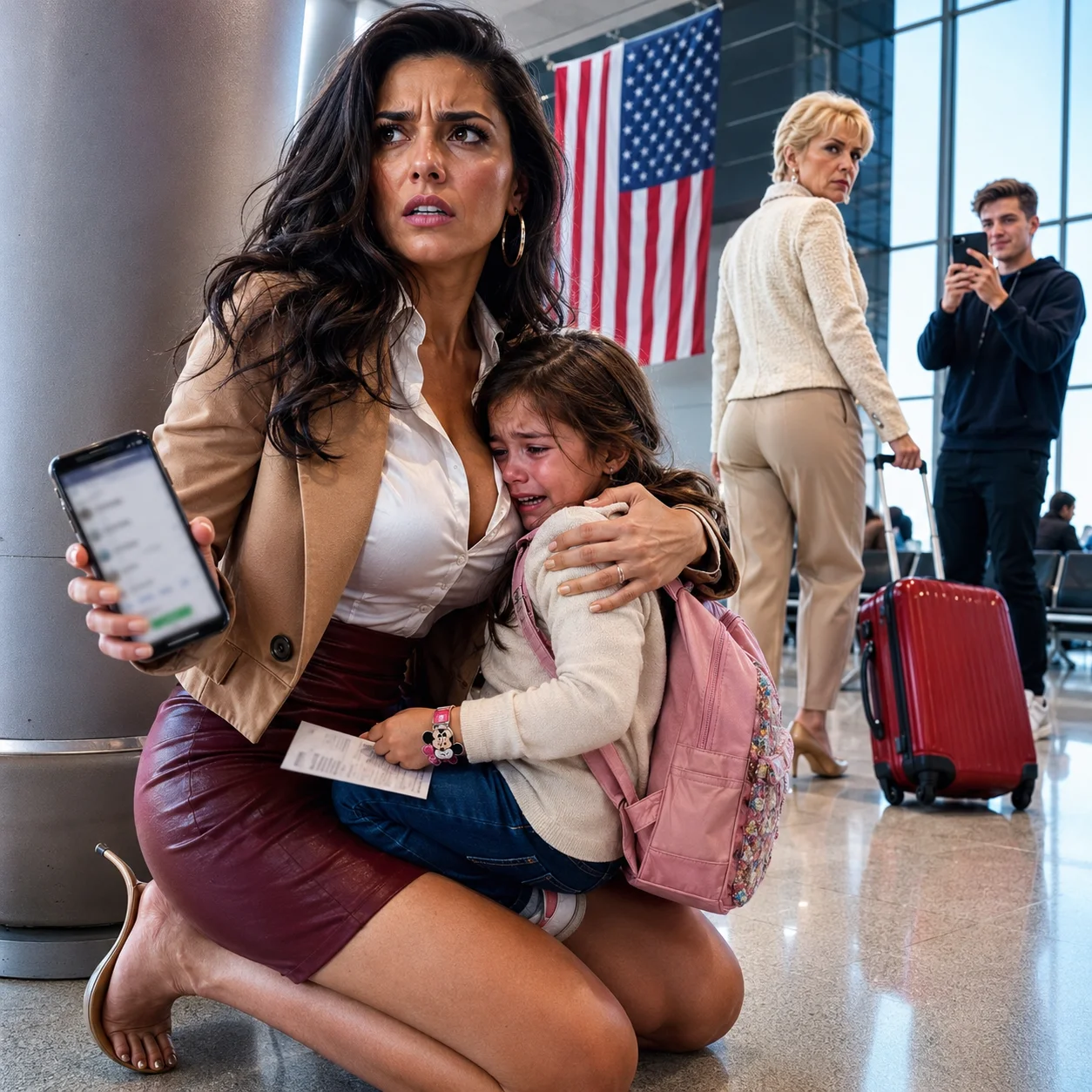
Sofía drew a huge airplane. She drew my mother holding a red suitcase. Then she drew herself as tiny as an ant beside a column.
When the psychologist asked her to draw where I was, Sofía drew me behind a wall, running, unable to find the door.
That drawing went to court with the airport report.
Three days later, my family returned to Mexico, escorted by a shame they could no longer hide behind Instagram filters.
My mother showed up at my building wearing dark sunglasses, carrying a Disney gift bag, and wearing the wounded expression of a victim who expected everyone to ask for her forgiveness.
The guard did not let her upstairs because the protection order was already active.
She started shouting in the lobby that I was keeping her away from her granddaughter, that grandmothers had rights too, that Sofía was her blood.
I watched through the security camera from my apartment while Sofía hid behind my leg.
“Can Grandma come in if she promises to be good?” my daughter asked.
That question told me the damage did not end when you closed the door.
I went downstairs alone.
The moment my mother saw me, she stopped shouting. For a second, she looked almost confident, as if she still expected me to shrink in front of her.
She held out the gift bag.
“I brought things for the girl. Stop making a show.”
Inside were Minnie ears, a pink shirt, and a shiny doll that could never erase the cold floor of an airport terminal.
“You can’t buy back a childhood you just broke,” I said.
My brother appeared behind her, red-faced with anger.
“You’re going to destroy this family over nothing?”
I pulled out my phone and showed him the video from the airport.
In it, he was not comforting Sofía. He was not calling security. He was not asking for help.
He was taking the photo he later sent me as a warning.
“You did not want me to come rescue her,” I said. “You wanted a record of me finding her abandoned.”
For the first time, my brother looked away.
My sister-in-law was the one who finally broke.
A few days later, she asked to speak with Samuel and handed over private messages where my mother explained the plan with a coldness that made me feel sick.
We leave her near security. Andrea arrives hysterical. We get witnesses to her breakdown. Then we file.
In another message, my brother asked if it was too much to leave Sofía without water.
My mother replied:
Fear teaches better than words.
When I read that, I did not cry.
Sometimes pain goes so deep that tears cannot reach it.
The temporary hearing was set for the following week.
My mother arrived dressed in white, holding a rosary between her hands, her face arranged into the expression of a suffering grandmother. My brother sat beside her, unable to look at Samuel.
Their lawyer tried to present the entire thing as a family misunderstanding.
He said Sofía had been difficult. He said no one had wanted to put her in danger. He said my police report was an emotional overreaction.
Then Samuel played the video.
On the courtroom screen, my daughter appeared beside the column while my mother walked away without looking back.
Then Samuel played my sister-in-law’s audio.
Then he submitted the family chat.
My mother stopped gripping the rosary.
The judge did not raise her voice.
That was what made it terrifying.
“This court is not seeing a lesson,” the judge said. “It is seeing a cruel punishment used as a tool of manipulation against a minor.”
Every word landed on my family like a locked door.
The judge ordered the protection measures to remain in place. She prohibited any direct or indirect contact with Sofía. She opened an investigation for abandonment and psychological violence.
My mother tried to speak then, crying, saying she had only wanted to help me become a better parent.
The judge interrupted her.
“Helping does not mean manufacturing trauma in order to gain authority.”
My brother apologized while staring at the table.
I did not accept it.
I did not reject it either.
I only thought of Sofía, who was in the children’s room of the courthouse, building a castle with blocks and putting a huge door in front of it.
When I stepped into the hallway, my mother was waiting.
She did not look like a queen anymore.
She looked like an old woman discovering that the fear she had planted could grow against her too.
“Andrea,” she said, “I am your mother.”
I looked at her calmly.
“And I am Sofía’s.”
That was the first time my voice did not ask permission from hers.
The months after that were not easy.
There was therapy. There were nightmares. There were questions no child should ever have to ask.
Sofía stopped wanting to go near airports. She stopped using her pink backpack. For weeks, she hid little bottles of water under her bed.
I learned not to rush her healing.
When she was ready, I bought her a new backpack. Not Minnie this time. Purple, with stars.
One day, she packed it herself. A notebook. A pencil case. A bottle of water. And a new drawing from therapy.
This time, she had drawn herself big, holding my hand, standing in front of an airplane that no longer took her away from me.
My family went to Disney believing they could teach my daughter a lesson.
But the real lesson was mine.
No bloodline is worth more than a child’s peace.
And no mother should ever let anyone call it drama when her instinct is saving her daughter.

![[FULL STORY] My Elitist Wife Laughed At My Blue-Collar Job With Her Friends, So I Ended Our Marriage On The Spot And Exposed Her Secret Empire Of Lies.](https://social-media.rabedo.com/thumbnails/1776852711_16.png)
![[FULL STORY] My fiancé said to me one day, "I need to talk to you… and this won't be easy for you." I was surpris](https://social-media.rabedo.com/thumbnails/1777363809_5.png)