
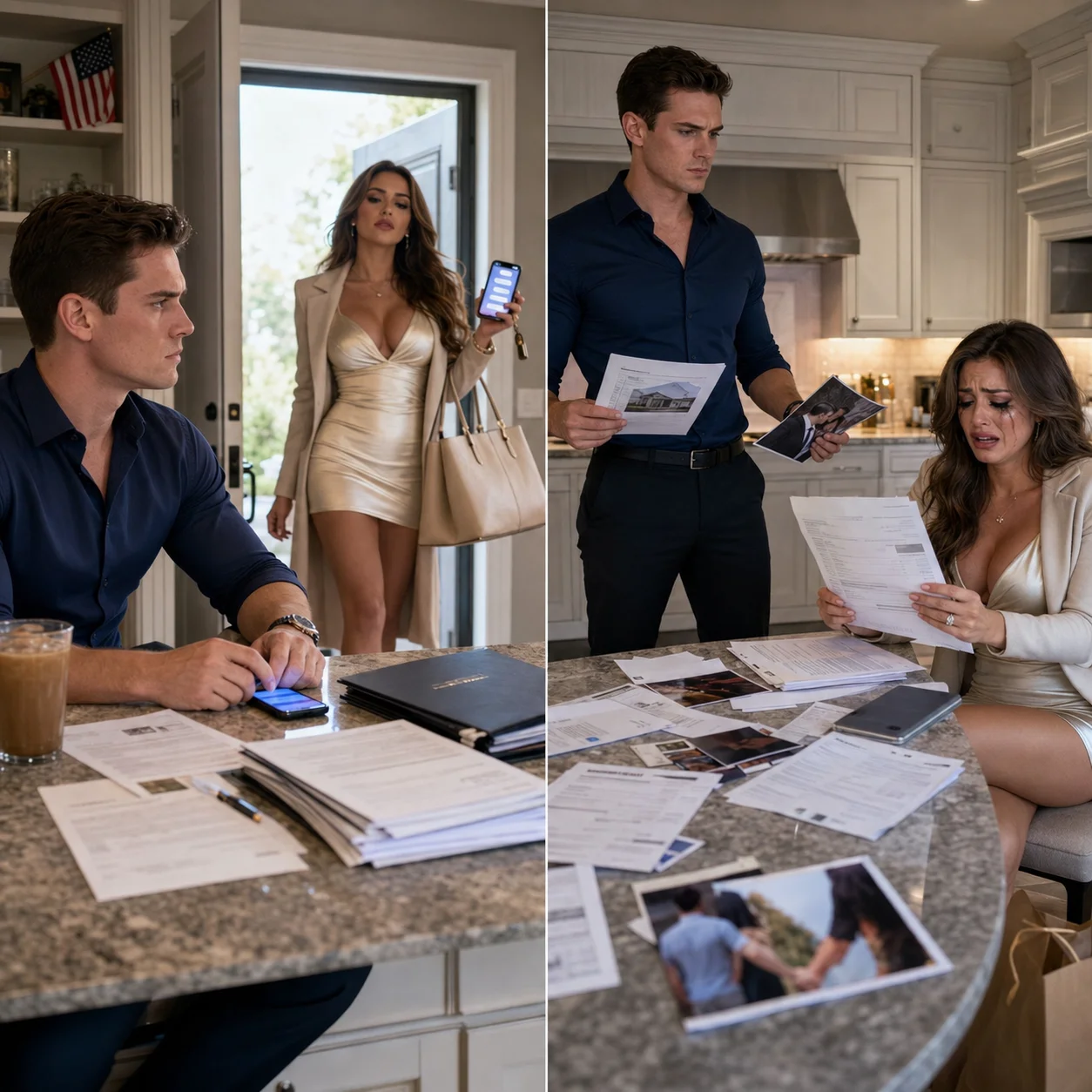
For five days, Daniel believed his wife had vanished without a trace. He filed a missing person report, hired a private investigator, and lived through the kind of terror no spouse should ever experience. But when she finally walked back through the front door with a designer shopping bag and a smirk, he realized her disappearance was not a tragedy — it was a betrayal she never expected him to survive calmly.
- FULL STORY WITH A STRONG LOGICAL ENDING
The coffee had gone cold in my hands three hours ago.
I sat at the kitchen table staring at my phone, willing it to ring, waiting for a call, a message, a police update, anything that would tell me my wife was alive. It had been five days since I had last seen her, and the silence in that house had become its own living thing. It pressed against the walls, filled the hallways, sat across from me at the table where she used to drink tea in the morning and complain that I made the coffee too strong.
It started on a Tuesday morning.
She kissed me goodbye, told me she was meeting her sister for lunch, and walked out the door with her purse slung over her shoulder. That was the last normal moment of my life.
By eight that evening, when she hadn’t returned any of my calls or texts, I knew something was wrong. My wife was many things, but she always answered her phone. Always. Even when she was angry with me, even when she was busy, even when she only sent back a clipped “Can’t talk right now,” she answered.
So I called her sister first.
“What do you mean lunch?” Rebecca asked, confusion thick in her voice. “We didn’t have plans today. I haven’t talked to her in over a week.”
The floor seemed to tilt beneath my feet.
After that, I called her best friend. Her coworkers. Her mother, who lived two states away. I called the little yoga studio she sometimes went to on weekends, the salon where she had an appointment the week before, even the pharmacy because I suddenly couldn’t remember whether she had picked up her blood pressure medication.
Nothing.
No one had seen her. No one had heard from her. Her car was gone. Her phone went straight to voicemail.
It was as if my wife had simply vanished into thin air.
By midnight that first night, I was at the police station filing a missing person report. The officer, a weathered man with tired eyes, took down all the information with practiced efficiency. Height. Weight. Last known clothing. Vehicle description. Medical issues. Possible places she might go. Possible reasons she might leave.
“Most adults who go missing turn up within forty-eight hours,” he said, trying to sound reassuring. “Usually it’s a misunderstanding. Sometimes they needed space.”
But I knew my wife.
This was not normal.
This was not her needing space.
We had problems, yes. What couple married for twelve years didn’t? We had been tired lately. Distant. Too polite in the mornings and too quiet at night. She said I worked too much. I thought she had become emotionally unreachable. We had fallen into routines that felt more like parallel lives than partnership.
But we talked through things.
Or at least, I thought we did.
She would not just disappear without a word.
The next four days blurred into a nightmare. I barely slept. Every sound made me jump. Every time a car slowed outside, I ran to the window. I checked my phone so often my thumb ached. I imagined her car at the bottom of a ravine. I imagined a hospital bed. I imagined a stranger with her purse. I imagined every terrible ending a mind can invent when love and fear have nowhere to go.
The police investigated, but by the second interview, I could see the skepticism in their eyes.
I had become that statistic.
The husband.
The first person everyone looks at when a wife goes missing.
They asked about our marriage. Arguments. Finances. Affairs. Insurance policies. They asked when I last saw her, then asked again later to see if the details changed. They were not cruel. They were just careful, and their carefulness made me feel like I was drowning in shame on top of terror.
On day three, I hired a private investigator.
Her name was Sarah. She was sharp, calm, and direct in a way that made me trust her almost immediately. She came highly recommended by a retired police captain I knew through work.
“I need you to find my wife,” I told her. My voice broke on the word wife. “I just need to know she’s safe.”
Sarah didn’t offer false comfort. She took notes. She asked for phone records, recent photographs, credit card access, names of friends, relatives, coworkers, old boyfriends, anyone my wife might have contacted. She asked questions that felt invasive but necessary. By then, I would have handed over my entire life if it meant getting an answer.
She was thorough.
She pulled phone records. Checked security footage. Interviewed neighbors. Traced card activity. Called places the police had not yet bothered to call because, in their minds, this still might be a wife who had simply chosen not to come home.
That was when things started to get strange.
Sarah found footage of my wife at a downtown hotel on Tuesday afternoon.
Checking in alone.
Paying cash.
I watched the clip on Sarah’s laptop in my kitchen, my heart hammering so hard I could barely hear what she was saying. My wife stood at the hotel counter wearing sunglasses, calm and composed, signing paperwork like a woman checking into a spa weekend. Not injured. Not frightened. Not confused.
Fine.
More than fine.
The next day, there was footage of her at a shopping mall, laughing with someone the camera angle didn’t fully catch. A man’s shoulder appeared briefly beside her. His hand touched the small of her back as they walked out of frame.
I stared at the screen until Sarah gently closed the laptop.
“I’m sorry,” she said.
My terror began morphing into something else.
Confusion first.
Then hurt.
Then, slowly, anger.
Sarah dug deeper. She found social media messages my wife had deleted. Conversations with an old college friend who had recently moved back to town. Nothing graphic. Nothing that proved, on its own, that she was having an affair. But the tone was familiar. Intimate. Private in a way that made my skin crawl.
Inside jokes.
Late-night messages.
Plans to meet.
Hours of phone calls I knew nothing about.
His name was Derek Patterson.
By day four, I had started making calls of my own.
I spoke with David, our lawyer, a family friend who had handled our wills and estate planning years earlier. At first, I framed it hypothetically because my mind still had not fully accepted what might be happening.
“Just hypothetically,” I said, sitting in my car outside the police station, “if I needed to protect our assets while my wife is missing, what would that look like?”
David was quiet for a moment.
“Are you sure about this?”
I wasn’t sure about anything anymore.
But I knew one thing.
If my wife had chosen to disappear, if she had allowed me to suffer through five days of hell thinking she was dead in a ditch somewhere while she lived out some fantasy with another man, there would be consequences.
Not revenge.
Consequences.
There is a difference.
On day five, I finished the paperwork.
The joint accounts were frozen pending investigation of suspicious activity. Large withdrawals had already raised concerns, and David moved quickly. I transferred control of several estate-planning instruments into protective status. The house, which had been held under a survivorship arrangement we had created years earlier after my father’s death, was moved under my sole administrative control while the missing person report and potential abandonment claim were reviewed.
It was not the kind of magic legal move people imagine in movies. It did not mean a judge had declared her dead after five days. It meant that because of the specific paperwork we had signed years earlier, combined with the missing person report, suspicious withdrawals, and evidence of possible marital abandonment, I had legal grounds to protect myself until the truth was sorted out.
David kept telling me the same thing.
“Document everything. Don’t threaten. Don’t guess. Don’t destroy anything. Protect yourself and let the facts do the work.”
So I documented everything.
Every call.
Every police report number.
Every message to her family.
Every receipt Sarah found.
Every hour of terror I had spent believing something terrible had happened.
I did not expect my wife to simply walk through the front door on the fifth evening, key in hand, as if she had been out grocery shopping.
But that was exactly what she did.
The sound of the key in the lock made my heart stop.
For five days, I had prayed to hear that sound. I had imagined myself running to the door, grabbing her, holding her, crying into her hair because she was alive. I had imagined relief so powerful it would knock me to my knees.
But when it finally happened, I felt nothing except a cold, spreading numbness.
The door swung open, and there she was.
My wife.
Completely unharmed.
Not a hair out of place.
Wearing clothes I didn’t recognize and carrying a designer shopping bag I definitely hadn’t paid for.
She walked into our home — my home now, though she did not know that yet — with the casual confidence of someone who had been gone for an afternoon, not nearly a week.
But it was her face that stopped me cold.
That smirk.
That self-satisfied, almost challenging expression that said she knew exactly what she had done and felt completely justified in doing it.
“You’re home,” I said.
My voice sounded flat, even to me.
I didn’t move from the kitchen table. I didn’t rush to embrace her. I didn’t demand to know where she had been. I just watched this woman I had been married to for twelve years, this person I had cried for, panicked for, defended to police, and suddenly she looked like a stranger wearing my wife’s skin.
She set down the shopping bag and crossed her arms.
The smirk deepened.
“Don’t look so shocked,” she said. “I needed some time to myself. Is that a crime?”
“Time to yourself?” I repeated slowly. “You needed time to yourself?”
“Yes,” she said, walking farther into the kitchen and opening the refrigerator like it was any normal day. “God, you’re so dramatic. I’m allowed to have my own life, you know. I don’t have to report my every movement to you.”
Something inside me hardened like cement setting.
“You’ve been gone for five days.”
“And?” She grabbed a bottle of water and twisted off the cap. “You survived, didn’t you? Honestly, you should be grateful I even came back. The way you’ve been suffocating me lately, texting constantly, always wanting to know where I am and what I’m doing. I needed space.”
Grateful.
She wanted me to be grateful.
I thought about the nights I spent awake imagining her hurt, scared, alone. I thought about the hours at the police station, being questioned like a suspect. I thought about the shame of calling our families and telling them my wife was missing. I thought about the private investigator’s fees, the lawyer consultations, the crushing weight of not knowing whether the person I loved was alive.
And she wanted gratitude.
“Where were you?” I asked quietly.
She waved one hand as if the question bored her.
“Around. I stayed at a hotel, did some shopping, caught up with an old friend. I just needed to remember who I was before I became someone’s wife, someone’s employee, someone’s daughter. Is that really so hard to understand?”
“You could have told me.”
She leaned against the counter and studied her nails.
“So you could talk me out of it? So you could make me feel guilty? I knew exactly what would happen. You’d get all clingy and emotional, and I’d end up staying home to make you feel better. Well, I’m tired of living my life for everyone else.”
I stood slowly and pulled out my phone.
“Did you check your email today?”
She frowned. For the first time, her confidence flickered.
“No. Why?”
“You might want to.”
I set my phone on the table, keeping my voice steady.
“You should have several messages from our bank. And one from David.”
David was our lawyer.
Her frown deepened. “What are you talking about?”
“I filed a missing person report on Tuesday night,” I said. “When you didn’t come home. When your sister said she hadn’t seen you. When no one knew where you were. The police opened an investigation.”
The smirk faded, replaced by irritation.
“Oh, please. You didn’t need to involve the police. That’s so embarrassing.”
“Is it?” I tilted my head. “I thought my wife was missing. Possibly dead. What was I supposed to do? Just assume you decided to take an impromptu vacation without telling anyone?”
“You’re being ridiculous.”
But her voice had lost some of its certainty.
“I also hired a private investigator,” I continued. “On Wednesday. She’s been very thorough. Would you like to know what she found?”
The color drained from her face.
“You hired a private investigator to follow me?”
“To find you,” I corrected. “Because I thought you were missing. You were, weren’t you? Missing. Gone. Vanished without a trace or a word.”
She opened her mouth, then closed it again.
The shopping bag seemed to catch her attention suddenly, and she picked it up defensively.
“You had no right.”
“I had every right,” I said, my voice hardening. “You’re my wife. You disappeared. Sarah found some very interesting things. Hotel receipts. Shopping sprees paid for in cash. Security footage from Tuesday afternoon showing you checking into a downtown hotel alone. Smiling.”
She stepped back and hit the counter.
“I don’t have to explain myself to you.”
“Actually,” I said, “you might have to explain yourself to a judge.”
The word judge hung between us like a blade.
I watched my wife’s face cycle through emotions. Confusion. Disbelief. Anger. Then, finally, the first glimmer of genuine fear.
“What the hell are you talking about?” she snapped, setting the water bottle down with a sharp crack. “A judge? Have you lost your mind?”
I pulled out the chair across from me and gestured to it.
“Sit down. We need to talk.”
“I’m not sitting down. I just got home and you’re threatening me with—what exactly? A judge?”
“Sit down.”
Something in my voice must have reached her because she moved to the chair, though she perched on the edge like she might bolt at any moment.
I opened the folder I had kept on the table for the past two days.
“These are bank statements,” I began, sliding the first set of papers across to her. “Our joint checking account. Our savings. The credit cards in both our names. Notice anything different?”
She snatched up the papers and scanned them.
I watched the exact moment comprehension hit.
Her eyes widened.
“These accounts are frozen. Why are the accounts frozen?”
“Suspicious activity,” I said calmly. “When a person goes missing and there’s evidence they may have been planning to drain marital assets, protective measures can be taken. David filed the paperwork on Thursday.”
“Drain marital assets?” Her voice rose. “I was taking a few days for myself.”
“Were you?”
I pulled out another document.
“This is a cash withdrawal you made on Monday. The day before you disappeared. Five thousand dollars. Can you tell me what that was for?”
She went pale. “That’s none of your business.”
“Everything in that account is my business. It’s a joint account. You withdrew five thousand dollars in cash and didn’t tell me. Then you vanished the next day. What was I supposed to think?”
“I don’t have to justify my spending to you.”
“Actually, you do. That’s how joint accounts work. That’s how marriage works.”
I pulled out more papers.
“But here’s what really interests me. These are records Sarah obtained through her investigation. Hotel stays. Restaurants. Shopping. You spent eight thousand dollars in five days.”
Her hands trembled as she looked at the evidence.
“You had someone spying on me.”
“I had someone searching for my missing wife,” I corrected. “There’s a difference. And what she found was very enlightening.”
Her lips parted.
“Should we talk about the phone records?” I asked.
“Stop it.”
Her voice was barely above a whisper now.
I pulled out the phone records anyway.
“Hundreds of texts and calls to a number I didn’t recognize. Hours of conversations, all deleted from your visible message history. But phone companies keep records. The number belongs to Derek Patterson. Your friend from college who moved back to town six months ago.”
She stood abruptly, the chair screeching against the floor.
“Nothing happened with Derek. We’re just friends.”
“Friends you lied to me about. Friends you spent hours talking to in secret. Friends you saw on Tuesday when you told me you were meeting your sister.”
Her breathing changed.
I kept going because if I stopped, I knew emotion might take over.
“Should I play the voicemail you left him? The one Sarah obtained? The one where you told him you were finally free for a few days and couldn’t wait to just be us?”
Her face crumpled.
“You don’t understand. Derek and I... we have a connection. A real connection. He understands me in ways you never have.”
“So you thought you’d disappear for five days to explore that connection? Without telling me. Without thinking about how I’d feel. Without considering that I might call the police. That there might be consequences.”
“I was going to come back.”
“Were you?”
I pulled out the final printed message.
“This is a text you sent to Derek on Wednesday night. I don’t know if I can go back to that life. To him. These few days have shown me what I’ve been missing. Does that sound like someone planning to come back?”
She sank back into the chair and covered her face with her hands.
“I was confused. I am confused. Derek makes me feel alive again. But I wasn’t going to just leave. I have a life here. A home.”
“About that,” I said.
I slid the final document across the table.
“This is the updated deed and control filing for the house.”
She looked up, wiping her eyes. “What about it?”
“Notice anything missing?”
She grabbed the paper and stared at it.
Her expression cracked.
“What did you do?”
“We set up our estate with a survivorship and emergency control clause years ago,” I explained. “In the event one of us was presumed missing, dead, incapacitated, or engaged in conduct that threatened the marital estate, certain assets could be placed under the other spouse’s control until the issue was resolved. When you disappeared, when there was a police report, when there were unexplained cash withdrawals, David activated the clause and filed protective documentation.”
“You can’t do that. I’m not dead.”
“No,” I said. “You’re not. And I’m glad you’re not. But you were missing. And based on the police report, the private investigator’s findings, and the evidence I’ve compiled, there’s reason to believe you abandoned the marriage and may have been preparing to misuse marital assets. That changes things legally.”
She stood again, backing toward the door.
“This is insane. You can’t just take everything because I needed a few days away.”
“I’m not taking everything,” I said quietly. “I’m protecting myself. Because the woman who walked through that door twenty minutes ago is not my wife. My wife wouldn’t have smirked at me. She wouldn’t have told me to be grateful she came back. She wouldn’t have spent five days letting me think she was dead while she played house with an old flame.”
“Derek and I didn’t—” She stopped because even she could hear how weak it sounded.
“It doesn’t matter,” I said.
And I meant it.
“Whether you slept with him or not, you chose him over me. Over our marriage. You chose to disappear without a word and let me suffer. Then you had the audacity to walk back in here like you were doing me a favor.”
She slumped against the wall, all the bravado draining from her body like water from a broken vessel.
For the first time since she had walked through the door, she looked truly afraid.
Not afraid of me. I had never given her reason to fear me physically.
She was afraid of what she had done.
Afraid of the consequences she had never bothered to consider.
“I want to call David,” she said, her voice small. “Our lawyer. I want to know if what you’re saying is legal.”
“Go ahead,” I said, gesturing to her purse. “But he won’t take your call as your attorney. He represents me now. Conflict of interest. You’ll need to find your own representation.”
She stared at me like I had spoken a foreign language.
“Your lawyer? David has been our lawyer for ten years.”
“And now he’s mine. I retained him on Wednesday when it became clear this wasn’t a simple missing person case. He advised me on every step I’ve taken.”
I moved to the coffee maker because I needed something to do with my hands.
“You should also know I’ve documented everything. Every call to the police. Every conversation with Sarah. Every hour I spent terrified something had happened to you.”
“Why?” The question came out almost as a sob. “Why are you doing this?”
I turned to face her, and for the first time in five days, I felt something close to clarity.
“Because you destroyed my life for five days and thought I should be grateful you came back to finish the job. Because you manipulated me, lied to me, and turned me into the frantic, suspicious husband while you played at some fantasy life with Derek. Because I deserve better than this.”
She wiped her eyes with the back of her hand, smearing her makeup.
“I didn’t mean for it to go like this. I just needed time to think. Derek and I ran into each other at that coffee shop in September, and we started talking, and he reminded me of who I used to be before the mortgage and the routines and the same conversations every night. He made me feel young again. Exciting.”
“So you thought you’d check out of our marriage for a test run,” I said. “See if the grass was greener.”
“Yes. No. I don’t know.”
She moved back to the table and sat down heavily.
“Do you even remember the last time you really looked at me? Really saw me? We’ve been going through the motions for months. Maybe years. When was the last time we did anything spontaneous? When was the last time you surprised me?”
“When was the last time you asked me to?” I shot back. “Marriage is a two-way street. If you were unhappy, we could have talked about it. We could have gone to counseling. We could have taken a vacation, changed our routines, done anything except what you did.”
“You would have said counseling was too expensive. You would have said you couldn’t take time off work for a vacation.” Her voice turned bitter. “You would have made me feel guilty for even asking.”
I set the coffee cup down carefully, fighting to keep my voice level.
“Is that really what you think of me? That I’m some kind of controlling monster who wouldn’t want to fix our marriage?”
She looked at me then.
Really looked at me.
For the first time since she had come home.
“I think we’ve both been pretending everything was fine when it wasn’t,” she said. “I think we stopped being partners and became roommates who shared a bed. And I think I handled it in the worst possible way.”
A laugh escaped me, harsh and humorless.
“You disappeared for five days. I filed a police report. I hired a private investigator. I called everyone we know, terrified you were hurt or dead. I barely slept. I couldn’t eat. I imagined every horrible scenario. And you were at a hotel shopping, laughing with Derek, feeling alive. So yes, you handled it badly.”
“I’m sorry.”
The words sounded hollow.
“I am,” she insisted. “I know I hurt you. I just felt trapped. Like I was suffocating. Derek represented this escape, this chance to be someone other than the woman who pays bills and goes to work and comes home to watch TV.”
“Then you should have left,” I said quietly. “Properly. Honestly. You should have sat me down and told me you were unhappy, that you wanted out, that you’d met someone else. Instead, you tortured me, and then you walked in here smirking like I was the problem.”
She winced.
“That was wrong. The smirking. The attitude. I was defensive. I knew what I’d done was terrible, and I couldn’t face it, so I tried to make it your fault. I tried to make it seem like you were overreacting.”
“I wasn’t overreacting.”
“No,” she whispered. “You weren’t.”
We sat in silence for a long moment.
The house settled around us with all the familiar creaks and sounds that used to feel comforting. Now they just felt empty.
“What happens now?” she asked finally. “With the house, the accounts, everything?”
I picked up my phone and opened the latest email from Sarah.
“That depends on you. The private investigator’s report is complete. She documented your movements for all five days. The hotels. The restaurants where you and Derek had dinner. The shopping trips. There’s even security footage from the mall on Wednesday where you two were holding hands.”
Her face flushed.
“It wasn’t—”
“It doesn’t matter,” I interrupted. “What matters is what this looks like. Abandonment. Possible infidelity. Misuse of marital assets. If we end up in divorce court, I have documentation of everything.”
“You’re divorcing me.”
It wasn’t a question.
“Are you giving me a reason not to?” I asked. “Because from where I’m sitting, you made your choice when you deleted Derek’s messages. When you withdrew five thousand dollars in cash. When you told him you didn’t know if you could come back to your life with me.”
She was crying now. Really crying, her shoulders shaking.
“I made a mistake. A huge, terrible mistake. But I came back. That has to count for something.”
“You came back because your vacation was over,” I said. “Not because you missed me. Not because you realized what you’d done. You came back because the fantasy had an expiration date and real life was waiting.”
“That’s not fair.”
“Fair,” I repeated.
The word tasted bitter.
“You want to talk about fair? Here’s what’s fair. I protected our assets. I documented everything. I made sure that whatever happens next, I’m not left financially destroyed on top of emotionally devastated. That’s fair.”
The kitchen clock ticked loudly in the silence that followed. Outside, someone was mowing their lawn. The sound was absurdly normal against the wreckage of our marriage scattered across the kitchen table.
My wife — I still thought of her that way, though I wasn’t sure for how much longer — sat with her head in her hands, her tears soaking into the legal documents that now defined our relationship.
“I need you to understand something,” I said finally.
My voice was softer than before. Not gentle. I wasn’t ready for gentle. But the sharp edge of anger had dulled because anger took energy I no longer had.
“These past five days changed me. I can’t unknow what I know now. I can’t unfeel what I felt.”
She looked up, her face blotchy and swollen.
“What do you mean?”
“I mean that when you walked out that door on Tuesday, you didn’t just disappear physically. You destroyed something. Trust. Security. The foundation of everything I thought we had built together. And when you walked back in with that smirk, telling me to be grateful you came back, you showed me exactly how little you valued what we had.”
“Had,” she repeated. “Past tense.”
“Can you give me a reason to use present tense?” I asked. “Because I’ve spent the last hour laying out everything you’ve done and everything you’ve destroyed. You’ve given me explanations and excuses, but not a single real reason to believe anything would be different going forward.”
She wiped her face with a napkin from the table.
“What would that look like? A real reason?”
“I don’t know,” I admitted. “Maybe that’s the problem. Maybe we’re so far gone I can’t even imagine what would make this fixable.”
She was quiet for a long time, staring at the documents spread between us.
“Derek called me this morning,” she said finally. “He asked when he’d see me again. When I’d leave you for good and we could start our real life together.”
My stomach twisted, but I kept my face neutral.
“What did you tell him?”
“Nothing. I didn’t answer.”
She looked at me, her eyes red but clear in a way they hadn’t been all evening.
“I realized this morning that Derek doesn’t actually want me. Not really. He wants the fantasy version of me. The spontaneous one. The carefree one. The woman with no responsibilities and no mortgage and no family obligations. But that’s not who I am. I have a career I’ve built for fifteen years. I have friends here. Family. A life. Derek wants to take me away from all of that and start fresh somewhere I’d be completely dependent on him.”
“And that scared you?”
“It terrified me. Because I realized I had been so focused on escaping what I saw as a cage that I was about to walk into an actual one.”
She twisted the wedding ring that was still on her finger.
I noticed.
“But that doesn’t change what I did to you,” she said. “And I don’t know how to fix it.”
“Maybe you can’t,” I said. “Maybe some things, once broken, can’t be put back together.”
“Is that what you want?” Her voice cracked. “For this to be over?”
I leaned back in my chair, feeling every one of my forty-three years.
“What I want is to not have spent five days in hell. What I want is to not have called your mother crying, thinking you were dead. What I want is to not have hired a private investigator who found evidence of my wife holding hands with another man. But I don’t get what I want. None of us do.”
“So what do we do?”
I gathered the papers, tapping them into a neat stack.
“Here’s what’s going to happen. The accounts stay frozen for now. The house stays under my control until we figure out what comes next. You’re going to get your own lawyer. David can recommend someone, but he no longer represents you. We’re going to have an honest conversation about whether this marriage has any chance of survival.”
“You’re giving me a chance.”
There was hope in her voice, fragile as spun glass.
“I’m giving us both time,” I corrected. “Time to think clearly. Time for you to decide if you want to be married to me or if you just don’t want to lose the assets. Time for me to decide if I can ever trust you again, or if every time you’re five minutes late, I’ll wonder if you’ve run off with Derek or whoever comes next.”
She flinched.
“I deserve that.”
“You deserve a lot of things right now,” I said. “But spite isn’t going to help either of us.”
I stood because I suddenly needed space from the table, from the documents, from her.
“Sarah’s investigation is complete, but I have her on retainer. Not to follow you. I’m not interested in that level of paranoia. But to finalize her report and make sure everything is documented properly. If we decide to divorce, it will be straightforward. If we decide to try to work through this...”
I trailed off.
“Then what?” she asked.
“Then we need counseling. Real, intensive marriage counseling. You need to cut off all contact with Derek permanently. No goodbye coffee. No closure conversation. Nothing. You need to be completely transparent about your phone, your email, your whereabouts. And honestly, I don’t know if even all of that will be enough.”
She stood too, wrapping her arms around herself.
“That sounds like a lot of rules.”
“Those aren’t rules. Those are the bare minimum requirements for me to even consider trusting you again. You broke something fundamental. If you want any chance of fixing it, you don’t get to complain about the terms.”
“And what will you do?” she asked. “While I’m jumping through all these hoops?”
“I’ll work on forgiving you,” I said simply. “Or deciding that I can’t. I’ll figure out whether the woman I married is still in there somewhere or if she’s been replaced by someone I don’t recognize. I’ll try to understand how we got here. What I missed. What I could have done differently.”
“You didn’t do anything wrong,” she said quickly. “This wasn’t your fault.”
“Maybe not. But marriages don’t fall apart in a vacuum. I may not have vanished for five days, but apparently I checked out enough that you felt justified doing it. That’s worth examining.”
She moved toward me, then stopped when I stepped back.
The hurt on her face was obvious, but I couldn’t help it. I wasn’t ready to be touched. I wasn’t ready to be comforted. I wasn’t ready to pretend any of this was okay.
“Can I stay here tonight?” she asked. “In the guest room? I mean... I don’t have anywhere else to go.”
I considered saying no. I considered making her find a hotel the way she had done for the past five days.
But spite wouldn’t help.
“Guest room,” I said. “Door closed. Tomorrow, you start looking for your own lawyer and a therapist. We both do. Whether we’re searching for marriage counselors or divorce attorneys, we need professional help to navigate this.”
She nodded and picked up her shopping bag.
“Thank you for not just throwing me out.”
“Don’t thank me,” I said. “This isn’t kindness. This is me trying to make rational decisions instead of emotional ones. Tomorrow, when I’m less numb, I might regret it.”
She walked toward the stairs, then paused.
“The smirk when I came in,” she said quietly. “That wasn’t confidence. It was defense. I knew what I’d done was indefensible. I thought if I acted like it was no big deal, maybe you’d let it go. Maybe we could pretend it never happened.”
“We can’t pretend,” I said. “That’s over. Whatever happens next, it happens in reality. With honesty.”
She nodded and disappeared upstairs.
I heard the guest room door close with a soft click.
I stood alone in the kitchen, surrounded by evidence of her betrayal and my methodical response to it. The house felt different now. Not like home, but like a museum of what we used to be.
Maybe it would feel like home again someday.
Maybe we would rebuild something new on the ruins of what had been destroyed.
Or maybe this was the beginning of the end, drawn out with lawyers, mediators, counseling sessions, and the civilized dissolution of twelve years together.
I honestly didn’t know which outcome I wanted anymore.
What I did know was that I would never again be the man who waited in terror for five days, hoping against hope that his wife would come home safely. That man had died somewhere between Tuesday night and the moment she walked through the door smirking.
In his place was someone harder.
More careful.
Someone who understood that love without respect was just another form of suffering.
And I was done suffering.
I picked up my phone and sent a message to Sarah, letting her know her services might be needed on an ongoing basis. Then I texted David asking for recommendations for marriage counselors who specialized in infidelity, abandonment, and betrayal trauma.
Finally, I opened the message to my wife’s mother that I had been drafting in my head all evening.
“She’s home safe. Thank you for your support these past few days. We have a lot to work through, but at least the not knowing is over.”
I hit send before I could second-guess it.
The not knowing was over.
That part, at least, was true.
But the knowing — the living with what I now knew, what I had documented, what I could not forget — was just beginning.
I poured out the cold coffee and made a fresh pot.
It was going to be a long night.
And probably an even longer tomorrow.
But for the first time in five days, I felt like I was standing on solid ground. I had protected myself. I had prepared for every outcome. I had refused to be the grateful, forgiving fool she apparently expected me to be.
Whatever happened next, I would face it with my eyes open, my assets protected, and my dignity intact.
And if she wanted to be part of my future, she would have to earn it.
One honest conversation at a time.
The next morning, she came downstairs wearing the same clothes she had arrived in, except now they looked less like evidence of a glamorous escape and more like a costume after the show had ended. She had not slept. Neither had I.
“I blocked Derek,” she said before I could ask.
She placed her phone on the table and slid it toward me.
I did not pick it up.
“I believe you blocked him,” I said. “That is not the same as believing you’re done with him.”
She swallowed. “I know.”
That answer surprised me more than any dramatic apology would have.
For the next three weeks, we lived in the same house like two people recovering from an accident neither of us could fully describe. She stayed in the guest room. The accounts remained frozen. She found her own attorney. I kept David. We started counseling twice a week with a woman named Dr. Patel, who had the remarkable ability to let silence become unbearable enough that the truth eventually crawled out.
My wife admitted more in those sessions than she had admitted in the kitchen.
She admitted the emotional affair had started months earlier.
She admitted she had enjoyed having a secret.
She admitted Derek made her feel powerful because he wanted her without knowing the tired, ordinary parts of her life.
She admitted that disappearing had not been an impulsive decision. She had planned part of it. The cash withdrawal. The hotel. The deleted messages. The lie about Rebecca. She said she convinced herself she was not leaving me, just “borrowing a different life for a few days.”
Dr. Patel looked at her and said, “People are not cars. You don’t get to test-drive betrayal.”
That sentence stayed in the room for a long time.
I did my part too.
I admitted I had hidden behind work. I admitted I had stopped asking hard questions because I was afraid of the answers. I admitted I had mistaken routine for stability, and I had assumed a marriage could coast if nothing catastrophic happened.
But what she did was catastrophic.
There was no way around that.
A month after she came home, Derek sent her flowers at work.
Not to the house.
To her office.
The card said, “You deserve to feel alive.”
She brought the flowers home and showed me immediately. Her hands were shaking.
“I didn’t ask for these,” she said.
“I know.”
For one brief moment, I saw the old version of us — the one where a problem came from outside and we stood on the same side of it.
Then her phone buzzed.
Derek again.
This time, she handed it to me without reading it.
The message said, “He’s controlling you. You know you want out. I can come get you tonight.”
That was when something in her face changed.
Not guilt this time.
Disgust.
She called him in front of me, on speaker.
“Do not contact me again,” she said.
His voice came through smooth and wounded.
“Come on. Don’t let him scare you back into that cage.”
She looked at me once, then closed her eyes.
“You were the cage,” she said. “I was just too flattered to see the bars.”
He laughed bitterly.
“You’ll regret this.”
She ended the call.
Then she blocked him again, sent the messages to her attorney, and changed her number the next day.
It should have made me feel better.
It did, for about ten minutes.
Then reality settled back in.
Doing the right thing after doing the unforgivable does not erase the unforgivable. It only proves the person is no longer actively making it worse.
By the second month, my wife had moved into a short-term rental. It was her choice, though I think Dr. Patel helped her understand that staying in the guest room was not healing either of us. She cried when she packed. I helped carry one suitcase to her car because I did not want our last image in that house to be me standing coldly in the doorway.
“I don’t want a divorce,” she said before she left.
“I know.”
“Do you?”
I looked at the woman I had loved for twelve years, and for the first time, I did not answer quickly just to soften the moment.
“I don’t know yet.”
She nodded like she deserved that.
For ninety days, we tried.
That is the part people always want to skip when they tell stories about betrayal. They want the clean ending. They want the slammed door, the dramatic court victory, the perfect revenge. But real marriages do not always die in one night. Sometimes they spend months in a hospital bed while both people stand nearby, arguing with God about whether to pull the plug.
We went to counseling.
We met for coffee on Sundays.
We talked about things we should have talked about years earlier.
She apologized without asking me to comfort her.
I listened without promising forgiveness.
Some days, I thought maybe we could rebuild.
Other days, she would be five minutes late to meet me somewhere, and my body would react before my mind could. My hands would go cold. My chest would tighten. I would imagine hotel lobbies, cash withdrawals, deleted messages, a man’s hand on the small of her back.
Trust is not rebuilt by the person who broke it deciding they feel sorry.
It is rebuilt in the nervous system of the person who was shattered.
And mine would not cooperate.
The final decision came quietly.
It was a Sunday afternoon in late August. We met at a park near the river, neutral ground, no history attached. She looked calmer than she had in months. Healthier too, though sadness still sat in her face.
“I think I need to say something before you do,” she said.
I waited.
“I destroyed this,” she said. “Not alone, maybe. But what I did... I don’t think you can feel safe with me anymore. And I don’t want to spend the next ten years watching you try to forgive me while I watch you flinch every time my phone buzzes.”
I looked out at the water.
Part of me wanted to argue, not because she was wrong, but because hearing the truth from her made it final.
“I wanted us to make it,” she whispered.
“So did I.”
“Do you hate me?”
I thought about the question.
“No,” I said. “But I don’t trust you. And I don’t know how to be married to someone I don’t trust.”
She nodded, tears sliding down her face.
“I’ll tell my lawyer to make this simple.”
To her credit, she did.
The divorce took seven months.
There were negotiations, of course. Twelve years of marriage cannot be untangled with a handshake. The house issue was resolved through a settlement. Because the protective filing had given me control but not a magical right to erase the marriage, I bought out her equitable share with a structured payment and kept the house. The frozen accounts were divided after the suspicious spending was accounted for. She accepted responsibility for the cash withdrawal and the hotel charges. There was no screaming in court. No last-minute accusation. No attempt to rewrite the facts.
The final hearing lasted twenty-three minutes.
When it was over, we stood outside the courthouse under a gray sky.
She looked at me and said, “For what it’s worth, leaving for those five days is the worst thing I’ve ever done.”
I believed her.
That did not change anything.
“I hope you find whatever you were looking for,” I said.
Her mouth trembled.
“I think I was looking for myself in the wrong man.”
Then she walked away.
I kept the house for one more year.
At first, I thought keeping it meant winning. Then I realized every room still held an echo. The kitchen table where the folder had sat. The hallway where she had smirked. The guest room where she slept that first night back. Even the front door had become a memory I did not want to relive every time a key turned in a lock.
So I sold it.
Not because she forced me to.
Not because I had to.
Because peace is sometimes worth more than property.
I moved into a smaller place across town with better light, fewer rooms, and no ghosts. I bought a kitchen table that had never held divorce papers. I learned how to sleep through the night again. I stopped checking my phone every few minutes. I stopped imagining the worst every time someone was late.
Slowly, my life became less about what she had done and more about what I was building after it.
Sarah, the private investigator, sent me a final invoice with a handwritten note at the bottom.
“You handled a brutal situation with more dignity than most people manage. I hope you never need my services again.”
I framed the note for about a week as a joke, then put it in a drawer because even dignity can become a shrine if you stare at it too long.
Two years later, I heard from Rebecca that my ex-wife had moved to Raleigh and was working with a therapist. Derek was gone. Apparently, his great plan for their “real life” lasted until she asked him what that life would actually look like. He had no answer beyond leaving everything behind and starting somewhere new with money he did not have.
Fantasy rarely survives logistics.
My ex-wife wrote me one letter after the divorce was final. She did not ask to come back. She did not ask for forgiveness. She said she understood now that she had used the word suffocated because it was easier than admitting she felt empty. She said I had loved her better than she had allowed herself to receive. She said she hoped I found someone who never made me wonder whether they were alive.
I read it once.
Then I put it away.
Some apologies matter even when they arrive too late to repair what they broke.
People sometimes ask what I would have done differently.
The answer is both simple and impossible.
I would have paid attention sooner.
To her distance.
To my silence.
To the way routine had become a wall between us.
But I would not blame myself for her choice. Unhappy people have options. They can talk. They can leave. They can ask for counseling. They can say, “I’m lonely,” before loneliness turns into betrayal.
What they cannot do is vanish for five days, let the person who loves them believe they might be dead, then come home smirking and call it space.
That was not space.
That was cruelty wearing the language of self-discovery.
The coffee from that night is long gone, but I still remember the weight of the mug in my hands. I remember staring at my phone, willing it to ring. I remember thinking that if she came home alive, I would forgive almost anything.
Then she did come home alive.
And I learned there are some things relief cannot repair.
In the end, I did not lose my wife when the divorce became final.
I lost her the moment she walked through the front door and expected gratitude for surviving the pain she caused.
The not knowing nearly broke me.
But the knowing set me free.
And if there is one thing I understand now, it is this: love can survive distance, boredom, routine, and even terrible mistakes if there is honesty underneath.
But love cannot survive contempt.
Not for long.
Not without turning the person who stays into someone they no longer recognize.
I protected my accounts.
I protected my home.
I protected my dignity.
But most importantly, I protected the part of me that still believed peace was possible.
That was the part she almost destroyed.
And that was the part I refused to let her take.

![[FULL STORY] My Fianceé Canceled Our Engagement Shoot To Be With Her Ex, So I Sent Her A Bouquet That Exposed Her Lies.](https://social-media.rabedo.com/thumbnails/1777367042_24.png)
![[FULL STORY] She Said, “I Need One Month to Act Like I’m on My Own Again. Don’t Make This Dramatic.” I Nodded, Changed My Address, and Made Sure Month One Was Also the Last One.](https://social-media.rabedo.com/thumbnails/1777358593_A3.png)
![[FULL STORY] She Blocked Me Overnight… But Forgot I Controlled The One Thing She Needed Most](https://social-media.rabedo.com/thumbnails/1776746752_c6ff8335-cad1-429f-831c-df0db7da8844.png)

![[FULL STORY] My Wife Packed Her Bags and Said She Was Done, So I Let Her Leave](https://social-media.rabedo.com/thumbnails/1777372530_47963664-b969-4469-adb9-f832195663a2.png)