
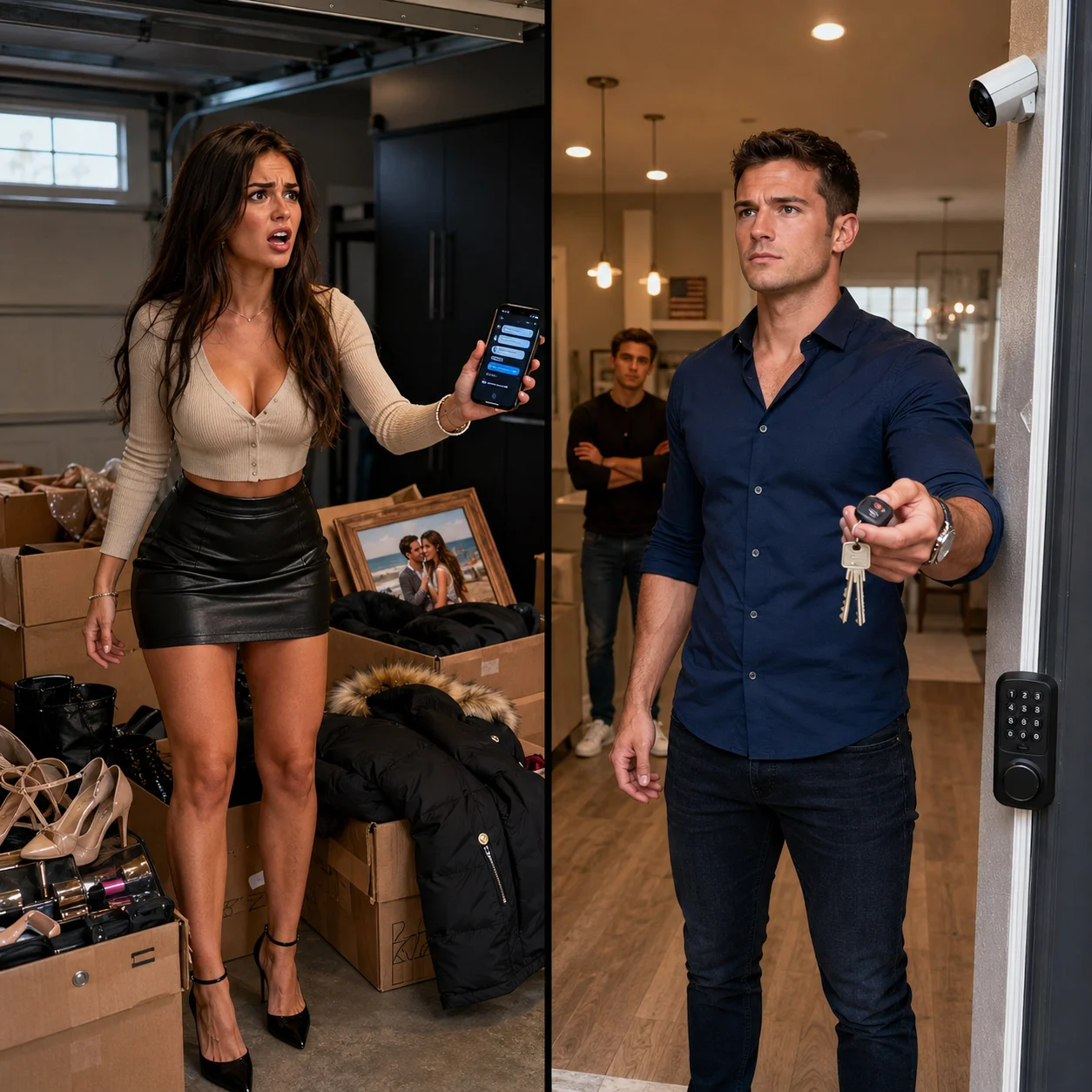
My girlfriend told me we were “basically strangers now.”
So I replied, “Then pack like one.”
That one sentence ended almost three years of trying to love someone who had slowly turned me into a guest in my own life. At the time, I thought I was just responding to another cruel text. Looking back, I think it was the first honest thing either of us had said in months.
My name is Carter. I’m thirty-four, and until recently, my girlfriend Alyssa was twenty-nine. We had been together almost three years and had lived together for ten months in my townhouse in Raleigh. I say my townhouse because that detail matters. The mortgage was mine. The utilities were mine. The property was mine before she ever moved in. Alyssa worked as a salon manager in Cary, and I worked as an IT project manager for a healthcare software company. My life was structured, predictable, and quiet. Hers was social, spontaneous, and always moving.
At first, I liked the balance. Alyssa got me to try new restaurants instead of ordering the same Thai place every Friday. She dragged me to weekend markets, rooftop bars, art walks, and birthday dinners for people I would never have met on my own. I thought she brought color into my life. I thought I brought calm into hers. For a while, that felt like partnership.
But somewhere in the last year, she stopped acting like my partner and started acting like I was just some guy who happened to share the Wi-Fi password.
She would leave the room to take calls. She would say she had plans without saying what those plans were. If I asked who she was going out with, she would snap, “Why are you interrogating me?” If I didn’t ask, she would say, “Wow, you don’t even care where I am.”
That was the game.
Ask, and I was controlling. Don’t ask, and I was cold. Try to talk, and I was exhausting. Stay quiet, and I was emotionally unavailable. There was no correct move because the point was not communication. The point was keeping me permanently off balance.
Then she started calling me her roommate.
Not once. Not as a joke. Repeatedly.
“My roommate is mad because I’m going out.”
“My roommate thinks we need to talk.”
“My roommate acts like I owe him a schedule.”
The first few times, I let it slide because I didn’t want to make a big deal out of a word. But words are rarely just words when someone uses them like a weapon.
One evening, after she said it in front of one of her friends, I waited until we were alone and told her, “Alyssa, I’m not your roommate. I’m your boyfriend.”
She smiled without looking up from her phone.
“Then start acting like someone I’d want to date.”
That should have been enough.
It wasn’t.
I told myself relationships had rough patches. I told myself we were both stressed. I told myself that moving in together changed the rhythm of things and maybe we just needed time to adjust. Mostly, I told myself whatever I needed to keep from admitting that the woman I loved had started treating me like an obligation she resented.
The final night happened on a Thursday.
I had made dinner because Alyssa told me she would be home by seven. Nothing fancy. Chicken, pasta, garlic bread, salad. A normal dinner for two people who supposedly lived together and still wanted to act like a couple.
Seven came.
Then eight.
Then nine.
At 9:23, my phone buzzed.
“Grabbing drinks after work. Don’t wait up.”
I stared at the message with the dinner sitting cold on the stove.
“You told me we were having dinner,” I wrote back.
Her reply came a minute later.
“Plans change.”
I took a breath before responding because I could already feel the argument forming. “It would have been nice if you told me before I cooked.”
Three dots appeared. Disappeared. Appeared again.
Then the text came.
“We’re basically strangers now anyway, Carter. Stop acting like my husband.”
I read it once.
Then again.
I expected anger to hit me, but it didn’t. Shock didn’t come either. What came was exhaustion, deep and quiet, like something inside me had finally sat down and refused to get up.
Because she was right about one thing.
We were basically strangers.
She had made sure of that.
I knew her coffee order, her favorite perfume, the way she twisted her hair when she lied, and which songs she skipped when she was in a bad mood. But I no longer knew where she went, who she trusted, what she wanted, or why she still came home to me. She had turned herself into someone I had to guess at, someone who punished questions and then punished silence.
So I replied, “Then pack like one.”
She answered almost immediately.
“Excuse me?”
I wrote, “If we’re strangers, you don’t live here anymore. I’ll pack your things tonight. Pick up tomorrow.”
She called immediately.
I didn’t answer.
Then came the texts.
“You’re being insane.”
“It was a figure of speech.”
“You always overreact.”
“You’re proving my point.”
I turned my phone face down and started in the closet.
I didn’t throw anything. I didn’t damage anything. I didn’t do the dramatic movie version where clothes go flying out a window onto the lawn. I folded her clothes into two suitcases and four boxes. Makeup went into travel bags. Hair tools went into a tote. Shoes went back into the boxes she kept stacked in the closet because, as she used to say, “Good shoes deserve homes too.”
By midnight, her side of the bedroom was empty.
I slept four hours.
At 5:50 in the morning, Alyssa came home. The garage door code still worked, so I heard it open. She walked into the kitchen and stopped dead when she saw the boxes lined up by the front door.
“Carter.”
“Morning,” I said.
She looked at the boxes, then at me. “You actually packed my stuff.”
“Yes.”
She laughed once, sharp and fake. “Because I called us strangers?”
“Because you meant it when it helped you hurt me,” I said. “And now you want to call it a joke because I believed you.”
Her face changed.
“I was frustrated.”
“I know,” I said. “You always are when you’re honest.”
She stepped closer and lowered her voice. “You’re not kicking me out.”
“You’re not on the mortgage. You’ve never paid rent. You’re welcome to pick up your things today between six and eight. My brother will be here.”
Her eyes narrowed. “You’re going to regret treating me like this.”
“I already regret letting you treat me like a stranger in my own home.”
For once, Alyssa had nothing ready.
That evening, she did not come alone. She arrived with her best friend Kennedy and her cousin Reese. I had moved every box into the garage so nobody needed to enter the house. My brother Mason stood beside me with his arms crossed, looking like he had been waiting years for this scene. He never liked Alyssa much. He said once that she had the emotional warmth of a locked filing cabinet, but I told him he didn’t know her like I did.
Turns out, he may have known her better.
Alyssa got out of Kennedy’s car wearing sunglasses even though the sun was already low. She looked at the garage and said, “Wow. You really made it look like an eviction.”
“Pick up only,” I said.
Kennedy shot me a disgusted look. “This is cruel, Carter. She made one comment.”
Mason muttered, “One comment that came with three years of bonus content.”
I gave him a look.
He sipped his coffee and shut up.
Alyssa tried to walk past me into the house.
I stepped in front of her.
“Garage only.”
“I need to check if you stole anything,” she said.
“Make a list.”
“I live here.”
“Not anymore.”
Reese pulled out her phone and started recording, probably expecting me to panic or say something they could use online later.
“Good,” I said. “Please record that everything is boxed, labeled, and undamaged.”
That annoyed them more than anger would have. I stayed calm. Mason stayed quiet. Alyssa had prepared for a fight, and I refused to give her one.
They loaded most of her things into the car. Alyssa kept stopping dramatically at different boxes, pulling out objects like she was sorting through the remains of a great love story.
“This candle was ours.”
“Take it.”
“This blanket was ours.”
“Take it.”
“This picture frame was ours.”
“Take it.”
Then she picked up my air fryer.
“Not that,” I said.
She turned on me. “Seriously? You’re going to fight me over an air fryer?”
“No,” I said. “I’m going to keep my air fryer.”
Mason almost choked on his coffee.
At 8:11, they left. Alyssa left one box behind, of course. It had winter coats, old birthday cards, and a framed photo of us at the Outer Banks. I texted her after they pulled away.
“One box remains. You have seven days to collect it.”
She replied, “Throw it away like you threw me away.”
I put it in the garage.
The next morning, I paid a locksmith one hundred ninety dollars and changed every exterior lock. I also changed the garage code, the alarm code, and the password to every streaming account she still used. By noon, her sister Paige called.
“Carter, this is not okay,” she said. “Alyssa is having panic attacks.”
“I’m sorry she’s upset.”
“She said you changed the locks overnight.”
“After she moved out.”
“She didn’t move out. You forced her.”
I sent Paige the screenshot.
“We’re basically strangers now anyway, Carter. Stop acting like my husband.”
Then my reply.
“Then pack like one.”
Paige didn’t answer for a full minute.
Then she said, much quieter, “She didn’t show me that part.”
“I assumed.”
Monday, the problem came to work.
My manager, Trina, called me into her office. She looked more confused than angry, which told me this was not going to be a normal conversation.
“Alyssa emailed the company’s general HR inbox,” Trina said. “She claimed there is a domestic emergency and that you’re refusing to communicate about shared housing.”
I pulled out my phone and showed Trina the texts. Then I showed her the mortgage statement with only my name on it, and the video Reese had recorded at the garage pickup, which Alyssa had apparently forgotten could protect me too.
Trina leaned back in her chair.
“Do you feel safe?” she asked.
“I feel annoyed.”
“Annoyed can become unsafe,” she said. “Send reception her picture.”
That was the first time I realized this was not over.
It was just changing locations.
Over the next few weeks, Alyssa’s new story became that I had “discarded her like a stranger.” That was the phrase she used online. She posted a black-and-white selfie from Kennedy’s guest room with the caption, “Some men wait years to show you they never really knew you.”
Her friends flooded the comments.
“You’re so strong.”
“He never deserved you.”
“This is emotional abuse.”
One mutual friend, Tyler, texted me, “Just so you know, she’s saying you threw her out at 6 a.m. with nowhere to go.”
I replied, “She came home at 5:50 after staying out all night and picked up her boxes that evening with two witnesses.”
Tyler wrote, “Yeah, she left that out.”
“She usually does.”
Then came the money.
Alyssa sent a Venmo request for $2,800 labeled “relocation damages.”
I declined it.
She sent another for $640 labeled “household contributions.”
I declined that too.
She had contributed to groceries sometimes. She had bought curtains once. She had never paid rent, utilities, repairs, property taxes, insurance, or HOA fees. Her biggest monthly contribution had been telling me I loaded the dishwasher incorrectly.
Two days later, she showed up at my gym.
It was 6:30 in the morning. I was halfway through shoulder presses when I saw her reflection in the mirror. She stood near the stretching area holding a water bottle, pretending this was casual.
I racked the weights and walked over.
“Can we talk for five minutes like adults?” she asked.
“Adults don’t ambush people at the gym.”
She looked around like I was embarrassing her. “I just want closure.”
“Closure was in my garage.”
Her voice dropped. “I miss you.”
“I believe you.”
For one second, she looked hopeful.
Then I said, “But missing me is not a reason for me to restart something that made me feel alone.”
Her eyes filled fast. Alyssa could cry on command. Not fake exactly. More like she always knew where the tears were stored and how quickly to reach them.
“You’re acting like I’m some stranger,” she whispered.
“Your words,” I said. “Not mine.”
I went to the front desk and asked them to make a note that she was not allowed to approach me there.
That afternoon, her mother Darlene called. I almost didn’t answer, but Darlene had always treated me decently. She was blunt, practical, and one of the few people in Alyssa’s family who didn’t automatically turn every problem into someone else’s fault.
“Carter,” she said, “I’m calling because my daughter is telling a version that sounds incomplete.”
“That sounds like Alyssa.”
There was a pause. Then Darlene said, “Tell me what happened.”
So I did.
I told her about the dinners. The roommate comments. The no-win arguments. The Thursday night text. The garage pickup. The work email. The gym.
When I read the exact line out loud, Darlene sighed.
“She told me you woke up one morning and decided you didn’t want commitment.”
“No,” I said. “She told me we were basically strangers. I just agreed.”
Darlene was quiet for a long time.
Then she said, “Her father used distance like punishment. Silent treatment. Separate rooms. Acting like family members were strangers until they begged. I tried so hard not to let her learn that.”
That hit me harder than I expected.
“I’m sorry,” I said.
“Don’t be,” Darlene replied. “You didn’t teach her this.”
For about a week after that, things got quiet.
I went to work. I fixed the guest room. I finally mounted the TV Alyssa said looked better leaning against the wall because “real homes have unfinished corners.” I went to dinner with Mason and his wife. I slept through the night for the first time in months.
Then I went on a date.
Her name was Natalie. She was a nurse practitioner and a friend of Trina’s. We met for tacos downtown. It was easy. That was the word that kept coming to mind. Easy conversation. No tests. No disappearing. No making me feel like asking a normal question was a character flaw.
I did not post about it. Natalie did not post about it. But Raleigh is a small city when people are hungry for gossip.
By Monday, Alyssa knew.
A new number texted me.
“Already replacing me with some stranger. That didn’t take long.”
Blocked.
Another number.
“Does she know you throw women away?”
Blocked.
Then an email.
Subject: “You made me a stranger.”
I saved it and did not answer.
That night, Alyssa came to my townhouse and rang the doorbell at 11:38. I watched from upstairs on the camera app. She was holding the box she had left behind. Somehow she had picked it up from the garage after I forgot to lock the side door earlier that week.
She lifted the framed Outer Banks photo toward the camera and said, “Remember when we weren’t strangers?”
I saved the footage.
The next morning, I called an attorney named Marissa. The consultation was three hundred dollars. The cease and desist letter was four hundred twenty-five. I paid it without blinking.
Marissa reviewed the texts, emails, Venmo requests, gym note, HR email, and the doorbell footage summary.
“She’s escalating because you’re not reacting,” Marissa said. “Keep not reacting, but document everything.”
The letter went out the next day.
Alyssa responded by texting from another new number.
“You can’t lawyer your way out of karma.”
So I filed a police report.
The police report changed the tone. Not because Alyssa suddenly respected boundaries, but because other people started taking my boundaries seriously.
The next time she came to my workplace, reception did not call me first. They called security. Alyssa told them she was my emergency contact and needed to speak with me immediately. Security asked for identification, checked the internal note, and told her to leave. She refused, so they documented it.
That became part of the file.
Marissa said we had enough to request a protective order, especially because Alyssa had been told in writing to stop contacting me and still showed up at my home, gym, and workplace.
The hearing was scheduled five weeks after the original text.
Alyssa came dressed like she was going to church. Cream sweater, simple jeans, no heavy makeup. Kennedy sat behind her. Paige sat behind me, which surprised me. Darlene came too, but she sat alone.
Marissa brought a folder thick enough to make a sound when she placed it on the table.
The judge reviewed the screenshots first. He read Alyssa’s “strangers” text silently, then my reply. Then he reviewed the work email. The gym incident note. The doorbell stills from 11:38 p.m. The texts from new numbers. The cease and desist letter. The workplace security report.
Alyssa said, “I was just trying to get closure.”
The judge looked over his glasses. “After he told you not to contact him?”
“I was emotional.”
“Emotional is not an exception to no contact.”
Then she said something that almost made me laugh.
“I just didn’t want us to become strangers.”
The judge looked back at the screenshot and said, “Ma’am, you introduced that language. He accepted it. Everything after that is unwanted contact.”
The protective order was granted for one year.
No contact. No coming to my home, workplace, or gym. No contacting me through friends, family, fake numbers, emails, or social media.
Alyssa cried when it was granted. Quietly. Controlled. Not enough to disrupt the courtroom, just enough to be seen.
As we left, Darlene stopped me near the hallway.
“I’m sorry she made you feel like a stranger in your own life,” she said.
I nodded. “Thank you.”
Paige texted me later that day.
“I should have asked more questions before I defended her. I’m sorry.”
I replied, “I appreciate that.”
Then I deleted the thread.
Three months passed.
Alyssa violated the order once by asking Kennedy to send me a long apology letter. Kennedy sent it, then immediately followed with, “I’m sorry. She said it was allowed if it came from me.”
It was not allowed.
Marissa handled it. Alyssa got a warning.
After that, silence.
Her social media became quotes about betrayal, abandonment, and being treated like nothing by someone you loved. I blocked every account connected to her. I didn’t need to monitor the performance. Whatever show she was putting on was no longer my responsibility to watch.
My life got smaller for a while.
Then it got better.
Work improved. Trina promoted me to senior project lead after a messy hospital software rollout somehow went right. She said I was good under pressure. I thanked her and did not explain that my personal life had turned me into a crisis management department.
Natalie and I kept seeing each other, slowly and carefully. She communicated like a normal person. If she was running late, she told me. If she was upset, she said so. If she needed space, she asked for it without turning it into punishment. She never called me a roommate, a stranger, or controlling for wanting basic respect.
The last box sat in my garage for weeks.
The winter coats. The old birthday cards. The Outer Banks photo.
One Saturday, I opened it. I did not read every card. I did not sit there drowning in old versions of us. I took out the photo and looked at it once.
We looked happy.
Maybe we were.
But a picture is not proof of a healthy relationship. It is proof that one second looked good from the outside.
I mailed the box to Darlene. Then I changed the garage code again.
A week later, I came home from work and stood in my kitchen for a long time. The house was quiet, but not in the way it used to be. Before, the silence had felt like waiting for Alyssa’s mood to enter the room. Now it felt clean. Mine. Safe.
I cooked dinner for myself. Chicken, pasta, garlic bread, salad. The same meal I had made that Thursday night. This time, nobody failed to come home. Nobody texted “plans change.” Nobody made me feel foolish for expecting basic consideration.
I sat at the table and ate while the evening light moved across the floor.
That was when I realized I had stopped feeling like a stranger in my own home.
Here is what I learned.
Being treated like a stranger by someone who knows your heart is worse than being rejected by someone who never knew you at all. Alyssa wanted the comfort of my home, my patience, my money, and my loyalty while acting like I had no right to ask where I stood. She wanted distance when it protected her, closeness when it benefited her, and outrage when I finally matched her energy.
So I did.
She said we were basically strangers.
I believed her.
And honestly, a stranger would have treated me better.
![[FULL STORY] My Girlfriend Told Me To Relax While Grinding On Her Ex At Her Sister's Wedding, So I Ruined Both Their Lives.](https://social-media.rabedo.com/thumbnails/1776998011_R8.png)
![[FULL STORY] I found my girlfriend’s hidden texts with her "soulmate" ex, so I returned her $10,000 custom engagement ring and moved out before she finished her "coffee date."](https://social-media.rabedo.com/thumbnails/1777003084_c19.png)
![[FULL STORY] My Fiancée Said It Wasn’t Cheating Because We Weren’t Married Yet, So I Waited Until the Altar to Answer](https://social-media.rabedo.com/thumbnails/1777368419_bc7ac4ec-bd17-4875-9986-a430d59ffa55 (1).png)