With fifty years of pain sitting across my shoulders.
The young waiter behind me offered me a napkin. I took it, but not to dry my tears.
I unfolded it.
Inside was a piece of paper.
Old. Yellowed. Folded so many times that the creases looked permanent.
My children stared at one another, confused.
Miguel turned pale.
“Valentina,” he whispered.
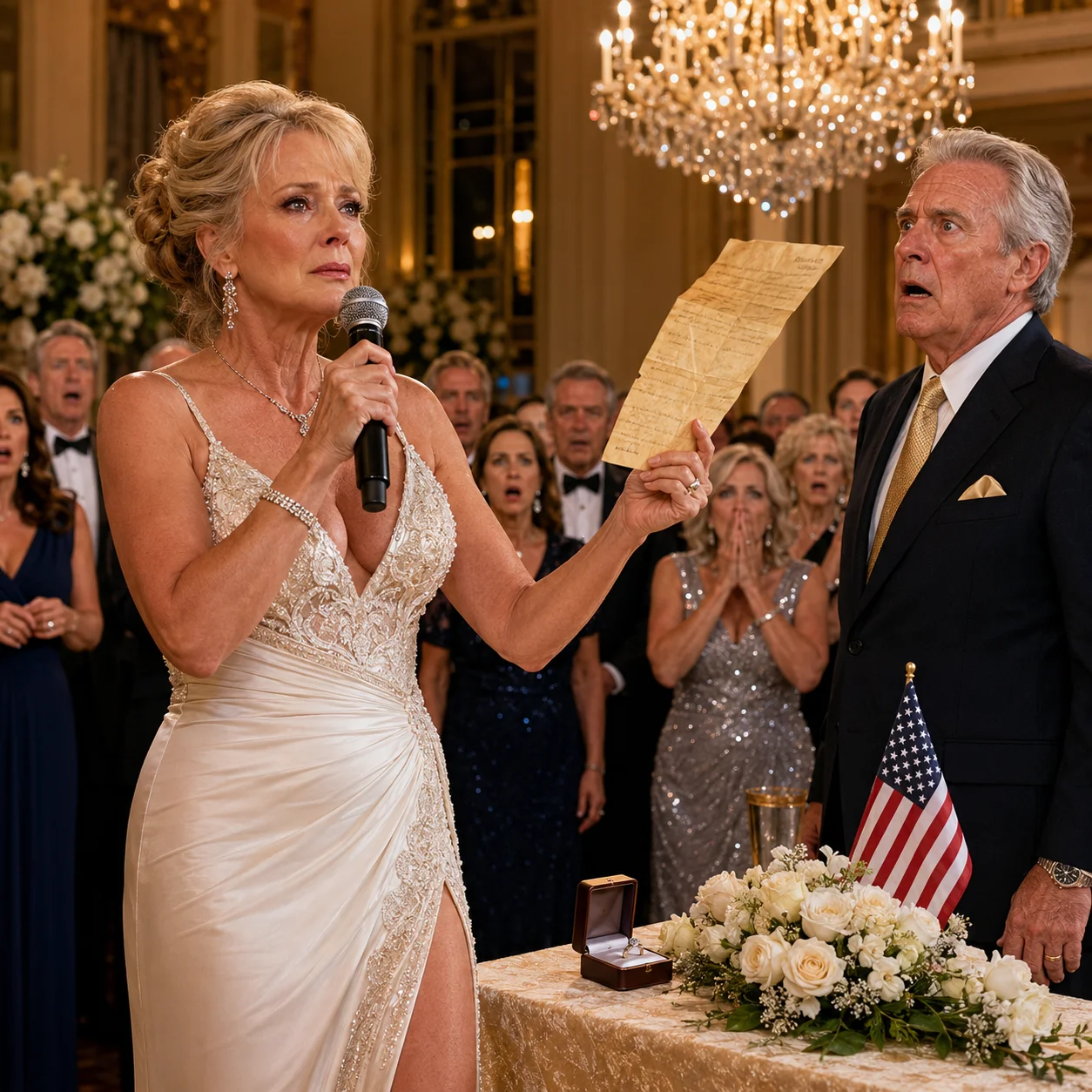
I held out my hand for the microphone.
No one applauded. No one spoke. Even the music in the background seemed to fade on its own.
I looked at my husband. Then at my children. Then at the grandchildren who still held their phones as if they no longer knew whether they should keep recording.
And in the calmest voice of the night, I said, “Miguel is right. He did not love me for fifty years. But what none of you know is what I did for love the night before our wedding.”
The entire ballroom seemed to lean toward me.
Miguel closed his eyes, as if he had been waiting for that sentence his whole life.
“The night before our wedding,” I said, “I had a suitcase packed.”
A gasp moved through the room.
My daughter Clara pressed one hand to her chest.
“Mom…”
I looked at her with tenderness.
“Let me finish, Clara.”
No one interrupted again.
“I was nineteen. I wanted to study nursing at the University of Guadalajara. I wanted to live near the city center, take the bus by myself, walk along Avenida Juárez with my books, and buy ice cream on Sundays. I wanted many things. Maybe too many things for a girl of my time.”
A faint smile touched my mouth, but it was not happiness. It was a door opening onto a life I had never lived.
“Miguel and I were engaged, yes. I cared for him. But I was not ready to become a wife. I was not ready to stop being myself.”
Miguel lowered his head.
I unfolded the paper from the napkin.
“That night, my father came into my room. He had this document in his hand. It was a debt. A large debt he had signed in Miguel’s name without Miguel knowing.”
Miguel’s head snapped up.
“What?”
I did not look at him yet.
“My father worked with your uncle, Miguel. They made bad deals. False papers. Purchases that never existed. When everything started falling apart, they needed a clean name. They used yours.”
A murmur passed through the tables.
Ernesto stood.
“Grandfather did that?”
“Yes,” I said. “And not only that.”
I took a slow breath.
“The night before the wedding, my father told me that if I did not marry Miguel the next day, he would let the debt come out. Miguel would have gone to jail or lost the workshop he had just opened. His mother would have lost her house. And I… I would have carried the guilt of not saving him.”
Miguel stepped toward me.
“Valentina, I never knew.”
“I know.”
The answer was so gentle that it hurt more.
“That is why I married you.”
Silence fell over the ballroom.
It was no longer morbid curiosity.
It was shame.
Slow, thick shame. The kind that begins touching even the people who were only watching.
I raised the paper.
“I signed with my father that night. I agreed to cover part of the debt with the dowry my grandmother had left me. I gave up my enrollment. I sold my mother’s gold earrings. And the next day, I walked toward the altar in a white dress that smelled like a locked room.”
Miguel covered his mouth.
“No…”
“Yes.”
I looked at him then.
“You thought I married you happily. Everyone did. And I let everyone believe it, because if I told the truth, your life would have fallen apart before it began.”
Ernesto came closer.
“Mom, why didn’t you ever say anything?”
I looked at him with the sad patience mothers have when their children ask the right question too late.
“Because when a woman stays silent once to save someone, everyone expects her to keep staying silent so no one feels uncomfortable.”
No one breathed.
Miguel tried to take the microphone, but I did not give it to him.
“I am not finished.”
His hand fell.
For the first time that night, he obeyed.
“Your father is right about one thing,” I said, looking at my children. “He did not love me for many years. He loved the idea of a wife who was always there. The hot food. The ironed shirts. The mother of his children. The woman who smiled at Christmas, organized baptisms, received guests even when she was sick, and cried in the bathroom so she would not ruin dinner.”
Clara began to cry.
I did not stop.
“But I was not innocent in my own disappearance either. I stayed. I swallowed words. I let my dreams become anecdotes. I convinced myself that love meant endurance. Then, without meaning to, I taught all of you the same thing.”
A sob came from a side table.
It was one of my daughters-in-law, the same woman who had wanted to record the perfect anniversary toast. Now her phone was facedown on the table.
Miguel spoke without the microphone.
“Valentina, forgive me.”
I heard him.
But I did not fall apart.
“Miguel, you were a good provider. No one can take that away from you. You worked hard. There was always a roof. Our children always went to school. But a house can be full, and a woman can still live alone inside it.”
Miguel cried.
Not theatrically. Not loudly.
He cried the way men cry when they understand too late and do not know what to do with their hands.
I turned to my grandchildren.
“I want you to hear this, especially you. Fifty years together does not always mean fifty years of love. Sometimes it means fifty years of habit, fear, duty, inherited silence. Do not celebrate how long something lasted if you do not know what it cost inside.”
The ballroom looked different now.
The cream flowers no longer looked elegant.
They looked too white for so much truth.
I looked down at the paper again.
“I kept this proof for fifty years. Not for revenge. Not to humiliate Miguel. I kept it because it was the only evidence I had that the girl in the blue dress existed. That I did not invent my dreams. That I was not born only to serve coffee and care for grandchildren.”
Miguel stepped closer.
“Why did you bring it tonight?”
I smiled with a clean kind of sadness.
“Because this morning, before coming here, I found my nursing enrollment letter in an old box. It had the date, the stamp, my name. And I realized something.”
“What?” Miguel asked.
“That I spent my entire life waiting for someone to apologize to me for the woman I never became. But no one can give that life back to me. Not you. Not my children. Not my father from his grave.”
I folded the paper back into the napkin.
“So I came tonight to say goodbye to her.”
Ernesto went pale.
“Say goodbye? What do you mean?”
I placed the microphone on the table. Then I picked up the small ivory purse beside my chair and took out a clean modern envelope with a letterhead on it.
I opened it.
“Three months ago, I enrolled in a nursing assistant course for elderly care. Not at the university, of course. I am no longer nineteen. My knees would not let me run through hospital halls the way I once imagined. But I can still study. I can still learn. I can still care from another place.”
Clara covered her mouth.
“Mom…”
“I also rented a small apartment near Chapalita.”
Miguel lifted his face.
The room went cold again.
“You are leaving?” he asked.
I looked at him without anger.
That was the hardest part.
“Yes.”
Miguel stepped back, as if only then realizing this confession was not a scene that would end in an embrace.
It was a door.
“Today?”
“Tomorrow morning.”
“But… what about us?”
I inhaled deeply.
“Miguel, we have spent fifty years being ‘us’ for everyone else. For the children, for the friends, for the neighbors, for the photos. I need to know who I am when no one is calling me wife, mother, or grandmother.”
Ernesto spoke urgently.
“Mom, you don’t have to leave. We can fix this. We can talk. Dad is sorry.”
I looked at him firmly.
“My son, your father’s regret does not make me fifty years younger.”
The sentence landed without violence.
But no one could stand up from it.
Miguel held the back of a chair as if he needed it to remain upright.
“I thought tonight I could tell the truth and begin again.”
“No, Miguel,” I said. “You thought you could tell a terrible truth and that I would reward you for telling it late.”
He closed his eyes.
“I did not want to hurt you.”
“I know.”
“Then…”
“But you did hurt me. In front of everyone. At a party organized to celebrate my endurance as if it were happiness.”
The eyes in the room shifted toward my children.
They understood.
Painfully, but they understood.
They had rented the ballroom, hired the music, chosen the menu, sent golden invitations, prepared speeches. They had wanted to celebrate a beautiful story without asking whether their mother had been happy inside it.
Clara came to me.
“Forgive me, Mom.”
I touched her cheek.
“It is not your fault, my girl.”
“But I used to say I wanted a marriage like yours.”
I looked at her with love.
“Then I owe you the truth. Do not want a marriage like mine. Want one where you can speak before you have to wait fifty years.”
A young waiter standing near the coffee table lowered his eyes.
Maybe he thought of his mother.
Maybe of his girlfriend.
Maybe of himself.
I took the microphone again.
“I want to make something clear. I am not leaving because I hate Miguel. If I hated him, maybe this would be easier. I am leaving because I loved him for too long in a way that left no room for me.”
Miguel cried silently.
“And because now, after hearing him say he did not love me, I understood that I did love him. But I did not always love myself.”
The entire ballroom seemed suspended in one long breath.
I removed my ring.
I did not throw it.
I did not let it fall.
I held it in my palm and looked at it the way one looks at an old photograph.
“This ring witnessed everything. My children being born. Illnesses. Debts. Half-reconciliations. Silent breakfasts. Good nights and nights that felt endless.”
Miguel extended a trembling hand.
I did not give it to him.
I placed the ring inside a small box.
“I am not going to throw it away. I am not going to deny my life. But I will no longer wear it like a chain.”
Clara cried openly.
Ernesto sat down, defeated.
Then Santiago, one of my grandsons, only sixteen, stood.
“Grandma.”
I turned.
His eyes were red.
“Can I visit you at your apartment?”
For the first time that night, I smiled for real.
“Of course.”
“And will you teach me how to make your guava pie?”
A small laugh escaped me.
“That secret is worth more than any inheritance.”
A few guests laughed softly through their tears. The tension loosened, just a little.
But Miguel remained standing, wearing the face of a man who had just lost something he had always believed was guaranteed.
“Valentina,” he said, “I do love you now.”
I looked at him for a long time.
“Maybe.”
He swallowed.
“You don’t believe me.”
“It is not about believing you. It is about the fact that I no longer want to live on late promises.”
Miguel nodded slowly.
“Can I do anything?”
I thought about it.
The whole room waited for my answer.
“Yes.”
Miguel lifted his face with painful hope.
“You can learn how to be alone without asking me to care for your guilt.”
The hope broke across his face.
But he did not argue.
That was new.
I turned toward my children.
“Tomorrow I will go for my things with Clara. I do not want arguments. I do not want scenes. I do not want anyone telling me I am exaggerating. Your father and I will talk calmly later, if we can both do it without hurting each other.”
Ernesto nodded.
Clara did too.
“And I want one more thing,” I added.
Everyone looked at me.
“I want this party to continue.”
Miguel blinked.
“What?”
“You paid for food, music, and flowers. The grandchildren dressed up. There is cake. I do not want you to turn my truth into a funeral.”
“Mom, we can’t celebrate after this,” Clara said.
I smiled.
“Then do not celebrate a perfect marriage. Celebrate that I am still alive.”
No one knew what to do.
Until Santiago started clapping.
One clap.
Then another.
It was not party applause.
It was respect.
Clara joined him.
Then Ernesto.
Then the others.
Miguel did not clap.
He only looked at me as if he were seeing me completely for the first time.
Not as his wife.
Not as the mother of his children.
Not as a habit.
As a woman.
And maybe that was the saddest thing about that night — that he recognized me at the exact moment I had already decided to leave.
The music returned slowly. Not the same soft background music as before. An old bolero began playing through the speakers.
I asked them to serve coffee.
Several guests came to hug me, but I accepted only some embraces. To others, I simply offered my hand. A woman is not obligated to comfort people who have just discovered her pain.
Miguel stayed seated.
Alone.
The microphone lay switched off in front of him.
For fifty years, he had occupied the head of every table.
That night, for the first time, the head of the table did nothing for him.
Later, when the cake arrived, I asked for a small slice. I sat with my grandchildren and told them what Guadalajara had been like when I was young. I told them how I used to take the bus downtown, how I bought used books near San Juan de Dios, how once I escaped to Tlaquepaque with a friend and we ate tortas ahogadas in secret because my father said “decent young ladies did not wander the streets alone.”
My grandchildren listened as if they had just met me.
Because they had.
At the end of the night, Miguel approached me. He was no longer wearing his jacket. He looked older. Smaller.
“I will take you home,” he said.
I picked up my purse.
“Thank you. Clara is taking me.”
He nodded.
“May I say goodbye?”
I did not answer immediately.
Then I stepped toward him.
Miguel opened his arms.
I hugged him.
It was not a reconciliation.
It was a farewell.
He understood.
That was why he cried on my shoulder the way he had never cried in fifty years.
“Forgive me,” he whispered.
I closed my eyes.
“I am forgiving myself too.”
The next day, I left the house where I had lived for half a century.
I did not take expensive dishes or large furniture. I took my old books, a box of photographs, two dresses, handwritten recipes, and the enrollment letter I had never been able to use.
My apartment in Chapalita was small. It had a window facing a jacaranda tree and a kitchen where no one expected me to serve them first.
The first night, I ate toasted bread with cheese and coffee.
Alone.
In silence.
And it tasted like freedom.
The following months were strange.
Miguel called many times. At first, he called to cry. Then to ask for advice. Later, little by little, he called to tell me simple things.
“I burned the rice today.”
“I found your sewing scissors.”
“I went to the market alone.”
Sometimes I answered.
Sometimes I did not.
Learning not to be available was also part of my new life.
I started my course. The first week, I arrived with a new notebook, nervous like a young girl. My classmates were younger than me, but no one laughed. One of them said, “Doña Vale, you take better notes than all of us.”
I smiled all afternoon.
Clara visited on Thursdays.
Santiago came on Saturdays.
Three months later, Miguel asked to see me. We met in a café near La Minerva. He arrived carrying a folder.
I stiffened.
“What is that?”
He opened it.
“Documents. The house will be put in your name. The savings account too. It is not payment. It is not an apology. It is delayed justice.”
I stared at him.
“Miguel…”
“Do not say anything,” he said. “If fifty years ago someone used my name to trap you, I do not want my name to keep binding you now.”
Tears filled my eyes.
“Thank you.”
He nodded.
“I also found something.”
He took out an old photograph.
A young woman in a blue dress, holding a book against her chest, her laughter caught forever in time.
I took it carefully.
“I thought it was lost.”
“No,” Miguel said. “I kept it all these years. But I never understood what I was looking at.”
I touched the photograph.
“And now?”
Miguel took a deep breath.
“Now I see a woman who deserved more than I knew how to give her.”
I did not answer.
But for the first time in a long time, hearing those words did not hurt.
A year later, on what would have been our fifty-first anniversary, there was no ballroom. No grand toast. No cream flowers. No speeches about perfect love.
There was a small meal in my apartment.
I made guava pie with Santiago. Clara brought coffee. Ernesto brought bread. Miguel arrived with a simple bouquet of calla lilies and asked permission before entering.
That was new.
I opened the door.
I never wore the ring again.
I never moved back in with him.
But sometimes we walked together through the neighborhood, slowly, like two older people learning to know each other without the weight of pretending.
Some people said it was a sad separation.
I did not see it that way.
Sadness had been staying silent for fifty years.
Sadness had been believing a woman’s worth was measured by how much she could endure.
Sadness had been watching everyone celebrate my silence as if it were love.
This was different.
It was not a fairy-tale happy ending.
It was something truer.
An ending where no one recovered what had been lost, but everyone stopped lying about what it had cost.
And whenever someone asked me if I regretted taking the microphone that night, I smiled.
“No,” I said. “I regret not asking for it sooner.”
Because Don Miguel had been right.
He had not loved me well for fifty years.
But that night, in front of children, grandchildren, friends, and waiters who had stopped breathing, I did something I had never fully done before.
I loved myself.
And this time, I was not too late.
I was right on time.

![[FULL STORY] My girlfriend called me a "suffocating stalker" for worrying about her at 3 AM, so I gave her the ultimate space by vanishing forever.](https://social-media.rabedo.com/thumbnails/1776926767_21.png)