
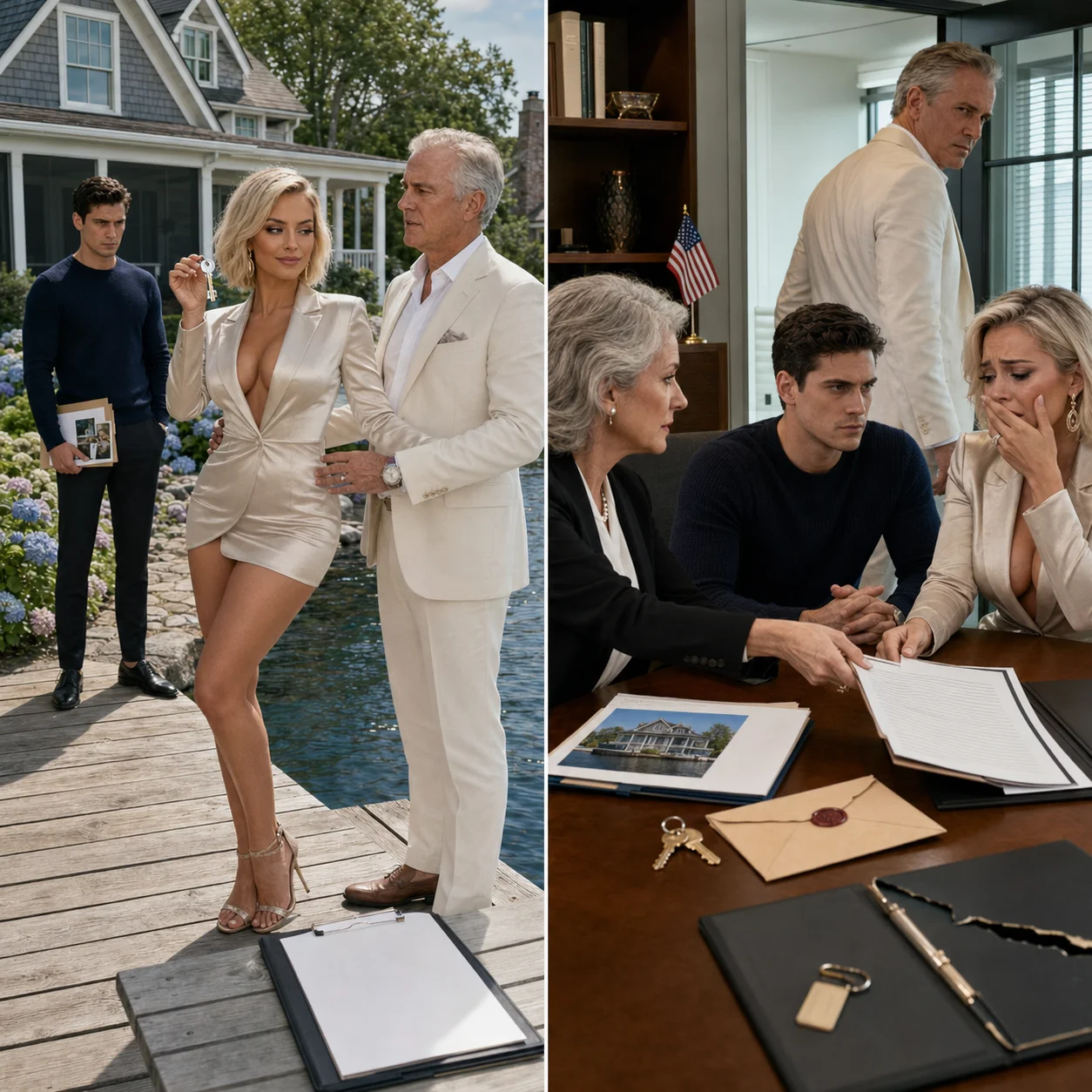
Something felt wrong the moment my wife casually suggested selling the lake house.
Not discussing it.
Not asking how I felt.
Selling it.
Like a decision had already been made somewhere without me.
We were sitting at the breakfast table on a gray Tuesday morning, the kind of morning where the house felt too quiet even though nothing had visibly changed. Elaine was scrolling through her tablet with one hand and stirring her coffee with the other, wearing the expression she usually reserved for museum board agendas and contractor estimates.
“I’ve been thinking,” she said. “We should sell the lake house before summer.”
I looked up from my toast.
For a moment, I genuinely thought I had misheard her.
“The lake house?”
“Yes,” she said, as if we were talking about replacing an old sofa. “It’s a strong market. Lakefront properties are moving quickly, and we’re not using it enough to justify holding it.”
That was the first thing that made my stomach tighten.
We.
We were not using it enough.
The problem was that this was not just a vacation property. It had been in my family for more than forty years. My father built parts of it with his own hands. My mother planted every hydrangea along the path from the porch to the water. My children learned to swim from that dock. I had proposed to Elaine under the old cedar tree near the shoreline. Every important memory seemed rooted to that place.
And Elaine knew that.
“I’m not selling the lake house,” I said.
She set her spoon down with a quiet click.
“Thomas, don’t be sentimental. It’s an asset.”
“It’s my family’s home.”
“It’s a house you visit a handful of times a year.”
“It’s not for sale.”
Her eyes sharpened then, just slightly.
“It may not be entirely your decision.”
That was when something cold settled in my chest.
After nearly thirty years of marriage, you learn how to ignore small cracks. You tell yourself every couple grows distant. Every marriage becomes practical. Every disappointment can be explained away by stress, age, routine, grief, or the simple exhaustion of being two people who have shared too much life to be surprised by each other anymore.
So at first, I tried to convince myself this was just another disagreement.
Elaine had always been practical about money. She had a talent for turning emotional things into numbers. She could walk through a house filled with family photographs and talk about “market timing” before noticing who was in the frames. It was one of those traits I had once admired as levelheadedness and later began to recognize as something colder.
But this felt different.
It was not the suggestion itself.
It was the certainty.
The first time Elaine said the lake house should be sold, she did not sound like a wife asking a question. She sounded like someone repeating a decision that had already been made in another room, with another person, long before I ever sat down at that breakfast table with toast in my hand.
After she left for her museum luncheon, I opened the email from my late mother’s estate attorney again.
My mother had died eleven months earlier. I was still grieving her in the strange, delayed way grief sometimes arrives when legal paperwork takes up the space where mourning should be. There had been estate emails, trust documents, tax forms, calls with attorneys, meetings with accountants. I had skimmed more legal language in one year than I had in the previous fifty-six.
But that morning, with Elaine’s words still sitting in the kitchen like smoke, I read everything more carefully.
Buried near the end of one attachment was a sentence I had missed before.
Elaine was not listed as an owner, trustee, beneficiary, or successor beneficiary.
Not one word connected her to the lake house.
Not one signature gave her power over it.
The lake house had never been hers.
And somehow, she seemed to think it was.
That realization forced me to start looking more closely at things I had ignored for years. The way Elaine always referred to the property as an “asset.” The way she talked about my family as if they were obstacles instead of relatives. The way she had suddenly become obsessed with market values, appraisals, tax exposure, and timing.
Then came the weekend trip to Boston.
Elaine told me about it while folding silk pajamas into an overnight bag.
“Lydia and I are going to Boston for a spa weekend,” she said smoothly. “Just two nights. I need to get away.”
Lydia was one of her museum friends. Wealthy, widowed, impeccably dressed, the sort of woman who referred to vacations as “restorative.” The trip sounded exactly like something Elaine would do.
But something in her voice was too smooth.
Too practiced.
I waited until she left, then called the hotel she claimed she had booked.
There was no reservation under Elaine’s name.
No reservation under Lydia’s either.
That was when the old details began arranging themselves in my head.
The new perfume.
The locked sunroom calls.
The credit card charges at a boutique hotel in Portsmouth.
The way Elaine had started speaking about our future as if I was only an obstacle in it.
By Saturday night, a private investigator had sent me three photos.
Elaine stepping out of her white Mercedes.
Elaine being kissed outside a small inn with blue shutters.
Elaine walking inside with Richard Vale, his hand resting comfortably on the small of her back.
Richard Vale.
That name made the betrayal feel less like a wound and more like a trapdoor opening under my life.
He was not a stranger.
He was a wealthy widower from Elaine’s social circle, a man who had drifted around our world for years at fundraisers, gallery openings, and charity auctions. Polished, silver-haired, always in expensive jackets, always speaking just softly enough that people leaned in to hear him. He owned commercial property, several waterfront parcels, and a reputation for getting what he wanted without appearing to ask for it.
I had never liked him.
Elaine always said I was being provincial.
But Richard Vale had one very specific interest everyone knew about.
Lakefront property.
The photo that finally made my anger turn cold came two weeks later.
Elaine took him to the lake house.
My mother’s house.
My father’s dock.
The private investigator sent the image just after sunset. Elaine stood beside Richard near the water, both of them facing the house. His hand was in his pocket. Hers was wrapped around a folder. They looked less like lovers and more like people evaluating a purchase.
That was what sickened me.
Not just the affair.
The inspection.
She had taken him to the place where my mother taught my children to make blueberry pancakes on rainy mornings. Where my father hammered the loose boards on the dock every spring and pretended he didn’t enjoy the work. Where my brother’s ashes had been scattered near the reeds after the accident.
She had brought another man there and shown it to him like inventory.
When Elaine came home that evening with a valuation folder in her hand, smiling like practicality had finally won, I knew the real fight was about to begin.
“We need to talk about the lake house,” she said.
I was sitting in the den, reading the same page of a book for the fifth time.
“No,” I said.
She blinked. “No?”
“No.”
“Thomas, this stubbornness is becoming childish.”
“Is that what Richard thinks too?”
The color left her face so quickly I almost felt sorry for her.
Almost.
She recovered fast. Elaine always did.
“I don’t know what you mean.”
“Yes, you do.”
Her mouth tightened. “Have you been following me?”
“I hired someone to document the truth.”
She laughed once, sharp and humorless. “That is pathetic.”
“No, Elaine. Pathetic is telling your husband you’re going to Boston with Lydia while you’re meeting Richard Vale in Portsmouth.”
Her face hardened.
For a few seconds, I saw the woman beneath the practiced calm. Not guilty. Not frightened. Angry.
Not angry that she had hurt me.
Angry that I knew.
“This marriage has been over for years,” she said.
“That’s convenient. You only mentioned it after I found out.”
“You weren’t listening.”
“I was grieving my mother.”
“You have been grieving everything for years,” she snapped. “Your parents. Your brother. That house. The past. You keep everything like a shrine and expect the rest of us to live inside it.”
That one landed.
Not because she was right about the affair.
Because she knew exactly where to aim.
I stood up slowly.
“You don’t get to use my grief as an excuse for your betrayal.”
“I’m trying to be practical.”
“No. You’re trying to sell something that does not belong to you.”
For the first time, uncertainty flickered across her face.
“What does that mean?”
“It means my mother’s attorney sent the final trust documents. You are not listed anywhere.”
Elaine stared at me.
Then she smiled.
It was a small, terrible smile.
“Thomas, we’ve been married almost thirty years. Don’t embarrass yourself. Everything acquired during marriage is marital.”
“The house was inherited.”
“We maintained it with marital funds.”
“My mother protected it.”
Her eyes narrowed.
That was the first moment I realized she did not know as much as she thought she knew.
And that terrified her.
The next morning, I called my mother’s estate attorney, Martin Hale.
Martin had known my parents for thirty years. He was dry, careful, and allergic to exaggeration. If Martin said something was serious, you listened. If Martin paused before answering, you stopped breathing.
I told him about Elaine’s push to sell, Richard Vale, the valuation folder, and the private investigator.
Martin was silent for a long time.
Then he said, “Thomas, I think you should come in.”
That is not a sentence any attorney says lightly.
When I arrived, Martin had already pulled several files. His office smelled like paper, leather, and old coffee. He motioned for me to sit, then placed a thick folder on the desk between us.
“Your mother was very specific about the lake house,” he said.
“I saw that Elaine isn’t listed.”
“No. But there is more.”
He opened the folder.
My mother had transferred the lake house into a family trust three years before she died. I knew that part. What I had not fully understood was the structure. The property was not simply left to me outright. I had lifetime use and management authority, but the trust restricted sale or transfer outside the bloodline without approval from a family board consisting of me, my two adult children, and an independent trustee.
Even if I wanted to sell it, I could not do so alone.
Elaine could not force a sale.
A divorce court would have limited reach.
And Richard Vale, no matter how wealthy or charming, could not touch it.
My mother had built a legal wall around the house.
“She never told me all of this,” I said quietly.
Martin leaned back.
“She told me not to explain the full protective provisions unless they became necessary.”
I looked at him.
“She expected something like this?”
Martin chose his words carefully.
“Your mother had concerns.”
“About Elaine?”
He folded his hands.
“She noticed things.”
I almost laughed.
Of course she had.
My mother had always been polite to Elaine, but there had been distance there. I had assumed it was the ordinary friction between a strong-willed mother and a strong-willed daughter-in-law. But now I remembered the little comments.
“Elaine has expensive dreams.”
“Some people see family history as clutter.”
“Promise me you won’t let anyone make you feel foolish for loving what your father built.”
At the time, I thought she was being sentimental.
She had been warning me.
Martin slid another document across the desk.
“There is also an anti-coercion clause.”
“What does that mean?”
“If a beneficiary attempts to transfer, pledge, encumber, or sell the property under undue influence, fraudulent inducement, or pressure connected to divorce proceedings or third-party financial interest, the independent trustee can freeze all action.”
I stared at him.
“My mother wrote that?”
“Your mother requested it. I drafted it.”
The room blurred for a moment.
My mother, dying slowly but still sharp enough to protect the house from a future I had not seen coming.
I looked down at the signature on the document.
Her handwriting was weaker than I remembered.
But it was there.
A few days later, Elaine’s attorney sent a letter.
It was polite, formal, and breathtakingly arrogant.
Elaine was seeking divorce. She wanted equitable division of marital assets. She asserted that the lake house had been maintained and improved with marital funds and therefore should be valued as part of the marital estate. She requested appraisals, access to trust records, and documentation of rental income, though the house had never been rented a day in its life.
At the bottom of the email chain was Richard Vale’s attorney.
Copied “for related transactional discussions.”
That was a mistake.
A beautiful one.
Martin read the letter twice, then looked at me.
“They copied Richard’s attorney?”
“Yes.”
He removed his glasses.
“That helps.”
“Why?”
“Because it suggests Richard has a financial interest in the property.”
The next weeks became a blur of attorneys, documents, and ugly discoveries.
Elaine had met with two realtors without telling me. One had prepared a preliminary valuation based on lakefront comparables. Another had quietly discussed “pre-market interest” from a private buyer who wanted discretion.
That buyer was connected to Richard.
Richard had also spoken with a land-use consultant about whether the lake house parcel could support additional structures if neighboring parcels were eventually acquired. In other words, he was not thinking about preserving my family’s home.
He was thinking about development.
Condos.
Luxury rentals.
A shoreline erased and replaced by profit.
While I was grieving my mother, my wife had been preparing her exit.
And somehow, the lake house sat at the center of everything.
The deeper we looked, the worse it became.
Elaine had told Richard I was “emotionally attached but persuadable.” She had forwarded him photos from family weekends. She had sent him old property tax bills. She had even sent a scanned copy of an outdated deed from before the trust transfer, making it look as if the property might be easier to access than it was.
The message that broke something in me came from discovery months later.
Richard had written, “Once Thomas sees the numbers, he’ll fold. Men like him always do when they realize sentiment has a price.”
Elaine replied, “He won’t fight me forever.”
I sat in Martin’s office reading that sentence over and over.
He won’t fight me forever.
She had mistaken my quiet for surrender.
That was her mistake.
The meeting that changed everything happened in a conference room overlooking the city.
A room full of attorneys.
A stack of documents.
One shocking discovery.
And a question nobody in that room was prepared to answer.
Elaine sat across from me in a cream blazer, wedding ring still on her hand like a prop. Her divorce attorney, Margaret Sloane, sat beside her. Richard Vale was not physically present, but his attorney was, a man named Stephen Cole who smiled too often.
Martin sat beside me with the independent trustee, Anne Whitcomb, a retired judge my mother had chosen specifically because she was “immune to charm.”
I loved my mother even more for that.
Margaret began by arguing that Elaine had a marital interest in the appreciation of the lake house due to years of upkeep, shared funds, and her “reasonable expectation” that the property formed part of our retirement planning.
Martin let her speak.
Then he opened the trust binder.
“The property is not subject to sale or transfer by Thomas alone,” he said. “Nor is Elaine an owner, trustee, beneficiary, or successor beneficiary. The trust contains restrictions that predate these proceedings.”
Stephen Cole leaned forward.
“No one is disputing the trust exists. But if marital funds improved the property, Mrs. Whitaker may have reimbursement claims.”
“Those can be discussed,” Martin said. “What cannot be discussed is forced sale to your client’s affiliate.”
The room went quiet.
Stephen’s smile faded.
Margaret looked at him sharply.
I turned toward Elaine.
For the first time, she looked genuinely afraid.
Martin slid a document across the table.
“This is correspondence obtained from Realtor Angela Brice pursuant to subpoena. It references a private buyer connected to Vale Development Holdings. Mr. Cole, that is your client’s entity, correct?”
Stephen did not answer immediately.
Anne Whitcomb, the trustee, looked over her glasses.
“That is not a difficult question.”
Stephen cleared his throat. “Vale Development Holdings has explored several lakefront opportunities in the region.”
“Including this property?” Anne asked.
“I would need to review—”
Martin placed another document down.
“Here is an email from Richard Vale to Mrs. Whitaker dated March 14th. He writes, ‘If Thomas signs before June, we can close quietly before the zoning proposal becomes public.’”
My pulse roared in my ears.
Zoning proposal?
I looked at Martin.
He looked back, grave.
That was the shocking discovery.
Richard had known something none of us knew.
The county was quietly considering a zoning change that would allow limited multi-unit development along certain lakefront corridors, including the area near my family’s property. If the change passed, the value of the land would skyrocket for developers.
Elaine had not just been trying to sell my family’s lake house.
She had been trying to sell it before I understood what it was truly worth.
And Richard had been helping.
Margaret Sloane slowly turned toward Elaine.
“Did you know about this?”
Elaine’s lips parted.
No answer.
Stephen said, “This is being taken out of context.”
Anne Whitcomb’s voice cut through the room like a blade.
“Then provide the context. Why was Mrs. Whitaker discussing a quiet sale before a zoning proposal became public?”
No one spoke.
That silence answered everything.
Elaine had walked into that room expecting leverage. Richard had expected legal pressure, emotional fatigue, and maybe a settlement large enough to make me surrender.
Instead, they had exposed something much closer to fraud.
The meeting ended quickly after that.
Not because everything was resolved.
Because Elaine’s attorney requested a private recess, then returned pale and significantly less aggressive. Richard’s attorney stopped smiling entirely.
A week later, Anne Whitcomb formally froze any trust-related action under the anti-coercion clause. Martin filed notices protecting the property from any attempted claim, transfer, lien, or unauthorized listing. Elaine’s divorce demands changed overnight.
Suddenly, she no longer wanted the lake house sold.
Suddenly, she wanted “a fair financial resolution.”
Suddenly, Richard Vale was nowhere to be found.
That did not last.
Men like Richard do not disappear because they feel shame. They disappear to protect themselves.
Two months into the divorce, Elaine learned that the future she thought she had secured with him was no future at all. Richard ended the affair through his attorney, not even with a phone call. He claimed their relationship had been “mischaracterized” and that any property discussions were “preliminary investment conversations.”
Elaine had risked her marriage, her reputation, and her family for a man who would not even admit loving her once the deal collapsed.
I wish I could say I felt nothing.
But after thirty years, even betrayal leaves bruises in strange places.
Part of me hated her.
Part of me pitied her.
Most of me was just tired.
The divorce settled nine months after that breakfast conversation.
Elaine received what the law entitled her to from our marital assets: a portion of retirement accounts, cash settlement, proceeds from the sale of our marital home after offsets, and reimbursement for documented marital contributions to maintenance at the lake house.
She did not receive ownership.
She did not receive sale authority.
She did not receive the future she had promised Richard with property that was never hers to offer.
The affair became public enough to cost her socially. Not dramatically. There was no screaming scene at the museum gala, no viral confrontation, no champagne thrown across a ballroom. It happened the way reputations usually die in our circles: through canceled lunch invitations, unanswered calls, and women who smiled politely while making sure their husbands were never seated next to her.
Richard Vale faced his own consequences. The zoning leak triggered scrutiny. I do not know every detail, and I did not need to. I only know that Vale Development Holdings withdrew from several pending projects, and Richard stopped appearing at the fundraisers where he had once moved like royalty.
As for the lake house, it stayed exactly where it had always been.
That first summer after the divorce, I drove there alone.
I arrived just before sunset. The hydrangeas were blooming along the path, blue and purple against the white fence. The dock still creaked on the third board from the end. The kitchen still smelled faintly of cedar and old coffee no matter how well it was cleaned.
For a while, I stood in the doorway and let the silence meet me.
This house had survived more than I had given it credit for.
So had I.
My children, Anna and Michael, came up the following weekend. They knew enough by then. Not every ugly detail, but enough. Anna walked the shoreline with me and cried when I told her how close we had come to losing it. Michael spent an hour repairing the loose dock board without saying much, just like my father used to do.
That night, we sat on the porch with beers and leftover pasta, watching the sun sink into the lake.
Anna said, “Grandma knew, didn’t she?”
I looked toward the hydrangeas.
“She knew something.”
Michael smiled sadly. “She always did.”
Later, after they went to bed, I found an envelope tucked inside the old writing desk in my mother’s room. I had cleaned that desk before, but somehow missed the thin drawer behind the center panel.
My name was written on the front.
Thomas.
Inside was a letter in my mother’s handwriting.
My hands trembled before I even unfolded it.
My dearest Tom,
If you are reading this, it likely means the lake house has become a source of conflict. I am sorry for that. I wish every gift could remain only a gift, but age teaches you that anything valuable attracts not only love, but appetite.
Your father built this place because he wanted our family to have somewhere the world could not hurry us. I have tried to protect that purpose as best I can.
Do not confuse peacekeeping with love. Do not confuse pressure with practicality. And do not let anyone make you feel foolish for protecting what was built with devotion.
A house is wood and stone, yes. But this one is also memory. If one day you choose to let it go, let it be because your heart is ready, not because someone else has calculated its price.
I trust you.
Love,
Mom
I sat there for a long time, holding the letter while the lake moved black and silver beyond the windows.
That was the moment I finally cried.
Not for Elaine.
Not even for the divorce.
For my mother. For my father. For the years I had spent trying to keep everyone comfortable while ignoring the discomfort in my own home. For the version of me who thought loyalty meant not looking too closely when someone you loved started becoming a stranger.
The next morning, I called Martin and asked about strengthening the trust for the next generation.
Over the following months, we updated everything. Anna and Michael became more involved. We created clear rules for maintenance, use, future decisions, and protections against forced sale. The house would not become a battlefield again if I could help it.
A year later, we held a family weekend there.
Not a memorial.
Not a dramatic reclaiming ceremony.
Just family.
My granddaughter, Lily, caught her first fish off the dock and immediately cried because she felt bad for it. Michael taught her how to release it gently. Anna replanted one of my mother’s hydrangeas that had not survived the winter. I fixed the porch railing. We grilled badly, laughed too loudly, and burned the garlic bread.
At sunset, Lily asked why the house mattered so much.
I looked around at my children, at the dock, at the flowers my mother had planted, at the water reflecting a sky my father would have stopped to admire.
“Because some places remember us,” I said.
She wrinkled her nose. “Houses can’t remember.”
“No,” I said, smiling. “But people can. And places help.”
That evening, after everyone went to sleep, I walked down to the dock alone. The air smelled like lake water and pine. For the first time in years, I did not feel like I was guarding the house from something.
I felt like I was part of it again.
Elaine sent one letter after the divorce was final.
It arrived in a cream envelope with my name written in her careful, elegant script.
Thomas,
I have started this letter many times and thrown it away because every version sounds either defensive or pathetic. I do not know how to apologize for turning your grief into an opportunity. I told myself I was being practical. I told myself you were trapped in the past. I told myself Richard saw a future I deserved.
The truth is uglier. I was afraid of getting older. I was afraid of disappearing into a marriage that had become quiet. Richard made me feel chosen, and I let that feeling become more important than loyalty.
I knew the lake house mattered to you. That is why I wanted it gone. It had roots I did not share and a history I could not control. I resented it. I resented your mother for seeing me more clearly than you did.
I am sorry.
Elaine
I read it twice.
Then I placed it in the desk drawer beside my mother’s letter.
Not because the two letters were equal.
They were not.
One was protection.
One was confession.
But both belonged to the story of how I finally opened my eyes.
I never replied.
Closure did not require conversation.
Sometimes closure is a locked trust, a quiet dock, and the knowledge that the thing someone tried to take from you is still standing.
I do not pretend I was blameless in my marriage. I had grown quiet too. I had avoided conflict. I had mistaken endurance for intimacy. There were years when Elaine and I lived more like polite partners than husband and wife. But distance is not permission for betrayal. Loneliness is not a deed. An affair is not a legal argument. And no amount of dissatisfaction gives someone the right to sell your inheritance out from under you.
The lake house remains in my family.
It always will, if I have anything to say about it.
The hydrangeas still bloom every summer. The dock still creaks. My children still complain that the upstairs shower has terrible pressure. My granddaughter has claimed the small bedroom facing the water because she says the sunrise “belongs to her.”
And every time I unlock the front door, I think of my mother’s final lesson.
Some people will call your memories impractical because they cannot profit from them.
Some people will call your boundaries selfish because those boundaries block their plan.
Some people will mistake your grief for weakness, your silence for surrender, and your love for something they can manipulate.
Let them be wrong.
Elaine thought the lake house was an asset.
Richard Vale thought it was an opportunity.
My mother knew it was a legacy.
And in the end, the woman they underestimated was the only one who saw clearly enough to save it.



![[FULL STORY] My Fianceé Called Me Too Emotional For Expressing My Needs, So I Stopped Talking And Moved Out While She Was Planning Our Wedding.](https://social-media.rabedo.com/thumbnails/1776996976_C5.png)