“No,” I said. “I have to go.”
He must have seen something on my face because he didn’t ask another question.
By the time I got to my truck, I had called Melissa seven times and Tyler four.
No answer.
I sat behind the wheel with the engine running and forced myself to think.
Melissa had lied about the tournament location.
She had turned off her location.
Tyler wasn’t answering.
They had left the house together.
If this had been anyone else, I might have assumed car trouble or a dead phone. But Melissa had not sounded stressed that morning. She had sounded prepared. Too prepared.
And for the first time in months, every strange little detail I had ignored began rearranging itself into something ugly.
The private calls she stepped outside to take.
The new passcode on her phone.
The sudden weekend errands that lasted three hours.
The way she had become strangely protective of Tyler’s schedule, volunteering to take him everywhere, but snapping if I offered to switch days.
I had thought she was trying to be more involved.
I had been grateful for it.
God help me, I had even praised her.
I pulled out of the parking lot and called the one person I trusted to stay calm.
My older sister, Rachel.
She answered on the second ring. “Hey, aren’t you working?”
“Melissa left with Tyler this morning and lied about where they were going.”
Silence.
Then Rachel’s voice sharpened. “What happened?”
I told her everything in broken pieces while driving. Coach’s call. The wrong tournament city. The unanswered calls. The disabled location.
Rachel didn’t waste time trying to comfort me.
“Go home first,” she said. “Check if she packed anything. Check passports, documents, Tyler’s room, everything. I’m coming over.”
“My son is missing, Rachel.”
“I know. That’s why you need evidence before you call the police. If she took him somewhere and claims it was a misunderstanding, you need proof it wasn’t.”
That was Rachel. A family court paralegal for eleven years. Calm under pressure. Practical when everyone else panicked.
I hated that she was right.
I drove home like the road owed me answers.
When I pulled into the driveway, Melissa’s SUV wasn’t there. The garage looked normal. The house looked normal. That was the cruelest part. Nothing about the outside of my life announced that it had just cracked open.
I unlocked the door and went straight to Tyler’s room.
His tournament bag was gone, of course. His favorite hoodie was gone too, the red one he wore on long drives. But his school backpack was still there. His tablet was on his desk. His old baseball trophies lined the shelf above his bed.
I opened his closet.
His suitcase was gone.
My heart dropped.
I checked the drawers. Some clothes were missing. Not enough for a vacation. Enough for a few days.
Then I ran to our bedroom.
Melissa’s overnight bag was missing from the top shelf of the closet. So were several outfits, her makeup case, and the small jewelry roll she used when traveling.
This was not a tournament.
This was planned.
Rachel arrived twenty minutes later with her laptop bag over her shoulder and a face that told me she had already prepared herself for something bad.
“Show me,” she said.
We went through the house together, not touching more than necessary. She took photos of Tyler’s half-empty drawer, Melissa’s missing bag space, the empty passport folder in our filing cabinet.
That was when I almost lost it.
The passport folder.
Tyler’s passport was gone.
Melissa’s was gone.
Mine was still there.
Rachel looked at me, and for once, she didn’t have a quick answer.
“Mark,” she said softly, “you need to call the police.”
I did.
The first officer who arrived treated it like a custody misunderstanding.
I could see it in his posture before he even finished asking questions. Married parents. Mother with child. No custody order. No immediate evidence of violence. Probably not urgent enough in his mind.
“She’s his mother,” he said carefully. “She has equal rights to take him places.”
“She lied about where she was taking him,” I said. “She turned off tracking. She took his passport.”
The officer’s expression changed slightly at that.
Rachel stepped in with printed screenshots, Coach Ramirez’s call log, tournament emails, and photos from the house.
“She knowingly gave the father false information about the child’s location,” Rachel said. “The child missed a scheduled event. Both child and mother are unreachable. Travel documents are missing. This is not a normal parenting dispute.”
The officer took more notes after that.
They entered a welfare concern, not a full Amber Alert, because there was still no evidence Tyler was in immediate physical danger. That sentence nearly broke something inside me.
No evidence.
As if my ten-year-old son disappearing with a lying parent wasn’t danger enough.
They asked if Melissa had family nearby.
Her parents lived in Missouri. Her younger sister, Dana, lived forty minutes away. She had an aunt in Arizona. No one in another country, at least not that I knew of.
They asked if we had marital problems.
I hesitated.
Not because we didn’t.
Because I had spent so long pretending we didn’t that saying it out loud felt like admitting I had failed to see what was happening inside my own house.
“Yes,” I said finally. “But not like this.”
Melissa and I had been married twelve years.
We met when I was twenty-six and she was twenty-four, at a friend’s barbecue where she spent most of the night arguing with a guy about whether Chicago-style pizza was actually pizza. She was sharp, funny, beautiful in a way that made people turn their heads without her trying.
When she laughed at my jokes, I felt chosen.
For the first five years, we were happy, or at least I thought we were. Tyler came along in year two, and fatherhood changed me in ways I didn’t expect. I stopped caring about late nights with friends. I started caring about school districts, savings accounts, and whether the backyard was safe enough for a tee.
Melissa struggled more than she admitted.
She loved Tyler. I never doubted that. But she missed attention. She missed being spontaneous. She missed being seen as a woman before being seen as a mother.
I tried to help. I encouraged her to go back to work when she felt restless. She became a marketing consultant, mostly remote, and for a while that seemed to help. Then the distance between us started growing slowly, the way water stains spread behind a wall before you notice the damage.
By the previous winter, we were polite more than affectionate.
We discussed bills. School. Baseball. Groceries. Dental appointments.
We slept in the same bed but often felt like two people sharing a hotel room.
Still, I never imagined she would use Tyler as part of whatever secret life she had built.
After the police left, Rachel made me sit at the kitchen table.
“You need to check financials,” she said.
I logged into our joint bank account.
There were three charges from the past week I didn’t recognize.
One for a motel off I-55.
One for a gas station near Springfield.
One for a prepaid phone card.
Rachel leaned over my shoulder. “Prepaid phone card?”
I felt sick.
Then she asked the question I had avoided.
“Do you think there’s another man?”
I stared at the screen.
“I don’t know.”
But I did know something.
Two months earlier, I had seen a name flash across Melissa’s phone while she was in the shower.
Evan.
Just Evan.
When I asked about it later, she said he was a client from work.
“No big deal,” she said.
But she had taken the phone from the counter too quickly.
I searched our phone bill.
Melissa had hundreds of texts with a number I didn’t recognize. Most were late at night. Many were during Tyler’s baseball practices.
Rachel wrote the number down.
“Do not call it,” she said. “Not yet.”
I didn’t listen.
I took my phone and dialed.
It rang three times.
A man answered.
“Yeah?”
My throat tightened.
“Who is this?”
A pause.
Then the line went dead.
I called back.
No answer.
Rachel looked furious. “Mark.”
“I had to know.”
“And now he knows you know.”
That sentence sat between us like a loaded gun.
For the next two hours, everything moved too slowly.
The police tried pinging Melissa’s phone but said it appeared off. Coach Ramirez sent me screenshots confirming Tyler had never arrived. Parents from the team began texting me, asking if everything was okay. I ignored most of them because I couldn’t bear to type the words.
At 2:06 p.m., my phone rang.
Unknown number.
I answered so fast I almost dropped it.
“Dad?”
My knees nearly gave out.
“Tyler? Buddy, where are you?”
His voice was small, shaky. “I don’t know.”
I pressed the phone tight to my ear. “Are you okay? Are you hurt?”
“No. Mom said I can’t talk long.”
Rachel stood frozen across from me.
“Tyler, listen to me. Look around. What do you see?”
“I’m in a room.”
“What kind of room?”
“A hotel, I think.”
“Is your mom there?”
“She’s in the bathroom. She said we’re going on a special trip.”
My chest tightened so hard I could barely breathe.
“What trip?”
“I don’t know. She said it was a surprise and I shouldn’t tell you because you’d ruin it.”
Rachel’s eyes filled with rage.
I kept my voice gentle.
“Buddy, I need you to be very brave. Can you see anything with a name on it? A hotel paper? A sign? A phone? Anything?”
There was rustling.
Then Tyler whispered, “There’s a card by the TV. It says Prairie Star Lodge.”
Rachel was already typing.
“Good job,” I said. “You’re doing great. What city?”
“I don’t see—”
A door opened on his end.
Tyler gasped.
Then Melissa’s voice snapped, distant but clear.
“Who are you talking to?”
The call ended.
For one second, I couldn’t move.
Then Rachel turned her laptop toward me.
“Prairie Star Lodge. Springfield.”
The motel charge.
I called the officer back and gave him the information.
This time, things moved.
Not fast enough, but faster.
Springfield police were contacted for a welfare check. I was told not to drive there, which was possibly the stupidest instruction anyone had ever given me. Of course I drove there.
Rachel came with me.
The drive took a little over three hours. It felt like three years.
On the way, I received one text from Melissa.
Stop making this dramatic. Tyler is fine.
I stared at those words until they blurred.
I typed back:
Where is my son?
She didn’t reply.
Thirty minutes later:
You don’t get to control everything anymore.
Rachel saw my face and held out her hand. “Give me the phone before you say something they’ll use against you.”
I handed it over because I didn’t trust myself.
Springfield police called when we were twenty minutes away.
They had found Melissa’s SUV in the motel parking lot.
The room was empty.
I nearly drove off the road.
“What do you mean empty?” I demanded.
The officer on the phone stayed professional. “Front desk says they checked out approximately forty-five minutes ago. A woman matching your wife’s description left with a young boy and an adult male.”
An adult male.
The words landed like a punch.
“Did they get a plate?”
“We’re reviewing cameras.”
Rachel covered her mouth.
I gripped the steering wheel until my knuckles hurt.
At that moment, I stopped thinking of Melissa as my wife.
I started thinking of her as the person who had taken my son.
We reached the motel just after five.
The room still smelled faintly of cleaning chemicals when the officer let us look from the doorway. One bed unmade. Empty soda bottle in the trash. A torn corner of a snack wrapper I recognized from Tyler’s lunch cooler.
On the nightstand was a small thing nobody else would have noticed.
A baseball card.
Tyler carried it everywhere. A worn-out card of Nolan Ryan his grandfather had given him before he died. It was bent at one corner and soft from being handled too much.
I picked it up with trembling fingers.
“He left it,” I said.
Rachel’s voice was quiet. “Maybe on purpose.”
That broke me more than anything else had.
Because Tyler was smart.
Tyler knew I would recognize it.
My son had left a trail.
The officer returned from the front desk with more information. Melissa had paid cash for the room under her own name. The man with her had arrived separately late that morning. Cameras showed the three of them leaving in a dark blue sedan.
The sedan plates came back to Evan Cole.
Thirty-nine years old.
Divorced.
Former youth sports trainer.
And according to Rachel’s quick search, recently hired by a private marketing firm Melissa had done contract work for.
Evan.
The client.
The man on her phone.
The man she had brought near my son.
Police issued a broader notice, but because Melissa was still Tyler’s legal mother and there was no custody order, every step had to be tied to evidence of deception, risk, or intent to unlawfully conceal him.
Rachel called an attorney she knew from family court.
His name was Daniel Price, and he answered even though it was Saturday evening.
Rachel summarized everything while I sat in the motel parking lot holding Tyler’s baseball card.
Daniel’s advice was blunt.
“File emergency custody immediately. Tonight if possible. You need a judge to establish that the child is being wrongfully concealed. Save every text, every call log, every receipt, every police report number. Do not threaten her. Do not negotiate custody through emotion. Ask only for the child’s location and safety.”
Then he asked me something I wasn’t ready for.
“Do you believe she may leave the state?”
I looked at Rachel.
The passports.
“Yes,” I said.
“Then we file with that concern.”
We drove back home in the dark.
I don’t remember most of the ride.
I remember Rachel typing. I remember my phone buzzing with texts from Melissa’s sister, Dana, who claimed she had no idea where Melissa was. I remember Coach Ramirez calling again, his voice thick with guilt, saying the whole team was praying for Tyler.
At 8:37 p.m., Melissa called.
Rachel put it on speaker and started recording with her own phone.
I answered.
“Where is Tyler?”
Melissa laughed once, cold and bitter.
“That’s all you care about, right? Not why I left. Not how unhappy I’ve been. Just Tyler.”
“Put him on the phone.”
“He’s asleep.”
“Where are you?”
“Safe.”
“With Evan?”
Silence.
Then she said, “Evan understands me.”
My stomach turned.
“You took our son to meet your boyfriend instead of taking him to his tournament.”
“You make everything sound ugly.”
“You lied to me. You lied to Tyler. You took his passport.”
“I am his mother.”
“And I am his father.”
“You barely see what’s in front of you, Mark. You care about schedules and bills and baseball stats. Evan sees me. He sees the life I deserve.”
I closed my eyes.
Rachel mouthed: Stay calm.
“Melissa,” I said slowly, “whatever is happening between us, Tyler should not be in the middle of it. Tell me where he is, and I will come get him. We can talk after.”
“No. Because if you get him, you’ll poison him against me.”
“You are scaring him.”
“He’s fine.”
“Then let me hear his voice.”
“He doesn’t want to talk to you.”
That was the first moment I felt hatred.
Not anger. Not heartbreak.
Hatred.
Because I knew my son. Tyler would never refuse to talk to me in a situation like that unless someone had frightened or pressured him.
Before I could respond, she said something that made the room tilt.
“We’re leaving tonight. After that, you can talk to my lawyer.”
The call ended.
Rachel immediately sent the recording to Daniel.
Within an hour, Daniel had prepared an emergency petition. By midnight, it was filed electronically, with supporting statements from me, Coach Ramirez, and Rachel. We included screenshots of Melissa’s texts, the missing passports, the motel information, and her recorded statement that she was “leaving tonight.”
I didn’t sleep.
I sat on Tyler’s bed until sunrise, holding that Nolan Ryan card, staring at the glow-in-the-dark stars we had stuck to his ceiling when he was six.
At 6:14 a.m., Daniel called.
“We have an emergency hearing at nine.”
By 9:45, a judge had granted temporary emergency custody to me and ordered Melissa to immediately disclose Tyler’s location and surrender his passport. Law enforcement was authorized to assist in recovering the child.
The order changed everything.
Melissa was no longer just a mother taking her child somewhere.
She was violating a court order.
At 10:22, police located Evan’s sedan.
Not at an airport.
Not at a hotel.
At a long-term parking lot near a charter bus station in St. Louis.
By then, I was already on the road with Rachel and Daniel on speaker.
Officers reached the bus station before us.
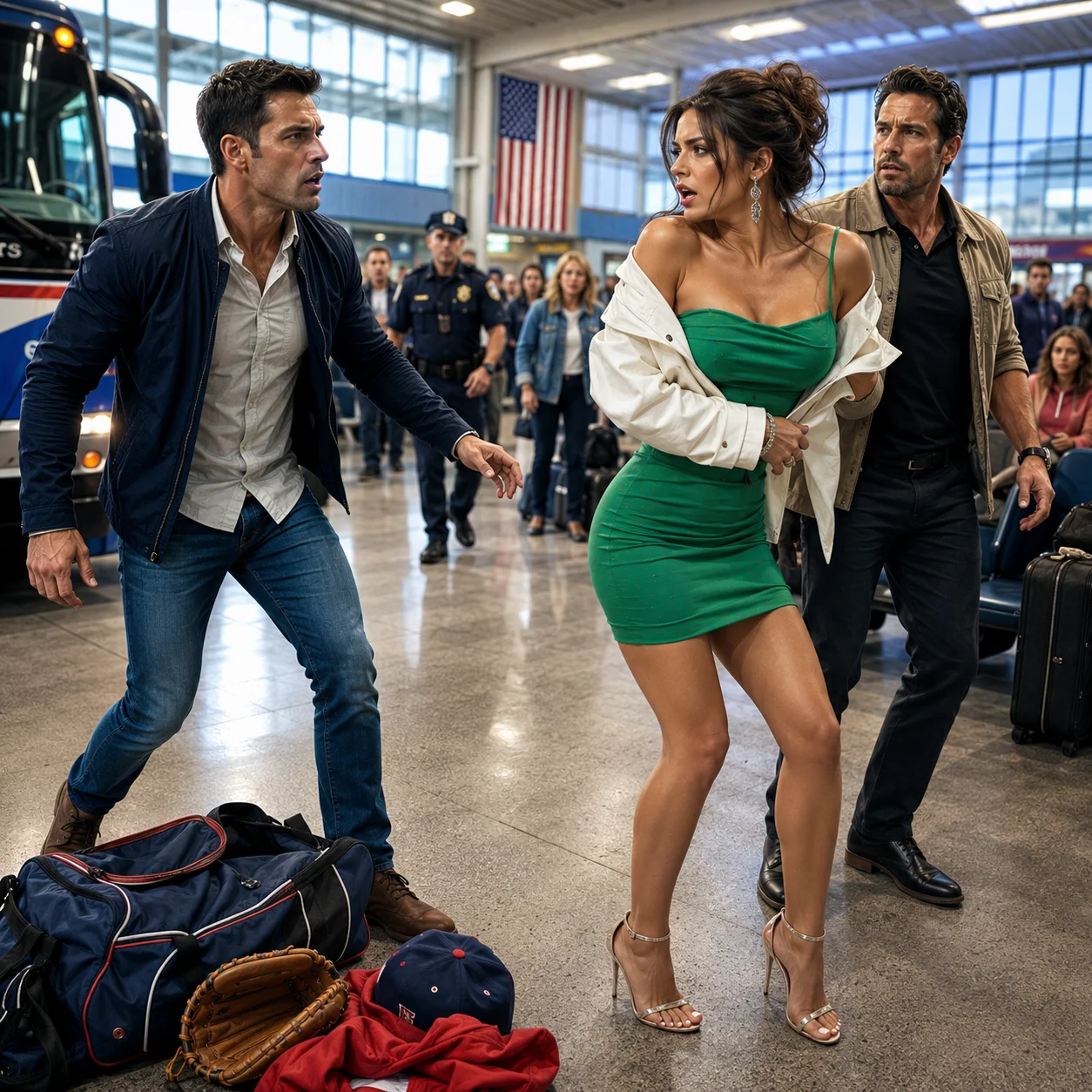
Melissa, Evan, and Tyler were found near Gate 6.
They had tickets to Denver.
From Denver, according to what police later found in Melissa’s bag, there were printed flight reservations to Vancouver.
I still cannot describe what that discovery did to me.
People hear stories like this and imagine screaming confrontations, dramatic speeches, somebody falling apart in slow motion.
It wasn’t like that.
When I arrived, the bus station smelled like diesel, old coffee, and rain-soaked coats. Fluorescent lights buzzed overhead. Travelers sat slumped over bags, unaware that my entire life was collapsing near a row of vending machines.
Then I saw Tyler.
He was sitting on a plastic chair between two officers, still wearing his baseball hoodie. His face looked pale and exhausted, but when he saw me, he jumped up so fast one officer reached out like he thought Tyler might trip.
“Dad!”
I ran to him.
He hit my chest and wrapped both arms around me, sobbing in a way I had not heard since he was a toddler.
I dropped to my knees and held him so tightly I was afraid I might hurt him.
“I’m here,” I kept saying. “I’m here. I’ve got you. You’re safe.”
He cried into my shoulder.
“I left my card,” he whispered. “I thought you’d find me.”
I broke.
Right there on the bus station floor, with strangers watching and police standing nearby, I cried into my son’s hair.
“You did perfect,” I said. “You did exactly right.”
Across the station, Melissa was arguing with another officer.
She looked nothing like the calm woman who had left our kitchen the morning before. Her hair was messy, her makeup gone, her face tight with panic and fury. Evan stood beside her with his hands in his jacket pockets, not looking nearly as brave as a man should when helping someone run off with another person’s child.
When Melissa saw me holding Tyler, her expression changed.
For a moment, I thought I saw shame.
Then it vanished.
“You had no right,” she shouted.
I stood slowly, keeping Tyler behind me.
“No,” I said. “You didn’t.”
She pointed at me like I was the criminal. “You turned my own son against me.”
Tyler flinched.
That was all I needed to see.
I looked at the officer. “I don’t want her near him right now.”
With the emergency order in place, they listened.
Melissa was not arrested that day, not immediately. That part shocked me at first. But Daniel had warned me. These cases moved through family court and criminal review carefully, especially because she was a parent. Evan was questioned. Melissa was served with the emergency order. Tyler’s passport was recovered from her bag.
And Tyler came home with me.
The drive back was quiet.
He fell asleep in the back seat within twenty minutes, his hand still clutching my sleeve like he was afraid I might disappear if he let go.
Rachel drove because I couldn’t.
Every few minutes, I turned around just to look at him.
Alive.
Safe.
In my truck.
Coming home.
That night, Tyler took a shower, ate half a grilled cheese sandwich, and asked if he could sleep in my room. I said yes before he finished the sentence.
At 2 a.m., he woke from a nightmare and whispered, “Mom said you were going to take me away from her forever.”
I sat up beside him.
“What else did she say?”
He stared at the blanket.
“She said you didn’t want us to be happy. She said Evan was going to help us start over somewhere better. She said if I called you, you’d make sure I never saw her again.”
I kept my voice even, though every word felt like a knife.
“Buddy, none of this is your fault.”
“I wanted to go to my tournament.”
“I know.”
“I told her Coach would be mad.”
I swallowed hard. “Coach wasn’t mad. He was worried.”
Tyler wiped his face with the sleeve of his pajama shirt.
“Are you mad at Mom?”
I looked at my ten-year-old son, who had been forced to carry adult fear in his small body, and I chose my words carefully.
“I’m angry at what she did,” I said. “But you do not have to decide how to feel tonight. You just have to rest.”
He nodded.
Then, after a long silence, he whispered, “I don’t want to go anywhere with Evan again.”
“You won’t,” I said.
And I meant it.
The following weeks were a blur of court hearings, attorney meetings, therapy appointments, police follow-ups, and phone calls from people who suddenly wanted to explain what they had known.
Dana admitted Melissa had told her she was thinking about “starting fresh” but claimed she never knew Tyler was involved.
Melissa’s mother cried on the phone and said Melissa had always been impulsive when she felt trapped.
One of Melissa’s friends, Kelly, confessed through a long message that Melissa had talked for months about how unfair it was that I was “the stable parent” and how she felt Tyler would choose me if we divorced.
That message mattered.
Because that was the truth underneath everything.
Melissa had not taken Tyler because she wanted a vacation.
She had taken him because she knew she was losing the marriage and wanted to control the ending.
In family court, the truth came out piece by piece.
Melissa and Evan had been involved for at least eight months. He had convinced her they could move out west and build a “new life.” Melissa had started transferring small amounts of money into a separate account. She had ordered copies of documents. She had told Evan that Tyler would “adjust” once they were away from me.
She claimed she never meant to leave the country permanently.
Daniel placed the printed Vancouver flight reservation on the table.
Her attorney advised her to stop talking.
The judge was not amused.
Coach Ramirez testified at the custody hearing. He was nervous, wearing a dress shirt that looked uncomfortable on him, but his voice was steady.
He confirmed the tournament location change. He confirmed Melissa had signed the updated travel sheet. He confirmed she had ignored calls and texts that morning.
Then he said something I will never forget.
“Tyler loved baseball because it made him feel brave,” Coach said. “Missing that tournament wasn’t the issue. The issue was that an adult used something he loved as a cover.”
I had to look down after that.
Because he was right.
That was the part I couldn’t forgive.
Melissa had not just lied to me.
She had used our son’s joy as camouflage.
The judge granted me temporary sole physical custody, with Melissa receiving supervised visitation pending psychological evaluation and further review. Evan was barred from contact with Tyler. Both passports were held under court order. Melissa was prohibited from removing Tyler from the county without written approval.
When the judge read the order, Melissa cried.
At first, I thought it might be remorse.
Then she turned to me and mouthed, “You’re destroying me.”
Even then, it was still about her.
The months after that were not simple.
People like clean endings. They like stories where the villain is exposed, the child comes home, and life snaps back into place.
Real life doesn’t do that.
Tyler struggled.
For a while, he refused to sleep with his door closed. He asked every Friday if he had baseball that weekend, and then he asked who was driving him, even when the answer was always me. He kept the Nolan Ryan card on his nightstand, not in his backpack anymore.
He started therapy with a child counselor named Dr. Patel, who had a gentle voice and a room full of stress balls, puppets, and board games. At first, Tyler only talked about baseball. Then one day, after almost a month, he told her he felt guilty for getting his mom in trouble.
That night, I sat in my truck outside the therapist’s office and cried where he couldn’t see me.
Because children will do that.
They will blame themselves for the storms adults create.
So I made a rule in our house.
No one spoke badly about Melissa in front of Tyler.
Not Rachel. Not my parents. Not friends. Not me.
We told the truth in age-appropriate ways, but we did not poison him. He had already been used once. I refused to use him again.
When supervised visits began, Tyler was quiet before and after them. Sometimes Melissa cried through the visits. Sometimes she brought gifts. Once, she tried to whisper something to him when the supervisor stepped aside, and the visit ended early.
The report said Tyler became visibly distressed.
After that, the court tightened the rules.
Melissa hated me for it.
She sent emails through the parenting app accusing me of alienation, control, cruelty, manipulation. Daniel told me not to respond unless the message involved logistics.
So I didn’t.
I learned something during that year.
Silence can be stronger than defending yourself.
Especially when the truth is already documented.
Evan disappeared from the story faster than I expected.
Men like him often do. He had enjoyed being chosen in secret. He had enjoyed being the escape fantasy. But court orders, police questions, and custody litigation were not romantic.
Three months after the bus station, Melissa admitted in therapy notes submitted to court that Evan had “needed space.”
By then, he had moved to Colorado without her.
I wish I could say I felt satisfaction.
Mostly, I felt tired.
The final custody hearing happened eleven months after the tournament that never was.
Tyler was eleven by then. Taller. Quieter in some ways, but laughing again. He was back on the baseball field, and Coach Ramirez had given him a spot as relief pitcher late in the season.
I never missed a game after that unless I was physically unable to be there.
Not because guilt controlled me.
Because I understood now that showing up was not about watching every pitch.
It was about making sure Tyler never again had to wonder which adult was telling the truth.
The judge’s final order granted me primary physical custody and final decision-making authority for education, travel, and medical care. Melissa received supervised visitation for six more months, with the possibility of expanded visitation only after compliance with therapy and parenting recommendations. She could not travel with Tyler overnight. She could not introduce romantic partners without court approval. She could not hold his passport.
When the hearing ended, Melissa approached me in the hallway.
For the first time in almost a year, she looked less angry than empty.
“Mark,” she said.
Rachel stiffened beside me, but I held up a hand.
Melissa glanced toward the bench where Tyler sat with my parents, eating crackers from a vending machine.
“I didn’t think it would go this far,” she whispered.
I looked at her for a long moment.
That was the closest thing to accountability she had ever offered.
But it still wasn’t the same as saying she was sorry.
“You planned bus tickets, flights, passports, motel rooms, and lies,” I said quietly. “It went exactly as far as you tried to take it.”
Her face crumpled.
“I love him.”
“I know,” I said. “But love doesn’t excuse what you did to him.”
She covered her mouth and looked away.
For a second, I saw the woman I married. Not the woman who lied in our kitchen before sunrise. Not the woman screaming in a bus station. The woman who once held our newborn son and cried because she couldn’t believe someone so small could have fingernails.
That memory hurt.
But it did not change what had to happen next.
I walked away.
A year later, Tyler’s team made the championship game in a weekend tournament.
It wasn’t Rockford. It wasn’t Naperville. It was a small sports complex outside Joliet with dusty parking lots and too few bathrooms. The kind of place where parents brought folding chairs, coolers, sunscreen, and more hope than dignity.
Tyler pitched the last two innings.
He walked one batter, struck out two, and caught a line drive that made every parent on our side jump to their feet.
When the final out came, his team rushed the field like they had won the major leagues. Tyler disappeared under a pile of boys in dirty uniforms.
I stood behind the fence with my hands gripping the chain link, laughing like an idiot.
Coach Ramirez came over and leaned beside me.
“He’s doing good,” he said.
I nodded, unable to speak for a moment.
“He is.”
Across the field, Tyler looked around until he found me.
Then he raised one hand.
Not a big wave. Not dramatic.
Just a quick little gesture to make sure I had seen him.
I raised my hand back.
After the medals were handed out and the team photos were taken, Tyler ran over with his gear bag bouncing against his hip.
“Dad,” he said, breathless. “Did you see that catch?”
“I saw everything.”
He grinned.
On the ride home, he fell asleep in the passenger seat, his medal still around his neck and dirt streaked across his cheek. His glove rested in his lap. The Nolan Ryan card was tucked safely inside the clear sleeve he now kept in his gear bag.
At a red light, I looked over at him and felt the strange, aching peace of someone who had lost the life he thought he had, but saved the part that mattered most.
Melissa still saw Tyler, carefully, slowly, under rules she had earned. Some visits were better than others. Some ended with Tyler quiet. Some ended with him smiling. Healing was not a straight road, and I had stopped expecting it to be.
As for me, I no longer needed Melissa to become the villain or the victim in order for my life to make sense.
She was simply a person who made a terrible choice.
And I was the father who answered the phone when the coach called.
That was the moment everything changed.
Not when she lied.
Not when she ran.
Not even when I found my son in that bus station.
Everything changed the second I realized love is not proven by what people say in the kitchen before sunrise.
It is proven by who shows up when a child disappears.
And every day after that, I made sure Tyler never had to wonder who would show up for him again.

![[FULL STORY] Her Male Best Friend Mocked Me: "We're So Close We've Even Slept Together -Does That Bother You?](https://social-media.rabedo.com/thumbnails/1776418444_0de9e09d-afd0-4bdb-b2e2-afafc76a8be0.png)
![[FULL STORY] My girlfriend forced me to apologize to her "soulmate" male best friend, so I gave him a confession his wife will never forget.](https://social-media.rabedo.com/thumbnails/1777006658_D1.png)
![[FULL STORY] My Girlfriend Called My Proposal Cheap — So I Returned the Ring and Bought My Dream Car](https://social-media.rabedo.com/thumbnails/1776413635_669617489_979355424616660_2292541992537624988_n.jpg)