

She looked me dead in the eyes, surrounded by her laughing friends, and said, “Did you really think someone like me would ever seriously date someone like you?”
And I just stood there.
Eight months gone in one sentence.
Let me take you back to the beginning.
My name is Jake. I was thirty at the time. I worked in IT consulting, made decent money, kept myself in shape, and generally had my life together. I was not the loudest guy in the room, but I was not invisible either. I knew what I wanted: a stable relationship, someone genuine, maybe eventually a family.
For eight months, I thought I had found exactly that.
Emma and I met at a rooftop barbecue the summer before last. She was twenty-seven, worked in marketing, and had this infectious laugh that could light up an entire room. She was beautiful, yes, but it was not just that. She seemed kind. She seemed real. We clicked fast.
Late-night conversations turned into weekend trips. Weekend trips turned into meeting each other’s friends. After four months, I introduced her to my parents. My mom loved her immediately. My dad said she had “good energy,” which was basically his highest form of emotional endorsement.
I was falling hard.
Looking back now, the signs were always there.
Emma checked her phone constantly when we were together, then waved it off as work or drama with her friends. She canceled plans at the last minute, always with a perfectly reasonable excuse. Her mood shifted without warning, warm and affectionate one day, distant and sharp the next. Sometimes she would talk about the future like I was already part of it. Other times, she acted like making plans two weeks ahead was too much pressure.
I told myself every relationship had rough patches.
I told myself I was overthinking.
I convinced myself things were fine.
I was wrong.
It happened on a Friday night, three weeks into what I thought was just another regular chapter of our relationship. We had planned to meet at a trendy wine bar downtown. It was her scene, her friends, her kind of place. I got there around eight wearing a button-down she had once told me made my eyes look nice.
I spotted her at a corner table with four of her friends: Jess, Alicia, Maya, and someone I did not recognize. They were already laughing, glasses half empty, riding that pre-tipsy energy where everything feels funnier than it really is.
I walked over with a smile.
“Hey,” I said. “Sorry I’m a little late. Traffic was insane.”
Emma looked up at me.
There was this split second, just a flash, where her face went completely blank. Not warm. Not welcoming. Just blank, like she had forgotten which version of herself she was supposed to be around me.
Then she glanced sideways at her friends.
Jess smirked. “Oh, he actually showed up.”
I laughed because I thought it was a joke. “Of course I showed up. Why wouldn’t I?”
Emma picked up her wine glass, took a long, slow sip, set it back down, and looked me straight in the eye.
“Honestly,” she said, “I don’t know why you keep trying so hard.”
The table went quiet.
Then Maya giggled nervously. Alicia covered her mouth. Jess stared down at her drink, grinning.
I frowned. “What do you mean?”
Emma leaned back in her chair and crossed her arms.
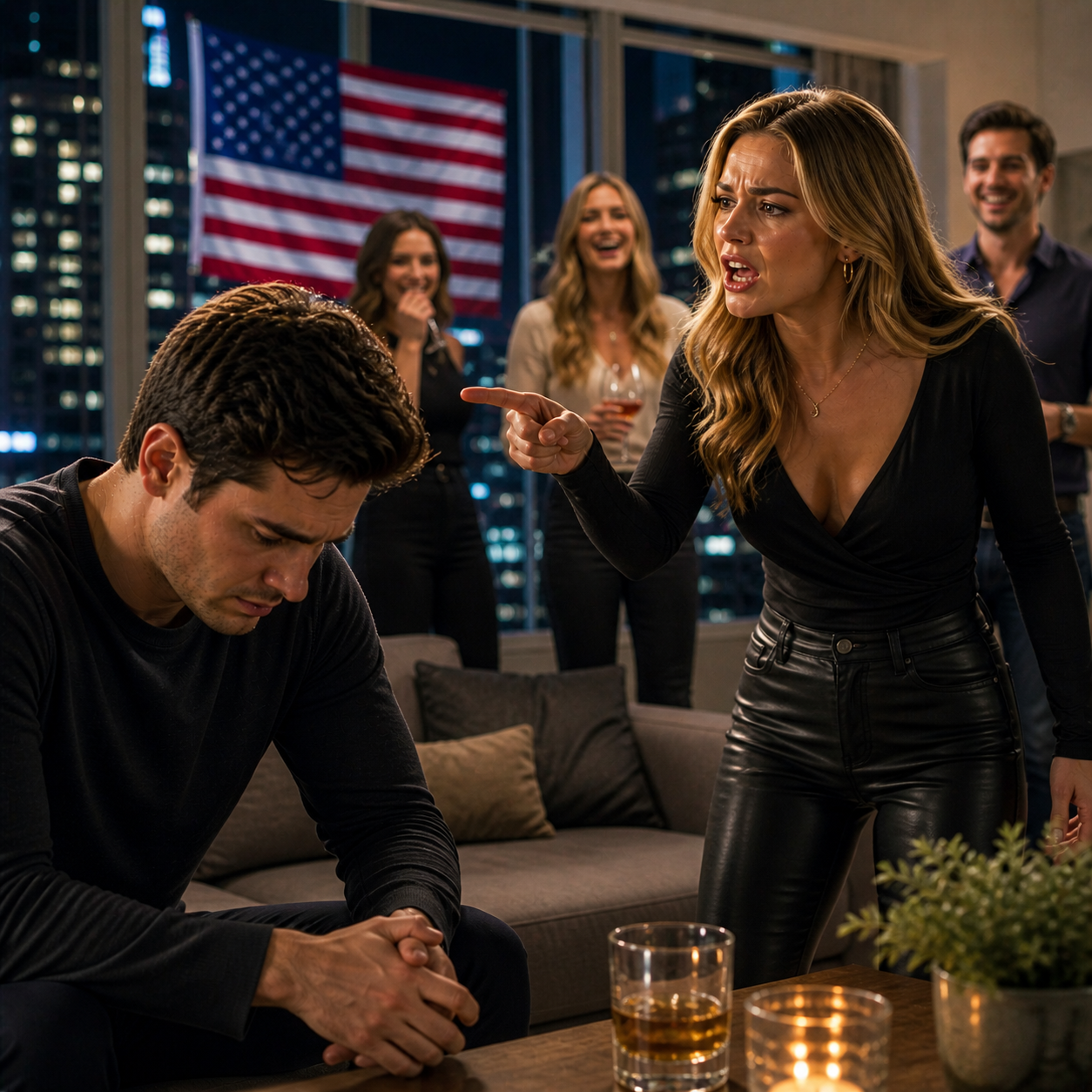
“I mean, look at you. Look at us.” She gestured around the table, then gave me a smile that did not reach her eyes. “Did you really think someone like me would ever seriously date someone like you?”
Her friends laughed.
Not loud, obnoxious laughter. That might have been easier, somehow. It was worse than that. Quiet, cutting little snickers, like they were all in on a joke I had never been invited to.
My chest tightened.
My face burned.
Every nerve in my body screamed at me to say something, to defend myself, to ask her why, to demand an explanation, to make her admit that the last eight months had meant something.
But I did not yell.
I did not flip the table.
I did not give her the explosion she might have wanted.
Instead, something inside me went completely, eerily calm.
I smiled.
Not a fake smile. The kind of smile you give when you finally understand something you should have seen much sooner.
“Good,” I said. “Then this is the last time you’ll ever have to see me.”
Then I turned and walked out.
I did not look back. I did not wait for her response. I heard her say something behind me, maybe my name, maybe a laugh she tried to turn into indifference. But I kept walking.
I got in my car, drove home, and sat on my couch in the dark for two hours, replaying every moment in my head.
I did not cry right away.
I was too numb.
Too confused.
Eight months. I had met her family. I had helped her move apartments. I had listened to her cry about her job, her insecurities, her past. I had brought her soup when she was sick. I had stayed up late helping her prepare for presentations. I had let myself imagine a future with her.
And this was how it ended.
In front of her friends, like I was some punchline she had been saving.
Around midnight, my phone buzzed.
Unknown number.
“Hey, this is Alicia. Emma’s friend from tonight. I need to talk to you. I’m so sorry about what happened. You didn’t deserve that.”
I stared at the screen.
Alicia. The one who had been sitting right there at the table. The one who had covered her mouth while everyone else laughed.
Part of me wanted to block the number and never think about any of them again. But something in her message felt different. Genuine, maybe. Or guilty.
I typed back, “Why are you texting me?”
Three dots appeared.
“Because what she did was wrong. And there’s more you should know. Not to hurt you more. Because you deserve the truth. Can we talk tomorrow?”
My hands went still.
I did not sleep that night.
The next day, Alicia walked into the coffee shop at exactly noon. No makeup, hair in a simple ponytail, wearing jeans and a sweater. She looked nothing like the girl from the wine bar. She looked tired. She looked like someone who had not slept much either.
She sat down across from me, wrapped both hands around her tea, and took a breath.
“Emma’s been going through something,” she said. “I don’t know all the details. She doesn’t talk about it directly, but I know she’s been seeing a therapist. Something about commitment issues. Self-sabotage patterns. Jess mentioned it a few weeks ago.”
A knot formed in my stomach.
“So what was last night?” I asked. “Some kind of test?”
“I don’t think so,” Alicia said quietly. “I think she got scared. You were getting serious. You’d met her parents. She told me once that whenever things feel real, she finds a way to destroy them before they can destroy her.”
I stared at my coffee.
“That doesn’t excuse what she did,” Alicia added quickly. “Nothing excuses that. But I thought you should know. It was never about you.”
I let out a humorless laugh. “It felt pretty personal.”
“I know. And I’m so sorry. I should have said something last night. Instead, I sat there like a coward.”
Then she said something that landed harder than almost anything Emma had said.
“Emma texted the group chat after you left. She didn’t apologize. She said she had finally gotten the courage to end things and that she felt free.”
My chest went cold.
Alicia looked down at her cup. “I left the group chat after that. And I told Emma this morning that I can’t be friends with someone who treats people that way. She called me a traitor. Jess and Maya are furious with me too, but I don’t care anymore.”
She looked up at me.
“I just needed you to know that not everyone at that table thought what happened was okay.”
I looked at this woman I barely knew, someone who had risked her friendships just to tell me the truth, and something inside me shifted.
Not healed.
Not fixed.
But less alone.
That night, I did something I had not done in years.
I called my older brother, David.
David and I are close, but we are not exactly feelings guys. We talk about sports, work, movies, and terrible dad jokes. So when I said, “I need advice,” I could hear the surprise in his silence before he even spoke.
I told him everything. The relationship, the wine bar, the humiliation, the conversation with Alicia.
I expected him to get angry on my behalf. I expected him to call Emma terrible and tell me I was better off.
Instead, he was quiet for a long moment.
Then he asked, “How are you feeling right now?”
That almost made me cry.
“Confused,” I said. “Hurt. Angry. Embarrassed. All of it at once.”
“That makes sense,” he said. “You got blindsided. That’s brutal, man.”
Then he told me something I did not know.
Something similar had happened to him in college. A girl he had been seeing for almost a year broke up with him at a party in front of everyone. Told him he was boring, that she had been seeing someone else the whole time, and that everyone knew before he did.
“I was devastated,” David said. “Spent weeks wondering what was wrong with me. Stopped going out. My grades tanked. And then one of my roommates sat me down and said, ‘You’re letting her win twice. She hurt you once. Now you’re hurting yourself.’”
That sentence hit me somewhere deep.
“She hurt you once,” David said. “Don’t let her keep doing it. Don’t let this define you. Don’t let her take more from you than she already has.”
By the time we hung up, I felt lighter.
Not fixed.
Not over it.
But lighter.
The next few days were hard.
I took Monday off and let myself feel everything I had been pushing down. Tuesday, I forced myself to the gym. Wednesday, I went back to work. My boss, Karen, pulled me aside after a meeting.
“You okay?” she asked. “You seem distracted.”
“Personal stuff,” I said. “I’m fine.”
She studied me for a moment. “Breakup?”
I nodded.
“Take the time you need,” she said. “I’ve been through my share. They suck, but you get through them.”
Something about that simple acknowledgement helped more than I expected.
By the end of that week, I was functioning again. Not great, but functional. I went to the gym every morning. I started meal prepping. I called my parents and told them Emma and I had broken up.
My mom wanted details.
My dad just said, “Her loss,” then changed the subject to football.
I loved him for that.
Two weeks after the wine bar, I was at the grocery store on a Sunday afternoon, debating pasta brands of all things, when I heard a voice behind me.
“Jake.”
I turned around.
Emma.
She looked smaller than I remembered. No makeup, hair pulled back, eyes red like she had been crying. She was holding a shopping basket against her chest like a shield.
“Can we talk?” she asked quietly. “Please. Just a minute.”
Every part of me wanted to say no.
But curiosity, or maybe the need for closure, won.
“One minute,” I said.
She set the basket down and wrapped her arms around herself.
“I’m sorry,” she said. “What I did was unforgivable. I know that. I don’t expect you to forgive me. I just needed you to hear me say it.”
She told me she had been in therapy. Her therapist had identified a pattern: fear of abandonment rooted in her parents’ divorce, a tendency to destroy relationships before they became serious enough to hurt her. When I introduced her to my parents, she panicked. Instead of talking to me like an adult, she chose the nuclear option.
“You were everything I should have wanted,” she said, eyes filling with tears.
“But you didn’t want it,” I replied.
“I did. That’s what scared me.”
I studied her face.
She looked genuine. Broken, even.
A month earlier, that moment would have shattered me. I would have wanted to hold her, comfort her, tell her we could fix it, tell her I understood. But standing there in the pasta aisle, all I felt was tired.
“I appreciate the apology,” I said. “But it doesn’t change anything. You humiliated me in front of your friends. You made me feel worthless. And according to Alicia, you didn’t even feel bad afterward. You said you felt free.”
Emma flinched.
“I did feel bad,” she whispered. “I just didn’t know how to admit it, so I pretended I didn’t care. I’m really good at pretending.”
“I can tell.”
Silence stretched between us.
“I hope you figure out whatever you need to figure out,” I said finally.
And I meant it.
Not because I wanted to go back. Not because I was trying to be noble. But because holding on to anger felt exhausting, and I was done carrying weight that was not mine.
She nodded, picked up her basket, and walked away.
I stood there for a moment.
Then I grabbed my pasta and kept shopping.
A month passed, then another.
Life started feeling like itself again.
I got promoted at work. Senior consultant, better pay, more autonomy. I joined a weekly basketball pickup game at the community center and made actual friends. One of them, Marcus, had the kind of no-nonsense honesty I had been craving. No games, no hidden meanings, just straight talk.
Alicia and I kept meeting for coffee every couple of weeks. Not romantically. It was never that. She was in therapy too, working through her own patterns, becoming a lighter, freer version of herself. She had left her old friend group behind and never looked back.
Then one evening in late spring, almost three months after everything, she sat across from me at a coffee shop with this look on her face, excitement she was barely containing.
“I joined a hiking group,” she said. “Weekend trips into the mountains. Bonfires. Camping. You should come.”
I raised an eyebrow. “That sounds suspiciously healthy.”
“It is,” she said. “Terrible, right?”
I laughed.
Then she added, “And there’s someone in the group I think you’d click with.”
I narrowed my eyes. “Are you trying to set me up?”
“Maybe.”
The old version of me would have said no immediately. I’m not ready. It’s too soon. I’m good alone. All of that might have been true, but it also might have been fear wearing a reasonable disguise.
I had spent months healing, rebuilding, processing.
Maybe it was time to start living again.
“Okay,” I said. “I’ll come.”
Alicia grinned. “You won’t regret it.”
She was right.
The hiking group had about twelve people, different ages, different backgrounds, all genuinely decent humans. And then there was Rachel, exactly as Alicia had described her: funny, sharp, disarmingly self-aware.
We ended up talking by the campfire until two in the morning, covering everything from favorite movies to worst relationship disasters. I told her about Emma. Not every detail, just the broad strokes. Rachel listened without judgment, her chin resting on her knees, the firelight soft across her face.
“Sounds like you handled it well,” she said.
“I walked away. That’s all.”
“That’s not all,” she replied. “Walking away with dignity and then doing the work to heal takes emotional maturity.”
“I didn’t have much choice.”
“You always have a choice,” Rachel said. “You could have gotten bitter. You could have closed yourself off. Instead, you’re here on a mountain taking a chance on new people. That’s brave.”
I had never thought of it that way before.
It has been almost a year since that night at the wine bar.
I am still with Rachel. We took things slow. Deliberately, intentionally slow. No rushing, no pretending, no forcing a future before we had earned the present. She is consistent. She is kind. She communicates. When something scares her, she tells me instead of blowing everything up.
My mom loves her.
My dad said she has good energy.
The exact same words he used about Emma.
That made me nervous for a second.
But Rachel is nothing like Emma.
Nothing at all.
I saw Emma one more time about two months ago. I was at a coffee shop with Rachel when Emma walked in with a guy I did not recognize. She saw me. I saw her. For one brief second, the room felt like it remembered everything.
Then Emma gave me a small, quiet, sad smile.
I nodded back.
That was it.
No conversation. No drama. No confrontation.
Just two people who used to know each other moving in very different directions.
I still think about that Friday night sometimes. The humiliation. The heat in my face. The eerie quiet before I walked out. The feeling that I might not recover from it.
But I did.
Not because I got revenge. Not because I made Emma feel as small as she made me feel. Not because the universe punished her in some dramatic way while everyone clapped.
I recovered because I chose to.
Because I did the work.
Because I surrounded myself with people who genuinely saw me.
David was right. Emma hurt me once. I refused to let her hurt me twice.
There were dark days in between. Days I did not want to get out of bed. Days I questioned everything about myself. Days I replayed the sound of her friends laughing until I felt sick. But those days passed, and on the other side was a life I built on purpose with people who valued me for exactly who I was.
Someone asked me recently if I had forgiven Emma.
Forgiveness is not quite the right word.
I have let go of the anger. I have accepted that what she did said everything about where she was and nothing about my worth. I hope her therapy is helping. I genuinely do. But whether it is or not is not my concern anymore.
That night at the wine bar taught me something I will carry forever.
How someone treats you in your most vulnerable moment tells you everything you need to know about them.
Emma showed me exactly who she was.
And I showed myself something too.
I could be humiliated and still leave with dignity. I could be blindsided and still rebuild. I could lose the person I thought was my future and discover that the future waiting on the other side was better, quieter, kinder, and real.
The last time Emma saw me, I was not bitter.
I was not broken.
I was sitting across from someone who loved me gently, honestly, and without making me audition for basic respect.
And maybe that was the ending I needed most.
Not revenge.
Not payback.
Growth.
The kind that happens quietly, after the laughter stops, after the door closes, after you finally choose yourself and keep walking.

![[FULL STORY] My fiancée confessed to sleeping with my father during their anniversary dinner, so I handed my mother the evidence that cost them $30 million and his freedom](https://social-media.rabedo.com/thumbnails/1776918115_5.png)
![[FULL STORY] My Fiancée Declared 'I'm Not Moving To That Boring Small Town For Your Job '](https://social-media.rabedo.com/thumbnails/1777371300_2.png)
![[FULL STORY] My Fiancée Ran Away To Marry The Man Of Her Dreams Just One Week Before Our Wedding. Three Years ...](https://social-media.rabedo.com/thumbnails/1777221037_R13.png)