
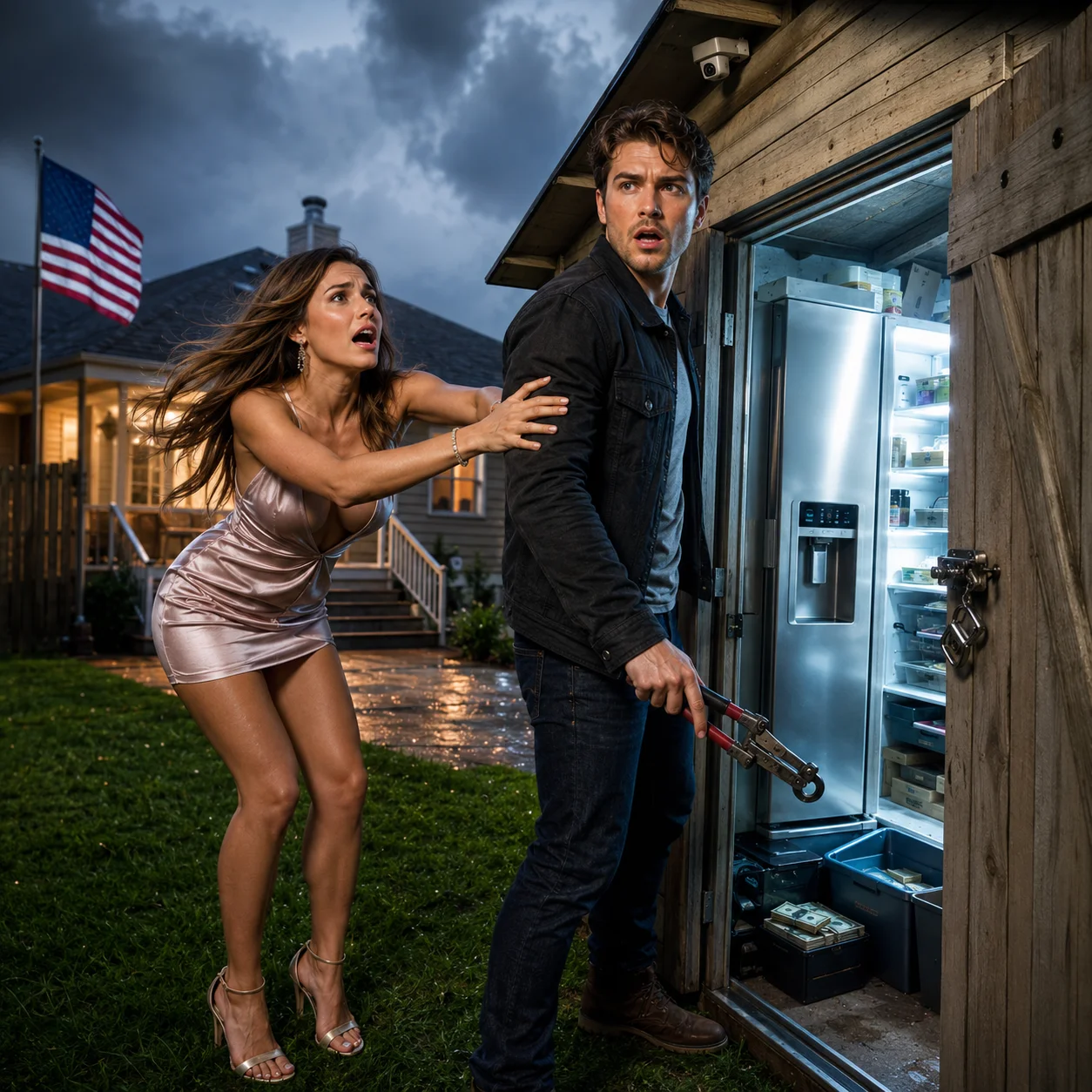
“You don’t know that.”
“Then prove me wrong.”
Her eyes filled with tears so suddenly I almost backed down. That was Lauren’s gift. She could summon emotion at the exact moment it was most useful. Not fake tears, necessarily. I think the fear was real. But I would later understand it wasn’t fear of me.
It was fear of exposure.
“Please,” she whispered. “Just leave it alone.”
That should have been enough to make me angry.
Instead, it scared me.
Because married people say many things during arguments. They say stop. They say you’re overreacting. They say we’ll talk tomorrow.
They don’t usually say leave it alone like they’re begging you not to open a grave.
I didn’t go outside that night.
Not because I believed her.
Because I realized I needed to know what I was walking into before I did.
The power came back on around 2:00 a.m. Lauren pretended to sleep beside me, her breathing too careful and too even. I lay awake until dawn, replaying every strange little thing I had ignored over the years.
The shed key she claimed we never had.
The time I found mud on her shoes even though she said she had been home all day.
The extension cord I once noticed running along the fence, which disappeared before I could ask about it.
The monthly cash withdrawals from our joint account that she said were for groceries, gifts, or “little emergencies.”
Her sudden panic whenever I suggested hosting a backyard barbecue.
By morning, the storm had passed. The yard was soaked. Tree branches littered the grass. The shed stood at the far end like it had been waiting for me.
Lauren came downstairs dressed for work even though it was Saturday.
“I have to go in for a few hours,” she said, not looking at me.
“Since when does the office open on Saturdays?”
“We’re behind on quarter-end reports.”
I nodded. “Okay.”
She paused by the coffee maker. “Are you still being weird about the shed?”
I looked up from my mug. “Are you still lying about it?”
Her face flushed.
“I don’t know what you think you heard,” she said, “but I’m asking you not to go out there.”
“Why?”
“Because I said so.”
“You’re not my mother, Lauren.”
“No,” she snapped. “I’m your wife. And sometimes that should be enough.”
The strange thing was, part of me wanted it to be enough. I wanted to laugh, apologize, blame the storm, and go back to the life where my biggest worry was whether we could afford new kitchen cabinets.
But trust doesn’t usually die in one dramatic moment.
It cracks.
And once it cracks, every old memory starts leaking through.
Lauren left at 8:15.
At 8:22, I walked into the garage, found my bolt cutters, and went outside.
The backyard was cold and wet. My shoes sank into the soft ground as I crossed toward the shed. Cooper watched from the back door, ears up, as if even he knew something was wrong.
Up close, the shed looked worse than I remembered. The boards were warped. The paint had bubbled from moisture. But the padlock was not old.
That was the first thing I noticed.
The lock was weathered on the outside, but the metal still had a newer shine where rain hadn’t touched it. It had not been hanging there for seven years.
My hands were steady when I cut it.
The lock snapped and dropped into the mud.
I opened the door.
The smell hit me first.
Cold air.
Bleach.
Plastic.
And something faintly sweet underneath, like old fruit beginning to rot.
I lifted the flashlight.
The shed was not empty.
Not even close.
Inside was a full-sized refrigerator humming against the back wall, plugged into a heavy-duty orange extension cord that disappeared through a drilled hole near the floor. Beside it were plastic storage bins stacked neatly on metal shelves. A small dehumidifier blinked green in the corner. There were labeled boxes, sealed bags, a folding table, a chair, cleaning supplies, and a small battery-powered security camera mounted near the ceiling.
A security camera.
In the shed my wife said was empty.
My chest felt tight.
I stepped inside.
The floorboards did not creak or sag. They had been reinforced with plywood. Someone had spent time and money making the inside of this shed functional while keeping the outside looking abandoned.
The refrigerator was old but clean, the kind with a freezer on top and a yellowing white handle. A magnetic notepad was stuck to the door.
I still remember the first words I read on it.
Do not unplug.
Underneath that, in Lauren’s handwriting, was a list of dates.
October 3.
October 10.
October 17.
October 24.
Every Friday.
The most recent date was the previous day.
I opened the refrigerator.
For one insane second, I braced myself for something horrifying. A body. Blood. Evidence of a crime. Something my brain had no language for.
Instead, I found rows of small glass vials, sealed plastic containers, ice packs, labeled envelopes, and three brown paper bags filled with prescription bottles.
The labels had been scratched off.
My mouth went dry.
In the freezer were two locked metal cash boxes.
I didn’t touch them at first.
I closed the refrigerator and opened the nearest storage bin.
Inside were old bank statements, printed emails, envelopes full of cash, and copies of documents with names I didn’t recognize.
Except one.
Rachel Whitman.
My wife’s sister.
The sister Lauren told me had moved to Arizona years ago after a family fight and wanted nothing to do with us.
I had never met Rachel. Lauren rarely spoke about her. When she did, it was always with a bitter little twist in her mouth.
“Rachel was unstable.”
“Rachel stole from my parents.”
“Rachel always made everything about herself.”
“She’s better off far away.”
But there, inside a plastic bin in the shed, was a folder with Rachel’s name written across the top.
I opened it.
There were medical bills. Guardianship papers. A copy of a restraining order. Photographs of a young woman with hollow cheeks and dark circles under her eyes. A hospital discharge summary. A handwritten letter addressed to Lauren.
My hands trembled as I unfolded it.
Lauren,
I know you hate me. I know I ruined everything. But Mom’s gone and Dad won’t answer me, and I don’t have anyone else. I’m not asking you to forgive me. I’m asking you to keep the account active until I can get through treatment. Please. If it stops, they’ll discharge me. You promised you wouldn’t let him control the money after what he did.
Please don’t let him find me.
Rachel
I read the last line three times.
Please don’t let him find me.
The shed seemed suddenly too small.
I pulled out another folder.
Inside were cashier’s check receipts, pharmacy invoices, and notes written by Lauren in careful columns. Dates. Amounts. Locations. Initials.
Then I saw my name.
Daniel joint acct: 400 cash.
Daniel bonus: 1,200 transfer.
Daniel tax refund: 2,800 held.
I stared at the page as heat rose into my face.
Money had been taken from our life for years. Not random spending. Not shopping. Not carelessness. It had been organized, tracked, hidden.
The refrigerator hummed behind me.
I opened one of the cash boxes from the freezer with a screwdriver I found on the table.
Inside was cash.
A lot of it.
Stacks of twenties and fifties wrapped in bank bands. Not millions. Not movie money. But enough to make my knees feel weak.
The second box held passports.
Lauren’s.
Rachel’s.
And one for a child named Emma Whitman.
My breath stopped.
A child.
I had never heard that name.
At the bottom of the box was a birth certificate.
Emma Rose Whitman.
Mother: Rachel Whitman.
Father: Unknown.
Date of birth: four years earlier.
I sat down hard on the folding chair.
The world didn’t spin. It sharpened.
Every sound became too clear. The rain dripping from the roof. The refrigerator motor. The distant hum of traffic beyond the fence. My own breathing, shallow and rough.
My wife hadn’t been hiding an affair.
She hadn’t been hiding a gambling problem.
She had been hiding a person.
Maybe two.
I heard a car door slam.
I froze.
Through the dirty shed window, I saw Lauren’s white SUV pull into the driveway.
She had come back.
For several seconds, I didn’t move. Then I shoved the papers back into the folder—not neatly, not the way I found them, but enough to hide the immediate evidence—and stepped outside, pulling the door behind me.
Lauren was already halfway across the yard.
Her face was pale. She must have seen the broken lock from the kitchen window.
“What did you do?” she shouted.
I held up the cut padlock.
“What did I do?”
She stopped ten feet away from me, breathing hard.
“You had no right.”
“It’s my property too.”
“No, Daniel. You had no right.”
“You told me it was empty.”
She looked at the shed door like it might speak for her.
“I need you to go inside,” she said.
I almost laughed. “That’s not happening.”
“Daniel, please.”
“Who is Emma?”
The color drained from her face so completely I thought she might collapse.
For a moment, there was no storm, no shed, no yard. Just my wife standing in wet grass, staring at me like I had opened a door she had nailed shut years ago.
“How much did you see?” she whispered.
“Enough.”
“You don’t understand.”
“Then start explaining.”
Her eyes flicked toward the neighboring houses.
“Not here.”
“Here is where you hid it.”
“Please.”
I stepped closer. “Is Rachel alive?”
Lauren’s mouth opened, but no sound came out.
“Is your sister alive?”
“Yes,” she said finally.
“Where?”
“I can’t tell you.”
I stared at her. “You can’t tell me?”
“No.”
“You’ve been taking money from our accounts for years. You have cash, passports, medicine, documents, and a refrigerator running in a shed you lied about. And you think you’re still in a position to decide what I get to know?”
Her face hardened again, but this time the fear beneath it was obvious.
“You don’t know what my family is like.”
“No. I don’t. Because you built our marriage on edited stories.”
“You think I wanted this?”
“I think you lied to me every day.”
“I was protecting them.”
“From who?”
She looked toward the house.
“From my father.”
I almost said, Your father is dead.
Because that was what she had told me.
Her father, Robert Whitman, had supposedly died of a heart attack three years before we met. Lauren said she didn’t like talking about him. She said he had been controlling, cruel, and impossible to please, but dead men don’t usually require hidden cash, false trails, and passports in freezers.
I swallowed.
“Your father is alive?”
Lauren closed her eyes.
That was answer enough.
Something in me broke—not loudly, not dramatically. It was quieter than that. A clean internal snap.
“How many people in your life are dead only because you told me they were?” I asked.
She flinched.
“I was going to tell you.”
“When?”
“When it was safe.”
“It’s been seven years.”
“It still isn’t safe.”
I looked back at the shed. “And the medicine?”
“Rachel needs it.”
“For what?”
Lauren wiped at her face, angry now. “For staying alive. Does that answer your question?”
“No, it doesn’t.”
“She has a condition. A real one. The kind that gets expensive fast when you don’t have good insurance and you’re trying not to leave a trail.”
“And Emma?”
“My niece.”
The word landed heavily between us.
“You’ve known about a child for four years,” I said.
Her voice cracked. “Yes.”
“And you never told me.”
“No.”
“Why?”
“Because telling you meant trusting you with something that could get them found.”
I stared at her, stunned. “I’m your husband.”
“I know.”
“No, I don’t think you do.”
She stepped toward me. “Daniel, my father is not just some angry old man. He has money. He has lawyers. He has friends in places people like us don’t even understand. Rachel testified against someone connected to him years ago. She tried to leave. He destroyed her life. He took her money, ruined her credit, had people watching her apartment. When she got pregnant, she disappeared. I helped her.”
“And you thought the best way to handle that was to lie to me for our entire marriage?”
“I thought the best way was to keep you safe.”
“Don’t do that,” I said.
Her eyebrows pulled together.
“Don’t turn betrayal into protection.”
She stared at me as if I had slapped her.
Maybe part of her thought I should have been moved. Maybe she expected me to see the shed and instantly understand the noble sacrifice beneath the lies.
But marriage is not just about motive.
You can betray someone while doing something for a good reason.
You can destroy trust while saving someone else.
Both things can be true.
“Where are they?” I asked.
Lauren shook her head. “I can’t.”
“You mean you won’t.”
“I mean I can’t risk it. Not even now.”
I laughed once, cold and empty. “You still don’t get it.”
“What?”
“I found out by accident. During a storm. Because the power went out. If I hadn’t heard that refrigerator, you would still be lying to me tonight. Tomorrow. Next year. For the rest of our lives.”
She looked down.
I waited for her to deny it.
She didn’t.
That hurt worse than almost anything she had said.
I went inside, packed a bag, and left.
Lauren followed me through the house crying, then pleading, then getting angry when pleading didn’t work.
“You can’t just walk away from this.”
“I’m walking away from you.”
“You don’t understand what’s at stake.”
“I understand more than you think.”
“No, you understand your pride got hurt.”
I stopped at the front door.
That was the wrong thing to say.
I turned around slowly.
“My pride?” I said. “You used my income, my accounts, my house, my trust, and my name to support a secret operation out of our backyard while telling me an entire part of your life didn’t exist. You made me unknowingly participate in something that could be dangerous or illegal. You installed a security camera on our property without telling me. You kept passports in a freezer. And now you think this is about pride?”
Her anger disappeared.
“I’m sorry,” she whispered.
I believed that she was.
But sorry did not change the fact that I no longer knew who I had been sleeping beside.
I spent that night at my friend Marcus’s house.
I didn’t sleep. I sat at his kitchen table with a cup of coffee gone cold in front of me while he listened to the entire story without interrupting.
Marcus had been my best friend since college. He was a criminal defense attorney, which was both comforting and terrifying under the circumstances. When I finished, he leaned back, rubbed both hands over his face, and said, “Okay. First, do not go back into that shed alone. Second, do not touch anything else. Third, you need your own lawyer.”
“I have you.”
“You have me as your friend,” he said. “You need a family attorney and maybe a separate civil attorney. I’ll give you names. But listen to me carefully, Dan. If anything in that shed connects to false documents, controlled medication, hidden funds, or someone evading a legal order, you do not want to be improvising.”
“She said she was protecting her sister.”
“Maybe she was.”
“You don’t believe her?”
“I believe people tell the version of the truth that makes them look least guilty.”
That sentence stayed with me.
The next morning, I checked our bank accounts.
The numbers made my stomach turn.
Over seven years, small withdrawals had become large withdrawals. Transfers labeled vaguely as home repairs, medical reimbursements, holiday expenses, cash savings. Some I had noticed and forgotten. Some I had asked about and accepted Lauren’s explanations. Some had been hidden behind credit card payments and refunds.
It wasn’t one dramatic theft.
It was erosion.
By noon, I had called a lawyer named Elaine Mercer, who specialized in divorce and financial misconduct. She agreed to meet me Monday morning.
At 3:16 p.m., Lauren texted me.
Please come home. We need to talk.
I didn’t answer.
At 3:28, she texted again.
Rachel is safe. Emma is safe. That’s all you need to know.
That’s all you need to know.
I stared at those words until my vision blurred.
Then another message came in.
I never meant to hurt you.
I typed several replies and deleted all of them.
Finally, I wrote:
Do not move anything from the shed. Do not destroy documents. I’m getting legal advice.
Three dots appeared.
Disappeared.
Appeared again.
Then she replied:
You’re making a mistake.
That was the first time I felt afraid.
Not heartbroken. Not betrayed.
Afraid.
Because it didn’t sound like a warning from a wife.
It sounded like a warning from someone protecting a system.
On Monday morning, Elaine Mercer’s office smelled like coffee, leather chairs, and expensive paper. She was in her late fifties, with silver hair cut to her chin and the kind of calm expression that made you feel both safe and doomed.
I told her everything.
She took notes without reacting much until I mentioned the passports in the freezer.
Then her pen stopped.
“Passports?” she said.
“Yes.”
“How many?”
“Three.”
“Were any expired?”
“I don’t know.”
“Did any appear altered?”
“I didn’t inspect them.”
“Good. Don’t.”
She asked for bank records, copies of any texts, photos if I had them, and a timeline of every financial irregularity I could remember. She told me not to return home alone. She told me not to accuse Lauren of crimes in writing. She told me not to contact Rachel, even if I found a way.
Then she said, “There’s one more thing.”
“What?”
“If your wife’s explanation is true, there may be a vulnerable adult and a child involved. If it’s false, there may be fraud. Either way, you need to separate your marital issues from any immediate safety issues.”
“What does that mean?”
“It means we proceed carefully. We document. We don’t play detective.”
Of course, I played detective anyway.
Not the reckless way. Not at first.
I started with public records.
Rachel Whitman had not moved to Arizona.
There was no record of her owning property there, no listed address, no employment history after 2018. But there was a domestic protection filing from years earlier, sealed in part, naming Robert Whitman as a respondent.
Robert Whitman was not dead.
He lived forty miles away in a gated community near Dublin.
He was very much alive.
He owned a private security consulting firm, had donated to political campaigns, and appeared in local business articles smiling beside men in suits. He had the smooth, heavy face of someone accustomed to being obeyed.
I stared at his photo for a long time.
Lauren had lied about him being dead.
But she had not lied about him being powerful.
That complicated my anger in ways I hated.
Because I wanted her to be simply wrong. I wanted a clean betrayal with a clean villain. I wanted to be able to say she had deceived me for no reason except selfishness.
Instead, every new fact made the truth uglier.
By Wednesday, Elaine had filed for financial disclosure and separation. Not divorce yet. Separation. She advised me to move slowly, legally, and visibly. “People who live in secrecy panic when light enters the room,” she said.
She was right.
Lauren panicked.
First came the apologies.
Then the accusations.
Then the bargaining.
Then silence.
On Friday, Marcus drove me back to the house to collect clothes and documents. Lauren’s SUV was in the driveway. When we stepped inside, the house was spotless in a way that felt staged.
Lauren sat at the kitchen table with her hands folded.
She looked exhausted. No makeup. Hair tied back. Eyes swollen.
Marcus stayed near the doorway.
“Who’s he?” she asked.
“My friend.”
“I know who Marcus is.”
“Then don’t ask.”
Her mouth tightened.
I went upstairs, packed two suitcases, collected my passport, tax records, birth certificate, spare checks, and the external hard drive from my desk. Lauren followed me from room to room without speaking.
When I opened the hall closet, I found three empty shelves where boxes had been.
“What was here?” I asked.
“Christmas decorations.”
I looked at her.
She looked away.
I walked downstairs and toward the back door.
She grabbed my arm.
“Don’t.”
Marcus straightened.
I looked down at her hand until she released me.
“What did you move?” I asked.
“Nothing important.”
That answer told me everything.
I went to the shed.
The refrigerator was still running.
The bins were still there, mostly. But two folders were gone. The cash boxes were gone. The passports were gone.
I stood in the doorway and felt something inside me go quiet.
Not rage.
Decision.
Lauren appeared behind me. “I had to.”
“No,” I said. “You chose to.”
“You don’t understand.”
“I understand that my lawyer told me to tell you not to move anything, and you moved things anyway.”
“Because you threatened everything.”
“I threatened your lies.”
She started crying again. “You think this is easy? You think I wanted to hide money in a shed like some lunatic? You think I wanted to live scared every day?”
“No,” I said. “I think you wanted control more than partnership.”
She froze.
That landed.
“You didn’t give me a choice,” I continued. “Not once. You decided what I could handle. You decided what I could know. You decided my money was available, my home was useful, and my trust was expendable. You may have been protecting Rachel, but you were also protecting your own power over the truth.”
Her lips trembled.
For the first time, she had no answer.
Then Marcus called my name from the yard.
There was a black SUV parked across the street.
A man sat inside with the engine running.
He wasn’t looking at us directly, but he didn’t need to.
Lauren saw him and went white.
“Inside,” she said.
“Who is that?”
“Inside now.”
The fear on her face was different from anything I had seen before. Raw. Animal.
Marcus pulled out his phone.
The SUV stayed there for another thirty seconds, then drove away.
Lauren sank onto the back step.
“That was one of his people,” she whispered.
“Your father?”
She nodded.
“How would he know?”
She looked at me, and the answer was in her eyes before she said it.
“The camera.”
The security camera in the shed.
It had not just been recording for Lauren.
It had been connected.
Someone had access.
Maybe Lauren.
Maybe Rachel.
Maybe someone else.
Maybe Robert.
I thought I had uncovered the secret.
I hadn’t.
I had tripped an alarm.
That changed the next seventy-two hours.
Marcus called a former colleague in law enforcement. Elaine contacted a private investigator she trusted. I gave a formal statement about the SUV, the shed, the documents, the financial withdrawals, and Lauren’s claims about her father.
Lauren, finally cornered by consequences bigger than our marriage, told the truth.
Not all at once.
People rarely do.
It came in pieces.
Rachel had been the rebellious daughter, the one who refused to work for Robert’s company, the one who saw things in his business she should not have seen. According to Lauren, Robert’s security firm had done “private intimidation work” for wealthy clients—stalking, surveillance, pressure campaigns, things hard to prove but easy to feel. Rachel had copied files, threatened to expose him, and then disappeared after a violent confrontation.
Lauren had helped her.
At first, it was a motel room. Then cash. Then medication. Then a fake trail out west. Then Emma was born, and everything became harder.
“Why the shed?” I asked her during one of the conversations Elaine insisted happen with attorneys present.
Lauren stared at the conference table. “Because I needed somewhere close but separate. Somewhere I could access without leaving the property. Somewhere you’d never bother with.”
I nearly laughed at the honesty of that.
Somewhere I’d never bother with.
That was what I had been in my own marriage. A safe blind spot.
“Why didn’t you tell me after we married?”
“I almost did.”
“When?”
She rubbed her thumb against her wedding ring. “After Emma was born. I came home from the hospital where Rachel delivered her and sat in the driveway for twenty minutes. I was going to walk inside and tell you everything.”
“But you didn’t.”
“No.”
“Why?”
“Because you were so happy that night,” she whispered. “You had made dinner. You had bought flowers because it was our anniversary. You were talking about maybe trying for a baby someday. And I realized if I told you, I could lose all of it.”
The room went still.
There it was.
Not protection.
Not entirely.
Fear.
She had not only been afraid Robert would find Rachel.
She had been afraid I would leave.
So she chose a version of our marriage where I stayed because I didn’t know enough to go.
That was the part I could not forgive.
The investigation took weeks.
Robert Whitman did not go down in some dramatic courtroom explosion. Real life rarely gives you that satisfaction. But pressure began to build around him. The private investigator found enough evidence of unauthorized surveillance to involve police. Rachel, through an attorney, confirmed she and Emma were alive and safe, though she refused direct contact with me. The missing passports were recovered through Lauren’s lawyer and turned over voluntarily. The medications were verified as legitimate prescriptions, though obtained through a complicated chain of assistance programs and cash payments.
The money was harder.
Lauren admitted she had used marital funds without my consent. Some of it had gone to Rachel’s care. Some to safe housing. Some to medical bills. Some to emergency travel plans. But not all.
That was another truth that came later.
There had been a separate account.
Lauren called it a contingency fund.
Elaine called it hidden marital assets.
I called it the final nail.
Because even after everything, even after the frightening parts proved real, Lauren had still carved out money for herself. Not for Rachel. Not for Emma. For herself. In case she had to run. In case I found out. In case the life she built with me became inconvenient.
When Elaine showed me the account statements, I sat in silence for a full minute.
Then I said, “File.”
She didn’t ask if I was sure.
She already knew.
The divorce was not clean.
Lauren fought at first. Then she collapsed emotionally. Then she tried to frame the entire marriage as a casualty of my inability to understand trauma. There was truth in her trauma. There was also truth in my betrayal. The court did not care much about emotional poetry. It cared about records, disclosures, property, accounts, and signatures.
The house was mine before marriage, but marital money had gone into improvements, so there were negotiations. I agreed to a settlement that cost me more than I wanted but less than a war would have. Lauren was ordered to repay a portion of the hidden funds, though I knew I’d never see all of it.
The shed was emptied under supervision.
I wasn’t there when they cleared it out.
I didn’t want to see the refrigerator again.
But Marcus went, partly as my witness, partly because he understood that some objects become haunted not because of ghosts, but because of what they prove.
He told me later the last thing removed was the extension cord.
It had been buried shallowly under mulch, running from an exterior outlet behind the house to the shed. A secret line of power, hidden in plain sight.
That felt too symbolic to ignore.
Lauren moved into an apartment across town.
Rachel and Emma were relocated through legal channels I was not told much about. I respected that. Whatever my feelings toward Lauren, I did not want harm coming to them. Emma was innocent. Rachel had survived something I still didn’t fully understand.
As for Robert Whitman, his world began shrinking. Not dramatically enough for my anger, but enough to matter. His company lost contracts after questions surfaced. A civil suit was filed. A local reporter started digging. He put his house on the market six months later.
The last time I saw Lauren was almost a year after the storm.
It was outside the courthouse after the divorce was finalized. She looked thinner, older, and tired in a way makeup couldn’t soften. She wore a navy coat I had bought her one Christmas and held a folder against her chest.
For a moment, we just stood there.
Then she said, “I really did love you.”
I believed her.
That was the tragedy.
“I know,” I said.
Her eyes filled. “But not enough?”
I shook my head. “Not honestly enough.”
She looked down.
“I thought if I controlled the truth, I could protect everyone.”
“You protected secrets,” I said. “People are different.”
She nodded slowly, like the sentence hurt because she knew it was fair.
“I’m sorry, Daniel.”
“I know.”
Then she asked the question I think she had been carrying for months.
“If I had told you in the beginning, would you have stayed?”
I looked across the parking lot at the gray winter sky, at strangers walking to their cars, at the ordinary world continuing like mine had not been split open by a humming refrigerator in an old shed.
“I don’t know,” I said honestly. “But at least the choice would have been mine.”
She cried then.
Quietly.
I didn’t hold her. I didn’t comfort her. That part of my life was over.
I walked to my car, drove home, and stood in the backyard for a long time.
The shed was gone by then. I had hired a crew to tear it down the week after Lauren moved out. They hauled away the boards, the shelves, the reinforced floor, the hidden wiring, everything. In its place was a rectangle of bare dirt that refused to grow grass for months.
Eventually, I planted a small garden there.
Nothing dramatic. Tomatoes. Basil. Peppers. A few flowers I couldn’t name because the woman at the nursery said they were hard to kill.
The first spring after the divorce, Cooper dug up half the basil and looked proud of himself. I laughed harder than the situation deserved, standing there in the sunlight with dirt on my hands, realizing it was the first time in months my body had laughed before asking permission from my grief.
People like clean morals in stories.
They want the liar to be evil, the betrayed person to be noble, the secret to be unforgivable in a simple way.
But my story was not clean.
My wife lied to protect her sister and niece from a dangerous man. That was true.
My wife also stole trust, money, choice, and years from our marriage because secrecy became easier than honesty. That was true too.
For a long time, I thought the worst thing I found was the refrigerator running inside that old shed.
It wasn’t.
The worst thing I found was proof that an entire marriage can keep humming quietly on hidden power, long after the truth has been unplugged from everything else.
And the saddest part is that from the outside, no one hears it.
Not until the storm comes.

![[FULL STORY] My "Workaholic" Girlfriend Claimed I Was Too Jealous Of Her Coworker, So I Moved Her Into The Guest Room While She Was Showering.](https://social-media.rabedo.com/thumbnails/1777367373_26.png)

![[FULL STORY] My Girlfriend Called Me “Safe, But Temporary” at Brunch. I Nodded and Replied, “Then Let Me Save You the Trouble of Waiting](https://social-media.rabedo.com/thumbnails/1777348801_m10.png)