
Diane stood on the porch, arms crossed. “There. You rescued your trash. Happy?”
I looked up at her, and for the first time in years, I did not try to hide how much I hated her.
“You don’t get to decide what my mother was worth,” I said.
Her face changed. Only for a second. The polished smile slipped, and something uglier showed beneath it.
“No,” she said softly. “But your father does. And he chose to move on.”
My father flinched like she had slapped him, but still he said nothing.
That was what broke my heart more than the jewelry box. Not Diane’s cruelty. I had known that for years. It was my father’s silence. His willingness to let her erase my mother one object at a time while he watched from the corner and called it peace.
I took the box upstairs, cleaned it carefully with a damp towel, and packed it in my overnight bag. I planned to leave that evening, but my father asked me to stay through Monday for the appraisal.
“I’d like you here,” he said quietly, catching me near the stairs after dinner.
“Why?”
He looked toward the kitchen, where Diane was speaking on the phone in a low, sharp voice.
“Because your mother would have wanted you here.”
It was the first time in years he had said my mother without lowering his voice.
So I stayed.
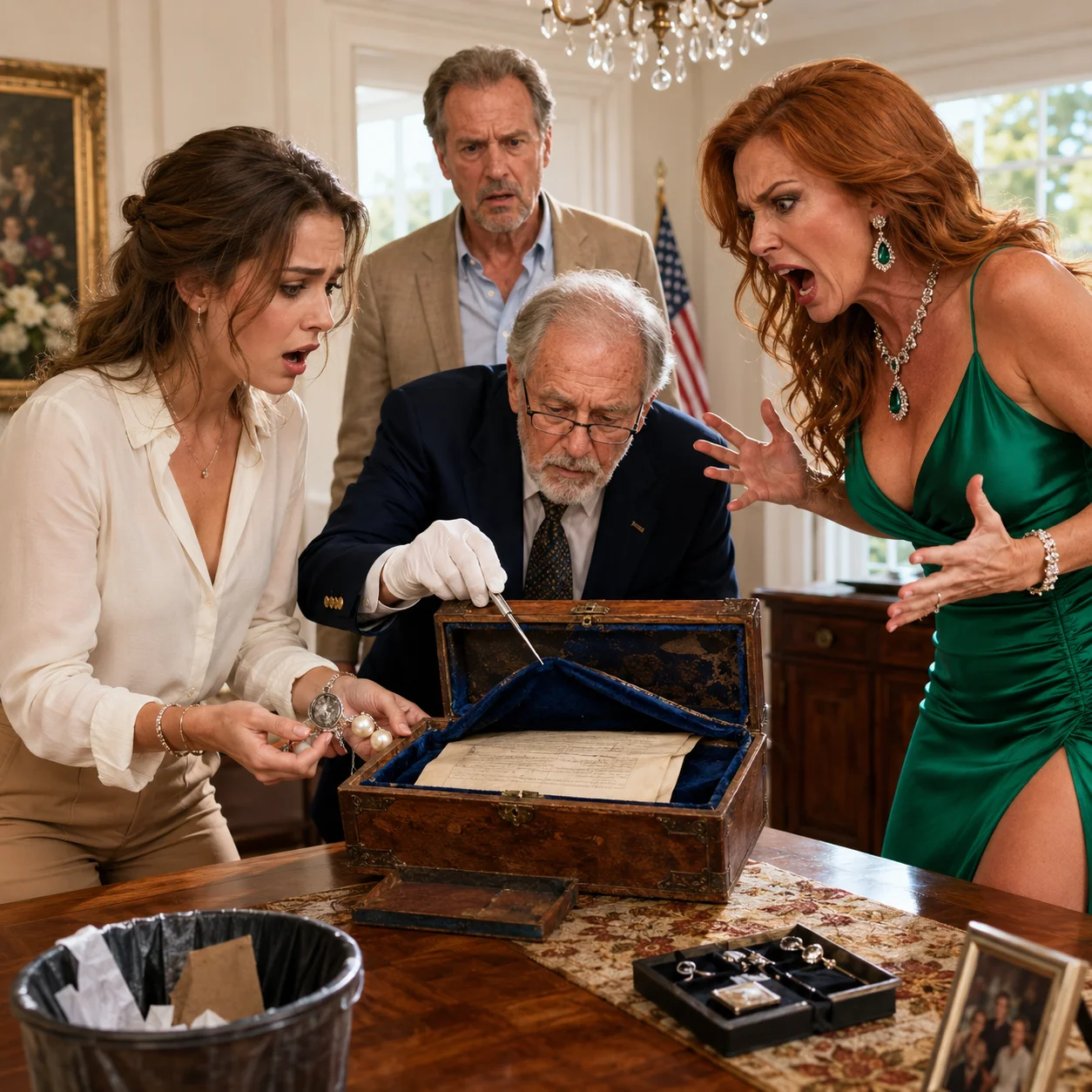
Monday morning, the appraiser arrived at ten. His name was Mr. Alden Price, a calm, silver-haired man in a navy blazer who carried leather folders and wore white gloves when handling delicate items. Diane greeted him like she was hosting a charity luncheon. She had arranged the dining room table with everything she wanted valued: her own diamond tennis bracelet, a set of silver candlesticks, my grandmother’s china, a few old watches, and a heavy gold necklace she claimed my father had bought for her on their anniversary.
My mother’s jewelry was not on the table.
I had placed the old box in my bag and kept it beside my chair.
Diane noticed.
Her mouth curved. “Mara insisted on including sentimental items. I warned her they won’t be worth much.”
Mr. Price smiled politely. “Sentimental items often have histories that matter more than their market value.”
Diane gave a light laugh. “History doesn’t pay insurance premiums.”
My father sat at the head of the table, quiet and tense.
The appraisal began slowly. Mr. Price examined the candlesticks, the watches, the necklace. He spoke in measured terms, explaining maker’s marks and replacement values. Diane leaned forward whenever something was worth more than expected and looked bored whenever it wasn’t.
Then he turned to me.
“And this is the piece you mentioned?” he asked.
I placed my mother’s jewelry box on the table.
Diane made a soft sound of annoyance. “Honestly, Mr. Price, you don’t have to waste time on that. It was nearly in the garbage two days ago.”
He looked at the box, not with disgust, but with interest.
“May I?”
I nodded.
He put on his gloves and opened it gently. The hinge squeaked. My mother’s locket and earrings rested inside. I had cleaned them as best I could. He examined each piece, confirming what I already knew. Modest value. Real pearls, but not large. Gold ring, low carat. Silver locket, old but not rare.
Diane leaned back with satisfaction.
Then Mr. Price paused.
He was looking at the interior of the box.
“Interesting,” he murmured.
“What?” I asked.
He ran one gloved finger along the velvet lining. “This base is slightly raised.”
Diane’s eyes narrowed. “It’s warped. The box is old.”
“Possibly,” he said.
He tilted it toward the light. “May I inspect underneath the lining? Carefully, of course.”
My heartbeat changed.
I looked at my father. His face had gone pale.
“Dad?” I asked.
He swallowed. “Let him.”
Diane turned sharply toward him. “Why?”
My father did not answer.
Mr. Price took a small tool from his case, thinner than a letter opener. With the patience of a surgeon, he lifted one corner of the faded velvet. The glue resisted, then released with a soft tearing sound. Beneath the lining was not wood.
It was paper.
Folded flat, sealed in yellowed wax paper, tucked into a shallow hidden compartment.
Nobody spoke.
Mr. Price lifted it out and placed it on the table.
Diane stood up. “What is that?”
My father whispered, “Evelyn.”
My hands started trembling.
Mr. Price looked at me. “Would you like to open it?”
I could barely breathe, but I nodded.
The wax paper crackled under my fingers. Inside was a folded document, old but carefully preserved. There was also a small photograph of my mother standing in front of the house, younger than I remembered, holding a set of keys and smiling like she had won the world.
I opened the document.
At the top were the words:
TRANSFER-ON-DEATH DEED.
My vision blurred.
I forced myself to read.
The house. Our house. The home I had grown up in. The home Diane had redecorated, controlled, and treated like her personal kingdom.
It had belonged to my mother.
Not my father.
My mother had inherited it from her parents before she married him. The document stated that upon her death, ownership of the property would transfer to me, Mara Evelyn Carter, her only child. It had been signed, notarized, and recorded with the county clerk thirteen years ago.
For several seconds, the only sound in the room was the ticking of the dining room clock.
Then Diane laughed.
It was not a real laugh. It was too sharp, too high.
“That’s impossible,” she said. “This house is Henry’s.”
Mr. Price adjusted his glasses. “This appears to be a legally executed transfer-on-death deed, but of course an attorney or title company would need to verify the recording.”
Diane snatched the paper from the table.
“Diane,” my father said.
She ignored him, scanning the document with frantic eyes.
“This is old. This means nothing. Henry, tell her. Tell her this is nothing.”
My father looked at the table.
And in that silence, I understood something terrible.
“You knew,” I said.
He closed his eyes.
My stomach dropped. “Dad. You knew?”
Diane turned on him. “Henry?”
He rubbed both hands over his face. When he finally spoke, his voice sounded like it belonged to someone much older.
“Evelyn told me before she died.”
The room seemed to tilt.
I stared at him. “You knew Mom left the house to me?”
“Yes.”
“And you never told me?”
He looked at me, eyes wet. “You were sixteen. You had just lost your mother. I thought… I thought it would be too much.”
“That was thirteen years ago.”
“I know.”
Diane’s face had turned red. “You told me this house was yours.”
My father’s mouth trembled. “I said we could live here.”
“No,” she hissed. “You said this was our home.”
“It was,” he said weakly.
Diane slammed the document onto the table. “I sold my condo because of you.”
“You sold your condo because you wanted to,” my father said, and for once there was a little steel in his voice.
She looked stunned that he had spoken back.
I could barely hear them. All I could think about was my mother sitting in her bed, placing that jewelry box in my lap, whispering that one day I would understand why women kept things men thought were useless.
She had hidden the proof where only I would care enough to look.
But I had left it behind.
And for thirteen years, my father had let Diane believe she ruled a house that had never belonged to her.
Mr. Price quietly packed his tools. “I believe my work here is done for today. Ms. Carter, I strongly recommend you contact a real estate attorney and title company immediately. Do not let that document out of your possession.”
Diane’s head snapped toward him. “You have no right to advise her.”
“I have every right to advise caution when a potentially significant ownership document has been discovered,” he replied evenly.
I picked up the deed and photograph. My hand was steadier now.
Diane reached for the paper. “I want a copy.”
I pulled it back. “No.”
Her eyes went cold. “Excuse me?”
“No,” I repeated. “You threw this box in the trash. You called my mother’s things worthless. You don’t get to touch what she left me.”
She looked at my father. “Are you going to let her speak to me like that?”
For once, my father did not defend her.
That frightened her more than anything.
I left the house within the hour.
My father followed me to the driveway, begging me to talk, but I could not look at him without seeing every year he had stayed silent. Every birthday where Diane hosted guests under my mother’s roof. Every Thanksgiving where she sat at the head of my mother’s table. Every time she told me I was too attached to the past while sleeping under a roof my mother had secured for me.
“I’m sorry,” he said as I opened my car door.
“You didn’t forget,” I said. “You chose not to tell me.”
His eyes filled. “I was afraid.”
“Of Diane?”
He did not answer.
That answer was enough.
I drove straight to Raleigh and called an attorney before I even unpacked. Her name was Patricia Monroe, a real estate and estate lawyer with a reputation for being polite until politeness became unnecessary. I sent her scanned copies of the document that afternoon. By Wednesday, she had confirmed it.
The deed was real.
It had been properly recorded. My mother had inherited the house before marriage, kept it separate, and executed a transfer-on-death deed naming me as beneficiary. Because no one had ever updated the title after her death, the county records still showed the necessary path clearly. There would be paperwork, affidavits, and formal correction, but the legal conclusion was simple.
I owned the house.
Not partially. Not eventually.
Already.
When Patricia said those words, I sat in my office conference room after everyone had gone home, staring at the city lights beyond the glass, and cried so hard I had to cover my mouth.
It was not about money, not really. The house was worth a lot more than I expected, nearly $640,000 according to preliminary estimates. But that was not why I cried.
I cried because my mother had protected me.
Even while dying, even while weak, even while everyone thought she was fading quietly, she had made one final decision that no one could erase. She knew my father was gentle but easily led. She knew the world could change around me. She knew someday another woman might stand in her kitchen and try to pretend she had never existed.
So my mother hid the truth beneath velvet.
The next two weeks were ugly.
Diane did not go quietly into reality.
First, she called me twenty-six times in one evening. I did not answer. Then she sent messages accusing me of “stealing from my own father,” “manipulating a dead woman’s paperwork,” and “trying to make an elderly man homeless.” My father was sixty-one, still working, and not remotely helpless, but Diane had always been skilled at turning herself into a victim using other people’s pain.
Then she contacted Patricia directly.
That was a mistake.
Patricia sent her a formal notice that all communication regarding the property should go through counsel and that Diane had no ownership interest in the residence based on available records.
Diane responded by posting on Facebook.
Some posts were vague: “Greed destroys families.” Others were not. She wrote that I had “dug through trash to manufacture a claim” and was trying to “evict my grieving father from his own home.” A few of her friends commented with prayer emojis and angry little speeches about disrespectful stepchildren.
I wanted to respond.
Patricia told me not to.
“People like Diane want you emotional,” she said. “Give her paperwork instead.”
So that was what we did.
A title company verified the deed. The county records were updated. Patricia sent my father and Diane formal notice confirming my ownership and requesting a written occupancy agreement if they intended to remain temporarily in the house. The agreement was generous. Ninety days. No rent. They only had to maintain the property, stop removing or disposing of items, and allow a full inventory of belongings connected to my mother and grandparents.
My father called me the day he received it.
“Diane says this is humiliating,” he said.
I almost laughed. “Diane threw my mother’s jewelry box in the trash.”
He was quiet.
Then he said, “I know.”
There was something different in his voice. Less defensive. More broken.
“I found the photo albums,” he added.
“What photo albums?”
“She put them in the crawl space years ago. I thought they were in the closet.”
My throat tightened.
He continued softly, “Your mother’s wedding album. Your baby pictures. Evelyn’s letters from her mother. Diane said she was organizing, but… Mara, I didn’t know she’d moved that much.”
I closed my eyes.
“You didn’t want to know,” I said.
He inhaled shakily. “Maybe that’s true.”
It was the first honest thing he had said.
Two days later, my father drove to Raleigh alone.
He arrived carrying three cardboard boxes and looking like a man who had walked out of a storm. We sat at my kitchen table while he unpacked the boxes piece by piece. My mother’s recipe cards. Her wedding album. A tin of Christmas ornaments. A bundle of letters tied with ribbon. My kindergarten drawings. A small cassette tape labeled Mara singing, age 5.
“I’m sorry,” he said.
I did not rush to comfort him.
He deserved to sit with the weight of it.
“I loved your mother,” he said, voice cracking. “I did. But after she died, everything in that house hurt. Diane didn’t. Diane made decisions when I couldn’t. At first, it felt like help. Then it became easier to let her keep deciding.”
“Even when she hurt me?”
His face folded.
“I told myself you were strong,” he whispered. “I told myself you didn’t need me the same way.”
“That’s what adults say when they don’t want to protect a child.”
He nodded, tears falling now. “I know.”
We sat there for a long time.
Forgiveness did not come in a dramatic wave. It did not arrive because he cried or because he brought back old photographs. I was not ready to absolve him, and I did not pretend otherwise. But for the first time, he stopped making excuses. That mattered.
He told me Diane was furious about the occupancy agreement. She wanted him to fight me. She had called two lawyers, but neither gave her the answer she wanted. One apparently told her that unless she could prove marital funds had significantly increased the property’s value in a way that created a claim, she had very little ground. Even then, it would likely be a claim between her and my father, not ownership of the house itself.
“She says I betrayed her,” my father said.
I looked at him. “Did you?”
He stared into his coffee.
“I think I betrayed everyone by being weak.”
That was the closest he had ever come to the truth.
A month later, Diane escalated.
During the inventory process, I returned to the house with Patricia’s assistant, a professional organizer, and a locksmith. My father had agreed to let us catalog my mother’s and grandparents’ items. Diane was supposed to be at her sister’s house that afternoon.
She was not.
She stood in the foyer wearing a cream sweater, arms folded, smiling like she had been waiting for battle.
“I don’t consent to strangers entering my home,” she said.
Patricia’s assistant, a calm woman named Laura, handed her a copy of the ownership documents and the signed temporary occupancy agreement.
Diane did not take it.
“This is harassment,” she said.
“No,” I replied. “This is inventory.”
She looked past me at the organizer. “Do you people know she’s trying to throw her father onto the street?”
The organizer blinked politely. “I’m here to identify and catalog household items.”
Diane’s smile vanished.
We found more than I expected.
My mother’s grandmother’s quilt was in a plastic bin behind paint cans in the garage. My mother’s books had been boxed under Christmas decorations. Her handwritten letters were in a storage ottoman Diane used as a plant stand. Some items were damaged from damp and neglect. Others were intact.
Then, in the upstairs hallway closet, Laura found a sealed plastic container labeled OLD LINENS.
Inside were silver picture frames, my grandmother’s cameo brooch, and my mother’s engagement ring.
I went still.
I had asked my father about that ring after my mother died. He told me he had misplaced it during the hospital chaos. I had believed him.
Diane appeared behind me.
“That old thing?” she said too quickly. “I found it years ago. I was going to give it to you when you were mature enough.”
I turned around slowly.
“You hid my mother’s engagement ring in a linen box.”
“I protected it,” she snapped.
“From who?”
Her face hardened. “From a dramatic teenager who would have lost it.”
I looked at the ring in my palm. The diamond was small, not the kind Diane would have admired, but I remembered it clearly. My mother used to twist it around her finger when she was thinking.
My father came up the stairs and saw it.
He stopped.
“Where was that?” he asked.
I answered without looking away from Diane. “In a plastic container. Hidden.”
His face changed. Pain, then shame, then anger.
“Diane,” he said.
She threw up her hands. “Oh, don’t start. I kept this house running while your daughter visited twice a year and judged me. I cleaned out the dead woman’s clutter because you couldn’t breathe in here. I made this place livable.”
“My wife’s name was Evelyn,” he said.
Diane froze.
For thirteen years, he had let her say my mother, your late wife, that woman, the past. But now he said her name like he remembered it still had power.
“Her name was Evelyn,” he repeated. “And this was her house.”
Diane’s mouth opened, but nothing came out.
That was the first time I saw fear in her eyes. Not sadness. Not remorse. Fear. The fear of a person realizing the man she controlled had finally found one locked room inside himself she could not enter.
After that day, my father moved out of the master bedroom and into the guest room. Diane called it manipulation. He called it breathing.
The ninety days did not last.
Six weeks into the agreement, a neighbor sent me a photo. Diane had hired a junk removal truck. Two men were loading boxes from the garage.
I called my father immediately.
He did not know.
Patricia moved fast. By the next morning, Diane had received a notice of violation for attempting to remove property under active inventory. The junk company returned the boxes after Patricia contacted them. Most contained old tools, gardening supplies, and several boxes of my mother’s belongings Diane had labeled “trash.”
That ended her free stay.
Under the agreement, violation allowed termination with thirty days’ notice.
I sent it.
Diane exploded.
She left voicemails calling me cruel, greedy, unnatural, jealous, bitter, and “just like your mother.” That last one, though meant as an insult, was the only thing she said that did not hurt.
My father did not fight the notice.
Instead, he asked if he could stay with me for a few weeks after leaving the house.
I said no at first.
Not because I wanted to punish him, but because I needed boundaries. He had spent years allowing Diane to make me feel like a guest in my mother’s home. I was not ready to become his safe place simply because his choices finally collapsed.
He accepted that.
“I understand,” he said.
He rented a small apartment near his office. It was plain, quiet, and his. The first night he slept there, he sent me a picture of a framed photo on his kitchen counter. It was my mother holding me as a baby in the backyard, sunlight in her hair.
His message said: I should have kept this out all along.
I stared at it for a long time before replying.
Yes. You should have.
Diane left the house three days before the deadline, but not before staging one last performance.
She waited until I arrived for the final walk-through. She had packed the foyer with designer luggage and wore sunglasses indoors, though her eyes were red behind them.
“I hope you enjoy your empty victory,” she said. “You got a house. You lost a father.”
I looked past her toward my father, who stood quietly near the staircase.
“No,” I said. “I lost him years ago. Now he has to decide whether he wants to come back.”
Her face twisted.
“You think you’re special because a dead woman signed a paper?”
I stepped closer, calm in a way I had never been around her before.
“No. I know I was loved because a dying woman protected me from someone exactly like you.”
For once, Diane had no answer.
She rolled her luggage out the door and left without looking back.
The house was silent after she was gone.
Not peaceful yet. Silence after years of control is not peace at first. It is shock. It is the strange echo left behind when someone’s voice has filled every corner for too long.
I walked from room to room slowly.
The living room still had Diane’s stiff furniture. The kitchen was still white and cold. The hallway walls still showed faint squares where my mother’s pictures had once hung. But underneath Diane’s choices, the house was still there. The same floorboards that creaked outside my old bedroom. The same window over the sink where my mother used to grow basil. The same backyard where she taught me how to plant tomatoes.
I found my father in the dining room.
He was holding the old jewelry box.
“I fixed the hinge,” he said.
I looked down. The brass clasp had been replaced. The wood had been cleaned and polished, though the scratches remained. I was glad he had not tried to make it look new.
“Thank you,” I said.
He handed it to me carefully.
“I don’t expect you to forgive me quickly,” he said. “Maybe not ever. But I want to try to become someone your mother would recognize again.”
My eyes burned.
“She would have wanted that,” I said. “But she also would have expected you to do the work.”
He nodded. “I know.”
For the next several months, he did.
He started therapy. He apologized without demanding reassurance. He gave me written statements about what had happened to my mother’s belongings, not because I asked him to perform guilt, but because Patricia said documentation mattered. He helped restore the house, not as an owner, not as a man reclaiming authority, but as a father trying to repair what he had allowed to be broken.
We painted the kitchen yellow again.
Not exactly the same shade. That color no longer existed, and maybe that was fitting. We found something close, warm and soft, called morning butter. The name made me laugh for the first time in that house in years.
We rehung my mother’s photos in the hallway. Her wedding picture. Her holding me in the backyard. Her standing proudly on the porch with the keys in her hand, the same photograph hidden with the deed.
I placed the jewelry box in the living room cabinet, not hidden, not tucked away, not treated like clutter.
Inside, I kept the locket, the pearls, the chipped blue ring, the bracelet, my mother’s engagement ring, and the deed.
Not because I needed the deed there anymore. The title was settled. The paperwork was safe in Patricia’s office and in a bank deposit box.
I kept it there because it belonged with the truth.
Diane tried to sue six months later.
Her claim was messy and emotional, filled with accusations about promises, sacrifices, and improvements she believed entitled her to compensation. Patricia handled it with ruthless calm. Diane had sold her condo years earlier and used most of that money on herself. The few improvements made to the house had been paid largely from my father’s income, not hers, and most were cosmetic changes she personally wanted. There was no ownership interest. No secret agreement. No legal miracle waiting beneath her outrage.
The case settled before court for a small amount my father agreed to pay from his personal savings, mostly to end the noise. I did not contribute a cent.
The last time I saw Diane was outside the mediator’s office.
She looked smaller without the house behind her. Still polished, still sharp, but diminished. She glanced at me and said, “Your mother wasn’t a saint, you know.”
I smiled faintly.
“I never needed her to be,” I said. “I just needed her to be my mother.”
Diane looked away first.
A year after the appraisal, I moved back into the house.
Not because I had planned to. At first, I intended to sell it. The place held too much grief, too much anger, too many memories of Diane’s perfume and my father’s silence. But every time I met with a realtor, something in me resisted. I would stand in the kitchen and see my mother peeling apples. I would touch the stair rail and remember sliding down it at eight years old while she pretended to be shocked. I would sit on the back steps and feel, beneath all the pain, a kind of waiting.
The house did not want to be sold.
It wanted to be reclaimed.
So I left Raleigh and negotiated remote work. I donated Diane’s furniture. I brought back color slowly. Soft curtains. Warm rugs. Shelves for books. My mother’s recipe cards framed in the kitchen. Her roses replanted along the porch.
My father came over on Sundays.
At first, it was awkward. We moved around each other carefully, like people carrying glass. But over time, Sunday became dinner. Dinner became coffee on the porch. Coffee became stories about my mother I had never heard because grief had locked them away.
He told me how she once drove through a snowstorm to bring soup to a neighbor she barely knew. How she beat him at poker on their third date and used the winnings to buy pie. How she chose that old jewelry box at a flea market before I was born because, she told him, “Pretty things should have secret places.”
One Sunday evening, while sunlight turned the porch gold, my father said, “She knew I might fail you.”
I looked at him.
He stared out at the roses. “That’s why she did it. The deed. The box. She loved me, but she knew me.”
There was no self-pity in his voice this time. Just truth.
“Yes,” I said softly. “She did.”
He nodded, eyes wet but steady. “I’m glad she was smarter than both of us.”
I laughed, and after a second, he did too.
That was the moment something loosened between us. Not everything. Some damage becomes part of the structure. But a door opened.
On the anniversary of my mother’s death, I took the jewelry box to the cemetery.
I sat beside her headstone under a gray morning sky, the grass damp beneath my coat. For years, I had visited her grave feeling like a child reporting losses. Diane moved your photos. Dad let her donate your coat. I couldn’t stop them. I’m sorry.
This time, I opened the box and touched the velvet lining, now repaired but still original where it mattered.
“You knew,” I whispered.
The wind moved softly through the trees.
I told her everything. About the appraiser. About the deed. About Diane leaving. About Dad trying. About the kitchen being yellow again and the roses coming back.
Then I cried, not because Diane had thrown the box away, but because she had almost succeeded in making me believe old things were powerless.
She was wrong.
The smallest objects can carry the loudest truths. A locket can hold a face. A ring can hold a promise. A recipe card can hold a voice. And an old jewelry box, scratched and nearly discarded, can hold the one document that proves love is not always loud, but it is sometimes very, very prepared.
A few weeks later, I hosted Thanksgiving in the house for the first time.
Not a huge gathering. Just my father, my aunt Linda, two cousins, and Mrs. Gable from next door, who cried when she saw my mother’s photos back in the hallway. We cooked from my mother’s recipes. The turkey was slightly dry, the pie crust too thick, and the kitchen got too warm with everyone talking at once.
It was imperfect.
It was alive.
Before dinner, my father stood near the table and raised his glass.
“To Evelyn,” he said.
My throat tightened.
Everyone repeated her name.
For the first time in thirteen years, my mother’s name filled her own dining room without anyone shrinking from it.
After dinner, when the dishes were stacked and the house smelled like cinnamon and coffee, I found my little cousin Lily standing in front of the living room cabinet, staring at the jewelry box.
“What’s that?” she asked.
I lifted it down and sat beside her.
“This,” I said, opening the lid, “belonged to my mother.”
“Is it treasure?”
I looked at the pearls, the locket, the chipped ring, the repaired lining, the hidden compartment beneath.
“Yes,” I said. “But not the kind people notice right away.”
Lily ran one gentle finger over the edge. “Why is it old?”
“Because it survived.”
She seemed satisfied with that answer.
So was I.
Years from now, maybe the house will belong to someone else. Maybe I will have children, maybe I won’t. Maybe I will keep the jewelry box forever, or maybe one day I will place it in another pair of careful hands and say what my mother said to me.
One day, you’ll understand why women keep things men think are useless.
But I already understand now.
My stepmother saw a broken box and thought she was throwing away the past.
What she actually threw away was her last chance to keep pretending the house was hers.
Because beneath the faded velvet, my mother had left more than a document.
She had left proof.
Proof that she knew me. Proof that she loved me. Proof that even after death, she had one final way to stand between her daughter and anyone who tried to erase her.
And in the end, that old jewelry box did what no one else in my family had been brave enough to do.
It told the truth.



![[FULL STORY] My Fianceé Told Me If I Loved Her I Would Fight For Her, So I Let Her Go And Canceled Our $40,000 Wedding Overnight.](https://social-media.rabedo.com/thumbnails/1777352007_B16.png)

![[FULL STORY] She Blocked Me 8 Days Before Our Wedding — So I Ended Everything](https://social-media.rabedo.com/thumbnails/1777262501_a2fb14d8-b421-49ef-9658-e6bcb5dba288.png)