
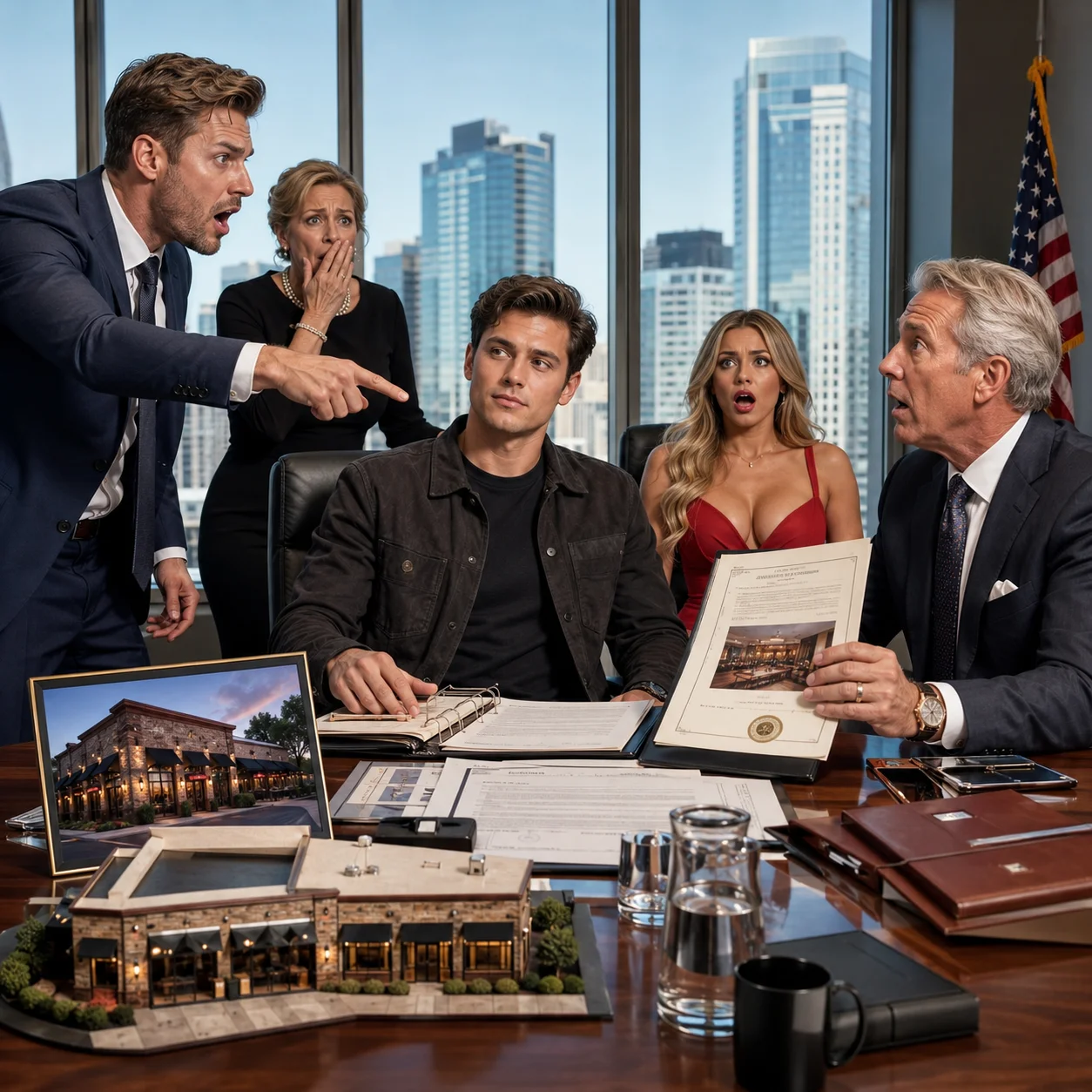
I picked up my folder and nodded slowly.
“Okay,” I said.
Derek looked satisfied, like he had won.
But he didn’t understand something about quiet people.
Sometimes we’re not quiet because we’re weak.
Sometimes we’re quiet because we’re listening, calculating, remembering where every body is buried.
And Derek had just reminded me of something he should have been very careful not to forget.
On Monday morning, I arrived at First Harbor Bank thirty minutes early.
I wore my only good jacket, the navy one my mother had bought me for Dad’s funeral. It still felt stiff around the shoulders. My boots were polished, but they were still work boots, and I could see the receptionist notice them when I walked in.
“Can I help you?” she asked.
“I’m here for the Marino’s meeting. Eleven o’clock with Mr. Hensley.”
She checked the screen. “Your name?”
“Lucas Marino.”
Her expression shifted slightly. “One moment.”
I knew Derek had tried to keep me out of the meeting. I also knew Mr. Hensley had known my father for years. Dad had taken out loans through that bank, deposited restaurant cash there every week, and brought cannoli to the staff every Christmas.
After a few minutes, the receptionist picked up the phone, spoke softly, then smiled.
“Mr. Hensley will see you when the others arrive.”
I sat in the waiting area with my folder on my lap and watched people move in and out of glass offices. My stomach turned, but not because I was scared of the bank.
I was scared of what would happen to my family when the truth came out.
Derek arrived at 10:57 with Mom beside him and a woman I recognized from the redevelopment company. Her name was Madison Vale. She had been to the restaurant twice, always in expensive coats, always looking around like she was measuring where to put new walls.
Derek stopped when he saw me.
“What are you doing here?”
I stood. “Same thing you are.”
He smiled tightly. “Lucas, don’t embarrass yourself.”
Mom touched his arm. “Derek, please. Not here.”
Madison looked at me with polite disinterest. “You must be the younger brother.”
“I’m the one who knows where the water shutoff valve is,” I said.
She blinked, not sure if that was supposed to be funny.
Before Derek could answer, Mr. Hensley stepped out of his office. He was in his sixties, with silver hair, rimless glasses, and the careful expression of a man who had delivered bad news professionally for decades.
“Elena,” he said warmly, taking my mother’s hand. “I’m sorry we’re meeting under these circumstances.”
“Thank you, Robert,” Mom said.
His eyes moved to me. “Lucas.”
“Mr. Hensley.”
“It’s been a while.”
“Yes, sir.”
Derek’s jaw tightened at the familiarity.
We went into the conference room. Derek sat at the head of the table like he owned it. Madison sat beside him and opened a leather portfolio. Mom sat near the window, small and tired in her black coat. I sat opposite Derek and placed my folder in front of me.
Mr. Hensley began with the numbers.
They were worse spoken aloud.
The business loan was past due. Vendor liens were possible. Payroll had barely cleared twice. The building needed electrical upgrades, roof repair, and a new HVAC unit within the next year. Without restructuring, cash infusion, or sale, the restaurant would not survive another quarter.
Derek leaned forward at exactly the right moment.
“That’s why we’re here,” he said. “Madison’s group is prepared to acquire the restaurant operations, satisfy the business debt, and offer my mother a transition payment. It’s the cleanest option.”
Madison slid papers across the table.
“We respect the Marino legacy,” she said smoothly. “Our proposal keeps the name recognizable while modernizing the use of the space.”
I opened the proposal.
They planned to close the restaurant for renovation, terminate current staff, keep only “select brand elements,” replace the menu entirely, and convert the upstairs banquet room into a private cocktail lounge.
I turned one page.
Then another.
There it was.
A lease contingency.
I read it twice.
Then I looked at Derek.
“This sale depends on securing a long-term lease for the building.”
Derek’s eyes flicked to Madison.
She answered before he could. “Naturally. The restaurant’s value depends heavily on location continuity.”
I nodded. “And who did you plan to negotiate that lease with?”
A silence passed through the room so quickly most people might have missed it.
Derek leaned back. “The property side is being handled separately.”
“By who?”
He gave a short laugh. “This is exactly why I didn’t want you here.”
Mr. Hensley, who had been reviewing documents quietly, looked up.
“Actually,” he said, “that’s an important point.”
Madison adjusted her pen.
Derek’s smile faltered. “Robert, the acquisition offer addresses the operating debt. The lease arrangement can be handled after—”
Mr. Hensley lifted a hand. “I understand. But before we discuss collateral, lease terms, or debt restructuring, I need clarification on the property ownership.”
Derek’s face tightened.
Mom looked confused.
I said nothing.
Mr. Hensley opened a folder from his side of the table. It was thicker than the others, with old title documents and photocopies clipped together.
Then he asked the question that changed everything.
“Why didn’t anyone tell me Lucas owns the building?”
The room went so still I could hear the faint hum of the fluorescent lights.
Derek stared at him.
Mom turned slowly toward me.
Madison’s pen stopped mid-note.
I looked down at my hands.
They were calloused, cracked at the knuckles, and still smelled faintly of bleach from scrubbing the kitchen floor the night before.
Derek laughed once, but there was no humor in it.
“That’s not possible.”
Mr. Hensley looked at the document again. “According to county records, the building at 418 West Mercer Street was transferred into Lucas Marino’s name seven years ago through a recorded quitclaim deed and estate planning trust release. The transfer appears valid and properly recorded.”
My mother whispered, “Lucas?”
I swallowed.
Derek shook his head. “No. Dad owned the building.”
“He did,” I said.
“Then Mom inherited it.”
“No,” I said. “She inherited his share of the business. Not the property.”
“That’s ridiculous.”
Mr. Hensley slid a copy across the table.
Derek snatched it up.
I didn’t need to look. I knew exactly what it said.
Seven years earlier, after Dad’s first heart surgery, he had asked me to drive him to an attorney’s office. He didn’t tell anyone because he didn’t want the family fighting while he was still alive. He told me he had made too many mistakes mixing the restaurant business with the building ownership. He was afraid creditors might one day come after both. He was afraid Derek would mortgage the property chasing some flashy expansion. He was afraid Mom, overwhelmed by grief, might sign whatever someone put in front of her.
So he transferred the building to me.
Not because I was his favorite.
Because, in his words, “You’re the only one who loves the place more than the idea of owning it.”
I had argued with him. I told him Derek would hate me. Mom wouldn’t understand. It would look like betrayal.
Dad had put his hand over mine and said, “Then don’t use it unless you have to.”
For seven years, I didn’t.
I paid the property taxes quietly through an account Dad had set up with me. When the roof needed patching, I paid half and called it “finding a cheap guy.” When insurance paperwork came, I handled it. When city notices arrived, I intercepted them before they scared Mom.
I never charged the restaurant real rent. Dad had written a simple family lease with a symbolic monthly amount, enough for bookkeeping but far below market value. It was one of the reasons Marino’s had survived as long as it had.
Derek never noticed because Derek never looked closely at anything that didn’t flatter him.
Now he was looking.
And for the first time in my life, my brother had no clever sentence ready.
“You knew?” Mom asked me, her voice breaking.
I turned to her. “Dad asked me not to say anything unless the building was at risk.”
Her eyes filled with tears. “Why didn’t he tell me?”
That question hurt more than Derek’s anger.
“I think he wanted to protect you from having to choose sides,” I said. “He knew after he was gone, everyone would have opinions. He wanted the building held by the person least likely to sell it.”
Derek slammed the paper onto the table.
“You manipulative son of a—”
“Careful,” Mr. Hensley said sharply.
Derek pointed at me. “You’ve been sitting on this while we struggled? While Mom cried over bills? While I tried to find solutions?”
“You tried to sell the restaurant out from under everyone.”
“I tried to save it.”
“You tried to profit from it.”
His face went red. “I don’t profit from watching my family collapse.”
I opened my folder.
“No? Then explain the consulting fee.”
Madison’s expression changed.
Derek froze.
I took out a printout and placed it on the table. “The redevelopment proposal includes a seventy-five-thousand-dollar advisory fee payable to Derek Marino upon successful acquisition.”
Mom’s hand flew to her mouth.
Derek’s mouth opened, then closed.
Madison exhaled through her nose and looked at him like he had just become a liability.
“That fee was standard,” Derek said quickly. “I brought the deal.”
“You brought vultures,” I said.
He leaned forward, furious. “You think owning the bricks makes you a hero? You still don’t have the money to run the restaurant.”
“No,” I said. “But I have collateral.”
That was when I slid my plan to Mr. Hensley.
The banker took it, adjusted his glasses, and began reading.
No one spoke for several minutes.
Derek sat rigid, tapping his finger against the table. Madison checked her phone. Mom stared at me like she was seeing a stranger wearing her son’s face.
Mr. Hensley read through the cost cuts, the supplier renegotiations, the event room reopening, the projected catering revenue, the proposed debt restructure secured by limited property collateral, and my personal guarantee.
Finally, he looked up.
“This is detailed.”
Derek scoffed. “It’s fantasy.”
Mr. Hensley ignored him. “Some assumptions are optimistic, but not impossible. The upstairs event space is underutilized. The delivery platform losses are significant. Vendor renegotiation could improve margins. Payroll restructuring would need care, but it’s workable.”
I nodded. “I’m not asking the bank to erase the debt. I’m asking for time and a restructure tied to performance. Six months of reporting. Strict controls. No new discretionary spending without approval. I’ll put the building up only as limited collateral, not for a reckless expansion. Just enough to stabilize operations.”
Derek laughed bitterly. “Listen to him. He sounds like he owns everything now.”
Mr. Hensley looked at him. “He owns the most valuable asset involved in this discussion.”
That sentence landed like a door closing.
Madison cleared her throat. “Our group would still be interested in negotiating directly with Mr. Marino regarding the property.”
“No,” I said.
She smiled professionally. “You haven’t heard our offer.”
“I heard enough.”
“Lucas,” Derek snapped, “don’t be stupid.”
I turned to him. “You called me broke in front of the entire restaurant. You called me an employee. You tried to collect seventy-five thousand dollars selling Dad’s name to people who would fire everyone who kept the place alive.”
His jaw flexed.
“You don’t get to call me stupid today.”
Mom started crying silently.
For a second, I wanted to apologize for the pain. Not for what I had done, but for the fact that truth sometimes arrives like a brick through a window. My mother had lost her husband, nearly lost the restaurant, and now she had to face the reality that one son had hidden ownership and the other had hidden a payday.
But some truths can’t be softened without becoming lies.
Mr. Hensley closed the folder.
“I can’t approve anything at this table today,” he said. “But I can take this proposal to committee. Given the property position and the operational plan, there may be a path to restructure. It would require transparency, updated financials, and clear management authority.”
“I’ll provide all of it,” I said.
Derek stood. “This is insane. You’re going to let him gamble the building?”
Mr. Hensley looked at me. “The building is his to risk.”
Derek grabbed his papers. “You’ll destroy this family.”
I looked at him. “No. I’m trying to stop you from selling what’s left of it.”
He stormed out of the room.
Madison followed a moment later, after giving me a card I did not take.
Mom stayed seated, crying into a tissue.
When Mr. Hensley excused himself to make copies, it was just the two of us.
My mother didn’t look at me for a long time.
Then she whispered, “Your father trusted you that much?”
I felt my throat tighten. “He trusted all of us in different ways.”
“No,” she said sadly. “He trusted Derek to shine. He trusted you to stay.”
I didn’t know what to say to that.
She reached across the table and touched my hand.
“I’m sorry I didn’t see it.”
That nearly broke me.
Because I had spent years telling myself I didn’t need anyone to see it. I didn’t need applause for fixing toilets, covering bills, working doubles, or taking home the fear nobody else wanted to carry. But when my mother said those words, I realized how badly I had wanted them all along.
I squeezed her hand.
“We still have work to do,” I said.
And we did.
The next six months were the hardest of my life.
Saving a restaurant sounds romantic only to people who have never done it. In reality, it is spreadsheets at midnight, grease burns on your wrists, vendors threatening delivery holds, staff members crying because they are afraid of losing their jobs, customers complaining when you remove their favorite slow-selling menu item, and your own brother telling half the neighborhood you stole from your dying father.
Derek did not disappear quietly.
The day after the bank meeting, he sent a family-wide email accusing me of manipulating Dad, hiding assets, and “weaponizing property ownership” against my mother. He attached nothing because he had nothing. But accusation doesn’t need evidence to spread. It only needs emotion.
My cousin Paul called me greedy. Aunt Rosa refused to speak to me for two weeks. One of Derek’s friends came into the restaurant and asked loudly if the “landlord king” was available. Someone left a fake crown on the bar.
I kept working.
The bank approved a conditional restructure. We had six months to hit revenue targets, reduce expenses, and remain current on payments. I became acting operations manager. Mom remained owner of the restaurant business, but every major decision had to go through documented approval. Derek was removed from financial authority after Mr. Hensley requested complete access to prior spending records.
That was when we discovered more.
Nothing criminal, at least not clearly. But careless. Self-serving. Infuriating.
Derek had billed “client development dinners” to the restaurant card. He had paid for branding consultations we never used. He had authorized furniture samples for a redesign Mom never approved. He had subscribed us to software platforms nobody understood. He had delayed vendor payments while spending money on presentation materials for the redevelopment pitch.
Every small vanity decision had become another weight around the restaurant’s neck.
When Mom saw the records, she sat in Dad’s old office for an hour without speaking.
I found her holding his recipe notebook.
“He would be so ashamed,” she whispered.
I leaned against the doorframe. “Of Derek?”
She shook her head. “Of me. For letting it happen.”
“No,” I said. “He’d be angry we wasted time blaming ourselves when there’s sauce burning downstairs.”
That made her laugh through tears.
It was the first time I’d heard her laugh in months.
We started with the menu.
I cut twenty-three items.
The staff nearly staged a rebellion over the loss of veal marsala, even though we sold maybe four orders a week and threw away more mushrooms than we used. We kept the classics that mattered. We added a rotating family special using ingredients already in inventory. We simplified lunch. We brought back Dad’s Sunday gravy by reservation only, served family-style with salad, bread, pasta, meatballs, sausage, and cannoli.
The first Sunday, twelve people came.
The second Sunday, thirty-one.
By the sixth week, we had a waiting list.
Then we cleaned the upstairs banquet room.
For years, it had been a graveyard of broken chairs, holiday decorations, old menus, cracked dishes, and boxes nobody wanted to open. I spent three nights up there with two cooks, a server named Nina, and my friend Ben from high school, who owned a small painting company. We patched walls, polished the old hardwood floor, replaced bulbs in the chandeliers, and hung family photographs along the stairwell.
We called it The Antonio Room.
No neon. No gimmick. Just warm lights, red tablecloths, framed photos, and food served the way Dad believed food should be served—too much, too hot, and with someone telling you to eat more.
A local teacher booked the room for her retirement dinner. Then a law office booked a holiday party. Then a church group. Then a rehearsal dinner.
Slowly, the numbers changed.
Not dramatically. Not like in movies. There was no overnight miracle, no viral influencer saving us with one video. Just steady, exhausting progress.
Revenue rose.
Waste dropped.
Payroll stabilized.
Vendors stopped calling with tight voices.
The bank received its reports on time.
And Derek got quieter.
He still came by sometimes, usually when Mom was there. He would stand near the bar in expensive shoes and look around like he was waiting for the place to fail so he could say he had been right. But every time he visited, the dining room looked a little fuller. The staff looked a little more confident. Mom stood a little straighter.
One night in December, during the dinner rush, Derek walked in with Madison Vale.
I saw them from the kitchen window.
Nina came back and whispered, “Your brother’s here with that shark lady.”
“I see them.”
“What do you want me to do?”
“Give them menus.”
She blinked. “Seriously?”
“It’s still a restaurant.”
They sat at the bar. Derek looked uncomfortable, like he had expected us to refuse service and give him a scene. Madison looked around with the same measuring eyes.
I went out after the rush slowed.
“Derek,” I said. “Madison.”
She smiled. “Lucas. The place looks… lively.”
“It is.”
Derek glanced toward the full dining room. “Holiday bump.”
“Maybe.”
Madison leaned forward. “Our offer for the building would still stand. In fact, given the improvements, we could increase it.”
“No.”
“You don’t even want to hear the number?”
“No.”
Derek let out a frustrated breath. “You’re impossible.”
I looked at him. “Why are you here?”
He stared into his drink.
Madison answered. “Because your brother believes you’re making an emotional decision that may cost everyone long-term security.”
I laughed softly.
Derek’s eyes flashed. “You think this is funny?”
“I think it’s funny that when you wanted to sell, it was strategy. When I want to keep it, it’s emotion.”
His face hardened. “You always do that.”
“Do what?”
“Act like you’re morally superior because you suffer quietly.”
That stopped me.
For once, his words didn’t sound rehearsed. They sounded bitter in a different way.
Derek looked around the restaurant. “You think I don’t know Dad loved this place more than he loved anything? You think I didn’t grow up watching him praise you because you could fix a sink while I was upstairs doing homework? You became his shadow. His loyal soldier. And I became the son who wanted out.”
I said nothing.
He laughed without humor. “Then he got sick, and suddenly wanting out made me selfish. Getting a degree made me arrogant. Wearing a suit made me fake. You all decided I didn’t care because I didn’t want to die behind a stove.”
The anger in me shifted. It didn’t disappear, but it changed shape.
“You didn’t have to want the restaurant,” I said. “You just had to not sell it behind our backs for a fee.”
He looked down.
Madison’s expression cooled, like she realized the conversation was no longer useful to her.
Derek said quietly, “I thought if I brought in enough money, everyone would finally admit I helped.”
There it was.
Not an apology. Not even close.
But something honest.
I leaned against the bar.
“You almost destroyed it trying to prove you were valuable.”
“And you hid the building for seven years.”
“Because Dad asked me to.”
“He should have told me.”
“Yes,” I said. “He should have.”
Derek looked surprised.
I continued, “He should have had the courage to tell everyone what he was doing. He put me in a position where no matter when the truth came out, I’d look like the villain to someone.”
For the first time, Derek didn’t argue.
Madison stood, buttoning her coat.
“I’ll let you two discuss family matters,” she said. “Lucas, my card remains available.”
“It can remain unavailable too,” I said.
She left.
Derek stayed.
For a long moment, we listened to the sound of plates, laughter, and Nina telling table six that yes, the cannoli cream was made in-house.
Derek finally said, “Mom hates me.”
“No, she doesn’t.”
“She looks at me like she doesn’t know me.”
“That’s different.”
He nodded slowly.
“I messed up.”
It was the closest thing to an apology I had ever heard from him.
“Yes,” I said. “You did.”
He looked at me, waiting for comfort I wasn’t ready to give.
Instead, I said, “If you want back in this family, start by telling Mom the truth. All of it. No spin.”
He swallowed.
“And the staff,” I added.
His head snapped up. “The staff?”
“You were ready to let them lose their jobs while you collected a fee. They deserve to hear it from you.”
“That’s humiliating.”
“Yes.”
He stared at me.
For a second, I thought he would walk out.
But then he looked around the restaurant again, and something in his face broke—not dramatically, not beautifully, just enough to show the tired man underneath the polished one.
“Okay,” he said.
Two days later, before opening, Derek stood in the dining room in front of the staff.
He wore a suit again, but he didn’t look powerful in it. He looked exposed.
Mom stood near the kitchen door. I stood in the back with my arms crossed.
Derek cleared his throat.
“I owe all of you an apology,” he began.
Nobody made it easy for him.
Nina stared at him like she could peel paint with her eyes. Marco, our head cook, leaned against the counter with a towel over his shoulder. Ben, who had come by to finish touching up paint upstairs, pretended not to listen while absolutely listening.
Derek told them he had supported a sale that would likely have cost them their jobs. He admitted he had stood to receive an advisory fee. He said he had convinced himself it was justified because the restaurant was failing, but that didn’t excuse keeping it from them.
His voice shook once.
I noticed.
So did Mom.
When he finished, nobody clapped. This wasn’t a movie. Forgiveness doesn’t arrive just because someone finally says what they should have said months ago.
But Marco nodded once.
Nina said, “That was messed up.”
Derek said, “I know.”
“You better know.”
“I do.”
Then she tied her apron and went back to work.
That was enough for the first day.
By spring, Marino’s was not saved forever.
I learned to hate that phrase.
Nothing is saved forever. Not a restaurant. Not a family. Not a building. Not a name painted on a window. Everything worth keeping has to be chosen again and again, especially after the emotional high fades and the hard work remains.
But by spring, Marino’s was alive.
We hit the bank’s targets four months ahead of schedule.
The upstairs room was booked every weekend through June. Sunday gravy had become a neighborhood ritual. We started bottling Dad’s marinara in small batches with a local market. A food writer did a piece on old family restaurants surviving in changing neighborhoods, and for once the attention brought customers who actually stayed.
Mom began smiling at guests again.
Not the polite smile she had worn after Dad died.
Her real one.
The one that made her eyes crease.
One evening after closing, I found her in the dining room, standing under the old photo of Dad by the front door.
She had a small envelope in her hand.
“What’s that?” I asked.
“Something I should have done sooner.”
She gave it to me.
Inside was a letter in Dad’s handwriting.
My chest tightened before I even unfolded it.
Lucas,
If you are reading this, then the building became a problem, or I became too much of a coward to explain myself while I was alive.
I hope it is the second one, because that means you still have time to be angry at me in person.
I put the property in your name because you understand the difference between ownership and responsibility. Many people want to own things. Fewer people are willing to be responsible for them.
This does not mean you owe your whole life to the restaurant. It does not mean you must sacrifice everything. It only means I trusted you to protect the choice. Sell it if you must. Keep it if you can. But never let anyone convince you that being quiet means being weak.
Your brother shines bright. You burn steady. A family needs both, if both sons learn humility.
Forgive me for the burden.
Dad
I read it twice.
Then a third time.
Mom wiped her eyes.
“He left that with his attorney,” she said. “Robert Hensley helped me get it after the bank meeting. I was angry when I first read it. Angry at him. Angry at you. Angry at myself. But now I think… maybe he knew exactly who you were.”
I folded the letter carefully.
“I wish he had known how tired I was.”
Mom touched my cheek.
“Then maybe it’s time you stop carrying it alone.”
That summer, Derek came back to Marino’s in a way none of us expected.
He did not return as the boss. I made that clear.
He returned on a limited consulting basis, unpaid for the first three months, handling corporate event outreach for The Antonio Room under my approval and Mom’s oversight. He had to document every contact, every proposal, every dollar. No restaurant credit card. No unilateral decisions. No Madison. No redevelopment friends.
He hated the rules.
Then he followed them.
At first, the staff barely spoke to him. But Derek was good at some things. He could pitch. He could talk to law firms, insurance offices, real estate groups, and medical clinics. He knew how to make private dinners sound like experiences without turning them into nonsense. He brought in bookings we would not have gotten on our own.
And slowly, something strange happened.
Derek stopped acting like the restaurant was beneath him.
One night, I found him upstairs after a corporate dinner, helping Nina stack chairs.
She was giving him instructions like he was a new busboy.
“No, not like that. You’ll scratch the floor.”
Derek looked annoyed, then adjusted the chair.
“Better?”
“Barely.”
He saw me watching and rolled his eyes.
I smiled for the first time in his direction in months.
We were not fixed.
But we were working.
The real test came in October, almost a year after the bank meeting.
A storm hit the city hard. Rain came sideways. Streets flooded. Power flickered across the block. Around nine at night, while we still had three tables finishing dinner, water began dripping from the ceiling near the back hallway.
Then dripping became pouring.
The roof patch had failed.
For one ugly second, I felt the old panic return. That familiar voice in my head telling me I had been arrogant to believe we could keep this place alive. Buildings age. Pipes burst. Debts return. Hope is expensive.
I ran for buckets.
Marco killed power to the affected area. Nina moved customers away from the leak. Mom called the roofing company. Derek, who had been upstairs showing the event room to a potential client, came running down in his dress shirt.
“What happened?”
“Roof,” I said. “Back section.”
He looked at the water, then at me.
A year earlier, he would have said something about liability or optics.
That night, he took off his jacket, rolled up his sleeves, and grabbed a mop.
For two hours, we worked side by side in ankle-deep water, moving boxes, covering equipment, calling emergency repair crews, and apologizing to customers who refused to leave because, as Mr. Wallace said, “I already ordered dessert.”
At one point, Derek slipped and nearly fell. I caught his arm.
He looked at me, soaked, furious, and embarrassed.
Then he started laughing.
I laughed too.
Not because it was funny.
Because sometimes, when a family has survived enough damage, even disaster starts to feel familiar.
The next morning, the repair estimate came in high but manageable. Insurance covered part of it. The emergency fund we had built covered the rest.
A year earlier, that leak might have ended Marino’s.
Now it was just a terrible week.
That was when I realized we had not just saved the restaurant.
We had changed the kind of people we were inside it.
By Thanksgiving, the dining room was packed.
We hosted a community dinner every year, but that year felt different. The neon sign had finally been repaired. The booths were reupholstered but still red. The old photos stayed on the walls. The kitchen smelled like garlic, rosemary, roasted turkey, and Dad’s sauce bubbling in the biggest pot we owned.
Mom moved through the room like she had ten years younger bones.
Derek stood near the host stand, checking reservations and greeting guests by name. He still wore a nice jacket, but his sleeves were rolled up, and there was a smear of flour on one cuff from helping Marco carry bread trays.
I stood by the bar for a moment, watching it all.
Nina caught me staring.
“You okay, landlord king?”
I groaned. “Are you ever letting that die?”
“Never.”
Fair enough.
Near the end of the night, Mom tapped a spoon against a glass.
The room quieted.
I immediately felt nervous because Mom with a glass and a room full of people usually meant feelings, and I preferred plumbing emergencies.
She stood beneath Dad’s photo.
“Most of you knew my husband,” she said, her voice warm but trembling. “Antonio believed a restaurant was not walls, tables, or recipes. He believed it was a promise. You feed people when they are hungry, yes. But you also give them somewhere to come back to.”
The room was silent.
“This year, we almost lost that promise. We almost lost Marino’s. And the truth is, we did not save it because of one person. We saved it because our staff fought for it, our neighbors returned to it, and my sons…” She paused, looking at Derek and then at me. “My sons finally learned that pride can destroy a family, but responsibility can rebuild one.”
Derek looked down.
I blinked hard.
Mom lifted her glass.
“To Antonio. To Marino’s. And to coming back.”
Everyone raised their glasses.
For a moment, I could almost see Dad standing in the kitchen window, wiping his hands on a towel, pretending he wasn’t crying.
After closing, Derek and I stayed behind.
The dining room was quiet except for the hum of refrigerators and the distant sound of Mom singing softly in the kitchen as she wrapped leftovers. Rain tapped lightly against the windows, but this time the roof held.
Derek stood near the bar.
“I never said thank you,” he said.
I looked at him. “For what?”
“For stopping me.”
I leaned back against a stool. “You hated me for it.”
“Yeah,” he said. “I did.”
“At least you’re honest.”
He smiled faintly.
Then his expression turned serious.
“I thought money would prove I mattered. The fee, the deal, all of it. I told myself if I brought in a big number, everyone would finally stop comparing me to Dad.”
“I don’t think anyone needed you to be Dad.”
“I know that now.” He looked around the restaurant. “I just didn’t know who I was here if I wasn’t the successful one.”
That sentence stayed with me.
Because maybe I had done the same thing in reverse. I had become the dependable one so completely that I didn’t know who I was without a crisis to solve.
I took Dad’s letter from my pocket. I carried it often now, folded soft at the edges.
“He said a family needs both sons if both learn humility.”
Derek gave a quiet laugh. “Of course he made it sound simple.”
“He was annoying like that.”
We stood in silence for a while.
Then Derek said, “Do you ever want out?”
I looked toward the kitchen.
For years, I would have said no because saying yes felt like betrayal. But the truth was more complicated.
“Sometimes,” I said. “Not out forever. But I want a life outside these walls. I want to travel without worrying the freezer will die. I want dinner with someone where I’m not checking vendor emails under the table. I want to sleep past five.”
Derek nodded.
“You should.”
“I’m working on it.”
“We can hire a real general manager.”
I raised an eyebrow. “We?”
He lifted both hands. “With approval. Documentation. No consulting fee.”
I laughed.
And for the first time in a long time, it didn’t hurt.
Six months later, we hired a general manager named Patricia, a terrifying woman from Queens who had run restaurants for twenty-five years and could silence a vendor with one look. She loved spreadsheets almost as much as she loved espresso. I trusted her within a week. Derek feared her within an hour.
With Patricia running daily operations, Mom cut back to four days a week. Derek continued handling events, and to everyone’s surprise, he became good at doing useful work without needing applause every time.
I stayed involved as property owner and part-time operations support, but I stopped living like Marino’s would collapse if I took a breath.
I moved out of the apartment above the laundromat and into a small place with actual sunlight. I replaced my truck, though I kept Dad’s boots. I started seeing someone named Claire, a nurse who came in one Sunday with friends, ordered too much pasta, and told me I looked like a man who needed to sit down.
She was right.
On the anniversary of the bank meeting, I went to Marino’s early.
The street was quiet. Morning light touched the repaired sign. Through the front window, I could see chairs flipped on tables, clean floors, and the old bar polished smooth.
I unlocked the door and stepped inside.
For years, the restaurant had felt like a weight.
That morning, it felt like a place.
Not a burden. Not a battlefield. Not proof of my worth.
Just a place my father built, my mother loved, my brother nearly sold, and I almost let consume me.
A place we chose to keep.
I walked to the back office and opened the old safe. Inside were property documents, bank agreements, insurance papers, Dad’s recipe notebook, and the letter he had left me.
I placed the letter back carefully.
Then I took out a new folder.
At the top was a revised ownership and succession plan. Not because I was giving the building away. Not because I trusted blindly. But because secrets had almost destroyed us as much as debt had.
The new plan made everything clear.
The building remained mine, protected from business creditors. The restaurant business remained Mom’s until she chose to retire. Derek had a defined role with no unilateral financial control. If anything happened to me, the building would go into a trust that preserved Marino’s as long as it remained financially viable and honestly managed. No hidden transfers. No silent burdens. No surprises waiting in a banker’s folder.
At noon, Mom and Derek came in.
We sat at the same corner table where Dad used to drink espresso after the lunch rush.
I gave them copies.
Derek read quietly.
Mom cried before page two, which I expected.
When Derek finished, he looked at me.
“You didn’t have to include me.”
“No,” I said. “I didn’t.”
“Then why?”
“Because Dad was wrong about one thing.”
Mom looked up.
I continued, “Responsibility shouldn’t belong to the person most willing to suffer. It should belong to the people willing to be honest.”
Derek swallowed.
“I can do that,” he said.
“I know,” I said. “But Patricia will audit you anyway.”
Mom laughed through her tears.
Derek groaned. “That woman scares me.”
“She scares everyone. That’s why she’s perfect.”
We signed what needed signing over the next few weeks. Lawyers reviewed it. The bank approved the structure. For the first time in years, Marino’s had no hidden crisis waiting under the floorboards.
That Friday night, I stood outside before dinner service and watched the neon sign glow steady in the window.
MARINO’S.
No flicker.
No buzz.
Just light.
Derek came outside carrying two coffees.
He handed me one.
“You know,” he said, “I still can’t believe Dad gave you the building.”
I took a sip. “I still can’t believe you thought a cocktail lounge with gold chairs was a good idea.”
“They were brass.”
“They were ugly.”
“They were modern.”
“They were ugly modern.”
He laughed.
Across the street, a young couple paused to look at the menu. Inside, Mom was arranging flowers near the host stand. Nina was arguing with Marco about bread baskets. Patricia was probably terrifying someone by email. The kitchen lights glowed warm against the evening.
Derek looked at the restaurant and shook his head.
“You really did save it.”
I thought about the bank meeting. About him laughing in front of everyone. About Mr. Hensley opening that folder. About Mom’s face when she learned the truth. About the months of work, the leak in the roof, the apologies that came late but still came.
“No,” I said. “We stopped treating it like something to win.”
Derek nodded slowly.
Then he looked at me with a small, tired smile.
“For what it’s worth, you were never too broke to save it.”
I looked through the window at the restaurant my father built.
Maybe I had been broke in some ways.
Broke from exhaustion. Broke from silence. Broke from carrying a secret that should never have been mine alone.
But I had not been empty.
And that, I realized, was what Derek had never understood.
Money can buy a building. Pride can lose one. But love, when it grows a backbone, can hold the door open long enough for a family to walk back inside.
That night, Marino’s filled before seven.
The old booths were packed. The Antonio Room upstairs hosted a rehearsal dinner. Someone ordered Dad’s Sunday gravy even though it was Friday, and Marco made it anyway because he was secretly soft. Mom moved through the dining room, touching shoulders, laughing with regulars, telling people to eat more.
Derek worked the host stand.
I fixed a loose hinge on the front door, because some things never change.
Then I sat at the bar, drank my coffee, and watched my family restaurant breathe again.
Not perfectly.
Not forever.
But honestly.
And for the first time, that was enough.

![[FULL STORY] She Cheated With Her Ex “To Test Her Feelings” — Then Came Home to Changed Locks and Packed Bags](https://social-media.rabedo.com/thumbnails/1777130363_132ada15-d2b4-4648-9b01-869029cca635.png)