

My wife gave our son a different name on the birth certificate.
Not the name we had chosen together.
Her ex’s name.
When I confronted her, she laughed and said, “Yeah, he’s not even yours. What are you going to do? Divorce me? This is a no-fault state. I’m taking half, loser.”
I didn’t say a word.
I didn’t scream. I didn’t throw anything. I didn’t even ask her to explain, because the cruelest part was that she already had. Instead, I walked out of the room, scheduled a DNA test, hired a lawyer, and started packing.
Three months later, she was outside my building, crying, homeless, and begging me to help her.
I’m thirty-four, and I still don’t fully know how to describe what it feels like when one piece of paper turns your entire life into evidence.
It happened five days after the baby was born. Vanessa, my wife, had been discharged from the hospital the day before, and I was sorting through the paperwork on the kitchen table. Birth certificate documents, insurance forms, hospital discharge instructions, pediatrician contacts, all the normal things new parents are supposed to handle while exhausted and emotional.
I remember feeling tired, but happy in that fragile, surreal way people feel when their life has just changed. There was a bassinet in our bedroom. There were tiny bottles drying by the sink. I had barely slept in days, but I kept telling myself that this was what every new father went through. This was the beginning of the life we had been building.
Then I saw the name.
Not James Taylor, like Vanessa and I had agreed.
Alexander Reynolds Taylor.
Alexander.
The name hit me like a truck.
Alexander was her ex’s name. Alex Reynolds. The guy she had dated before me. The guy she claimed was ancient history. The guy whose name had occasionally appeared in old stories with a little too much hesitation, but never enough for me to question it seriously.
I stared at the birth certificate until the letters blurred.
Then I picked it up and walked into the bedroom, where Vanessa was resting against the pillows with the baby nearby. She was scrolling on her phone, looking tired but calm.
“Vanessa,” I said, holding up the paper. “What’s this?”
She barely glanced up. “What?”
“The birth certificate says Alexander. Not James.”
“Oh, yeah,” she said, looking back at her phone. “Last-minute change of heart. Alexander sounds better.”
I felt something cold move through my chest.
“Alexander,” I repeated. “Like your ex?”
That was when her face changed.
The softness disappeared. The exhausted new-mother expression vanished, and something cold and calculating settled into its place. She looked at me for a long second, then gave a small, ugly laugh.
“Surprised you caught that so quickly.”
I stood there, still holding the paper. “Why would you name our son after your ex?”
“Because he’s not our son, Mark.”
The room seemed to tilt.
“What?”
“You heard me,” she said. “The baby isn’t yours. He’s Alex’s son.”
For a moment, my mind refused to process the words. I could hear the baby making tiny restless sounds beside the bed. I could hear the faint hum of the air conditioner. I could hear my own pulse pounding in my ears.
“Alex and I have been seeing each other for about a year,” Vanessa said, like she was telling me we had run out of milk.
I stared at her.
A year.
A year of my marriage. A year of doctor’s appointments. A year of me painting the nursery, assembling furniture, reading parenting books, and putting my hand on her stomach while she let me believe I was feeling my son kick.
“What are you going to do about it?” she asked.
Her voice had turned almost amused.
“Divorce me?” she continued. “This is a no-fault state. I get half of everything either way. The house, your savings, plus child support.”
She turned back to her phone as if the conversation was already over.
“Stay and play daddy, or leave and pay. Either way, I win.”
There are moments in life when rage becomes so big it passes through you and leaves silence behind. That was what happened to me. I think she expected me to explode. She wanted me to yell, to give her something dramatic she could use later, something she could show people and say, See? This is why I had to do what I did.
I didn’t give her that.
I set the birth certificate down on the dresser, turned around, and walked out of the room.
My first call was to a DNA testing facility. They could see me the next day.
My second call was to a law firm specializing in divorce and paternity cases. The receptionist heard something in my voice and found an opening for a consultation that same afternoon.
That was how I met Jessica Winters.
Jessica was exactly what I needed. Experienced, direct, and strategically calm in a way that made me feel like the floor had stopped collapsing beneath me.
“No-fault divorce doesn’t mean what your wife thinks it means,” Jessica explained after I told her everything. “It means you don’t need to prove wrongdoing to get divorced. It does not mean she automatically receives half of everything, especially if there is evidence of fraud.”
“Fraud?” I asked.
“Paternity fraud,” she said. “If she knowingly put you on the birth certificate or attempted to hold you financially responsible for another man’s child while concealing the truth, that matters. Her admission about taking your assets and child support also shows intent. We can work with that.”
For the first time since seeing the name Alexander, I felt a small piece of myself come back online.
Jessica outlined a plan.
Get the DNA test. Gather financial records, especially anything proving what assets I owned before marriage. Secure valuables and irreplaceable personal items. Find new housing. Document every message. Most importantly, do not tip my hand more than I already had.
“Let her think she won,” Jessica said. “The more complacent she is, the better.”
Three days later, the DNA test confirmed what Vanessa had already admitted.
The baby was not mine.
Even when you know the truth, seeing it in a formal report is different. It makes the betrayal clinical. Official. Inarguable. There it was in black and white: zero probability of paternity.
I sat in my car outside the testing facility for twenty minutes, holding the report and staring through the windshield. I thought about the name James, the name I had wanted because it was my grandfather’s. I thought about the tiny socks I had bought. I thought about how I had cried quietly in the hospital when the baby was born because I thought I was becoming a father.
Then I folded the report, put it in an envelope, and drove to my storage unit.
Over the next week, I became methodical. I gathered financial records. Bank statements. Property documents. Business sale records. Mortgage history. My house had mostly been purchased with money from a software business I sold before Vanessa and I married. Premarital asset. Jessica told me that documentation would be critical.
I moved my important documents, heirlooms, and personal valuables into secure storage. I opened a new bank account. I researched apartments. I slept badly, but I moved carefully. Vanessa, meanwhile, seemed almost smug. She acted like I was sulking, like sooner or later I would realize she held all the cards and return to my assigned role.
A week later, while Vanessa was at a postnatal checkup with her mother, I executed the plan.
The movers arrived at 9:00 a.m. sharp. They packed my premarital furniture, my office equipment, my personal belongings, and everything Jessica had advised me to remove. By 11:00, they were gone.
I had my name removed from utilities where appropriate. I left the divorce papers on the dining table with one note.
“All communication through my attorney.”
Then I drove to my new apartment.
The calm was surreal. Not happiness. Not relief exactly. More like stepping out of a burning building and realizing you were still breathing.
Vanessa returned home around two that afternoon. According to our neighbor Ted, who texted me later, the screaming started about fifteen minutes after that.
Then the calls began.
Twenty-one missed calls. Thirty-one texts. I read a few before blocking her.
“What the hell did you do?”
“You can’t just leave like this.”
“This isn’t how we’re supposed to handle this.”
“You were supposed to stay and support us or pay from afar, not fight.”
“You’ll regret this.”
That one told me everything. She was not shocked that I left because she thought she had done something wrong. She was shocked because I had not followed the script she wrote for me.
Jessica had already told me what to do.
“Don’t delete anything,” she said. “Don’t respond. Document everything.”
So I created a folder and let the messages collect there.
By evening, Vanessa called in reinforcements.
Her mother, Sandra, left voicemails.
“Mark, this is Sandra. Vanessa is distraught. You need to come home right now and discuss this like adults. This isn’t how things are supposed to go. You have responsibilities.”
Responsibilities.
To a child who wasn’t mine.
To a woman who had deliberately deceived me.
To a family that apparently thought “adult conversation” meant me accepting fraud with a calm smile and an open wallet.
Vanessa must have realized I was serious by day two. She contacted Jessica directly, starting with threats.
“Tell your client this isn’t what we discussed. He can leave if he wants, but he needs to keep supporting us. Otherwise, I’ll take him for everything.”
Jessica’s response was perfect.
“My client never discussed any arrangement regarding a child that is not his. We have DNA confirmation and documentation of your admission of paternity fraud. We will see you at the preliminary hearing.”
That changed the tone quickly.
By the next day, Vanessa was begging to know where I was staying. She claimed she just needed to talk. When that failed, she sent her sister Diane to my office.
Diane cornered me in the parking lot after work, her arms crossed like she had arrived to scold a misbehaving child.
“Mark, you need to go home,” she said. “Vanessa made a mistake. A horrible mistake. But this isn’t how things were supposed to go.”
I looked at her carefully. “How were things supposed to go?”
“You were supposed to leave amicably and support them. Not fight her legally.”
That was when I finally understood the full picture.
“Not my child, Diane. Not my problem.”
“That doesn’t matter,” she snapped. “She told you she’d let you off the hook for actual fatherhood duties. She just needs your financial support. She can’t do this alone.”
“So that was the plan?” I asked. “I either stay and raise another man’s child or leave and keep paying for everything?”
Diane’s expression barely changed, which meant yes.
“Then why tell me the truth at all?”
“Because she thought you’d be reasonable,” Diane said. “She thought you’d understand the situation and do the right thing.”
“The right thing being funding her lifestyle while she raises her lover’s child?”
“She’s postpartum, Mark. She’s scared.”
“She laughed in my face and called me a loser.”
Diane’s mouth tightened. “You cold bastard. After everything Vanessa’s done for you—”
“Done for me?” I repeated. “Like cheat for a year and try to pass off another man’s child as mine?”
She had no answer.
“Leave before I call security,” I said.
Jessica filed for an expedited hearing based on the paternity fraud, though she warned me the court system moved at its own pace. Even with urgent filings, it could take weeks to get on the calendar. We also pushed for Vanessa to cover legal fees because of the evidence of bad faith.
The strangest message came a few days later from an unknown number. It was obviously Vanessa using someone else’s phone.
“Alex wants nothing to do with us. He blocked me. You can’t just abandon us like this. We need you.”
Translation: her backup plan had failed.
Alex Reynolds, the man she named the baby after, the man she had betrayed me with for a year, had disappeared the moment responsibility knocked.
I almost felt sorry for her.
Almost.
Six weeks later, the preliminary hearing finally happened.
Vanessa arrived looking exhausted, carrying the baby in a carrier. It was an obvious play for sympathy, and I hated myself for noticing that the baby was beautiful. He had done nothing wrong. None of this was his fault. But he was also not mine, and that truth had to matter.
Jessica sat beside me at counsel table, calm and prepared. Vanessa’s attorney looked far less confident once Jessica began presenting evidence.
The DNA test. Documentation of Vanessa’s admission. Screenshots and messages. A financial breakdown showing that roughly eighty percent of the house had been purchased with my premarital assets. Records from the software business sale. Mortgage contributions. Everything.
The judge listened without much expression until Jessica played a voicemail Vanessa had left for my brother, apparently not realizing he and I were not close and that he would immediately forward it to me.
“Tell Mark he’s making a huge mistake,” Vanessa said in the recording. “I’ll drag this out until his lawyer bills bankrupt him. He’ll regret this.”
The courtroom went very quiet.
The judge ordered a freeze on marital assets and scheduled an expedited final hearing. He ordered Vanessa to provide a complete accounting of all spending since our separation and to vacate my home office, where I still had consulting equipment and business records.
Then he said something I will never forget.
“While this is a no-fault state, the court does not look kindly on attempts to manipulate the legal system through fraud or bad faith actions.”
Vanessa’s face changed when he said that. For the first time, I think she realized “no-fault” was not the magic shield she thought it was.
Outside the courtroom, she tried to approach me with the baby in her arms.
“Mark, please,” she said. “You know me. We can work through this.”
I kept walking, Jessica beside me.
“All communication through counsel,” Jessica said without slowing.
“You’ll regret this,” Vanessa called after us. “This isn’t just about you and me. This is a child.”
“A child whose actual father you should be contacting,” Jessica replied.
Over the next week, Vanessa escalated.
She was ordered to return my work equipment but claimed some of it had been damaged in an accident. Then she emptied our joint checking account, about thirty-eight hundred dollars, despite the asset freeze. Jessica immediately reported it to the court. The judge ordered Vanessa to repay the money or face contempt.
Then she somehow got my new address, probably from a mutual friend who thought they were helping, and showed up at my building.
She pounded on my door with the baby crying in her arms.
“Open the door, Mark. You can’t hide from your responsibilities. We need to talk.”
I did not open the door.
I recorded everything through the peephole and called building security. Jessica filed for a protective order based on harassment, supported by the recording, the security report, and the documented pattern of escalating behavior. The judge granted a temporary order pending a full hearing.
Meanwhile, I started rebuilding.
At first, rebuilding looked boring. New apartment. New plates. New sheets. Furniture that didn’t carry memories. I reconnected with friends Vanessa had subtly pushed away over the years, people she always claimed were “bad influences” or “not really there for me.” Funny how many of them showed up when I needed them.
I slept better than I had in months.
There is a strange liberation in seeing someone clearly. It hurts like hell at first, but once the truth settles, you stop wasting energy trying to solve a puzzle that was never missing pieces. Vanessa was not confused. She was not overwhelmed. She was not a woman who made one mistake in a vulnerable moment. She had made a plan, and I had simply refused to play the role assigned to me.
Four months after that first birth certificate discovery, we finally had our day in court.
The process took longer than I wanted, but by then Vanessa had damaged her own credibility repeatedly. Missed financial disclosure deadlines. “Lost” documents. Another attempt to contact me despite the protective order. Spending that violated court instructions. Each mistake made Jessica’s job easier.
The final hearing lasted less than three hours.
The judge was thorough and visibly irritated by Vanessa’s conduct. The ruling was direct.
The house would be sold, with eighty percent of the proceeds going to me, reflecting my documented premarital contribution and the source of the funds. My retirement accounts remained solely mine. Property purchased before the marriage returned to its original owner. Vanessa was ordered to pay eight thousand dollars of my legal fees due to her pattern of bad-faith actions, about half of my total costs.
Most importantly, I was legally established as not being the baby’s father. I had no child support obligation, and the court ordered the birth certificate amended.
Vanessa broke down when the judge ruled on paternity.
“But, Your Honor,” she cried, clutching the baby carrier. “He’s the only father this child has. Alexander won’t—”
The judge interrupted her gently but firmly.
“Mr. Taylor is not the child’s biological father. The child has a right to support from his biological parent. You may pursue a paternity action against Mr. Reynolds through family court.”
“But Alex is married,” Vanessa whispered. “His wife would leave him.”
“Your personal arrangement with Mr. Reynolds is not the court’s concern,” the judge said. “The child’s rights exist independently of your relationship status.”
I looked down at my hands, feeling no triumph.
Just finality.
The house sold within three weeks in a hot market. I kept my job, my savings, and most of my sanity. Vanessa, through mutual friends, had to move in with her parents in a small town fifty miles away. That made her sales territory nearly impossible to cover, and eventually she took a much lower-paying retail job closer to them.
The entitlement did not disappear overnight.
A few weeks after the ruling, Vanessa emailed Jessica.
“Mark got everything he wanted. The least he could do is help me with a down payment on a condo. After four years of marriage, I deserve something.”
Jessica forwarded me the message with only one note: “Do not respond.”
Her official reply was colder.
“The court has made its determination. Please refer to the restraining order conditions before attempting further contact.”
Six months after the birth certificate, life had almost become quiet again.
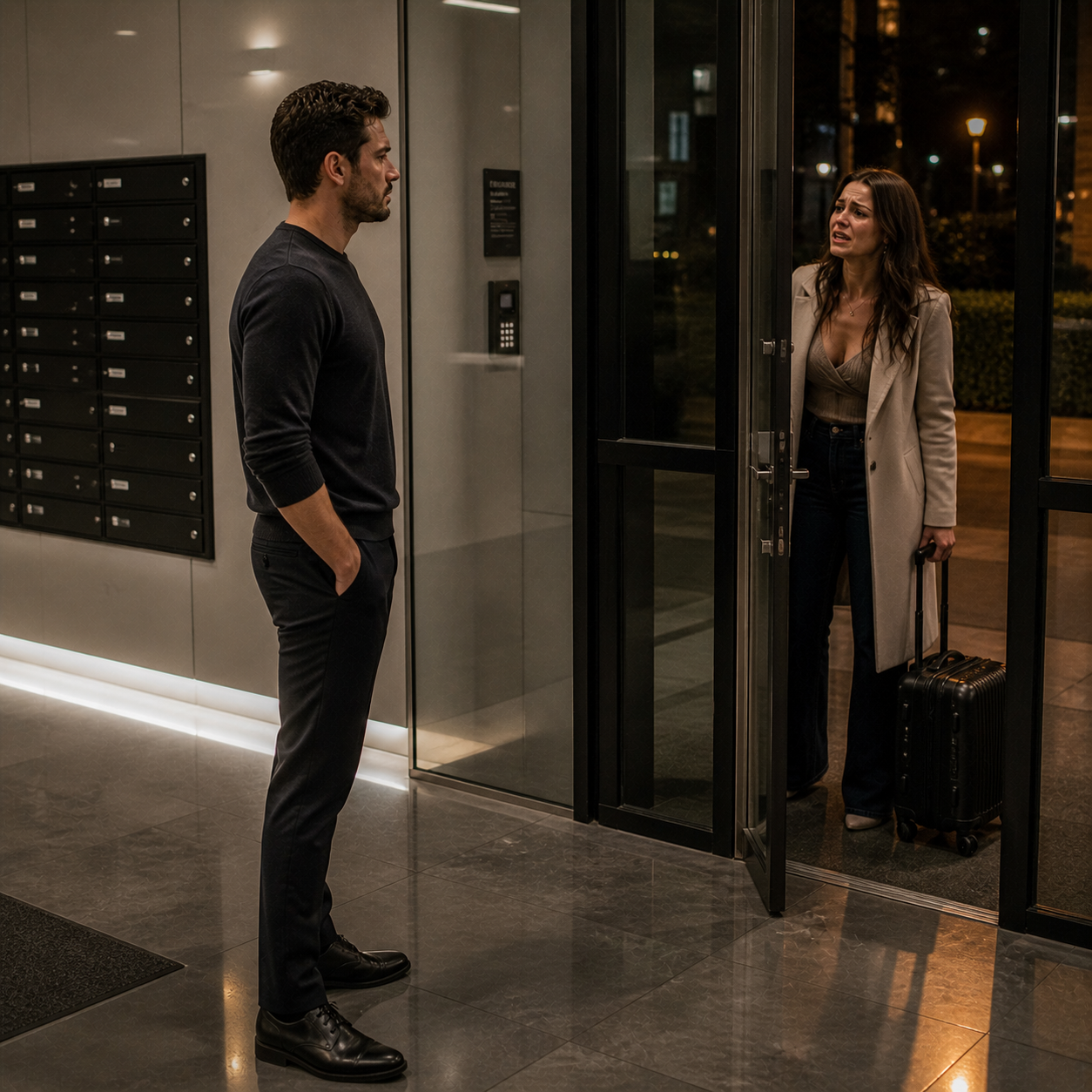
Then yesterday, I was walking out of my building to meet a friend for dinner when I saw her.
Vanessa sat on a bench across the street with the baby in a stroller beside her. For a second, I almost didn’t recognize her. She looked thinner. Her hair was pulled back. She wore jeans and a plain sweater instead of the designer clothes she used to insist were “investment pieces.” She looked tired in a way makeup couldn’t hide.
When she saw me, she stood, hesitated, and crossed the street.
“Please,” she said. “Just five minutes.”
Every instinct told me to keep walking. The protective order was there for a reason. But there was a stroller beside her, and a baby shifting under a small blanket, and for one moment my anger tangled with the human ugliness of the situation.
“Five minutes,” I said. “From here. Don’t come closer.”
She nodded quickly.
“I lost my job last month,” she said. “My parents are selling their house and moving to Florida. I can’t go with them. I don’t have anywhere stable to go.”
I said nothing.
“Alex still won’t acknowledge the baby,” she continued. “He won’t even take a DNA test. He says his wife would leave him.”
I thought about the birth certificate. Alexander Reynolds Taylor. A name she had chosen like a trophy, now attached to a man hiding behind his own marriage.
“I’ve applied for emergency housing,” she said. “There’s a waiting list. I’ve slept in my car some nights.”
“What do you want from me, Vanessa?”
Her eyes filled with tears.
“Help,” she whispered. “Not to come back. I know that’s impossible. But maybe you know someone who needs an assistant or has a room to rent. Maybe just a little money for a deposit. I’m not asking you to be his father. I’m just asking you to be human.”
The baby stirred in the stroller, and Vanessa automatically rocked it. For the first time, I saw something in her that wasn’t calculation. Fear, maybe. Exhaustion. Consequences stripping the arrogance down to bone.
There was a time when that would have torn me apart.
That time was gone.
“I am being human,” I said quietly. “I’m not yelling. I’m not humiliating you. I’m not calling the police, even though you shouldn’t be here. But I’m also not saving you from what you did.”
She started crying harder. “Mark, please.”
“You committed paternity fraud,” I said. “You laughed in my face. You told me you would take half my life and force me to support another man’s child. You didn’t ask for help then. You demanded obedience.”
“I was scared.”
“No,” I said. “You were confident. There’s a difference.”
She looked down.
I softened my voice, not for her, but for the baby.
“Alexander deserves support. He deserves stability. But that support needs to come from his father, from the courts, and from the family you chose when you made these decisions. Not from the man you tried to trap.”
Vanessa wiped at her face with the sleeve of her sweater.
“I don’t know what to do.”
“File the paternity action against Alex,” I said. “Go to legal aid. Apply for every program you qualify for. Call social services. Stop trying to solve this by coming back to me.”
She stared at me like she was searching for the old version of me, the man who would have stepped in because the situation was painful and someone needed to fix it.
But that man had been mistaken for weakness too many times.
“I can’t be your backup plan,” I said. “Not anymore.”
For a moment, neither of us spoke.
Then she whispered, “Did you ever love him? Even for a second?”
The question surprised me.
I looked at the baby in the stroller. He was awake now, blinking at the gray sky, tiny and innocent and completely unaware of the wreckage around him.
“I loved who I thought he was,” I said. “And I’m sorry for him. Truly. But he is not mine.”
Vanessa covered her mouth, and I saw the words land exactly where they needed to.
Not cruelly.
Finally.
I stepped back.
“If you contact me again outside of counsel, I’ll enforce the order. I mean that.”
She nodded slowly.
I walked away before she could ask again.
That night, I expected to feel guilty. Instead, I felt something steadier. Not happiness. Not revenge. Peace.
The revenge was never in the legal victory. It wasn’t keeping my assets, selling the house, or watching Vanessa’s plan collapse. The real freedom was standing in front of the woman who had tried to destroy me and realizing she no longer had access to the part of me she once manipulated.
She had expected me to be a doormat.
A wallet.
A convenient father.
A man so afraid of being alone that I would accept betrayal if it came with enough pressure.
Instead, I became quiet. Methodical. Unavailable.
I had proven her wrong in the most important way.
I wasn’t a loser.
I was a man who knew his worth and refused to be used.
The life she tried to steal from me is gone, but so is the illusion that kept me trapped in it. What I have now is smaller in some ways. A new apartment. Fewer shared memories. Quieter evenings. A future I’m still learning how to imagine.
But it is mine.
And sometimes the best revenge is not destroying the person who hurt you. Sometimes it is simply refusing to be destroyed by them, then stepping aside while the consequences they created finally find their way home.
![[FULL STORY] I Betrayed My Best Friend’s Darkest Secret at a Party—And Lost Her Forever](https://social-media.rabedo.com/thumbnails/1777474788_7b22379c-9ba7-41e8-88ad-03732b9bc393.png)
![[FULL STORY] She Said “Free Rent Is Free Rent” — So I Packed Her Bags Before Breakfast](https://social-media.rabedo.com/thumbnails/1776421235_7ba3781c-e171-46cf-b98c-bdfc110fa833.png)

![[FULL STORY] She Said, “My Guy Best Friend Is Coming Over—You Can Take The Couch.” In My Own…](https://social-media.rabedo.com/thumbnails/1776668188_c12036d5-d2bf-47b7-92b0-642c6b5dbb98.png)
![[FULL STORY] Girlfriend Laughs at My Feelings and Says I’m Not “Boyfriend Material” — So I Ended Everything Quietly](https://social-media.rabedo.com/thumbnails/1776418378_667837595_1909926373293862_9079454661936178985_n.jpg)