“I can’t believe I have to sleep with him just to keep getting his money.”
That was the sentence that ended my marriage.
Not an affair. Not a drunken mistake. Not some dramatic confession screamed across a restaurant table. Just one sentence, spoken casually over a glass of wine in my own kitchen, by the woman I had been married to for fifteen years. She didn’t know the security camera was recording. She didn’t know I would hear every word. And she definitely didn’t know that twenty seconds of careless honesty would save me from five more years of lies.
I didn’t confront her that night. I didn’t storm downstairs. I didn’t scream, break a glass, or ask her how long she had hated touching me. I simply saved the footage, sent it to our family lawyer, and began quietly dismantling the life I thought we had built together.
Her name is Rose. Mine is James. The names are changed for obvious reasons, but the damage was real. I’m forty-seven, the CEO of a commercial construction company I built from nothing over the past twenty years. Rose is forty-five. She hasn’t worked since before we got married. We have two children, Megan, nineteen, who is away at college, and Ryan, seventeen, who is finishing high school.
When I met Rose, she was a paralegal with sharp instincts and more ambition than anyone else in the room. She was funny, polished, organized, and terrifyingly persuasive when she wanted something. I admired that about her. I thought she admired my drive too. Back then, I was still building my company from a tiny rented office with secondhand furniture, working sixteen-hour days and taking on projects bigger companies ignored. Rose used to tell me I was going to make something of myself, and in those early years, hearing her say that felt like being seen.
After we married, she told me she wanted to leave her job and focus on being a full-time mother. Later, when the kids were older, she said she preferred managing the household and our social life. I supported her completely. We could afford it, and I wanted her to be happy. I never saw her choice as laziness. I saw it as partnership. I worked hard outside the house. She made sure our family life functioned. That was the story I believed.
Eight weeks before everything exploded, we had a package stolen from our front porch. It wasn’t anything valuable, but it annoyed me enough that I went into my home office to check our security footage. We had cameras outside and in common areas of the house. They were visible, properly disclosed, and Rose knew exactly where they were. Normally, I only checked them if something happened, and that day I was looking for a porch thief.
Instead, I found my wife.
Rose was sitting at the kitchen island with her friend Melissa, drinking wine in the middle of the afternoon. Melissa had been around for years, one of those friends who always seemed harmless because she laughed too loudly and complimented everything. I clicked through the footage, barely paying attention at first, until I heard Rose mention a vacation.
“This trip is going to be amazing,” Rose said, swirling wine in her glass. “James thinks it’s next month, but I pushed it to September. Told him it was because of the weather, but really I need more time at the spa first.”
Melissa laughed. “Getting all beautified for the beach?”
Rose gave this little dismissive snort. “Please. I can’t believe I have to sleep with him just to keep getting his money. It’s exhausting maintaining this parade.”
I froze so completely I forgot to breathe.
Rose continued like she was discussing a grocery list. “You know, we hadn’t had sex in three months before last week. Then he starts talking about reconnecting, and I had to give in. Nearly gagged the whole time.”
Melissa’s smile faded. “Rose, that’s cold.”
“It’s business,” Rose said. “I’ve invested fifteen years in this arrangement. Three more until Ryan finishes college. Then I can cash out with half of everything. The prenup expires on our twentieth anniversary.”
Melissa looked uncomfortable now. “And then what?”
“Divorce,” Rose replied, like the answer was obvious. She took another sip of wine. “I’ve already got multiple accounts he doesn’t know about. Been siphoning money for years. Once the prenup expires, I’ll take half his company, half the properties, and the house. He can keep his boat and his pride.”
I stared at the monitor, unable to move.
Melissa lowered her voice. “Does he suspect anything?”
“James?” Rose laughed. “God, no. He’s so focused on his precious business and being the provider. It’s pathetic how easy he is to manipulate. Last week, I mentioned admiring Jennifer’s diamond bracelet, and guess what appeared on my nightstand the next day? Men are so simple.”
They laughed.
Then the conversation drifted to spa treatments and dinner reservations, as if my entire life hadn’t just been reduced to a financial strategy.
I sat there long after they left the kitchen, staring at the frozen image of my wife’s empty wineglass on the island. Fifteen years of marriage. Two children. Vacations. Holidays. Hospital rooms. Birthday parties. School plays. Sunday breakfasts. All of it, in her words, had been an arrangement. I wasn’t her husband. I was a wallet with a pulse.
The first emotion wasn’t anger. It was disbelief. My mind kept trying to reject what I had heard, to soften it, to make it mean something else. Maybe she was venting. Maybe she was exaggerating for Melissa. Maybe this was just an ugly moment from a frustrated woman who didn’t mean it.
Then I replayed the video.
And again.
And again.
By the fourth time, denial had nowhere left to hide.
I backed up the file to a secure cloud server, then closed my laptop and went upstairs to take a shower. I stood under water so hot it reddened my skin and tried to decide who I was going to be next. A broken husband? A furious man? A fool begging for an explanation from a woman who had just described him like a business model?
No.
I needed to think.
Rose and I had a prenuptial agreement. It did indeed have a clause that would expire on our twentieth anniversary, something her lawyer had insisted on during negotiations. I had agreed to it because at the time, I couldn’t imagine not being with Rose forever. I thought the clause was a formality, a compromise made by two practical adults before a lifetime of love.
Naive doesn’t begin to cover it.
The prenup had specific language about financial transparency and fidelity. It didn’t only cover physical affairs. It clearly stated that deliberate concealment of assets, fraud, or actions taken in bad faith against the financial interests of the other spouse would constitute a breach. At the time, I thought those clauses were standard legal clutter.
Now they looked like a lifeline.
The video wasn’t just morally devastating. It was legally actionable.
That night, Rose left for book club. I kissed her goodbye at the door, the way I always did, and watched her smile at me like she hadn’t been laughing about gagging through intimacy with her own husband hours earlier. Book club, I now suspected, might not have anything to do with books.
The moment her car pulled out of the driveway, I started making calls.
The first was to Sam Wright, my personal attorney, who had handled the prenup years earlier. I explained everything, sent him the video, and asked one question.
“What are my options?”
He was quiet for a long moment after watching the footage. Then he said, “James, don’t confront her. Not yet.”
The second call was to Michael Chen, my company’s CFO and one of the few people I trusted completely. I asked him for a discreet audit of any personal or business accounts Rose might have access to directly or indirectly. I didn’t tell him all the details, only that I had reason to believe household funds had been misdirected.
The third call was to Garrett Bell, a private investigator recommended by Sam. Garrett specialized in asset searches and surveillance. His voice was calm in that unsettling way people sound when they’ve heard every kind of betrayal before.
“Send me what you have,” he said. “Then stop touching anything unless your attorney tells you to.”
For the next six weeks, I lived two lives.
In one life, I was the same James I had always been. Attentive husband. Devoted father. Busy CEO. I brought Rose flowers. I took her to dinner. I listened to her talk about redecorating the guest room and nodded at the right times. When she touched my arm, I didn’t flinch. When she kissed me, I kissed her back. When she initiated intimacy, I went through with it while fighting the kind of revulsion I still don’t have words for, knowing exactly what she had said about me in that kitchen.
In the other life, I was quietly removing Rose from my future.
I started leaving financial statements where she could see them. I mentioned business successes at dinner. I let her believe my company was doing even better than it was. I told her about potential deals, careful to make sure nothing confidential was actually exposed. I wanted her comfortable. Greedy people make mistakes when they think the vault is getting bigger.
And Rose made mistakes.
The first discovery was the hidden accounts. There were three of them at two different banks, containing just over four hundred forty thousand dollars. The money had been moved in small amounts over the years from our joint account, disguised as household spending, reimbursements, and personal expenses. It was money I had earned, taxed as income, and trusted Rose to manage for our family.
Garrett traced the transfers. Michael cross-checked irregular withdrawals. Sam reviewed the legal implications. The pattern was unmistakable.
Then we found out book club was not book club.
Rose had been meeting monthly with a divorce attorney named Karen Elliot, known for aggressive tactics in high-net-worth divorces. She had apparently spent more than a year planning how to position herself before the prenup expired. Not a few months. Not after some recent argument. Over a year.
But the most disturbing discovery came during a security audit of my home office computer.
Rose had installed spyware.
At first, Michael’s IT contractor thought it was a remote access tool accidentally downloaded through a malicious link. Then they traced when it had been installed and how often it had been used. It was deliberate. Someone had been monitoring documents, emails, and private business communications from my home office system.
After that, Garrett arranged for a physical sweep of my office while Rose was at one of her spa days.
They found a recording device inside my desk drawer.
I remember standing there, looking at that tiny piece of plastic in Garrett’s gloved hand, feeling something inside me go cold and final. She hadn’t just been planning to leave me. She had been spying on my business conversations. Company valuations. Upcoming deals. Private discussions with partners and attorneys.
In our state, recording conversations without consent from all parties is illegal. It wasn’t just betrayal anymore. It was potentially criminal.
My company was worth roughly sixteen million dollars. Our house was worth about 1.8 million. We had investment properties producing income. We lived well, but not recklessly. I had spent two decades building something stable, not just for myself, but for my family.
Rose had been plotting to take around nine million in assets, plus ongoing support, while secretly hiding hundreds of thousands and gathering business intelligence.
The hardest part was still coming home every night and pretending I didn’t know.
Sometimes she would sit across from me at dinner, laughing about something Ryan said, and I would wonder which version was real. The mother who remembered our son’s favorite meal? The woman who reminded Megan to call before exams? Or the woman in the kitchen calmly telling Melissa she had invested fifteen years and planned to cash out?
I started to understand that both could be real. That was the sickest part. People can love parts of their life while still exploiting the person who built it.
Working with Sam, I developed a strategy. We would wait. We would document everything. We would protect the company, protect the children, freeze what needed to be frozen, and strike when Rose least expected it.
I chose the moment carefully.
Rose’s parents were celebrating their fortieth wedding anniversary at their country club. It was going to be lavish, with about one hundred twenty guests. Rose had talked about it for months. Her parents were respected in their social circle. Her father was a retired judge. Her mother was the kind of woman who treated reputation like oxygen. Rose wanted to appear as the perfect daughter, perfect wife, perfect mother. I knew that because she had spent years curating that image.
So I helped her curate it one last time.
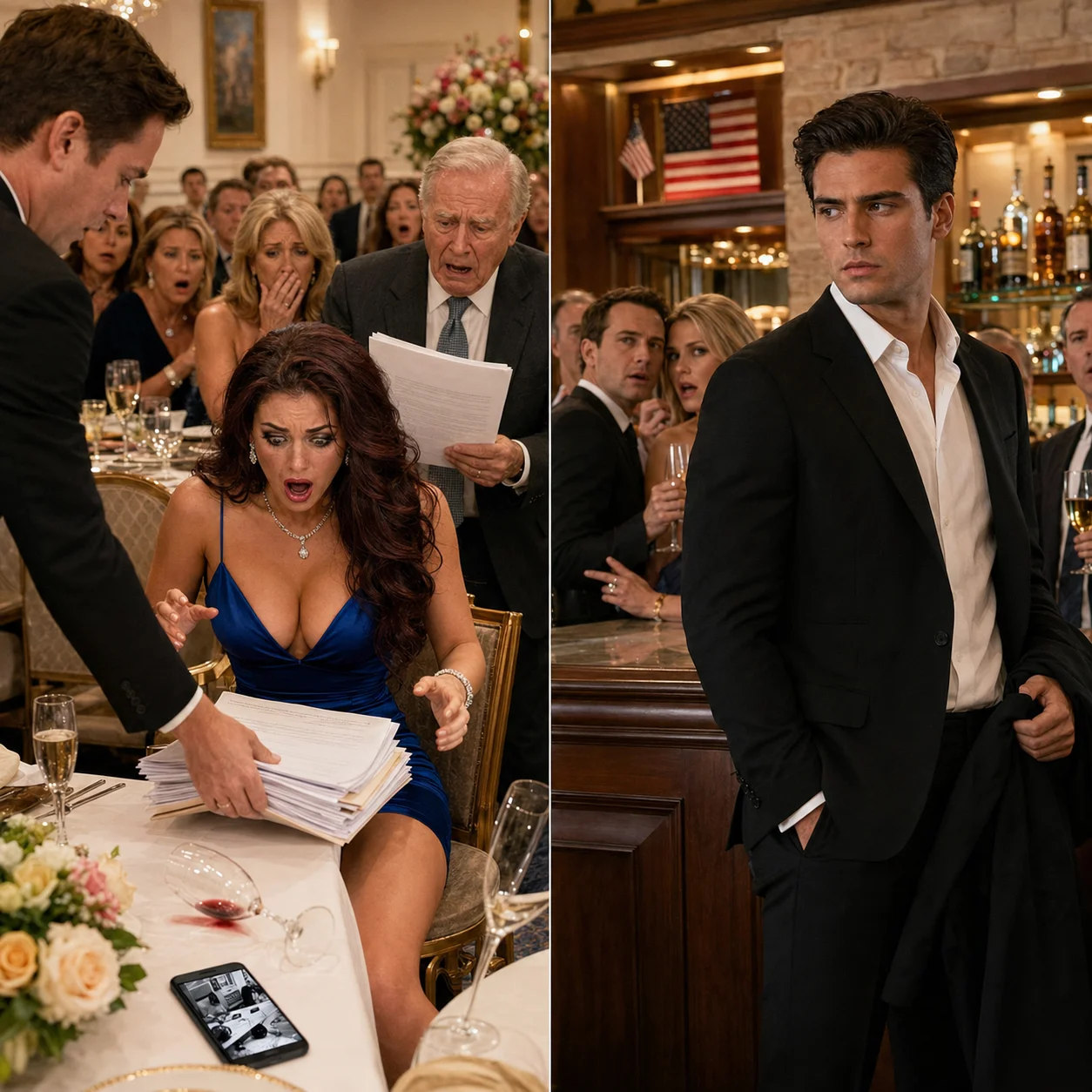
I suggested we celebrate our fifteenth anniversary in style at the same event. I bought her parents an extravagant gift: a fully paid Mediterranean cruise. When I gave them the envelope earlier that evening, her mother cried. Her father hugged me and called me the son they never had. Rose stood beside me, glowing in her blue dress, basking in the reflected glory of her successful husband’s generosity.
Looking back, I think that was the cruelest part. Not what I did. What she allowed. She smiled while her parents thanked me, knowing she had been planning to financially gut me. She held my hand while guests complimented us on our marriage, knowing she had described touching me as something that made her nearly gag.
At precisely 8:30 p.m., as dinner was being served, my attorney Karen Nelson entered the private dining room with a process server. Not Rose’s lawyer, Karen Elliot. Mine.
I excused myself from the table as if I were going to the restroom, then met them near the entrance.
“She’s in the blue dress,” I said quietly. “Center table.”
Karen gave me one brief nod.
I stepped aside and watched from near the bar.
The process server approached Rose. At first, she smiled politely, probably thinking it was club staff. Then he said her name and handed her the papers. I watched confusion pass over her face. Then irritation. Then shock.
Then horror.
She looked across the room and found me.
I didn’t move.
The documents included the divorce petition, financial injunctions, notices regarding hidden assets, and notice that criminal complaints related to unlawful recording and digital surveillance were being pursued. Her father immediately recognized the gravity of what was happening. He asked for the papers with shaking hands, scanned the first few pages, and then looked up at Rose with devastation in his eyes.
Her mother started crying before anyone even explained anything.
The room fell into that strange silence that only happens when people know something terrible has occurred but don’t yet know whether to look away.
I didn’t stay for the full meltdown.
I nodded to Karen, retrieved my coat, and walked out.
My phone started ringing before I reached my car. Rose. Then her father. Then Rose again. I turned it off, drove to a hotel I had already reserved, opened a bottle of scotch, and finally allowed myself to feel what I had refused to feel for six weeks.
Grief.
Not victory. Not satisfaction. Grief.
Because no matter how prepared you are, no matter how many documents your lawyer has organized, no matter how clean your strategy is, there is nothing simple about accepting that your marriage was not what you thought it was. I didn’t just lose Rose that night. I lost the memory of who I thought she had been. I lost the story I had told myself about our life.
And that story had been my home for fifteen years.
The next morning, I turned my phone back on to forty-seven missed calls and dozens of texts.
Most were from Rose.
“James, please call me.”
“This is a misunderstanding.”
“You’re destroying our family over nothing.”
“Think about the kids.”
That last one almost made me laugh. Almost.
Her father had called twice. Her mother five times. I responded only to them with a brief message.
“Check your email. I’ve sent you the video, documentation of hidden accounts, and evidence of the recording devices. Ask Rose about her plans.”
I didn’t hear from them again that day.
The legal battle was swift because Rose had made it that way. Her hidden accounts were frozen. Her attorney withdrew after learning about the recorded kitchen footage, the concealed assets, the spyware, and the illegal recording device. The prenup’s financial fidelity clause was triggered by deliberate asset concealment and actions taken in bad faith against my financial interests.
Rose tried everything.
At first, she cried. She left voicemails saying she had been angry, that Melissa had pushed her, that she didn’t mean what she said. Then she became furious, accusing me of humiliating her and ruining her relationship with her parents. Then she tried guilt.
“You’re destroying the family.”
“You’re punishing the kids.”
“You’re throwing away fifteen years.”
But I had prepared for that too.
The night before serving her, I sat down with Ryan. It was the hardest conversation I have ever had with my son. I showed him a carefully edited version of the kitchen video. It included Rose discussing hidden accounts, the prenup, and her plan to divorce me after the twentieth anniversary. It did not include the sexual comments. No child needs to hear his mother speak that way about his father.
Ryan sat silent for a long time afterward.
Then he asked, “Was any of it real?”
I didn’t know how to answer.
“I think your mother loves you and Megan,” I said carefully. “I think she made choices that hurt me deeply. Both things can be true.”
His eyes filled with tears. “I want to live with you.”
I nodded, even though my throat felt like it was closing. “Okay.”
Megan flew home from college for a similar conversation. With her, I described the financial deception and the legal situation instead of showing the video immediately. She asked to see proof, and I showed her documents and a short edited clip. She cried, then became very quiet in that way she does when she’s trying not to fall apart.
“I don’t want to talk to her right now,” she said.
“You don’t have to,” I told her. “But she’s still your mother. Whatever happens between her and me, I don’t want you carrying hatred because of adult choices you didn’t make.”
I meant that. Even then.
Rose did try to turn the children against me. She told Ryan I had blindsided her. She told Megan I was punishing her for wanting independence. But the evidence made manipulation difficult. Both kids were devastated by their mother’s betrayal, but I made it clear from the beginning that I would not use them as weapons.
That mattered later.
The divorce finalized faster than anyone expected. Rose received a settlement aligned with the prenup’s breach provisions, about one-eighth of what she would have received if she had waited until the twentieth anniversary and kept her hands clean. No alimony. Reduced child support because Ryan chose to live with me. No claim to my business interests. She had to sell her portion of our investment properties to cover legal fees and penalties connected to the concealed accounts. The secret accounts were deemed marital assets acquired through deception and divided accordingly, with penalties assessed against her share.
She kept her car, her jewelry, and personal belongings.
I kept the house, my company, and what remained of my self-respect.
For a while, I thought keeping the house would feel like winning. It didn’t. Every room held a memory I no longer trusted. The kitchen island where she laughed about using me. The bedroom where I had slept beside her for years. The dining room where we hosted holidays and pretended we were a family built on love instead of lies.
Six months after the country club, I sold it.
People assumed I sold it because it was too big. That was partly true. But mostly, I sold it because grief has architecture. Some houses hold pain in the walls.
I bought a smaller place closer to my office. Three bedrooms, enough space for Ryan, enough space for Megan when she came home, and no ghosts. The first night there, Ryan and I ate takeout on the floor because the furniture hadn’t arrived yet. He laughed for the first time in weeks when I spilled soy sauce on the moving blanket.
That laugh did more for me than the divorce judgment ever could.
Rose moved into a small condo and eventually got a job at a law firm, ironically as a paralegal again. At first, she called constantly. Then less often. Her messages shifted over time. Anger became apology. Apology became nostalgia. Nostalgia became carefully worded suggestions that we talk “for the sake of the family.”
I never responded to those messages.
Some betrayals can be apologized for.
Some reveal a person so completely that apology becomes irrelevant.
That doesn’t mean I wanted her destroyed. That’s something people online never seem to understand. They want revenge stories to end with someone ruined forever. But real life is messier. Rose is still Megan and Ryan’s mother. She still packed lunches when they were little. She still stayed up with them when they had fevers. She still knows the exact songs Megan used to sing in the car and how Ryan likes his birthday cake.
So when both kids slowly started speaking to her again, cautiously and on their own terms, I encouraged it.
Not because Rose deserved easy forgiveness.
Because my children deserved the freedom to decide what kind of relationship they could live with.
One evening, about seven months after the divorce, Ryan came home from seeing her. He dropped his backpack by the door and stood in the kitchen, unusually quiet.
“How was it?” I asked.
He shrugged. “Weird.”
I waited.
“She cried,” he said. “She said she was sorry. Not just because she got caught. She said she didn’t realize how much she had turned everything into money until it was gone.”
I leaned against the counter. “How did that make you feel?”
“Angry,” he said. “And sad. And kind of relieved.”
“That’s allowed.”
He looked at me then. “Do you hate her?”
I thought about lying. Then I thought better of it.
“No,” I said. “I don’t hate her. I don’t trust her. I don’t want to be married to her. But hate takes too much energy, and I’ve already given her enough of my life.”
Ryan nodded slowly, like he was storing that away for later.
Megan handled it differently. She avoided Rose for months, then agreed to meet her for coffee during winter break. Afterward, she came to my place and sat on the couch with her coat still on.
“She asked if I thought she was a terrible mother,” Megan said.
“What did you say?”
“I told her she was a good mother who did a terrible thing.”
That one sentence stayed with me for days.
Maybe that was the most mature answer any of us could offer.
As for me, I started dating casually. Nothing serious. Dinner here, coffee there. I wasn’t looking for someone to fill the space Rose left. The space needed to remain empty for a while. It needed air, light, and silence. I needed to remember who I was when I wasn’t performing the role of provider for someone who saw provision as weakness.
My company grew faster than ever that year. At first, I thought work would be a distraction, but it became something steadier than that. It reminded me of the man I had been before Rose’s betrayal made me question my own judgment. I had built something real. Not because I was easy to manipulate. Not because I was pathetic. Because I was disciplined, loyal, and willing to carry weight.
Those qualities had been used against me in my marriage.
That didn’t make them flaws.
One day, almost a year after the divorce, I received a letter from Rose. Not a text. Not a voicemail. A handwritten letter mailed to my office. I almost threw it away unopened, but something made me read it.
She didn’t ask for reconciliation this time.
She wrote that returning to work had been humiliating at first, then sobering. She wrote that she had spent years convincing herself she was owed more because I was gone so often building the company. She wrote that resentment had become entitlement, and entitlement had become a plan. She admitted the hidden accounts. She admitted meeting the attorney. She admitted that what she said on the kitchen video was cruel and unforgivable.
The last paragraph said, “I know you may never believe this, but there were years when I loved you. Then I became someone who measured everything by what I thought I deserved. I am sorry I turned our marriage into a transaction. You were not just money. You were my husband, and I forgot that until I lost the right to call you that.”
I read the letter twice.
Then I put it in a drawer.
I didn’t forgive her that day. Forgiveness, if it comes at all, does not arrive because someone finally finds the right words. But I did feel something loosen in me. Not for her. For myself.
For months, I had wondered whether Rose ever loved me or whether it had always been about money. Her letter didn’t answer that completely, but it gave me something more useful than certainty. It gave me permission to stop asking.
Sometimes people love you poorly. Sometimes they love what you provide more than who you are. Sometimes they start with affection and end with calculation. The beginning does not erase the ending, and the ending does not always explain the beginning.
What mattered was that I found out before year twenty. Before she could take half my life’s work. Before I spent five more years mistaking performance for partnership.
Last week, I had dinner with Ryan and Megan at a small Italian restaurant near my new place. Ryan had just been accepted to his first-choice college. Megan was doing well in school again. They were laughing over appetizers, arguing about who had inherited my terrible sense of direction, and for a moment I watched them with this quiet ache in my chest.
Not sadness exactly.
Gratitude.
The family looked different now. Smaller in some ways. More honest in others.
At one point, Megan raised her glass of water and said, “To new houses, new colleges, and no more secrets.”
Ryan clinked his glass against hers. “And to Dad finally learning how to order something other than steak.”
I laughed, and for the first time in a long time, it didn’t feel forced.
When people ask if I’m bitter, I tell them the truth.
Not anymore.
There were months when anger carried me. I needed it. Anger got me out of bed. Anger helped me sit through legal meetings. Anger kept me from answering Rose’s calls when loneliness tried to disguise itself as mercy. But anger is not a place to live. Eventually, I had to put it down.
Now, strangely, gratitude has replaced most of it.
I’m grateful for the stolen package that made me check the cameras. Grateful for the visible security system Rose forgot about because she was too comfortable in her contempt. Grateful for twenty seconds of truth that saved me from five more years of lies. Grateful for Sam, Michael, Garrett, and Karen. Grateful my children knew enough truth not to be manipulated. Grateful I had the prenup she thought she could wait out.
And on the darkest days, when the old humiliation tries to crawl back into my mind, I remind myself of one simple thing.
It is better to sleep alone in an honest house than beside someone who has to pretend you are worth touching.
Rose wanted to cash out.
Instead, she exposed herself.
And I walked away with the one thing she never understood was more valuable than half a company, a house, or a bank account.
I walked away with my life back.
![[FULL STORY] My Pregnant Girlfriend Threw A Vase At Me And Shouted: “Hormones!” Then In Fury She Let Slip The...](https://social-media.rabedo.com/thumbnails/1776397717_7b95dcf7-2d91-4569-b4fe-45595ba17ef6.png)


![[FULL STORY] She Humiliated Me in Front of Her Friends — Then Came Back Crying When She Saw Who Replaced Her](https://social-media.rabedo.com/thumbnails/1777386170_04397289-deb0-48b3-85b9-ce8bf34882e9.png)