
One of Vanessa’s aunts gave a soft laugh. “Oh, Linda, weddings in this family are never small.”
Vanessa squeezed my hand under the table, but not affectionately. It was a warning.
“I think what Ethan means,” she said, “is that his side is more comfortable with simple things.”
There it was again.
Simple.
My mother’s smile stayed in place, but I saw it weaken.
Dad reached for his water glass.
Charles watched all of us with unreadable eyes. “Weddings are not only emotional events,” he said. “They are social events. They reflect families.”
“Exactly,” Denise added. “And we want both families represented properly.”
Vanessa turned to me, her voice sweet enough to rot. “That’s why I told you we should let my parents handle most of the planning. It’s just easier.”
“My parents may want to contribute too,” I said.
The silence that followed was immediate.
Forks slowed. Eyes shifted.
Denise looked at my mother, then my father, then me. “Contribute?”
I hated the way she said it. Like I had suggested my parents might donate a kidney at the table.
My father set down his glass. “We’d be happy to help where we can.”
Vanessa’s cousin, Madison, smiled into her wine. “That’s generous.”
My mother heard it. I know she did. Her fingers folded together in her lap.
Vanessa leaned closer to me. “Ethan.”
I ignored her.
Charles dabbed his mouth with a napkin. “I appreciate the sentiment, Raymond. But the scale of this wedding may be somewhat beyond what you’re imagining.”
Dad did not flinch. “Maybe. But Ethan is our son. We’d like to do something.”
“And what exactly would that be?” Denise asked.
My mother’s cheeks went pink.
“Mom,” Vanessa said sharply, though not because she was defending my parents. She was trying to manage the embarrassment.
I felt heat rising in my neck. “That’s enough.”
But Vanessa turned on me with a look I had only seen a few times before. Usually when we were alone. Usually when I challenged her too directly.
“No, Ethan,” she said quietly. “Maybe we should be honest.”
The room became so still I could hear the candle flame flicker.
I stared at her. “Honest about what?”
She looked at my parents with a smile that did not reach her eyes.
“This wedding is important to my family. It’s not just a backyard barbecue. There are expectations. Guests. People who matter. And pretending everyone can contribute equally just makes things uncomfortable.”
My father’s face hardened for the first time that night.
My mother looked down at her plate.
I said, “Vanessa, stop.”
But she did not stop.
Maybe she had held it in too long. Maybe she was embarrassed by the truck outside, by my mother’s dress, by my father’s rough hands on her family’s polished silverware. Maybe she thought that because I loved her, I would let her say anything.
She took a breath and said, “Your family has nothing to offer here, Ethan. That’s not an insult. It’s just reality.”
For a moment, I could not move.
My mother’s eyes filled so quickly she had to blink and turn her face away. My father sat perfectly still, jaw tight, one hand curled beside his plate.
The words seemed to hang above the table, ugly and enormous.
Nothing to offer.
I heard myself speak before I had decided to.
“Apologize.”
Vanessa looked startled. “What?”
“Apologize to my parents.”
Her face flushed. “I’m not going to apologize for telling the truth.”
I stood up.
The chair scraped against the marble floor loudly enough to make Denise gasp.
“Ethan,” my mother whispered.
“No,” I said, looking only at Vanessa. “You don’t get to humiliate them in front of your family and call it honesty.”
Vanessa stood too, anger flashing behind her eyes. “You are being dramatic.”
“I’m being dramatic?”
“Yes. My parents are paying for everything. They’re opening doors for us. They’re giving us a future most people would kill for, and instead of being grateful, you’re making this about your pride.”
“My pride?” I repeated.
Charles finally spoke. “Sit down, Ethan.”
It was not a request.
I turned to him. “No.”
His eyebrows lifted slightly. He was not used to that word.
Vanessa laughed once, sharp and bitter. “This is exactly what I was afraid of. You always get defensive because deep down you know I’m right.”
My father pushed back his chair.
“Ray,” my mother said softly.
But he was already standing.
He did not shout. My father never shouted unless something was on fire or someone was about to get hurt. His voice was calm, and somehow that made it stronger.
“Vanessa,” he said, “you don’t have to respect me. But you will not speak to my wife like she is beneath you.”
Denise made a small offended sound. “No one said Linda was beneath anyone.”
Dad looked at her. “You’ve been saying it since we walked in.”
That landed harder than any raised voice could have.
Vanessa’s face twisted. “I’m sorry you feel that way, Mr. Cole, but this is exactly why I said mixing families like ours would be difficult.”
“Families like ours,” I said quietly.
She looked at me, and for the first time, I saw no softness there. Only frustration. Resentment. Maybe even shame.
“Yes,” she said. “Families like ours. Mine has worked for generations to build something. Yours—”
“Careful,” I said.
But she was past careful.
“Yours survives,” she said. “Mine builds.”
My dad’s expression changed.
Not anger. Not hurt.
Recognition.
It was almost invisible, but I saw it. A flicker in his eyes when she said the word builds. Like something old had moved under the surface.
Charles saw it too.
For the first time that night, his attention shifted fully to my father.
“What did you say your last name was again?” Charles asked.
My father looked at him. “Cole.”
“Raymond Cole?”
“Yes.”
Charles’s face lost a little color.
Denise noticed. “Charles?”
He did not answer her. His eyes stayed on my dad.
“From Pueblo?”
Dad’s jaw tightened. “Originally.”
Charles leaned back slowly, as if the chair had moved beneath him. “Ray Cole Construction.”
My father said nothing.
I looked between them. “Dad?”
Vanessa frowned. “What is he talking about?”
Charles stood abruptly.
The movement startled everyone.
“Excuse me,” he said.
Then he walked out of the dining room.
Nobody spoke for several seconds.
Denise looked annoyed. “Charles, where are you going?”
He did not answer.
A moment later, we heard a door open somewhere down the hall. Then another. Then the faint metallic beep of a keypad.
Vanessa looked embarrassed now, but still angry. “I don’t know what kind of performance this is, but—”
My father’s voice cut across hers.
“Sit down, Vanessa.”
She froze.
Not because he shouted.
Because he sounded like someone who already knew how the story ended.
I stared at him. My father looked older under the chandelier light. Tired, maybe. But not small. Not ashamed. Not like the man they had tried to make him into.
“Dad,” I said quietly. “What is going on?”
He did not look at me. “Something I should have told you a long time ago.”
Before I could ask what he meant, Charles returned.
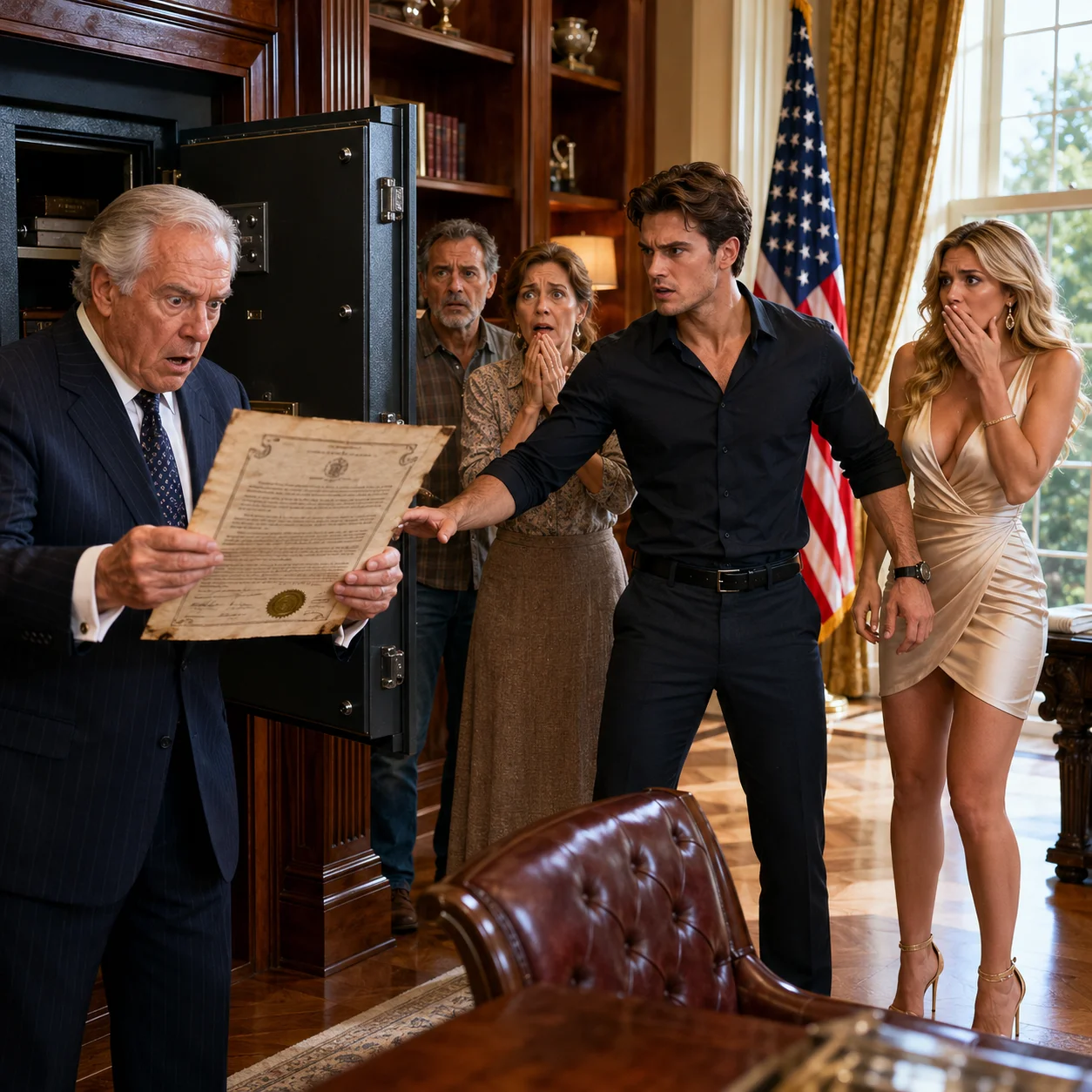
He was holding a leather folder so old the edges had cracked. Behind him, one of the housekeepers stood in the hallway looking nervous, as if she had watched him tear apart half the study to find it.
Charles came back to the table slowly.
His hand was shaking.
That was what I noticed first.
Not much. Just enough.
The powerful Charles Whitmore, the man who had spent the evening treating my parents like charity guests, was shaking.
He placed the folder on the table.
Denise stared at it. “What is that?”
Charles did not answer.
He opened the folder and pulled out a stack of papers clipped together with a rusted brass fastener. The top page was yellowed with age. At the bottom were signatures.
One of them was my father’s.
Raymond Cole.
The other was Charles Whitmore’s.
My father closed his eyes briefly.
Vanessa looked confused. “Daddy?”
Charles turned the contract around so everyone could see.
“This,” he said, voice low, “is the original development agreement for Ridgewell Estates.”
No one moved.
I knew the name. Everyone in Colorado real estate knew the name. Ridgewell Estates was the Whitmore family’s crown jewel—the luxury community that turned Charles Whitmore from a regional developer into a household name among the wealthy. Gated homes. Golf course. Private lake. The Ridgewell Club where Vanessa wanted our wedding reception.
It was the foundation of everything the Whitmores bragged about.
Charles looked at my father.
“You kept your copy?” he asked.
Dad’s mouth tightened. “I kept everything.”
Denise’s face went pale with irritation. “Charles, explain.”
He swallowed. “Ray Cole was one of the original partners.”
The room changed.
It was almost physical.
Vanessa blinked. “What?”
Charles looked at the table instead of his daughter. “Ray owned the land access rights and handled the initial construction phase. Without his crews, his permits, and his agreements with the county, Ridgewell would never have broken ground.”
My ears rang.
I looked at my father. “You were partners with him?”
Dad exhaled slowly. “For a while.”
Vanessa shook her head. “No. That doesn’t make sense.”
My father looked at her then. “Why not?”
She opened her mouth, but no words came out.
Because the honest answer would have been obvious.
Because in her mind, men like my father did not own anything important. They built things for men like Charles. They carried lumber, poured concrete, followed instructions, and disappeared from the story before the ribbon cutting.
Charles turned another page. His voice grew quieter.
“The agreement gave Ray a deferred ownership interest in several parcels attached to the development, along with a percentage of future club revenue if the land was ever consolidated under Whitmore Development.”
Denise stood so quickly her chair nearly tipped. “That is impossible.”
My father looked at her. “No. It’s inconvenient.”
Charles flinched.
Vanessa stared at the contract like it was written in another language.
I felt like the room had tilted. “Dad, why didn’t I know this?”
He looked at me, and the pain in his face hurt worse than anything Vanessa had said.
“Because I lost almost everything after that deal,” he said. “And I didn’t want my son growing up thinking bitterness was an inheritance.”
Charles rubbed a hand over his mouth.
My father continued, still calm. “Your father and I started that project together when I was thirty-one. I had crews, equipment, local relationships, and access agreements on land his investors needed. Charles had money and connections I didn’t. It should have made both families secure.”
“What happened?” I asked.
Charles said nothing.
My father answered.
“What usually happens when one man trusts another man too much.”
Denise snapped, “That is a serious accusation.”
Dad looked at her. “Yes, it is.”
Charles sat down slowly.
For the first time all evening, he looked small.
My father pointed to the contract. “The deferred ownership clause was supposed to activate when Ridgewell reached phase two. Instead, Charles’s lawyers restructured the company, shifted assets through two subsidiaries, and claimed the clause didn’t apply because Whitmore Development technically wasn’t the entity collecting the revenue anymore.”
“That was legal strategy,” Charles said weakly.
“That was theft dressed up in a suit,” my father replied.
The words landed like a hammer.
Vanessa looked horrified, but not for my father. Not yet. She looked horrified because the family legend had cracked open in public.
“No,” she said. “Daddy wouldn’t do that.”
My father looked at her with something almost like pity. “Your father did many things.”
Charles’s face tightened. “Ray, enough.”
“No,” my dad said. “You let your daughter call my family worthless at your table. You let your wife treat Linda like a servant who wandered into the wrong room. You sat there and listened while they said we had nothing to offer.” He tapped the contract once with two fingers. “This house has pieces of my life in its walls.”
My mother covered her mouth.
I realized then she already knew.
Maybe not every detail, but enough.
I turned to her. “Mom?”
Her eyes were wet. “Your father tried to fight it. For years. Legal fees almost buried us. Then you were born, and…” She looked at Dad. “He chose peace over revenge.”
“That isn’t true,” Dad said gently. “I chose my family.”
The room was silent.
All those wealthy relatives, all those polished people who had looked at my parents like they were furniture, now sat frozen around the table while the past crawled out of the safe.
Charles picked up the contract again, but my father’s hand came down over it.
“Don’t,” Dad said.
Charles looked at him.
Dad’s voice dropped. “You had twenty-eight years to open that folder.”
Charles’s face reddened. “I thought the matter was settled.”
“It was buried. Not settled.”
Vanessa turned to me, panic creeping into her expression. “Ethan, this is obviously some old business dispute. It has nothing to do with us.”
I stared at her.
Nothing to do with us.
Minutes earlier, my family’s worth had been very much her business. My parents’ clothes, their truck, their money, their manners, their supposed lack of status—all of it had been open for discussion. But now that the humiliation had reversed direction, she wanted privacy.
I pulled my hand away when she reached for me.
Her face changed.
“Ethan,” she whispered.
I looked at the woman I had planned to marry. The woman who had cried when I proposed at the overlook near Garden of the Gods. The woman who had once told me she loved how grounded I was because her world was so fake. The woman who now looked at my father’s signature like it was a disease spreading across her family’s table.
“What did you think marriage meant?” I asked.
Her brows drew together. “What?”
“When you agreed to marry me, did you think my family disappeared?”
“That’s not fair.”
“No, Vanessa. What’s not fair is watching you smile while your mother insults mine. What’s not fair is hearing you say my family has nothing to offer because they don’t perform wealth the way yours does.”
She looked around, embarrassed by the attention. “Can we not do this here?”
I almost laughed.
“Here is exactly where you chose to do it.”
Charles stood again, slower this time. “Ethan, perhaps we should speak privately.”
My father shook his head. “No more private rooms, Charles.”
Charles looked at him sharply.
Dad continued, “Private rooms are where men like you rewrite history.”
Denise’s voice trembled with anger. “How dare you come into our home and speak to my husband this way?”
My mother finally spoke.
She had been quiet all night. Too quiet. But when she lifted her head, there was no weakness in her face anymore.
“Your home?” she said softly.
Denise stared at her.
My mother looked at the contract, then at the chandelier, then at the long table filled with people who had mistaken polish for character.
“Ray helped build the development that paid for this home,” she said. “So maybe you should ask yourself how much of it is truly yours.”
Denise looked as if my mother had slapped her.
Vanessa’s cousin Madison whispered, “Oh my God.”
Charles sat down again, defeated by something heavier than embarrassment.
I turned to my father. “Is the contract still enforceable?”
He looked at me for a long moment.
Charles answered before he could.
“It could be,” he said.
Denise spun toward him. “Charles.”
He stared at the papers. “If challenged under the original terms, with the way the subsidiaries were later merged back into Whitmore Development…” He swallowed. “It could expose the company to a substantial claim.”
“How substantial?” I asked.
Charles did not answer.
My father did.
“Enough.”
One word.
Enough to explain why Charles was pale.
Enough to explain why that folder had been locked in a safe instead of thrown away.
Enough to explain why my father, a man who supposedly had nothing to offer, suddenly held the invisible beam supporting the Whitmore empire.
Vanessa looked at me with desperate softness now. “Ethan, please. We can talk about this.”
I studied her face and wondered how many times softness had worked on me because I wanted it to.
“Talk about what?” I asked. “Whether you meant it?”
She swallowed. “I was upset.”
“No. You were comfortable. There’s a difference.”
Tears gathered in her eyes, but I did not trust them. Not yet. Maybe not ever again.
“I love you,” she said.
My chest hurt when she said it. Because part of me still wanted that to matter more than everything else.
But love without respect is just possession with prettier words.
“You loved the version of me that could fit into your family’s story,” I said. “The grateful outsider. The man lucky enough to be chosen by you.”
“That’s not true.”
“Then why did my parents have to earn kindness tonight?”
She had no answer.
My mother stood slowly. “Ray, I’d like to go home.”
My father nodded at once. “Of course.”
I stepped toward them. “I’m coming with you.”
Vanessa grabbed my arm. “Ethan, don’t leave like this.”
I looked down at her hand, then back at her.
“Take off the ring,” I said.
Her face went white.
“What?”
“The engagement is over.”
Someone gasped. Denise, maybe. Madison. I did not care.
Vanessa shook her head. “You don’t mean that.”
“I do.”
“You’re ending our engagement because of one dinner?”
“No,” I said. “I’m ending it because tonight showed me what our marriage would become. You humiliating my family when you felt powerful. Me apologizing to keep peace. My parents swallowing disrespect so I could pretend love was enough.”
Her tears spilled over now. “Ethan, please.”
I looked at the diamond on her finger. I had saved for ten months to buy it. It was modest by Whitmore standards, which Vanessa had only mentioned once, but once was enough.
“You can keep the ring,” I said. “Consider it the last thing my family has nothing to offer.”
Then I walked out with my parents.
The night air felt colder than it had when we arrived. The fountain still glowed. The mansion still towered behind us. The Bentley still sat beside my father’s old pickup like a symbol someone had arranged for a morality play.
My mother cried quietly in the passenger seat before we even reached the gate.
Dad stood beside the truck, keys in hand, looking at the house.
I had never seen him look at anything with that kind of grief.
“Why didn’t you tell me?” I asked.
He rubbed the back of his neck. “Because I didn’t want you carrying my war.”
“I could have helped.”
“You were a kid.”
“I’m not a kid now.”
He looked at me then. “No. You’re not.”
The gate opened slowly in front of us.
For some reason, that made my anger sharpen.
They had guarded that house with iron and cameras and old money confidence, but the most dangerous thing inside had been a folder they forgot to fear.
We drove home in silence.
My parents lived in the same ranch house where I grew up. Pale yellow siding. Two porch chairs. A mailbox my dad had repaired three times instead of replacing. Inside, everything smelled like lemon cleaner and the cinnamon tea my mother drank when she was upset.
She went straight to the kitchen, because that was what she did when emotions got too large. She put water on the stove, took down three mugs, and tried to behave like her future daughter-in-law had not just carved open twenty-eight years of buried pain.
Dad sat at the table.
I sat across from him.
“Tell me everything,” I said.
He looked tired.
But this time, he did not refuse.
He told me about meeting Charles Whitmore before Charles was Charles Whitmore. Back then, he was ambitious, charming, hungry, and not nearly as rich as people later assumed. He had investors, but no local trust. My father had trust. He knew county officials, surveyors, suppliers, union crews, landowners who would not return Charles’s calls.
Ridgewell Estates had not been born from the Whitmore genius. It had been built out of my father’s relationships and labor.
“Charles needed me,” Dad said. “And I thought I needed him.”
They formed an agreement. My father would provide crews, equipment, access coordination, and early construction management at reduced upfront cost in exchange for deferred ownership interest and future revenue participation.
A risk.
A big one.
“If it worked,” Dad said, “your mother and I would have been set for life.”
“And it did work,” I said.
His smile was humorless. “For Charles.”
Phase one sold faster than anyone expected. The club membership waiting list filled before the roads were finished. Investors poured in. Then the legal restructuring began.
New entities. Management agreements. Licensing transfers. Land consolidation through companies my father had never heard of until the paperwork arrived.
By the time he understood what had happened, Charles had protected the profits behind walls my father could not afford to climb.
“I sued,” Dad said. “Or tried to. We got buried in motions. Every month cost more. Then your mom got pregnant with you.”
My mother placed tea in front of us and sat down. “We had to choose whether to keep fighting or keep our home.”
Dad looked at her. “I was angry for years.”
“I know,” she said.
“I wanted to burn his whole world down.”
“I know.”
“But every time I looked at you, then at Ethan…” His voice roughened. “I couldn’t let Charles take my family too.”
My throat tightened.
All my life, I had thought my father was simply humble. A man satisfied with little. I never knew some of that humility was scar tissue.
“Do you still have proof?” I asked.
Dad looked toward the hallway.
My mother sighed. “Ray.”
He stood and disappeared into their bedroom. When he returned, he carried a metal lockbox older than I was.
Inside were documents.
Contracts. Letters. Invoices. Photographs of early Ridgewell construction. Copies of checks. Handwritten notes. County permit records. Legal correspondence. Even a picture of my dad and Charles standing on an empty stretch of dirt, hard hats under their arms, smiling like men about to become legends together.
I picked up the photo.
Charles looked younger, thinner, human.
My father looked proud.
That hurt most.
“Why keep all this?” I asked.
Dad sat down heavily. “At first, because I thought I’d fight again someday. Later, because throwing it away felt like admitting it never happened.”
The next morning, Vanessa called fourteen times before breakfast.
I did not answer.
Then came the texts.
I’m sorry.
Please talk to me.
I was emotional.
My parents were pressuring me.
You embarrassed me too.
That last one told me more than the apology did.
By noon, Charles called.
I almost ignored him, but my father said, “Answer.”
So I did.
Charles’s voice was controlled, but strained. “Ethan. I’d like to meet with you and your father.”
“Why?”
“To discuss last night.”
“You mean the contract.”
A pause.
“Yes.”
“My father decides whether he wants to meet.”
Another pause, longer this time. “Of course.”
Dad agreed, but not at the Whitmore house.
Two days later, we met at the office of a lawyer named Marjorie Vance, an old friend of my mother’s from the school district who now handled business litigation with the calm confidence of someone who had made powerful men sweat for thirty years.
Dad brought the lockbox.
Charles brought two attorneys.
That told us everything.
Vanessa came too, though nobody had invited her. She sat beside her father in a cream-colored coat, eyes red but makeup perfect.
When I entered with my parents, she stood.
“Ethan,” she said.
I gave her a nod and sat beside my father.
The meeting began politely. Then Marjorie opened the documents.
Within twenty minutes, Charles’s attorneys stopped looking bored.
Within forty, they stopped interrupting.
Within an hour, one of them asked for a private recess.
Marjorie smiled. “No.”
Charles looked at my father. “Ray, we can resolve this without making it ugly.”
Dad leaned back. “It was ugly when you did it.”
Vanessa flinched.
Charles pressed his palms together. “I made decisions I thought were necessary to protect the project.”
“You made decisions to protect yourself,” Dad said.
“I was under pressure.”
“So was I.”
Charles looked away.
Marjorie tapped one document. “Mr. Whitmore, the issue is not only the original deferred ownership clause. It’s the correspondence showing you acknowledged Mr. Cole’s continuing interest after the restructuring.”
One attorney stiffened. “We have not authenticated those letters.”
My father reached into the lockbox and pulled out a small bundle tied with string.
“Originals,” he said.
Marjorie’s smile widened slightly.
Charles closed his eyes.
That was when Vanessa seemed to understand this was not just an old misunderstanding. Not a sentimental grievance. Not some poor man’s fantasy of importance.
It was real.
Her family’s wealth had a crack in its foundation, and my father’s name was written inside it.
After the meeting, Vanessa followed me into the hallway.
“Ethan, please wait.”
I stopped but did not turn right away.
She came around in front of me. For once, she looked less polished. More human. But I could not tell whether that humanity came from remorse or fear.
“I said horrible things,” she whispered.
“Yes.”
“I know I hurt your parents.”
“Yes.”
“I was raised around people who talk that way. I know that’s not an excuse.”
“No,” I said. “It isn’t.”
She swallowed. “I don’t want to lose you.”
I looked through the glass wall of the conference room. My father sat beside my mother, shoulders squared, while Marjorie sorted the evidence of a life he had tried to move past.
“You lost me at dinner,” I said.
Vanessa’s face crumpled. “Because of what I said?”
“Because you believed it.”
She covered her mouth.
“And because even now,” I continued, “I don’t know if you’re sorry you hurt us or sorry your father got exposed.”
Her eyes filled again, but this time she did not argue.
That silence was the only honest thing she gave me.
Over the next month, the Whitmore family tried everything.
At first, they wanted confidentiality. Then mediation. Then a quiet settlement. Then a public statement framing my father as an “early contractor” whose “contributions were being honored.” Marjorie rejected every version that erased him.
Dad did not want revenge.
That surprised people.
It even surprised me.
Part of me wanted him to take everything. I wanted Denise Whitmore to lose her country club table. I wanted Vanessa’s cousins to whisper in corners. I wanted Charles to see headlines using the word fraud.
But Dad was calmer than all of us.
“I don’t need to destroy him,” he told me one evening on the porch. “I just need the truth on paper.”
The final settlement came with three things.
First, financial compensation large enough that my parents would never worry about medical bills, home repairs, or retirement again.
Second, restoration of Raymond Cole’s documented founding role in Ridgewell Estates and the original development history.
Third, a transfer of ownership interest in two commercial parcels still connected to the Ridgewell development—land Charles had forgotten was covered by the earliest access agreement.
That last part made Marjorie laugh for the first time.
“Your father didn’t just keep records,” she told me. “He kept the right records.”
The Whitmores fought the public acknowledgment until the end.
But Charles finally signed.
Not because he became noble.
Because the alternative was court.
And court meant discovery.
The announcement appeared quietly at first on Whitmore Development Group’s website.
Ridgewell Estates was originally developed through a foundational partnership between Whitmore Development and Raymond Cole of Ray Cole Construction, whose early leadership, land access coordination, and construction management were instrumental to the project’s success.
Instrumental.
I stared at that word for a long time.
My mother cried when she read it.
Dad just nodded once, then went outside to fix a loose porch step he had been ignoring for two weeks.
That was my father.
Give him vindication, and he still reached for a toolbox.
As for Vanessa, she tried for months.
Letters. Calls. Emails. Apologies sent through mutual friends. One handwritten note delivered to my apartment with the engagement ring inside.
I did not open the note for three days.
When I finally did, it was not cruel. That almost made it harder.
She wrote that she had grown up confusing wealth with worth. She wrote that she had watched her family measure people by usefulness and status until she did it without hearing herself. She wrote that seeing my father’s name in that contract forced her to confront the ugliness in herself.
Maybe that was true.
Maybe losing me changed her.
But I had learned something too.
Not every apology is a doorway back.
Some are just flowers left outside a house that has already been emptied.
I mailed the ring back.
No note.
Six months later, my parents bought a small cabin near a lake my dad loved. Not flashy. Not gated. Just quiet, with pine trees and a dock that needed work. Dad claimed he bought it because it was a “good project,” but I knew he liked sitting there at sunrise with coffee while my mother read beside him.
One Saturday, I drove out to help him replace boards on the dock.
We worked for three hours mostly in silence. That was how Dad and I talked best sometimes. Hammer strikes. Sawdust. Passing nails without asking.
Near noon, he sat back and looked across the water.
“You hate her?” he asked.
I knew who he meant.
“No,” I said after a while.
“Good.”
I looked at him. “You don’t think I should?”
He shook his head. “Hate keeps you tied to people who already took too much.”
I smiled faintly. “You sound like Mom.”
“Your mother is usually right.”
We sat there listening to the water slap gently against the dock posts.
Then he said, “I’m sorry I didn’t tell you.”
“I understand why you didn’t.”
“That’s not the same as it being right.”
I looked at his hands. Scarred. Strong. The same hands Vanessa had dismissed without knowing they had helped build the world she lived in.
“I’m proud of you,” I said.
He looked away fast, but not before I saw his eyes shine.
“Yeah,” he muttered. “Well. Don’t get sentimental. This dock’s not going to finish itself.”
I laughed.
And for the first time in months, it felt clean.
A year after the dinner, Ridgewell Club hosted an anniversary event celebrating the development’s history. Charles Whitmore attended, of course. So did Denise. So did Vanessa.
My parents were invited as honored guests.
My mother almost refused.
Dad did refuse.
Then Mom told him, “Raymond Cole, I did not spend twenty-eight years watching you swallow your pride just so you could hide when the truth finally learned your name.”
So they went.
I went with them.
The ballroom was filled with the same kind of people who had once made my parents feel like intruders. But this time, the name cards were different.
Raymond and Linda Cole were seated at the head table.
Charles gave a speech.
I could tell every word cost him.
He spoke about ambition, partnership, and mistakes made in pursuit of success. He did not confess everything. Men like Charles rarely do when a polished version will suffice. But then he turned toward my father and said, in front of everyone, “Ridgewell Estates would not exist without Ray Cole.”
The applause started slowly.
Then grew.
My mother reached under the table and took my father’s hand.
Dad stared straight ahead, his face unreadable, but his thumb moved gently over hers.
Across the room, Vanessa watched us.
She looked different. Less decorated somehow. Still beautiful, but quieter. When our eyes met, she gave a small nod.
I nodded back.
That was all.
No dramatic confrontation. No tearful reunion. No second chance framed by music and regret.
Just acknowledgment.
Some stories do not end with people getting what they deserve in the loudest possible way. Sometimes they end with a man who was erased finally hearing applause in a room built from his own sacrifice. Sometimes they end with a mother sitting tall after being made to feel small. Sometimes they end with a son understanding that wealth is not what a family can offer.
My family had offered loyalty.
Work.
Patience.
Forgiveness that cost more than gold.
And the kind of love that does not need a mansion to prove it exists.
After the event, we stepped outside into the cool night. The Ridgewell Club’s lights glowed behind us. Valets moved quickly. Guests laughed under the portico. Somewhere near the entrance, an American flag shifted softly in the wind.
My father paused at the top of the steps and looked back at the building.
For a second, I wondered if he was seeing the past—the dirt roads, the unfinished frames, the younger version of himself standing beside Charles with trust in his eyes.
Then he took my mother’s hand and started down the stairs.
“You okay?” I asked.
Dad smiled slightly.
“Yeah,” he said. “I am.”
At the curb, the valet pulled up my father’s old blue pickup truck.
Still dented.
Still faded.
Still clean.
This time, nobody laughed. Nobody stared with pity. Nobody asked why he had brought it.
The valet opened the door with the same respect he had given every luxury car that night.
My mother climbed in first. Dad handed her carefully into the passenger seat, then turned to me.
“You coming?” he asked.
I looked back once at the glowing club, at the polished windows, at the people inside who had spent their lives confusing shine with substance.
Then I looked at my father’s truck.
“Yeah,” I said.
And I climbed in.
![[FULL STORY] She Told Me to Step My Game Up — So I Removed Her From Everything I Paid For](https://social-media.rabedo.com/thumbnails/1776414041_671800449_978674831351386_3478751464949451631_n.jpg)



![[FULL STORY] My Mother Destroyed My Life for 3 Years… Until a Dead Woman Saved Me From Beyond the Grave](https://social-media.rabedo.com/thumbnails/1777200863_0bbf9c32-ed34-41e7-98e9-b2df941bd0d9.png)