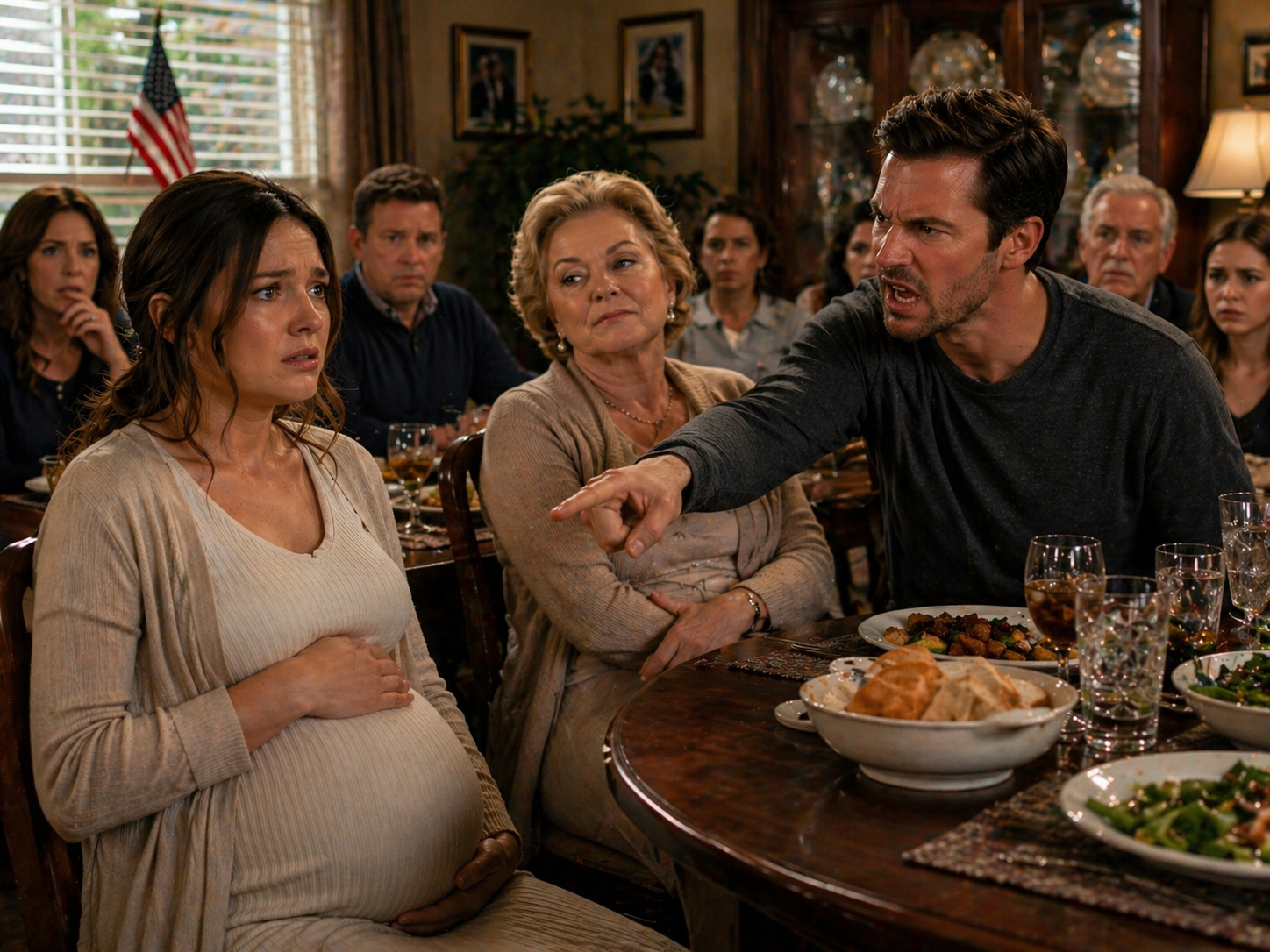
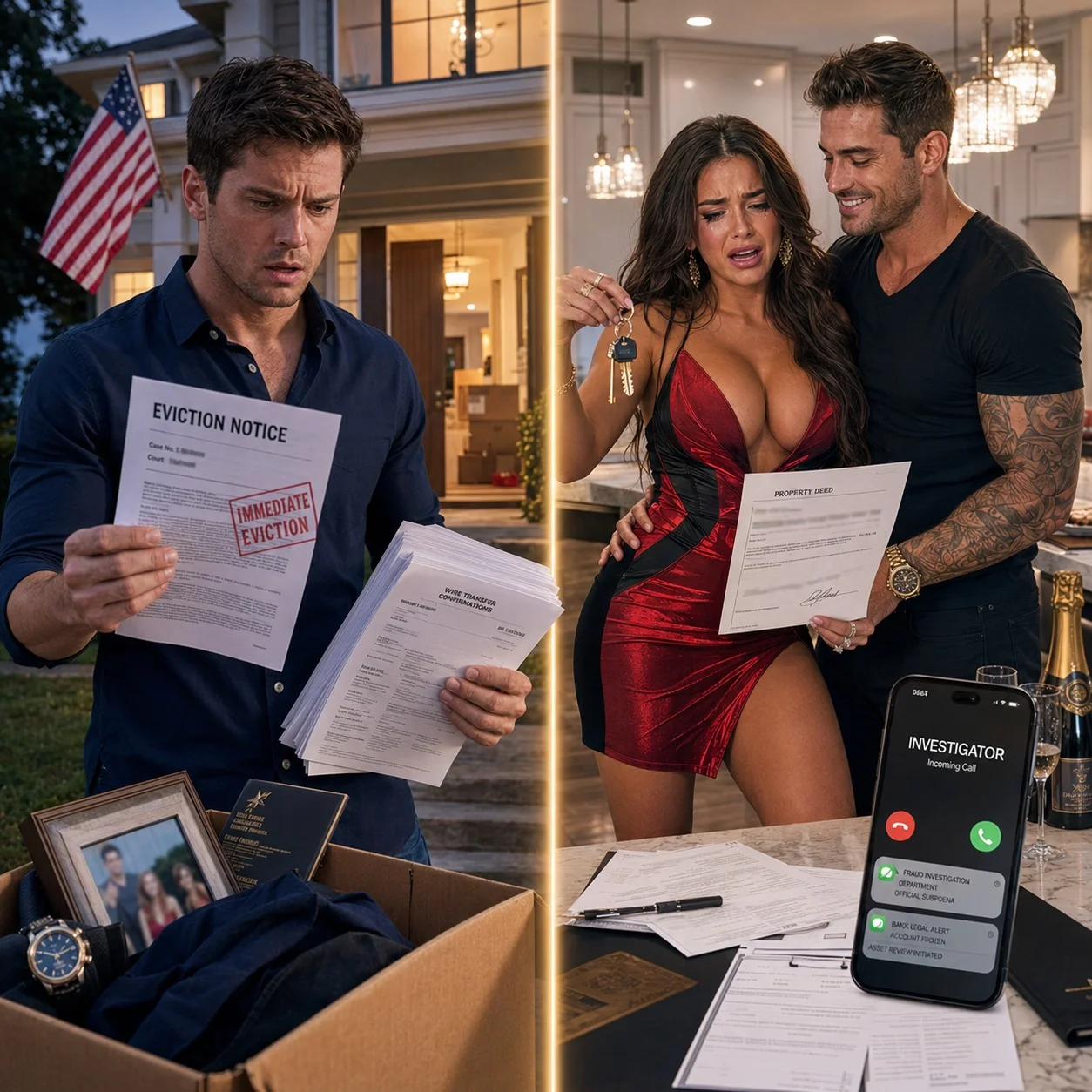
When my girlfriend handed me eviction papers, I honestly thought it had to be some kind of mistake. The folder was too formal, too cold, too impossible to belong in the same entryway where we had once stood barefoot, laughing about paint colors and arguing over where the Christmas tree would go. Then Cara opened the front door wider so her ex-boyfriend could carry boxes into the house I had helped pay to buy.
That was the moment the room seemed to tilt.
Trevor stepped past me with a cardboard box in his arms, avoiding my eyes like I was the embarrassing stranger interrupting something private. He smelled like cheap cologne and driveway dust, and there was something almost casual about the way he walked through the front hall, as if he had always known he would end up there. Cara stood beside the door with her arms crossed, calm in a way that frightened me more than anger would have.
“It’s my house, Alex,” she said. “You’re just a renter.”
I don’t think I had ever felt my stomach drop like that before. Not because she was breaking up with me. Not even because Trevor was there. It was because six months earlier, I had emptied almost my entire savings account to help us buy that house together.
At least, that was what I thought we were doing.
Cara and I had been together for two years before the house. We lived in my apartment, split groceries, talked about marriage in that comfortable half-serious way couples do when they think forever is slowly becoming practical. We had conversations about kids, schools, holidays, retirement accounts, and whether we would ever get a dog. Nothing about us felt perfect, but it felt real. Stable. Ordinary in the best possible way.
One night, she started talking about how stupid it was to keep paying rent when we could be building equity instead. She already had Zillow listings saved. She had neighborhoods picked out, mortgage calculators bookmarked, even a Pinterest board labeled “future home.” I remember teasing her about how fast she had gone from casual browsing to planning backyard furniture.
She smiled and said, “Because I’m serious about us.”
That sentence worked on me harder than any sales pitch ever could have.
I was cautious at first because houses are expensive and I wasn’t rich. I worked in software development and had spent years saving carefully. I drove an old car, packed lunches, skipped trips I wanted to take, and built up around forty thousand dollars in savings. Cara worked in marketing, but she constantly complained about student loans and credit card bills. She made decent money, but somehow money was always tight for her.
Then she told me her dad, who worked in accounting, had found a way for us to save money if the mortgage and deed stayed in her name temporarily.
“Tax advantages,” she called it.
I didn’t understand enough about real estate law to immediately challenge it, and that was the first mistake I made. Cara explained it like it was boring adult stuff, the kind of complicated financial strategy couples used when they were trying to get ahead. She said we would still legally split ownership through a private partnership agreement her dad would help draft after closing.
I remember asking her directly, “So I’m protected legally, right?”
She looked at me like I had insulted her.
“Alex,” she said softly, touching my face, “why would I ever screw you over? This is our house.”
Looking back now, I think she already knew exactly what she was going to do to me.
The craziest part is how believable she made everything feel. We spent weeks touring houses together. She obsessed over layouts, kitchen counters, backyard size, school districts, commute times, and whether the master bedroom got enough morning light. She took notes during showings. She talked about where my desk would go because I worked from home twice a week. She joked that our future dog would claim the backyard before either of us did.
If she was acting, she was better than anyone I had ever met.
When we found the house, I fell for it too. It was a modest three-bedroom with a wide front porch, an old maple tree in the yard, and a kitchen that needed updating but had good bones. Cara walked through it like she was already living there. She stood in the empty dining room and said, “This is where we’ll host Thanksgiving someday.”
I should have been thinking about contracts. Instead, I pictured my parents at that table, Cara laughing beside me, a life that felt sturdy enough to trust.
Right before closing, she told me the paperwork protecting my investment wasn’t ready because her dad was “still working out the tax details.” That should have been the moment I stopped everything. I should have refused to release a single dollar until my name was on something real. But love has a dangerous way of making caution feel like betrayal.
Cara cried when I hesitated.
Not sobbing dramatically. Nothing obvious enough to feel manipulative. Just quiet tears, the kind that made me feel like a monster for doubting her.
“I can’t believe you think I’d do that to you,” she whispered. “After everything we’ve talked about.”
So I apologized.
Then I handed her a cashier’s check for forty-seven thousand dollars.
My savings.
Practically everything I had.
She promised we would finalize the agreement right after closing. She kissed me in the parking lot outside the title company, thanked me for trusting her, and told me we were about to become homeowners together.
Except only one of us actually became a homeowner.
After we moved in, I started sending her half the mortgage every month. Automatic transfers straight into her account. I also paid for several repairs because she said her finances were stretched from closing costs. I bought a washer and dryer. I paid half the fence replacement. I paid for new locks, new paint, light fixtures, and a plumber when the upstairs bathroom leaked.
Every payment felt like an investment in our future.
Every receipt later felt like evidence in a crime scene.
Anytime I brought up the partnership agreement, Cara had an excuse. Her dad was busy. Tax season was brutal. The attorney had questions. The language needed to be revised. We had to wait until after the first mortgage payment posted. Then after the first property tax statement. Then after her dad got back from a conference.
Every explanation sounded reasonable enough to buy another month of patience.
Then around month six, something shifted.
Cara started staying late at work more often. She smiled at texts she wouldn’t show me. She began taking calls in the garage or on the back porch. She pulled away emotionally but acted irritated whenever I noticed. If I tried to hug her while she was cooking, she stiffened. If I asked about her day, she gave me short answers. If I mentioned money, her whole expression changed.
During one argument, I referred to the house as ours.
She looked up from the kitchen counter and said coldly, “I own a house. You’ve just been helping with expenses.”
I remember staring at her because something about the way she said it felt rehearsed.
“Helping with expenses?” I repeated. “Cara, I gave you forty-seven thousand dollars.”
“You helped with the down payment,” she said, almost bored. “That doesn’t mean you own it.”
For a few seconds, I genuinely couldn’t speak. My brain refused to process the sentence.
“You told me we were signing an agreement.”
“And we were going to,” she said. “But things changed.”
“What things?”
She looked at me then, really looked at me, and I saw something behind her eyes that I had been refusing to recognize for months. Not guilt. Not confusion. Calculation.
“I don’t think this relationship is healthy anymore,” she said.
A week later, she told me it was over.
Then she told me Trevor was moving in.
At first, she called him “an old friend helping her think clearly.” Then she admitted they had been talking for months. Then, during one of the worst conversations of my life, she told me he had stayed over while I was at work.
I felt my chest go hollow.
“You brought him into our house?”
“My house,” she corrected.
I don’t remember everything I said after that. I remember my voice rising. I remember her standing there with her arms crossed like I was a difficult tenant. I remember asking how she could do this after everything I gave her.
She said, “You chose to help me financially. That doesn’t make you entitled to my property.”
Then came the eviction papers.
I came home from work on a Thursday evening and found Trevor’s truck in the driveway. For one irrational second, I thought maybe he was dropping something off. Then I opened the front door and saw boxes stacked in the entryway.
Cara was waiting for me.
She held out a folder.
“What is this?” I asked.
“Formal notice,” she said. “You have thirty days.”
I opened it with shaking hands. It was real. Legal language. My name. Her name. The address of the house I had helped buy.
I looked up, expecting some flicker of shame. There was none.
Trevor walked in behind her carrying a box labeled “BEDROOM.”
That single word nearly broke me.
“You can’t be serious,” I said.
Cara’s voice stayed perfectly calm. “Legally, you’re just a renter here.”
That night, I slept in my car because I couldn’t stand being under that roof with them. I parked two blocks away from the house and sat there gripping the steering wheel until my hands hurt. I kept replaying everything, trying to find the moment where love turned into fraud. Or maybe the fraud had been there from the beginning and love was just the costume it wore.
By sunrise, the shock had hardened into something else.
I called a lawyer.
His name was Martin Ellis, and he was the first person who didn’t make me feel stupid for being deceived. I expected him to scold me for handing over money without a signed agreement. Instead, he listened, took notes, and asked for every document I had.
“Bank transfers, texts, emails, receipts, anything showing she represented this as a joint purchase,” he said. “Do not delete anything. Do not threaten her. Do not confront her alone. And do not move out permanently until we understand your legal position.”
“I’m not on the deed,” I said. “Does that mean I’m screwed?”
“It means this is harder,” he replied. “It does not mean she gets to steal forty-seven thousand dollars from you without consequences.”
For the first time in days, I breathed.
I went back to the house that evening with my phone recording audio in my pocket. Cara acted annoyed the second I walked in, like I was inconveniencing her by existing in the home my money had helped secure.
“I talked to a lawyer,” I said.
Her expression changed before she could hide it.
Trevor, sitting on the couch with his feet on my coffee table, looked up sharply.
Cara recovered quickly. “Good. Then you know you have no ownership.”
“I know I gave you forty-seven thousand dollars based on your promise that we were buying this together.”
She laughed. “You gave me money. People give their partners money all the time.”
“For a down payment.”
“To help with expenses.”
“You called it our house in writing, Cara.”
Her eyes narrowed.
I saw it then. Fear, small but real.
Over the next week, Martin helped me gather everything. Screenshots of texts where Cara had said “our mortgage,” “our closing,” “our first home,” and “we’re building equity together.” Emails with Zillow links she had sent me captioned “possible future home for us.” Bank records showing the cashier’s check. Automatic mortgage transfers labeled “house payment.” Receipts for repairs and appliances.
Then came the detail that changed everything.
Martin asked if I had access to any shared computer or cloud storage from when Cara and I lived together. I remembered an old tablet we had both used for streaming recipes and YouTube videos in the kitchen. It was mine originally, but Cara had logged into her accounts on it months ago.
I found it in a drawer with a cracked screen and a dead battery.
When it charged, several old messages synced.
Not all of them. Not enough to tell the whole story. But enough to make my hands go cold.
There were messages between Cara and Trevor from before she ever mentioned buying a house to me.
Trevor: “Did he agree to put up the money?”
Cara: “Not yet. He’s nervous, but I can get him there.”
Trevor: “Just make sure his name stays off everything.”
Cara: “Relax. Dad says as long as the deed is mine, he won’t have a clean claim. Alex trusts me.”
Trevor: “Poor guy.”
Cara: “He wants a future so badly he’ll ignore the details.”
I read that last line over and over until the words blurred.
He wants a future so badly he’ll ignore the details.
I had never felt so exposed in my life. It wasn’t just that she stole from me. It was that she had studied my best intentions and used them as weaknesses. She had known exactly which parts of me to press: loyalty, trust, hope, the quiet dream of building a home with someone.
I sent the screenshots to Martin.
He called me ten minutes later.
“Alex,” he said, voice sharper than usual, “do not communicate with her except in writing. I’m referring you to someone who handles civil fraud, and we may need to involve law enforcement.”
The deeper investigators dug, the worse Cara’s story became.
Her father had not been “drafting” any partnership agreement. In fact, when contacted through an attorney, he claimed he knew nothing about any arrangement between us. He had advised Cara on general mortgage paperwork, but he denied ever telling her to put the deed solely in her name for tax advantages related to me.
That revelation felt like another punch.
The entire explanation, the whole responsible-dad-accountant story, had been theater.
Martin also discovered that the eviction notice had been prepared before Cara officially broke up with me. She had already spoken to a landlord-tenant attorney while she was still sleeping beside me, still letting me pay half the mortgage, still accepting money for repairs.
Then the digital forensic investigator recovered more messages from backups I didn’t even know existed.
Cara and Trevor had discussed the plan for months.
In one message, Trevor asked, “What if he asks for paperwork before closing?”
Cara replied, “I’ll cry. He always folds when I cry.”
In another, Cara wrote, “Once I get him out, you can move in. He’ll be mad but legally he can’t do much.”
Trevor responded, “Free house upgrade thanks to software boy.”
I stared at that one for a long time.
Software boy.
Two years of love reduced to a joke between thieves.
When those messages were submitted with the civil complaint, Martin’s tone changed from cautious optimism to controlled fury.
“This is not just a relationship dispute anymore,” he told me. “This looks like a coordinated scheme.”
The state attorney general’s office eventually opened a fraud investigation because the evidence suggested Cara and Trevor may have done something similar before. That part shocked me almost as much as what she had done to me. Investigators found another man who had loaned Cara money years earlier under the promise of a shared business investment that never materialized. The amount was smaller, and he had been too embarrassed to pursue it. But the pattern mattered.
Cara had not become a fraud overnight.
She had simply gotten bolder.
Once the legal machinery started moving, her confidence disappeared quickly. She tried calling me from blocked numbers. She sent emails that began with insults and ended with pleading. She accused me of trying to ruin her life. She said I was being vindictive. She said Trevor had manipulated her. She said she had loved me and panicked. She said a lot of things, but not once did she say, “I’m sorry I stole from you.”
Not in a way that mattered.
Trevor was worse. He sent one message from an unknown number that said, “Drop this before it gets ugly.”
I forwarded it to Martin.
Martin forwarded it to the investigator.
After that, Trevor stopped contacting me.
The hardest part was still living in the house while the legal process unfolded. On Martin’s advice, I did not leave right away because Cara’s attempt to classify me as a tenant was part of the dispute. The arrangement was unbearable. Cara and Trevor stayed mostly in the primary bedroom. I slept in the spare room on a mattress I bought online. We passed each other in hallways like enemies in a war neither side could pretend was civilized.
One night, I came home and found Trevor drinking beer on the porch, sitting in the chair I had assembled the week after we moved in.
“You know,” he said, “you should’ve just walked away with some dignity.”
I looked at him for a long moment.
“Dignity isn’t letting people steal from you because fighting back makes them uncomfortable.”
He smirked, but his eyes were nervous.
By then, they both knew the messages had been recovered.
Cara tried one final emotional performance two weeks before the first court hearing. She knocked on the spare room door late at night and stood there in sweatpants, no makeup, eyes red.
“Can we talk?” she asked.
I kept the door halfway closed. “Anything you need to say can go through my lawyer.”
Her face twisted. “Alex, please. I know I messed up.”
“Messed up?” I repeated.
“I got scared,” she said. “You were so serious about everything. Marriage, kids, the future. I felt trapped.”
“So you took my savings?”
“I didn’t think of it like that.”
“You texted Trevor that I wanted a future badly enough to ignore details.”
Her mouth opened, then closed.
I continued, “You knew exactly what you were doing.”
For the first time, she had no answer.
The court process was not as dramatic as people imagine. There was no movie-style moment where a judge slammed a gavel and called Cara evil. Real justice, I learned, is slower and more paperwork-heavy. But there was power in that too. Every document told the story she thought she could bury. Every bank record, every message, every lie in writing became a brick in the wall closing around her.
My civil case sought repayment of the down payment, mortgage contributions, repair expenses, legal fees, and damages connected to fraudulent misrepresentation. Cara’s attorney initially tried to argue that I had gifted her the money because we were romantically involved.
Then Martin presented the messages.
The room changed.
There is a special kind of silence that happens when someone’s carefully built lie dies in public. Cara sat at the table across from me, face pale, while her own attorney read the texts she had sent Trevor before closing.
“Did he agree to put up the money?”
“Just make sure his name stays off everything.”
“He wants a future so badly he’ll ignore the details.”
I watched Cara stare at the table.
For months, I had wondered if seeing her exposed would feel satisfying. In that room, it didn’t feel satisfying exactly. It felt necessary. Like setting a broken bone. Painful, ugly, but the only way healing could begin correctly.
The judge denied her attempt to have my claims dismissed. A temporary order allowed me to remain in the house until the ownership and financial dispute was resolved, but I chose to move out shortly after. Not because Cara won, but because I was done letting that house own any more of me.
I moved into a small apartment across town with cheap blinds, thin walls, and no memories of Cara in any corner. The first night there, I slept on an air mattress with one lamp on the floor and takeout containers beside me. It should have felt like starting over from nothing.
Instead, it felt clean.
The fraud investigation continued in the background. I gave statements. So did the other man investigators found. Cara’s father cooperated and provided emails showing he had never drafted or promised any partnership agreement. That destroyed one of her biggest lies. Trevor tried to distance himself, claiming his messages were jokes, but the pattern was too clear.
Eventually, Cara agreed to a civil settlement before trial.
She had to refinance or sell the house to pay me back. Since her finances were worse than she had admitted and the investigation had damaged her employment, refinancing was impossible. The house went on the market.
I expected that to hurt.
It didn’t.
When I saw the listing online, with its bright kitchen photos and carefully staged living room, I felt almost nothing. That house had once represented every dream I thought I wanted. Now it just looked like walls, windows, and a front porch where a dishonest woman had handed me eviction papers.
At the settlement conference, Cara looked smaller than I remembered. Not physically, but somehow diminished. Trevor wasn’t there. I later learned he had left her shortly after the investigation became serious. Apparently, a house gained through fraud was attractive to him. Legal consequences were not.
Cara sat across from me with her attorney and avoided my eyes.
The settlement required her to repay my down payment, documented mortgage contributions, repair expenses, and a portion of my attorney’s fees from the proceeds of the sale. It was not perfect. Nothing about the process could give me back the years, the trust, or the version of myself who believed her without fear. But it was real accountability.
Before we left, Cara asked for a private minute.
Martin looked at me, leaving the choice completely mine.
I agreed, but only in the conference room with the door open and both attorneys nearby.
Cara folded her hands on the table. “I don’t know what to say.”
“That’s probably because there’s nothing you can say that fixes this.”
Her eyes filled with tears. Once, that would have undone me. Once, I would have reached across the table and comforted her even while she was the one hurting me.
This time, I just waited.
“I was selfish,” she said. “And scared. And Trevor made it easier to become someone I didn’t think I was.”
I shook my head. “Trevor didn’t make you text him that I trusted you enough to ignore the details. Trevor didn’t make you take my savings. Trevor didn’t make you hand me eviction papers in a house I paid for. At some point, Cara, you have to stop hiding behind the nearest excuse.”
She cried harder, but quietly.
“I did love you,” she whispered.
I looked at her for a long moment, and I thought about all the times I had replayed those words in my own head. Had she loved me? Had any of it been real? Could love and exploitation exist in the same relationship? I still don’t have a perfect answer.
But I knew one thing.
“You loved what my trust could give you,” I said. “That’s not the same thing as loving me.”
She lowered her head.
I stood up.
“Goodbye, Cara.”
That was the last conversation we ever had.
The house sold two months later. After the mortgage was paid and the settlement processed, a wire transfer hit my account on a Friday afternoon. I was sitting at my desk at work when the notification appeared.
For a second, I just stared at the number.
It was not everything I had lost emotionally, but it was the money. My money. The proof that I had not been crazy, not dramatic, not “just a renter,” not some bitter ex trying to rewrite reality. The system had looked at what happened and agreed that what Cara did was wrong.
I closed my office door and cried.
Not because I was sad. Not exactly.
Because for the first time since the day she handed me those papers, I felt the ground come back under my feet.
The criminal side took longer. Cara eventually accepted a plea agreement related to fraud. She avoided prison, which angered me at first, but she did not avoid consequences. She received probation, mandatory restitution connected to the broader investigation, community service, and a permanent record that damaged the career she had tried so hard to protect. Trevor, whose threats and messages tied him to the scheme, received his own charges and a separate plea. Neither of them walked away clean.
People sometimes ask if that felt like enough.
The honest answer is complicated.
No legal outcome can fully repair betrayal. No court order can restore the version of your heart that trusted easily. No settlement can refund the nights you slept in your car wondering how someone you loved could turn you into a funding source.
But accountability matters.
The day I received the final paperwork closing the civil case, I printed it and placed it in a folder with every receipt, screenshot, and legal document from the past year. Then I put that folder in a storage box and taped it shut.
Not because I wanted to forget.
Because I wanted the story to have a place to rest.
A year after the eviction papers, I bought a condo.
This time, everything was in my name. Every document was reviewed by my own attorney. Every signature was mine. It wasn’t a dream house with a maple tree or a big porch. It was a small two-bedroom unit with good light, a balcony, and a kitchen just large enough for one person to cook comfortably. But when I unlocked the door for the first time, I stood in the empty living room and felt something I had never felt in Cara’s house.
Peace.
No one had manipulated me into it. No one had used my hope against me. No one could stand in the doorway and tell me I was just a renter.
My parents came over that weekend with takeout and a bottle of champagne. My dad helped me assemble a bookshelf while my mom unpacked dishes and pretended not to cry. At one point, she found me standing on the balcony, looking out at the city.
“You okay?” she asked.
I smiled. “Yeah. I think I actually am.”
She touched my shoulder. “I’m sorry we didn’t protect you from her.”
“You couldn’t have known,” I said. “I didn’t know.”
For a long time after Cara, I blamed myself. I replayed every warning sign. The delayed paperwork. The excuses. The way she controlled lender meetings. The moment I handed her the check. I called myself stupid more times than I can count.
Therapy helped with that.
So did time.
So did realizing that trust is not stupidity. Wanting a future is not weakness. Loving someone is not a character flaw. The shame belonged to the person who exploited those things, not the person who offered them honestly.
I didn’t date for a while. Not because I stopped believing in love, but because I needed to rebuild the part of me that could tell the difference between intimacy and dependency, promises and proof. When I eventually started seeing someone new, I moved slowly. I asked direct questions. I watched actions more than words. I learned that the right person does not punish you for needing clarity. They do not call your caution paranoia. They do not ask for blind trust where legal protection belongs.
The first time I told my new girlfriend the full story, I expected pity.
Instead, she said, “I’m glad you fought back.”
That simple sentence stayed with me.
Because for a long time, I thought the story was about how badly I had been fooled. I thought the defining image would always be Cara standing in the doorway, eviction papers in hand, telling me I was just a renter while Trevor carried boxes into a house I helped buy.
But that is not where the story ended.
It ended with my name on my own deed.
It ended with my savings rebuilt.
It ended with Cara forced to sell the house she stole from me and Trevor disappearing the moment consequences arrived.
It ended with a judge reading the messages she thought no one would ever see.
It ended with me standing in a home no one could take from me, understanding that betrayal had changed me, but it had not destroyed me.
Sometimes karma does not arrive as a lightning strike. Sometimes it arrives as subpoenas, bank records, recovered texts, court filings, and a wire transfer on a quiet Friday afternoon. Sometimes revenge is not screaming at the person who hurt you. Sometimes it is staying calm long enough to prove the truth.
Cara once told me, “It’s my house, Alex. You’re just a renter.”
She was wrong.
I was never just a renter.
I was the man she underestimated because she mistook trust for weakness. And in the end, the house she used to betray me became the evidence that exposed her.


![[FULL STORY] She Said the DNA Didn’t Matter Because I’d Be an Amazing Father — So I Disappeared](https://social-media.rabedo.com/thumbnails/1777889779_0d49f345-c07a-4b74-b5dc-085677683eb0.jpg)

![[FULL STORY] She Posted “Upgraded” With Another Man… So I Unbooked Our Entire Future](https://social-media.rabedo.com/thumbnails/1777140011_664c1232-bd0f-4b82-8ee6-5afa5d88e46f.png)