But there is a particular kind of dread that makes your hand move before your conscience catches up. I pulled the envelope out. It wasn’t sealed. Inside was a single photograph.
Emily, standing outside a café.
Ryan, beside her.
His hand on her shoulder.
The photo wasn’t intimate exactly, but it wasn’t old. Emily’s belly was visible under her sweater. This had been taken during the pregnancy.
On the back, written in blue ink, were six words:
You can’t keep pretending forever.
I stood in the rain beside her car, holding that photo until the paper began to soften at the edges.
When I confronted her that night, Emily didn’t deny seeing him.
That surprised me more than any denial would have.
She sat at the kitchen table with both hands wrapped around a glass of water, her face pale and tired. “He found out I was pregnant,” she said. “I don’t know how. He started calling. I ignored him at first, but then he showed up at my office.”
“You told me he hadn’t contacted you in years.”
“He hadn’t,” she said quickly. “Not until recently.”
“Why didn’t you tell me?”
“Because I knew how it would look.”
“It looks bad because you hid it.”
Her eyes filled with tears. “I didn’t want stress. I didn’t want drama. He was part of my past, and I didn’t want him anywhere near this baby.”
“This baby,” I repeated. “Our baby.”
Emily flinched like I had slapped her.
“Of course,” she whispered. “Our baby.”
That should have comforted me.
It didn’t.
I asked why Ryan would write something like that on the back of the photo. She said he was unstable. She said he wanted attention. She said he had always hated being replaced. Every answer was plausible enough to survive, but not strong enough to erase the question.
“Did anything happen with him?” I asked.
Her face crumpled.
“No,” she said. “Nothing like that. I swear on our daughter.”
I wanted to believe her so badly that I did something worse than believing. I decided not to know.
I told myself that every relationship has ghosts. I told myself a jealous ex could twist innocent things into threats. I told myself pregnancy made everything feel bigger and darker than it was.
For the next month, we pretended.
Emily blocked Ryan’s number in front of me. She deleted his messages without reading them. She promised there had been no secret meetings beyond the café photo, and even that, she said, had lasted less than ten minutes. I slept beside her every night and tried to ignore the way she sometimes cried quietly in the bathroom.
Then came the hospital.
It was a Thursday night, a little after eleven, when Emily woke me up gripping my arm so hard her nails dug into my skin.
“Something’s wrong,” she gasped.
I was out of bed before fully understanding the words. There was pain in her face, real pain, the kind that strips away every argument and leaves only fear. She was thirty-four weeks pregnant, too early for delivery, too far along for anything to feel small.
I drove to the hospital with one hand on the wheel and one hand reaching for hers whenever traffic slowed. She kept breathing in sharp little bursts, whispering, “Please be okay, please be okay,” over and over again.
In the emergency maternity unit, everything became bright lights, moving hands, clipped questions, monitors, paperwork. A nurse asked Emily her pain level. Another asked how far along she was. Someone told me to wait outside while they examined her, and for the first time since the pregnancy test, I felt completely useless.
I stood in the hallway under fluorescent lights, staring at a wall poster about newborn safety, trying not to imagine all the ways a life could change in one hour.
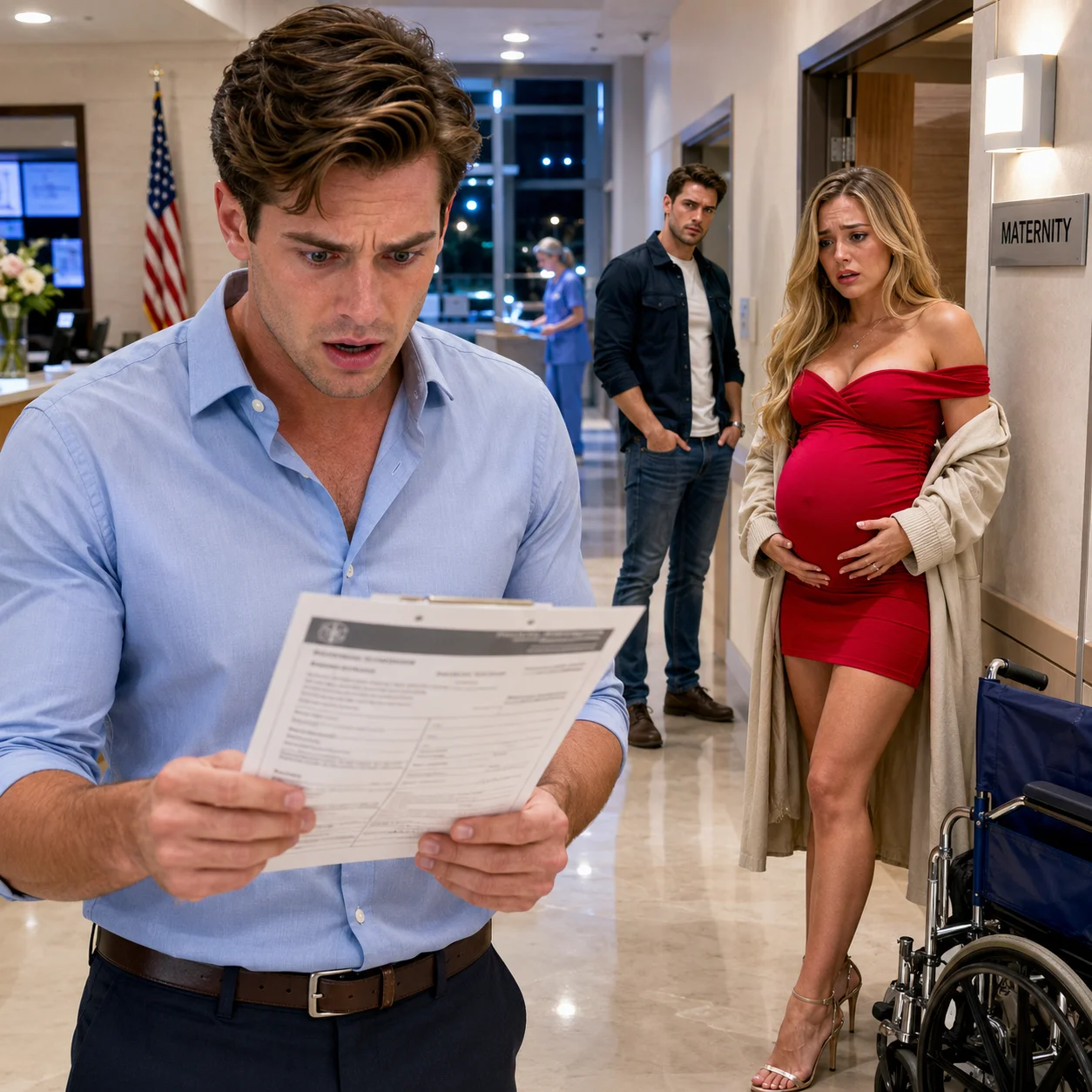
After twenty minutes, a nurse came out holding a clipboard.
“Mr. Carter?”
“Yes,” I said immediately.
She glanced down. “You’re the fiancé?”
“That’s right. Is she okay?”
“The doctor is still examining her. The baby’s heartbeat is stable right now. We just need you to verify some information for the admission forms.”
My knees almost gave out from relief at the word stable.
The nurse handed me the clipboard. “Some of this was pre-filled from her previous intake records. Just check that everything is correct.”
I took the pen.
Name: Emily Grace Walker.
Date of birth. Address. Insurance.
Emergency contact: Daniel Carter.
That was me.
I kept reading, my eyes moving quickly down the page until they stopped on a line halfway through the second sheet.
Father of baby / secondary guardian: Ryan Matthew Keller.
For a moment, the letters didn’t become words.
They were just shapes.
Ryan Matthew Keller.
I stared at them until the hallway seemed to go silent around me.
The nurse must have noticed because she leaned slightly toward me. “Sir?”
I looked up slowly. “This is wrong.”
“Which part?”
I tapped the paper, though my hand didn’t feel like mine. “This name.”
She glanced at it. “The secondary guardian?”
“No,” I said, my throat tightening. “The father of the baby.”
Her expression changed with professional caution. “That information would have been entered during patient registration or transferred from previous paperwork. We can update it if it’s incorrect.”
Previous paperwork.
The words hit harder than the name.
Not a typo from tonight. Not a random clerical mistake. Something already in the system.
“Where did this come from?” I asked.
“I can’t disclose details without the patient’s consent,” she said gently. “But if there’s an error, we can have Ms. Walker correct it when she’s able.”
If there’s an error.
I almost laughed.
Not because anything was funny, but because my brain was trying to reject the shape of what was happening.
I walked to the end of the hallway and sat in a plastic chair with the clipboard still in my hand. I read the line again. Then again. Each time, I expected the name to rearrange itself into mine.
It didn’t.
Ryan Matthew Keller.
The man who hadn’t contacted her in years.
The man who had supposedly shown up only recently.
The man whose name was apparently already attached to my unborn daughter.
When the doctor finally allowed me back into the room, Emily was lying on her side with monitors strapped around her belly. Her face was exhausted, damp with tears, but she smiled weakly when she saw me.
“She’s okay,” she whispered. “They said she’s okay.”
I stood beside her bed, unable to move closer.
For a few seconds, the relief and the devastation existed together inside me. Our baby was stable. Emily was safe. And somehow, everything had collapsed.
The nurse set the clipboard on a counter. Emily saw it. Then she saw my face.
Her smile disappeared.
“Daniel?”
I didn’t raise my voice. I barely recognized it when I spoke.
“Why is Ryan listed as the father on the hospital paperwork?”
The room changed.
Not visibly. The machines kept beeping. The lights stayed bright. The nurse turned toward the monitor with sudden intense interest, pretending not to hear. But Emily’s entire body went still.
She closed her eyes.
That was the answer before she said a word.
“Daniel,” she whispered.
“No.” My voice broke. “Don’t say my name like I’m the one who needs calming down.”
Tears slipped down her temples into her hair. “I can explain.”
“Then explain why your ex’s name is on paperwork for our baby.”
The nurse quietly excused herself. The door clicked shut behind her.
Emily pressed one hand against her stomach. “I was going to tell you.”
The sentence was so old, so cowardly, so predictable that something in me hardened instantly.
“When?” I asked. “After the delivery? After I signed the birth certificate? After I held her and named her and promised to love her for the rest of my life?”
“She is yours in every way that matters.”
I stepped back like the words had physically touched me.
“In every way that matters,” I repeated.
She started crying harder. “I didn’t mean it like that.”
“How did you mean it?”
“I don’t know.” She covered her face. “I don’t know how to say any of this.”
“The truth usually works.”
She looked at me then, and for the first time, I saw the thing she had been carrying for months. Not just guilt. Not just fear. Shame. Deep, old, suffocating shame.
“It happened once,” she said.
The room tilted.
I gripped the metal rail at the foot of the bed.
“When?”
She sobbed. “Right before I found out I was pregnant.”
My mouth went dry.
“Before,” I said slowly. “Before the test?”
She nodded.
“With Ryan.”
Another nod.
Every piece rearranged itself with cruel precision. Her strange silences. The phone calls. The café. The photograph. The way she had sworn on “our daughter” with that broken look in her eyes.
I wanted to shout. I wanted to demand every detail. I wanted to walk out and never see her again. But she was lying in a hospital bed with our baby—no, a baby—monitored between us, and I couldn’t even hate her cleanly.
“You told me he hadn’t contacted you in years.”
“He hadn’t before that night,” she said quickly. “I saw him by accident. At Rebecca’s birthday dinner. He was there with someone from work. I didn’t know he would be there.”
“And then what? You accidentally slept with him too?”
She flinched.
“I was drunk,” she whispered. “We argued outside. He said all the things he used to say, that I left because I was scared, that I never really stopped loving him. I was angry. I was confused. You and I had fought that week about money and the wedding, and I felt—”
“Don’t,” I said sharply. “Do not turn our argument into a doorway for him.”
Her mouth closed.
I could hear the baby’s heartbeat on the monitor. Fast. Steady. Innocent.
“Did you know?” I asked.
Emily’s face crumpled again.
I didn’t need to finish the question.
Did you know the baby might not be mine?
“Yes,” she whispered. “Not at first. I wanted to believe the timing meant it was yours. I convinced myself. But then Ryan started doing the math, and he kept pushing, and I panicked.”
“Did you do a paternity test?”
Her silence was worse than any answer.
“Emily.”
“I did a prenatal test,” she said. “Privately.”
I felt something inside me go quiet.
“When?”
“Four weeks ago.”
“Four weeks,” I said. “You knew for four weeks.”
She shook her head desperately. “I didn’t know how to tell you.”
“So you let me paint the nursery.”
“I’m sorry.”
“You let me assemble the crib.”
“I’m sorry.”
“You let me put my hand on your stomach and talk to her.”
Her tears kept falling.
“You let me call her my daughter.”
Emily reached for me, but I stepped back before she could touch my hand.
“Is she his?” I asked.
Emily looked away.
That was enough.
Still, she forced the words out.
“Yes.”
The monitor beeped steadily.
Somewhere down the hall, a newborn cried.
And I stood there beside the woman I was supposed to marry, listening to the sound of another man’s child’s heartbeat.
I don’t remember leaving the room.
I remember the hallway. I remember the nurse saying my name. I remember sitting in my truck in the parking garage with both hands on the steering wheel, unable to start the engine. My phone buzzed again and again. Emily. Then her mother. Then Emily again.
I didn’t answer.
For an hour, I sat there while rain streaked down the windshield and tried to figure out whether grief could kill a person without leaving a mark.
At 2:14 a.m., my sister called.
My sister, Lauren, has always had a sixth sense for disaster. Maybe because she raised two sons alone after her husband died, or maybe because she knew me better than anyone. I didn’t answer the first time. She called again.
When I finally picked up, she didn’t say hello.
“What happened?”
I tried to speak, but nothing came out.
“Daniel,” she said, softer. “Where are you?”
“At the hospital.”
“Is Emily okay? Is the baby okay?”
“The baby’s stable.”
“Oh thank God.” She exhaled. “Then what is it?”
I stared through the windshield at the concrete wall in front of me.
“She’s not mine.”
There was a long silence.
Then Lauren said, “I’m coming.”
“No.”
“I’m coming.”
“Lauren—”
“You don’t have to talk. Just tell me which hospital.”
She arrived forty minutes later wearing sweatpants, a coat over pajamas, and the expression of someone ready to fight God if necessary. She found me in the parking garage, opened the passenger door, and sat beside me without saying anything.
That was what broke me.
Not Emily crying. Not the paperwork. Not even the confession.
My sister sitting quietly beside me made me feel like a little boy again, and I put my face in my hands and cried until my throat hurt.
For the next three days, I operated like a man underwater.
Emily remained in the hospital for observation. The doctors managed to stop the early contractions, and the baby was safe. Everyone kept telling me that as if it solved something.
The baby is safe.
Good.
The baby is innocent.
True.
Emily is sorry.
Maybe.
None of it told me what I was supposed to do with the nursery in my house.
Emily’s mother, Patricia, called me repeatedly. At first, she was gentle. Then urgent. Then defensive.
“You can’t abandon Emily right now,” she said on the third call.
I was sitting at my kitchen table, staring at a stack of baby shower cards.
“I didn’t abandon anyone,” I said. “I found out I was lied to for months.”
“She made a terrible mistake.”
“No. A mistake is buying the wrong paint color. This was a series of choices.”
“She was scared.”
“So was I,” I said. “I was scared every day about being a father. I didn’t get to lie my way through it.”
Patricia cried. She said Emily loved me. She said biology wasn’t everything. She said I had already bonded with the baby. She said leaving now would destroy her daughter.
I listened until my chest felt hollow.
Then I asked, “Did you know?”
Silence.
“Patricia.”
“She told me she was unsure,” her mother whispered. “I told her to be honest with you.”
“When?”
Another silence.
“When, Patricia?”
“After the test.”
Four weeks.
Everyone had known except me.
Something about that hurt differently. It wasn’t only Emily’s betrayal anymore. It was a whole quiet room of people deciding I was easier to manage without the truth.
I ended the call.
That evening, Ryan came to my house.
I had just removed the crib from the nursery. Not taken it apart. Not thrown it out. Just moved it into the garage because looking at it made me physically sick. When the doorbell rang, I thought it might be Lauren. Instead, Ryan stood on my porch in a dark jacket, rain shining on his hair.
I had seen photos of him before, but never in person. He was taller than I expected, with the kind of controlled confidence that made him look like he was always entering a negotiation he intended to win.
“Daniel,” he said.
I laughed once, humorlessly. “You have a lot of nerve.”
“I know you don’t want to see me.”
“You’re right.”
“I came because of the baby.”
“The baby,” I repeated.
He looked past me into the house, toward the hallway that led to the nursery. “I’m not here to fight.”
“Then you should leave before that changes.”
His jaw tightened. “Emily told you?”
“She told me enough.”
“I wanted her to tell you sooner.”
I stared at him.
He had the audacity to look almost sincere.
“You wanted honesty?” I asked. “Is that why you sent the photograph?”
His expression flickered. “She was going to let you raise my daughter without knowing.”
“And that bothered you morally after sleeping with an engaged woman?”
He looked down.
Good.
For one second, shame touched his face.
“It shouldn’t have happened,” he said.
“But it did.”
“Yes.”
“And now what? You want to play father?”
“I am her father.”
The words hit hard, but not because he was wrong.
Because he wasn’t.
“You don’t get to walk onto my porch and say that like you’re the victim here.”
“I’m not saying I’m the victim. I’m saying the baby is mine, and I’m going to be in her life.”
The possessiveness in his voice made my anger sharpen.
“You don’t even know her.”
“Neither do you.”
I moved before thinking. Not enough to hit him, but enough that he stepped back.
“Say one more thing like that,” I said quietly.
Ryan lifted both hands. “I didn’t come to make this worse.”
“You are the worse.”
His mouth tightened again. “Emily and I have history.”
“She and I had a future.”
That shut him up.
For a moment, neither of us spoke. Rain fell behind him in silver lines. Somewhere inside my house, the baby mobile Emily had ordered still sat unopened on the dining table.
Finally, Ryan said, “I know you hate me.”
“You don’t know anything about me.”
“I know what it feels like to love her and not be chosen.”
I looked at him, really looked at him, and saw it then. Not confidence. Not victory. Something uglier and weaker. He wasn’t here as a father fighting for his child. Not fully. He was here because some part of him had finally won a contest I didn’t even know we were in.
And that made him smaller.
“I did choose her,” I said. “Every day. That’s the difference between us.”
His face hardened.
I closed the door in his face.
The next week was logistics disguised as heartbreak.
I spoke to a lawyer because my sister insisted. I learned more about presumed paternity, birth certificates, parental rights, and legal obligations than I ever wanted to know. The lawyer, a calm woman named Marsha Ellis, listened without interrupting while I explained everything.
“Do not sign anything at the hospital unless you are absolutely certain,” she told me. “Do not let guilt, pressure, or emotion put your name on a legal document you don’t understand.”
The sentence haunted me because part of me still wanted to sign.
That was the most shameful truth.
Even after everything, part of me still loved the baby. Not as an abstract idea. Not as a symbol. I loved the kicks I had felt under my palm. I loved the name we had whispered into the dark. I loved the tiny socks already folded in the drawer.
We had planned to name her Lily.
I didn’t know whether Emily and Ryan would keep that name. I hated that I cared.
Emily came home from the hospital five days after the admission. She didn’t come to our house. She went to her mother’s.
She texted me first.
Can we talk?
I stared at the message for ten minutes before answering.
Tomorrow. Public place.
We met at a quiet café near the hospital because neither of us trusted ourselves inside the home we had built together. Emily looked smaller when she walked in, swallowed by a cream sweater, her hair tied back without effort. Her belly was round beneath the fabric. I hated how my first instinct was still to stand and help her sit.
I did it anyway.
Not because she deserved it.
Because I couldn’t become cruel just because she had been dishonest.
“Thank you for coming,” she said.
I sat across from her. “Say what you need to say.”
She looked down at her hands. No ring. She had removed it.
That hurt too, though I had no right to want it there.
“I know sorry isn’t enough,” she began.
“It isn’t.”
“I know.” She swallowed. “I’ve tried to write this down a hundred times, and every version sounds like an excuse. So I’m not going to make excuses. I slept with Ryan. I lied. I found out there was a possibility the baby wasn’t yours, and instead of telling you, I kept hoping the truth would somehow become unnecessary.”
“The truth is never unnecessary.”
“I know that now.”
“You knew it then.”
She closed her eyes briefly. “Yes.”
For the first time, she didn’t soften it. Didn’t blame fear. Didn’t blame stress. Didn’t blame our fight. She simply sat in the damage.
That made it worse and better at the same time.
“I loved you,” I said.
Her chin trembled. “Loved?”
I looked out the window because seeing her face made it harder to stay honest.
“I don’t know what tense to use anymore.”
She cried silently.
“I wanted to marry you,” I continued. “I wanted that baby. I wanted midnight feedings and hospital bracelets and stupid fights about sleep schedules. I wanted all of it. And you let me live inside a lie because it was easier for you.”
“I was terrified you’d leave.”
“So you made sure I would have to leave after loving more.”
That landed. I saw it in her face.
She pressed one hand against her stomach. “Ryan wants to be involved.”
“I know. He came to the house.”
Her eyes widened. “He what?”
“He wanted to mark territory.”
Her face darkened with a flash of anger. “He had no right.”
“Emily,” I said tiredly, “none of us are standing on much right anymore.”
She looked away.
For a while, we sat with the sounds of coffee machines and quiet conversations around us, absurdly normal.
Then she said, “I don’t want to be with him.”
I looked back at her.
“I need you to understand that,” she said quickly. “What happened with Ryan wasn’t some hidden romance. It was old weakness. Old damage. I didn’t choose him. I don’t love him.”
“But you protected him.”
“No. I protected myself.”
That was the truest thing she had said.
I nodded slowly.
She leaned forward. “Daniel, I know I destroyed what we had. But I also know you would be a better father than Ryan could ever be. And I know that’s unfair to say, but it’s true. You already loved her. You already showed up.”
I felt anger rise again, hot and clean.
“Don’t use my love as evidence in your case.”
She recoiled.
“I’m not a backup father,” I said. “I’m not a safety plan because the biological father is inconvenient.”
“That’s not what I meant.”
“But it is what you’re asking.”
Her tears spilled over. “I don’t know what I’m asking. I just know I’m scared.”
I believed that.
I believed she was scared. I believed she regretted it. I believed she wished she could tear time open and choose differently.
But regret is not restoration.
“I’ll help with practical things until the birth,” I said.
She stared at me. “What?”
“I won’t abandon you in a medical crisis. I’ll make sure you have the hospital bag and the documents and whatever things are at the house that belong to you or the baby.”
“Daniel—”
“But I won’t pretend I’m her father. I won’t sign the birth certificate. I won’t marry you. And I won’t raise Ryan’s child because you lied to me until I had already built a nursery.”
She covered her mouth with one hand.
“I’m sorry,” I said, and the terrible thing was I meant it.
I was sorry for all of us.
But I stood up anyway.
The next month was the strangest grief I have ever lived through.
I packed Emily’s belongings into boxes with Lauren’s help. Maternity clothes. Books. Makeup. Her favorite chipped mug. A framed photo from our engagement that I wrapped in paper and then unwrapped because I couldn’t decide whether sending it was cruel. In the end, I placed it face down in the box.
The nursery was harder.
Some things I returned. Some I donated. Some I couldn’t touch.
The crib stayed in the garage under a sheet.
Every corner of the house held evidence of a future that had been canceled without my consent. The cabinet where I had stored bottles. The drawer full of tiny folded onesies. The kitchen calendar with Emily’s due date circled in blue.
Friends found out slowly. Some were furious for me. Some tried to be neutral, which felt like betrayal in miniature. One old college friend said, “Man, if you loved the baby, maybe DNA shouldn’t matter.”
I didn’t speak to him again for a while.
Because DNA wasn’t the only thing that mattered.
Truth mattered. Consent mattered. The right to choose your own life with full knowledge mattered. I could have loved a child who wasn’t biologically mine. Men do it every day. But I could not build fatherhood on a lie someone else laid beneath my feet.
Emily went into labor three weeks early.
Patricia called me at 4:30 in the morning.
For one breathless second, I was back in the old life. I almost grabbed my keys before remembering.
“She’s asking for you,” Patricia said.
I sat on the edge of my bed in the dark. “Is Ryan there?”
A pause. “He’s on his way.”
“Then she has support.”
“Daniel, please. She’s terrified.”
I closed my eyes.
I could have refused. No one would have blamed me. Maybe I should have. But grief does not erase care in a clean line. Sometimes love remains after trust dies, and all you can do is decide what shape it is allowed to take.
“I’ll come,” I said. “But I’m not going into the delivery room.”
At the hospital, Patricia hugged me too hard and cried into my shoulder. Ryan paced near the vending machines, looking pale and out of place. He glanced at me but didn’t approach.
Good.
Emily was already in active labor. I saw her once before they took her fully into delivery. She was sweaty, scared, gripping the bed rails. When she saw me, her face broke open with relief and guilt.
“You came,” she whispered.
“I came.”
“I’m sorry,” she said again, as if labor had stripped her down to only the truest words.
“I know.”
She reached for my hand.
I let her hold it for ten seconds.
Then I gently pulled away.
“I hope she’s healthy,” I said.
Emily cried harder, but she nodded.
I waited in the hallway with Lauren beside me. Ryan went into the delivery room. That hurt in a strange, brutal way. Not because I wanted to be in his place exactly, but because for months, I had imagined that room as mine. My hand cut by Emily’s grip. My voice telling her she was strong. My daughter’s first cry changing me forever.
Instead, I sat beside a vending machine under fluorescent lights and listened for the cry of a baby I had loved before I knew she was not mine.
When it came, thin and fierce and alive, I lowered my head.
Lauren put her arm around my shoulders.
“She’s here,” she whispered.
I nodded, unable to speak.
An hour later, Patricia came out.
“She’s healthy,” she said through tears. “Six pounds, two ounces. Beautiful.”
“Good,” I said.
And I meant it.
Emily asked if I wanted to see her.
I almost said no.
Then I thought about the months I had spent talking to that little life through Emily’s belly. None of that was the baby’s fault. My goodbye didn’t have to be cold to be final.
So I went.
Emily was in bed, exhausted, holding a tiny bundle wrapped in a white blanket with pink and blue stripes. Ryan stood near the window, awkward and emotional, one hand pressed against his mouth.
When I stepped into the room, Emily looked at me with eyes full of a question I could not answer for her.
“She’s beautiful,” I said softly.
And she was.
Tiny face. Dark hair. One wrinkled hand near her cheek. Completely innocent of the storm that had brought her here.
Emily whispered, “Her name is Lily.”
I closed my eyes for half a second.
Of course it was.
Ryan looked surprised too, which told me Emily had chosen it without asking him.
“She should have the name you think fits her,” I said carefully.
Emily’s tears started again. “You picked it with me.”
“I know.”
I stood beside the bed and looked at Lily. For a moment, I let myself love her. Not as my daughter. Not as a responsibility stolen from me. Just as a newborn child who deserved peace.
“Have a good life, Lily,” I whispered.
Emily made a small sound like pain.
I stepped back.
“Daniel,” she said. “Please don’t disappear.”
I looked at her, then at Ryan, then back at the baby.
“I’m not disappearing,” I said. “I’m leaving a place I was never honestly allowed to stand in.”
Then I walked out.
That was not the end, although I wished it had been.
Endings in real life are rarely clean. There were more calls, more messages, more boxes exchanged through Lauren because I couldn’t handle seeing Emily every week. There was the official cancellation of the wedding venue. The return of deposits we barely recovered. The awkward explanations to relatives. The final conversation with our pastor, who cried when I told him we would not be needing the church after all.
There were nights I almost called Emily.
There were mornings I woke up angry.
There were afternoons I walked into stores and saw baby clothes and had to leave.
For months, my life became a quiet reconstruction. I started therapy because Lauren threatened to schedule the appointment herself if I didn’t. I sold the house eventually, not because I couldn’t afford it, but because every room had become a museum of almost. I moved into a smaller place across town with better light and fewer ghosts.
Emily sent updates at first. A photo of Lily’s hand. A message saying she smiled today. Another saying Ryan had already missed two pediatric appointments. I didn’t answer most of them. When I finally did, I wrote one clear message.
I hope Lily is healthy and loved. But I cannot be part of her life in pieces. Please don’t send updates unless there is an emergency involving you or her safety.
She replied hours later.
I understand. I’m sorry for everything.
I didn’t answer.
Almost a year passed before I saw Emily again.
It happened at the park where we had met, because fate has a cruel sense of symmetry. I was walking back from a Saturday farmers market with a bag of peaches when I saw her near the fountain, pushing a stroller.
For a second, I considered turning around.
Then she saw me.
We both froze.
She looked different. Tired, softer, older in the way people age after consequences. Lily sat in the stroller wearing a yellow sunhat, chewing on a toy giraffe.
Emily approached slowly, like she was giving me time to run.
“Hi,” she said.
“Hi.”
Lily looked up at me with wide brown eyes.
“She’s gotten big,” I said.
Emily smiled sadly. “She has.”
There was a pause filled with everything we were not saying.
“How are you?” she asked.
“Better,” I said honestly. “Not perfect. But better.”
“I’m glad.”
I looked at her left hand. No ring. Not from Ryan. Not from anyone.
As if reading the glance, she said, “Ryan’s not involved much.”
I didn’t respond.
“He liked the idea more than the reality,” she continued. “He fought hard before she was born. Then once she was here, the work scared him.”
“I’m sorry for Lily,” I said.
Emily nodded, tears brightening her eyes. “Me too.”
For once, she didn’t ask me to step in. She didn’t imply I would be better. She didn’t use my old love as a bridge back to obligation. She simply stood there, carrying the consequence of what she had chosen.
“I’m doing it alone,” she said. “Mostly. My mom helps. I got a different job with better hours.”
“That’s good.”
“I’m trying to become someone who doesn’t lie because she’s afraid.”
That hit me harder than I expected.
I nodded. “I hope you do.”
She swallowed. “I loved you, Daniel. Badly, selfishly, dishonestly at the end. But I did love you.”
“I know,” I said.
And I did.
That was the worst and most human part of it. She had loved me. She had also betrayed me. Both were true. One did not erase the other.
“I loved you too,” I said. “But I love who I was trying to become with you more than I love the lie we lived in.”
Emily cried quietly.
Lily dropped her toy. I bent without thinking, picked it up, wiped it on my sleeve, and handed it back to her. She grabbed it with both hands and smiled at me.
A simple baby smile.
No guilt. No history. No betrayal.
Just life continuing.
I smiled back.
Then I stood.
“Take care of her,” I said.
“I will.”
“Take care of yourself too.”
She nodded.
I walked away before the moment could become something it wasn’t.
Two years later, I still think about that chapter sometimes.
Not every day. Not painfully every time. But sometimes.
I think about the nursery painted soft yellow. I think about the hospital hallway. I think about the line on the paperwork that changed the shape of my life.
Father of baby: Ryan Matthew Keller.
For a long time, I hated that line.
Now I understand it differently.
It was brutal, yes. Humiliating. Devastating. But it was also the truth arriving before a lie could become permanent. It saved me from signing my name to a life I had not been allowed to choose. It saved Lily from growing up inside a secret that would one day explode around her. It forced Emily to face what she had done, and it forced me to learn that love without honesty is not love strong enough to build a family on.
I am not married now, though I’m seeing someone.
Her name is Rachel. She knows the whole story. I told her early, awkwardly, over coffee one evening because I promised myself I would never again build intimacy on carefully edited truth. I expected her to look frightened by the damage.
Instead, she reached across the table and said, “You deserved the truth before you gave your heart that deeply.”
I did.
That was the lesson.
Not that love is unsafe. Not that every woman hides something. Not that biology is everything, because it isn’t.
The lesson was that fatherhood, marriage, forgiveness, and sacrifice all mean something only when they are chosen freely.
Emily took my choice away.
The paperwork gave it back.
And as painful as it was, I have learned to be grateful for the moment I saw that name before my own became part of the lie.