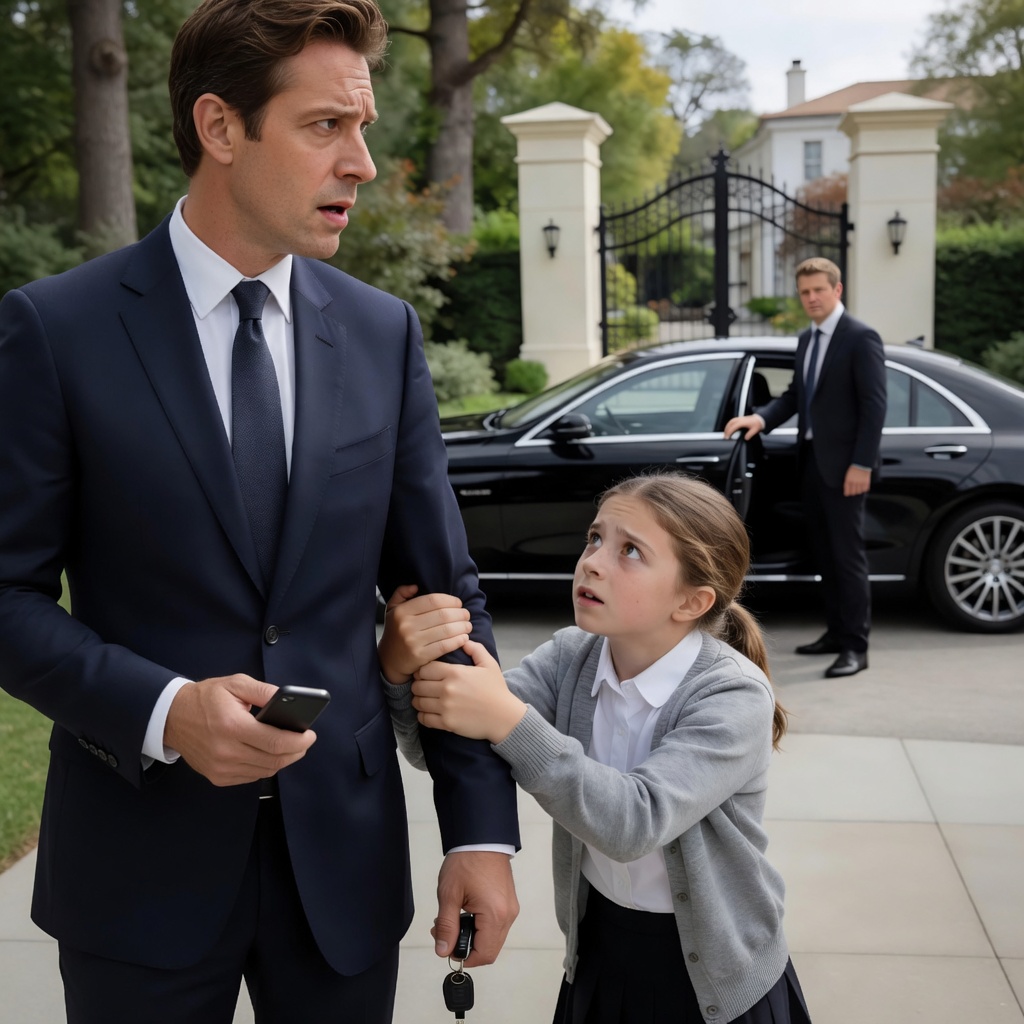

“Explain.”
Claire lifted one hand toward me. “Ethan, not here.”
I let out a quiet laugh. It did not feel like mine. “A child just called you Mom in front of a hundred people, and your ex somehow knows who I am. I think ‘not here’ passed us about thirty seconds ago.”
Marcus glanced around. “There’s a private lounge down the hall.”
“I wasn’t asking you,” I said.
Claire touched my arm. “Please. Just five minutes. I promise I can explain.”
The problem with loving someone is that your heart keeps reaching for them even when your mind starts backing away.
I wanted to walk out.
I wanted to demand the truth right there.
I wanted to ask why a little girl had looked at my fiancée like she was the safest place in the world.
But Claire’s hand was shaking, and some stupid, loyal part of me still believed there had to be a reason. A misunderstanding. A painful history she had not known how to tell me. Something complicated, but not unforgivable.
So I followed them.
The private lounge was smaller, dimmer, and lined with leather chairs. The music from the ballroom became muffled the second Marcus closed the door behind us.
Claire stood near the window, arms wrapped around herself.
I stayed by the door.
Marcus did not sit either.
“Start talking,” I said.
Claire closed her eyes. “Lily is not my daughter.”
I waited.
“She isn’t,” Claire said again, more desperately this time. “Biologically, she isn’t mine.”
Marcus’s face hardened slightly. “That’s not the whole truth.”
Claire shot him a warning look. “Marcus, don’t.”
I stared at her. “Don’t what?”
Silence.
It stretched long enough that I could hear my own breathing.
Finally, Marcus said, “Claire helped raise Lily for almost three years.”
The words entered my mind slowly, like they were in a language I almost understood.
“Helped raise her,” I repeated.
Claire covered her mouth with one hand.
Marcus continued, “Lily’s biological mother left when she was nine months old. Claire and I were together then. She moved in with me not long after. Lily started calling her Mom before she turned two.”
I looked at Claire.
Three years.
Not a weekend. Not a temporary babysitting arrangement. Not a sad child confused by a friendly woman at a charity event.
Three years.
Claire had lived with Marcus. Raised his daughter. Been called Mom.
And in three years with me, she had never said a word.
“You told me you and Marcus dated for eight months,” I said.
Claire’s face crumpled.
“I know.”
“You told me it was a short, toxic relationship.”
“It was toxic.”
“You told me you hadn’t spoken to him since before we met.”
She looked down.
Marcus gave a low, humorless laugh. “That part is interesting.”
I turned to him. “Meaning?”
Claire snapped, “Marcus, stop.”
“No,” I said. “Let him talk.”
Marcus looked at me for a long moment, and for the first time, I saw exhaustion beneath the polish. “She saw Lily last month.”
The room went still.
My mouth went dry.
“Last month,” I said.
Claire whispered, “It was one time.”
Marcus shook his head. “It was not one time.”
I felt something inside me begin to break quietly. Not dramatically. Not like in movies, where people scream and throw glasses. More like a crack spreading through ice.
“How many times?” I asked.
Claire did not answer.
Marcus did. “About once every few weeks for the past year.”
I stared at her.
The past year.
The year we were planning our wedding. The year we picked table linens, tasted cakes, debated vows, and toured venues. The year she cried in my arms because she said marriage felt sacred to her and she wanted us to enter it with complete honesty.
Once every few weeks, she had been seeing her ex and his daughter.
“Were you sleeping with him?” I asked.
Claire’s head snapped up. “No.”
Marcus said nothing.
That silence was enough to make my blood turn cold.
Claire turned on him. “Tell him.”
Marcus looked at me. “We haven’t been sleeping together.”
I believed him more than I believed her, and that hurt in a way I did not have words for.
“Then what is this?” I asked. “What have you been doing?”
Claire stepped toward me. “Lily got sick last year.”
I blinked.
“She had pneumonia,” Claire said, voice trembling. “It was bad. Marcus called me because Lily kept asking for me. I hadn’t seen her in years, Ethan. I tried to stay away. I did. But she remembered me. She remembered songs I used to sing to her. She remembered how I did her hair. She kept asking why Mom didn’t come.”
I looked away because the pain in her voice was real, and I hated that it still affected me.
“I went to the hospital,” she continued. “I told myself it would only be once. Just to comfort her. But then she started improving, and Marcus asked if I could visit again. Then it became lunches. Birthdays. School events. I know I should have told you.”
I laughed once. “Should have?”
Her eyes filled with tears. “I was scared.”
“Of what? Me knowing you had a past?”
“Of you thinking I still belonged to them.”
I looked at the engagement ring on her finger. “Did you?”
“No.”
The answer came fast.
Too fast.
Marcus crossed his arms. “Claire, don’t lie to him more than you already have.”
She turned toward him, furious now. “I am not lying.”
“You were never honest with either of us.”
The sentence hit the room like thunder.
Claire went pale again.
I looked between them. “Either of us?”
Marcus exhaled, then ran a hand over his face. “She told Lily you were her coworker.”
I stared at Claire.
“What?”
Claire cried, “I didn’t know how to explain!”
Marcus’s voice sharpened. “You told my daughter you were busy because of work. You told her Ethan was someone from your office. She didn’t even know you were engaged until she saw the ring tonight.”
I felt like the floor had shifted beneath my feet.
“You hid me from a child?”
Claire pressed both hands against her temples. “I was trying to protect her.”
“No,” I said quietly. “You were trying to protect yourself.”
She looked at me then, and the tears finally spilled.
“Ethan, please. You have to understand. I loved Lily. I still love her. Leaving Marcus meant leaving her, and it almost destroyed me. I couldn’t talk about it because I didn’t know how to grieve a child who was still alive but not mine.”
For a second, I could see it.
Not forgiveness. Not acceptance.
But the shape of the wound.
Claire had entered a little girl’s life, become her mother in every way that mattered to a toddler, then lost her when the relationship ended. There was tragedy in that. Real tragedy. The kind nobody teaches you how to explain on a first date.
But tragedy did not excuse deception.
It did not explain why she let me build a life on missing pages.
“You could have told me,” I said. “At any point.”
“I know.”
“When we got serious.”
“I know.”
“When I proposed.”
Her face twisted.
“When we started planning a wedding.”
“I know.”
“When you began seeing them again.”
She sobbed once, quietly.
“You had a year,” I said. “A full year to tell me. Instead, you made me look like a stranger in my own relationship.”
Marcus looked away, giving us some version of privacy.
I suddenly felt humiliated. Not because Lily had called Claire Mom. Lily was innocent. She was the only person in that ballroom who had told the truth.
I felt humiliated because everyone else seemed to have known more than I did.
Marcus knew me.
Lily knew there was a man named Ethan, even if she had been lied to about who I was.
Claire’s coworkers probably knew. The woman watching Lily probably knew. Maybe everyone in this polished little charity circle knew that Claire Whitman had once been Lily’s almost-mother.
Everyone except the man she was about to marry.
I reached for the door.
Claire rushed forward. “Where are you going?”
“Home.”
“Ethan, please don’t leave like this.”
I turned back to her. “How else should I leave?”
“We can talk.”
“We are talking.”
“No, I mean really talk. Away from him. Away from all this.”
Marcus said quietly, “Claire, let him go.”
She glared at him. “You don’t get to decide that.”
“No,” I said. “He doesn’t. I do.”
I opened the door.
The ballroom noise spilled back in. Music. Laughter. Applause from some donation announcement I had missed.
Claire whispered my name behind me.
I did not turn around.
I walked through the crowd with my head high because pride is sometimes the only thing holding a person together. I passed Lily near the donation table. She looked up at me with curious, worried eyes.
“Is Mom mad?” she asked.
The word hit me differently this time.
I crouched down slightly so I would not seem like another adult towering over her with secrets.
“No,” I said gently. “She’s just having a hard night.”
Lily nodded as if she understood hard nights better than a child should. “She cries after she visits sometimes.”
I went still.
“She does?”
Lily nodded again. “Dad says grown-ups cry when they love people they can’t keep.”
I swallowed.
Out of the mouths of children.
“Your dad sounds like he knows a lot about that,” I said.
Lily looked toward the lounge door. “Are you Mom’s boyfriend?”
I hesitated.
Six weeks ago, the answer would have been simple.
“Yes,” I said finally. “Something like that.”
She smiled sadly. “She didn’t tell me she had a boyfriend.”
“I know.”
Then she said the thing that stayed with me longer than anything Claire or Marcus said that night.
“Grown-ups forget kids can tell when they’re lying.”
I stood slowly.
“Yes,” I whispered. “They do.”
Then I left.
I drove home alone through streets blurred by traffic lights and the kind of silence that makes your own thoughts unbearable. Claire called before I had even reached the freeway. I let it ring. Then she texted.
Please come home.
Then:
Please let me explain without Marcus there.
Then:
I love you. I have always loved you.
Then:
Nothing happened between us. I swear on everything.
I did not respond.
When I reached the townhouse we had rented together for two years, I sat in the car for ten minutes staring at the front door.
It was such an ordinary door.
Blue paint. Brass handle. A wreath Claire had bought from a fall market even though it was spring because she said “home should feel like a season you want to remember.”
Behind that door were our wedding invitations stacked on the dining table. Her shoes by the entryway. My coffee mug in the sink. A half-finished seating chart. The life we had built, still standing, unaware that its foundation had cracked.
I went inside.
For a while, I did nothing dramatic.
I took off my jacket.
I hung it in the closet.
I poured a glass of water.
Then I walked to the dining table and picked up one of the wedding invitations.
Ethan Cole and Claire Whitman request the honor of your presence…
I stared at our names until they stopped looking real.
Claire came home forty-three minutes later.
I knew because I had been watching the clock like it owed me an answer.
She opened the door quietly, as if noise might make things worse. Her makeup was smudged beneath her eyes. She had taken off her heels and held them in one hand. For a second, she looked so broken that my instinct was still to stand and comfort her.
I hated that instinct.
“Ethan,” she said.
I sat at the dining table. “Tell me everything.”
She nodded, setting her shoes down near the door. “Okay.”
“No soft version. No careful version. Everything.”
She pulled out the chair across from me but did not sit until I gave a slight nod.
Then she told me.
Not all at once. Not cleanly. The truth came out in pieces, tangled with shame and tears and long silences.
She had met Marcus when she was twenty-four and working at a boutique advertising agency. He was older by six years, recently abandoned by Lily’s mother, overwhelmed, brilliant, and wounded. Claire had fallen for both of them, though she admitted she did not realize at first that loving a man with a baby meant becoming part of the baby’s world too.
“She was so small,” Claire said, staring at her hands. “She used to fall asleep with one hand wrapped around my necklace. I thought I was helping. I thought I was just being kind. Then one day she called me Mama, and Marcus cried, and I…”
Her voice broke.
“You became a family,” I said.
She nodded.
For nearly three years, Claire lived with Marcus and Lily. She packed lunches. Went to pediatric appointments. Took Lily to the park. Learned which stuffed animal had to be in the bed before Lily would sleep. She helped choose preschools. She stayed up during fevers. She sang the same old song every night.
Then the relationship with Marcus collapsed.
Not because of cheating, she said. Because of control, dependency, resentment, and the impossible imbalance of loving a child she had no legal right to. Marcus wanted her to stay for Lily, even when the romantic relationship was dead. Claire wanted to adopt Lily or at least become a legal guardian in some limited way. Marcus refused because, in his words, “you don’t need paperwork if you’re not planning to leave.”
That sentence told me more about Marcus than any insult could have.
Eventually, after one brutal fight, Claire packed a bag and left.
Lily was four.
“She screamed when I walked out,” Claire whispered. “She thought I was abandoning her. And I was. No matter how I explain it, I was.”
“Did you ever try to see her after?”
“For a while, yes. Marcus let me come twice. Then he stopped answering. He said it confused her. Maybe he was right. Maybe he just wanted to punish me. I don’t know. I went to therapy. I tried to move on. Then I met you.”
I leaned back.
“And you decided none of this was worth mentioning?”
She flinched.
“I told myself it was too heavy for the beginning,” she said. “Then we got happy. And the happier we got, the harder it became to tell you there was this whole part of me that still hurt.”
“That’s not an answer.”
“I was afraid you’d think I was damaged.”
“I asked you about Marcus directly.”
“I know.”
“You lied directly.”
“Yes.”
There was no defense in her voice now. Only exhaustion.
“Then last year,” I said, “he called.”
Claire nodded. “Lily was in the hospital. Marcus said she was scared and kept asking for me. I didn’t tell you because I thought you’d say no.”
I stared at her. “Did you really think that little of me?”
“No,” she said quickly. “I thought that little of myself. I knew if I told you the whole story, I would have to admit I still wanted to see her. And if you looked hurt, I didn’t know if I would be strong enough to go anyway. So I made the decision alone.”
There it was.
The quiet arrogance of secrecy.
People always act like lies are born from fear, but sometimes they are born from the belief that only one person has the right to choose.
“You decided I didn’t get a say in my own life,” I said.
Claire cried silently.
“Were you ever going to tell me?” I asked.
She looked at the table.
That was answer enough.
“Claire.”
“I wanted to,” she whispered.
“That’s not what I asked.”
She closed her eyes. “I don’t know.”
The words hurt more than another lie would have.
Because they were finally honest.
I stood and walked to the kitchen window. Outside, our street was quiet. A neighbor’s porch light flickered. Somewhere, a dog barked.
Behind me, Claire said, “I love you, Ethan.”
“I know.”
“I don’t want Marcus. I don’t want that life back.”
“What do you want?”
“You.”
“And Lily?”
She was silent.
I turned.
She looked at me with red eyes. “I don’t know how to stop loving her.”
I believed her.
That was the tragedy.
I believed that Claire loved me. I believed she loved Lily. I believed she did not want Marcus romantically. I believed she had been carrying a grief so complicated it had twisted into secrecy.
But love is not only measured by what people feel.
It is measured by what they choose when the truth is inconvenient.
“You can love Lily,” I said carefully. “But you cannot marry me while hiding an entire motherhood-shaped piece of your life.”
She nodded frantically. “Then I’ll tell you everything now. We can postpone the wedding if we need to. We can go to counseling. I’ll do anything.”
The word postpone hung in the air.
Six weeks.
Guests had booked flights. Deposits had been paid. My mother had already altered her dress. Claire’s vows were probably saved in some folder on her laptop.
But none of that mattered if I could not look at her and know she was telling me the truth.
“I’m sleeping in the guest room,” I said.
Her face fell.
“Ethan—”
“I need space.”
She nodded, crying harder now. “Okay.”
I took a blanket from the hall closet and went upstairs.
I did not sleep.
The next morning, Claire made coffee and placed a mug outside the guest room door like a peace offering. I left it there until it went cold.
Over the next few days, we lived like ghosts in the same house.
She offered to answer questions. Sometimes I asked them. Sometimes I did not want to know more. That is the strange thing about betrayal. You crave details because details feel like control, but every answer becomes another image you cannot unsee.
I learned that Marcus had been texting Claire regularly.
Not romantic messages, according to her. Mostly about Lily. School updates. Photos. Questions about whether she could attend a recital. Whether she could help with a birthday party. Whether she knew where Lily’s old stuffed rabbit had come from.
Claire showed me the messages.
She did not volunteer them at first. I asked.
That mattered.
As I scrolled, I saw nothing explicitly sexual. No love confessions. No late-night “I miss you” messages from Claire.
But I saw intimacy.
A different kind.
Marcus sending a photo of Lily asleep with the caption: She asked for your song again.
Claire replying: Tell her I love her to the moon.
Marcus texting: She drew us as a family today. I didn’t know what to say.
Claire replying: Don’t correct her tonight. Let her have the comfort.
Us.
Family.
Comfort.
Every message was a thread tied around a part of Claire I had never been allowed to touch.
Then I saw one from three months earlier.
Marcus: Does Ethan know yet?
Claire: Not yet.
Marcus: You can’t keep living two lives.
Claire: I’m not living two lives.
Marcus: Then why does Lily think he’s your coworker?
Claire: Because I panicked.
Marcus: She deserves better.
Claire: I know.
Marcus: So does he.
I stared at that message for a long time.
So does he.
I hated Marcus for knowing that before I did.
I handed the phone back.
Claire looked small on the couch beside me. “I’m sorry.”
“You were warned.”
“Yes.”
“By him.”
“Yes.”
“And you still didn’t tell me.”
She nodded.
I stood.
“I need to cancel the wedding.”
She gasped softly, as if the words had physically struck her.
“Cancel?” she whispered.
“At least for now.”
“Ethan, please. Postpone it. Don’t cancel.”
“What is the difference to you?”
“Cancel sounds like you’ve already decided.”
I looked at her.
“I haven’t decided everything,” I said. “But I’ve decided I’m not marrying someone I don’t know.”
She covered her face.
Calling our families was brutal.
My mother cried, not because she was angry about the wedding, but because she heard something in my voice that told her I was not okay. My father got quiet in the way men get when they are trying not to say something destructive. Claire called her parents herself. I could hear her sobbing through the bedroom wall.
We told people the wedding was canceled due to personal reasons.
Personal reasons.
A polite little phrase for a collapsed future.
For the next week, Claire moved through the house like someone awaiting sentencing. She started therapy twice a week. She wrote me a letter every night and left it on the dining table. I read some. Others I could not bear to open.
In one letter, she wrote:
I think I hid Lily from you because I was afraid there was no version of the truth where I got to keep everyone I loved. So I chose dishonesty and pretended it was protection. I know now that protection without consent is control.
That line stayed with me.
Protection without consent is control.
Maybe her therapist gave it to her. Maybe she found it herself. Either way, it was true.
Then, nine days after the gala, Marcus called me.
I almost did not answer.
But some part of me wanted to know what he could possibly say.
“Ethan,” he said when I picked up. “I know I’m probably the last person you want to hear from.”
“You’re in the top three.”
A faint sigh. “Fair enough.”
“What do you want?”
“I wanted to apologize.”
I said nothing.
“I knew Claire hadn’t told you everything,” he said. “I pushed her to, but I also kept letting her come around. That made me part of the lie.”
“Why did you?”
He paused. “Because my daughter loves her.”
That answer was simple enough to hurt.
“And because you still love Claire?” I asked.
He was quiet for a beat too long.
“I love who she was in our home,” he said finally. “I love what she gave Lily. But no, I’m not trying to get her back.”
“Does Claire know that?”
“Yes.”
“Does Lily?”
His breath caught slightly. “Lily is seven. She knows what she feels. She doesn’t understand adult boundaries. That’s my fault.”
I walked to the window, phone pressed to my ear.
“She told me I was Claire’s coworker.”
“I know. I corrected it after the gala.”
I closed my eyes. “How did she take it?”
“Badly.”
That one word carried a world.
“She asked if Claire was getting a new family,” Marcus said. “Then she asked if she was being left again.”
I opened my eyes.
For all my anger, I had not stopped thinking about Lily. Her small hand clutching Claire’s dress. Her solemn voice saying grown-ups forget kids can tell when they’re lying.
“She shouldn’t have been put in that position,” I said.
“I agree.”
“Then why are you calling me?”
Marcus exhaled. “Because Claire wants to see Lily again, and I told her no unless you were part of the conversation.”
I almost laughed. “You want me involved now?”
“Yes.”
“Little late.”
“I know.”
I should have hung up.
Instead, I asked, “Why?”
“Because if Claire is going to be in Lily’s life, it cannot be as a secret. Not from you, not from Lily, not from anyone. And if she’s not going to be in Lily’s life, then she needs to stop reopening the wound.”
I hated how reasonable that sounded.
Marcus continued, “I’m not asking you to approve anything. I’m asking you to understand that Lily is attached to someone who may or may not stay. And right now, the adults need to decide before she pays for our confusion again.”
Our confusion.
He was including me now, though none of this had been my choice.
“I’ll think about it,” I said.
That evening, I told Claire about the call.
She sat across from me at the dining table, hands clasped, face pale.
“What do you want?” I asked.
She did not answer quickly this time.
“I want Lily to be okay,” she said.
“And what do you want for yourself?”
Her eyes filled again. “I want to stop being a coward.”
It was the first answer that did not sound like she was trying to save the wedding.
Two days later, I agreed to meet Marcus and Lily at a park.
Not for Claire.
For myself.
And maybe for the little girl who deserved at least one adult willing to stand in the truth.
Claire came too, but we arrived separately. That was my condition. We were not presenting ourselves as a happy couple. Not to Lily. Not to anyone.
The park was bright with late morning sun. Children climbed over a wooden playground shaped like a castle. Parents sat on benches with coffee cups and tired eyes. An American flag moved gently above a nearby community center, snapping softly in the breeze.
Lily saw Claire first.
She ran toward her, then stopped halfway, uncertain.
That hesitation hurt more than the running had.
Claire crouched down, tears already in her eyes. “Hi, sweetheart.”
Lily looked at Marcus. He nodded.
Then she walked, slowly this time, into Claire’s arms.
Claire held her like she was afraid to hold too tight.
I stood a few feet away with Marcus.
Neither of us spoke for a while.
Finally, Lily looked over Claire’s shoulder at me. “Are you really her fiancé?”
I stepped closer and crouched so we were eye level.
“I was,” I said gently. “Right now, Claire and I are figuring some things out.”
Lily frowned. “Because she lied?”
Claire closed her eyes.
I glanced at Marcus, but he did not interfere.
“Yes,” I said. “Because she lied.”
Lily turned back to Claire. “You said he was from work.”
Claire nodded, crying openly now. “I did. And that was wrong. I’m so sorry, Lily.”
“Why did you lie?”
Claire wiped her face. “Because I was scared and selfish. I thought if I told the truth, I might lose people I loved. But lying hurt everyone more.”
Lily absorbed that with the grave seriousness only children can have.
“Are you leaving again?” she asked.
Claire looked like the question had cut through her.
She looked at Marcus. Then at me. Then back at Lily.
“I don’t know what my place should be,” Claire said carefully. “But I know I should never make promises I can’t keep. So I won’t promise I’ll be your mom the way I was before. But if your dad agrees, and if it’s healthy for you, I would like to be someone who loves you and visits you honestly.”
Lily’s eyes filled. “But I want you to be Mom.”
Claire pulled her close.
“I know,” she whispered. “I know, baby.”
I had to look away.
There are kinds of heartbreak that do not fit neatly into blame.
For the next hour, we sat at a picnic table and talked in the clumsy, painful way adults talk when a child’s heart is on the line. Marcus had already found a child therapist for Lily. Claire agreed that any future contact would be structured, honest, and guided by professional advice. No surprise visits. No pretending. No letting Lily believe Claire might move back into a role no one had defined.
Then Lily asked if I wanted to see her drawing.
She pulled a folded paper from her little backpack. It showed four stick figures under a big yellow sun. Marcus. Lily. Claire. And a fourth person labeled “Efin.”
I stared at it.
“That’s me?” I asked softly.
She nodded. “I didn’t know how to spell Ethan.”
“That’s okay,” I said. “I’ve been called worse.”
She giggled.
Claire watched me with an expression I could not read.
On the drive home, I realized something that made my chest ache.
I did not hate Claire.
Even after everything, I did not hate her.
But love without trust is a house with beautiful windows and no floor. You can admire the light all you want. You still cannot live there.
That night, Claire and I sat in the living room.
No television. No music. Just the hum of the refrigerator and the faint sound of cars outside.
“I saw how you were with her,” Claire said.
“She’s a good kid.”
“She liked you.”
I nodded.
Claire twisted the ring on her finger. “Do you think there’s any way back for us?”
The question I had been avoiding finally stood between us.
I looked at the woman I had planned to marry. The woman who made rainy Sundays feel warm. The woman who knew exactly how I took my coffee, who cried at old dog commercials, who danced barefoot in the kitchen when she thought I was not watching.
I also saw the woman who had lied to me for years.
Both were real.
That was the hardest part.
“I don’t know if there’s a way back,” I said. “But I know there isn’t a way forward to the wedding we planned.”
She nodded slowly, tears sliding down her cheeks.
“I can earn your trust back,” she whispered.
“Maybe.”
“Do you want me to try?”
I was quiet for a long time.
“Yes,” I said finally. “But not as my fiancée.”
Her breath caught.
I looked at the ring on her hand.
“I need you to give it back.”
She covered it instinctively, then seemed ashamed of the gesture. With trembling fingers, she slipped off the ring and placed it on the coffee table between us.
The small sound it made against the wood felt final.
Claire began to cry, silently at first, then with her whole body.
I did not comfort her.
Not because I wanted to punish her.
Because for once, I needed to let her feel the consequence without rescuing her from it.
Two weeks later, she moved into a short-term apartment across town.
We divided our things with the strange politeness of people trying not to bleed on the furniture. She took the blue wreath from the door. I kept the coffee maker. We canceled the venue. Returned gifts. Sent awkward messages. Endured sympathetic calls from relatives who wanted details we were not willing to give.
Claire continued therapy.
So did I.
For a while, we did not speak except about logistics.
Then, one Saturday afternoon, a letter arrived in my mailbox.
Not from Claire.
From Lily.
The handwriting was uneven, the spelling creative, the paper covered in stickers.
Dear Ethan,
I am sorry Claire lied to you. I told my dad lying makes stomachs hurt. He said yes. Thank you for not yelling at me when I called her Mom. I hope you are not sad forever. Claire says grown-ups can love people and still need space. I think space is boring but maybe good.
From Lily.
At the bottom, she had drawn another picture.
This one had three people: Lily, Marcus, and Claire, standing beside a small figure labeled Ethan, who was drawn a little farther away but still under the same sun.
I sat at my kitchen table for a long time holding that letter.
Then I cried for the first time since the gala.
Not angry tears.
Grief.
The kind that finally arrives when your body realizes no one is coming to fix the story.
Months passed.
Not dramatically. Not cinematically. Just one ordinary day after another.
I went to work. Came home. Cooked badly. Slept poorly. Got better slowly.
Claire and I began speaking again after three months, first through emails, then phone calls, then coffee in public places. She did not ask for the ring back. She did not pressure me. She answered questions without defensiveness. She told me when she saw Lily. She told me what the therapist recommended. She told me when she felt confused, ashamed, hopeful, scared.
For the first time since I had known her, Claire stopped trying to manage the version of herself I saw.
It made her messier.
It also made her more real.
One afternoon, we met at a quiet café near the river. She looked different. Not less beautiful, but less polished. Her hair was tied back, her makeup minimal, her eyes tired but steady.
“I need to tell you something,” she said.
My stomach tightened out of habit.
“Okay.”
“Marcus was offered a job in Seattle.”
I blinked. “Is he taking it?”
“Yes. In August.”
“And Lily?”
“She’s going with him.”
I watched her carefully. “How are you doing?”
Claire looked out the window. “Sad. But not destroyed.”
“That’s good.”
She nodded. “The therapist helped us explain things. Lily knows I love her. She knows I’m not her mother in the way she wanted me to be. We’re going to write letters. Video calls sometimes, if she wants. But Marcus and I agreed it’s better for her to build stability there.”
“That must be hard.”
“It is.” She looked back at me. “But I didn’t fight it just because losing her hurts me. That’s new for me.”
I believed that too.
Then she reached into her purse and pulled out a small envelope.
“I wrote this for you,” she said. “You don’t have to read it now.”
I took it.
“What is it?”
“A goodbye to the version of us I ruined.”
Her voice trembled, but she did not cry.
“And maybe,” she added, “an apology to the version of you who deserved the truth before he loved me.”
I looked down at the envelope.
“Claire…”
“I’m not asking for anything,” she said quickly. “I just wanted you to have it.”
That night, I read the letter.
It was not a plea.
That surprised me.
It was an inventory.
Not of excuses, but of choices. Every place she could have told the truth and did not. Every time fear became manipulation. Every way she had confused being needed with being loved. Every way she had made me pay for wounds I had not caused.
At the end, she wrote:
I used to think the worst thing would be losing you because of my past. Now I understand the worst thing was making you love a version of me that was incomplete. I am sorry I made you doubt your own place in my life. You were never second to Marcus, but I treated you like second to my fear. That was unfair, and I will regret it forever.
I folded the letter and placed it in my desk drawer.
Then I slept better than I had in months.
By August, Marcus and Lily moved to Seattle.
Claire told me the goodbye was painful but peaceful. Lily cried, of course. Claire cried too. But there were no dramatic promises. No “I’ll always be your mom.” No confusing declarations. Just love, boundaries, and a photo of the three of them at the airport with Lily holding a stuffed rabbit.
Claire sent me that photo and wrote:
This time, everyone knew the truth.
I stared at the message for a long time before replying.
Good.
A year after the canceled wedding, Claire and I met again at the same park where Lily had shown me her drawing.
It was early fall. The leaves had started to turn. The air smelled like cut grass and distant rain.
We walked side by side, not touching.
She told me she had stayed in therapy. I told her I had been promoted. She told me Lily was doing well in Seattle and now called her “Claire” most of the time, though sometimes “my old almost-mom” in letters. I laughed at that because it sounded exactly like Lily.
Eventually, we reached the community center. The flag above it moved gently in the wind.
Claire stopped walking.
“I still love you,” she said.
I looked at her.
There was no performance in her voice. No panic. No attempt to pull me back with tears.
Just truth.
“I know,” I said.
“Do you still love me?”
I looked across the park, at a father helping his son tie a shoe, at a woman pushing a stroller, at two teenagers sharing fries on a bench.
“Yes,” I said. “I do.”
Hope flickered across her face before she could stop it.
“But love isn’t the whole answer,” I continued.
She nodded slowly, and I could tell she already knew.
“I don’t know if I can build a marriage where the first foundation cracked that deeply,” I said. “Maybe someone else could. Maybe another version of me could. But I can’t.”
Her eyes filled, but she smiled through it.
“Thank you for telling me honestly.”
The simplicity of that sentence nearly broke me.
A year earlier, honesty had arrived like a wrecking ball.
Now it arrived like mercy.
“I want you to be happy, Claire,” I said.
“I want that for you too.”
We stood there for a moment, both of us grieving something that was no longer sharp but still tender.
Then she hugged me.
Not like a fiancée. Not like a woman trying to keep me.
Like someone saying goodbye with love instead of lies.
I held her for a few seconds, then let go.
Six months later, I received a postcard from Seattle.
The front showed a rainy skyline. The back was written in Lily’s uneven handwriting, though much improved.
Dear Ethan,
I spelled your name right this time. Claire says you are doing good. Dad says you were nice even when grown-ups were being dumb. I think that means you are a good grown-up. I hope you have a dog someday because you seem like a dog person.
From Lily.
P.S. Space is still boring but it works.
I laughed so hard I had to sit down.
I put the postcard on my refrigerator.
People sometimes ask why I kept it.
They think betrayal stories should end with revenge, with someone exposed under bright lights, with the liar ruined and the betrayed person walking away victorious. I understand that. There was a time I wanted that ending too.
But real life is often quieter and more complicated.
Claire did not become a villain.
Marcus did not become a hero.
Lily was not a plot twist.
And I was not saved by humiliating anyone.
I was saved by finally accepting that love without truth is not love you can safely live inside.
Claire and I did not get married.
We did not find our way back to each other romantically. By the time trust became possible again, the shape of us had changed too much. But we did find peace. Real peace. The kind built from honesty, distance, and the painful maturity of not forcing broken things to become beautiful just because you once imagined them that way.
Two years after the gala, I met someone new.
Her name was Anna. On our third date, she told me about her divorce, her anxiety, her complicated relationship with her brother, and the fact that she hated olives but kept pretending to like them because people at restaurants seemed offended when she picked them out of salads.
I told her about Claire.
All of it.
Not on the tenth date. Not after we had already fallen too far.
The third.
Anna listened without interrupting. When I finished, she reached across the table and touched my hand.
“That must have hurt,” she said.
It was such a simple response.
No suspicion. No judgment. No dramatic questions.
Just recognition.
“Yes,” I said. “It did.”
A year later, when I proposed to Anna, I did not do it in front of a crowd. I did it in our kitchen, while rain tapped against the windows and our badly behaved rescue dog tried to steal chicken from the counter.
She said yes with tears in her eyes.
Before we called anyone, I opened the drawer where I kept old letters and postcards. Claire’s apology was still there. Lily’s postcard too. Not because I was holding on to the past, but because those pieces of paper had taught me something I never wanted to forget.
Truth is not the enemy of love.
Truth is the only place love can stand without collapsing.
I did not invite Claire to the wedding. That would have been too much for everyone. But a week before the ceremony, I received one final letter from her.
Dear Ethan,
I heard from a mutual friend that you’re getting married. I wanted to say congratulations. I hope this love feels easy in the places where ours felt heavy. I hope she knows all of you, and I hope you never again have to beg for truth from someone who promised you forever.
Lily is twelve now. She is tall, dramatic, and convinced she will become either a lawyer or a singer depending on the day. She asked about you last month and said, “Tell Ethan I hope he got a dog.” I told her I would.
Thank you for being kinder than my choices deserved. Thank you for walking away without cruelty. Losing you forced me to become someone more honest. I wish I had become that person before I hurt you.
Be happy.
Claire.
I showed the letter to Anna.
She read it, then handed it back.
“She loved you,” Anna said.
“Yes.”
“And she hurt you.”
“Yes.”
“Both can be true.”
I smiled because that was exactly why I loved Anna.
On our wedding day, there were no shocking interruptions. No secret children calling anyone Mom. No exes appearing from the past. No hidden histories waiting in corners.
Just sunlight, vows, friends, family, and the woman in front of me choosing truth even when it was uncomfortable.
When Anna said, “I promise to be honest with you, especially when honesty is hard,” my throat tightened.
Because I knew the cost of the opposite.
Later, during the reception, my phone buzzed.
It was a message from an unknown number with a Seattle area code.
Hi Ethan. It’s Lily. Claire gave me your number because I wanted to say congratulations. She said only if it was okay and not weird. So congratulations. Also I was right. You ARE a dog person.
Attached was a photo of a golden retriever wearing a crooked bow tie, sitting beside a handwritten sign that said, Congratulations.
I laughed, then showed Anna.
She grinned. “Smart kid.”
“The smartest.”
I typed back:
Thank you, Lily. You were right about the dog.
Then I put my phone away and returned to my wife.
Not because the past meant nothing.
Because it no longer owned the room.
That night, as Anna and I danced under strings of warm lights, I thought about the little girl in the cream dress who had run across a ballroom and accidentally told the truth everyone else was afraid to say.
At the time, I thought she had destroyed my life.
But really, she had saved it.
She had exposed the crack before I built a marriage over it. She had forced all of us, especially Claire, to stop pretending love could survive in hidden rooms. She had reminded me that children notice lies, that silence is not kindness, and that being chosen in secret is not the same as being chosen fully.
My fiancée had said her ex was history.
But history is never gone just because someone refuses to read it aloud.
It waits.
It echoes.
And sometimes, it runs across a crowded ballroom in a little cream dress, wraps its arms around the person you love, and calls her “Mom” in front of everyone.
That was the night I lost the future I thought I wanted.
It was also the night I found the truth I needed.
And in the end, that truth gave me a life that did not have to be hidden from anyone.
![[FULL STORY] I Caught My Fiancee "Time-Traveling" To Her Past At A Secret Party While I Was Home Planning Our Future Together.](https://social-media.rabedo.com/thumbnails/1776996672_R4.png)
![[FULL STORY] She texted: "The wedding is on, but I’m spending the last few nights with my ex—to clear my heart."](https://social-media.rabedo.com/thumbnails/1776760900_1.png)
![[FULL STORY] On My 30th Birthday, My Wife Said She Forgot And Went Out With Friends I Tracked](https://social-media.rabedo.com/thumbnails/1777869542_15-.jpg)