
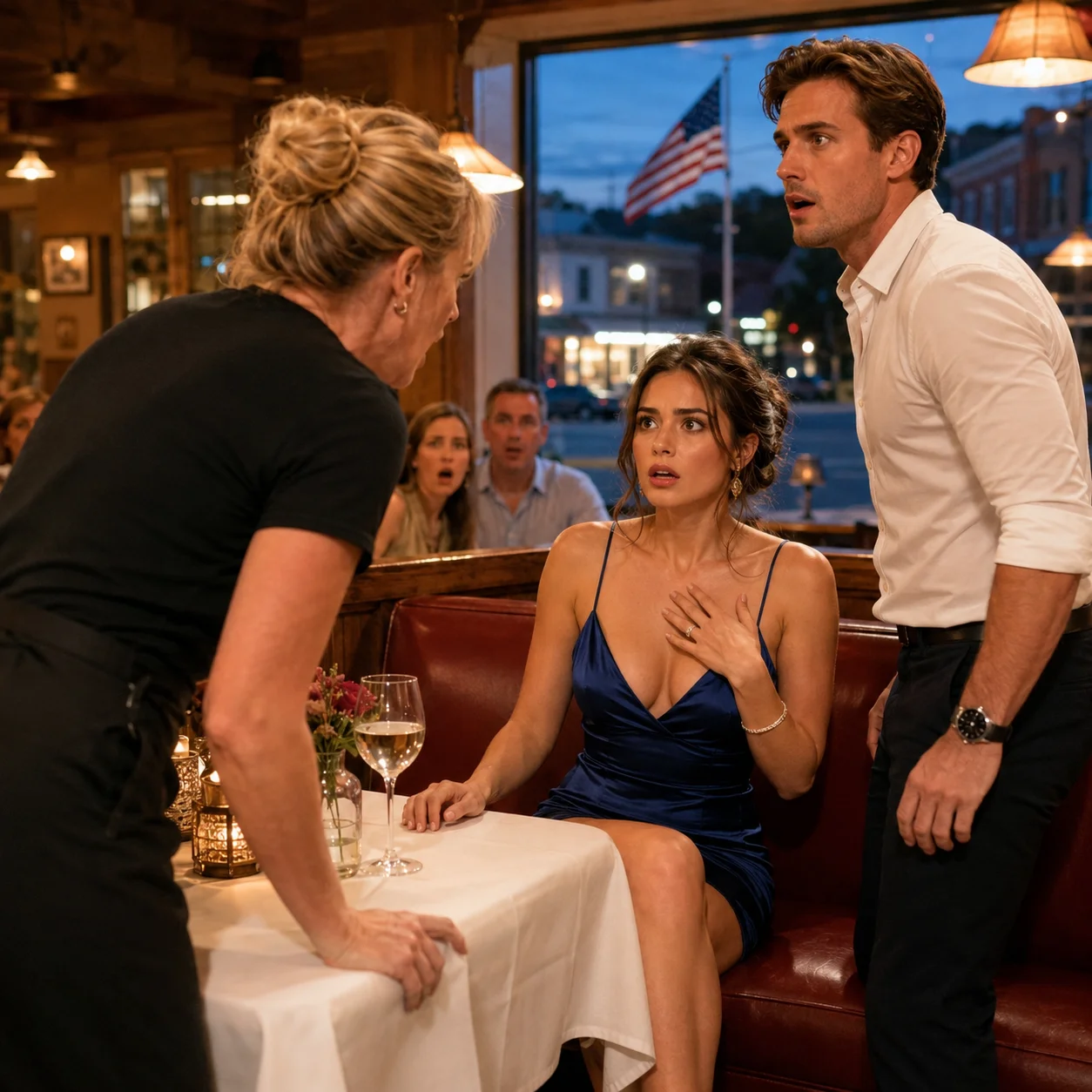
It was not dramatic at first. No gasp. No dropped tray. Just the smallest pause. A blink that lasted too long. A smile that froze before it fully formed.
Then Marcy said, “Well, I’ll be. Lauren Bennett.”
The name landed at the table like a glass shattering.
Lauren went completely still.
My mother’s smile faded slightly. My father looked from Marcy to Lauren, confused. Natalie, sitting beside me, lowered her menu.
Lauren’s face did not change much, but I felt her foot shift under the table. She recovered quickly.
“I’m sorry?” she said.
Marcy’s smile became uncertain. “Oh. I’m sorry, honey. I thought—”
“You must have me confused with someone else,” Lauren said, still polite, still soft, but there was steel underneath.
Marcy looked embarrassed. “Maybe so. You just look exactly like someone who used to come in here years ago. Same name too, I thought.”
“My name is Lauren Whitaker,” my fiancée said.
“Of course.” Marcy nodded quickly. “My mistake.”
She took our drink orders and left.
For a few seconds, no one spoke.
Then my mother gave a small laugh, the kind people use to cover discomfort. “Small-town mix-ups. Happens all the time.”
“Bennett?” Natalie asked casually.
Lauren smiled at her. “I’ve never used that name.”
I looked at Lauren. Her hands were folded neatly in her lap, but her knuckles were white.
“You okay?” I asked quietly.
“Of course,” she said. “That was just strange.”
It was strange.
But what made my stomach tighten was not that Marcy recognized her. People make mistakes. Faces resemble other faces. Names overlap. Small towns exaggerate coincidences.
It was the way Lauren reacted.
Like a person hearing a ghost speak.
Dinner continued, but the mood never fully recovered. My father tried to talk about the Steelers. My mother overpraised the food. Natalie watched Lauren with the sharp stillness of someone mentally filing every detail for later. Lauren performed calmness so well that anyone else might have believed her.
I did not.
When Marcy came back with dessert menus, she avoided Lauren’s eyes.
After dinner, while my father paid the bill, Lauren excused herself to the restroom. I waited about thirty seconds before standing.
Natalie caught my wrist.
“Don’t ambush her,” she murmured.
“I’m just going to check on her.”
“No, you’re going to ask her why a waitress called her by another name.”
I stared at my sister.
She looked back evenly. “Just don’t do it in a restaurant hallway.”
I sat back down.
Lauren returned two minutes later, looking composed again. On the drive home, she leaned her head against the window and said she had a headache. My mother fussed over her when we got back, offering tea, medicine, extra blankets. Lauren thanked her sweetly and said she just needed sleep.
In my old bedroom, with the door closed and the house quiet, I finally asked.
“Who is Lauren Bennett?”
She was brushing her hair in front of the mirror. The brush stopped halfway down.
“I told you. I don’t know.”
“Marcy seemed pretty sure.”
“She was mistaken.”
“She called you by your first name and a last name.”
Lauren set the brush down carefully. “Ethan, do you know how many Laurens there are in the world?”
“In Briar Glen?”
“I have never been here before.”
The words were clear. Too clear.
I sat on the edge of the bed. “Then why did you look scared?”
She turned around. “Because it was uncomfortable. Your entire family was staring at me like I had done something wrong.”
“I’m not accusing you.”
“You are.”
“I’m asking.”
“No, you’re doubting me because a waitress made a mistake.”
Her eyes filled with tears then, and I hated myself for the instant guilt that hit me. Lauren rarely cried during arguments. When she did, it made me feel like I had become cruel without noticing.
“I’m sorry,” I said. “It just caught me off guard.”
“It caught me off guard too.”
I stood and crossed the room. “Come here.”
She let me hold her, but she stayed stiff for a few seconds before softening against my chest.
“I love you,” she whispered. “Please don’t let this weekend turn into something ugly.”
“I don’t want that.”
“Then trust me.”
Trust me.
Those two words can feel like a promise when you are in love. Later, they can sound like a warning you ignored.
The next morning, Lauren acted normal. She helped my mother in the kitchen, laughed with my nephews, and kissed my cheek while I poured coffee. If anything, she was more affectionate than usual, touching my arm, leaning into me, making little jokes.
But something in me had shifted.
After breakfast, Natalie pulled me outside under the excuse of loading folding chairs into her car. The air was cold enough to sting.
“You’re thinking about it,” she said.
“Obviously.”
“Do you believe her?”
I looked toward the house. Through the kitchen window, I could see Lauren smiling at my mother.
“I want to.”
“That wasn’t my question.”
I exhaled. “I don’t know.”
Natalie leaned against her car. “I asked Mom if she remembered a Lauren Bennett. She didn’t. But she said the Bennett family lived on Birch Street years ago. Not sure if related.”
“Great. So now we’re investigating my fiancée based on one waitress.”
“No,” Natalie said. “You’re investigating because your fiancée lied with her whole body before she lied with her mouth.”
I did not answer.
Natalie softened. “Ethan, I’m not saying she’s evil. But before you marry someone, you need to know who they are.”
That sentence stayed with me long after the weekend ended.
We left Briar Glen Sunday afternoon. Lauren seemed relieved as we pulled onto the highway. She fell asleep after an hour, or pretended to. I drove with both hands tight on the wheel, replaying Marcy’s voice.
Lauren Bennett.
Back in Chicago, life resumed its normal shape, but I could not unhear that name.
For three days, I said nothing.
Then, on Wednesday night, while Lauren was showering, I did something I am not proud of. I searched her name online. Not Lauren Whitaker. Lauren Bennett.
At first, there were too many results. Wedding photographers, LinkedIn profiles, old school announcements. I narrowed it with “Briar Glen.” Nothing obvious. Then I tried “Lauren Bennett Pennsylvania.”
Still too many.
Then I typed “Lauren Bennett Briar Glen restaurant.”
A result appeared from an archived local newspaper page dated eleven years earlier.
The headline was small and ordinary:
LOCAL TEEN VOLUNTEERS AT SUMMER FUNDRAISER FOR MILLER FAMILY.
There was a grainy photo beneath it. A group of teenagers standing outside The Lantern House, holding donation jars.
Third from the left was Lauren.
Younger, yes. Seventeen or eighteen maybe. Darker hair. Rounder face. But unmistakably her.
The caption read:
Volunteers included Hannah Miller, Lauren Bennett, Casey Monroe, and Tyler Graves.
My skin went cold.
Lauren came out of the shower in a robe, towel around her hair, and found me staring at the laptop.
“What are you doing?” she asked.
I closed it too quickly.
Her expression changed.
“Ethan.”
I stood. “You told me you’d never been to Briar Glen.”
She looked at the laptop, then back at me. “What did you find?”
“That’s not an answer.”
Her face drained of color.
“What did you find?” she repeated, softer this time.
I opened the laptop and turned it toward her.
For several seconds, she did not move.
Then she sat on the edge of the bed like her legs had failed.
“Lauren,” I said carefully, “why is there a newspaper photo of you in my hometown under the name Lauren Bennett?”
She covered her mouth with one hand.
I expected denial. I expected anger. I expected another polished explanation.
Instead, she whispered, “I was hoping you’d never find that.”
The room seemed to tilt.
“So you lied.”
“Yes.”
One word. Quiet. Devastating.
I waited, but she did not continue.
“Why?”
Her eyes were glossy, but she did not cry. Not yet. “Because I was afraid if you knew, you would never look at me the same way.”
“Knew what?”
She stood and walked toward the window, wrapping her arms around herself.
“I lived in Briar Glen for six months when I was seventeen.”
“Why didn’t you tell me?”
“Because it was a terrible time in my life.”
“That’s not enough.”
She turned back. “My mother’s maiden name was Bennett. I used it for a while after my parents separated. We moved there because my mother had a cousin nearby. I hated it. I was miserable. I didn’t want to talk about it.”
“That still doesn’t explain why you swore you’d never been there.”
“I panicked.”
“For two years?”
She flinched.
I felt anger rising, not hot and explosive, but cold and steady. “You had countless chances to tell me. Every time I mentioned Briar Glen, every time my mother invited us, every time I asked if you’d been anywhere near there, you lied.”
“I know.”
“What happened there?”
She looked down.
And I knew then that the six-month story was only the first layer.
“What happened?” I repeated.
Lauren’s voice became flat. “There was a boy.”
The words hit harder than I expected, not because she had dated someone before me. Of course she had. We both had pasts. But because her face carried the look of someone approaching a locked room she never wanted opened.
“A boy from Briar Glen?” I asked.
“Yes.”
“Who?”
She hesitated.
“Lauren.”
“Tyler Graves.”
The name sounded familiar. It took me a second. Then I remembered the newspaper caption.
Tyler Graves.
My chest tightened. “He was in the photo.”
“Yes.”
“Who was he?”
She swallowed. “Someone I dated.”
“When you were seventeen?”
“Yes.”
I almost laughed, but nothing about this felt funny. “You hid an entire town from me because of a teenage boyfriend?”
Her eyes flashed. “It was not that simple.”
“Then make it simple.”
She sat down again, but this time she looked smaller than I had ever seen her.
“When I moved to Briar Glen, I was angry at everyone. My parents were divorcing. My father had started a new family before he ended the old one. My mother was drinking too much. I felt invisible.” She rubbed her palms against her knees. “Tyler was charming. Everyone liked him. He worked at The Lantern House after school. He made me feel like I mattered.”
I stayed silent.
“It became intense fast. Too intense. He was older than me by almost three years, already out of school, and I thought that made him exciting. My mother hated him. We fought constantly. Then I found out I was pregnant.”
The room went completely still.
I stared at her.
Pregnant.
The word opened a space between us I did not know how to cross.
“What happened?” I asked, my voice barely there.
“I lost it,” she said quickly. “Early. Before anyone except Tyler and my mother knew.”
I sat down slowly.
She kept talking, as if stopping would make it worse. “After that, everything fell apart. Tyler changed. Or maybe I finally saw him clearly. He was cruel. Possessive. He told people things about me. Ugly things. My mother took me out of town two weeks later. I went back to using Whitaker after the divorce was final, and I decided Lauren Bennett didn’t exist anymore.”
I did not know what to say.
Part of me felt sympathy. Real sympathy. She had been young. Hurt. Scared. It sounded traumatic.
But another part of me could not ignore the lie.
“Why didn’t you tell me any of this before we got engaged?” I asked.
“Because I was ashamed.”
“Lauren, I told you about my worst mistakes. I told you about my drinking after college, about losing my job, about therapy. I gave you the parts of myself I hated because I thought that was what we were building.”
“I know.”
“No, I don’t think you do.”
She looked at me then, tears finally spilling over. “I thought if I buried it deep enough, it wouldn’t matter anymore.”
“It mattered the second you lied.”
“I’m sorry.”
“Is Tyler still in Briar Glen?”
“I don’t know.”
That answer came too quickly again.
I stood up.
She saw it in my face. “Ethan, please.”
“Do you know where he is?”
She pressed her lips together.
“Lauren.”
“I know he still lives somewhere near there.”
“How?”
She closed her eyes.
And there it was. The next door.
“How?” I repeated.
“He reached out to me last year.”
My heart gave one hard, painful beat.
“Last year?”
“Yes.”
“Before or after we got engaged?”
“Before.”
“What did he want?”
“Nothing. He found me online. Sent a message.”
“Did you respond?”
She hesitated.
That was enough.
I turned away, running a hand over my face.
“Ethan, it wasn’t romantic.”
“Did you respond?”
“Yes.”
“How many times?”
“A few.”
“What does a few mean?”
She did not answer.
I laughed once, bitterly. “Of course.”
She stood quickly. “No. Don’t do that. Don’t turn this into something it wasn’t.”
“What was it, then?”
“He apologized. For how he treated me. For what happened back then.”
“And you kept that from me.”
“I didn’t want to reopen it.”
“You did reopen it. You just didn’t tell me.”
Her face crumpled. “I was trying to handle it alone.”
“You’re about to be my wife.”
“I know.”
“Do you?”
The silence after that felt endless.
That night, I slept on the couch.
Or tried to.
Around three in the morning, I got up and went to the kitchen for water. Lauren was sitting at the table in the dark, her phone in front of her, untouched.
“I’ll show you,” she said.
I stopped.
“The messages. I’ll show you.”
I wanted to say no. I wanted to say trust could not be rebuilt by scrolling through a phone under fluorescent kitchen light. But I also wanted the truth so badly it felt like hunger.
She unlocked her phone and opened an archived conversation.
Tyler Graves.
The first message was from eleven months earlier.
Hey Lauren. Not sure if you remember me. I’ve thought a lot about Briar Glen and wanted to apologize for who I was back then.
Her reply came two days later.
I remember. I don’t know what you expect me to say.
There were dozens of messages. Not hundreds, but enough. Tyler apologized. Lauren resisted. Then she softened. They talked about the past. He asked about her life. She said she was with someone. He said he was glad she was happy. She asked if he still lived near Briar Glen. He said yes, outside town.
The conversation should have ended there.
It did not.
There were messages about memories. Places they used to go. The fundraiser. The winter she left. The baby they lost.
My stomach tightened reading that part. Not because grief was wrong, but because I had never been invited into it.
Then I saw one message from Tyler that changed everything.
Does Ethan know his brother was the one who told everyone?
I looked up slowly.
“My brother?” I said.
Lauren closed her eyes.
I stared at her. “I don’t have a brother.”
“I know.”
“Then what does that mean?”
She took the phone back with shaking hands and scrolled farther.
“I need to explain.”
“You need to stop saying that and actually do it.”
She looked physically ill.
“When I lived there, I knew your family.”
I froze.
“What?”
“Not well. Not your parents personally. But I knew who you were.”
I could barely process the words. “You knew me?”
“I knew of you.”
“How?”
“You were in college then. You came home some weekends. Everyone talked about the Keller family because your dad helped people, your mom worked at the school, Natalie was popular.” She inhaled shakily. “I met Natalie once.”
My sister’s name in her mouth suddenly felt invasive.
“You said you didn’t know my family.”
“I didn’t think it counted.”
I stared at her, stunned by the absurdity.
“You didn’t think knowing my hometown, my sister, and some mysterious rumor involving my nonexistent brother counted?”
“It wasn’t your brother.”
“Then who?”
She looked down at the table.
“Mark.”
I went cold.
“My brother-in-law Mark?”
“He wasn’t your brother-in-law then. He and Natalie were dating.”
I gripped the back of the chair.
“What did Mark do?”
Lauren spoke carefully, as if one wrong word might break the room apart. “He was friends with Tyler. Not close, but enough. After I lost the pregnancy, Tyler told people. He made it sound like I had lied about it, like I was trying to trap him. Mark heard something, repeated it, and by the next week half the town knew. I was humiliated.”
I felt sick.
Mark. Quiet, dependable Mark, who came to family dinners and fixed my mother’s porch steps. Mark, who gave speeches about loyalty at Thanksgiving. Mark had been part of this?
“Does Natalie know?” I asked.
“I don’t know.”
“Did Mark know who you were when he met you in Chicago?”
“I don’t think so.”
“You don’t think so?”
“I looked different then. I used a different last name. It was eleven years ago.”
“But he might know.”
“Yes.”
The room felt airless.
Suddenly, Lauren’s reaction at The Lantern House made more sense. It was not just that her old name had surfaced. It was that my hometown was not an innocent place to her. It was tied to shame, grief, and possibly my own family.
But another question rose immediately.
“Why did you agree to marry me?” I asked.
Her head snapped up. “Because I love you.”
“Did you know who I was when we met?”
“No.”
“Don’t lie.”
“I’m not lying.”
“Lauren, you just told me you knew of my family.”
“I didn’t connect you to Briar Glen at first. Keller is not a rare name. You said you were from Pennsylvania, but not the town until later. By the time I realized, I was already falling in love with you.”
“And then you hid it.”
“Yes.”
“Because you were afraid of Mark?”
“Because I was afraid of all of it.”
I leaned against the counter, trying to breathe.
For two years, I had thought our story began at a charity auction beside a photograph of a storm. Now I could not tell whether our beginning was real or just the continuation of something I had never known existed.
The next day, I called Natalie.
I did not tell Lauren first. Maybe that was unfair. Maybe by then fairness had become impossible.
Natalie answered cheerfully. “Hey, little brother. Recovering from hometown trauma?”
“Do you remember a girl named Lauren Bennett?”
Silence.
Not confusion. Silence.
My stomach dropped.
“Natalie.”
She exhaled slowly. “Where did you hear that name?”
“So you do remember her.”
Another pause.
“Yes.”
“What do you remember?”
“Ethan, what’s going on?”
“What do you remember?”
Her voice changed. “She was only in town a short time. People were awful to her.”
“Was Mark involved?”
Natalie did not answer.
That was answer enough.
“I need the truth,” I said.
“I don’t know all of it.”
“Then tell me what you know.”
Natalie’s voice became quiet. “Mark repeated something Tyler told him. A rumor. I yelled at him for it when I found out. He said he didn’t realize how serious it was. I almost broke up with him.”
“Almost.”
“I was twenty. I was stupid.”
“Did you know Lauren lost a pregnancy?”
Natalie sucked in a breath.
“No,” she whispered. “I knew there was a rumor that she said she was pregnant. I didn’t know it was true.”
I closed my eyes.
“What did Mark say about her this weekend?” I asked.
“Nothing.”
“Did he recognize her?”
“I don’t know. He was quiet after dinner when I told him about Marcy calling her Bennett.”
“What did he say?”
“He said, ‘That was a long time ago.’”
My grip tightened on the phone.
So Mark knew.
My sister started crying softly. “Ethan, I’m sorry.”
“For what?”
“For not putting it together sooner. For bringing him around her. For everything.”
I did not have the energy to comfort her.
“Ask Mark if he recognized her.”
“I will.”
“No. Put him on the phone.”
“He’s at work.”
“Then tell him I’m coming this weekend.”
“Ethan—”
“I’m coming.”
When I hung up, Lauren was standing in the hallway.
“You called Natalie,” she said.
“Yes.”
Pain crossed her face. “You didn’t trust me to tell it.”
“You had two years.”
She nodded, absorbing the blow because she knew it was deserved.
“What happens now?” she asked.
“I’m going back to Briar Glen.”
Her eyes widened. “Why?”
“Because apparently everyone knows part of my fiancée’s life except me.”
“I don’t want to go back there.”
“I didn’t ask you to.”
She looked wounded. “You’re going without me?”
“I need to talk to Mark. And Marcy. Maybe Tyler.”
At Tyler’s name, she went pale. “No.”
“Why?”
“Because he ruins things.”
“He already did.”
She stepped closer. “Ethan, please. Don’t let him drag you into the past.”
“I’m already in it.”
She wrapped her arms around herself. “Then I’m going with you.”
“No.”
“Yes,” she said, firmer. “If this is about me, I’m not hiding behind you.”
I almost argued. But something in her expression had changed. Fear was still there, but underneath it was a kind of exhausted resolve.
So two days later, we drove back to Briar Glen.
The car ride was nothing like the first. No wedding playlist. No easy conversation. Just road noise and the weight of things unsaid.
This time, when we passed the town sign, Lauren did not pretend wonder. She stared at it like someone returning to the scene of a crime.
We went first to Natalie’s house.
Mark opened the door.
He was thirty-four, broad-shouldered, gentle-faced, wearing jeans and an old sweatshirt. He looked like a man who should have been safe. When his eyes landed on Lauren, I saw recognition flash before he buried it.
“You knew,” I said.
No greeting. No pretense.
Mark glanced at Natalie behind him. Her face was swollen from crying.
“Come in,” he said.
We sat in their living room. Lauren took the armchair farthest from Mark. I remained standing.
Mark rubbed his hands together. “I didn’t recognize her right away.”
“That’s a lie,” Lauren said quietly.
Mark looked at her.
For a moment, neither of them spoke.
Then he looked away. “I recognized you at dinner.”
Natalie made a small sound.
I stared at him. “And you said nothing.”
“I didn’t know what to say.”
“How about the truth?”
Mark’s jaw tightened. “I was twenty-three, Ethan. I repeated something I shouldn’t have. I’ve regretted it for years.”
Lauren laughed softly, without humor. “You regretted it so much you stayed silent when you saw me engaged to your wife’s brother.”
“I didn’t want to expose your past.”
“You mean your part in it.”
Mark flinched.
Natalie looked at him like she had never seen him clearly before.
“What exactly did you do?” I asked.
Mark leaned forward, elbows on knees. “Tyler told me Lauren was saying she was pregnant. He said she was lying to force him to stay with her. I mentioned it to someone at work. That’s all.”
“That’s all?” Lauren’s voice trembled. “By Monday, people were whispering when I walked into the diner. Girls at school called me desperate. Someone wrote ‘liar’ on my locker. My mother screamed at me because she thought I had told everyone. I had just lost a baby, and strangers were laughing about it.”
Mark’s face crumpled.
“I didn’t know,” he whispered.
“No,” Lauren said. “You didn’t care enough to know.”
The room went silent.
I had come for anger, but hearing Lauren say it like that shifted something in me. For the first time, I fully saw the seventeen-year-old girl beneath the polished woman. Not innocent in every choice, not honest now, but wounded in a way that had shaped every lie afterward.
Mark covered his face with both hands.
Natalie stood. “Did you ever apologize?”
He dropped his hands. “I didn’t know where she went.”
“You knew she was sitting across from you at dinner,” Natalie said.
He looked ashamed.
I turned to Lauren. “Do you want an apology from him?”
She stared at Mark for a long moment.
“No,” she said. “I want him to tell the truth to his wife. All of it. Because secrets rot everything they touch.”
The irony of her words hung between us.
She heard it too. Her eyes flicked to mine, then away.
After we left Natalie’s house, Lauren asked me to stop near the old park. We sat on a bench beneath bare trees, the town quiet around us.
“I know I’m a hypocrite,” she said.
I did not answer.
“I told Mark secrets rot everything, but I kept mine from you.”
“Yes.”
She nodded. “I’m not asking you to pretend I didn’t.”
“What are you asking?”
“For the chance to tell you everything. No more protecting myself. No more polished version.”
I looked at her. “Can you even do that?”
“I don’t know,” she admitted. “But I want to try.”
Before I could answer, my phone buzzed.
A message from an unknown number.
You should ask Lauren why she really came back.
Below it was a photo.
Lauren, younger but clearly adult, standing outside The Lantern House. Not seventeen. Older. Maybe twenty-five. The timestamp on the image was four years ago.
Four years ago.
Long before she met me, but long after she supposedly left Briar Glen forever.
I showed her the screen.
Her face went white.
“Ethan—”
“Who sent this?”
She closed her eyes.
“Tyler.”
The name had barely left her mouth when another message came in.
She didn’t tell you everything.
Lauren whispered, “Don’t respond.”
I stared at the photo.
“You said you never came back.”
“I came back once.”
“When?”
“Four years ago.”
“Why?”
She looked toward The Lantern House down the street, though it was not visible from the park.
“Because Tyler told me he had something of mine.”
“What?”
“A letter.”
I waited.
She swallowed hard. “After I lost the baby, I wrote a letter. To the baby. I know that sounds—”
“It doesn’t.”
Her eyes filled again. “My mother found it and gave it to Tyler somehow. I don’t know why. Maybe she thought he should feel guilty. Maybe she was drunk. Years later, he messaged me through an old account and said he still had it. I came back to get it.”
“And you didn’t mention that either.”
“No.”
“Did anything happen between you?”
“No.”
I looked at her.
“No,” she repeated, stronger. “I met him in a parking lot. He tried to talk. I took the letter and left.”
“Then why is he texting me like this?”
“Because Tyler likes control. If he can’t have a place in your life, he’ll make one by destroying it.”
My phone buzzed again.
Ask her about the motel.
I felt my body go cold.
Lauren saw the message and grabbed my wrist. “No. Ethan, listen to me.”
“The motel?”
“He followed me after I left the parking lot.”
“What does that mean?”
“It means he scared me. I was crying. I didn’t want to drive three hours back to the airport like that, so I stopped at a motel outside town. Alone.”
“Did he go there?”
“He showed up.”
I pulled my hand away.
“He showed up,” she said quickly, “and I called the front desk. I threatened to call the police. He left.”
“Why didn’t you tell me this when he contacted you last year?”
“Because I had already lied about Briar Glen, and telling one truth meant admitting all the lies.”
That was the most honest thing she had said.
And maybe the most painful.
I stood up from the bench and called the unknown number.
Lauren said my name, but I ignored her.
Tyler answered on the third ring.
“Well,” he said, voice smooth and amused. “Ethan Keller.”
“You want to talk?” I said. “Let’s talk.”
Lauren shook her head, terrified.
Tyler chuckled. “I’m surprised she let you call.”
“Where are you?”
“Close.”
“Of course you are.”
“Careful,” he said. “You don’t know me.”
“I know enough.”
“No, you know what Lauren tells you. That’s always been her gift. She makes herself the wounded one.”
My jaw clenched. “Meet me at The Lantern House.”
Lauren whispered, “Ethan, don’t.”
Tyler laughed. “Sentimental choice.”
“Thirty minutes.”
I hung up.
Lauren looked devastated. “You’re giving him exactly what he wants.”
“No,” I said. “I’m ending the part where everyone talks around me.”
Thirty minutes later, we walked into The Lantern House.
Marcy was working again. When she saw Lauren, then me, then the expression on my face, she seemed to understand immediately that the past had not stayed buried.
Tyler was already at the bar.
He was in his early thirties now, handsome in a careless way, with dark hair, a leather jacket, and the relaxed posture of someone who still believed charm could get him out of anything. When he saw Lauren, his smile softened in a way that made my skin crawl.
“Laurie,” he said.
“Don’t call me that,” she replied.
His smile sharpened.
We took a booth in the back. Lauren sat beside me, not across from me. That mattered more than I wanted it to.
Tyler leaned back. “So. How much has she told you?”
“Enough to know you’ve been harassing her.”
He laughed. “Is that what we’re calling honesty now?”
Lauren’s voice was steady. “You sent him photos to hurt me.”
“I sent him context.”
“You sent him pieces.”
Tyler looked at me. “Did she tell you she came back to see me?”
“She told me.”
“Did she tell you she stayed overnight?”
“Yes.”
His smile faltered slightly.
That was when I realized Lauren had told at least the main shape of the truth.
Tyler recovered. “Did she tell you she cried in my arms?”
Lauren went still.
I turned to her.
She closed her eyes. “In the parking lot. For maybe ten seconds. Then I pushed him away.”
Tyler smirked. “Memory is flexible.”
Marcy approached with coffee, though none of us had ordered it. She set the cups down hard, looked directly at Tyler, and said, “Still making women uncomfortable in public places, I see.”
Tyler’s expression darkened. “Stay out of it, Marcy.”
“No,” Marcy said. “I don’t think I will.”
Lauren looked up at her.
Marcy’s face softened. “I’m sorry I said your name the other night. I didn’t mean to expose anything.”
Lauren swallowed. “It’s okay.”
“It’s not,” Marcy said. Then she looked at me. “But since everything is already out, you should know something. Back then, Tyler lied about her. Everyone knows it now. Some of us knew it then and were too cowardly to say it.”
Tyler stood abruptly. “This is pathetic.”
“No,” Marcy said. “What was pathetic was a grown man letting a teenage girl take the blame for his cruelty.”
The restaurant had gone quiet around us.
Tyler looked at Lauren. “You always were dramatic.”
Lauren rose slowly.
For the first time since I had known her, she did not look polished. She looked furious. Not loud, not theatrical, but clear.
“I was seventeen,” she said. “I lost a pregnancy alone because you were too selfish to even sit with me in a clinic. Then you told people I made it up because you were afraid they’d think you were irresponsible. Years later, you used a letter I wrote in grief to drag me back here. And when I finally built a life without you, you tried to poison that too.”
Tyler’s face flushed. “You built a life on lies.”
“Yes,” Lauren said, and her voice broke slightly. “I did. And I’ll spend the rest of my life owning that. But my lies were born from shame. Yours were born from cruelty.”
No one moved.
Then Tyler looked at me with a thin smile. “Good luck marrying that.”
I stood.
For a second, I wanted to hit him. Every primitive part of me wanted the satisfaction of violence. But then I looked at Lauren, and I knew that giving Tyler a scene would only make him the center of her story again.
So I said, “I’m not here to defend marrying her. I’m here to make sure you understand something. Whatever happens between Lauren and me after today, you’re done using her past as entertainment.”
Tyler scoffed.
Marcy lifted her phone. “Funny thing about small towns, Tyler. Everyone knows a police officer.”
He looked around and realized the restaurant was no longer on his side.
For once, he had no audience to charm.
He left without finishing his coffee.
Lauren sat back down like her bones had given out.
I sat beside her.
Neither of us spoke for a long time.
That night, we stayed at a motel outside Briar Glen, not the same one from her story. We got separate rooms. She did not argue. I appreciated that.
Around midnight, there was a knock on my door.
Lauren stood outside in jeans and a sweater, her face bare, eyes tired.
“I wrote everything down,” she said, holding out several folded pages. “Timeline, names, messages, the parts I remember, the parts I avoided telling you. You don’t have to read it tonight. You don’t have to forgive me. But I wanted you to have the whole truth without making you drag it out of me.”
I took the pages.
“Thank you,” I said.
Her eyes filled with tears, but she nodded. “I love you, Ethan. I know that may not be enough.”
“It isn’t.”
She flinched.
I hated hurting her. I hated that the truth had made compassion and anger live in the same room inside me.
“But it matters,” I added.
She nodded again, then went back to her room.
I read the pages twice.
They did not make everything okay.
But they made things clearer.
Lauren had been a scared girl once. Then she became a woman who survived by controlling the narrative so tightly that even love felt like a threat to it. She had not cheated on me. She had not come into my life to manipulate my family. But she had lied. Repeatedly. Deliberately. She had taken away my chance to know who I was marrying.
Both things were true.
In the morning, we drove back to Chicago.
We did not talk much until we were two hours from the city.
Then Lauren said, “I’ll postpone the wedding.”
I glanced at her.
“I already emailed the planner,” she continued. “I didn’t cancel. Just asked what postponement would require.”
I felt something loosen painfully in my chest.
“You didn’t ask me first.”
“No,” she said softly. “I made one decision without forcing you to be the responsible one.”
I looked back at the road.
“What do you want?” she asked.
“I don’t know.”
“That’s fair.”
“I want to trust you again.”
“I know.”
“But wanting it doesn’t make it happen.”
“I know that too.”
For the first time, she did not plead. She did not cry to soften the moment. She simply sat beside me and accepted the consequence.
We postponed the wedding by a year.
People asked questions, of course. My mother worried. Her friends speculated. Vendors complained. Lauren told them the truth in the only way that belonged to them: we had personal things to work through before marriage. No dramatic details. No victim performance. No pretending everything was fine.
She started therapy two weeks later. Not because I demanded it, though I would have. Because she said she was tired of being loyal to fear.
We also went to couples counseling.
The first few sessions were brutal. I learned how much resentment can hide beneath calm sentences. Lauren learned that an explanation is not the same as accountability. I learned that empathy does not erase betrayal. She learned that privacy and secrecy are not the same thing.
Mark eventually apologized to Lauren in writing. She read the letter once and did not respond. Natalie separated from him for several months, not only because of what he had done years before, but because he had hidden his recognition of Lauren when truth mattered most. They worked on their marriage separately from us. I stopped trying to manage everyone’s healing.
Tyler sent two more messages. Lauren did not answer. I did not answer. She changed her number, documented everything, and sent one clear warning through an attorney. He disappeared back into whatever sad corner of the past still made him feel powerful.
A year passed.
Slowly, trust did not return like a grand romantic scene. It returned in small, unglamorous ways.
Lauren told me when something embarrassed her instead of hiding it. She let me see old photos. She introduced me to the parts of her history she had edited out. Some were painful. Some were ordinary. Some were even funny. The more truth she gave me, the less her past felt like a locked room between us.
And I had to do my part too.
I had to stop treating every hesitation like proof. I had to decide whether I wanted to rebuild or punish. That was harder than I expected. Anger can become a house if you stay in it long enough.
One evening, almost exactly a year after the first trip, Lauren asked if I would take her back to Briar Glen.
“Why?” I asked.
She looked nervous, but not afraid. “Because I don’t want that place to only be where I lied to you.”
So we went.
This time, we did not stay with my parents. We booked a bed-and-breakfast near Main Street. We visited my family. We walked through town. Lauren held my hand openly, even when people looked at her with recognition or curiosity.
On Saturday night, we went to The Lantern House.
Marcy saw us and smiled carefully.
“Well,” she said. “Table for two?”
Lauren smiled back. “Yes, please.”
No one called her Bennett. No one needed to.
At the end of dinner, Marcy brought dessert on the house. Apple pie with two forks.
Lauren laughed softly. “You didn’t have to do that.”
Marcy shrugged. “Small-town apology.”
Lauren looked down at the plate, then back up. “Thank you.”
After dinner, we walked outside into the cool night. Main Street was quiet, the old lamps glowing, the American flag outside the town hall moving gently in the wind.
Lauren stopped beside me.
“I need to ask you something,” she said.
My heart kicked once. “Okay.”
She reached into her coat pocket and pulled out my ring.
The engagement ring.
She had stopped wearing it after we postponed the wedding. I had not asked for it back, but she had kept it in a small velvet box on her dresser, untouched.
“I don’t want to assume I still have the right to wear this,” she said. “And I don’t want a wedding because we already planned one. I only want it if we choose it now, honestly.”
I looked at the ring, then at her.
The woman standing in front of me was not the flawless Lauren I had proposed to the first time. She was more complicated now. More human. Less perfect. More real.
And I realized I loved this version more, not because she had hurt me, but because she had finally stopped asking me to love a carefully edited version of herself.
I took the ring.
Her face trembled, but she did not look away.
I held it for a long moment.
Then I took her hand and slid it back onto her finger.
“I’m not marrying the story you told me at the beginning,” I said. “I’m marrying the woman who finally told me the truth.”
She cried then, but quietly.
Six months later, we got married in my parents’ backyard under the same kind of twinkling lights my mother had always imagined. It was smaller than our original wedding would have been. No grand ballroom. No two-hundred-person guest list. Just family, close friends, honest vows, and a woman who did not hide her shaking hands when she promised to never again make fear the keeper of our marriage.
During the reception, Natalie gave a toast that made everyone cry. My father danced badly. My mother kept touching Lauren’s face like she was making sure she was really there. Mark was not invited. That was Natalie’s choice, not ours.
Near the end of the night, Lauren pulled me aside.
“I used to think love meant being seen at your best,” she said.
I smiled. “And now?”
She looked across the yard at my family, at the lights, at the life we had almost lost before it began.
“Now I think it means being known at your worst and still choosing not to lie.”
I kissed her under the lights, not because everything had been easy, and not because every scar had vanished.
But because truth, once finally spoken, had given us something lies never could.
A beginning that was actually real.
![[FULL STORY] The first patrol car rolled up before the pizza even got there.](https://social-media.rabedo.com/thumbnails/1777371151_367a96d6-da71-4ad3-96dc-d731ceac6a8e.png)
![[FULL STORY] She Said: “My Life, My Rules—If You Don’t Like It, There’s The Door.” I Smiled. “Perfect.” What I](https://social-media.rabedo.com/thumbnails/1776396440_25256d92-5144-4e19-9b7f-84cbf77a3e23.png)
![[FULL STORY] My Girlfriend Said She Wouldn’t Speak Until I Learned My Lesson — So I Let the Silence End Us](https://social-media.rabedo.com/thumbnails/1777883886_5afeb185-6861-40fe-b8cd-f8f1726e2de5.png)
![[FULL STORY] She Said “Good Daughters Get Rewards”… So I Walked Out and Found the Family She Hid From Me](https://social-media.rabedo.com/thumbnails/1777667922_328ad42e-a3f1-40f7-9de8-a868e87f4940.png)