
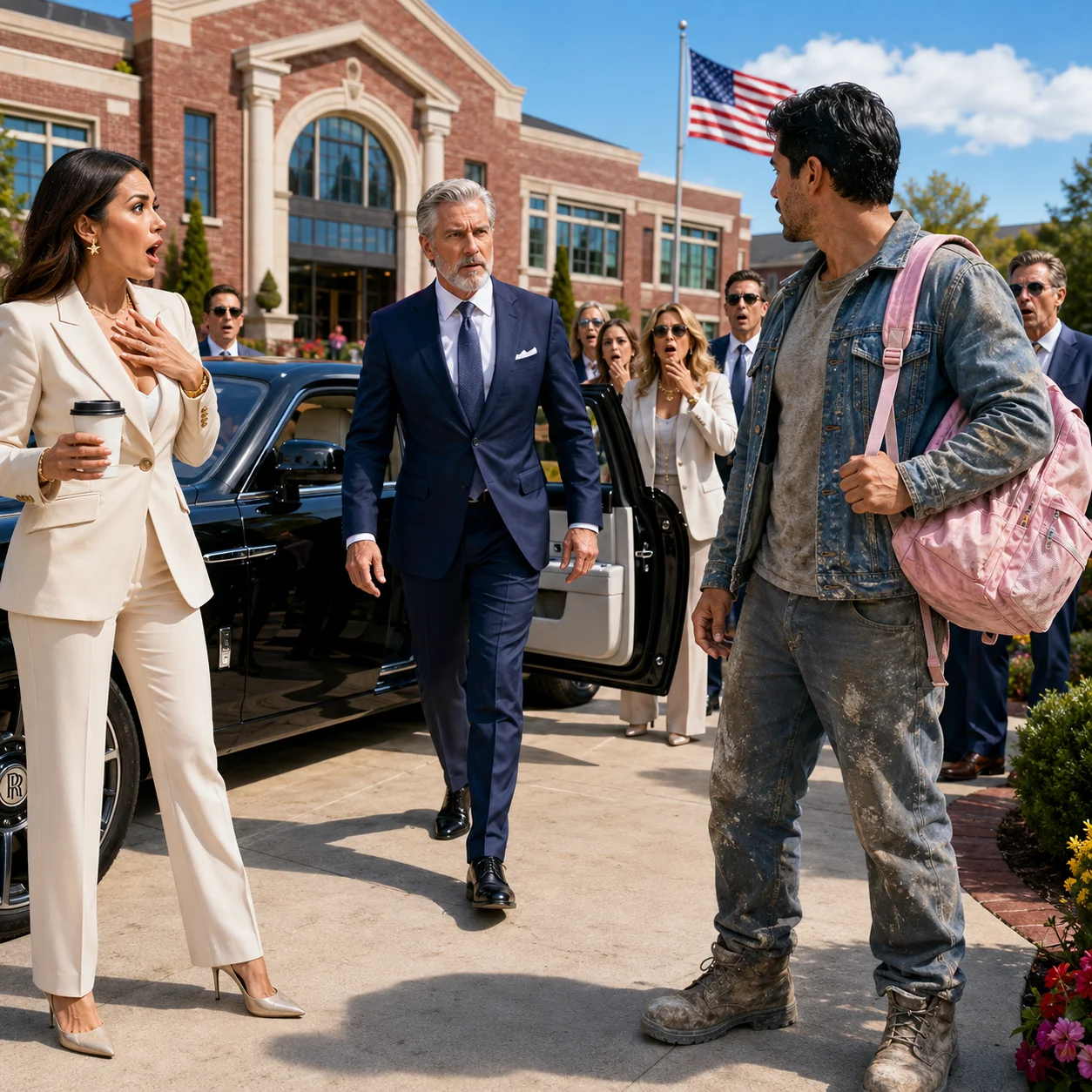
“It had to be here,” he replied quietly. “Because here, they were humiliating you without knowing who you are.”
The murmurs around them grew.
Rodrigo gave a nervous laugh.
“All right,” he said. “What exactly is going on?”
Alejandro finally turned toward him.
“What is going on,” he said, his voice calm and sharp, “is that you just insulted the man who saved my life twenty years ago.”
Mariana went pale.
Carlos closed his eyes.
“Alejandro, don’t.”
“No, Carlos,” Alejandro said. “Enough.”
The billionaire raised his voice just enough for every parent, teacher, and child in the courtyard to hear.
“When I was twenty-two years old, I had nothing. I was repairing computers out of a storage warehouse in Tepito, sleeping between boxes, trying to build a company no one believed in. One night, an electrical fire broke out. I was trapped inside. This man kicked through a side door, pulled me through smoke, and carried me out before the roof collapsed.”
Every eye turned to Carlos.
“To save me,” Alejandro continued, “he burned both hands. He lost his identification documents. He lost the job he had at the time because he missed work recovering. He never asked me for a peso. He disappeared before I could properly thank him.”
Sofía looked at Carlos’s hands.
She had seen the scars before, of course. She had touched them when she was little and asked if they hurt. Carlos had always told her they were old marks from work.
Now her mouth opened slightly.
“Daddy?” she whispered.
Carlos could not look at her.
Alejandro opened the envelope.
“For years, I searched for the man who saved me. When I finally found Carlos Ramírez, I discovered something else. Something much bigger than a debt I owed.”
Carlos stepped back.
Mariana’s face tightened.
“What?” she asked.
Alejandro removed a copy of an old birth record, yellowed at the edges, with notary stamps and official seals.
“Carlos Ramírez is not just a construction worker.”
The silence became heavy.
Alejandro looked at Sofía, then Mariana, then the circle of parents who had laughed only minutes earlier.
“He is the legitimate heir of Grupo Castillo.”
Rodrigo dropped his phone.
It struck the pavement with a loud crack.
Mariana’s lips parted, but no sound came out.
Carlos stared at the document as if it had been pulled from someone else’s life.
“My mother told me my father died before I was born,” he said.
Alejandro shook his head.
“He did not die then. He was hidden from you. Your father, Don Esteban Castillo, spent years looking for the child he had been told was lost. Before his death, he left a clause in the family trust. Everything tied to his personal shares, properties, and controlling inheritance would pass to his missing son if identity could ever be proven.”
Carlos felt the ground tilt beneath him.
Don Esteban Castillo.
He had heard the name in passing, on television, in newspapers, in conversations between people who lived far above him. He had never connected it to himself. He had never imagined he belonged to anything larger than the rented rooms, job sites, and unpaid bills that had shaped his life.
His mother, Elena, had raised him alone. She had been loving but guarded, a woman with tired eyes who changed the subject whenever Carlos asked about his father. She told him his father had died young. She told him some pain was better left buried. Carlos had believed her because children believe the person who feeds them, holds them, and kisses their fevered forehead at night.
Now he understood that his whole life had been built over a locked room.
Mariana pressed one hand to her chest.
“Carlos…”
He did not look at her.
Sofía tugged his sleeve.
“Does that mean they won’t laugh at you anymore?”
Carlos wanted to answer, but Alejandro pulled out another paper.
This time, the billionaire’s face changed.
“There is something else.”
Mariana stepped back.
“What else?”
Alejandro read the document again, though Carlos could tell he already knew what it said. Then he lifted his eyes toward Mariana.
“The house you kept in the divorce was never Carlos’s property.”
Mariana turned white.
“What?”
Carlos frowned.
Alejandro turned the page so Carlos could see the signature at the bottom.
“That property was held under a private trust connected to Sofía’s biological father.”
The courtyard froze.
Carlos slowly looked at Mariana.
She began shaking her head before he said a word.
“No, Carlos. I can explain.”
But Sofía had already seen the paper.
And when Carlos read the name printed on the last line, the world seemed to go silent around him.
Rodrigo Villaseñor.
Mariana’s fiancé.
For several seconds, Carlos heard nothing but the sound of his own breathing.
The laughter from the parents was gone. The polished confidence on Rodrigo’s face had vanished. Mariana stood in her expensive heels, trembling as if the pavement beneath her had cracked open.
Carlos looked at Rodrigo first.
Then at Mariana.
Then at Sofía.
His daughter stared up at him with wet eyes, not understanding the whole meaning of the paper but understanding enough to know something terrible had happened.
“Daddy?” she whispered.
That word nearly destroyed him.
Daddy.
Not Carlos. Not Mr. Ramírez. Not the poor man in dirty boots. Daddy.
Whatever blood said, whatever lies Mariana had buried, whatever name appeared on a document, that word belonged to him.
Carlos knelt again, ignoring everyone else.
“Sofía,” he said carefully, forcing his voice not to break. “Look at me.”
She did.
“I am your father,” he said. “Do you understand? I am your father because I was there when you were born. I held you when you had fever. I taught you how to ride your bike. I made your bed. I packed your lunches. I scared away the monsters under your blankets. Nothing on a piece of paper changes that.”
Sofía began to cry harder and threw herself into his arms.
Carlos held her tightly.
Around them, the courtyard remained silent.
Mariana covered her mouth.
Rodrigo looked at Alejandro with panic in his eyes.
“This is private,” Rodrigo said quickly. “You have no right to expose—”
“You exposed him first,” Alejandro interrupted. “In front of his daughter. In front of the school. In front of people who only laughed because they thought he had no power.”
Rodrigo’s jaw worked, but no words came.
Carlos stood slowly, keeping Sofía close to his side.
He looked at Mariana.
“How long?”
Her eyes filled with tears, but Carlos saw no love in them. Only fear.
“Carlos, please. Not here.”
“How long?” he repeated.
Mariana looked around at the parents, the phones, the teachers, the principal watching in horror from the steps.
Her voice dropped.
“Before the wedding.”
Carlos felt something inside him go cold.
Before the wedding.
Before the vows.
Before he had stood in a small church beside Mariana and promised to love her, protect her, and build a life with her. Before he had spent years believing Sofía was a miracle they had made together. Before he had worked himself numb paying for a home that had been tied to another man the whole time.
Rodrigo swallowed.
“It was complicated.”
Carlos laughed once.
Not because anything was funny.
Because if he did not laugh, he might collapse.
“You were with her before we married?”
Rodrigo glanced at Mariana.
Mariana started crying harder.
“It was one mistake.”
Alejandro’s expression darkened.
“One mistake does not create an eight-year lie,” he said.
Carlos looked at Mariana.
“You let me raise her while you let him buy the house.”
“No,” Mariana said quickly. “It wasn’t like that. Rodrigo’s family had the trust. I didn’t know all the details.”
“But you knew he was her father.”
Mariana said nothing.
That silence was the answer.
Carlos looked down at Sofía again. She had pressed her face against his shirt, hiding from the world. He placed one hand over her ear, as if he could still protect her from what had already been said.
“You let me love her,” he said. “You let me lose everything in the divorce because I didn’t want to fight in front of her. You stood here today and mocked the bed I built for her with these hands, knowing I had given up everything for a child you lied to me about.”
Mariana reached for him.
“Carlos, I was scared.”
He stepped back.
“No. You were comfortable.”
The words landed hard.
For the first time in all the years Carlos had known her, Mariana had no sharp reply ready.
Alejandro moved closer.
“Carlos, my legal team is already reviewing the divorce settlement. If fraud was involved, it can be challenged. The property trust, custody arrangements, financial disclosures—everything.”
Rodrigo’s face twisted.
“Now wait a second. You can’t just—”
Alejandro looked at him.
“I can.”
The billionaire’s voice was calm, but it carried the weight of someone who did not bluff.
“And I will.”
The principal finally stepped forward, pale and nervous.
“Mr. Castillo, perhaps we should take this conversation somewhere private.”
Carlos looked at the children gathered near the classroom doors. Some were confused. Some were whispering. Sofía’s classmates stared at her, and Carlos realized the damage of this day would not end when they left the parking lot.
He took a slow breath.
“You’re right,” he said to the principal. “My daughter has heard enough.”
Then he turned to Sofía.
“Do you want to go home?”
She nodded into his shirt.
Carlos lifted the pink backpack from his shoulder and adjusted it gently on hers.
Mariana took one step forward.
“Sofía, come with Mommy.”
Sofía did not move.
Mariana’s face crumpled.
“Sofía, please.”
The little girl looked at her mother through tears.
“Why did you laugh at Daddy?”
Mariana froze.
It was such a simple question.
So much worse than any accusation from Carlos.
“I didn’t mean—”
“Yes, you did,” Sofía whispered. “You always do.”
Carlos closed his eyes.
He had thought his daughter did not notice everything. He had prayed she did not. But children collect pain quietly. They hide it in small places until one day it spills out.
Sofía reached for Carlos’s hand.
“I want to go with Daddy.”
Mariana began sobbing.
Rodrigo looked furious.
Alejandro nodded to his driver.
“My car is available,” he said gently.
Carlos shook his head.
“No. Thank you, but no.”
Alejandro looked surprised.
Carlos took his daughter’s hand.
“I came in my truck.”
The old blue pickup was parked under a jacaranda tree near the back of the lot, dusty and dented, with a toolbox in the bed and a cracked taillight he had been meaning to fix. It was nothing compared to the Rolls-Royce, but it was his. Bought with work. Paid for honestly.
Alejandro understood.
He stepped aside.
Carlos walked away with Sofía.
No one laughed this time.
Three days later, Mariana’s lawyer called.
Carlos was on a job site, standing on scaffolding with a drill in his hand. His phone vibrated in his pocket. He almost ignored it, but something told him not to.
The lawyer spoke with the smooth voice of a man trying to control a fire that had already reached the roof.
“Mr. Ramírez, my client would like to resolve this situation calmly.”
Carlos looked across the half-built wall in front of him.
Calmly.
That word almost made him smile.
Mariana had not wanted calm when she mocked him at school. She had not wanted calm when she took the house. She had not wanted calm when she let him work double shifts for a child support arrangement built on lies.
“What situation?” Carlos asked.
There was a pause.
“The misunderstanding regarding certain documents.”
Carlos wiped sweat from his forehead with his sleeve.
“Which documents? The inheritance documents? The property trust? The divorce settlement? Or Sofía’s birth records?”
Another pause.
“Mr. Ramírez, this can become very damaging for everyone involved.”
Carlos looked down at his scarred hands.
For years, he had measured damage by what it did to a child.
Not to reputations. Not to bank accounts. Not to polished families with lawyers on speed dial.
“Then tell your client to stop lying.”
He ended the call.
That evening, Alejandro visited Carlos’s rented apartment.
The apartment was small but clean. A narrow living room. A tiny kitchen. A table with two mismatched chairs. Sofía’s drawings covered one wall, taped carefully in crooked rows. The pink bed Carlos had built sat in the bedroom, covered with a blanket printed with stars.
Alejandro stood in the doorway for a moment, looking at the bed.
“You made that?”
Carlos nodded.
“Scrap pine. Sanded it for two weeks because I didn’t want her getting splinters.”
Alejandro ran one hand over the smooth pink rail.
“It’s beautiful.”
Carlos looked away.
People with money said beautiful differently. Sometimes it sounded like politeness. But Alejandro sounded as if he meant it.
Sofía was asleep in the bedroom, exhausted from days of questions she was too young to carry. Carlos closed the door halfway and returned to the kitchen.
Alejandro placed a folder on the table.
“I know this is too much,” he said. “But you need to understand what is happening before others decide for you.”
Carlos sat across from him.
“I don’t want their money.”
“I know.”
“I don’t want cameras. I don’t want interviews. I don’t want people bowing because they found out my blood is useful.”
Alejandro nodded.
“That is exactly why Don Esteban’s clause matters.”
Carlos frowned.
Alejandro opened the folder.
“Your father’s family fought over everything after he died. Shares, land, factories, development rights, foundations, investments. But the controlling portion was frozen because of the missing heir clause. For years, lawyers tried to break it. They failed. When I found you, I did not know you were connected to the Castillos. I was looking for the man who saved me. But when we ran the background checks, old records led us to your mother’s name, then to a private birth certificate, then to the notary who had handled Esteban Castillo’s final amendment.”
Carlos listened without moving.
“Your father believed your mother left him,” Alejandro continued. “Your mother believed he abandoned her. Someone made sure both things seemed true.”
“My mother is dead,” Carlos said quietly.
“I know.”
“She can’t defend herself.”
“No,” Alejandro said. “But records can.”
He slid a copy of a letter across the table.
Carlos did not touch it at first.
The handwriting was unfamiliar, old-fashioned, slanted sharply to the right.
To my son, if this ever reaches him.
Carlos felt his throat close.
Alejandro spoke softly.
“It was sealed with the trust documents. Don Esteban wrote it before his final surgery.”
Carlos picked up the letter.
His hands trembled.
My son,
If you are reading this, then the world has finally failed to keep you from me.
I do not know your face. I do not know your voice. I do not know whether you hate me, or whether you were told I died, or whether you were told I never wanted you. But I need you to know this: I looked for you until my body could no longer obey me.
Your mother was not the woman they described. She was kind, proud, stubborn, and braver than any person I knew. If she left, it was because someone made her believe she had no other choice.
Everything I leave is not payment for your pain. Nothing can pay for that. It is only proof that you were never unwanted.
If you have children, love them loudly. Do not let anyone teach them shame.
Your father,
Esteban Castillo
Carlos covered his mouth with one hand.
He had spent his whole life believing he was the son of a ghost.
Now the ghost had a voice.
Alejandro looked away, giving him privacy.
For a long time, neither man spoke.
Finally, Carlos folded the letter carefully and placed it beside the folder.
“What happens now?”
“Now,” Alejandro said, “you choose.”
Carlos looked at him.
“You can claim everything. You can step into the company. You can sell your shares. You can build something of your own. Or you can reject all of it. But do not let Mariana, Rodrigo, or the Castillo board make that choice for you.”
Carlos let out a slow breath.
“And Sofía?”
Alejandro’s expression became more serious.
“That depends on what you want.”
Carlos’s voice sharpened.
“I want her safe.”
“Then we act carefully. Not for revenge. For custody, stability, and the truth.”
The next weeks were the hardest of Carlos’s life.
Harder than construction.
Harder than divorce.
Harder than poverty.
Because poverty was simple. Cruel, yes, but simple. You worked, you paid, you survived. This was different. Lawyers called. Reporters appeared outside job sites. Mariana sent messages that swung wildly between apology and accusation. Rodrigo vanished for three days, then returned with his own lawyers claiming that Carlos had no right to interfere with a child that was not biologically his.
That was the first time Carlos truly wanted to break something.
Alejandro stopped him from answering in anger.
“Let the court hear that,” he said. “Let a judge see what kind of man uses blood to erase eight years of fatherhood.”
So Carlos stayed quiet.
He kept waking up at five. He kept packing Sofía’s lunch. He kept brushing her hair badly, then letting her fix it herself while pretending he had done a decent job. He kept taking her to school, though he transferred her quietly to another campus after the courtyard incident. He kept reading bedtime stories even when his eyes burned from exhaustion.
One night, Sofía asked the question he had feared.
“Is Rodrigo my real dad?”
Carlos sat on the edge of her pink bed.
The room was lit by a small moon-shaped lamp. Sofía held her stuffed rabbit under her chin.
Carlos chose each word like he was placing glass on a shelf.
“Rodrigo is the man who helped give you life,” he said. “That is one kind of truth.”
Sofía stared at him.
“But you’re my dad.”
Carlos nodded, his eyes burning.
“Yes. I am your dad.”
“Can someone take that away?”
“No, princess.”
“Even a judge?”
Carlos leaned forward and kissed her forehead.
“Not if I can help it.”
The custody hearing took place six weeks later.
Mariana arrived in a navy dress, her face pale and carefully made up. Rodrigo sat beside her, looking irritated rather than ashamed. Carlos came in a clean white shirt Alejandro had insisted on buying him, though he wore his own old watch and carried Sofía’s drawing folded in his pocket for courage.
Alejandro sat behind him.
Not as the center of attention.
As support.
Mariana’s lawyer argued that Carlos was emotionally unstable because of the inheritance revelation. Rodrigo’s lawyer argued that biological parentage should be considered. They painted Carlos as a hardworking but limited man, someone who loved Sofía but could not provide the life she deserved.
Carlos listened.
He had heard versions of this argument for years.
Poor men love, rich men provide.
Then Carlos’s lawyer stood.
She was a sharp woman named Valeria Núñez, recommended by Alejandro but chosen by Carlos because she spoke to him like a person, not a rescue project.
“Your Honor,” Valeria said, “the opposing side wants to discuss biology and money because those are the only two areas where they believe they can create confusion. But this case is not confusing. For eight years, Carlos Ramírez has been Sofía’s father in every meaningful, legal, emotional, and practical sense. He was listed, represented, and treated as her father by the mother. He provided care. He paid school fees. He attended medical appointments. He built her home environment. He was encouraged to assume responsibility when it benefited the mother, and now that deception has been exposed, they seek to punish him for the lie they created.”
Mariana lowered her head.
Valeria continued.
“As for financial stability, Mr. Ramírez has worked consistently and honorably. Recent inheritance matters only strengthen his ability to provide. But the court should not miss the deeper truth: this child is not a trophy to be transferred to whoever has the cleanest shoes.”
Carlos looked down at his hands.
For once, his scars did not feel like shame.
They felt like evidence.
When the judge asked Carlos if he wanted to speak, he stood.
His voice was quiet at first.
“I don’t know how to talk like they do,” he said. “I build things. Walls, stairs, doors, roofs. I know when something is crooked, you don’t hide it behind paint. You tear back what’s weak and make it strong again.”
The room was silent.
“I loved Sofía before I knew any of this. I loved her when I was broke. I loved her when her mother made me feel small. I loved her when I thought losing the house was the price of keeping peace. I am not asking the court to punish Mariana. I am asking the court not to punish my daughter by ripping away the one thing in her life that has never been a lie.”
Mariana began to cry.
Carlos did not look at her.
“I may not be Sofía’s father by blood,” he said. “But I am her father by every morning I showed up. And I will keep showing up until my last breath.”
The judge granted Carlos primary physical custody pending full investigation.
Mariana received supervised visitation until the court could review the fraud allegations, the concealed paternity, and the property arrangements.
Rodrigo cursed under his breath as they left.
Carlos ignored him.
Outside the courthouse, Mariana approached.
For once, she had no audience.
No wealthy parents.
No fiancé standing proudly beside her.
No school courtyard.
Just Carlos, the man she had underestimated until the world put a different price tag on him.
“I did love you once,” she said.
Carlos looked at her for a long moment.
“I know.”
Her face crumpled with relief, as if that single sentence might save her.
Then Carlos added, “That’s what made it worse.”
She looked down.
“I was scared. Rodrigo’s family had money. My family pressured me. When I found out I was pregnant, I didn’t know what to do. You were kind. You wanted a family. I told myself you would be a better father than him.”
Carlos’s jaw tightened.
“You were right about that.”
Mariana flinched.
“But you didn’t choose me because you loved me,” he said. “You chose me because I was useful.”
“I’m sorry.”
Carlos nodded slowly.
“I believe you’re sorry now.”
She wiped her tears.
“Can you ever forgive me?”
Carlos looked toward the courthouse steps, where Alejandro waited beside Valeria. Beyond them, Sofía sat in the car with Alejandro’s driver, drawing hearts on the fogged window.
“I don’t know,” Carlos said honestly. “Maybe someday. But forgiveness doesn’t mean I hand you the knife again.”
Mariana had no answer.
Three months later, Carlos stood in front of the old Castillo headquarters for the first time as a recognized heir.
The building was not what he expected.
He had imagined glass towers and cold marble, but this was older, built from volcanic stone and polished wood, with carved doors heavy enough to outlast generations. Portraits lined the main hall. Men in suits. Women in pearls. Faces that looked nothing like him and yet, in strange flashes, looked exactly like him.
A board meeting had been called to formally recognize the transfer of Don Esteban’s frozen shares.
Some members expected Carlos to be overwhelmed.
Some expected him to sell.
Some expected him to be grateful for whatever place they offered him.
They did not expect him to arrive with rolled blueprints under one arm.
Alejandro walked beside him, amused.
“You know they prepared a speech about legacy.”
Carlos nodded.
“I prepared one about concrete.”
Inside the boardroom, twelve people sat around a long table. Lawyers lined the walls. Rodrigo was not there; his family’s connection to one property trust had already triggered investigations that made his presence impossible. Mariana was fighting her own legal battles quietly, away from cameras.
Carlos placed the blueprints on the table.
A gray-haired board member named Ignacio Castillo looked down his nose.
“Mr. Ramírez, before any decisions are made regarding operational influence, we should discuss your experience.”
Carlos nodded.
“I agree.”
Ignacio seemed pleased.
Carlos unrolled the first blueprint.
“I have twenty-two years of experience watching rich men approve buildings they would never allow their own children to sleep in.”
The room went still.
Alejandro covered a smile.
Carlos pointed to the plans.
“This housing project in Ecatepec. Your contractors cut ventilation, reduced wall thickness, used cheaper waterproofing, and delayed worker payments by six weeks.”
Ignacio’s face hardened.
“That is a complex development.”
“It’s a dangerous one,” Carlos said.
He unrolled another sheet.
“This school renovation in Iztapalapa. Same problem. Cheap materials hidden behind nice renderings.”
A woman on the board leaned forward.
“How did you get those?”
Carlos looked at her.
“I know workers. The people you don’t invite into rooms like this.”
No one spoke.
Carlos placed both scarred hands on the table.
“I don’t want to run your company. Not yet. Maybe not ever. But I own enough of it now to stop pretending I don’t see rot. So here is what will happen with my shares. First, every active construction contract connected to this group will be audited by independent engineers. Second, worker payment delays end immediately. Third, any housing project under the Castillo name will meet standards I would trust for my own daughter.”
Ignacio scoffed.
“You are emotional.”
Carlos nodded.
“Yes. Buildings should be emotional. Someone’s grandmother will climb those stairs. Someone’s child will sleep under that roof. Someone’s father will work thirty years to buy one room behind that door. If that sounds too emotional for this board, then maybe this board has been too comfortable.”
The room changed.
Not dramatically.
Not like in movies.
But enough.
A few people looked at the blueprints with new attention. A younger board member asked a question. Then another. Alejandro said nothing, letting Carlos stand on his own.
By the end of the meeting, Carlos had not become a polished executive.
He had become something more dangerous.
A man no one could laugh out of the room.
Six months after the school courtyard incident, Carlos opened the first Ramírez-Castillo Foundation workshop.
Not a charity gala.
Not a marble lobby with champagne.
A real workshop.
It sat on a renovated lot near the same neighborhoods where Carlos had worked most of his life. There were carpentry benches, drafting tables, safety equipment, scholarship offices, and classrooms where teenagers could learn trades without being treated as failures for choosing work with their hands.
Above the entrance hung a simple sign:
Build With Dignity.
Carlos hated the attention, but Sofía loved the opening day. She wore a yellow dress and carried a small clipboard, pretending to be in charge of everything.
Alejandro gave a speech and kept it short.
Valeria attended with her wife and brought flowers.
Workers from Carlos’s old job sites came with their families.
Even the principal from Sofía’s former school sent a formal apology, which Carlos accepted but did not frame.
Mariana arrived near the end.
Carlos saw her standing by the entrance, thinner than before, dressed simply, without Rodrigo. Their engagement had ended weeks after investigators uncovered that Rodrigo had used Mariana and Sofía’s trust connection to hide assets tied to his family. When pressure came, he had abandoned Mariana exactly as Carlos suspected he would.
She approached carefully.
Sofía saw her and ran over, but stopped halfway, uncertain. Their relationship was healing slowly, with therapy, supervised visits, and painful honesty. Carlos never poisoned Sofía against her mother. He did not need to. The truth had done enough damage. Now the only useful thing was repair.
Mariana knelt and hugged her daughter.
Then she looked at Carlos.
“This place is beautiful.”
Carlos nodded.
“Thank you.”
Her eyes moved to the sign.
“Build With Dignity,” she read softly. “That sounds like you.”
There was a time when Carlos would have wanted those words from her more than anything.
Now he was simply glad they did not hurt.
Sofía grabbed Mariana’s hand, then Carlos’s.
“Can I show Mom the bed section?”
Carlos smiled.
The workshop had a corner where children could design simple furniture with help from carpenters. Sofía had insisted on calling it the bed section because of the pink bed Carlos made for her.
“Go ahead,” he said.
Mariana hesitated.
“Are you sure?”
Carlos looked at Sofía.
“She wants to show you.”
That was enough.
Mother and daughter walked inside.
Alejandro came to stand beside Carlos.
“You did good.”
Carlos watched Sofía pull Mariana toward a row of painted headboards.
“I’m trying.”
“That’s more than most people do.”
Carlos smiled faintly.
For a while, they stood in silence.
Then Alejandro said, “There is one more thing.”
Carlos looked at him with suspicion.
“I don’t like when you say that.”
Alejandro laughed and handed him a small envelope.
Carlos opened it.
Inside was a restored photograph.
A young woman stood beside a man in a white shirt outside a half-built house. The woman was Carlos’s mother, Elena. Younger than he had ever seen her. Smiling in a way he barely remembered. The man beside her had Carlos’s eyes.
On the back, in faded ink, someone had written:
Elena and Esteban. The first home we dreamed of.
Carlos stared at it for a long time.
His father had not been only a name in a legal document. His mother had not been only a keeper of secrets. Once, before fear and money and family pressure had torn them apart, they had stood in front of unfinished walls and dreamed of a home.
Carlos slipped the photograph into his shirt pocket.
Sofía came running back moments later, breathless.
“Daddy! Come see! I made a design for a new bed!”
Carlos let her drag him inside.
The bed was drawn in purple marker, crooked and impossible, with stairs on one side, stars on the posts, and a secret drawer for treasures.
“It’s for the workshop,” Sofía announced. “For kids who don’t have one.”
Carlos looked at the drawing.
Then at his daughter.
Then at the scarred hands that had once embarrassed him in rooms full of polished people.
He knelt beside her.
“It’s perfect,” he said.
Sofía grinned.
“Can we build it?”
Carlos looked around the workshop, at the tools, the wood, the families, the young students learning to measure twice and cut once. He thought of the courtyard, the laughter, the dirty boots Mariana had mocked. He thought of the Rolls-Royce, the envelope, the truth that had nearly shattered him. He thought of the father he never knew and the daughter no lie could take from him.
Then he picked up a pencil.
“Yes, princess,” he said. “We can build it.”
And for the first time in years, Carlos Ramírez was not trying to prove his worth to anyone.
He was simply building something that would last.
![[FULL STORY] My Fiancé Controlled My Life So Quietly I Almost Married Him](https://social-media.rabedo.com/thumbnails/1777557623_0a038c71-f4f0-4608-8445-230012af2234.png)
![[FULL STORY] I returned from a business trip at 4 AM to an empty house, then her ex-boyfriend handed me a USB drive that destroyed our three-year relationship forever.](https://social-media.rabedo.com/thumbnails/1776917645_9.png)
![[FULL STORY] My girlfriend abandoned me on my birthday to "save" her ex, so I invited her parents to witness her ultimate downfall.](https://social-media.rabedo.com/thumbnails/1776927575_23.png)
![[FULL STORY] "My girlfriend said mockingly, ‘Stop being so needy. I’ll talk to you whenever I feel like it.’I](https://social-media.rabedo.com/thumbnails/1776995633_1.png)