On the top corner of the first page, I could read our names.
Rosaura Méndez de Aguilar.
Valdemar Aguilar Robles.
The room seemed to move away from me.
“What is that?” I whispered.
Valdemar slid the folder closer with the tip of his shoe, just enough for him to reach it.
Then Guillermo stood up.
He held a glass in one hand and wore the smile of a perfect son.
“Tonight,” he began, “we celebrate two people who gave us everything. Two people who now deserve to rest, to be cared for, and to allow us to make certain decisions for them.”
Everyone applauded.
I did not.
Felipa pulled out a tissue and dabbed at a tear that had not fallen.
“Mom, Dad,” she said, “we are doing this out of love.”
Valdemar opened the folder with two fingers.
I saw the first page.
Application for admission to a senior residential facility.
Below it were our names.
Farther down: signatures of responsible family members.
And on another line: consent due to cognitive decline.
I could not breathe.
“Valdemar…”
He turned the page.
The second one froze me even deeper.
Authorization for management of assets during permanent stay.
House.
Land.
Bank account.
Vehicle.
Pension.
Everything written down.
Everything organized.
Everything ready.
As if we were no longer people.
As if we were an inconvenient process standing between our children and what belonged to us.
I looked at Guillermo.
My son was speaking about love with one hand over his chest.
“Sometimes parents refuse to accept that they need help,” he said. “But as children, we have to be strong.”
Strong.
That was what he called putting us in a home and keeping the house.
Felipa took the microphone.
“Mom, Dad, we know you may resist at first, but tonight the whole family is here to support us.”
Support us.
Not support Valdemar and me.
Support them.
Suddenly I understood the party.
The witnesses.
The champagne.
The medical questions.
The papers they had wanted signed quickly.
The hidden folder.
The man in the dark suit by the bar.
It was not a celebration.
It was a trap with music.
Valdemar squeezed my wrist.
Hard.
Harder than he had ever touched me in our whole marriage.
“Don’t drink anything,” he whispered. “Don’t sign anything. Don’t argue.”
I looked at him with tears filling my eyes.
“They’re our children.”
His face broke for one small second.
“Not tonight.”
The music kept playing.
The guests smiled awkwardly, not fully understanding.
My grandchildren stared at their phones.
The waiter returned with the glass.
“Ma’am, your toast.”
Valdemar pushed it away.
Guillermo saw him.
For the first time, his smile disappeared.
Felipa signaled to the man in the dark suit.
He picked up a black folder and began walking toward our table.
Valdemar lowered his voice.
“Rosaura, listen carefully. I found this yesterday in Guillermo’s email.”
“What?”
“They already paid for the place.”
My heart shrank.
“What place?”
“Las Jacarandas Residence. Admission tomorrow at nine in the morning.”
I went silent.
Tomorrow.
At nine.
While the whole family believed we had accepted between applause and music.
Guillermo kept speaking into the microphone.
“Dad, Mom, please come up here. You only have to sign some symbolic documents.”
Symbolic.
The ugliest word of the night.
Valdemar looked at me.
His eyes no longer held fear.
They held decision.
“Pretend you fainted,” he whispered. “We have to escape now.”
I opened my mouth to say no.
To say he was exaggerating.
To say no child would ever do something like this.
Then Felipa approached with the champagne glass in her hand and a sweet, rotten smile.
“Mom, drink this first,” she said. “It will help you stay calm.”
Calm.
The same word the doctor had used when he asked if I “got nervous.”
The same word Guillermo had used when he wanted us to sign without reading.
The same word children use when they no longer want parents.
They want property without resistance.
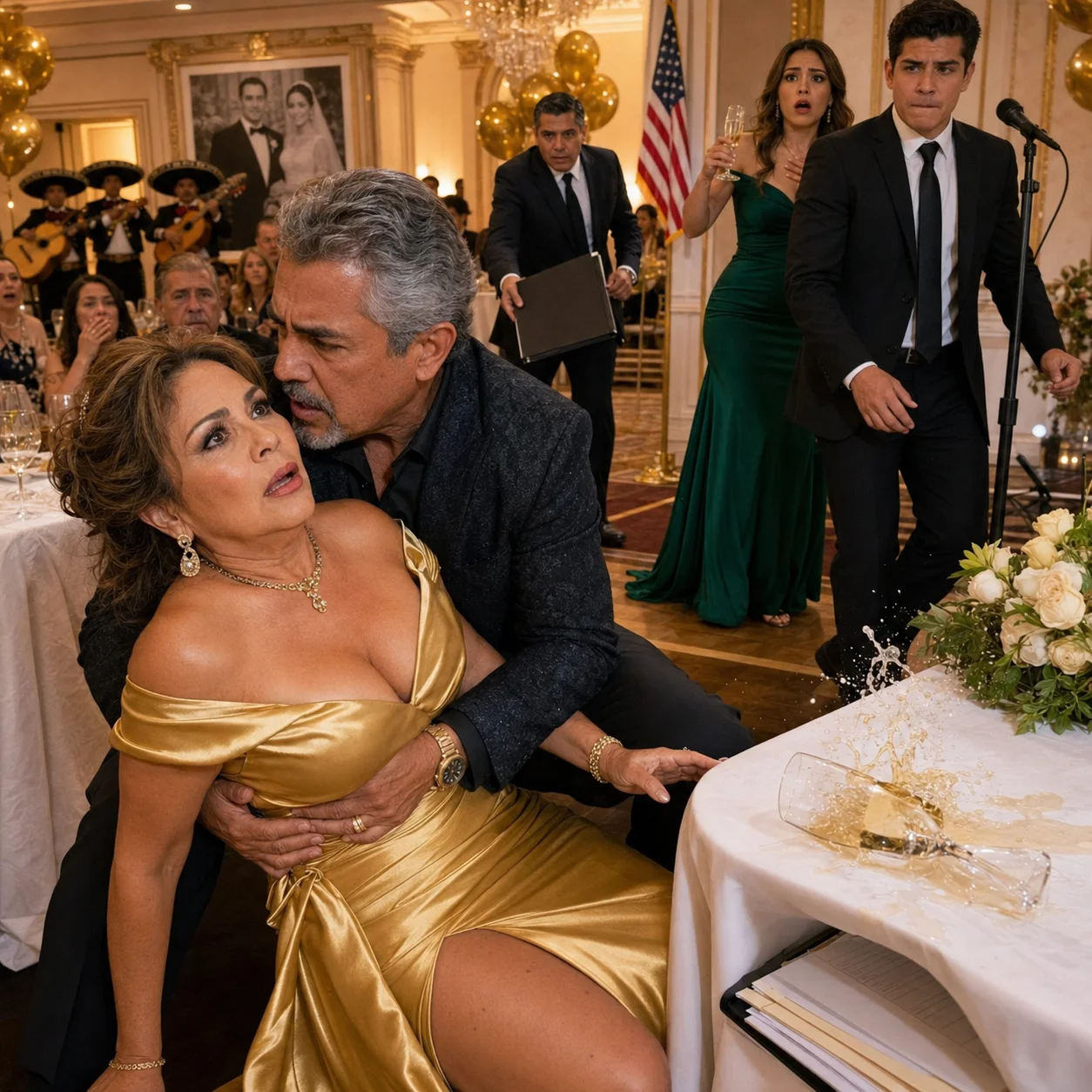
Valdemar knocked the glass over with his elbow.
Champagne spilled across the tablecloth.
Felipa went white.
The man in the suit stopped.
Guillermo came down from the stage.
“What did you do, Dad?”
My husband did not answer him.
He put one arm around my waist.
“Now, Rosaura.”
And with everyone watching, I brought one hand to my chest, closed my eyes, and let my body fall toward him.
The room screamed.
Chairs scraped the floor.
Someone shouted for air.
Someone said to call an ambulance.
But while everyone rushed around believing one lie, Valdemar brought his lips close to my ear and whispered the truth that finished freezing me.
“Guillermo requested a private ambulance. Not a city one.”
I kept my eyes closed, loose in his arms, listening to the panic around me as if it came from the bottom of a well.
“Private?” I murmured without moving my lips.
“From Las Jacarandas,” Valdemar whispered. “If they get you inside that vehicle, you won’t come out unless they sign for it.”
Terror climbed up my throat.
All my life, I had trusted my children with that foolish, sacred trust a mother carries under her skin. But that night, lying against my husband’s chest, I understood that blood can also learn how to steal.
“Make room!” Guillermo shouted. “My mother is very sick.”
“Don’t move her,” Valdemar said firmly. “She needs air.”
“Dad, stop being stubborn.”
“I said don’t move her.”
Someone tried to separate me from him.
Valdemar held me tighter.
“To the kitchen,” he whispered. “When I say.”
I did not know how we were going to escape a hall full of people, with our children watching and a man in a suit waiting for our signatures. But after forty years with Valdemar, I knew one thing: if he said “now,” I walked even if I was dying.
“Bring alcohol!” an aunt shouted.
“Sit her down!” someone else said.
Valdemar used the chaos. He lifted me as best he could, pretending to support my fainted body, and began walking toward a side hallway.
“Where are you taking her?” Felipa asked.
“To the bathroom,” he said. “Or do you want your mother to vomit in front of everyone?”
Felipa hesitated.
That hesitation saved us.
We crossed the hallway. I opened my eyes just a little. I saw the kitchen door, the steam rising from pots, trays of red rice, a young man in an apron carrying plates of mole.
Valdemar pushed the door open.
“You can’t come through here,” a cook said.
My husband pulled a wrinkled bill from his jacket and placed it in the man’s hand.
“My wife feels sick. Tell me where the staff exit is.”
The young man looked at my pale face, then toward the banquet hall, where Guillermo was already coming after us.
“That way,” he said quietly. “By the trash bins.”
We stepped out through a back door into the alley.
Cold air hit my face.
The mariachi music stayed behind us, muffled by the walls. Outside, it smelled like gas, damp concrete, and hot tortillas from a nearby taqueria. I straightened with difficulty.
“What now?” I asked.
Valdemar pulled keys from his jacket.
“The truck is far. I moved it before we went inside.”
“You knew this was going to happen?”
“Not all of it. But enough.”
We walked close to the wall like two old thieves stealing back our own lives.
I was wearing heels. My feet hurt. My gold dress felt heavy, as if it had been sewn out of guilt. At the corner, an organ grinder played a sad melody while people came out of a bakery with bags of conchas and bolillos.
The city kept living, indifferent to the fact that two old people were running from their own children.
We reached an old truck.
The same truck Valdemar swore he would sell every December and never did.
When I climbed in, I saw a backpack on the back seat.
“What’s that?”
“Birth certificates, property deeds, bank books, medicine, your ID, and the house papers.”
I went still.
“Valdemar…”
He started the engine.
“Yesterday I used Guillermo’s email because he asked me to print something. He left the session open. I saw the messages with Felipa. I saw the contract with Las Jacarandas. I saw they wanted to declare us unfit to manage the house.”
I covered my mouth.
“But I passed that checkup.”
“You did. That’s why they paid for another report.”
A hard blow landed in my chest.
“A false one?”
“Signed by a doctor who never examined us.”
The truck moved through dark streets. Behind us, the banquet hall became smaller, with its golden balloons, untouched cake, and love song turned into a trap.
My phone began ringing.
Felipa.
Then Guillermo.
Then my daughter-in-law.
Then Felipa again.
Valdemar took it and turned it off.
“No.”
“They’re my children.”
“Tonight they are your attackers, Rosaura.”
I wanted to be angry with him for saying it that way.
I could not.
Because it was true.
We arrived at Don Nacho’s house, an old friend of Valdemar’s who had once been a locksmith in Colonia Roma and now lived in Portales surrounded by saints, old radios, and aloe plants.
He opened the door in sweatpants, his hair messy, a cup of coffee in his hand.
“Come in,” he said, without asking too much. “I figured something ugly was coming.”
I stared at him.
Valdemar lowered the backpack.
“I left him copies yesterday.”
“And I called my niece,” Don Nacho said. “She’s a lawyer. She’s on her way.”
I sat in a plastic chair.
For the first time since walking into that banquet hall, I truly cried.
“When did I stop being their mother and become property?”
Valdemar knelt in front of me.
His knees cracked.
“I don’t know, vieja. But I’m not going to let them store you away like old furniture.”
Half an hour later, Don Nacho’s niece arrived.
Her name was Marisol. She wore her hair tied back, had tired eyes from too much work, and carried a wine-colored folder. She listened without interrupting. She reviewed the copies, the photos Valdemar had taken, the printed emails, the admission request, the medical report, the asset authorization forms.
Her face hardened.
“This is not care,” she said. “This is financial and family abuse.”
I lowered my gaze.
The word made me feel ashamed, as if the guilt belonged to me.
Marisol noticed.
“Doña Rosaura, listen to me. Being over sixty does not take away your will. You have the right to decide where you live, to manage your own property, and to be free from violence by your family. Nobody can put you in permanent residential care as if you were packages.”
Valdemar took a deep breath.
“What do we do?”
“First, we file a report. Second, we request protective measures. Third, we revoke any authority they may have tried to create. And early tomorrow morning, we go to the public registry and the notary.”
“At this hour?” I asked.
“At this hour, we start a record,” she said. “So tomorrow your children cannot claim you disappeared, got confused, or were manipulated by someone else.”
We went to the public prosecutor’s office.
I had never entered one in the middle of the night. The walls had posters about family violence, a broken coffee machine, and metal benches where sadness sat with crossed arms.
A woman with bruises waited with her child.
A man cried because his taxi had been stolen.
And we, dressed for an anniversary party, with flowers still pinned to Valdemar’s jacket, were there to report our own children.
When I said it out loud, something inside me cracked.
“My children tried to lock us away and take our house.”
The clerk looked up.
She did not laugh.
She did not make a face like this was just a family matter.
She began typing.
Valdemar handed over the manila folder he had taken from the banquet hall. Marisol asked them to record the possible forced transfer, management of assets without consent, and the allegedly false medical report.
I signed my statement with a shaking hand.
For the first time that night, my signature was used to defend me.
Not erase me.
At six in the morning, we stepped back outside. The city smelled like old rain and fresh bread. On the corner, a vendor was heating tamales with strips of poblano peppers and chocolate atole.
Valdemar bought two.
We ate standing beside the truck.
“Happy anniversary,” he said, with a tenderness so sad it broke me all over again.
I laughed while crying.
“The worst one ever.”
“But we’re still together.”
That was true.
At nine in the morning, when according to my children’s plan we were supposed to enter Las Jacarandas, we were sitting in a notary’s office with Marisol and Don Nacho as witnesses.
The notary was a serious man with thick glasses. He checked our identification, asked us questions separately, and confirmed that we understood what we were doing.
“Do you know what properties you own?” he asked me.
“A house in Narvarte, a little piece of land in Morelos that I inherited from my father, and a savings account where Valdemar thinks I don’t know how much he keeps.”
The notary almost smiled.
“She knows.”
Valdemar exhaled.
We signed revocations.
We signed clear instructions.
No one could manage our assets without the express authorization of both of us. The house could not be sold, rented, mortgaged, or used as collateral without our physical presence and notarial confirmation.
Then we did something that hurt more than everything else.
We changed the will.
We did not remove our children out of hatred.
We protected what they had already tried to tear away.
Part would go to our grandchildren when they became adults. Another part would go to a day center for older adults in the borough, one of those places where women go to dance danzón, take workshops, eat with company, and remember that aging is not the same as disappearing.
And the house, as long as one of us was alive, would be untouchable.
When we left, my phone was full of messages.
Guillermo had written:
“Where are you? The ambulance arrived. You’re making fools of yourselves.”
Felipa had written:
“Mom, don’t let Dad manipulate you. He’s not well anymore.”
Valdemar read that in silence.
His jaw trembled.
I took his hand.
“They are not going to turn us against each other.”
Then a message arrived from my granddaughter Jimena, Felipa’s oldest daughter.
“Grandma, is it true what my parents are saying? That you and Grandpa agreed to move into a residence?”
My soul stopped.
I did not want to pull my grandchildren into that rot.
But I also did not want to keep decorating lies.
I sent her a photo of the admission request.
Another of the asset authorization.
And I wrote only:
“We did not agree, my girl. They wanted us to sign in front of everyone.”
Jimena did not respond right away.
Ten minutes later, the fire began.
Not on social media.
In the family.
Cousins called.
A sister-in-law sent a crying voice message.
Valdemar’s brother said he had seen the man in the suit insisting they take us “for evaluation.” A niece said Felipa had asked several relatives to record the signing moment because it would look “beautiful.”
Beautiful.
What an elegant way to say trap.
At noon, Guillermo appeared at our house.
By then, we were already there with Marisol and two officers, because the prosecutor’s office had advised us not to be alone. Don Nacho was changing the locks on the front door. On the sidewalk, the jacaranda tree dropped purple flowers onto the hood of the truck, as if the street itself wanted to cover the shame.
Guillermo arrived angry.
“What did you do?” he shouted. “Police? Lawyers? Against your own children?”
I stepped out to the gate.
“Lower your voice. This is still my house.”
“We all paid for that house!”
Valdemar stepped forward.
“No. Your mother and I paid for it. You paid for Netflix for three months and still count it as sacrifice.”
Guillermo turned red.
Felipa arrived behind him, wearing dark sunglasses like a fallen actress from a bad movie.
“Mom, please,” she said. “This got out of control.”
“No,” I said. “This came into the light.”
She tried to hug me.
I stepped back.
I saw pain in her face.
Or maybe it was fear.
“I only wanted you to be cared for,” she said.
“Then why did you need authorization over our assets?”
She did not answer.
“Why the false medical report?”
She lowered her eyes.
“Guillermo said it was necessary.”
Guillermo looked at her with hatred.
“Don’t put all of this on me.”
And right there, they broke.
Not in front of a judge.
Not in front of the whole family.
In front of the same door they had knocked on as children when they wanted water, homework help, money, comfort.
Felipa started crying.
“We owed money, Mom. A lot. The kids’ school, credit cards, the car loan. Guillermo said if you two moved into a residence, we could rent the house and manage the pension while everything got fixed.”
“While what got fixed?” Valdemar asked.
She could not answer.
Because there was no fix.
There was only theft dressed as responsibility.
Guillermo exploded.
“You don’t understand! You have a huge house for two old people! We are drowning. What is the point of holding on to everything while your children are sinking?”
I stared at him.
That was my boy.
The child I had carried with a fever to the clinic.
The one I waited for outside school with a ham sandwich.
The one who slept holding my shawl when thunder scared him.
And there he was, saying our life was an unfair accumulation.
“I would have given you a plate of food,” I said. “I would have helped you with a debt. I would have opened the door if you had come with humility. But you did not want help, Guillermo. You wanted inheritance while we were still alive.”
That silenced him.
Felipa removed her sunglasses.
Her eyes were swollen.
“Forgive me, Mom.”
The word pierced me.
But it did not bend me.
“Someday we can talk about forgiveness. Today we talk about limits.”
Marisol stepped forward with a document.
“They have protective measures. You cannot enter, pressure, threaten, or approach without authorization. Any attempt to move them from their home or dispose of their assets will be added to the case file.”
Guillermo let out a bitter laugh.
“You’re going to sue us?”
Valdemar looked at him as if he had aged ten years in one second.
“Son, you sued us first. You just did it with music.”
That sentence fell into the street, and no one picked it up.
Weeks passed.
The family divided, as families always do when the truth becomes more uncomfortable than an elegant lie. Some said we exaggerated. Others said we did the right thing. A few asked why we did not “settle it privately,” because there are still people who believe family violence stops being violence if it is served with coffee.
We kept going.
We attended therapy at a support center for older adults. We changed bank cards. We blocked account access. We placed an alert on the house. I learned words I never thought I would need: coercion, dispossession, informed consent, financial abuse.
I also learned a harder word.
Autonomy.
It did not mean living without help.
It meant choosing who was allowed to help you.
Jimena began visiting us on Sundays.
The first time, she arrived crying with a bag of churros she had bought to sweeten the impossible.
“Forgive me, Grandma,” she said. “I clapped that night. I didn’t know.”
I hugged her tightly.
“You were a child at a table full of lying adults. Do not carry that.”
She stayed for lunch. I made caldo tlalpeño. Valdemar told her stories about building walls in Coyoacán and how I used to sell green tamales from a blue steamer. Jimena listened as if she were meeting us for the first time.
Maybe she was.
Grandchildren sometimes inherit edited versions of their grandparents.
A month later, Valdemar and I returned to the banquet hall.
Not to complain.
To pick up a box the owner had saved for us: two wedding photos, the cake knife, and a little bride-and-groom figurine that had survived intact.
The place was empty.
No balloons.
No music.
No applause.
I stood in the middle of the dance floor where I had pretended to faint and felt a chill pass through me.
“We almost said goodbye to our life here,” I said.
Valdemar took my hand.
“No,” he said. “We got it back here.”
I looked at him.
He had more wrinkles than he did the night before the party.
So did I.
But his eyes were still the same ones I had seen when I was seventeen, when he bought me corn at the town fair because he could not afford anything else.
“Do you regret it?” I asked.
“Having children? No. Teaching them that we would always solve everything for them? Maybe.”
I leaned against his shoulder.
“Me too.”
“But I do not regret anything with you.”
I smiled.
“Not even when I sold tamales and you burned the rice?”
“Especially then.”
That afternoon, instead of a party, we bought two clay cups of coffee and walked through the Alameda. There were families, balloons, cotton candy vendors, and a man making huge bubbles that children chased while laughing.
Life went on.
But it no longer dragged us behind it.
Guillermo took three months to write again.
He did not ask for money.
He did not ask for the house.
He wrote only:
“I am in therapy. I do not expect you to believe me. I just wanted to say I understand now that I tried to bury you before your time.”
I did not answer that day.
Or the next.
Forgiveness, when it is real, is not thrown like charity or demanded like debt.
It is worked for.
It waits.
It proves itself.
Felipa was slower.
She sent a handwritten letter. She said shame had stolen her sleep, that Jimena no longer looked at her the same way, that she had confused concern with control and need with entitlement.
I put the letter in a drawer.
I did not tear it up.
That was a lot.
Today, when someone asks me how we celebrated forty years of marriage, I do not say with mariachis or cake.
I say we celebrated by running away.
I say my husband saved me with one small lie from one enormous lie.
I say that night I pretended to faint so I could finally wake up.
Because sometimes children do not abandon you by leaving you alone.
Sometimes they abandon you by surrounding you with people, music, flowers, and applause while they take your voice away with a glass of champagne.
I still live in my house.
Valdemar waters the jacaranda every morning, even though he says he is not sentimental.
I make coffee, and some Sundays, tamales with poblano strips for Jimena.
In the living room, we still keep a photo of Guillermo and Felipa when they were children. I did not take it down. I do not kiss it either.
I look at it and remember that a mother can love without offering herself as a sacrifice.
She can open the door without letting someone empty the house.
She can forgive one day without placing her neck back under the same hand.
That night, I thought God was finally giving me my children back.
I was wrong.
God gave me Valdemar back.
He gave me my signature back.
My house.
My name.
And most of all, He gave me back something I had been handing away little by little, believing that was what love required.
The certainty that my life still belongs to me.