
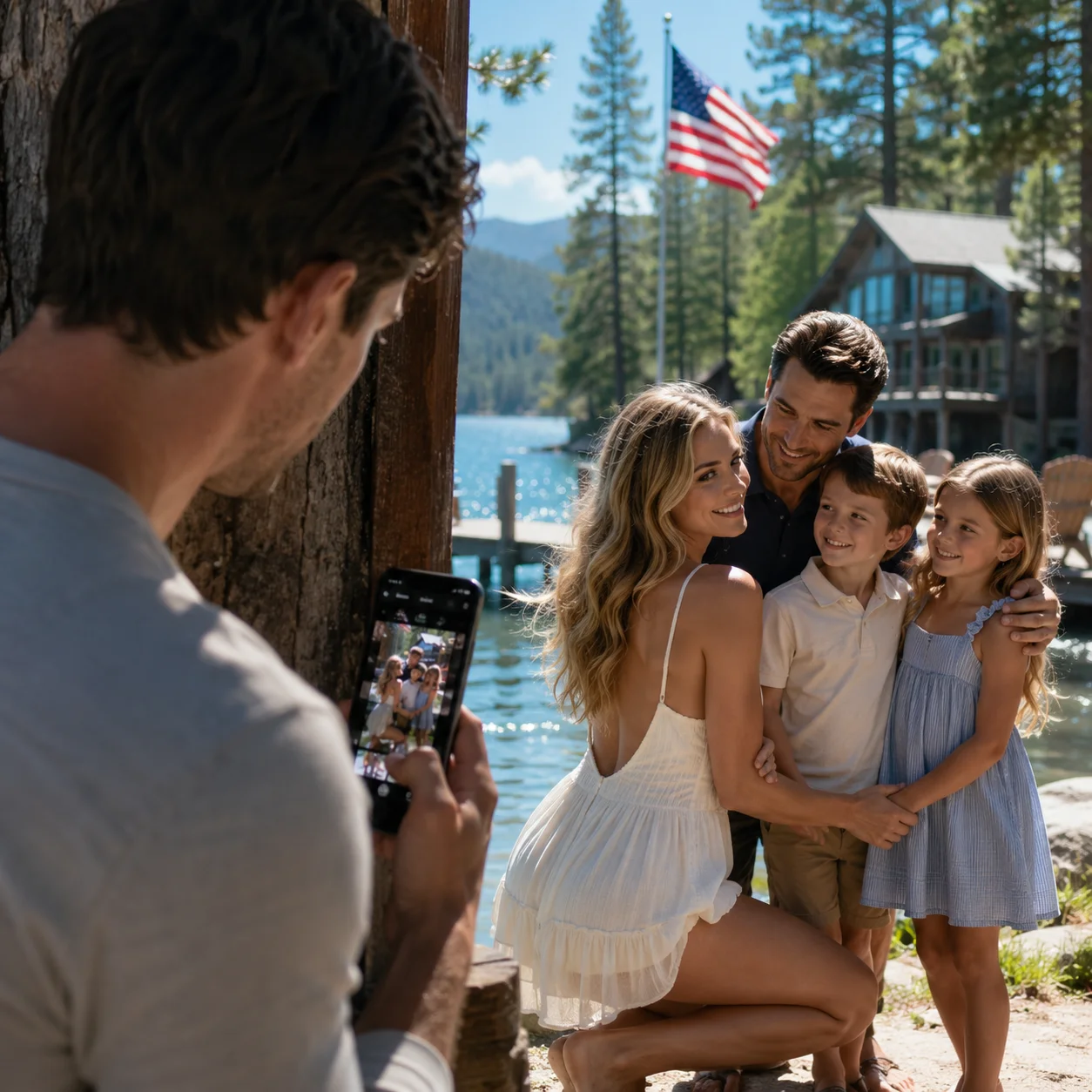
Beautiful blended family.
The kids.
The love between all of you.
I read those words again and again until they stopped looking like English.
Then I checked the recipient line.
The email had been sent to Natalie’s address and mine.
Mine.
My email had been included because months earlier, when Natalie booked the session, she had used my email for the deposit confirmation. The photographer had probably saved both addresses and sent the preview without thinking.
A mistake.
One simple mistake.
That was all it took to crack open my entire life.
Mason looked up from the rug. “Daddy?”
I locked my phone and turned away too fast.
“Yeah, buddy?”
“Can you help me find the blue piece?”
My mouth opened, but no sound came out at first. I swallowed hard, forced myself to breathe, and walked over to kneel beside him.
“Sure,” I said.
My son placed a tiny Lego piece in my palm and smiled at me like the world was still safe.
I don’t know how I made it through the next hour.
Natalie came home at 6:03 p.m. carrying two grocery bags and wearing the same perfect outfit from the photos. Her cheeks were flushed, her eyes bright. She looked lighter than she had in weeks.
“Hey,” she said, stepping inside. “How were pancakes?”
I stood in the kitchen holding a dish towel.
Mason and Lily ran to her. She hugged them, laughing, kissing their hair. The sight almost broke me. Not because she looked guilty. Because she didn’t.
She looked like a woman who had learned to divide herself so cleanly that neither life stained the other.
“Fine,” I said.
She glanced at me. “You okay?”
I wanted to throw my phone onto the counter and ask her who Daniel was. I wanted to scream. I wanted to demand why another man’s children had spent the afternoon wrapped around my wife while our own children waited at home in matching clothes.
But something stopped me.
Maybe it was the kids standing between us. Maybe it was instinct. Maybe it was the cold realization that if she had lied this smoothly, this confidently, then one confrontation would only give her time to destroy evidence.
So I said, “Just tired.”
She relaxed immediately.
That hurt more than I expected.
Over dinner, Natalie acted normal. She asked Mason about school. She wiped Lily’s mouth. She told me the grocery store was crowded. She mentioned her mother had a headache and “wasn’t very chatty.”
I watched her lie between bites of pasta.
Every ordinary movement became unbearable. The way she poured water into Mason’s cup. The way she reminded Lily not to feed noodles to the dog. The way she reached across the table and squeezed my hand when I seemed quiet.
“You sure you’re okay?” she asked softly.
I looked at her hand over mine.
Her wedding ring caught the kitchen light.
“Yeah,” I said. “Just a long day.”
That night, after the children were asleep, Natalie took a shower. I sat on the edge of our bed with my phone in my hand, staring at the preview email again.
I zoomed in on the man’s face.
Daniel.
There was something familiar about him, but I couldn’t place it. I searched Natalie’s social media. Nothing. Her Facebook was full of family posts, school fundraisers, birthday pictures, carefully chosen marriage photos. Instagram was private and boring. Work events, coffee, occasional pictures of the kids.
No Daniel.
Then I searched her text notifications on our shared iPad.
That was the first time I realized how far behind I was.
The iPad still received some of her messages, but only from numbers she hadn’t disabled. Most were normal—her sister, her mom, school group chats, delivery updates. But there was one thread with no name. Just a number.
The latest message had been sent at 2:11 p.m.
Today was perfect. They already asked when “Miss Nat” is coming over again.
My blood went cold.
Miss Nat.
Not Natalie. Not Aunt Natalie. Not a stranger.
Miss Nat.
I scrolled up. The messages were sporadic, but enough had synced to the iPad to form a pattern.
Can’t talk tonight. Evan’s home.
The kids keep asking if you’re coming to the game Saturday.
I hate lying like this.
Soon. I promise.
You looked beautiful today.
There were gaps everywhere, likely because she deleted messages from her phone before they synced, but what remained was enough.
I took photos of the screen with my own phone.
Then I searched the number.
It belonged to Daniel Mercer.
The name hit me like a memory returning from another room.
Mercer.
Natalie had mentioned a “Dan” from work months earlier. A widower with two kids. She said he was part of a volunteer committee connected to the children’s hospital where she helped organize donations. I remembered feeling sorry for him when she told me his wife had died three years earlier. She said he was quiet, devoted to his children, “one of those rare good men life had been unfair to.”
I had nodded while making coffee.
I had no idea my wife was auditioning for a role in his life.
I didn’t sleep that night.
Natalie did.
She lay beside me breathing peacefully while I stared at the ceiling and replayed every recent oddity in our marriage. Her sudden errands. Her changed password. Her new yoga class. Her increased interest in volunteering. The weekends when she said she needed “space to reset.” The way she had stopped touching me but became defensive whenever I stopped trying.
One memory returned with brutal clarity.
Two months earlier, Mason had asked at breakfast, “Who’s Owen?”
Natalie had dropped her spoon.
I’d looked up from my coffee. “Who?”
Mason shrugged. “Mommy said Owen made her a bracelet.”
Natalie laughed too loudly. “Oh, Owen is one of the kids at the charity event. He made bracelets for all the volunteers.”
I believed her.
The little boy in the orchard photo was probably Owen.
The next morning, I called in sick to work.
Natalie left after breakfast, saying she had a meeting at the hospital donation office. I waited twenty minutes, dropped the kids at school, then drove to the address listed for the photography studio.
Marissa Hill worked out of a small converted farmhouse on the edge of town. My hands shook on the steering wheel as I parked.
When she opened the door, she smiled politely. “Hi. Can I help you?”
“I’m Evan Hart,” I said.
Her smile changed slightly. “Oh. Natalie’s husband?”
The question landed between us like a loaded gun.
I watched her face carefully.
“Yes,” I said. “I got the preview email yesterday.”
All the color drained from her expression.
“Oh,” she whispered.
“I need to understand what happened.”
She stepped back and let me inside.
Her studio smelled like coffee, candles, and printer paper. Framed family portraits covered the walls—laughing toddlers, couples embracing, grandparents holding newborns. Normal lives. Honest lives.
Marissa led me to a small consultation table.
“I am so sorry,” she said before I could speak. “I thought Daniel had given me both emails. Natalie filled out the form from your original booking, and I didn’t realize…” She stopped, visibly horrified. “I didn’t know.”
“How long ago did they book the session?”
She swallowed. “Three weeks ago.”
“That was our session.”
Her eyes lowered.
I already knew, but hearing silence confirm it did something terrible to me.
“She canceled on me yesterday,” I said. “She told me you had an emergency.”
Marissa closed her eyes briefly. “No. I didn’t.”
“Did she ask you to switch the session?”
Marissa hesitated.
“I’m not here to attack you,” I said, though my voice sounded strange even to me. “I just need the truth.”
“She called about ten days ago,” Marissa said quietly. “She said there had been a family situation and you couldn’t come. She asked if she could still use the time slot with… with Daniel and his children. She said the deposit had already been paid and that you knew.”
I laughed once, but there was no humor in it.
Marissa’s face crumpled. “I’m truly sorry.”
“Did she seem close to the children?”
The photographer looked at me with pity, which somehow felt worse than anger.
“Yes,” she said. “Very.”
I nodded slowly.
Then she said something that turned the knife deeper.
“The little girl called her ‘Natalie’ most of the time, but the boy accidentally called her Mom once. Everyone got quiet. Daniel corrected him gently. Natalie looked upset afterward.”
I looked down at my hands.
My wedding ring suddenly felt too tight.
I asked Marissa if she could send me the full invoice, booking form, and any communication connected to the session. She said she couldn’t release everything without permission but could forward the emails that included my address and the invoice tied to my payment method. That was enough.
When I left, she touched my arm briefly.
“I photograph families every day,” she said. “I know what real smiles look like. I also know what performance looks like. I don’t know what your wife is doing, but I’m sorry you found out this way.”
I drove to a parking lot and sat there for nearly an hour.
Then I called the only person I trusted completely.
My older sister, Rachel.
She answered on the second ring. “Hey. Everything okay?”
I tried to say yes.
Instead, I broke.
Rachel didn’t interrupt. She listened while I told her everything, from the canceled photo shoot to the pictures, the text messages, the photographer, the boy calling Natalie Mom.
When I finished, she was silent for a moment.
Then she said, “Do not confront her yet.”
“I don’t know how to sit in that house with her.”
“I know,” Rachel said. “But you have kids. You need to be smart before you are angry.”
That was Rachel. Practical even when furious.
She told me to call a family attorney before saying anything to Natalie. She told me to gather financial documents, secure copies of the children’s birth certificates, document everything, and avoid doing anything Natalie could twist against me.
“You’re not just finding out about cheating,” she said. “You’re finding out about a second household. That changes things.”
A second household.
The words made me nauseous.
I met with an attorney named Denise Walker the next morning.
Her office was calm, expensive, and smelled faintly of leather. She listened without reacting much, taking notes with a silver pen.
When I showed her the photos, her eyebrows rose slightly.
“Well,” she said. “That’s not subtle.”
“No.”
“Do you want divorce?”
The question should have felt complicated.
It didn’t.
“I want my children protected,” I said. “And I want the truth.”
Denise nodded. “Then we prepare before we reveal what you know.”
Over the next week, I became two people.
At home, I was still Natalie’s husband. I packed school lunches, read bedtime stories, answered work emails, and nodded while she told me about errands that were not errands.
Inside, I was quietly dismantling the life we had built together.
I checked accounts.
That was when I discovered money missing.
Not enormous amounts at first glance, but steady withdrawals. Cash back at grocery stores she hadn’t visited. Venmo payments labeled “committee supplies.” Charges at restaurants across town. A children’s boutique where she had bought clothes in sizes that did not fit Mason or Lily.
Then I found the worst one.
A payment to a private elementary school fundraiser.
Daniel’s children’s school.
The memo read: For Owen and Sophie’s classroom auction.
From our joint account.
I stared at the screen until my vision blurred.
Our money. Our household. Our children’s future.
She had been buying her way into another family while telling me we needed to cut back on Mason’s soccer camp.
I printed everything.
Denise advised me not to empty accounts, not to threaten, not to confront Daniel directly. “You need to stay calm and boring,” she said. “Courts like calm and boring.”
I did not feel calm.
I felt like a house burning quietly from the inside.
The hardest part was the children.
Mason and Lily knew something was wrong, though they didn’t understand what. Kids always know. They read silence better than adults. Mason started asking why Mommy was gone so much. Lily became clingier at bedtime.
One night, while I tucked her in, Lily touched my face and asked, “Daddy, are you sad?”
I kissed her little hand.
“A little,” I admitted.
“Because Mommy canceled pictures?”
I froze.
“What do you mean, sweetheart?”
She shrugged sleepily. “I wanted pictures with apples.”
My throat tightened.
“We’ll take pictures someday,” I said.
“With Mommy?”
I couldn’t answer right away.
Lily’s eyes were already closing.
“With people who love you,” I whispered.
The breaking point came on a Thursday.
Natalie told me she had a late meeting. I had already learned that “late meeting” meant Daniel. Denise had recommended hiring a licensed investigator if I wanted more documentation for custody negotiations, but part of me still resisted crossing that line. It felt ugly. It felt like becoming someone I didn’t want to be.
Then Natalie kissed our children goodbye and told Mason she might miss his school art night because “work was very important.”
Mason tried to hide his disappointment, but I saw it.
That night, instead of going straight to the school art event, I drove by Daniel Mercer’s street.
I didn’t plan to stop. I told myself I only needed to know.
But there it was.
Natalie’s car in his driveway.
Through the warm windows of the house, I saw shapes moving. A kitchen. A table. Children running past. Then Natalie appeared near the window holding a dish towel, laughing at something Daniel said. She looked comfortable. Domestic. At home.
At home.
I gripped the steering wheel so hard my knuckles hurt.
My phone buzzed.
A text from Natalie.
Meeting running long. Tell Mason I’m sorry. Love you.
I looked up at her through Daniel’s window while she lied to me from inside another man’s house.
For one wild second, I wanted to walk up to the door.
Instead, I took a photo of her car in the driveway, drove to Mason’s school, and watched my son explain his painting of our family to an empty space where his mother should have been.
He had painted four people under an apple tree.
Me, Natalie, himself, and Lily.
All holding hands.
I kept that painting.
Three days later, Natalie made her biggest mistake.
She suggested a family dinner.
Not with us. With Daniel.
She didn’t say his name at first. She approached it like someone testing ice.
“There’s someone from the hospital committee I think you’d get along with,” she said while folding laundry. “He’s a widower. Really nice. He has kids around Mason and Lily’s age.”
I slowly put down a towel.
“Oh?”
“Yeah. Daniel. I think I mentioned him before.”
I looked at her face.
There it was. Not guilt. Hope.
She wanted to introduce him into our lives.
Not as her lover. Not yet. As a “friend.” A widower. A good man. A family connection. She was building a bridge between the two worlds instead of choosing one.
“Why would I need to meet him?” I asked.
She shrugged too casually. “I just think it’d be good for us to have more couple friends. Well, not couple friends, obviously, since he’s single. But family friends.”
Single.
I nearly laughed.
“Sure,” I said.
Her eyes brightened. “Really?”
“Yeah. Invite him.”
She smiled like I had given her a gift.
I had.
Just not the one she thought.
The dinner was set for Saturday at our house.
Denise advised against confrontation in front of children. Rachel advised against confrontation in a room containing knives. I promised both of them I would be careful.
But I also knew something Denise didn’t: Natalie was going to keep lying until the lies became the official version of our life. She was going to make Daniel familiar to my children, maybe slowly make me seem unreasonable, distant, difficult. Then one day she would say she had “fallen out of love,” and Daniel would already be waiting in the wings as the noble widower who had supported her.
I refused to let her rewrite me as the obstacle in her love story.
So I prepared.
I arranged for Rachel to take Mason and Lily out for pizza and a movie that evening. Natalie protested when I told her.
“But Daniel is bringing his kids,” she said. “I thought it would be nice for all of them to play.”
“I know,” I said. “But Rachel already promised them movie night. They’re excited.”
Her irritation flashed, then vanished.
“That’s fine,” she said.
Daniel arrived at 6:12 p.m.
He brought wine.
He also brought his two children, Sophie and Owen, because apparently Natalie had forgotten to tell him mine wouldn’t be there. The moment I opened the door, I recognized them from the photos. Sophie was polite and shy. Owen hid halfway behind Daniel’s leg until he saw Natalie.
Then he smiled.
“Miss Nat!”
He ran to her.
Natalie bent down and hugged him before remembering herself.
I watched Daniel watching me.
He knew.
Maybe not everything. But he knew enough.
“Evan,” Natalie said brightly, “this is Daniel Mercer. Daniel, my husband, Evan.”
My husband.
The word sounded obscene in her mouth.
Daniel extended his hand.
I shook it.
His palm was warm. Mine was cold.
“Nice to finally meet you,” he said.
Finally.
“Yes,” I replied. “I’ve heard a little about you.”
Natalie’s eyes flickered.
Dinner was surreal.
Sophie and Owen ate at the breakfast nook while the adults sat at the dining table. Natalie played hostess with frantic cheer. Daniel spoke politely about his work in commercial real estate, his late wife, his children’s school. He had the nervous confidence of a man who believed he was involved in something tragic but romantic.
I let him talk.
Then, halfway through dinner, Owen called from the breakfast nook, “Natalie, can I have more bread?”
Not Miss Nat.
Natalie.
Comfortable. Familiar.
She stood too quickly. “Of course.”
I looked at Daniel.
His jaw tightened.
When she returned, I said, “So how long have you two known each other?”
Natalie answered before he could. “A little over a year. Through the hospital committee.”
Daniel nodded. “Natalie has been wonderful with the kids.”
“I saw that,” I said.
Natalie froze.
Daniel looked at me.
I reached beside my chair and picked up the envelope I had placed there before they arrived.
Natalie’s face went pale.
“What’s that?” she asked.
“Family photos,” I said.
The silence that followed was complete.
I slid the first printed photo across the table.
Natalie stared at it.
Daniel closed his eyes.
It was the orchard picture. Natalie, Daniel, Sophie, Owen. The perfect blended family.
“I got the preview gallery,” I said calmly. “Beautiful lighting.”
Natalie whispered, “Evan.”
I slid another photo across.
Then another.
Then the invoice.
Then the text screenshots.
Then the bank statements.
Daniel stood suddenly. “Kids, get your coats.”
Sophie looked confused. “Dad?”
“Now.”
Natalie turned to him, panicked. “Daniel, wait—”
“No,” he said, and his voice cracked with anger. “You told me he knew.”
I looked at him.
That sentence changed the room.
Natalie shook her head. “I didn’t say that.”
Daniel’s face twisted. “Yes, you did. You said your marriage was over. You said you were separated in the house until after the holidays because of the kids. You said he knew you were moving on.”
I stared at Natalie.
Separated in the house.
Moving on.
The lie was so elegant it almost impressed me. She hadn’t just lied to me about Daniel. She had lied to Daniel about me.
“Natalie,” I said quietly, “did you tell him we were separated?”
Her mouth opened and closed.
No answer.
Daniel’s eyes filled with disgust. “My children thought you were going to be part of our family.”
That hit her harder than anything I had said.
“Daniel, please,” she whispered.
He backed away from her.
“No. You brought my kids into this.”
His voice was low now, shaking with restraint.
“My wife died. My children already lost one mother. You let them get attached to you while lying to everyone. What kind of person does that?”
Natalie looked like she had been slapped.
Maybe because that was the first accusation she couldn’t twist into my fault.
Daniel gathered Sophie and Owen. Before he left, he turned to me.
“I’m sorry,” he said. “I should have asked more questions.”
I believed him.
That surprised me.
After the door closed behind them, Natalie and I stood alone in the dining room surrounded by the wreckage of two families.
For the first time since I had known her, she had nothing ready to say.
I waited.
Finally, she whispered, “It wasn’t supposed to happen like this.”
I almost laughed.
“How was it supposed to happen?”
She folded her arms around herself. “I was unhappy.”
“There it is.”
Her eyes flashed. “Don’t do that.”
“Do what?”
“Make me the villain.”
I stared at her.
“You used our family photo session to take pictures with another man’s children.”
Tears filled her eyes. “I felt invisible here.”
“No,” I said. “You felt ordinary here. There’s a difference.”
She flinched.
I continued because now that the truth was open, I could not stop it.
“You had a husband who worked, came home, raised his kids, loved you, trusted you. You had children who adored you. But Daniel looked at you like a rescue. His kids needed you. His grief made you feel important. And instead of going to therapy or telling me the truth, you built a fantasy where you got to be the beautiful woman healing a broken family while still using this one as your safety net.”
She started crying harder. “That’s not fair.”
“No,” I said. “What wasn’t fair was Mason standing beside his painting at school while you played house across town.”
Her face crumpled.
Good.
I wanted it to hurt.
But even then, I didn’t scream. I didn’t break furniture. I didn’t call her names. I simply walked to the hall table, picked up the folder Denise had prepared, and set it on the dining table.
“What is that?” Natalie asked.
“A temporary parenting agreement proposal. And a list of financial records my attorney will request formally if we can’t handle this cleanly.”
Her tears stopped.
There it was—the moment emotion became calculation.
“You talked to a lawyer?”
“Yes.”
“When?”
“After the photographer sent me pictures of my wife with another man’s children.”
She sat down slowly.
“You’re divorcing me?”
“Yes.”
The word landed with finality.
Natalie stared at the folder as if it were a living thing.
“You can’t just destroy our family.”
I looked around the room. At the plates. The wine. The printed photos. The chair Daniel had occupied.
“I’m not the one who did that.”
The months that followed were ugly, but not in the dramatic way people imagine.
There were no screaming fights in the driveway. No police. No viral social media posts. No public revenge.
Just paperwork.
That was worse somehow.
Divorce turns heartbreak into forms. Custody schedules. Asset disclosures. Mediation dates. Parenting plans. Receipts. Screenshots. Bank records. Every private wound converted into evidence.
Natalie tried, at first, to control the story.
She told her sister we had “grown apart.” She told her mother I had become cold and suspicious. She told mutual friends I had blindsided her with divorce after “one mistake.”
Then Daniel sent her sister a message.
Not cruel. Not dramatic. Just clear.
He explained that Natalie had represented herself as separated, involved his children emotionally, used a family photo session under false pretenses, and lied to both households. He asked that his family be left out of further conflict.
That message spread quietly.
Natalie’s version collapsed.
Her mother called me one night crying.
“I’m sorry,” she said. “I didn’t raise her to do this.”
I didn’t know what to say, so I said the only true thing I could.
“I know.”
The custody arrangement was my biggest fear.
I never wanted to take the children away from their mother. Whatever Natalie had done to me, Mason and Lily loved her. And despite everything, she loved them in her own flawed, selfish way.
But I also refused to let her instability become their burden.
Denise helped me negotiate primary residence during the school week with shared weekends, expanding later if Natalie completed counseling and maintained consistency. Natalie fought it until the financial records became part of the conversation. Spending marital money on another man’s household did not look good. Neither did missing school events while lying about work.
Eventually, she agreed.
The first night the kids slept in the house after Natalie moved into an apartment, Mason cried.
He tried to be brave, but I found him sitting in the hallway holding the family painting from art night.
“Is Mommy gone because of me?” he asked.
That question broke something in me deeper than the affair ever could.
I sat beside him on the floor and pulled him into my arms.
“No,” I said firmly. “Never. This is grown-up stuff. You and Lily did nothing wrong.”
“Did you and Mommy stop loving each other?”
I took a breath.
“Sometimes adults hurt each other in ways that mean they can’t live together anymore. But Mommy loves you. I love you. That will never change.”
He cried into my shirt.
Lily came out of her room and climbed into my lap too, not understanding everything but understanding enough to be afraid.
So we sat in the hallway, the three of us, under the dim night-light glow.
And for the first time in weeks, I let myself cry where they could see me.
Not because I wanted them to carry my pain, but because I wanted them to know sadness did not mean the world was ending.
It meant we were still human.
Winter came slowly.
Natalie started therapy. Whether from guilt, fear, or genuine self-awareness, I didn’t know. She stopped seeing Daniel. Not because she chose to, but because Daniel cut all contact after the dinner.
I heard through a mutual acquaintance that he had pulled his children from the hospital committee events Natalie attended. I felt sorry for Sophie and Owen. They had been innocent in all of it. In another life, maybe our children could have been friends. In this one, they were collateral damage in Natalie’s fantasy.
One afternoon in December, Natalie asked if we could talk after exchanging the kids.
We stood outside her apartment building while Mason and Lily played with the first thin snow on the sidewalk.
She looked different. Less polished. Tired in a way makeup couldn’t hide.
“I owe you an apology,” she said.
I said nothing.
A year earlier, I might have filled the silence for her. Not anymore.
She took a shaky breath.
“I was selfish. And cruel. And I told myself I was lonely so I wouldn’t have to admit I was addicted to being needed. Daniel’s grief made me feel special. His kids made me feel like I could start over as someone better. But I wasn’t better. I was just lying in a nicer outfit.”
The honesty stunned me.
“I don’t expect you to forgive me,” she continued. “I just wanted to say it without excuses.”
I looked past her at our children.
Mason was helping Lily make a tiny snowball. They were laughing.
“I hope therapy helps you,” I said.
Her eyes filled with tears, but she nodded.
“Me too.”
Then she asked the question I had expected eventually.
“Do you hate me?”
I thought about it.
The answer surprised me.
“No,” I said. “I don’t hate you.”
Her face softened with something like hope.
So I finished.
“But I don’t trust you. And I don’t want a life with someone I have to investigate in order to love.”
That hope faded.
She nodded because there was nothing else to do.
The divorce finalized in March.
It was raining that day.
Denise shook my hand outside the courtroom and told me I had handled things well. I didn’t feel proud. I felt tired. Divorce was not victory. It was amputation. Necessary, sometimes life-saving, but still a loss.
Rachel took me to lunch afterward. She ordered champagne. I ordered coffee.
“To freedom,” she said, lifting her glass.
I stared out the restaurant window at the rain sliding down the glass.
“To peace,” I corrected.
Because that was all I wanted.
Peace.
That spring, I booked a new family photo shoot.
Not at the orchard. I couldn’t bring myself to go back there.
I found a photographer who specialized in documentary-style home sessions. No matching outfits. No staged picnic blanket. No fake perfection under golden trees.
Just us.
Me making pancakes with Mason and Lily. Lily sitting on the counter with flour on her nose. Mason showing off his missing tooth. The dog stealing toast. The three of us piled on the couch reading books. A picture of Mason’s hand in mine. Lily asleep against my shoulder.
At one point, the photographer asked if I wanted a more formal portrait.
I almost said no.
Then I looked at my children.
“Yeah,” I said. “Let’s do one.”
We sat on the front porch. Mason on one side, Lily on the other, both leaning into me. The photographer told them to smile.
Lily did a ridiculous wide grin. Mason laughed at her. I laughed too.
The camera clicked.
A week later, when the gallery arrived, I opened it alone at the kitchen table.
I braced myself without meaning to.
Photos had become dangerous things to me. Proof. Evidence. Betrayal frozen in perfect lighting.
But these were different.
There was no performance in them.
Just a tired father and two children learning how to become a smaller family without becoming a broken one.
My favorite photo was the porch picture.
Not because it looked perfect. It didn’t. Lily’s hair was messy. Mason’s shirt was wrinkled. My eyes looked a little sad.
But his hand was on my arm.
Her head was against my shoulder.
And all three of us were laughing.
I printed that one large and hung it in the hallway where the old family portrait used to be.
A few weeks later, Natalie came over to pick up the kids and saw it.
She stopped.
For a moment, she just stared.
I watched her face carefully, expecting jealousy or hurt.
Instead, she smiled sadly.
“That’s a beautiful picture,” she said.
“It is.”
Her eyes moved from Mason to Lily to me.
Then she whispered, “They look happy.”
I looked at the photo too.
“They’re getting there.”
She nodded, blinking fast, then turned away before the kids could see her cry.
After she left, Mason came downstairs and stood beside me.
“Daddy?”
“Yeah?”
“Can we take another picture when Mommy comes for my birthday?”
I felt the old pain stir, but it didn’t control me anymore.
“Sure,” I said. “We can do that.”
“Will it be weird?”
“Maybe a little.”
He considered that.
Then he shrugged. “That’s okay.”
Kids are better than adults at accepting new shapes of love. They don’t need everything to look perfect. They just need the people around them to stop pretending.
And that was the lesson I carried from everything Natalie had done.
A family photo is not a family.
A ring is not a marriage.
A smile in golden light is not proof of love.
Sometimes the most beautiful picture is the biggest lie in the room.
And sometimes the honest one is messy, imperfect, missing someone who used to belong there—but still full of life, because the people left inside it are finally telling the truth.


![[FULL STORY] My fiancée texted me at night:"I used your card for my refreshment trip because you love me."](https://social-media.rabedo.com/thumbnails/1776842967_10.png)
![[FULL STORY] Her Male Best Friend Mocked Me: "We're So Close We've Even Slept Together -Does That Bother You?](https://social-media.rabedo.com/thumbnails/1776418444_0de9e09d-afd0-4bdb-b2e2-afafc76a8be0.png)
![[FULL STORY] Post Surgery, My Fiancée Assumed I Was Still Sedated When She Told Her Friend, 'The Doctor](https://social-media.rabedo.com/thumbnails/1777019708_T1.png)