
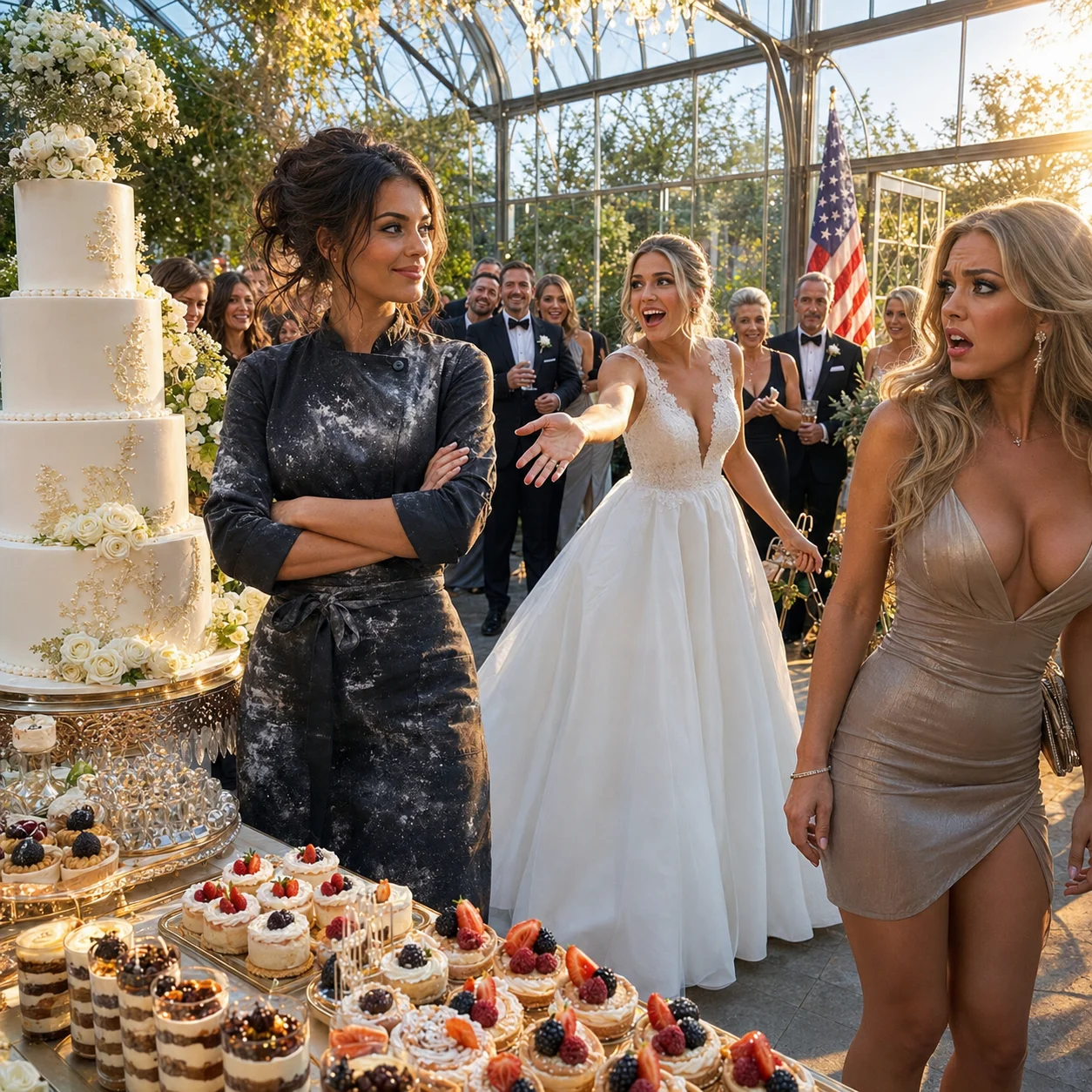
“I have insurance,” I said calmly. “And delivery experience. And setup coordination. I’ve done weddings before.”
Clara tilted her head. “Small ones.”
The room became painfully quiet.
Marissa looked upset. Daniel looked furious. My mother-in-law looked like she wanted the wall to open and swallow the entire family.
I could have fought back. I could have listed every wedding I had done, every five-star review, every venue that had approved my insurance certificate. But defending yourself to someone committed to underestimating you only gives them more stage time.
So I folded my napkin and said, “Marissa, I’ll send over sketches tomorrow. You can decide what feels right for you.”
Marissa reached across the table and squeezed my hand. “I already decided.”
That should have been the end of it.
It was not.
Two days later, Marissa called me sounding near tears.
“I’m so sorry,” she said. “Clara talked to my mom, and now everyone is saying maybe I should use Sebastian because there’s too much risk. They keep saying they don’t want me stressed.”
I closed my eyes in the bakery office, surrounded by invoices and flour-dusted order forms.
“Marissa, you don’t have to apologize. It’s your wedding.”
“I know. But Aunt Patricia is paying for half, and she says if I insist on using you, she doesn’t want responsibility if something goes wrong.”
There it was.
Something going wrong.
As if I were a child carrying a cake in my lap instead of a professional with commercial equipment and years of training.
I took a quiet breath. “Do what gives you peace. I won’t be offended.”
That was a lie, but it was the generous lie.
Marissa cried. I told her I loved her. Then I hung up and sat in my office until my assistant, Nina, knocked softly and asked if I was okay.
I said yes.
Then I went into the walk-in freezer and cried for exactly four minutes between trays of unbaked croissants.
After that, I washed my face and went back to work.
Marissa used Sebastian.
The wedding cake was beautiful. Of course it was. It had five tiers, gold leaf, fresh orchids, and a sugar lace design that probably cost more than my first car. It looked like wealth in dessert form.
It also tasted like chilled cardboard and perfume.
I knew because Marissa brought me a slice the following week and whispered, “Yours would have been better.”
That should have made me feel better.
It didn’t.
Around that time, something unexpected happened at The Little Whisk.
A food writer named Nora Fields came in on a rainy Tuesday because her car had broken down outside the bookstore next door. She ordered a black coffee and a slice of my brown butter pear cake because she said the bakery smelled like her grandmother’s kitchen. I had no idea who she was until a week later, when an article appeared in the weekend section of the city newspaper.
The headline was simple: “The Tiny Bakery Making the Best Cake in the City.”
It changed everything.
By Monday morning, there was a line down the block.
People came for the brown butter pear cake. Then they came back for the cardamom rolls, the salted honey tart, the pistachio cream puffs, and the wedding consultation slots I had quietly added to the website months earlier. My inbox filled with inquiries. My phone rang until I had to hire a receptionist part-time. Brides who wanted “warm but elegant” found me. Couples who hated dry fondant found me. People who wanted their guests to actually eat the dessert found me.
Within six months, I hired two more bakers, expanded our back kitchen, and started booking weddings almost a year out.
Clara noticed.
She did not congratulate me.
Instead, at Christmas, she said, “I saw that little article. Must be nice to get free publicity.”
Daniel replied, “Must be nice to earn it.”
I almost choked on my cider.
Clara’s smile froze.
By then, her own business was beginning to change too, though none of us knew how much.
Luxury weddings were getting more demanding. Brides wanted personal, emotional, unique details, not just expensive flowers. Social media had made everyone more visually obsessed and less patient. Clara’s company still looked successful online, but the vendor community had started whispering.
She was difficult. She delayed payments. She blamed vendors for her own communication mistakes. She bullied assistants. She promised clients impossible things and expected everyone else to make them happen.
I heard pieces of it quietly, the way people in the wedding industry hear everything eventually.
A florist told me Clara had screamed at her because peonies were not available in August.
A photographer said Clara tried to control his editing style after the contract was signed.
A rental company stopped working with her after she tried to return stained linens and claim they arrived that way.
I never repeated these stories. I had no interest in dragging Clara down. Running my own business gave me enough stress without joining the gossip economy.
But I listened.
And I paid attention.
The real disaster began with the Worthington wedding.
Even if you are not in the wedding industry, you know families like the Worthingtons if you live in a city long enough. Their name was on hospital wings, university buildings, charity boards, and gala invitations printed on paper thick enough to injure someone. Their only daughter, Vivienne Worthington, was marrying a tech founder named Grant Ellis, and the wedding was rumored to have a budget that could have bought my entire block.
Clara landed the job.
For weeks, she became unbearable.
Every family dinner included references to “the Worthington event,” as if she were planning a royal coronation rather than a wedding for two people with excellent cheekbones and inherited money.
“It’s not just a wedding,” Clara said one night, sipping sparkling water with lime. “It’s a statement. Everyone important will be there.”
My mother-in-law glowed. “Clara, that’s incredible.”
Clara smiled. “Vivienne trusts me completely. She told me she wanted the best, and obviously my name came up.”
I kept cutting my roast chicken into small pieces.
Daniel glanced at me, already knowing what I was thinking.
Obviously.
Then Clara turned to me.
“They’re using Maison Delacroix for the dessert installation,” she said. “Twelve-foot cake wall, suspended sugar flowers, individual plated petit fours. Very high concept.”
“That sounds ambitious,” I said.
Her smile sharpened. “It is. Not really the kind of thing most small bakeries could handle.”
I looked up slowly.
“No,” I said. “Most small bakeries would probably ask whether the dessert still tasted good after becoming architecture.”
Daniel coughed into his napkin. Marissa, who had come with her husband, bit her lip to hide a smile.
Clara’s eyes narrowed.
“It’s luxury, Emily. It’s not meant to feel homemade.”
“No,” I said gently. “I can see that.”
For once, she had no immediate reply.
I wish I could say that moment satisfied me, but it didn’t. A clever comeback is nice for about five seconds. Then you still have to wake up the next morning and run your life.
So I went back to my bakery, back to dough and invoices and brides and broken mixers and the steady rhythm of honest work.
Then, three weeks before the Worthington wedding, Sebastian from Maison Delacroix walked into my bakery.
I had met him only twice before at vendor events. He was tall, elegant, and always looked as though he had just stepped away from a marble counter in a cooking show. That morning, though, he looked tired. His eyes had shadows under them, and he held his phone like it had personally betrayed him.
“Emily,” he said. “Do you have a minute?”
I wiped my hands on my apron. “For you? Sure.”
We sat at the tiny table near the front window while Nina gave him an espresso and pretended not to listen.
Sebastian looked around the bakery for a moment.
“You’ve built something lovely here,” he said.
“Thank you.”
He tapped his fingers against his cup. “I am going to tell you something confidential.”
My stomach tightened.
“Okay.”
“I am withdrawing from the Worthington wedding.”
I stared at him.
“Clara’s Worthington wedding?”
“Yes.”
“Three weeks before the event?”
His mouth pressed into a grim line. “Yes.”
I leaned back. “Sebastian, that’s not a small withdrawal.”
“I know.”
“What happened?”
He looked toward the window, jaw tight. “Clara happened.”
The story came out slowly.
According to Sebastian, Clara had sold Vivienne on a massive dessert concept without confirming whether his team could execute the final version. The original plan was already complicated but manageable: a five-tier cake, plated petit fours, and a smaller dessert station. Then Clara kept adding things based on Vivienne’s Pinterest board. A floating macaron chandelier. Hand-painted sugar butterflies. Individual monogrammed cakes for VIP tables. Gluten-free, dairy-free, nut-free alternatives that still had to look identical to the regular desserts. A midnight pastry cart. A rehearsal dinner dessert bar.
Every time Sebastian pushed back, Clara told him he was being negative.
Then she delayed his deposit payment.
Then she sent revised design expectations without updated pricing.
Then, according to him, she told Vivienne that any delay was because “Sebastian was being temperamental.”
“She damaged my relationship with the client,” he said quietly. “And she expected me to absorb thousands in additional labor. I will not do it.”
I sat very still.
“Does Vivienne know?”
“She knows I withdrew. I sent a professional explanation. Not emotional. Not dramatic. Just facts.”
“And Clara?”
Sebastian gave a humorless laugh. “Clara has left me fourteen voicemails.”
I rubbed my forehead. “Why are you telling me?”
His gaze met mine. “Because Vivienne asked me who I would trust if I could not do it.”
The bakery noise seemed to fade around me.
“And you said me?”
“I said you were the only person in this city whose cakes taste better than they look, and whose ego would not ruin the event.”
I did not know what to say.
Sebastian finished his espresso and stood. “I am not asking you to take it. Frankly, I would advise against it unless the contract is clean and the payment is immediate. But I wanted you to hear it from me before Clara comes here pretending she respects you.”
He adjusted his coat, then added, “And Emily?”
“Yes?”
“Charge properly.”
Then he left.
For several minutes, I sat by the window while the bakery moved around me. Customers came in. Nina rang up orders. Someone laughed near the display case. A child pointed at a chocolate cupcake.
Clara was in trouble.
Not ordinary trouble. Not a delayed florist or a missing seating chart. The kind of trouble that could damage her company permanently.
And for the first time in all the years I had known her, the solution to her problem might be me.
She called two hours later.
I knew it was her before I even looked at the phone. Some part of me felt it in the air.
“Emily,” she said when I answered, her voice too bright. “Hi. Are you busy?”
I looked around my bakery, where every table was full, my ovens were loaded, and two brides were scheduled for tastings that afternoon.
“Yes,” I said. “I am.”
She laughed lightly. “Of course. Listen, I have a little situation and I was thinking this might actually be a nice opportunity for you.”
There it was.
A nice opportunity.
Not an emergency. Not an apology. Not a request.
An opportunity.
“What kind of situation?” I asked, though I already knew.
“The Worthington wedding dessert vendor had a scheduling conflict.”
I nearly laughed.
“A scheduling conflict?”
“Yes. Unfortunately, Maison Delacroix can no longer fulfill the order.”
“Interesting.”
“So I immediately thought of you,” Clara said. “Family first, right?”
Family first.
The same family that had not trusted me with Marissa’s lemon cake.
“What exactly are you asking me to do?” I asked.
“Well, the event is in three weeks. There’s a main cake, some dessert elements, nothing crazy. I can send the design files. Obviously, it would be amazing exposure for you.”
I closed my eyes.
Exposure. The currency people offer when they do not want to pay for labor.
“Clara,” I said, “what is the full scope?”
She hesitated. “I’ll send the packet.”
“Now.”
“I’m not at my computer.”
“Then send it when you are.”
Her tone tightened. “Emily, I’m trying to help both of us here.”
“No,” I said calmly. “You’re trying to replace a luxury pastry team three weeks before a major wedding because something went wrong. I need the full scope before I can even tell you whether it’s possible.”
Silence.
Then she said, colder now, “Fine. I’ll send it.”
The packet arrived twenty minutes later.
It was worse than Sebastian had described.
Not impossible, but close.
Five-tier wedding cake with architectural sugar floral cascade. Three hundred plated mini desserts. A midnight pastry cart for two hundred guests. Custom monogrammed sugar cookies for welcome bags. Rehearsal dinner dessert table. Bridal brunch pastry assortment. Gluten-free and vegan alternatives. Delivery to three locations over two days. Setup at the main venue under a tight schedule with florist coordination.
And she had described it to me as “some dessert elements.”
I printed the packet and laid it across the stainless steel table in the back kitchen.
Nina came over, read silently for thirty seconds, and said, “Absolutely not.”
I smiled despite myself. “That’s one option.”
My head baker, Luis, joined us. He was forty-two, calm in all emergencies, and capable of piping buttercream roses so perfect they looked illegal.
He studied the pages.
“We could do it,” he said slowly.
Nina stared at him. “Why would you say that out loud?”
Luis shrugged. “Because we could. Not at current staffing. Not with our existing schedule. Not without cutting off custom orders for two weeks. But technically? Yes.”
I nodded.
That was what I had already started calculating.
It would be brutal. We would need temporary staff. Overnight shifts. Ingredient rush orders. Extra refrigeration. A revised design that suited our strengths instead of copying Sebastian’s concept. Immediate payment. Direct communication with the bride, not through Clara. Full creative control within the approved theme. A contract protecting us from Clara’s chaos.
Could we do it? Yes.
Should we do it?
That was harder.
Daniel came by after work and found me still sitting with the packet.
He took one look at my face and said, “Clara called.”
“She did.”
He read through the scope, his expression darkening page by page.
“No,” he said when he finished.
I raised an eyebrow. “That was fast.”
“Emily, she has spent years treating your business like a joke. Now she wants you to save her biggest client?”
“Yes.”
“And I know my sister. If it goes well, she’ll take credit. If anything goes wrong, she’ll blame you.”
“Yes.”
“So no.”
I leaned back in my chair. “That’s the smart answer.”
He studied me. “But not your answer?”
I looked through the doorway at my bakery. Nina was boxing cookies. Luis was checking inventory. A teenage cashier was laughing with a regular customer. The evening light turned the front window gold.
“I don’t want to do it for Clara,” I said. “I want to do it because I can.”
Daniel sat across from me.
“That’s different,” he said.
“I’ve spent years letting her decide what level I belong on. Maybe I’m tired of pretending I don’t know my own skill.”
His expression softened.
“Then do it on your terms,” he said. “Not hers.”
So I did.
The next morning, I emailed Clara a formal proposal.
Not a friendly text. Not a family favor. A professional proposal on The Little Whisk Bakery letterhead, with itemized pricing, rush fees, staffing fees, delivery fees, design fees, rental coordination fees, overtime labor, and a non-negotiable clause requiring direct communication with Vivienne Worthington and full payment within forty-eight hours of contract signing.
The number at the bottom was large.
Very large.
It was fair. It reflected the work, the timeline, the risk, and the fact that saving a collapsing luxury wedding three weeks out is not the same as making cupcakes for a picnic.
Clara called within four minutes.
“Are you insane?” she snapped.
I leaned back in my office chair. “Good morning to you too.”
“This number is ridiculous.”
“No, it’s accurate.”
“Sebastian’s original quote was lower.”
“Sebastian’s original quote was for a different scope and a normal timeline. You’re asking for emergency production, multiple events, custom design, and priority scheduling.”
“You’re taking advantage of the situation.”
I laughed once, quietly.
“Clara, that is a fascinating sentence coming from you.”
She inhaled sharply. “Excuse me?”
“You asked me to save your biggest wedding after minimizing my business for years. You described a full-scale luxury dessert program as ‘some dessert elements.’ You offered exposure instead of respect. And now that I’ve priced the work properly, you’re offended.”
“This is family.”
“No. This is business.”
Her voice turned icy. “I can find someone else.”
“Then you should.”
Silence.
I let it sit.
Finally, she said, “Vivienne wants to speak with you.”
“I included that requirement in the proposal.”
“You don’t understand the pressure I’m under.”
“You’re right,” I said. “I understand the pressure my team would be under. That’s the part I’m responsible for.”
Her breathing was audible through the phone.
Then she said something I never expected.
“Please.”
It was small. Tight. Almost swallowed.
But it was there.
I did not enjoy hearing it as much as I thought I might.
Maybe because Clara did not sound humbled. She sounded cornered.
And cornered people can still bite.
“I’ll speak with Vivienne,” I said. “After that, I’ll decide.”
That afternoon, I had a video call with Vivienne Worthington and her mother.
Vivienne was not what I expected. I thought she would be spoiled, dramatic, impossible. Instead, she looked exhausted. Her hair was pulled back, her eyes were red, and she had the strained politeness of a woman who had been told her dream wedding was becoming a logistical hostage situation.
“Ms. Parker,” she said. “Thank you for speaking with us.”
“Please call me Emily.”
She nodded. “Sebastian spoke highly of you.”
“That means a lot.”
Vivienne looked down at the proposal. “Can you really do this?”
I answered honestly.
“I can do a version of this that will be beautiful, delicious, and stable. I will not promise the exact design Sebastian’s team originally planned because it was built around his equipment, staffing, and style. If you want me, you get my work. Not a rushed imitation of his.”
Her mother’s eyebrows lifted slightly, but Vivienne seemed relieved.
“What would you change?”
I shared my screen and walked her through it.
Instead of a towering cake wall that risked looking empty if even one element shifted, I proposed a grand but warmer dessert experience: a five-tier centerpiece cake with sugar flowers inspired by her grandmother’s garden, a curved dessert table with height variation, hand-finished petit fours, seasonal fruit tarts, champagne cream puffs, salted honey madeleines, and a midnight pastry cart designed to feel like a secret bakery arriving at the party. For the welcome bags, I suggested embossed shortbread instead of fragile sugar cookies. For dietary needs, I proposed visually related desserts that tasted excellent on their own instead of sad copies of the originals.
Vivienne leaned closer to the screen.
“That actually sounds more like me,” she said quietly.
Her mother glanced at her. “Darling?”
Vivienne swallowed. “I never really wanted the dessert wall. Clara said it would photograph well.”
There it was again.
Clara planning for the photo instead of the person.
I kept my face neutral.
“This is your wedding,” I said. “The desserts should feel like something you want to remember, not just something guests post online.”
Vivienne’s eyes filled with tears.
“I want that,” she said.
We signed the contract that night.
Payment arrived the next morning.
Clara did not call to congratulate me. Instead, she sent a curt email requesting to be copied on “all dessert-related communications.”
I replied professionally.
“Happy to keep you updated on logistics. Per contract, all design approvals will be handled directly with Vivienne.”
She did not respond for three hours.
Then she wrote, “Understood.”
That one word felt like a door closing on an old version of our relationship.
The next three weeks were the hardest of my professional life.
We stopped accepting new custom orders. I called every regular customer whose cake would be affected and offered refunds, rescheduling, or alternate designs. Most were kind. A few were annoyed. That was fair. Business decisions always have consequences.
I brought in two freelance pastry assistants I trusted. Luis created production charts so detailed they looked like military strategy. Nina handled communication, invoices, emergency supply runs, and the emotional stability of the entire bakery. Daniel came after work every night to wash dishes, label boxes, and remind me to eat something that was not leftover buttercream.
We tested recipes until our hands cramped.
We built sugar flowers petal by petal.
We embossed shortbread until the custom monogram stamp nearly broke.
We argued over tart sizes, filling ratios, transport temperatures, and whether the midnight pastry cart needed warm lighting. It did. Nina was right. I told her so, and she wrote it down as proof.
Vivienne came to the bakery twice.
The first time, she tasted everything and cried over the honey madeleines because they reminded her of summers at her grandmother’s house. The second time, she brought Grant, her fiancé, who ate six cream puffs and said, “I don’t care what else happens at the wedding. These need to survive.”
They were lovely together.
That made me want to do even better.
Clara came once.
She swept into the bakery in cream trousers and sunglasses, even though it was raining. She looked around at the trays, the racks, the organized chaos, and I saw something flicker across her face that was not quite contempt.
It might have been surprise.
“You’ve changed the concept significantly,” she said.
“Vivienne approved every change.”
“I hope you understand the visual standard expected.”
I wiped my hands slowly.
“Clara, I need to say this once. I am not your assistant. I am not your backup plan. I am not here because I got lucky. I am the contracted pastry vendor for this wedding. You can coordinate logistics with me respectfully, or you can communicate through Nina.”
Her face went pale.
“Are you threatening me?”
“No. I’m setting a boundary.”
She looked around the bakery again, maybe expecting someone to look embarrassed on her behalf. No one did. Luis kept working. Nina stared at Clara with the expression of a woman who had already imagined three ways to remove her from the premises.
Clara lowered her voice. “You’re enjoying this.”
I met her eyes.
“No,” I said. “I’m working.”
For once, she had no polished reply.
The wedding weekend arrived with clear skies and the kind of early summer light photographers dream about.
The rehearsal dinner desserts went out first: mini lemon tarts, dark chocolate pots de crème, vanilla bean panna cotta, and a small cutting cake decorated with pressed edible flowers. Vivienne texted me that night.
“Everyone loved them. My dad ate three tarts and said not to tell his cardiologist.”
I smiled so hard I forgot I had slept only four hours.
The next morning, we delivered the bridal brunch pastries to the Worthington estate: almond croissants, berry danishes, orange blossom scones, and tiny cinnamon rolls glazed while still warm. The house was enormous but strangely quiet, filled with women in silk robes, makeup artists, hairstylists, and the gentle panic that lives in every wedding morning.
Vivienne hugged me when she saw the boxes.
“You saved the part I was dreading,” she whispered.
“No,” I said. “You made good choices.”
At the main venue, controlled chaos waited.
The wedding was being held at the Hawthorne Conservatory, a glass-walled botanical venue outside the city. Flowers hung from the ceiling. Long tables curved around a dance floor. Candles waited unlit in crystal holders. The American flag stood outside near the entrance beside the venue’s stone columns, moving softly in the wind.
It was beautiful.
It was also exactly the kind of place where a dessert disaster would be noticed by everyone.
We arrived in two refrigerated vans.
Luis oversaw cake assembly. Nina coordinated with the venue manager. I checked every dessert, every label, every table measurement, every backup tray. My hands were steady because they had to be. Inside, my nerves were sparking like live wires.
Clara was everywhere.
She moved through the venue with a headset, a clipboard, and a smile that looked painted on. I could tell she had not slept. Her makeup was perfect, but her eyes were sharp and frantic.
At one point, I caught her watching our team assemble the dessert table.
Not criticizing. Not interrupting.
Just watching.
The centerpiece cake rose five tiers high, ivory buttercream smooth as porcelain, with sugar flowers trailing down one side in soft shades of blush, cream, and pale gold. Around it, the dessert table curved like a garden path: fruit tarts shining under glaze, cream puffs dusted with gold, petit fours arranged in neat rows, madeleines stacked under glass domes, dark chocolate cups topped with flakes of sea salt. It was elegant, but alive. Luxurious, but warm.
It looked like Vivienne.
That mattered more than looking like Clara.
The first real test came during cocktail hour.
A server carrying one of the specialty dietary dessert trays tripped near the kitchen corridor. Not dramatically. Not in view of guests. But enough to send half the tray sliding onto the floor.
Nina found me instantly.
“We lost twelve vegan raspberry domes.”
I looked at the timeline. Dinner service in forty minutes. Dessert service after speeches. We had backups, but not many.
“Pull the emergency chocolate ganache cups,” I said. “Add the raspberry garnish. Mark them vegan. Same table placement.”
Luis was already moving before I finished.
Clara appeared behind us. “What happened?”
“Handled,” I said.
“But what happened?”
I turned. “A tray fell. No guest saw it. Replacement is in progress. We built backups.”
She looked stunned. “You built backups?”
“Yes.”
For the first time, Clara looked at me as if she was seeing something that had been there all along.
Professionalism.
Not luck. Not cuteness. Not a hobby.
Preparation.
The second test came when Vivienne’s mother asked whether we could send a small dessert plate to Vivienne’s grandfather, who was too frail to walk to the dessert table but had come to the wedding anyway. Clara started to say something about timing.
I said, “Of course.”
I made the plate myself: a tiny slice of cake, a honey madeleine, a soft chocolate cup, and one lemon tart. I sent it with a server and a note that said, “For Mr. Worthington, with warm wishes.”
Twenty minutes later, the server came back and said the old man had cried.
I had to step into the kitchen for a second and breathe.
The third test came at midnight.
The pastry cart rolled out as the band shifted into a softer set and guests were loosened by champagne, dancing, and relief. The cart was lit with warm little bulbs Nina had insisted on, and stacked with fresh mini cinnamon rolls, coffee éclairs, chocolate-dipped strawberries, and tiny paper bags of shortbread for people to take home.
Guests swarmed it.
Not politely. Not in the distant way rich people sometimes observe food they think is beneath them.
They lined up.
They took photos. They laughed. They asked who made everything. They came back for seconds. The groom stood beside the cart eating an éclair with the shameless joy of a man who had survived wedding planning and found sugar at the finish line.
Then Vivienne found me.
She was still in her wedding dress, cheeks flushed, hair slightly loosened from dancing. She grabbed my hands.
“Emily,” she said, “this is my favorite part of the whole wedding.”
I laughed, overwhelmed. “Don’t tell your florist.”
“I’m serious.”
“I know.”
She squeezed my hands tighter. “Clara told me this would be a disaster when Sebastian left. She said we were lucky you were available, but that we’d need to manage expectations.”
My smile faded.
Behind Vivienne, across the room, Clara stood near the bar watching us.
Vivienne’s voice lowered.
“She was wrong.”
I did not know what to say.
Vivienne turned then, still holding my hand, and called, “Clara, come here.”
Clara froze.
For a second, I almost felt sorry for her.
Almost.
She walked over with the careful expression of someone approaching a live microphone.
Vivienne smiled, but there was steel beneath it. “I want you to hear me say this. Emily didn’t just save the dessert program. She made it better than the original plan.”
Clara’s face changed by tiny degrees.
“Vivienne, I’m so glad you’re happy,” she said.
“I am,” Vivienne replied. “But I also want to be clear. I don’t appreciate being told to lower my expectations when the person you dismissed turned out to be the person who understood me best.”
The air around us seemed to still.
Clara’s mouth opened, then closed.
I could have piled on. I could have mentioned the hobby comment, Marissa’s cake, every little insult Clara had wrapped in sweetness for years. I could have finally made her small in front of someone important.
But I looked at Vivienne in her wedding dress, at the room full of people celebrating, at my team across the venue still working with tired smiles.
This night was not about revenge.
It was about proof.
And proof does not need to scream.
So I said, “I’m just grateful Vivienne trusted us.”
Clara looked at me then.
Not kindly. Not warmly. But differently.
The wedding ended after one in the morning. By the time we loaded the last trays into the van, my feet felt broken and my hair smelled like sugar, coffee, and exhaustion. Luis fell asleep sitting upright in the passenger seat before we even left the parking lot. Nina cried when I handed her the bonus checks I had prepared from the rush fee.
Daniel was waiting at the bakery when we returned.
He had made coffee, badly, but with love.
When I stepped inside, he looked at my face and said, “You did it.”
I leaned against him, too tired to pretend I was not shaking.
“We did it,” I whispered.
The next morning, my phone exploded.
Vivienne had posted photos from the dessert table and tagged The Little Whisk Bakery. So had Grant. So had half the wedding guests, including people with follower counts large enough to make Nina scream from the office.
The comments were immediate.
“Who made the cake?”
“That pastry cart is genius.”
“This is the most beautiful dessert table I’ve ever seen.”
“I need this bakery for my wedding.”
By noon, we had seventy-four inquiries.
By dinner, more than two hundred.
Two days later, a bridal magazine emailed asking for an interview.
A week later, Nora Fields, the food writer, sent me a message that said, “Well, I guess the secret is officially out.”
But the message I remember most came from Marissa.
It was a photo of a half-eaten lemon tart from the wedding, followed by:
“Still should have used you for mine. Proud of you.”
That one made me cry.
Clara did not contact me for nine days.
Then she asked if we could meet.
I almost said no.
Daniel told me I did not owe her anything. He was right. But curiosity is a powerful thing, and some conversations need to happen not because they change the past, but because they close a door properly.
We met at The Little Whisk on a Monday after closing.
Clara arrived without sunglasses, without the silk armor, without the sharp smile. She looked tired in a human way.
For a while, she stood near the display case, looking at the empty trays.
“I never understood this place,” she said finally.
I folded my arms. “I know.”
She gave a small, humorless laugh. “You’re not going to make this easy.”
“No.”
She nodded. “Fair.”
The bakery was quiet around us. For once, Clara did not fill silence just to control it.
“I was awful to you,” she said.
It was such a simple sentence that I almost did not trust it.
“Yes,” I said.
Her eyes flickered. “You could say something polite.”
“I could.”
“But you won’t.”
“No.”
She looked down. “I used to think if something didn’t look expensive, it wasn’t impressive. That was stupid.”
I waited.
“And I think,” she continued, slower now, “I resented you because people liked what you made without needing to be convinced it mattered.”
That landed somewhere I did not expect.
Clara swallowed. “My business became all performance. I was always selling the image. The perfect wedding. The perfect vendor list. The perfect life. And then you were here, making things people actually loved, and I kept telling myself it was small because admitting it wasn’t made me feel… I don’t know.”
“Threatened?” I asked.
She looked at me.
“Yes.”
It was the first honest thing she had ever said to me.
I did not forgive her in that moment. Life is not a movie where one apology erases years of being diminished. But I believed she was, at least for that second, telling the truth.
“I appreciate you saying that,” I said.
She nodded. “I also owe you an apology for Marissa’s wedding.”
My throat tightened unexpectedly.
“You do.”
“I shouldn’t have interfered.”
“No, you shouldn’t have.”
“And I’m sorry.”
The words sat between us.
Not enough to fix everything.
Enough to acknowledge something had been broken.
Then Clara took an envelope from her bag and placed it on the counter.
“What’s that?” I asked.
“A check.”
I frowned. “For what?”
“I reviewed the Worthington invoice. You undercharged for the additional dietary replacements and the second delivery adjustment. I would have charged for them if I were you.”
I stared at her.
“Are you feeling okay?”
For the first time, Clara smiled like an actual person. “Don’t make me regret being decent.”
I opened the envelope. The check was significant.
“You didn’t have to do this.”
“I know. That’s why I’m doing it.”
I set it down.
Then she said, “I’d like to recommend you to clients going forward.”
I looked up slowly.
“No.”
Her face fell before she could hide it.
I softened my voice, but not my decision.
“Not yet. Maybe someday. But not because you need to look generous after what happened. Not because I’m suddenly useful to your brand. If we work together, it will be because you respect my team, my process, and my boundaries. Consistently. Not once.”
Clara nodded, and to her credit, she did not argue.
“That’s fair.”
“Yes,” I said. “It is.”
After she left, I stood alone in the bakery, watching her car disappear down the street.
For years, I had imagined what it would feel like for Clara to finally see me. I thought it would feel triumphant, sharp, almost delicious. Instead, it felt quieter than that. Heavier. More adult.
Because the truth was, I had not needed Clara to make me legitimate.
I had already been legitimate at three-thirty in the morning, unlocking the bakery alone.
I had been legitimate when I paid my first employee.
I had been legitimate when a bride cried over a cake sketch.
I had been legitimate when I fixed the mixer with YouTube videos and stubbornness because I could not afford the repairman until Friday.
I had been legitimate every time someone walked into my bakery tired, lonely, celebrating, grieving, or just hungry, and left holding something made with care.
Clara had not made me small.
She had only failed to see my size.
That was her failure, not mine.
Six months after the Worthington wedding, The Little Whisk moved into a larger space two doors down. We kept the original storefront as a tasting room and small retail counter, but expanded production into a bright kitchen with proper storage, double ovens, and enough room for Luis to stop threatening violence against sheet pans.
Nina became operations manager. Luis became executive pastry chef. Daniel built the new front shelves himself, even though we could finally afford to hire someone. He said some things should still have fingerprints on them.
The bridal magazine feature brought more attention than I expected, but we grew carefully. I did not want to become so successful that the work lost its soul. I had seen what happened when an image became more important than the people inside it.
One afternoon, Marissa came in with her baby daughter and ordered a lemon elderflower cupcake.
“For research,” she said solemnly.
“Research for what?”
“Our vow renewal someday. I’m correcting past mistakes early.”
I laughed and gave her an extra cupcake.
Clara and I did not become best friends. That would be dishonest. But she changed in small, observable ways. She stopped making jokes at my expense. She started paying vendors faster. She lost two clients after the Worthington chaos, then rebuilt slower and with more humility than I thought she was capable of. Months later, she sent me a client referral with a note attached:
“Only if you want it. I told them your process is non-negotiable.”
I accepted that one.
The wedding went beautifully.
Clara stayed out of my kitchen.
Progress.
The most unexpected moment came almost a year after the Worthington wedding, at another family dinner in my mother-in-law’s house.
It was Sunday again. Roast chicken again. Dry, somehow, again.
Daniel’s father asked Clara about a wedding she had planned at a vineyard. She answered, but instead of taking over the table for twenty minutes, she turned to me.
“Emily did the dessert table for that one,” she said. “Honestly, it was the best part of the event.”
The table went quiet.
My mother-in-law blinked.
Daniel stared at his sister as if checking for signs of possession.
Clara looked uncomfortable but continued.
“The bride’s father told me he’d never seen guests actually line up for wedding cake before.”
I took a sip of water.
“Thank you,” I said.
Clara nodded once.
No big speech. No dramatic apology in front of everyone. No magical family healing.
Just a small public correction after years of public dismissal.
Sometimes that is what justice looks like.
Not someone begging on their knees.
Not a villain destroyed.
Just the truth finally entering the room and sitting down at the table like it always belonged there.
Later that night, Daniel and I drove home under a sky full of low clouds. He reached over and took my hand.
“You okay?” he asked.
I smiled.
“I think so.”
“You know, she called it a business tonight.”
“She did.”
“Not a hobby.”
I looked out the window at the quiet streets, at the storefronts closed for the night, at the city that had watched me build something from almost nothing.
“No,” I said softly. “Not a hobby.”
The next morning, I arrived at The Little Whisk before sunrise.
The street was dark. The air smelled like rain. I unlocked the door, turned on the lights, and stood for a moment in the warm glow of the bakery I had fought for in all the quiet ways no one had seen.
Soon, Nina would arrive with coffee. Luis would complain about supplier pricing. The ovens would heat. Dough would rise. Customers would come in for bread, cupcakes, wedding consultations, comfort, celebration, and ordinary sweetness.
I tied on my apron.
Outside, the world was still half asleep.
Inside, my bakery came alive.
And this time, I did not need anyone else to understand what it was worth.

![[FULL STORY] Security Guard Showed Me My Husband Kissing Another Woman — Then I Took Back Everything He Tried to Steal](https://social-media.rabedo.com/thumbnails/1777012195_82598907-c1d1-4c85-921e-9bdd56643baa.png)

![[FULL STORY] I Spent Five Months Carving My Father a Chess Set… The Next Morning, I Found It in the Trash](https://social-media.rabedo.com/thumbnails/1777747281_686993618_993732209845648_5306842972271932410_n.jpg)