And I went back to being treated like the lucky outsider.
No thank-you at Christmas.
No public acknowledgment.
No change in how they looked at me.
Charles would occasionally meet my eyes across a dinner table and give me a tight nod that carried the weight of a confession no one else could hear. But even he never stopped his family when they mocked me.
Maybe shame made him silent.
Maybe cowardice did.
Either way, silence became the Whitmore family language.
By our fifth year of marriage, Evelyn had absorbed that language completely.
She stopped coming to my work events because she found them “awkward.” She bought my clothes without asking and laid them on the bed before family gatherings like costume pieces. She corrected my father for saying “real good” instead of “really well” at Sunday brunch and then told me later I was being sensitive when I got upset.
“My family has standards,” she said.
“So does mine,” I replied.
She sighed like I had missed the point. “Daniel, your family is kind. But it’s different.”
Different.
That word became a locked door between us.
The breaking point came at the Whitmore Legacy Dinner.
Every spring, the family hosted a private dinner at the estate to celebrate the trust, announce foundation gifts, and remind everyone in their orbit that the Whitmores still mattered. It was part family reunion, part financial theater. Lawyers, trustees, major donors, cousins, spouses, and invited social climbers all gathered under chandeliers while Margaret floated around like a queen inspecting her court.
That year, Evelyn was obsessed with appearances.
She spent three weeks planning our outfits, our arrival time, even what I should say if anyone asked about my company.
“Don’t get too technical,” she told me while adjusting her earrings in our bedroom mirror. “People don’t want to hear about cybersecurity audits at dinner.”
“They ask because they’re curious.”
“They ask because they’re being polite.”
I watched her reflection. “Do you hear yourself sometimes?”
She paused, lipstick halfway to her mouth. “Excuse me?”
“You talk about me like I’m something you have to manage.”
Her face tightened. “I’m trying to help you fit in.”
“I’m your husband, Evelyn. Not your project.”
She turned from the mirror. “And I am trying to make sure tonight goes smoothly. My family has been under a lot of pressure.”
“What pressure?”
Her eyes flickered.
It was quick. Almost nothing.
But I saw it.
“Nothing,” she said. “Just family business.”
That should have warned me.
When we arrived at the estate, the driveway was already packed with black cars. Valets moved between them in white gloves. The house glowed against the evening sky, every window warm and golden, every hedge trimmed into obedience.
Inside, a string quartet played near the staircase. Waiters carried trays of champagne. Portraits of dead Whitmores stared down from the walls as if judging whether the living had remained sufficiently important.
My parents had been invited that year.
That was new.
Evelyn said it was because Margaret wanted to “blend families more.” I wanted to believe that. My mother bought a navy dress and asked me twice if it was formal enough. My father polished his shoes until they shone.
They looked nervous when they arrived.
They also looked proud.
My mother hugged Evelyn carefully, not wanting to wrinkle her dress. Evelyn accepted it with a smile that didn’t reach her eyes.
“You look lovely, Linda,” she said.
“Thank you, sweetheart,” Mom replied. “This house is something else.”
Margaret appeared behind us like she had been summoned by the word house.
“Isn’t it?” she said. “It’s been in the family for generations. Some things are worth preserving.”
Her gaze moved to my parents, and I felt my stomach tighten.
My father extended his hand. “Good to see you, Margaret.”
She looked at his hand for half a second too long before taking it. “Robert. Welcome.”
Welcome.
Like he was visiting a museum.
Dinner was worse.
My parents were seated near the end of the long table, far from Evelyn and me. When I noticed the place cards, I leaned toward my wife.
“Why are my parents down there?”
She didn’t look at me. “Seating was complicated.”
“They’re my parents.”
“And this is a family trust dinner, Daniel. There are trustees and major donors here.”
I stared at her. “They’re family.”
She finally turned, her expression controlled and sharp. “Please don’t start tonight.”
Across the room, my mother caught my eye and smiled as if everything was fine. That hurt more than if she had looked upset.
Halfway through dinner, Charles stood to give his annual speech. He talked about legacy, stewardship, responsibility, and the sacred duty of preserving what previous generations had built. His voice was smooth. His tuxedo was perfect. Nobody listening would have guessed that three years earlier, he had sat in his study with shaking hands while I explained how close his sacred legacy had come to legal disaster.
Then Margaret spoke.
She praised the trustees. She praised the family office. She praised Evelyn for “carrying herself with the grace expected of a Whitmore woman.” She even praised Evelyn’s brother, Preston, who had never carried anything heavier than a golf bag.
Then she looked toward me.
“And of course,” Margaret said lightly, “we welcome those who have joined us from different walks of life. It is always refreshing to see our world through new eyes.”
A few people chuckled.
I felt my father go still at the far end of the table.
Evelyn touched my wrist under the table. Not affectionately. Warningly.
After dessert, the guests moved into the ballroom for drinks and speeches from the legal team. The Legacy Dinner always ended with a formal update on the trust. Usually boring. Usually ceremonial. That year, several trustees had flown in, and the family attorney, Thomas Granger, stood near the fireplace with a leather folder tucked under his arm.
I knew Thomas.
He was one of the attorneys Charles had brought in during the restructuring. He had gray hair, a dry voice, and the tired eyes of a man who had seen rich families destroy themselves over things poor families would have solved with one honest conversation.
When Thomas saw me, he gave a polite nod.
I returned it.
Evelyn noticed.
“You know Mr. Granger?” she asked.
“We’ve met.”
“When?”
“Through your father.”
Her eyes narrowed. “For what?”
Before I could answer, Preston appeared with two cousins and a glass of whiskey.
“There he is,” Preston said, throwing an arm around my shoulder with fake affection. “The people’s champion.”
I stepped out from under his arm. “Evening, Preston.”
He grinned. “Relax, Dan. Big night. Try to enjoy it. Not every day you get invited into the inner sanctum.”
“I’m married to your sister.”
“Yes, but marriage and belonging are different things.”
The cousins laughed.
I looked at Evelyn, waiting.
She sipped her champagne.
I felt something inside me cool.
Not break. Not explode. Just cool into something clear and hard.
A few minutes later, my father approached me near the windows.
“You okay?” he asked quietly.
“I’m fine.”
He gave me that firefighter look, the one that had probably made scared people tell the truth for thirty years. “No, you’re not.”
I looked across the room at Evelyn laughing with her cousins, radiant beneath the chandelier, completely at home in a world that treated my family like tolerated guests.
“I thought love meant building a new world together,” I said. “Not begging for a seat in hers.”
Dad put a hand on my shoulder. “Then stop begging.”
Before I could answer, a crystal glass chimed.
Margaret stood near the fireplace, smiling.
“If everyone would gather, Mr. Granger has a few trust matters to review before we close the evening.”
The room shifted into polite attention.
Thomas Granger stepped forward, opened his folder, and began with the usual formalities. Trust performance. Foundation allocations. Updated governance. He spoke in precise sentences that made half the room look bored and the other half pretend not to be.
I stood near the side wall with my parents. Evelyn remained across the room beside her mother.
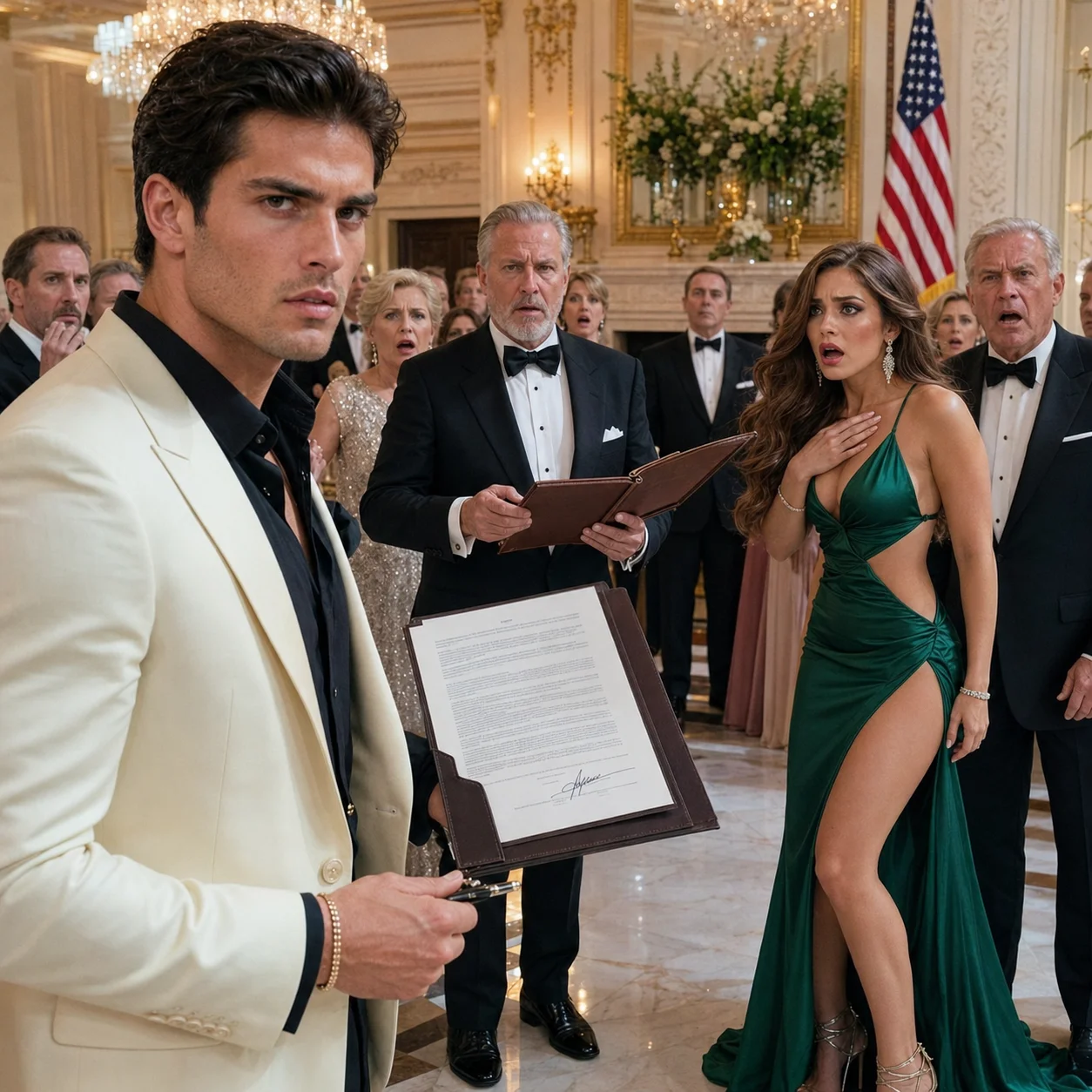
Then Thomas said, “Before the updated trustee acknowledgments are executed tonight, there is one outstanding matter concerning the emergency restructuring authorization from three years ago.”
Charles’s face changed.
Only slightly.
But I saw the blood drain from it.
Margaret turned toward him. “Charles?”
Thomas continued. “Certain signatures are required to confirm continuity between the prior special fiduciary authority and the current amended trust structure.”
Preston frowned. “What does that mean?”
“It means,” Thomas said, “that the party whose signature authorized the protective restructuring must acknowledge the updated documents before the trustees finalize tonight.”
My heart began to beat slower.
Not faster.
Slower.
Because I suddenly understood what was happening.
Charles had tried to bury the past, but legal documents do not care about family pride. The updated trust structure still needed a link to the emergency authorization. And that link was me.
Evelyn looked confused. “What party?”
Thomas adjusted his glasses. “Daniel Mercer.”
The room went quiet.
Not silent. Quiet.
There is a difference. Silence is empty. Quiet is full of things people are afraid to say.
Margaret blinked. “I’m sorry?”
Thomas looked toward me. “Mr. Mercer, I apologize. I was informed you had been briefed that your acknowledgment might be required this evening.”
I looked at Charles.
He couldn’t meet my eyes.
“No,” I said. “I wasn’t briefed.”
Evelyn stared at me as if I had stepped out of a disguise. “Daniel, what is he talking about?”
Before I could answer, Preston laughed once, loudly and awkwardly.
“That can’t be right. Why would Daniel’s signature be on anything related to the trust?”
Thomas looked from Preston to Charles, then back to his folder. “Because Mr. Mercer served as the independent special fiduciary during the Whitmore Trust emergency restructuring in 2023.”
The words landed like a chandelier crashing to the floor.
My mother’s hand flew to her mouth.
My father looked at me, stunned.
Evelyn took one step forward. “Emergency restructuring?”
Margaret’s voice sharpened. “Charles.”
Charles closed his eyes.
Thomas, clearly realizing the family had not been told, paused. “Perhaps this should be discussed privately.”
“No,” I said.
Every head turned toward me.
I stepped away from the wall.
For years, I had swallowed insults in that house. I had let them call me lucky, temporary, different. I had watched my parents sit at the far end of tables while people who owed their lifestyle to my silence looked through them.
I was done being polite for people who confused cruelty with class.
“No,” I repeated. “They’ve had plenty of privacy.”
Evelyn’s face flushed. “Daniel, don’t.”
I almost laughed.
Don’t.
That had been the theme of our marriage.
Don’t embarrass me. Don’t correct them. Don’t make this difficult. Don’t forget your place.
I looked at her across the room and said, “Earlier tonight, your brother told me marriage and belonging were different things. Your mother called my perspective refreshing because I come from a different walk of life. And you sat there. Again.”
Her lips parted.
“Daniel—”
“No. Let’s finally make it clear what world I’m supposedly just a guest in.”
The room was frozen now. Even the waiters had stopped moving.
I turned to Thomas. “Tell them why the trust needed emergency restructuring.”
Thomas hesitated. “Mr. Mercer—”
“Tell them generally. No privileged details. Just enough.”
Charles finally spoke, voice low. “Daniel, please.”
I looked at him. “You asked me to protect your family. I did. You asked me to keep your dignity intact. I did. And then you let them humiliate my parents in your dining room.”
Charles looked as if I had struck him.
Good.
Margaret turned on him. “Charles, what did he do?”
For once, Charles Whitmore had no polished answer.
So Thomas gave one.
“Several years ago, the trust faced serious internal mismanagement and exposure,” the lawyer said carefully. “Mr. Mercer identified key vulnerabilities, helped coordinate independent review, and served in a limited fiduciary role because existing parties had conflicts. His authorization enabled the trust to move forward with protective measures.”
Preston’s whiskey glass lowered slowly. “Are you saying he saved the trust?”
Thomas glanced at me. “In practical terms, his involvement was critical.”
Critical.
One word.
Six years of humiliation cracked under it.
Evelyn looked like she couldn’t breathe. “You never told me.”
“You never asked what I did when your father called me into his study for four months,” I said.
“I thought—”
“You thought what? That he was teaching me which fork to use?”
Her eyes filled with tears, but I couldn’t tell if they came from hurt or humiliation.
Margaret’s face had gone pale with fury. “Charles, how could you let a non-family member have authority over the trust?”
That sentence told me everything.
Not thank you. Not we were in trouble. Not Daniel helped us.
A non-family member.
I smiled faintly. “There it is.”
Margaret looked at me. “Excuse me?”
“You’re not upset that the trust was in danger. You’re not upset that people inside your own circle were draining it. You’re upset that someone like me had to help.”
Her mouth tightened. “You have no idea what this family represents.”
“I know exactly what it represents,” I said. “A beautiful house full of people who mistake inheritance for character.”
A gasp moved through the room.
Evelyn whispered, “Stop.”
I turned to her. “Why? Am I embarrassing you?”
She flinched.
“Because my parents were embarrassed tonight,” I said. “Quietly. Politely. The way decent people handle cruelty when they’re guests. Your mother looked at my father like shaking his hand was charity. Your brother joked that I didn’t belong. Your cousins laughed. And you let them.”
Evelyn wiped at her cheek. “I didn’t know about the trust.”
“This isn’t about the trust,” I said. “It’s about the fact that you needed the trust to respect me.”
That silenced her more completely than anything else.
Thomas cleared his throat softly. “Mr. Mercer, the acknowledgment—”
I turned to him. “What happens if I don’t sign tonight?”
A murmur ran through the room.
Charles’s head snapped up. “Daniel.”
Thomas hesitated again.
I held his gaze. “Legally.”
“The updated amendments would be delayed,” Thomas said. “Certain asset transfers and trustee confirmations could not proceed until the continuity issue is resolved.”
“And if there’s no resolution?”
“Then the prior restructuring documents would need court clarification. That could expose historical issues the family likely prefers to keep confidential.”
Preston swore under his breath.
Margaret looked at Charles like she wanted to kill him.
Evelyn stared at me in horror. “Are you threatening my family?”
I looked at my wife, really looked at her.
Five years of marriage. Thousands of small compromises. Hundreds of swallowed insults. Dozens of nights hoping she would choose me without being forced.
And even now, after everything, her first instinct was to protect the family machine.
“No,” I said quietly. “I’m done protecting it.”
I walked toward the table where Thomas had placed the documents. The entire room watched me. I picked up the pen, turned it once between my fingers, and thought about signing. Not for Margaret. Not for Preston. Not for Charles.
For Evelyn.
The woman I had loved. The woman who had once eaten takeout on my apartment floor and told me she hated families who negotiated love.
I looked back at her.
There was panic on her face. Shame, too. But beneath it, I saw something that hurt worse.
Calculation.
She wasn’t looking at me like a wife afraid of losing her husband.
She was looking at me like a Whitmore afraid of losing control.
I set the pen down.
“I won’t sign tonight.”
Chaos erupted instantly.
Preston stepped forward. “You son of a—”
My father moved before I did. He didn’t touch Preston. He didn’t have to. He simply stepped between us, shoulders squared, eyes steady.
“Careful,” Dad said.
Preston stopped.
It was amazing how quickly old money learned caution when faced with a man who had spent his life running into burning buildings.
Margaret’s voice rose. “This is blackmail.”
“No,” I said. “Blackmail is demanding something in exchange for silence. I haven’t asked for anything.”
“Then what do you want?” Charles asked.
The desperation in his voice filled the room.
I looked at my parents. My mother’s eyes were wet, but her chin was lifted. My father stood steady as stone.
Then I looked at Evelyn.
“I wanted a wife,” I said. “Not a sponsor. Not a handler. Not someone who loved me in private and apologized for me in public.”
Her face crumpled.
For one second, I almost stepped toward her.
Then she said, “Daniel, we can talk about this at home.”
Home.
As if this was a scheduling issue.
As if she hadn’t spent years making sure I understood that home was wherever her family allowed me to stand.
“No,” I said. “We’ll talk through lawyers.”
The words shocked even me.
Evelyn went still. “What?”
“I’m leaving.”
“You can’t just walk out.”
I gave her a sad smile. “Watch me.”
I turned to Thomas. “Send all trust-related communication through independent counsel. I’ll review whatever legal obligations I still have, but I won’t be pressured in a ballroom.”
Thomas nodded slowly. “Understood.”
Charles looked broken. “Daniel, I am sorry.”
I studied him for a moment.
I believed him.
But sorry without courage is just regret wearing good manners.
“You should have said that three years ago,” I replied.
Then I walked to my parents.
My mother took my hand. My father put his arm around her shoulders. Together, we walked out of the Whitmore estate under the stare of every person who had thought we were lucky to be invited.
Outside, the night air was cold and clean.
The valets looked startled when I asked for my car. My mother started crying quietly while we waited.
“I’m sorry,” she whispered.
I turned to her. “For what?”
“For tonight. For being there. Maybe we made it harder.”
Something inside me cracked then, not from anger but from love.
I hugged her tightly. “No, Mom. You made it impossible for me to keep lying to myself.”
My father cleared his throat and looked away, but not before I saw tears in his eyes.
The drive home was silent.
Evelyn called fourteen times before midnight.
I didn’t answer.
The next morning, she came home in the same dress she had worn to the dinner, wrinkled now, her makeup faded. I was sitting at the kitchen table with coffee and a list of divorce attorneys.
She stopped when she saw it.
“So that’s it?” she asked.
Her voice was hoarse.
“No conversation? No chance for me to explain?”
I looked up. “Explain what?”
She dropped her purse onto the counter. “I was shocked last night. I didn’t know what to say.”
“You never know what to say when your family insults me.”
“That’s not fair.”
“No,” I said. “It’s accurate.”
She pulled out the chair across from me but didn’t sit. “I didn’t know what my father had done. I didn’t know you helped.”
“And if I hadn’t?”
Her eyes flickered. “What?”
“If I hadn’t helped the trust, would I still deserve respect?”
“Of course.”
“Then why didn’t I have it before?”
She looked down.
There it was again. Silence. The Whitmore family language.
“I loved you,” I said. “I loved you enough to protect your family from a disaster they created. I loved you enough to keep your father’s secrets. I loved you enough to believe every excuse I made for you. But I cannot keep loving someone who treats my dignity like an inconvenience.”
Evelyn sat slowly.
“I was raised in that world,” she whispered. “You don’t understand what it’s like.”
“You’re right,” I said. “I don’t understand having every advantage and still being too afraid to be kind.”
She flinched.
“I know I failed you,” she said. “But divorce? Daniel, please. We can go to counseling. I’ll talk to my mother. I’ll change.”
I wanted to believe her.
That was the cruelest part. Love doesn’t vanish just because respect does. It lingers. It argues. It brings up old memories like evidence in favor of staying.
I remembered her laughing on my apartment floor.
I remembered her saying yes through tears.
I remembered the woman she had been before the Whitmore name swallowed her whole.
But then I remembered my mother apologizing for existing in a room that should have welcomed her.
“No,” I said gently. “You won’t change while losing me is just a fear. Maybe you’ll change when it becomes a fact.”
She cried then.
Not delicately. Not like a Whitmore woman at a charity luncheon. She broke down at my kitchen table, shoulders shaking, hands over her face.
I didn’t comfort her.
That may sound cold, but it was the first honest thing I had done for myself in years.
Over the next month, the Whitmore family tried every tactic.
Charles asked to meet privately. I agreed once, at my attorney’s office. He looked ten years older, his expensive suit hanging loose around his shoulders.
“I should have defended you,” he said.
“Yes.”
“You saved us.”
“Yes.”
“I was ashamed.”
“I know.”
He folded his hands on the conference table. “The court exposure would damage innocent people, too. Employees. Foundation beneficiaries. Your mother-in-law’s charities.”
I almost smiled at that. Even in apology, he was negotiating.
“I’m not trying to destroy the trust,” I said. “I’ll fulfill any lawful obligation. But I won’t sign anything under social pressure, and I won’t hide misconduct to preserve your family myth.”
He nodded. “What do you need?”
“Full transparency to all current beneficiaries. Independent audit. Removal of anyone involved in the prior mismanagement from any influence. Written acknowledgment of my role. And an apology to my parents.”
He swallowed. “Margaret won’t agree.”
“Then Margaret can explain that to a judge.”
He looked at me for a long time.
Then he nodded.
The audit happened.
Quietly at first, then not so quietly.
Two cousins lost access to trust distributions. Evelyn’s uncle resigned from three boards. Preston, who had enjoyed mocking me for years, was exposed for using a family business account as his personal vacation fund. Nothing criminal enough for prison, unfortunately, but enough to end the illusion that the Whitmore children were better stewards of money than anyone else.
Margaret fought the apology hardest.
She sent one of those stiff handwritten notes rich people use when they want credit for humility without actually feeling it.
Dear Robert and Linda, I regret if anything said or done at our home made you feel unwelcome.
My father read it once and snorted.
“If,” he said.
I sent it back through my lawyer.
Two weeks later, Margaret Whitmore came to my parents’ small brick house in person.
I was there because my mother asked me to be.
Margaret stood on the porch in a camel coat, looking deeply uncomfortable without marble beneath her feet.
My father opened the door.
For once, Margaret did not offer her hand like a favor.
She clasped both gloved hands in front of her and said, “Robert. Linda. I treated you poorly. Not accidentally. Not because of misunderstanding. I was arrogant, and I was unkind. You were guests in my home, and I made you feel beneath us. I am sorry.”
My mother, because she had more grace than Margaret deserved, invited her in for coffee.
Margaret accepted.
She sat at my parents’ kitchen table under a calendar from the local fire department and drank coffee from a mug that said World’s Best Grandpa, even though my parents didn’t have grandchildren.
It was one of the strangest hours of my life.
It did not heal everything. It did not make Margaret warm. It did not turn the Whitmores into better people overnight.
But it was real.
And real was more than they had offered before.
Evelyn and I separated formally that spring.
She moved into a condo downtown. I stayed in our house until the divorce terms were settled, then sold it. I didn’t want the walls. Too many memories lived in them, and not all of them were bad. That made it harder.
She did start counseling. Alone. She wrote me letters for months, some apologetic, some defensive, some painfully honest. I read them all. I answered only the ones that required logistics.
One letter stayed with me.
I thought I was protecting us by teaching you how to survive my family, she wrote. I see now that I was teaching you how to disappear.
That sentence almost made me call her.
Almost.
But love without trust is a house with no foundation. You can stand inside it for a while, but eventually every storm sounds like a warning.
The divorce was finalized nine months after the Legacy Dinner.
Evelyn didn’t fight over money. Maybe guilt stopped her. Maybe the audit did. Maybe she finally understood that taking from me after everything would make her exactly what I had accused her of being.
The Whitmore Trust survived, but changed.
Independent trustees took over. The foundation became more transparent. Charles stepped down from direct control and, to everyone’s shock, started volunteering twice a month at one of the community housing projects the foundation funded. Whether from guilt or growth, I never knew.
Preston avoided me forever after.
I considered that a gift.
A year after the divorce, I opened my own risk advisory firm. My first office was above a bakery, and the conference room had a radiator that hissed during calls. I loved it. Every scuffed floorboard belonged to me. Every client who walked in hired me because of what I knew, not who I had married.
One afternoon, my assistant buzzed my office.
“There’s a woman here to see you,” she said. “Evelyn Whitmore.”
I almost said no.
Then I looked out the window at the city below, at people moving through ordinary lives without trust funds or legacy dinners, and I realized I wasn’t afraid of seeing her anymore.
“Send her in.”
Evelyn entered wearing a simple gray coat, her hair shorter than before. She looked less polished. More human. There were faint lines around her eyes that hadn’t been there during our marriage.
“Hi, Daniel,” she said.
“Hi.”
She glanced around the office. “This place feels like you.”
I smiled a little. “Radiator and all?”
“Especially the radiator.”
For a moment, we were almost easy.
Then she reached into her bag and took out an envelope.
“I’m not here to reopen anything,” she said quickly. “I promise. I just wanted to give you this myself.”
I took it.
Inside was a check from the Whitmore Foundation made out to the firefighter relief fund my father supported every year. The amount was large enough to make me look up sharply.
“It was approved by the new board,” Evelyn said. “Not as charity. As part of a new annual grant program for first responder families.”
I studied her face. “Was this your idea?”
“Yes.”
“Why?”
She looked down at her hands. “Because your father deserved to be honored in rooms where people like my family used to overlook him.”
I didn’t know what to say.
She continued, voice quiet. “And because I’m trying to become someone who doesn’t need to lose everything before doing the right thing.”
There was no performance in her voice. No polished Whitmore cadence. Just regret.
“Thank you,” I said.
She nodded.
At the door, she paused. “Daniel?”
“Yeah?”
“I did love you. Badly. Cowardly. But I did.”
I felt the old ache move through me, softer now.
“I know,” I said. “I loved you, too.”
She smiled sadly. “I hope someone loves you better.”
I thought about that.
Then I said, “I hope you love yourself better first.”
She left.
Two years later, I received an invitation to a public foundation event honoring first responders. My father was being recognized for his decades of service. He didn’t want to go at first.
“Fancy people clapping doesn’t change anything,” he said.
“No,” my mother replied, adjusting his tie. “But making them clap for you might be fun.”
So we went.
The event was held not at the Whitmore estate but at a community center the foundation had helped renovate. No chandeliers. No dead ancestors glaring from oil paintings. Just bright lights, folding chairs, families, firefighters, teachers, social workers, and kids running around with cookies.
Charles was there, older and quieter. Margaret was there, too, seated without ceremony in the second row. Evelyn stood near the back, helping organize name tags.
When my father’s name was called, the room rose in applause.
Real applause.
Not polite. Not social. Real.
He walked to the podium, embarrassed and proud, and gave a short speech about service, family, and how nobody gets through life without help.
Then he looked at me.
“My son taught me something,” he said into the microphone. “Sometimes the strongest thing a man can do is stop trying to earn respect from people who should have offered it freely.”
My throat tightened.
The room applauded again.
Across the aisle, Evelyn wiped her eyes.
After the ceremony, Margaret approached my parents. She didn’t perform humility this time. She simply congratulated my father and asked my mother about her garden. It was awkward, but sincere enough.
Charles shook my hand.
“Your signature is no longer needed on anything,” he said with a faint smile.
“That’s good.”
“But your influence remains.”
I looked around the community center, at the families eating, laughing, talking without fear of using the wrong fork.
“Then maybe something useful came out of all this,” I said.
Charles nodded. “More than useful.”
Evelyn approached last.
We stood a few feet apart while people moved around us.
“You look well,” she said.
“I am.”
“I’m glad.”
I believed her.
That was the strange mercy of time. It didn’t erase what happened, but it stripped away the need to keep bleeding over it.
She glanced toward my parents. “Your dad was wonderful.”
“He usually is.”
She smiled. “He always was.”
A silence settled between us, but it wasn’t the old silence. Not the Whitmore kind. This one was peaceful. It held the past without asking us to return to it.
“I’m seeing someone,” I said.
Her eyes flickered, but her smile stayed. “That’s good. Is she kind?”
“Yes.”
“Good,” she whispered. “That matters more than people think.”
“It matters more than almost anything.”
She nodded.
Then she did something I never expected.
She stepped past me, walked to my parents, and hugged my mother. Not carefully. Not like someone worried about wrinkles or appearances. A real hug.
My mother hugged her back.
My father shook her hand afterward, and whatever he said made Evelyn laugh through tears.
I watched from a distance, feeling something unclench that I hadn’t realized I was still holding.
Forgiveness is not always reunion.
Sometimes forgiveness is being able to stand in the same room as your past and no longer feel the need to prove you survived it.
I never went back to the Whitmore estate.
I never again sat at their long table or stood under their chandeliers while people weighed my worth against their inheritance. I heard the mansion was eventually opened for foundation events a few times a year. Margaret hated the foot traffic at first, then apparently became obsessed with giving tours.
People can surprise you.
Not always in time to keep your love.
But sometimes in time to become better than they were.
As for me, I built a life that did not require permission.
My firm grew. My parents finally let me pay off the rest of their mortgage, though my father insisted on calling it a “temporary loan” because pride runs in working-class families, too. I fell in love again with a woman named Claire, a public defender with messy hair, sharp humor, and absolutely no patience for pretension. The first time she met my parents, she brought homemade lasagna and asked my father so many questions about firefighting that he talked for two hours.
Afterward, in the car, she looked at me and said, “Your parents are amazing.”
I waited for the other sentence. The comparison. The polite but. The little signal that she saw where I came from as something to manage.
It never came.
Instead, she took my hand and said, “Now I understand why you are the way you are.”
“How am I?”
She smiled. “Steady.”
That one word meant more to me than every compliment I had ever received in a ballroom.
Years later, people still occasionally asked about my first marriage when they learned I had once been connected to the Whitmore family.
Some asked whether it was strange to walk away from that kind of wealth.
I always told them the truth.
I didn’t walk away from wealth.
I walked away from being poor in the one place money can’t help you.
Respect.
Evelyn once told me I was just a guest in her family’s world.
For a long time, I believed the only way to win was to prove I belonged there.
But the night their lawyer asked why my signature was on their trust fund, I finally understood something that changed my life.
I had never needed a place in their world.
I needed the courage to leave it and build my own.