
Slowly.
Elise saw it happen. Her cheeks colored.
“Mom, Dad,” she said, her voice too bright, “you remember Daniel.”
“Of course,” Victor said, extending his hand. His handshake was firm but brief. “The watch repairman.”
“Restorer,” I said politely. “I restore antique watches and clocks.”
“Right.” He smiled without interest. “Charming work.”
Margaret leaned in to kiss Elise’s cheek, then turned to me. “Daniel. How… nice that you could come.”
There was a pause after “nice” just long enough for me to feel it.
Elise laughed nervously. “He insisted on wearing something meaningful tonight.”
Margaret’s eyes flicked over my suit again. “Meaningful. How sweet.”
A younger man standing beside Victor smirked into his champagne glass. I recognized him from Elise’s Instagram: Preston Vale, her family’s favorite kind of man. He was a private equity associate, owned too many loafers, and had the relaxed arrogance of someone who had never been asked to prove his worth because his last name had already done it for him.
“Elise,” Preston said, kissing her cheek. “You look incredible.”
“Thank you,” she said, smiling in a way I had not seen since we walked in.
Then Preston looked at me.
“And you must be Daniel.” His smile widened. “Vintage look. Bold choice.”
I smiled back. “Thank you.”
“I admire confidence,” he said. “Most men would have panicked and rented something.”
A few people nearby chuckled.
Elise’s fingers dug into my arm.
I could have answered. I could have embarrassed him easily. But my grandfather had taught me that dignity often looks like silence to people who mistake loudness for strength.
So I said nothing.
For the next hour, I became an accessory Elise kept trying to hide.
When someone asked how we met, she said, “Through a friend,” and quickly changed the subject. She did not mention that she had come into my shop with her grandmother’s broken Cartier watch and cried when I fixed it because her grandmother had worn it every Sunday for forty years. She did not mention that she had returned twice with no watch at all, just coffee and excuses to talk.
When someone asked what I did, she answered before I could.
“He works with antiques,” she said vaguely.
At one point, I reached for her hand, and she shifted away under the excuse of taking champagne from a passing tray.
I told myself not to take it personally.
Then she laughed at me.
It happened near the main auction display, in front of a group of her friends. Someone had made a joke about “old money versus old fabric,” and Preston, of course, had turned toward me with that lazy smile.
“Daniel, I have to ask,” he said. “Is the suit intentionally retro, or did you lose a bet?”
The group laughed.
I looked at Elise, expecting her to step in. Not dramatically. Not angrily. Just enough to say, “Don’t be rude.”
Instead, she covered her mouth, trying and failing to hide her smile.
Then she laughed too.
It was small. Embarrassed. Almost automatic.
But it cut deeper than Preston’s joke ever could.
Because his cruelty was cheap. Hers was a choice.
I looked at her, and for a moment she looked back. Something like guilt flashed across her face, but it disappeared quickly beneath annoyance.
“Oh, come on,” she whispered. “Don’t look like that. It’s just a joke.”
“Is it?”
“You’re being sensitive.”
“I’m standing here while your friends make fun of my grandfather’s suit.”
She glanced around, lowering her voice. “No one knows it’s your grandfather’s suit unless you keep bringing it up.”
“I didn’t bring it up.”
“Daniel.”
The way she said my name made me feel like a problem she wanted to tuck under the table until dessert.
I stepped back. “I’m going to get some air.”
Her eyes widened. “Not now.”
“I’ll be back.”
“Daniel, the auction starts soon.”
“I know.”
I walked away before she could say anything else.
Out in the hallway beyond the ballroom, the noise softened into a hum. I stood beside a tall window overlooking the city and breathed slowly, trying to steady the anger rising beneath my ribs.
I had not come to that gala to impress Elise’s parents. Not really. I had come because the charity mattered.
The Hartwell Foundation’s gala supported a children’s cardiac research center. Years earlier, that same center had performed the emergency surgery that saved my younger cousin Lily’s life. My aunt still sent a donation every Christmas, even when she could only afford twenty dollars. When the foundation reached out months ago searching for major auction pieces, I had been contacted through an old client: Dr. Martin Reyes, a retired surgeon and collector whose family knew mine.
He had asked whether I still had the Breguet pocket watch.
The watch was famous in collector circles. A rare nineteenth-century piece, hand-engraved, with documented provenance. My grandfather had acquired it decades ago from an estate sale when no one recognized what it was. He never sold it. He restored it slowly over many years and kept it locked in his shop safe, saying some objects came into your life not to make you rich, but to test what kind of person you were when money finally had a voice.
When he died, the watch became mine.
Six months before the gala, a private collector offered me $1.2 million for it.
I turned him down.
Not because I didn’t need money. I did. My shop’s roof leaked. My student loans were not gone. I lived in an apartment where the heat clanged through the pipes like a haunted ship in winter. But Lily had been alive for nineteen years because doctors at that cardiac center had known what to do. I could not save every child. I could not repay every miracle.
But I could do this.
So I donated the watch anonymously for the gala auction.
I had asked the foundation to keep my name private until the bidding opened because I did not want Elise’s family making a performance out of it. I did not want Victor Hartwell shaking my hand for cameras. I did not want Elise deciding I was suddenly acceptable because my poverty had been misunderstood as hidden wealth.
I wanted to give something meaningful.
Quietly.
And maybe, foolishly, I wanted to see who Elise was when she thought I had nothing to offer her world.
Now I knew.
I was still standing by the window when someone approached.
“Mr. Cole?”
I turned. A woman in a navy gown stood beside me, holding a clipboard. She was in her fifties, composed, with sharp eyes and a warm smile.
“Yes?”
“I’m Marianne Wells, executive director of the Hartwell Foundation.” She extended her hand. “I wanted to thank you personally before the auction begins.”
I shook her hand. “Please, call me Daniel.”
“I can’t tell you how much your donation means to us.”
“I’m glad it can help.”
“It will do more than help.” Her voice softened. “We have several international bidders on the phone. The estimate may be conservative.”
I nodded, unsure what to say.
She studied me for a second. “Are you all right?”
I looked back toward the ballroom, where laughter and music spilled through the open doors.
“Yes,” I said. “Just needed a minute.”
Her gaze followed mine. She understood more than I wanted her to.
“You know,” she said quietly, “generosity reveals character. But so does how people behave before they know what you’ve given.”
I looked at her.
She smiled sadly. “I’ve worked enough galas to know.”
Before I could answer, one of the event coordinators hurried toward her, whispering something about the auction schedule. Marianne touched my arm lightly.
“The auctioneer will announce the provenance before bidding. Your name will be included, as agreed.”
“Yes.”
“If you prefer to remain anonymous even then, I can still change it.”
I thought of Elise laughing behind her hand.
“No,” I said. “Announce it.”
Marianne nodded once. “Very well.”
When I returned to the ballroom, Elise was standing with Preston near the champagne tower. She looked relieved and irritated when she saw me.
“There you are,” she said. “Where did you go?”
“To breathe.”
She glanced at Preston, then back at me. “Can we not do this tonight?”
“We’re not doing anything.”
“You walked off.”
“You laughed.”
Her expression tightened. “Daniel, please. Not here.”
That phrase again.
Not here.
Not in front of people who matter.
Preston took a slow sip of champagne, clearly enjoying himself. “Trouble in paradise?”
Elise shot him a look, but not enough of one.
I looked at him. “No trouble. Just clarity.”
His smile faltered slightly.
Before Elise could respond, the lights dimmed. A soft chime echoed through the room, and the crowd began moving toward the auction stage. At the front, a polished man in a tuxedo stepped behind the podium, his voice smooth and theatrical as he welcomed everyone.
We took seats at a round table near Elise’s parents. I sat between Elise and an empty chair, with Preston on her other side. She leaned toward me without looking directly at me.
“Just smile,” she whispered. “After tonight, we can talk.”
I almost laughed.
After tonight.
As if tonight was not the conversation.
The early auction items came and went. A week at a villa in Tuscany. A signed guitar from a famous musician. A diamond bracelet donated by Margaret’s friend. A painting from a contemporary artist I had never heard of. Bids rose in neat, confident increments. People clapped. Victor beamed whenever the numbers passed expectations.
Then the auctioneer paused.
“And now,” he said, his tone shifting, “we come to the centerpiece of tonight’s auction. Ladies and gentlemen, this is one of the rarest pieces ever offered in support of the Hartwell Foundation.”
A hush moved through the ballroom.
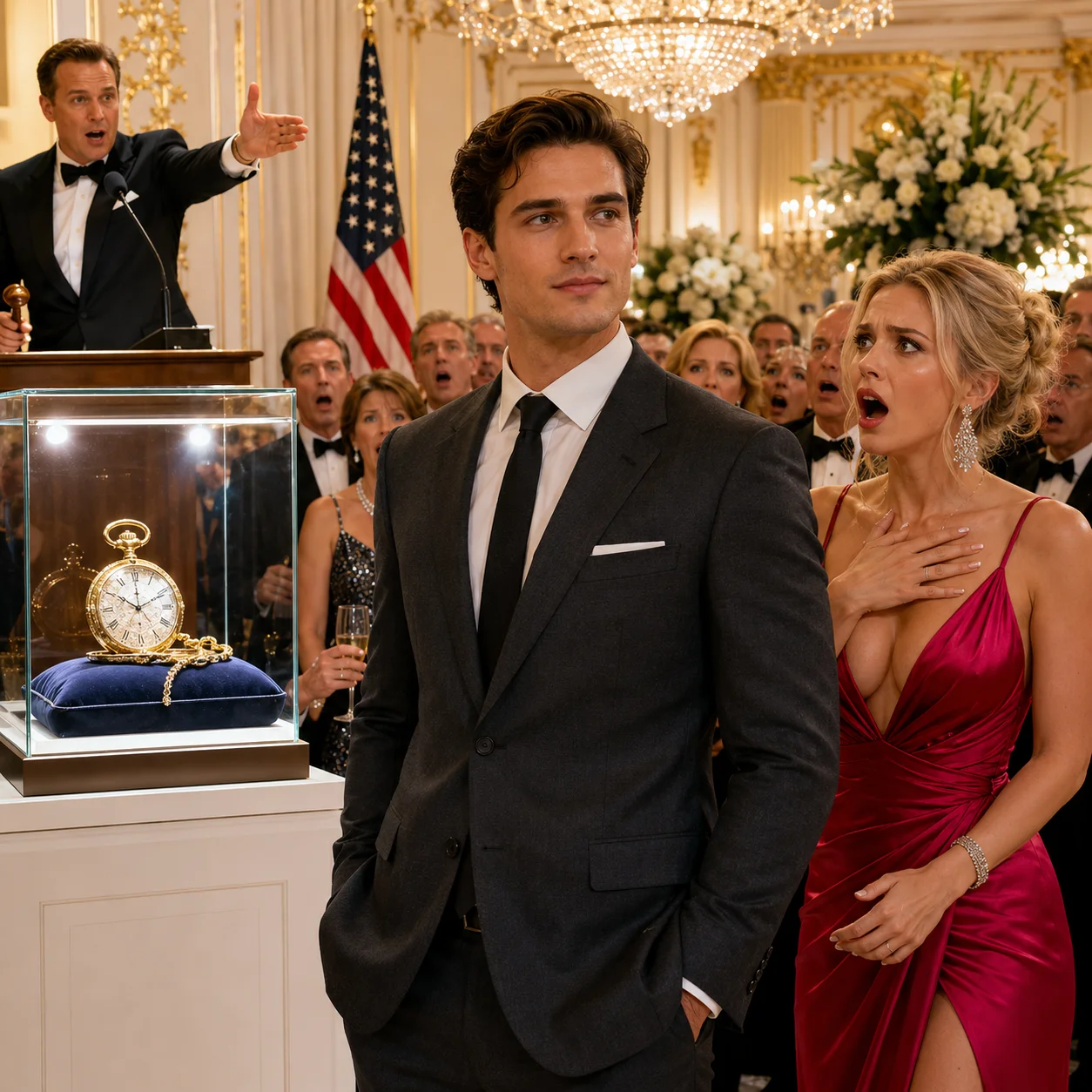
Two white-gloved attendants approached the covered display case at the front. One lifted the silk cloth.
The room seemed to inhale.
Inside the case rested my grandfather’s Breguet pocket watch.
Even under glass, it glowed. The gold case had been restored until every engraved line caught the light. The enamel dial was clean and elegant, the blue hands delicate as flame. Beside it lay a small card explaining its history.
Elise leaned forward, suddenly interested.
“Oh,” she whispered. “That’s beautiful.”
Preston gave a low whistle. “Now that is serious money.”
Victor sat straighter. Margaret’s eyes sharpened with recognition. Around the room, collectors murmured.
The auctioneer continued, “This exceptional nineteenth-century Breguet pocket watch, with documented provenance and original movement, has been privately held for decades. It has been fully restored by one of the finest independent horological restorers in the country.”
Elise’s head turned slightly.
I kept my eyes on the stage.
“The pre-auction estimate was set at eight hundred thousand to one million dollars,” the auctioneer said. “However, given the extraordinary interest received from private collectors tonight, we anticipate a spirited bidding process.”
A ripple of excitement spread through the room.
Then he smiled.
“And before we open bidding, the Hartwell Foundation would like to recognize the donor of this extraordinary item. This watch was donated in honor of Henry Cole, a master watchmaker whose devotion to restoration and craftsmanship preserved this piece for future generations. The donor is his grandson…”
The pause felt endless.
“Mr. Daniel Cole.”
For one second, the ballroom was silent enough for me to hear Elise stop breathing.
Then heads turned.
Not some heads.
Every head.
Victor looked at me as if I had changed shape in my chair. Margaret’s lips parted. Preston’s champagne glass froze halfway to the table. Elise stared at me, her face draining of color so quickly I almost felt sorry for her.
Almost.
The auctioneer gestured toward our table. “Mr. Cole, would you please stand?”
I did not want to.
But Marianne, standing near the stage, gave me a small encouraging nod.
So I stood.
The applause began politely, then grew louder as people realized the man standing in the old suit was not a guest someone had smuggled in by mistake. He was the donor of the most valuable item in the room.
I did not smile for the crowd. I simply nodded once.
The auctioneer continued, “Mr. Cole requested that the proceeds directly support pediatric cardiac surgery research and family assistance grants. His donation tonight is expected to fund multiple programs for children and families facing life-threatening heart conditions.”
The applause grew again.
Elise whispered my name.
I did not sit down until the auctioneer opened bidding.
“Opening at five hundred thousand dollars.”
A paddle lifted near the front.
“Five hundred thousand. Do I hear six?”
Another paddle.
“Six hundred thousand.”
Within minutes, the number climbed past one million.
Elise sat frozen beside me.
At 1.3 million, Victor leaned toward me for the first time all evening with real attention.
“Daniel,” he whispered, his voice thick with disbelief, “you donated that?”
“Yes.”
“That watch belonged to your grandfather?”
“Yes.”
“Do you understand what it’s worth?”
I turned to him. “Yes.”
His mouth opened, then closed.
Onstage, the bidding continued.
“One million five hundred thousand.”
A phone bidder entered.
“One million six.”
Preston muttered something under his breath that sounded like profanity.
Elise finally moved. Her hand reached for mine under the table.
I looked down at it.
Then I gently moved my hand away.
She flinched as if I had slapped her.
At 1.8 million, the room was electric. People leaned forward, whispering, watching paddles rise from opposite ends of the ballroom. The auctioneer’s voice grew brighter with every bid.
“One million nine hundred thousand.”
A pause.
“Two million dollars.”
Gasps broke across the room.
Marianne covered her mouth with one hand, tears shining in her eyes.
The final bid came from a collector on the phone.
Two million one hundred thousand dollars.
The gavel fell.
“Sold.”
The ballroom erupted.
People stood. Applause thundered against the chandeliers. I remained seated this time, my throat tight, not because of the money exactly, but because I could almost see my grandfather in his old shop, shaking his head at the absurdity of a room full of wealthy people clapping for a watch he had once found in a dusty box beneath a dead man’s staircase.
Elise leaned toward me, her voice barely audible.
“Daniel… why didn’t you tell me?”
I looked at her.
The answer was simple.
“Because I wanted to see whether you respected me before you had a reason to be impressed.”
Her eyes filled instantly.
“Daniel, I didn’t know.”
“I know.”
“That’s not fair.”
“No,” I said quietly. “What wasn’t fair was laughing at me because my suit was old. What wasn’t fair was treating my work like something to hide. What wasn’t fair was making me feel like I should be grateful just to stand beside you.”
She swallowed hard. “I was nervous.”
“You were ashamed.”
The word landed between us heavier than anything the auctioneer had said.
Preston pushed his chair back awkwardly. “I’m going to get a drink.”
No one stopped him.
Victor cleared his throat. “Daniel, perhaps after the program we could speak privately.”
I looked at him. “About what?”
His smile was strained. “I may have underestimated you.”
“That seems to be going around tonight.”
Margaret looked down at her lap.
Elise touched my sleeve. “Please don’t do this here.”
I almost smiled at that.
“There it is again,” I said. “Not here.”
Her face crumpled. “I’m sorry.”
“I believe you’re sorry right now.”
“That’s not the same?”
“No.”
Because apologies given under chandeliers while everyone is watching are not always remorse. Sometimes they are damage control wearing perfume.
The rest of the gala blurred around me. People came to our table to shake my hand. Collectors congratulated me. Doctors thanked me. A mother with a little boy in a bow tie told me her son had received surgery through one of the programs the foundation funded. She cried when she thanked me, and for the first time that night, I nearly broke.
That boy mattered.
Not Elise’s embarrassment. Not Preston’s jokes. Not Victor’s delayed respect.
That boy.
Near the end of the evening, Marianne asked if I would say a few words. I did not want attention, but when I saw the families seated near the front, I knew I couldn’t refuse.
So I walked onto the stage in my old suit while the ballroom watched.
The lights were warm and bright. The microphone felt too tall. For a moment, I saw nothing but reflections on glass and diamonds.
Then I looked at the watch in its case.
“My grandfather used to say that broken things are not worthless,” I began. “They are just waiting for the right hands.”
The room quieted.
“He was a watchmaker. He spent his life repairing things most people had already given up on. He didn’t come from money. He didn’t care about status. But he believed craftsmanship was a form of love. Patience was a form of love. And giving something your best, even when no one applauded, was a form of love.”
My voice tightened, but I kept going.
“When my cousin was a child, doctors like the ones supported by this foundation saved her life. My family could not have paid back that gift if we had worked for a hundred years. Tonight is not repayment. It’s gratitude.”
I looked across the ballroom, not at Elise, but somehow through the whole glittering room.
“I hope this donation reminds someone that value is not always where people expect to find it. Sometimes it comes in an old box, an old shop, an old suit. Sometimes the things people laugh at are carrying histories they never bothered to ask about.”
No one moved.
I stepped back from the microphone. “Thank you.”
The applause that followed was different from before. Less excited. More human.
When I returned to the floor, Elise was crying.
Not loudly. Not dramatically. Just silently, her makeup perfect except for the wet shine beneath her eyes.
“Can we talk?” she asked.
I nodded.
We stepped out onto the hotel terrace. The city stretched below us, all lights and glass. Music drifted faintly through the doors behind us. For a while, neither of us spoke.
Then Elise wrapped her arms around herself and said, “I became someone I don’t even like tonight.”
I stared out at the traffic moving far below. “Maybe tonight just made it visible.”
She flinched.
“I deserved that,” she said.
“I’m not trying to punish you.”
“No. You’re just telling the truth.” She wiped carefully under one eye. “I was ashamed of you. Not always. Not in the beginning. But lately… yes. I let my parents get in my head. I let that world get in my head. I told myself I was helping you fit in, but I was trying to edit you.”
I looked at her then.
She was shaking.
“I loved how grounded you were when we met,” she continued. “I loved your shop, your stories, the way you talked about your grandfather. And then the closer you got to my family, the more I started measuring you by their standards. Your apartment. Your clothes. Your work. I hate that I did that.”
“So do I.”
“I’m sorry, Daniel.”
For the first time that night, the apology sounded real.
But real did not mean enough.
I leaned against the stone railing. “Do you know what hurt the most?”
She shook her head.
“I could handle your parents looking down on me. I expected it. I could handle Preston making jokes. Men like him need someone to feel above. But you knew what that suit meant. You knew who gave it to me. And you laughed anyway.”
She covered her mouth.
“I know,” she whispered.
“I don’t need a partner who thinks I’m impressive after a public announcement. I needed one who didn’t treat me like an embarrassment before it.”
She cried harder then, turning away as if she could hide it from the city.
“I can change,” she said.
“I hope you do.”
Her eyes searched mine. “But not with you?”
I did not answer immediately.
Because I loved her.
That was the part that made it complicated. Love does not disappear just because someone wounds you. Sometimes it stays, bleeding quietly, asking whether forgiveness and self-respect can sit at the same table.
But I thought about the months of small corrections. The way she told me not to wear certain jackets. The way she introduced me vaguely. The way she laughed tonight when she thought the room agreed I was beneath her.
And I knew.
“I don’t think I can stay,” I said.
She pressed her lips together, trying to hold herself together. “Because of one night?”
“No,” I said softly. “Because tonight showed me the pattern.”
She nodded slowly, as if each word had to travel through pain before she could understand it.
Behind us, the terrace door opened.
Victor stepped out.
“Elise,” he said, then stopped when he saw her face. His gaze moved to me. “Daniel. I apologize for interrupting.”
“You’re not interrupting,” Elise said, her voice unsteady. “We were done.”
Victor looked between us, then lowered his eyes.
“I owe you an apology,” he said to me.
I was surprised enough to stay quiet.
“I judged you,” he continued. “Openly enough that my daughter clearly felt permitted to do the same. That is not leadership. It is arrogance.”
Elise looked at him, stunned.
Victor exhaled. “Your grandfather sounds like he was a better man than most I’ve met in rooms like this.”
“He was,” I said.
“I would like to make a personal contribution to the cardiac center in his name,” Victor said. “Not as a performance. Not through the foundation’s publicity office. Quietly.”
I studied him, searching for the angle.
Maybe there was one. Maybe there wasn’t.
“Then do it,” I said. “Quietly.”
He nodded.
Margaret appeared behind him a moment later, looking smaller without the ballroom around her.
“Daniel,” she said, “your speech was beautiful.”
“Thank you.”
She seemed to want to say more, but years of polished pride held her back. Finally, she said, “I’m sorry for how I treated you.”
I accepted her apology with a nod, not because she deserved my warmth, but because my grandfather had also taught me not to become cruel just because others had been.
I left the gala before dessert.
Elise offered to ride with me. I told her no.
The valet brought my old car around after moving two luxury SUVs out of the way. I stood beneath the hotel lights in my grandfather’s suit while people glanced at me differently than they had when I arrived. Some with respect. Some with curiosity. Some with embarrassment because they had laughed too.
I drove home alone.
For the first time all night, I felt peaceful.
Not happy. Peaceful.
There is a difference.
The next morning, I woke to twenty-three missed calls, nine voicemails, and more messages than I wanted to read. Elise had sent several.
The first said, I’m sorry.
The second said, Please let me explain.
The third said, I know I lost you last night, but I need you to know I am going to become better than what I showed you.
That one I read twice.
Then I put the phone down.
I spent the day at the shop.
The bell above the door rang softly as customers came and went. A retired teacher brought in a mantel clock. A young man came in with his father’s wristwatch. A woman cried when I told her I could restore the pocket watch her husband had carried before he passed.
Work steadied me.
By Monday afternoon, an envelope arrived from the Hartwell Foundation. Inside was a handwritten letter from Marianne and a copy of the final auction report. After fees and matched pledges inspired by the sale, the total raised because of my grandfather’s watch had reached nearly three million dollars.
At the bottom of the letter, Marianne had written:
Henry Cole’s legacy will help families who may never know his name, but whose lives will be changed because of him.
I sat at my workbench for a long time after reading that.
Then I opened the drawer where I kept my grandfather’s tools. His loupe. His tweezers. His tiny screwdrivers worn smooth from decades of use.
“You were right,” I whispered. “Value isn’t price.”
A week later, Elise came to the shop.
I saw her through the front window before she came in. No silver gown. No diamonds. No perfect gala armor. She wore jeans, a cream sweater, and nervousness. In her hands was a small paper bag.
The bell rang.
“Hi,” she said.
“Hi.”
She looked around the shop the way she had in the beginning, before she started seeing it through her family’s eyes.
“I won’t stay long,” she said. “I just wanted to bring this back.”
She reached into the bag and pulled out the Cartier watch I had repaired for her the first month we met.
“My grandmother’s watch?” I asked.
She nodded. “It stopped again.”
I took it carefully.
“And,” she added, her voice trembling, “I think I did too.”
I looked up.
“I don’t expect you to forgive me today,” she said. “Or ever. But I started therapy yesterday. I also resigned from the gala committee.”
“Elise…”
“I’m not saying that to win points. I know that’s not how this works. I just wanted you to know I heard you. Really heard you.”
For a moment, I saw the woman I had fallen for. Not the polished Hartwell daughter. Not the embarrassed girlfriend. Just Elise, flawed and frightened and maybe finally honest.
“I’m glad,” I said.
Her eyes filled, but she smiled a little. “You always fix things carefully. I’m trying to learn how.”
I looked down at her grandmother’s watch. “Some things can be repaired.”
She waited.
“But they’re never exactly what they were before.”
“I know.”
We stood in silence.
Then she nodded, accepting what I had not fully said.
“I’ll pay for the repair,” she said.
I almost smiled. “You always were a terrible customer.”
She laughed softly through tears. “Why?”
“Because you never waited for the estimate.”
For one small second, the old warmth returned.
Then she left.
Months passed.
The story of the gala spread through social circles faster than I expected. Articles appeared. Most exaggerated things. Some called me a “mystery donor.” Others called the watch a “million-dollar miracle.” I declined interviews until Marianne asked if I would speak at a small hospital event for families.
That one, I accepted.
Not because I wanted attention, but because Lily came with me. She was twenty now, bright-eyed, stubborn, alive. She stood beside me after the event and hugged one of the surgeons who had saved her when she was too young to remember his face.
That was worth every headline I avoided.
Victor Hartwell did make the quiet donation. A large one. He also visited my shop once, awkward and overdressed, carrying an antique clock that had belonged to his father.
“I was told you’re the best,” he said.
I looked at him over my glasses. “You were told correctly.”
He actually laughed.
We were never friends, exactly, but something shifted. Respect, perhaps. Or humility, which is respect after it has been forced to kneel.
As for Elise, she kept changing.
Not for me, at least not only for me. She left several committees. Took a job with a nonprofit outside her family’s orbit. Sent one letter months later, not asking for another chance, just telling me she finally understood that she had spent years confusing approval with love.
I kept the letter.
I did not answer it immediately.
A year after the gala, the Hartwell Foundation unveiled a new family assistance grant named after my grandfather. The Henry Cole Restoration Fund. It helped parents stay near the hospital while their children received treatment. Hotel rooms. Meals. Transportation. Repairs for lives paused by fear.
Marianne invited me to the ceremony.
I wore the same old suit.
Not because I had nothing else to wear. By then, I had bought a new one, navy and perfectly tailored. But this ceremony was for him.
The ballroom was smaller this time. Less glitter. More families. More doctors. Fewer people trying to be seen.
When I arrived, no one laughed.
Near the front, I saw Elise.
She was not dressed to impress anyone. Simple black dress, no diamonds, hair loose around her shoulders. She looked nervous when she saw me, but she did not run over. She simply smiled and gave me space.
After the ceremony, I found her standing near the display about the fund.
“My grandmother’s watch is still running perfectly,” she said.
“I’m glad.”
She looked at my suit. “He would be proud.”
I followed her gaze. “I hope so.”
“He’d probably tell you the cuffs need work.”
That surprised a laugh out of me.
“They do,” I admitted.
We stood together in quiet understanding.
“I never thanked you,” she said, “for ending things the way you did.”
I raised an eyebrow. “By leaving?”
“By not humiliating me when you could have.” She looked toward the families gathering near the stage. “You had every right to. After how I behaved.”
“I didn’t want revenge.”
“I know that now.”
“I wanted truth.”
She nodded. “You gave me that too.”
Something settled between us then. Not romance. Not quite forgiveness in the easy sense. But peace.
And peace, I had learned, was sometimes the ending love could still offer when forever was no longer possible.
Later that night, after everyone left, I stood alone near the foundation display. There was a photograph of my grandfather on the table, the one I had given Marianne: Henry Cole in his shop, sleeves rolled up, gray hair wild, smiling over a half-repaired clock.
Beneath it was a quote from his old notebook.
Broken things are not worthless. They are waiting for patient hands.
I touched the edge of the frame.
For years, I had thought my grandfather left me a watch.
But he had left me more than that.
He left me the ability to recognize value when others missed it. He left me the strength not to sell my dignity for acceptance. He left me the patience to restore what could be restored, and the wisdom to walk away from what could not.
That night at the gala, Elise laughed because she saw an old suit.
The room laughed because they saw a man who did not belong.
But my grandfather would have seen the truth immediately.
A man does not become valuable when rich people finally notice him.
He becomes free when he stops needing them to.
![[FULL STORY] She Said I Wasn’t Good Enough for Her Career — So I Took Mine and Left](https://social-media.rabedo.com/thumbnails/1777446495_[FULL STORY] She Said I Wasn’t Good Enough for Her Career — So I Took Mine and Left.png)
![[FULL STORY] My Husband’s Mistress Showed Up With Luggage—So I Showed Her Who Actually Owned Everything](https://social-media.rabedo.com/thumbnails/1776761706_D75.jpeg)

![[FULL STORY] She Said “It’s Just Dinner With My Ex” — Then Saw Me There With Another Woman and Lost Everything](https://social-media.rabedo.com/thumbnails/1776585949_025e5c0a-ce5d-446f-badb-59d700fd9214.png)