
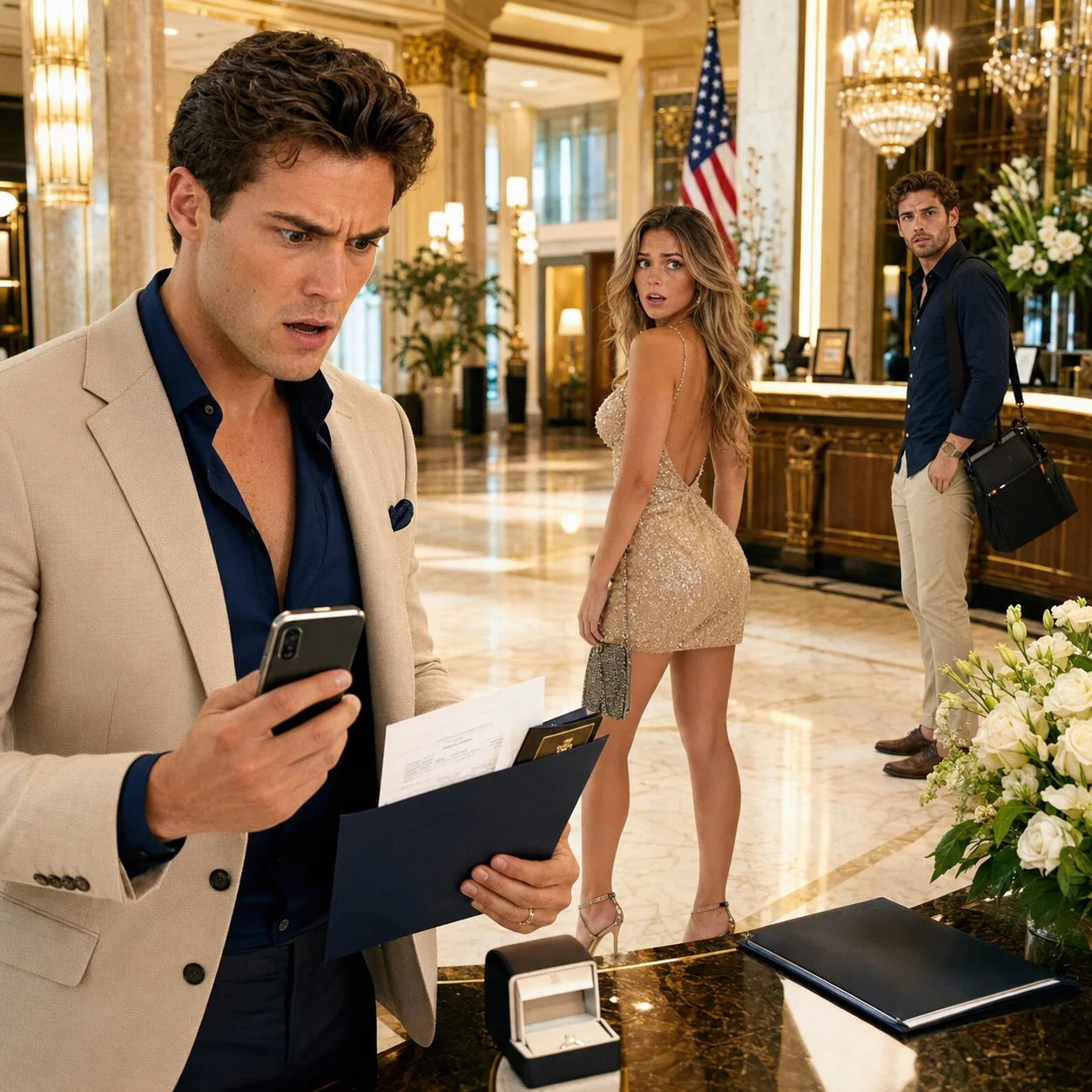
Natalie and I had always gotten along. She was blunt, funny, allergic to family drama, and fiercely loyal to Claire in the way younger sisters are when they have watched an older sister survive heartbreak.
One Saturday, about six weeks before the wedding, Natalie came over to help assemble welcome bags for guests. Claire was out picking up ribbon samples, which apparently mattered deeply to civilization.
I was at the dining table stuffing miniature bottles of maple syrup into gift bags when Natalie glanced at me and said, “Is Claire okay?”
I looked up. “What do you mean?”
“She’s been weird.”
“How?”
Natalie hesitated. That was unlike her.
“Just emotional,” she said. “More than normal wedding stress.”
“It’s a big wedding.”
“Yeah, but…” She stopped.
“But what?”
She shoved a small box of chocolates into a bag, then sighed. “Never mind.”
“Natalie.”
She met my eyes. “Has she mentioned Daniel?”
The room seemed to shrink around that name.
I kept my voice calm. “Why?”
“Because Mom said she saw him downtown last month.”
I felt my hands stop moving.
“Here?” I asked.
Natalie nodded. “Apparently he’s back in Boston for some photography thing. Or he was. I don’t know. I didn’t want to bring it up because Claire gets defensive.”
“Did Claire see him?”
“I don’t know.”
But her face said she suspected more.
When Claire came home, I watched her hug Natalie, watched them fall into easy sister chatter, watched Claire kiss me on the cheek and ask if we had eaten lunch.
I almost asked right then.
But guests, bags, wedding tasks, and my own fear all got in the way.
That night, I brought it up.
“Natalie said Daniel’s been in Boston.”
Claire was brushing her hair in front of the bathroom mirror. Her hand paused halfway down.
“Oh,” she said.
“Oh?”
“I didn’t know.”
I watched her reflection. “You didn’t?”
“No.”
“Claire.”
She turned around, annoyed now. “What do you want me to say?”
“The truth.”
“That is the truth.”
It was the first time in our engagement that I felt like I was talking to a locked door instead of a person.
I stepped closer. “You told me he was just a memory.”
“He is.”
“Then why do you look terrified every time I say his name?”
Her eyes flashed. “Because I hate being interrogated about someone who hurt me.”
That landed.
Hard.
Guilt rushed in, exactly where doubt had been.
“I’m sorry,” I said.
She looked away. “I don’t want him in our life. Please don’t bring him into our wedding.”
Our wedding.
Those two words softened me.
I apologized again.
She let me hold her that night, but something between us stayed stiff and careful.
The third sign was the hotel reservation.
It happened by accident.
Two weeks before the wedding, I was sitting in my office finalizing our travel details. My assistant had asked whether I needed transportation arranged from the Charleston airport to The Marlow House. I realized I did not have the full confirmation email because Claire had handled the booking.
I texted her.
Can you forward me the hotel reservation? Need it for airport transfer.
She replied twenty minutes later.
I’ll send later. In meeting.
Two hours passed.
Then four.
By the time I got home, she said she had forgotten and would send it after dinner.
She did not.
The next morning, I asked again.
She smiled too brightly and said, “Oh my God, yes, I’m sorry. Wedding brain.”
At lunch, instead of forwarding the confirmation, she sent me a screenshot.
It showed the hotel name, dates, room type, and confirmation number.
But the top part of the reservation was cropped.
Not enough to be obvious.
Just enough to be strange.
I stared at it for a long time.
Then I called The Marlow House.
A woman answered with a polished Southern voice. “Good afternoon, The Marlow House. This is Amelia speaking.”
“Hi,” I said. “I’m calling to confirm an upcoming reservation.”
“Of course. May I have the confirmation number?”
I gave it to her.
“One moment.”
The soft clicking of a keyboard filled the silence.
“Yes, I see that here,” she said. “Arriving the twenty-second, departing the twenty-fifth. Magnolia Suite.”
“That’s right.”
“And may I confirm the guest name?”
I expected her to say Claire Whitman.
Instead, she said, “I have Claire Whitman and Daniel Hart.”
For a second, I did not understand the sentence.
It was like hearing a familiar language arranged in an impossible order.
“I’m sorry,” I said. “Could you repeat that?”
“Claire Whitman and Daniel Hart,” she said pleasantly. “Is there a change needed?”
My hand tightened around the phone so hard it hurt.
I stood up from my desk.
“No,” I said slowly. “No change. I just… wanted to confirm.”
“Of course. We look forward to welcoming Ms. Whitman and Mr. Hart.”
Mr. Hart.
Not Evan Brooks, the man paying half the wedding invoices.
Not Evan Brooks, the groom.
Daniel Hart.
I thanked her and hung up.
Then I stood there in my office with my phone in my hand, staring at nothing.
There are moments in life when your body understands the truth before your mind can assemble it. My heartbeat slowed first. My skin went cold. My ears filled with pressure. The room did not spin. It sharpened.
Every detail became cruelly clear.
Claire cropping the screenshot.
Claire taking calls on the balcony.
Claire saying Daniel was just a memory.
Claire wanting that hotel specifically.
Claire looking at old photos.
Claire changing the first dance song.
Claire flinching every time I said his name.
I sat down.
Then I stood up again.
Then I walked into the conference room at the end of the hall, locked the door, and called the hotel back.
This time, I asked for the manager.
Amelia transferred me to a man named Robert, who sounded older and less scripted.
I explained that I was Claire’s fiancé, that I believed there might have been an error with the reservation, and that I needed to understand how Daniel Hart’s name had been added.
Robert was cautious. Privacy policy. Guest information. He could not disclose too much.
“I understand,” I said. “But my wedding is in two weeks, and this reservation is supposed to be for my honeymoon.”
There was a pause.
A long one.
Then his voice softened.
“Mr. Brooks, I can’t discuss private communications in detail. But I can say the reservation was originally requested by Ms. Whitman. Mr. Hart’s name was added at the time of booking as the second guest.”
“At the time of booking?”
“Yes, sir.”
Not accidentally.
Not recently.
Not by the hotel.
From the beginning.
I asked one more question.
“Was my name ever on it?”
Another pause.
“No, sir.”
I thanked him.
I do not remember leaving work. I remember getting into my car. I remember sitting in the parking garage with both hands on the steering wheel, breathing through my nose like I was trying not to vomit.
My first instinct was to drive home and confront her.
My second instinct was to call Daniel and threaten him.
My third was to cancel everything immediately.
But beneath the rage, something quieter spoke up.
Find out the truth before she turns it into confusion.
I hated that I had to think like that.
I hated that love had brought me to a place where evidence mattered more than words.
That evening, I went home and acted normal.
It was one of the hardest performances of my life.
Claire was in the kitchen, barefoot, wearing one of my old sweaters, making pasta like she hadn’t placed another man’s name on our honeymoon suite.
“Hey,” she said. “You’re late.”
“Work ran long.”
She kissed me.
I let her.
That is another embarrassing truth.
Sometimes betrayal does not make love disappear instantly. Sometimes your body still responds to the person who is destroying you because it has not received the news yet.
Over dinner, she talked about centerpieces.
I nodded.
She talked about her mother being impossible.
I nodded.
She asked if I had confirmed airport transportation.
I looked at her across the table.
“Not yet,” I said.
Her fork paused.
“Why not?”
“I’ll do it tomorrow.”
She relaxed.
That tiny relaxation told me more than any confession could have.
After she went to bed, I opened my laptop and searched Daniel Hart.
He was not hard to find.
Photographers rarely are.
His website was full of moody portraits, expensive weddings, black-and-white street shots, and self-important captions about “capturing truth in transition.” He had a recent gallery from Boston. Natalie had been right. He was back.
His Instagram was public.
That surprised me.
I scrolled carefully.
No obvious photos of Claire.
No romantic posts.
No tags.
But then I found a story highlight labeled Charleston.
My pulse picked up.
It contained old photos. The Marlow House courtyard. A balcony with ivy. A hand holding champagne. A woman’s shoulder in a satin dress, her face out of frame.
The date was five years ago.
Before me.
During Claire.
I stared at the balcony photo.
Then I opened the hotel website and found the Magnolia Suite.
Same balcony.
Same courtyard.
Same hotel.
Claire had not chosen The Marlow House because of some event planning connection.
She had chosen it because she had been there with Daniel.
I kept scrolling through his old posts. Eventually, I found a caption from five years earlier.
Some places know the ending before you do.
No names.
No faces.
But I knew.
I leaned back in my chair and laughed once. It came out wrong, dry and cracked.
My fiancée had booked our honeymoon in the same suite she had once stayed in with her ex.
And she had put his name on the reservation.
The next morning, I called my best friend, Mark.
Mark had been my college roommate, my future best man, and the only person in my life blunt enough to say terrible things gently.
I told him everything.
He was silent for a while.
Then he said, “Do you want me to talk you down, or do you want the truth?”
“The truth.”
“You can’t marry her until you know why his name is there.”
“I know why.”
“No,” he said. “You know what it looks like. You don’t know how deep it goes.”
That sentence stayed with me.
How deep it goes.
So I did something I never thought I would do.
I hired a private investigator.
His name was Martin Reeves. He was a retired police detective with tired eyes and a voice like gravel. His office smelled like coffee and old paper. I felt ridiculous sitting there explaining my wedding problem, like some jealous fool from a bad movie.
Martin did not make me feel ridiculous.
He listened, wrote everything down, and asked practical questions.
“Do you have access to shared accounts?”
“Yes. Wedding email. Some vendor portals.”
“Joint finances?”
“No. We were going to merge after the wedding.”
“Good,” he said.
That word chilled me.
Good.
As if my marriage failing before it began was, administratively, a blessing.
He told me he could do basic lawful surveillance and background research. No hacking. No illegal access. No phone tracking. I appreciated that. I did not want revenge enough to become someone I hated.
For the next four days, I lived two lives.
In one, I was Evan Brooks, groom-to-be, smiling through final dress fittings, seating chart arguments, and cake confirmations.
In the other, I was a man waiting for proof that the woman he loved was not who he thought she was.
Martin called me on a Thursday.
“Can you meet?”
My stomach dropped.
We met in his office after work.
He placed a folder on the desk.
“Daniel Hart has been in Boston for seven weeks,” he said. “He’s renting a studio apartment in Fort Point. Your fiancée has visited that building three times that I could confirm.”
The words entered me like cold water.
I looked at the folder but did not open it.
“How long did she stay?”
“First visit, forty minutes. Second, about an hour and a half. Third, twenty minutes.”
“When?”
He gave me dates.
One was the night Claire said she had a late meeting with the florist.
Another was the afternoon she claimed to be at her final gown adjustment.
The third was the morning after I had asked if Daniel reached out.
Martin slid photographs across the desk.
Claire outside Daniel’s building.
Claire walking in.
Claire leaving with sunglasses on and her hair pulled back.
Not kissing. Not touching. Nothing dramatic.
But enough.
More than enough.
“There’s more,” Martin said.
I looked up.
He hesitated. “You sure?”
“No.”
He waited.
I swallowed. “Show me.”
He opened the folder to a printed email.
“It came from your shared wedding account. You said you had access. I didn’t access anything you didn’t provide.”
The email was from The Marlow House to Claire.
Subject: Magnolia Suite Reservation Update.
The visible line read:
As requested, we have kept Mr. Daniel Hart listed as the second guest and noted your preference for the same suite as your previous stay.
I felt something inside me tear.
Same suite.
Previous stay.
Martin watched me carefully. “I’m sorry.”
I nodded because I could not speak.
Then he showed me the final page.
A vendor invoice.
Daniel Hart Photography.
Booked for: Whitman-Brooks Wedding Weekend.
I stared at it.
“What is this?”
“Your wedding photographer,” Martin said.
“No,” I said. “Our photographer’s name is Elise.”
“Elise Turner is the primary vendor on your contract. But Daniel Hart is listed as a contracted second shooter for the reception.”
The room went silent.
Claire had hired her ex to photograph our wedding.
Not openly.
Not honestly.
Hidden beneath another photographer’s business.
My mind replayed every conversation we had about wedding photos.
Claire insisting on Elise.
Claire saying she trusted Elise’s “team.”
Claire brushing me off when I asked why the photography package was so expensive.
Daniel was not just back in her life.
She had woven him into our wedding like a secret thread.
By the time I got home, I had passed through rage and entered something colder.
Claire was sitting at the dining table surrounded by place cards.
She looked up and smiled.
“There you are,” she said. “Can you help me decide whether your cousin goes near the bar or near the dance floor?”
I stood in the doorway.
For a moment, I saw two versions of her.
The woman I loved, with messy hair and ink on her finger, building our wedding one tiny detail at a time.
And the woman who had lied to my face while placing her ex inside that wedding.
“Sure,” I said.
I helped her with the seating chart for forty minutes.
Not because I was weak.
Because I needed one more thing.
I needed to hear her lie when given the chance to tell the truth.
When we finished, I poured two glasses of wine and sat across from her.
“Claire,” I said, “I need to ask you something.”
She looked tired but relaxed. “Okay.”
“Have you seen Daniel since we got engaged?”
The relaxation disappeared.
There it was again.
That tiny crack.
“No,” she said.
Just one word.
No.
I nodded slowly.
“Has he contacted you?”
“No.”
“Is he involved in the wedding in any way?”
Her face changed.
Not much.
But enough.
“What kind of question is that?”
“A clear one.”
She laughed, but it was sharp. “Evan, this again? Seriously?”
“Answer me.”
“I already did.”
“No, you didn’t.”
She stood up. “I’m not doing this two weeks before our wedding.”
I stood too.
“Neither am I.”
Something in my voice made her stop.
I took the hotel screenshot from my pocket. The one she had sent me.
Then I placed beside it the full reservation printout Martin had obtained through the wedding email attachment Claire had forgotten existed.
Claire Whitman and Daniel Hart.
Her face drained.
For a few seconds, she did not move.
Then she whispered, “Where did you get that?”
“The hotel confirmed it.”
Her mouth opened.
Closed.
Opened again.
“It’s not what you think.”
There it was.
The sentence guilty people use when they need time to build a bridge over the truth.
I almost laughed.
“What do I think, Claire?”
She pressed a hand to her forehead. “I can explain.”
“Start with why your ex’s name is on our honeymoon reservation.”
“It wasn’t supposed to be our honeymoon.”
That sentence hit me sideways.
“What?”
She closed her eyes, and for the first time, I saw not panic, but shame.
“I booked it before I was sure.”
“Before you were sure about what?”
She did not answer.
“About marrying me?”
Tears filled her eyes.
I stepped back as if she had physically pushed me.
“Claire.”
“I was confused,” she said quickly. “Daniel came back, and it brought up things I thought were gone. I didn’t ask for it. I didn’t plan it.”
“You booked a hotel room with him.”
“I didn’t go.”
“But you booked it.”
She wiped at her face. “At first, yes. I thought maybe if I saw him one more time, if I went back to that place, I’d know for sure that it was over.”
I stared at her.
“That is insane.”
“I know.”
“No, Claire. That is not confusion. That is planning.”
She flinched.
I picked up the photography invoice and set it down in front of her.
“What about this?”
She covered her mouth.
“Was he supposed to help photograph us saying vows?”
She began crying harder.
“Evan, please.”
“Was he?”
“Elise told me she needed a second shooter. Daniel was available. I didn’t think—”
“Don’t insult me.”
Her crying stopped abruptly.
I had never spoken to her like that before.
“You didn’t think?” I said. “You didn’t think hiring your ex to photograph our wedding after secretly meeting him would matter?”
“It wasn’t like that.”
“Then what was it like?”
She looked down at the table.
And finally, after months of soft lies, she told me something close to the truth.
Daniel had messaged her eight weeks earlier.
At first, she ignored him.
Then he apologized.
Then he sent old photos.
Then he told her he had never loved anyone the way he loved her.
Then he said seeing her engagement announcement had “broken something open” in him.
She said she felt guilty, then curious, then angry at herself for feeling anything at all.
So she met him.
“Nothing physical happened,” she said. “I swear.”
I did not know whether I believed her.
Worse, I realized it did not matter.
Betrayal is not only bodies in beds.
Sometimes betrayal is a reservation.
A hidden meeting.
A name placed where yours should be.
A future quietly split in two while you are still standing inside it.
“Did you love him?” I asked.
She cried silently.
That was answer enough.
“Do you love me?” I asked.
“Yes,” she said instantly. “Evan, yes.”
“But not enough to be honest.”
She reached for me.
I stepped away.
Her hand hovered in the air before falling.
“I chose you,” she said.
I looked at the reservation again.
“No,” I said. “You postponed choosing him.”
She broke then.
She sank into the chair and sobbed into her hands, saying she was sorry, saying she had panicked, saying weddings made people emotional, saying she had been afraid to lose me, saying Daniel had a way of making her doubt herself.
I listened.
Not because her excuses deserved patience.
But because I needed to hear every word to kill the version of her I still wanted to protect.
When she ran out of explanations, the room was quiet.
“What happens now?” she whispered.
“I’m postponing the wedding.”
Her head snapped up. “Postponing?”
“Canceling if I have to.”
“No. Evan, please. We can fix this.”
“Maybe you can fix yourself,” I said. “But I can’t marry you in two weeks.”
She looked terrified, not heartbroken.
That difference mattered.
“People are flying in,” she said. “My parents have paid deposits. Your family—”
“My family can survive embarrassment better than I can survive a marriage built on lies.”
Her face crumpled again.
I slept in the guest room that night.
Actually, I did not sleep.
I lay awake listening to Claire cry down the hall, feeling grief move through me in waves so intense they became physical. Around three in the morning, I got up, opened my laptop, and began making calls through email because my voice was not reliable.
Wedding planner.
Venue.
Caterer.
Band.
Florist.
Officiant.
I used the word postponed first.
Then, after a few hours of staring at the ceiling, I changed it to canceled.
By sunrise, I knew.
There was no version of me who could stand at an altar and wait for Claire to walk toward me while wondering whether Daniel was watching through a camera lens.
At seven-thirty, I called my parents.
My mother answered cheerfully, asking if I was excited.
I told her the wedding was off.
There was silence.
Then my father said, from somewhere behind her, “Put him on speaker.”
So I told them enough.
Not every detail.
Just enough.
My mother cried quietly. My father, who had never been poetic in his life, said, “Better a broken engagement than a broken home.”
I held onto that sentence for months.
Claire’s parents were harder.
Her mother called me hysterical, insisting there must have been a misunderstanding. Her father asked to meet privately. I agreed.
We met at a coffee shop that afternoon.
Richard Whitman was a quiet man with silver hair and kind eyes. He had always treated me well. When I showed him the reservation and invoice, he aged in front of me.
He did not defend her.
He simply closed his eyes and said, “I’m sorry, Evan.”
That almost broke me more than Claire’s crying.
Because it meant I was not crazy.
By evening, the news had begun moving through our families.
Claire stayed in our condo, locked in the bedroom.
I stayed at Mark’s.
For three days, I ignored Daniel Hart.
Then he called me.
I do not know how he got my number. Maybe Claire gave it to him. Maybe he found it somewhere. His name appeared on my screen while I was sitting on Mark’s couch eating takeout I could not taste.
I answered.
“Evan,” he said. “This is Daniel.”
His voice was exactly what I expected. Soft. Careful. Trained to sound sincere.
“What do you want?”
“I think we should talk.”
I laughed once. “No.”
“I know you’re angry.”
“You don’t know anything about me.”
“I didn’t mean for this to happen.”
That sentence lit something in me.
“You didn’t mean to contact an engaged woman? You didn’t mean to meet her secretly? You didn’t mean to let your name stay on a hotel reservation with her?”
He went quiet.
Then he said, “Claire reached out too.”
There it was.
The knife twist.
I closed my eyes.
“I’m not calling to fight,” he said. “I just think you deserve to know she was confused before I came back.”
I opened my eyes.
And suddenly, I understood him.
Daniel did not want Claire.
Not really.
He wanted to win.
He wanted to be the storm that proved he still had power.
“You’re pathetic,” I said.
He exhaled sharply. “Excuse me?”
“You heard me.”
“You don’t know what we had.”
“No,” I said. “But I know what you don’t have.”
“What’s that?”
“A future with her that doesn’t begin by wrecking her life.”
Then I hung up.
He texted me twice afterward.
I deleted both without reading.
The official cancellation was humiliating.
There is no graceful way to tell 142 people that the wedding they bought clothes and flights for is no longer happening. Some people were kind. Some were curious. A few were shameless.
Claire posted nothing online.
I posted nothing either.
But people knew.
People always know enough to invent the rest.
A week after the cancellation, I returned to the condo with Mark to collect my things. Claire was there, sitting on the living room floor among half-packed wedding gifts.
She looked smaller somehow.
No makeup.
Hair tied back.
Eyes red.
“I thought you were coming tomorrow,” she said.
“I texted.”
“My phone’s been off.”
I nodded and walked toward the bedroom.
“Evan, can we talk?”
Mark looked at me, silently asking if I wanted him to stay.
“I’ll be fine,” I said.
He stepped onto the balcony, leaving the door cracked.
Claire stood slowly.
“I ended it with Daniel,” she said.
I felt nothing sharp this time.
Only exhaustion.
“Okay.”
“I told him I never wanted to see him again.”
“Okay.”
Her eyes filled. “That’s all you have to say?”
“What do you want me to say?”
“That it matters.”
I looked around the condo we had chosen together. The framed prints. The couch we argued over. The stack of returned wedding gifts in the corner. The life that had almost happened.
“It would have mattered before,” I said.
She began crying again, but quietly this time.
“I know I ruined everything,” she said.
I did not disagree.
She took a breath. “I loved the idea that Daniel still wanted me. I hated myself for it, but I loved it. He made me feel like the younger version of myself was still alive. Like I hadn’t become predictable. And then you were so steady, so good, and instead of feeling grateful, I started wondering if steady meant boring.”
The words hurt, but they were honest.
Finally.
“And now?” I asked.
“Now I know steady is what love is supposed to feel like when it’s safe.”
I looked at her.
For one cruel second, the old part of me wanted to forgive her.
Not because she deserved it.
Because forgiveness would let me avoid grief.
It would let me walk back into the almost-life and pretend the cracks were decorative.
But I knew better.
“I hope you remember that next time,” I said.
She covered her mouth.
“Next time,” she repeated.
I went into the bedroom and packed my clothes.
When I came out, she was holding the engagement ring.
“I don’t know what to do with this,” she said.
“Keep it for now,” I said. “I’m not ready to talk about money or property today.”
She nodded.
Then she said, “Was any of it real to you?”
That question stopped me.
I turned back.
“All of it was real to me,” I said. “That’s why I’m leaving.”
I moved into a short-term rental two days later.
The months that followed were strange.
Grief is not dramatic most of the time. It is boring. Repetitive. Petty. It is opening your fridge and realizing you no longer need to buy oat milk. It is receiving a refund from the florist and feeling like someone mailed you a receipt for your own humiliation. It is waking up at 2:17 a.m. with your hand reaching across the bed before your brain remembers.
Claire emailed me three times.
The first was an apology.
The second was a longer apology.
The third was a request to meet.
I did not answer the first two.
I answered the third with one sentence.
I’m not ready, and I don’t know if I ever will be.
She respected that.
To her credit, she did not harass me. She did not send friends. She did not perform heartbreak online. Natalie texted me once to say she was sorry and that she loved her sister but knew I had made the right decision.
That message meant more than she probably realized.
Three months after the canceled wedding, I received a small padded envelope at my office.
Inside was the engagement ring.
No letter.
Just the ring box and a folded hotel confirmation.
The Marlow House.
Reservation canceled.
Daniel Hart removed.
At the bottom, in Claire’s handwriting, were six words.
You deserved your name there first.
I sat with that note for a long time.
Then I put the ring in my desk drawer and went back to work.
I eventually sold it.
Not immediately.
At first, I thought selling it would feel cruel. Then I realized keeping it was crueler. I donated part of the money to the same charity auction where Claire and I had met, which felt poetic in a bitter way. The rest I used for something I had always postponed because wedding savings came first.
I took the Italy trip alone.
People love to say solo travel heals you, as if heartbreak can be cured by pasta and old churches. It cannot. But it can remind you that your life is still happening. That beauty does not require the person who hurt you to witness it. That silence at dinner is not the same thing as loneliness.
In Florence, I met an older American couple at a small restaurant near the river. They had been married forty-one years. The wife noticed my bare ring finger and the pale line where my engagement ring had never been but somehow still felt absent.
“Divorced?” she asked gently.
“Almost married,” I said.
“Ah,” she replied. “That can hurt just as much.”
Her husband raised his glass. “To almost disasters.”
I laughed for the first time in weeks.
“To almost disasters,” I said.
When I came back to Boston, my condo felt less haunted.
I painted the bedroom.
Changed the couch.
Deleted the wedding folder from my laptop.
Then, one rainy Thursday nearly seven months after everything fell apart, I saw Claire again.
Not intentionally.
I was leaving a bookstore when I spotted her across the street under a black umbrella. She was standing outside a café, talking to someone I did not recognize. A woman, maybe a coworker. Claire looked different. Shorter hair. Simpler clothes. Less polished.
She saw me.
For a moment, neither of us moved.
Then she crossed the street.
“Hi,” she said.
“Hi.”
Rain tapped against her umbrella.
She looked nervous, but not desperate.
“You look good,” she said.
“So do you.”
A small sad smile crossed her face. “I’m in therapy.”
“I’m glad.”
“I don’t expect that to mean anything to you.”
“It means something,” I said. “Just not what it used to.”
She nodded.
We stood there in the awkward shelter of her umbrella, two people who had once planned vows and now had nothing safe to say.
“I never went to Charleston,” she said.
“I know.”
“I wanted you to know that.”
“I did.”
Her eyes searched mine.
“Are you happy?” she asked.
I thought about lying politely.
Then I chose the truth.
“Not always,” I said. “But I’m peaceful more often than I used to be.”
Tears filled her eyes, but she blinked them back.
“That’s good,” she whispered.
“What about you?”
She looked down the street. “I’m learning the difference between being wanted and being loved.”
That was the most honest thing she had ever said to me.
I nodded.
“I hope you do,” I said.
Then I stepped out from under her umbrella and walked away in the rain.
I did not look back.
A year later, I received a wedding invitation.
Not Claire’s.
Mark’s.
He married a woman named Julia in a small ceremony at a vineyard in Vermont. I was his best man. During the reception, as I stood near the bar pretending not to get emotional during their first dance, Julia’s cousin asked why I looked like I had seen a ghost.
“Long story,” I said.
She smiled. “I like long stories.”
Her name was Hannah.
We did not fall in love that night.
This is not that kind of ending.
But we talked. Then we talked again. Then, weeks later, we had coffee. She knew some of what had happened because Mark had told Julia, and Julia had apparently told her just enough to make Hannah careful with me.
I appreciated that.
Careful felt better than exciting.
For a long time, I had mistaken intensity for depth. Claire and Daniel had intensity. Their history had drama, gravity, unfinished sentences, old songs, hotel rooms with ivy balconies. I used to fear that kind of love because I thought it was powerful.
Now I know better.
Some fires are not meant to warm you.
Some only prove how much they can burn.
Two years after the canceled wedding, I returned to Charleston for a work conference.
I did not stay at The Marlow House.
But on my last afternoon, curiosity pulled me there anyway. I walked past it slowly, like visiting the grave of someone I used to be. The courtyard looked exactly like the pictures. Ivy. Lanterns. White columns. A couple posed near the entrance, laughing while a photographer adjusted his camera.
For a moment, I imagined the life I had almost stepped into.
Claire beside me in white.
Daniel behind a lens.
Me smiling, unaware that my marriage had begun with a lie hiding in the guest list.
Then the vision passed.
My phone buzzed.
A message from Hannah.
How’s Charleston? Still alive?
I smiled.
Still alive, I typed back. Better than that, actually.
Across the street, an American flag moved gently above the hotel entrance, bright against the soft evening sky.
I stood there for another minute, not angry anymore.
Not grateful exactly.
But clear.
Claire had once told me Daniel was just a memory.
She was wrong.
He was a warning.
And so was she.
A warning that love without honesty is just performance.
A warning that being chosen means nothing if someone is still secretly auditioning the past.
A warning that your name belongs on the reservation for the life you are building, not hidden behind someone else’s history.
I walked away from The Marlow House without going inside.
For the first time, I did not feel like I had lost the wedding.
I felt like I had escaped the marriage.
And sometimes, the life you don’t get is the one that saves you.
![[FULL STORY] She Skipped Our Anniversary Dinner to Visit Her Ex. When She Came Home at 3 A.M. and Asked If I Was Jealous, I Said, “Not Anymore.”](https://social-media.rabedo.com/thumbnails/1776935516_16.png)
![[FULL STORY] She laughed with her friends, “He’s so obsessed with me. No matter how much I push him away, he…”](https://social-media.rabedo.com/thumbnails/1776759120_1.png)