
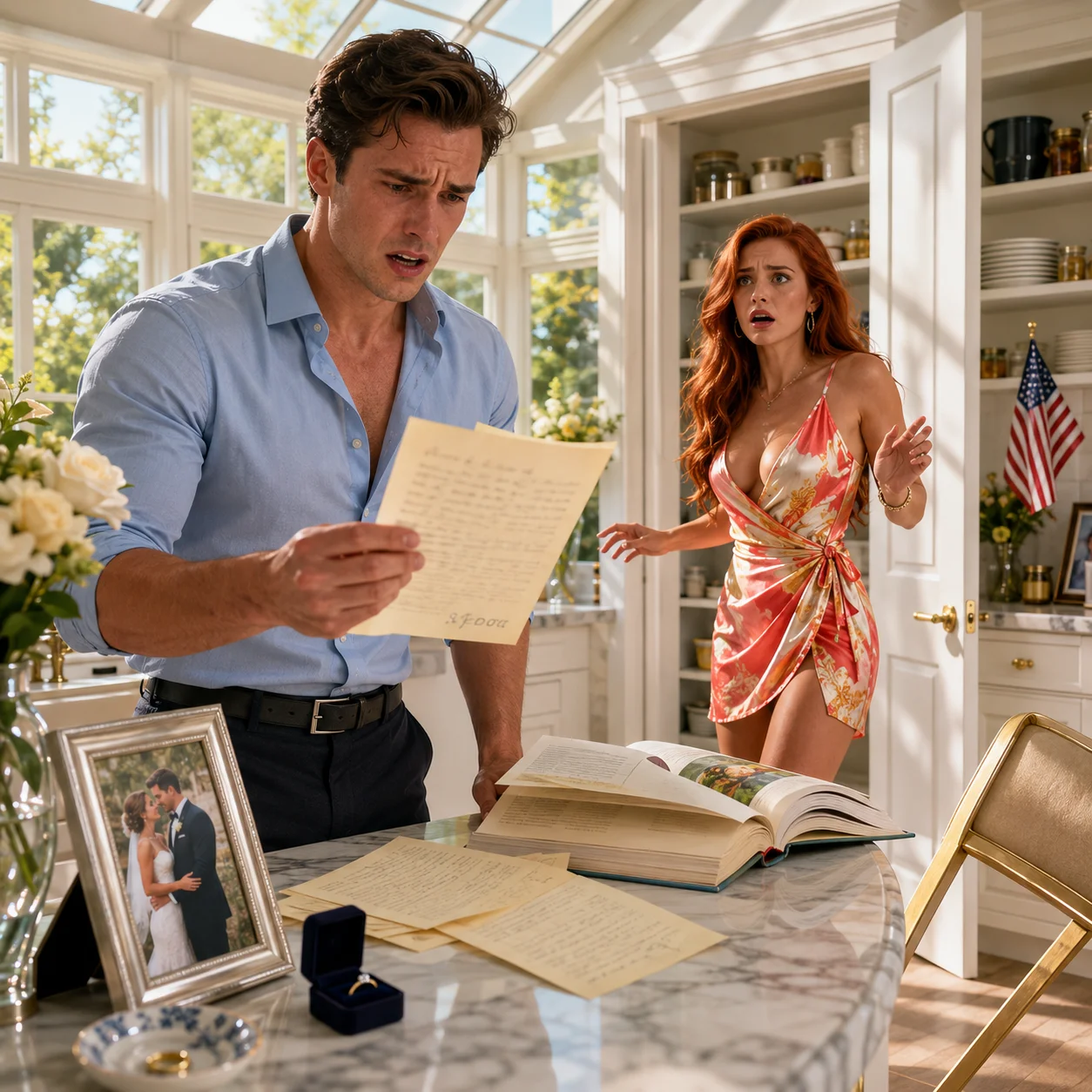
M.
M.
I searched my memory like a desperate man digging through rubble.
Who did Claire know whose name began with M?
Michael from accounting at the hotel. Older, married, two kids.
Marcus, one of the photographers she booked often for events.
Miles, her college friend who had moved to Colorado years ago.
Matthew.
The name landed in my mind quietly, but my body reacted before I could explain why.
Matthew Ellis.
Claire’s ex-boyfriend.
The one she almost married before me.
I knew about Matthew. Of course I did. Everyone has a past, and Claire had never hidden the fact that she had been in a serious relationship before we met. She described it as intense but wrong. They were too young, too dramatic, too caught up in wanting love to feel like a movie. They broke up after three years because he wanted to move to Chicago for a creative director job and she wanted to stay close to her mother after her father died.
When Claire told me that story early in our relationship, I had listened with the calm confidence of a man who believed the past was safely behind him.
Matthew was old history.
A chapter before me.
A ghost with no real shape.
Until that moment.
I folded the letter again, badly this time. My fingers did not cooperate. I put it on the kitchen table and stared at it.
Then I heard Claire’s car in the driveway.
The sound of the garage door opening made my stomach drop.
For one wild second, I considered putting the letter back. Pretending I had never found it. Cooking dinner. Smiling. Watching her face across the table while the letter sat upstairs in my mind like a loaded gun.
But I was tired.
Tired of pretending I did not notice things.
Tired of swallowing questions because I was afraid the answers would change my life.
So I left the letter on the table.
Claire came in through the garage door, juggling her purse, a garment bag, and her phone tucked between her shoulder and ear.
“No, I told them ivory linens, not white,” she said, voice sharp with professional control. “There’s a difference. Yes, I know the client said white, but she means ivory. Trust me.”
She stopped when she saw me.
Her eyes moved from my face to the table.
To the letter.
Everything about her changed.
It was fast. So fast someone else might have missed it. Her posture stiffened. Her mouth parted. The color drained from her cheeks, then came back too quickly.
“I’ll call you back,” she said into the phone.
She ended the call.
For a few seconds, neither of us spoke.
The rain filled the silence.
Then Claire gave a small, nervous laugh.
“Where did you find that?”
That was not the question an innocent person asks first.
Not “What is that?”
Not “Why are you looking at my private things?”
Not even “Daniel, let me explain.”
Where did you find that?
“In the cookbook,” I said.
Her eyes flicked toward the pantry.
“Oh,” she said. “God. I forgot that was even there.”
I waited.
She dropped her purse onto the counter slowly, as if sudden movements might startle me.
“Daniel,” she said, softening her voice, “that’s old.”
Old.
The word should have helped.
It did not.
“How old?” I asked.
She exhaled, almost relieved to have a path. “Years. Before us, probably. Or maybe early on when we were dating. I don’t know. Matthew wrote a lot of dramatic stuff back then.”
So she knew it was Matthew.
I had not said his name.
Something cold moved through me.
“You knew who wrote it.”
Claire blinked. “I mean, yes. Obviously. It’s his handwriting.”
“Obviously,” I repeated.
She flinched at my tone.
“Daniel, it doesn’t mean anything. I should have thrown it away years ago. I didn’t even remember I had it.”
I looked at the folded letter.
“Why was it hidden in a cookbook?”
“It wasn’t hidden.” She forced another laugh, but it came out thin. “It was just tucked away. You know how I am with old papers.”
I did know how she was.
That was why the lie hurt.
Claire did not accidentally tuck meaningful things away. She curated memories. She chose hiding places. She wrapped emotional objects in rituals and private logic. If that letter had survived seven years of marriage, three home cleanouts, two pantry reorganizations, and her annual January decluttering obsession, it had survived on purpose.
But I wanted to believe her.
That was the worst part.
Some foolish, wounded part of me wanted desperately for her explanation to be enough. I wanted to be the mature husband who could laugh at an old love letter and say, “We all had lives before each other.” I wanted to close the drawer on the whole thing and go back to being a man who knew where he stood.
So I asked the question gently.
“Have you talked to him recently?”
Claire’s expression changed again.
Not dramatically.
Just a flicker.
A tiny hesitation.
“No,” she said.
Too fast.
“No?”
“No. Not really.”
Not really.
Those two words opened a dark room inside my chest.
“What does that mean?”
She rubbed her forehead. “It means maybe we’ve exchanged a few messages over the years. Birthdays. Career updates. Things like that. Nothing important.”
“Have you seen him?”
“No.”
Again too fast.
I stared at her.
She looked away first.
“Claire.”
She closed her eyes. “Daniel, please don’t do this.”
“Do what?”
“Turn something old into something ugly.”
Something inside me cracked.
“I’m not turning it into anything,” I said quietly. “I found a love letter from another man in our house.”
“From years ago.”
“You keep saying that.”
“Because it’s true.”
I picked up the letter again.
Her eyes followed my hand.
I had not read the last page carefully. In my shock, I had skimmed the ending, caught the initial, and stopped. Now, standing across from my wife while she told me it was old, I unfolded it again.
Claire stepped forward.
“Daniel, don’t.”
That was when I knew.
I looked down.
The last page had only a few lines at the bottom, written beneath the closing paragraph. I had missed them because they were separated from the main body, almost like an afterthought.
I wish I could have stayed longer this morning. Watching you sleep made leaving feel impossible.
Under that was the initial.
M.
And beneath the initial, in smaller handwriting, was the date.
March 14.
This year.
Not years ago.
Not before us.
Not early in our relationship.
March 14.
Three months earlier.
The room seemed to tilt.
I stared at the date until it blurred.
Claire did not say anything.
She did not need to.
I looked up at her, and whatever she saw on my face made her start crying instantly.
“Daniel,” she whispered.
I laughed once.
It did not sound like me.
“Years ago?”
She covered her mouth.
“Years ago, Claire?”
“I can explain.”
“No,” I said. “You already did.”
She reached for me, but I stepped back so sharply the chair scraped against the floor.
“Don’t touch me.”
Her hand froze in the air.
I had never said that to her before.
Not once in seven years.
The words seemed to shock both of us.
“I didn’t mean for this to happen,” she said.
That sentence.
God, that sentence.
People say it when what they really mean is they did not mean to get caught.
I placed the letter on the table carefully, smoothing it with my palm as though it were evidence in a courtroom.
“How long?”
Claire cried harder. “It wasn’t like that.”
“How long?”
She wrapped her arms around herself.
“It started with messages.”
“When?”
“Last fall.”
Last fall.
Nearly eight months.
I felt the answer move through my body in layers. First disbelief. Then nausea. Then an almost physical ache, like someone had struck me in the chest with something blunt.
“Last fall,” I repeated.
“He reached out because his mother was sick,” she said quickly. “I know how it sounds, but she was like a second mother to me when we were younger. I just wanted to be kind.”
“And then?”
“And then we talked.”
“About what?”
“Life. Work. His divorce. My stress. Things.”
“Your marriage?”
She looked at the floor.
That was answer enough.
A strange image came to me then: Claire sitting beside me on the couch months earlier, one hand in a bowl of popcorn, laughing at a show while some part of her had already stepped outside our life and begun describing it to another man.
I thought of every night she went upstairs early because she was tired.
Every time she smiled at her phone.
Every time she accused me gently of being “emotionally unavailable” when I asked what was wrong.
Had she been comparing me to him the whole time?
Had I been living inside a trial she never told me I was part of?
“Did you sleep with him?” I asked.
Her silence lasted too long.
Then she whispered, “Once.”
The kitchen disappeared.
Not literally, of course. The cabinets remained. The rain remained. Claire remained, crying beneath the pendant lights we had chosen together after buying the house. But something in me left the room. I watched the moment from a distance.
Once.
A word small enough to fit inside a breath, large enough to destroy a marriage.
“When?” I asked.
She pressed both hands to her face.
“Claire.”
“The night before that letter.”
March 13.
My mind began working against my will.
Where had she been March 13?
I remembered because it had been the weekend of the Henderson gala, one of the hotel’s biggest events of the season. Claire had come home late Sunday morning, exhausted, wearing the same black dress she had left in the day before. She told me a pipe had burst in one of the banquet rooms after midnight and she had stayed at the hotel to manage the cleanup. I had made her coffee. I had rubbed her shoulders while she sat at the kitchen island with damp hair and red eyes.
I had felt sorry for her.
I had kissed the back of her neck.
She had leaned into me.
Now I knew why she had showered for forty minutes before letting me touch her.
I gripped the edge of the table.
“Was it at the hotel?”
Her crying turned quiet.
“Yes.”
“In a room?”
She nodded once.
My stomach twisted.
“Did you pay for it?”
“No. God, no. He had a room.”
“That makes it better?”
“No. I just—Daniel, please.”
I looked at her then, really looked.
Claire was beautiful in the way that used to make strangers glance twice and me feel secretly lucky. Dark blonde hair pinned messily from work, green eyes wet with tears, cream blouse wrinkled at the waist, wedding ring still on her finger. My wife. The woman who had danced barefoot with me in our first apartment because we could not afford a honeymoon. The woman who held my hand at my father’s funeral. The woman who used to leave notes in my laptop bag before big presentations.
And also the woman who had lied to my face for three months while carrying another man’s letter around our home like a sacred object.
“Do you love him?” I asked.
She looked terrified of the question.
That was answer enough too.
“I don’t know,” she whispered.
I nodded slowly.
The body does strange things when pain gets too large. Mine became calm. My voice lowered. My breathing steadied. I folded the letter along its original creases and slid it into my pocket.
Claire watched me do it.
“What are you doing?”
“I need air.”
“Daniel, please don’t leave like this.”
I walked past her.
She grabbed my arm.
I stopped, looked down at her hand, and she let go as if burned.
“Please,” she said. “We need to talk.”
“We did.”
“No, we didn’t. You’re in shock. I’m in shock. We need to sit down and talk like adults.”
That almost made me laugh again.
“Like adults?”
Her face crumpled.
“I made a horrible mistake.”
“Eight months of messages. A hotel room. A love letter. Three months of lies. That’s not a mistake, Claire. That’s a second life.”
I went upstairs.
She followed me.
I pulled a duffel bag from the closet and started putting clothes into it. Not carefully. Not dramatically. Shirts, jeans, socks, charger, medication from the nightstand.
Claire stood in the doorway sobbing.
“Where are you going?”
“Brian’s.”
“My God, Daniel. You’re just leaving?”
I turned to her.
“You did.”
She had no reply.
At my friend Brian’s apartment, I did not sleep.
I lay on his guest room mattress with my eyes open until morning, staring at the ceiling fan and replaying every detail. Brian, to his credit, did not force advice on me. He opened the door, took one look at my face, and stepped aside.
In the morning, he put coffee on the dresser and said, “You don’t have to decide anything today.”
But the problem was, I already knew I could not go back to not knowing.
Claire texted twenty-three times before noon.
I did not answer.
Then she called.
I let it ring.
Then she sent a message that made my blood go cold.
Please don’t tell anyone yet. Especially not my mother. I need time to figure out what I’m going to say.
Not “I’m sorry I destroyed you.”
Not “Are you safe?”
Not “Please let me know where you are.”
Please don’t tell anyone yet.
Even in the wreckage, she was managing the event.
Controlling the guest list.
Choosing the lighting.
Deciding who saw what.
That was the moment something in me hardened.
I called a divorce attorney that afternoon.
Her name was Marisol Grant, and she had the calm, unsentimental voice of someone who had heard every version of human betrayal and no longer flinched. I told her I was not sure I wanted a divorce yet. She said that was fine. Knowing my options did not force me to choose them.
Then she asked a question I was not ready for.
“Do you have proof?”
I thought of the letter in my jacket pocket.
“Yes.”
“Good,” she said. “Preserve it. Photograph it. Do not alter it. Do not threaten her with it. Do not post it. Do not confront the other man. Do not move money around impulsively. And do not leave the marital home permanently without legal guidance.”
Her voice was firm enough that I listened.
That evening, I photographed every page of the letter under bright light. The date. The handwriting. The initial. The sentence about watching her sleep.
I hated myself for doing it.
Then I hated her for making it necessary.
For three days, Claire swung between apologies and explanations.
She said she had been lonely.
She said I had been distracted by work.
She said Matthew made her feel seen at a time when she felt invisible.
She said she never planned to sleep with him.
She said afterward she felt sick with guilt.
She said she kept the letter because she did not know how to let go of the person she had become with him.
She said she still loved me.
That one angered me most.
Because maybe it was true.
Maybe people can love you and still betray you. Maybe someone can cry in your arms while hiding the knife behind their back. Maybe love is not always protection. Maybe sometimes love is just the excuse people use to ask for mercy after they have used up your trust.
On the fourth day, I agreed to meet her at the house.
Not to reconcile.
To talk.
I arrived at six in the evening. The house looked painfully normal. Porch light on. Lawn trimmed. Her white SUV in the driveway. The same wind chimes her mother bought us swaying beside the door.
Claire opened before I could use my key.
She looked smaller.
No makeup. Hair tied back. Oversized sweater. Bare feet. Wedding ring still on.
For one terrible second, I wanted to hold her.
Then I remembered the date.
March 14.
She stepped aside.
The kitchen table had become a shrine of desperation. Two mugs of tea. A box of tissues. A notebook. Her laptop. Marriage counseling brochures printed from the internet. A list written in her careful handwriting.
Things I Need to Own.
I sat across from her, not touching the tea.
She began reading from the list.
“I lied to you. I betrayed our marriage. I minimized it. I tried to protect myself after hurting you. I understand that you may never forgive me.”
Her voice broke.
I looked out the window.
She continued.
“I ended contact with Matthew.”
“When?”
“Yesterday.”
I turned back.
“Yesterday?”
She swallowed.
“I needed to tell him it was over.”
“You needed three days to tell him?”
“No. I was trying to find the right words.”
I leaned back in my chair.
“There it is.”
“What?”
“You were still protecting his feelings.”
She looked stricken.
“No. That’s not fair.”
“Did you call him after I found the letter?”
Her silence answered.
“Did he know I found it?”
“Yes.”
“What did he say?”
She closed her eyes.
“Claire.”
“He said maybe it was for the best.”
I stared at her.
“For the best?”
“He thought maybe it would force us to face the truth.”
The truth.
I almost admired the arrogance of it. Another man sleeping with my wife, writing her love letters, then framing the discovery as some grand spiritual honesty.
“And what truth is that?” I asked.
Claire wiped her cheek.
“That I haven’t been happy.”
I nodded slowly.
“There it is.”
“I didn’t say it to hurt you.”
“No. You just outsourced your unhappiness to a man who wanted you.”
She flinched.
“I know I was wrong.”
“Did you tell him you loved him?”
She looked down.
I stood up.
“Daniel, wait.”
“Answer.”
Her lips trembled.
“Yes.”
The word dropped between us.
I felt strangely unsurprised. Almost relieved. There was something clean about confirmation. Cruel, but clean.
“How many times?”
“Twice.”
“Before or after the hotel?”
She covered her face.
“After.”
Of course.
I walked into the living room because the kitchen suddenly felt too small. Claire followed.
The living room was full of our life. Wedding photo above the fireplace. Bookshelves we assembled badly one Sunday while drinking cheap wine. The blue armchair where she used to fall asleep under a blanket. The coffee table with a scratch from the night we adopted a dog that later died of cancer and left us both crying on the kitchen floor.
How could a life hold so many true things and still break?
Claire stood near the sofa.
“I want to fight for us,” she said.
I looked at our wedding photo.
In it, she was laughing, head tilted back, my hand wrapped around hers. I remembered that exact moment. The photographer had told me to whisper something romantic, and I had panicked and whispered, “Your uncle is doing finger guns at the cake.” Claire had burst out laughing.
That was real.
So was the letter.
“Why now?” I asked.
“What?”
“Why do you want to fight now? Because you love me? Or because I found out?”
She did not answer quickly enough.
I nodded.
“I need the full truth.”
“I’ve told you.”
“No. You’ve told me what I already had enough evidence to ask about. That’s different.”
Her face hardened slightly. A defensive flash. The Claire who negotiated with angry clients and made problems disappear.
“What else do you want me to say?”
“I want the timeline. All of it. Messages. Calls. Meetings. The hotel. Anything else. And I want access to the messages.”
Her eyes widened.
“Daniel, that feels invasive.”
I stared at her.
“Invasive?”
“I know I don’t have the right to privacy the same way right now, but some of those messages are… humiliating. For me.”
“For you.”
She flushed.
“I’m ashamed.”
“You should be.”
The words came out harsher than I expected, but I did not take them back.
She sat down heavily on the sofa.
“I deleted most of them.”
There it was.
Of course.
“When?”
“The night you left.”
A laugh escaped me.
Not because it was funny.
Because some part of my mind had already predicted it.
“You deleted evidence after I found out.”
“I panicked.”
“You protected yourself.”
“I was scared.”
“So was I.”
We looked at each other across the room.
In that moment, I knew we were not having the same conversation. I was trying to understand what had happened to my marriage. Claire was trying to reduce the blast radius.
That difference mattered.
I left again that night.
This time, I did not go to Brian’s.
I checked into a quiet business hotel near my office, the kind with gray carpets and sad lobby fruit and curtains that blocked out the city. I needed a room where nothing reminded me of Claire.
The next morning, Marisol called.
I told her about the deleted messages.
She sighed.
“Common.”
“What does that mean for me?”
“It means you stop asking her for honesty as your only source of truth.”
That sentence stayed with me.
Stop asking her for honesty as your only source of truth.
So I began looking.
Not obsessively. Not illegally. I did not hack her accounts or follow her car. I did not become the kind of man I would have judged before this happened. But I reviewed what belonged to me. Shared credit cards. Phone bills under our family plan. Calendar entries. Hotel charges.
The story Claire had told me began falling apart almost immediately.
March 13 was not the only hotel room.
There had been a charge at a restaurant two towns over in January, on a night she told me she was at a vendor tasting with clients. A parking garage receipt from February near an art district where Matthew’s design studio had recently opened a branch. Multiple late-night calls to a number ending in 8821, always when I was traveling or asleep.
The worst discovery was not financial.
It was in our shared cloud photo backup.
Claire must not have realized some photos from her phone still synced to our family storage. Most were normal: event setups, floral arrangements, pictures of menus and table settings. But one image stopped me cold.
It was a photograph of a hotel room window at sunrise.
No people.
Just the view.
But reflected faintly in the glass was Claire, standing in a robe, holding the phone. Behind her, blurred but unmistakable, was a man’s white dress shirt on a chair.
The photo was dated March 14.
6:42 a.m.
Watching you sleep made leaving feel impossible.
I closed the laptop and sat in the hotel room for a long time.
I did not cry then.
Crying would come later, unexpectedly, in a grocery store aisle when I saw Claire’s favorite tea on sale and almost bought it out of habit.
What I felt in that hotel room was something colder.
Clarity.
I filed for divorce two weeks after finding the letter.
When Claire was served, she called me thirteen times.
I answered the fourteenth.
“You filed?” she said, voice shaking.
“Yes.”
“Without telling me?”
“You knew it was a possibility.”
“A possibility isn’t the same as this.”
I almost laughed at the irony.
“You’re upset I made a life-changing decision without including you?”
She sobbed.
“That’s cruel.”
“No, Claire. Cruel was letting me rub your shoulders the morning after you slept with him.”
The line went silent.
Then she whispered, “I hate myself for that.”
“I believe you.”
“I never wanted to become this person.”
“But you did.”
She cried quietly.
For the first time, I did not feel responsible for comforting her.
That was new.
The divorce process turned our private heartbreak into paperwork.
Assets. Accounts. Retirement contributions. Equity in the house. Furniture. Cars. Insurance. The ugly inventory of a life once built on faith.
Claire wanted mediation.
I agreed.
Not because I wanted peace with her, but because I wanted out cleanly.
At our first mediation session, she wore the navy dress I used to love. I wondered if that was deliberate. She looked tired but composed, sitting beside her attorney with a folder full of documents and red-rimmed eyes.
Matthew was not mentioned at first.
Everything was numbers.
Then we reached the house.
Claire wanted to keep it.
That surprised me.
I had assumed she would want to sell. Too many memories. Too much damage. But she said the house was close to her mother, close to work, and emotionally important to her.
Emotionally important.
I looked at her across the conference table and thought of the letter hidden in our pantry.
“My client is open to a buyout,” Marisol said, calm as ever.
Claire’s attorney nodded.
Then Claire spoke directly to me.
“I know you’re angry, but please don’t punish me with the house.”
Punish.
That word lit something in me.
“I’m not punishing you,” I said. “I’m dividing what we own.”
Her attorney placed a hand lightly on her arm, warning her not to engage.
But Claire continued.
“This was our home.”
“Yes,” I said. “It was.”
She looked down.
In the end, she could not afford the buyout without draining accounts she wanted to protect. The house would be sold.
When that decision was made, Claire broke down in the hallway outside the mediation room.
I heard her through the door.
Not loud, not theatrical.
Just broken.
For a moment, grief moved through me with such force I had to grip the edge of the table.
Marisol noticed.
“You can feel compassion without changing your decision,” she said.
I nodded, unable to speak.
The hardest part was not dividing money.
It was telling people.
My mother cried.
My older brother swore for five straight minutes.
Brian simply said, “I’m proud of you,” which somehow hurt more than sympathy.
Claire’s mother called me one evening, and I nearly did not answer. I loved Diane. She had treated me like a son from the beginning.
“Daniel,” she said, voice trembling, “Claire told me some of it.”
Some of it.
I closed my eyes.
“What did she tell you?”
“That she reconnected with someone and made a mistake.”
There was that word again.
Mistake.
I could have destroyed Claire in that moment. I had the letter. The dates. The hotel photo. The charges. I could have corrected every softened phrase.
But Diane was seventy-one and recently widowed, and her pain did not need my precision.
“She hurt me very badly,” I said. “And it wasn’t something I can move past.”
Diane cried.
“I’m so sorry.”
“So am I.”
“She loves you.”
I looked around my hotel room, at the suitcase on the chair, at the takeout container on the desk, at the life I had been reduced to.
“I know,” I said quietly. “But love wasn’t enough to make her honest.”
Diane had no answer for that.
The house sold in late August.
A young couple bought it. They came to the final walkthrough with a baby sleeping against the woman’s chest and measuring tape in the man’s pocket. They smiled at the kitchen, the pantry, the living room. They saw possibility where I saw ghosts.
Claire and I met there one last time to collect the remaining items.
By then, the divorce was nearly final.
We moved through the house separately at first. She packed dishes. I took tools from the garage. The rooms echoed without furniture.
Near the end, I found her standing in the kitchen, staring at the pantry.
The cookbook was on the counter.
The one that had held the letter.
“I forgot that was still here,” she said.
I almost smiled.
“No, you didn’t.”
She looked at me, and this time she did not lie.
“No,” she admitted. “I didn’t.”
For a while, neither of us spoke.
Then she said, “I’m not with him.”
I looked at her.
“Matthew.”
I had not asked.
She continued anyway.
“I thought you might wonder. Or maybe you don’t care. But I’m not. We tried talking after you filed, but it wasn’t…” She gave a small, devastated laugh. “It wasn’t love. Not really. It was escape. Fantasy. A version of myself I wanted to believe still existed.”
I leaned against the counter.
“Did you figure that out before or after it cost you your marriage?”
She accepted the hit.
“After.”
At least she was honest now.
Too late, but honest.
“He liked being the man I ran to,” she said. “He didn’t know what to do with me when I had nowhere to run back from.”
That sounded painfully believable.
Affairs survive best in shadows. Take away the secrecy, the stolen hours, the dramatic ache of impossibility, and sometimes all that remains is two selfish people staring at the wreckage they romanticized.
“I’m sorry,” she said.
“I know.”
“No, Daniel. I need to say it without trying to make you forgive me.” Her eyes filled. “I’m sorry I made you question your own instincts. I’m sorry I let you comfort me after I betrayed you. I’m sorry I kept that letter like it was beautiful when it was proof of something ugly. I’m sorry I turned your trust into something you had to investigate.”
My throat tightened.
That apology came closer than any before.
Maybe because it did not ask anything from me.
“I loved being married to you,” I said.
She broke.
I looked away because watching her cry still hurt.
“I did,” I continued. “That’s what makes this hard. I’m not leaving because there was never anything good. I’m leaving because there was.”
She wiped her face with both hands.
“I know.”
I picked up the cookbook.
“Do you want this?”
She stared at it for a long moment.
Then shook her head.
“No.”
I opened the trash bin and dropped it inside.
It landed with a heavy, final thud.
The divorce was finalized in September.
I expected to feel free that day.
Instead, I felt tired.
The courthouse hallway smelled like old paper and floor polish. Claire stood a few feet away with her attorney, wearing a gray coat and no wedding ring. When it was done, she looked at me like she wanted to say something, then seemed to think better of it.
I appreciated that.
Outside, the weather was unfairly beautiful. Bright blue sky. Clean wind. Leaves just beginning to turn at the edges.
Claire stopped near the courthouse steps.
“Daniel.”
I turned.
She walked toward me slowly.
“I hope someday you’re happy again.”
I studied her face.
There was a time when that sentence would have opened a door in me. A time when I would have mistaken sorrow for destiny, regret for repair.
But healing had already begun in small, unromantic ways.
Sleeping through the night once.
Eating breakfast without nausea.
Going a full afternoon without checking dates in my memory.
Laughing at something Brian said and realizing afterward that the laugh had been real.
“I hope you are too,” I said.
And I meant it.
That surprised me.
She nodded, crying silently, then walked away.
I watched her go, not because I wanted her back, but because endings deserve witnesses.
Six months later, I moved into a small house on the other side of town.
It was not as beautiful as the one Claire and I had owned. The kitchen was outdated. The backyard fence leaned slightly. The bathroom tile looked like someone had chosen it during a personal crisis in 1998.
But it was mine.
No hidden letters.
No rooms full of suspicion.
No memories waiting in drawers.
On the first night there, Brian came over with pizza and a bottle of cheap champagne as a joke. We sat on the floor because my couch had not arrived yet.
“To new beginnings,” he said.
I raised my plastic cup.
“To reading the last page,” I said.
He gave me a sad half-smile.
That night, after he left, I unpacked a box of books.
One by one, I placed them on the shelf. Novels. Work books. A few biographies. A battered copy of a mystery novel my father had loved.
At the bottom of the box, I found an envelope with my name on it.
For one awful second, my body reacted before my mind could catch up.
A letter.
But it was not from Claire.
It was from me.
I had written it during therapy, months earlier, when my therapist asked me to write something to the version of myself who still wanted answers from someone who had already shown me the truth.
I sat on the floor and opened it.
Daniel,
You are not weak because you wanted to believe her. You are not stupid because you trusted your wife. You are not less of a man because another man crossed a line and she let him. The betrayal belongs to the people who chose it, not the person who discovered it.
You will miss her. Let yourself.
You will remember good things. Do not rewrite them as fake just because the ending was painful.
You will want the story to make perfect sense. It may never.
But one day, the date on that letter will no longer be the moment your life ended. It will be the moment your life stopped being built on a lie.
I read that last line three times.
Then I folded the paper and placed it in the top drawer of my desk.
Not hidden.
Not preserved like a wound.
Just kept.
A reminder.
A year after the divorce, I saw Claire by accident at a farmer’s market.
She was standing near a flower stall, laughing softly at something the vendor said. Her hair was shorter. She looked older, but not ruined. For some reason, that comforted me. Pain had changed us both, but it had not erased us.
She saw me a second later.
The smile faded, then returned differently. Gentler.
“Hi,” she said.
“Hi.”
There was no dramatic music. No rain. No confession. No final twist.
Just two people standing under a white tent between buckets of sunflowers and lavender.
She asked how I was.
I said I was good.
And for the first time, it was true.
She told me she had changed jobs. No more hotel events. She worked for a nonprofit now, organizing community fundraisers. She said it was less glamorous and paid less, but she slept better.
I told her I had adopted a dog, a ridiculous brown mutt named Stanley who stole socks and barked at ceiling fans.
She laughed.
The sound hit an old place in me, but softly now.
Not like a knife.
Like an echo.
Before we parted, she said, “I still think about that day. The letter.”
I looked at her carefully.
“So do I.”
“I wish I had told you before you found it.”
I nodded.
“I wish you had too.”
She swallowed.
“I’m sorry, Daniel.”
This time, the apology did not pull me backward.
“I know,” I said. “I forgave you.”
Her eyes filled.
I held up a hand gently before she could misunderstand.
“Not because what you did was okay. It wasn’t. Not because I want anything back. I don’t. I forgave you because carrying it was starting to feel like staying married to the worst moment of my life.”
She wiped a tear quickly, embarrassed.
“I’m glad,” she whispered.
I meant to walk away then, but she asked one more question.
“Are you happy?”
I thought about my small crooked house. Stanley asleep on my laundry. Sunday morning coffee on the porch. The quiet that no longer felt like abandonment. The way I had begun cooking again, not to save a marriage, but because I liked the smell of garlic and butter in my own kitchen.
“Yes,” I said. “I am.”
She smiled through tears.
“Good.”
Then we went in opposite directions.
That evening, I made dinner from memory.
Chicken with lemon, garlic, and rosemary. The dish I had meant to cook the night I found the letter. I did not need the cookbook anymore. I knew the recipe by heart, or close enough. I burned the edges a little. Stanley sat near my feet, hopeful and useless.
While the chicken roasted, I opened my desk drawer and took out the letter I had written to myself.
I read it once.
Then I placed it back.
There are dates that divide a life.
The day you meet someone.
The day you marry them.
The day you discover they are not who you thought they were.
For a long time, March 14 was a wound I kept touching, proof that the life I loved had been contaminated before I knew it.
But eventually, another date became more important.
Not the day I found the letter.
Not the day the divorce was final.
Not even the day I saw Claire again and felt nothing sharp.
It was the first ordinary evening I stood in my own kitchen, in my own peaceful house, cooking dinner for myself without wondering where anyone else was, who they were texting, or what truth might be hidden on the last page.
That was the day I understood something I wish I had known earlier.
Trust can be broken by someone else.
But peace is something you can rebuild alone.


![[FULL STORY] She Called Me “Just a Phase” — Then Learned I Was the Foundation Holding Her Life Together](https://social-media.rabedo.com/thumbnails/1777446090_ChatGPT Image 09_28_57 29 thg 4, 2026.png)