
They won’t see me, Daniel. They’ll see you. They always see the man with his name on the door.”
I stopped the recording and sat there with my heart pounding so hard I could feel it behind my eyes. Outside, cars passed along the road above the river. Somewhere nearby, birds lifted from the trees. The world had the nerve to continue.
There were more recordings. In one, my grandmother confronted my mother after the arrest. Ruth’s voice trembled with rage. “You know he didn’t do this alone, if he did any of it at all.” My mother answered softly, almost kindly, “Ruth, grief is making you cruel.” “Don’t use that voice on me.” “What voice?” “The one you use when men are watching.” In another file, my father called from jail before trial. My mother told him the lawyers had advised her not to discuss finances. My father said, “You can still tell the truth.” My mother said, “The truth is that you signed everything.” My father said, “I signed what you put in front of me because you were my wife.” Her answer was so quiet I had to raise the volume. “That was your mistake.”
I do not remember driving back to campus. I remember sitting on my dorm floor with papers spread around me like wreckage. I remember ignoring six calls from my mother. I remember vomiting once in the bathroom, not from disgust exactly, but from the physical collapse that comes when your mind finally accepts what your heart has been refusing to see. By midnight, I had read enough to understand the outline. My mother had been responsible for the company’s books. Money had been moved into fake vendor accounts. Some accounts connected to a man named Victor Hale, who had once worked as a financial consultant for my father’s company. Victor had testified at trial that my father pressured him to create misleading reports. According to Grandma Ruth’s notes, Victor had also been seen with my mother several times during the months before the arrest. There were photographs. Grainy, distant, but clear enough. My mother and Victor outside a hotel. My mother getting into his car. My mother touching his arm in a way that made my skin crawl because I had seen her touch my father that way in old photographs.
At two in the morning, I called the prison.
Getting approved for a visit took two weeks. Those two weeks were the longest of my life. My mother knew something was wrong. Of course she did. She had raised me, studied me, shaped me. She knew the sound of my silence. She asked if school was stressful. She asked if I was angry with her. She showed up at my dorm unannounced with groceries and that wounded look that had controlled me for years. “You are pulling away,” she said, standing beside my mini fridge while my roommate wisely disappeared. “I am busy.” “Do not lie to me, Noah.” I almost laughed because the sentence was too perfect and too terrible. Instead, I said, “Grandma Ruth left me some things.” The color left her face, but only for a second. “I warned you.” “About what?” “About letting a bitter woman poison you.” “She left documents.” My mother set the grocery bag down slowly. “Documents can be misunderstood.” “And recordings?” That was the first time I saw her mask crack. Not fall. Just crack. Her eyes sharpened. Her mouth parted slightly. Then the tears came. Fast. Familiar. Devastating. “I cannot believe you would do this to me,” she whispered. My chest tightened automatically. Some trained part of me wanted to apologize. She stepped closer. “After I held this family together. After I protected you from things no child should know. After I carried shame that was not mine.” “What shame?” I asked. She pressed her hand to her heart. “Your father was not the man you think he was.” “Then help me understand.” “Some truths would destroy you.” “No,” I said, surprising myself with the steadiness of my voice. “They might destroy the version of you I believed in. That is different.”
She left without the groceries.
The prison was two hours away, surrounded by flat fields and chain-link fences that made the sky look farther away than it was. I had imagined seeing my father as a broken man. Smaller. Diminished. Maybe ashamed. But when he walked into the visiting room in beige prison clothes, older and thinner than I remembered, he still carried himself like my father. His hair had gone mostly gray at the temples. There were lines around his mouth that had not been there before. But his eyes were the same, and when he saw me, all the strength went out of his face. He stopped walking for half a second. Then he came to the table and sat across from me, separated by rules, cameras, and three years of stolen time.
“Hey, kid,” he said.
I hated that I almost cried from those two words.
“Did you do it?” I asked. I had planned a longer opening. Something careful. Something fair. But the question came out raw.
He closed his eyes. When he opened them, they were wet. “No.”
“Did you know she did?”
His face changed. Pain moved through it slowly, like he had been expecting the blow but still felt it. “I knew something was wrong. I knew money was moving. I knew Victor Hale was involved. I did not know how deep it went until it was too late.”
“Why didn’t you say that in court?”
“I tried.” His voice stayed calm, but his hands folded tightly on the table. “My lawyers argued unauthorized access. They questioned the vendor accounts. But the documents had my signatures. My passwords. My approvals. Your mother testified that she followed my instructions. Victor testified that I directed him. By the time I understood they had built a cage around me, I was already standing inside it.”
I swallowed hard. “Mom testified because they forced her?”
He looked at me for a long moment. “Your mother made a deal.”
The words landed without drama. No thunder. No music. Just a sentence that cut through the last thread holding my childhood together.
“What kind of deal?”
“She provided documents to investigators before my arrest. She gave them internal files, emails, account summaries. She said she discovered irregularities and feared I was committing fraud. In exchange, they treated her as a cooperating witness instead of a suspect.” He looked down. “She cried on the stand. The jury believed her.”
I remembered the newspapers calling her brave. I remembered people touching her shoulders. I remembered myself holding her while she shook. “Why didn’t you tell me?”
“You were sixteen.”
“That is not an answer.”
“It is the only one I had.” His voice broke then, just slightly. “Your mother had custody. She controlled what you heard, what letters reached you, whether you visited. If I accused her from in here without proof, I was afraid she would cut me out of your life completely. Ruth was trying to gather evidence. We thought, when you were older, when there was enough—” He stopped. “Then your grandmother died.”
“She left me everything.”
He nodded, grief passing over his face. “Of course she did.”
I leaned back, suddenly angry. “You let me hate you.”
My father accepted that like he had accepted the sentence. “Yes.”
“You let me think you destroyed us.”
“Yes.”
“You let her play victim while you sat in here.”
His jaw tightened. “I did not let her. I lost. There is a difference.”
That was the first honest thing anyone had said to me in three years, and it hurt more than any lie.
He told me the rest in pieces. My mother and Victor had started working together on a private investment scheme behind my father’s back. At first, my father believed she had been manipulated. Victor was charming, connected, and skilled at making risky financial moves sound sophisticated. But when the losses began, they hid them with money from my father’s company. Then they created false vendors to cover gaps. Then investor funds got tangled in the mess. When my father started noticing, my mother moved first. She gathered files, arranged timelines, and walked into the investigators’ office as the terrified wife of a corrupt businessman. Victor backed her story because it saved him. My father’s name was on everything because my father had trusted his wife with the machinery of his life.
“Did she love him?” I asked.
My father looked away. That was answer enough.
The case did not reopen quickly. Real life does not move like a movie. Truth does not kick down doors just because a son finally believes it. I took the box to a criminal defense attorney Mr. Albright recommended, a woman named Marisa Cole who had the blunt, exhausted manner of someone who had seen too many innocent people discover that innocence was not the same as freedom. She reviewed the materials for three weeks. She warned me that recordings might be challenged. Documents needed authentication. Bank records required subpoenas. Victor Hale had vanished from Tennessee two years earlier. My mother’s cooperation deal would be buried under layers of prosecutorial discretion and old case files. “This is enough to start asking questions,” Marisa said. “It is not enough to promise a miracle.”
I did not need a miracle. I needed motion.
The first motion led to a hearing request. The hearing request led to subpoenas. Subpoenas led to bank records Grandma Ruth had not been able to access. Those records led to an account in Kentucky tied to an LLC Victor had created under his cousin’s name. From there, Marisa found payments made to my mother over eighteen months after my father’s conviction. Not huge payments. That would have been too obvious. Smaller transfers disguised as consulting fees. Five thousand here. Seven thousand there. Enough to support a woman who claimed to be barely surviving. Enough to prove the relationship had not ended with the trial.
I moved out of my mother’s house completely that winter. I did not tell her first. I rented a room near campus, took extra shifts at a warehouse, and blocked her number for three days because I needed to learn what silence felt like when it belonged to me. When I finally agreed to meet her, I chose a public café. She arrived in a cream coat, hair perfect, eyes red. She looked beautiful in the way expensive porcelain looks beautiful right before it shatters.
“You are being manipulated,” she said before sitting down.
“By Dad?”
“By his mother. By his lawyer. By your own need to make him innocent.”
I placed one bank record on the table. Her eyes dropped to it. She did not touch it.
“Victor paid you after the trial,” I said.
She inhaled slowly. “You do not understand what those payments were.”
“Then explain.”
“They were repayments.”
“For what?”
“For money I was owed.”
“For helping him frame Dad?”
Her face hardened so quickly that I finally understood the tears had always been a door she could open and close. “Lower your voice.”
“No.”
People nearby glanced over. My mother smiled faintly at them, then leaned toward me. “You think your father is noble because he is quiet. You think silence means innocence. But your father ignored me for years. He built that company and expected me to be grateful for whatever corner of it he allowed me to manage. I handled the books. I fixed the problems. I kept him from failing long before anyone knew his name.”
“That does not answer the question.”
Her eyes shone, but no tears fell. “Your father would have ruined us.”
“So you ruined him first?”
“I survived.”
There it was. Not a confession, not legally. But morally, spiritually, completely. I stared at the woman who had held me when I cried, signed school forms, made soup when I was sick, and taught me that loyalty meant standing beside family. I had spent three years thinking prison had taken my father from me. Now I understood my mother had taken both of them. She had taken him with lies and taken herself with the truth.
“You cried,” I said quietly.
Something flickered in her face.
“When they arrested him. At the trial. Every time his name came up. You cried like you loved him.”
“I did love him,” she said.
“No. You loved being seen as the woman he hurt.”
Her hand moved before I could react. The slap was not hard, but the sound cracked across the table. The café went silent. My cheek burned. My mother looked shocked, not because she had hit me, but because witnesses had seen it. I stood up slowly.
“I am going to help reopen his case,” I said. “And when they ask me what you said today, I am going to tell them.”
Her voice dropped into something almost tender. “Noah, if you do this, you will lose your mother.”
I looked at her then, really looked at her, and felt the last child in me step backward into the dark. “I think I already did.”
The new evidence did not free my father overnight, but it changed everything. Marisa filed a petition arguing prosecutorial reliance on false testimony, concealed financial conflicts, and newly discovered evidence pointing to alternative perpetrators. The local press picked it up because fallen businessman might be guilty was old news, but grieving wife may have framed him was irresistible. My mother’s image began to rot publicly. People who had once praised her dignity now replayed old courthouse footage with suspicion. They slowed down videos of her crying. They analyzed her expressions like grief was a crime scene. I hated that too. Not because she was innocent, but because I had learned the danger of letting strangers turn real lives into entertainment.
Victor Hale was found in Arizona under a slightly altered name, working for another small company and, according to investigators, repeating old habits. When questioned, he denied everything at first. Then Marisa’s team found messages between him and my mother from before the trial. Not many. Most had been deleted. But deleted is not always gone. In one recovered exchange, Victor wrote, “If Daniel keeps digging, we need to make sure he looks like the source.” My mother replied, “He already does. His name is on all of it.” In another, sent two days before my father’s arrest, Victor wrote, “Once you give them the files, there is no going back.” My mother answered, “I know. Crying is easier than prison.”
Crying is easier than prison.
That sentence became the key that unlocked the cage.
My father’s conviction was vacated eighteen months after Grandma Ruth’s box landed in my hands. He had served four years and seven months for crimes he did not commit alone and, according to the final review, likely did not knowingly commit at all. The state did not apologize in the way people imagine apologies should sound. There was no dramatic speech of remorse. The official language was careful, bloodless, and designed to admit as little as possible. But the gates opened. My father walked out on a windy April morning carrying one cardboard box, wearing clothes that did not fit, blinking at sunlight like he did not trust it.
I was there. Marisa was there. Mr. Albright was there. My mother was not.
For a second, my father and I just stood facing each other. Then I crossed the space between us and hugged him with the force of every year we had lost. He held me carefully at first, like he was afraid I might vanish if he gripped too hard. Then his arms tightened, and I felt him shake once. Only once. My father was still quiet. Even freedom did not make him loud.
“I am sorry,” I said into his shoulder.
He pulled back and looked at me. “For what?”
“For believing her.”
His eyes filled. “You were a child.”
“I still believed her.”
“You were my child,” he said. “That means it was my job to carry what you could not.”
My mother was arrested six weeks later.
I wish I could say I felt satisfaction. I wish I could say watching her led away in handcuffs healed some symmetrical wound in me, but life is rarely that poetic. I did not attend the arrest. I saw a photo online before I could avoid it. She wore sunglasses and a gray blazer. Her face was angled down. People in the comments were vicious. Some called her a monster. Some called her brilliant. Some said my father was stupid for trusting her. That last kind made me angriest, because only people who have never loved anyone think trust is stupidity. Trust is the foundation of every home. My mother did not outsmart a fool. She poisoned a sacred thing and then blamed the body for dying.
Her trial was shorter than my father’s but uglier in a different way. Victor took a plea and testified against her. He claimed she had masterminded the framing. She claimed he had manipulated her. The jury saw the records, the messages, the payments, the recordings. They heard the sentence, “Crying is easier than prison.” My mother cried on the stand again. This time, nobody leaned toward her with sympathy. I watched from the back row beside my father. He looked older than any man in the room.
When the prosecutor asked whether she had knowingly provided misleading evidence against her husband, my mother said, “I believed Daniel was responsible for the environment that allowed those things to happen.” It was such a perfect sentence, so polished and empty, that I almost admired the craftsmanship of it. She did not answer questions. She rearranged blame. She did not deny pain. She weaponized it. But the world had finally changed around her. The same tears that once protected her now looked rehearsed under fluorescent courtroom lights.
She was convicted of conspiracy, fraud, obstruction, and perjury. The sentence was not as long as my father’s original sentence, which felt unfair until Marisa reminded me that fairness is not a natural resource courts distribute evenly. My mother turned around before they took her away. For one wild second, I thought she would look at my father. She looked at me instead.
Her expression was not apologetic. It was wounded. Accusing. As if my refusal to protect her lie was the real betrayal.
That look followed me for months.
Rebuilding a life is harder than exposing a lie. People think truth is the finish line, but sometimes truth is just the moment the rubble becomes visible. My father could not simply return to being the man he had been. His company was gone. His reputation was damaged even after exoneration, because suspicion leaves stains facts cannot always remove. Some friends came back with awkward apologies. Others stayed away because facing him meant facing their own cowardice. He moved into a small apartment near the river and got work managing operations for a warehouse owned by a man who had served on his old softball team and never believed the charges. It was not glamorous. It was honest. For my father, that mattered more.
Our relationship healed slowly. We went fishing once and barely spoke for three hours. Then, while packing up, he said, “Your mother was not always like what you saw.” I wanted to reject that. It felt too generous. But he continued before I could answer. “Or maybe she was, and I only saw what I needed. I have asked myself that a thousand times.” “Do you still love her?” I asked. He looked out at the water. “I love the woman I thought she was. I grieve the woman she chose to be. Those are not the same thing.”
I visited my mother once in prison. I told myself I was doing it for closure, though I no longer believe closure is something other people give you. She entered the visiting room with her hair shorter, her face bare, her beauty sharpened by bitterness. For a moment, she looked like my mother again, and my chest hurt with a child’s stupid hope.
“Noah,” she said softly.
“Mom.”
Her eyes filled immediately. I watched the tears gather and felt nothing move inside me. Not because I had become cruel. Because my body had finally stopped mistaking water for truth.
“I think about you every day,” she said.
“I think about you too.”
“Do you hate me?”
I considered lying. Then I thought about my father walking into sunlight after four years behind fences. I thought about Grandma Ruth dying before she could see him free. I thought about my sixteen-year-old self holding my mother on the porch while she performed the grief that kept me from running after the innocent man in the police car.
“I do not know what I feel,” I said. “But I know I do not trust it around you.”
She flinched. “I did what I thought I had to do.”
“No,” I said. “You did what you thought you could survive.”
“What is the difference?”
“The people you buried to do it.”
For the first time in my life, my mother had no answer.
I left after fifteen minutes. She cried when I stood up. Maybe the tears were real. Maybe she was grieving me. Maybe she was grieving herself. Maybe she was simply afraid of being alone with the consequences of her own choices. I did not try to solve them anymore. Her emotions were no longer my assignment.
I am twenty-three now. My father and I have dinner every Thursday. Sometimes we talk about the case. Most nights we do not. He asks about my work, my classes, my plans. He is learning how to live without apologizing for surviving. I am learning that loving someone does not require handing them the knife twice. We keep Grandma Ruth’s box in my closet, not because we need the evidence anymore, but because I need the reminder. Truth can be buried. It can be mocked, delayed, discredited, and locked away. But sometimes one stubborn person keeps receipts. Sometimes a grandmother saves what everyone else wants forgotten. Sometimes a son opens a box and realizes the villain in his story has been sitting beside him at dinner, asking if he wants more potatoes.
People ask me whether I forgive my mother. They usually expect a clean answer, yes or no, because clean answers make ugly stories easier to digest. The truth is that forgiveness is not a door I have found yet. Maybe someday I will. Maybe I will not. What I know is this: I no longer confuse tears with innocence. I no longer believe the loudest grief belongs to the deepest wound. And I no longer think betrayal always arrives with a raised voice or a slammed door.
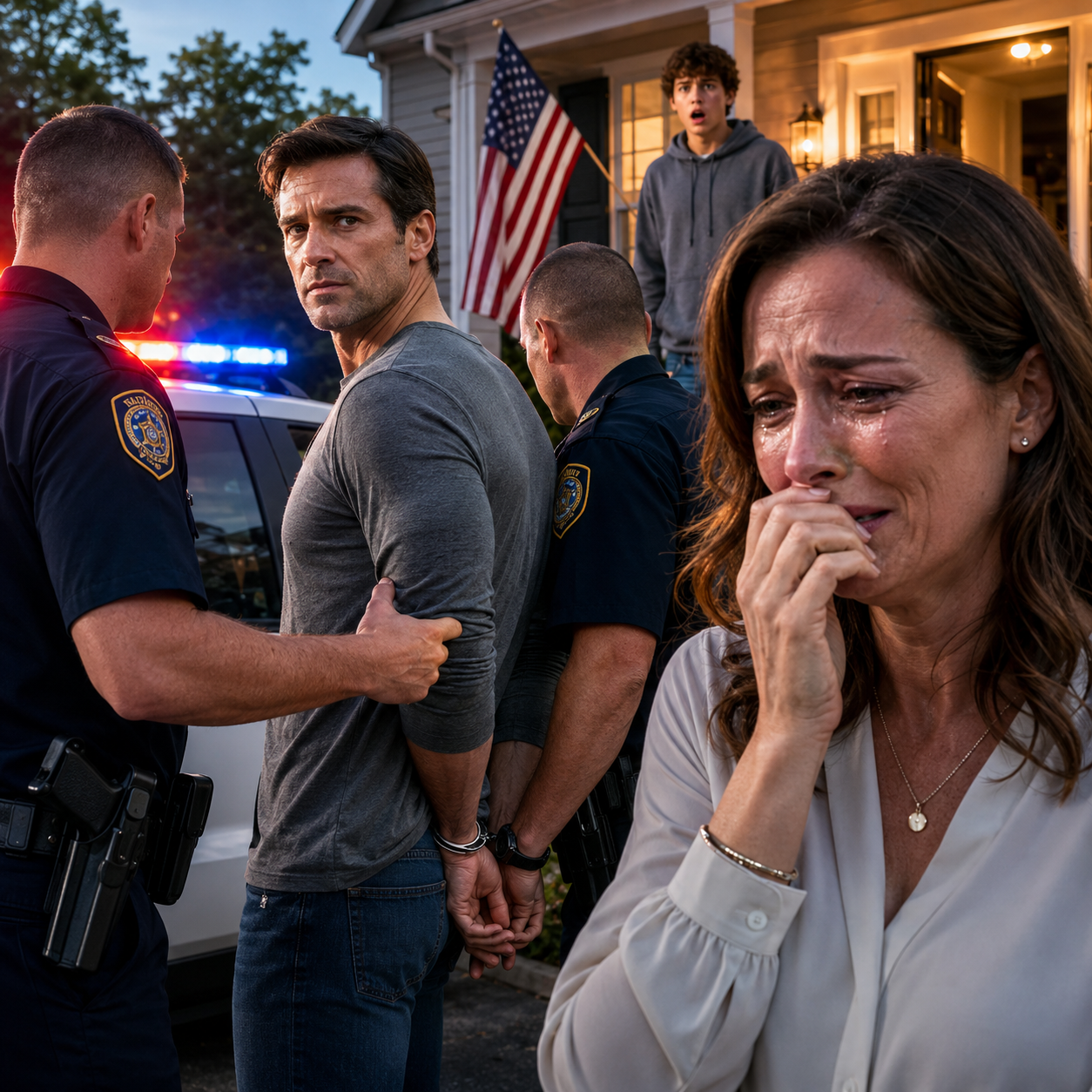
Sometimes betrayal kneels on the porch and sobs into your shirt while the person she destroyed is driven away in handcuffs.
Sometimes she tells you to take care of her.
And sometimes, three years later, you find out that you were comforting the arsonist while your father burned.



![[FULL STORY] She Said She’d Always Choose Her Male Best Friend — So I Let Her](https://social-media.rabedo.com/thumbnails/1776939104_fc6b0a2d-595b-40cd-98f2-1030d34682d8.png)