

I glanced up from my laptop. “Life isn’t cinematic.”
“That’s exactly what I mean.”
I should have argued.
Instead I just went back to answering emails.
Because part of me thought maturity meant tolerance.
I confused emotional self-control with emotional self-erasure.
Three weeks later, things got worse.
Her company hosted a luxury networking gala downtown. Black-tie event. Influencers, executives, marketing people, athletes. The kind of place where everyone secretly evaluated each other’s social value within thirty seconds.
Olivia spent nearly four hours getting ready.
Hair.
Makeup.
Dress.
Jewelry.
I wore a dark tailored suit and waited patiently while she changed outfits three different times.
When we finally arrived, she looked incredible.
But something felt off immediately.
She introduced me differently than usual.
This sounds insignificant until you experience it yourself.
Normally she’d say, “This is my boyfriend Daniel.”
That night she kept saying things like:
“This is Daniel.”
Or:
“Daniel works in logistics.”
No warmth.
No pride.
Just information.
At one point we stood with a group near the champagne tower while some venture capitalist talked about buying property in Miami.
One of the women asked Olivia how we met.
Before Olivia could answer, another woman interrupted jokingly.
“Oh my God wait, is he the low-maintenance boyfriend?”
Everybody laughed.
Olivia laughed too.
Then she said the sentence I still remember word for word.
“He’s emotionally safe. That’s his brand.”
Again, everyone laughed.
I smiled politely.
But internally something cold shifted position inside me.
Because I realized she had turned me into a category.
Not a partner.
A utility.
The dependable man.
The safe option.
The stable provider women settle down with after they finish chasing excitement.
And the worst part?
She genuinely believed that role made me lucky to have her.
On the drive home, she noticed I was quiet.
“You okay?”
“Yeah.”
“You seem weird.”
I kept my eyes on the road. “Do you respect me?”
She blinked. “What?”
“It’s a simple question.”
“Of course I do.”
“That’s not what I asked.”
Silence filled the car for several seconds.
Then she sighed dramatically.
“Oh my God, are you upset about tonight?”
“I’m asking if you respect me.”
“You’re being sensitive.”
There it was.
The fastest way modern people dismiss emotional honesty.
You’re sensitive.
Meaning:
Your pain is inconvenient for me.
“I just don’t understand why you talk about me like I’m some boring appliance you keep around because it’s practical.”
“That’s not what I do.”
“You called me emotionally safe like it was an insult.”
“It wasn’t an insult.”
“Then why did everybody laugh?”
She crossed her arms and stared out the window.
“You know what your issue is?” she said finally. “You always take everything personally.”
I almost laughed at the irony.
Because what exactly should a relationship be if not personal?
That night I barely slept.
Not because I was devastated.
Because I was thinking.
Really thinking.
For the first time in years, I stopped viewing the relationship emotionally and started evaluating it objectively.
And once I did that, the imbalance became impossible to ignore.
I financed almost everything important in our lives.
I planned long-term stability.
I handled emergencies.
I solved problems.
I created peace.
Meanwhile she contributed aesthetics, excitement, and social validation.
Which sounds cruel until you realize she herself treated those things like they were more valuable than what I offered.
The next morning I went to the gym before sunrise.
I hadn’t trained seriously in years.
Not because I couldn’t.
Because life became work, routines, responsibilities.
That morning I stayed nearly two hours.
Then I came home, showered, and started making changes.
Not dramatic ones.
Quiet ones.
I upgraded my wardrobe.
Started training regularly again.
Cut alcohol almost entirely.
Reconnected with old friends I’d neglected during the relationship.
Spent less time seeking Olivia’s approval.
More time building my own life.
The funny thing about self-respect is that it immediately changes relationship dynamics.
Especially when someone has grown comfortable benefiting from your emotional dependency.
At first Olivia liked the changes.
“You’re getting hotter,” she joked one evening while I buttoned a fitted charcoal shirt before dinner with coworkers.
Then she noticed something else.
I stopped chasing her attention.
Stopped asking if she was upset.
Stopped trying to fix every emotional fluctuation.
Stopped orienting my entire mood around her approval.
And that unsettled her more than any argument ever had.
One Friday night she came into the bedroom while I packed for a weekend fishing trip with college friends.
“You’re gone a lot lately.”
I folded another shirt calmly. “Not really.”
“You’ve been acting different.”
“How?”
“I don’t know. Detached.”
I looked at her carefully.
For the first time in years, I noticed how much of our relationship depended on me emotionally managing everything.
Her anxieties.
Her moods.
Her need for reassurance.
Meanwhile nobody had been managing mine.
“I think I just got tired,” I said honestly.
“Tired of what?”
“Being treated like a reliable background character in my own relationship.”
She rolled her eyes immediately.
“Are we seriously still doing this?”
That reaction told me everything.
To her, the conversation had ended weeks ago.
To me, it had only just begun.
The fishing trip changed my life in a way I never expected.
Not because anything dramatic happened.
Because I spent forty-eight hours around men who actually liked themselves.
That sounds simple.
It isn’t.
Most adult men slowly disappear inside obligations. Work. Relationships. Bills. Responsibilities. They become functional instead of alive.
But my friends were different.
Married. Divorced. Single. Didn’t matter.
They still possessed identities outside romantic validation.
Saturday night we sat around a fire near the lake drinking whiskey while one of my friends, Marcus, talked about his recent divorce.
“You know the craziest part?” he said. “The marriage wasn’t even terrible. I just realized she liked what I provided more than who I was.”
Nobody interrupted him.
Because every man there understood exactly what he meant.
Marcus poked the fire with a stick.
“She cried harder losing the lifestyle than losing me.”
That sentence sat heavily in the dark.
Then he looked directly at me.
“You’ve got that look.”
“What look?”
“The look of a guy realizing he’s being tolerated instead of admired.”
I didn’t answer.
Didn’t need to.
Marcus nodded slowly. “Yeah. I remember it.”
Sunday afternoon I drove home with an unsettling clarity I couldn’t ignore anymore.
I wasn’t unhappy because Olivia wanted excitement.
I was unhappy because she viewed stability as unimpressive instead of valuable.
And people eventually destroy whatever they stop respecting.
When I got home, she barely looked up from the couch.
“You’re back early.”
“It’s six o’clock.”
“Oh.”
No hug.
No excitement.
No warmth.
Just expectation.
Like furniture returning to its assigned location.
I stood there looking at her while something final clicked quietly into place.
I still loved her.
But I no longer believed she saw me clearly.
And love without respect eventually becomes emotional servitude.
Over the next few months, the distance between us grew slowly enough that outsiders probably wouldn’t notice.
But Olivia noticed.
Because for the first time since we met, she was no longer the emotional center of my universe.
Ironically, that made her pursue me harder.
She started dressing up more around me.
Posting pictures of us online more frequently.
Touching me more often in public.
But none of it felt authentic.
It felt reactive.
Like she sensed control shifting and wanted to regain it.
Then came the dinner party that finally destroyed everything.
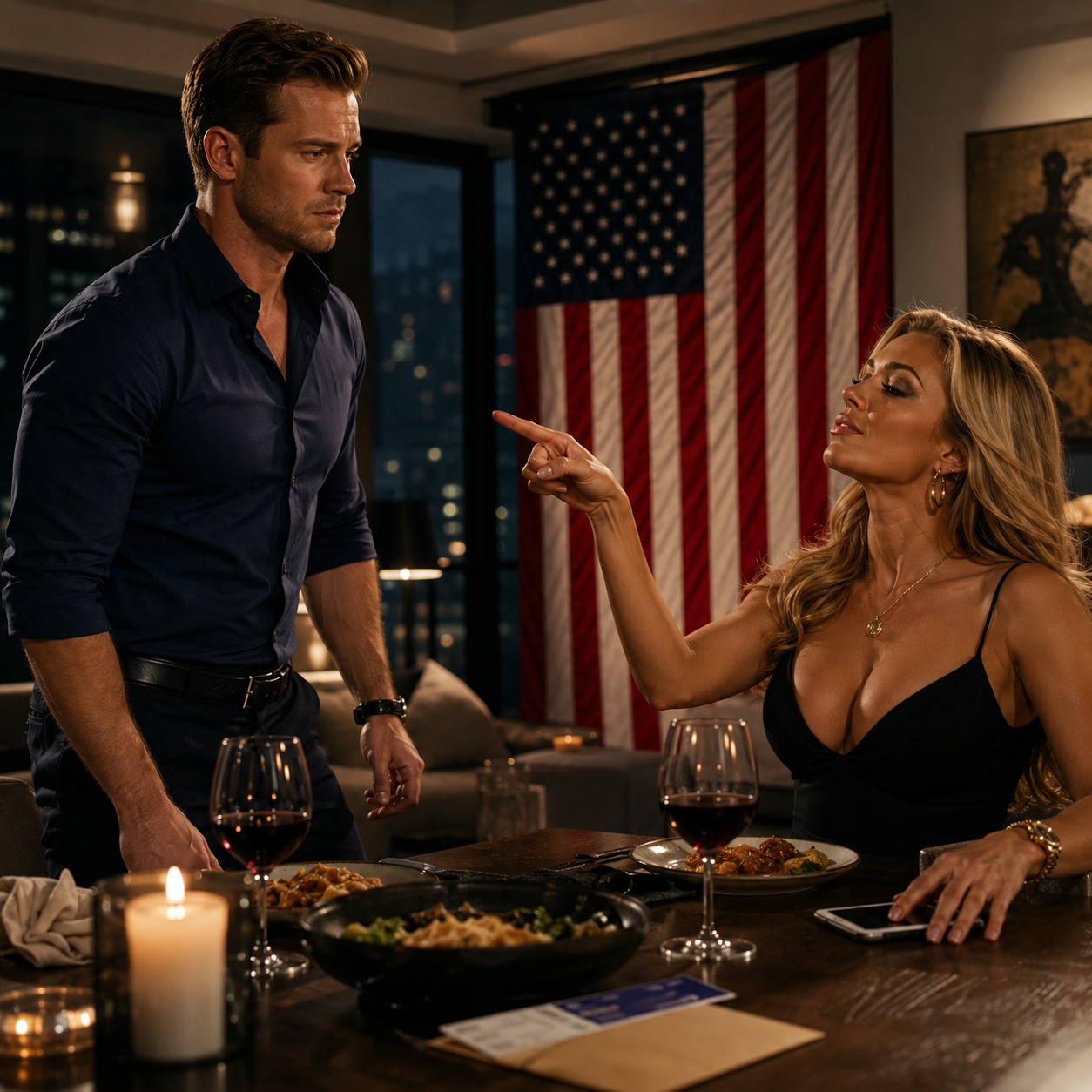
Her friend Vanessa hosted it in a luxury condo downtown. About twelve people total. Mostly marketing professionals, finance people, influencers, startup types.
The entire night revolved around subtle competition disguised as conversation.
Whose vacations were better.
Whose relationship looked happier.
Whose life appeared more aspirational.
At one point Vanessa asked everyone a question while refilling wine glasses.
“What’s the biggest relationship red flag?”
People gave predictable answers.
Cheating.
Lying.
Narcissism.
Financial irresponsibility.
Then Vanessa looked at Olivia.
“What about you?”
Olivia laughed lightly and swirled her wine.
“Honestly? Men who stop trying.”
A few women nodded.
Vanessa grinned. “Explain.”
“You know,” Olivia continued casually, “when guys get too comfortable. Like they think paying bills is enough effort forever.”
I felt several eyes shift toward me.
Olivia kept talking.
“They stop being exciting. Stop courting you. Stop making you feel special. They become emotionally… predictable.”
Everyone laughed softly.
Again.
That same familiar laughter.
And suddenly I realized something important.
These people weren’t laughing because I was pathetic.
They were laughing because Olivia framed me as pathetic.
There’s a difference.
I sat there calmly while she continued discussing me like a case study instead of a partner.
Then Vanessa asked the question that changed the room.
“So why are you still with him?”
Olivia smiled without hesitation.
“Because stable men make the best long-term investments.”
The room erupted in laughter again.
But this time nobody missed the expression on my face.
Because I wasn’t smiling anymore.
I set my wine glass down carefully.
Then I stood.
“I’m gonna head out.”
The room quieted slightly.
Olivia frowned. “What?”
“I’m leaving.”
“Daniel, don’t be dramatic.”
Dramatic.
Amazing word.
People use it whenever consequences arrive faster than expected.
I grabbed my jacket calmly.
Then I looked directly at her.
“You know what the problem is, Olivia?”
Her expression hardened immediately.
“You spent so much time worrying whether I was the kind of man women brag about online that you never realized you stopped acting like the kind of woman a good man feels proud to come home to.”
Silence.
Complete silence.
Nobody moved.
Nobody laughed.
Olivia stared at me like I’d slapped her.
I continued calmly.
“You don’t admire stability because you’ve never had to survive instability. You think peace is boring because you’ve mistaken emotional chaos for passion.”
“Daniel—”
“No. You don’t get to publicly reduce me to a financial personality trait for months and then act shocked when I finally respond.”
Her face turned bright red.
Vanessa looked horrified.
One of the guys suddenly became deeply interested in his drink.
I picked up my keys.
“I genuinely hope someday you realize how rare it is to find someone who makes your life safer instead of harder.”
Then I left.
Nobody stopped me.
The breakup technically happened three days later.
But emotionally, it happened in that condo.
Olivia came home furious that night.
Not remorseful.
Furious.
“You humiliated me.”
I laughed quietly in disbelief.
“That’s your concern?”
“You embarrassed me in front of everyone.”
“You’ve been embarrassing me for months.”
“That’s not the same thing.”
“Why?”
“Because I was joking.”
“No. You were revealing how you actually see me.”
She paced the kitchen angrily.
“You’re twisting everything.”
“Am I?”
“Yes.”
“Then answer one question honestly.”
She crossed her arms.
“What?”
“If a handsome millionaire influencer with a private jet wanted a serious relationship with you tomorrow, would you leave me?”
The silence answered before she did.
And once silence answers a question like that, the relationship is already dead.
She eventually whispered, “That’s not fair.”
I nodded slowly.
Exactly.
Not fair.
Because she couldn’t even lie convincingly anymore.
We separated the following week.
No screaming.
No cheating scandals.
No dramatic destruction.
Just two adults finally acknowledging something ugly.
She loved the life I created more than she loved me.
And I had finally stopped accepting that as enough.
The first month afterward felt strangely peaceful.
Painful.
But peaceful.
I kept training.
Working.
Rebuilding routines.
Therapy helped too, though I never told many people about that. Mostly because men are still quietly taught that emotional exhaustion should be endured privately.
My therapist said something during our third session that stuck with me.
“Do you know why her comments affected you so deeply?”
“Because they were disrespectful?”
“No. Because part of you already feared they were true.”
That irritated me initially.
Until I realized she was right.
I had spent years shrinking myself into pure functionality.
Work.
Bills.
Reliability.
I stopped being fully alive long before Olivia stopped admiring me.
The relationship merely exposed what I’d abandoned in myself.
So I started changing things for real this time.
Not for revenge.
For identity.
I traveled more.
Took risks.
Started saying yes to invitations instead of defaulting to routines.
By thirty-seven, I was in the best shape of my life.
But more importantly, I finally looked like a man who respected his own existence.
And people reacted differently immediately.
Women especially.
Not because I became richer or more attractive overnight.
Because confidence without desperation changes your entire presence.
About eight months after the breakup, I met Claire.
Not in some cinematic way.
At a bookstore café.
She was sitting near the window reading while waiting for her coffee.
I noticed her because she looked peaceful.
Not performative.
Not curated.
Just present.
We started talking accidentally after she commented on the book in my hand.
That conversation lasted two hours.
Our relationship developed slowly after that.
And the strangest part was how easy everything felt.
Claire admired ordinary things.
Consistency.
Reliability.
Calmness.
She once told me, “You make life feel safe without making it feel small.”
I nearly went silent hearing that.
Because it was the first time in years someone described stability like a gift instead of a deficiency.
A year after my breakup with Olivia, something happened that perfectly summarized everything.
One of my coworkers was getting married, and I attended the wedding with Claire.
Outdoor venue.
Summer evening.
String lights.
Live jazz band.
Halfway through the reception, Claire went to the bar while I spoke with some colleagues near the dance floor.
That was when I saw Olivia.
I genuinely hadn’t known she’d be there.
Apparently she worked with the bride on a marketing campaign months earlier.
For a second we just stared at each other across the reception.
She looked beautiful.
But tired.
Not physically.
Emotionally.
Like someone permanently trying to maintain an exhausting image.
Then her eyes shifted toward Claire returning with drinks.
And something in Olivia’s face changed instantly.
Recognition.
Not of Claire specifically.
Of the situation.
Claire walked up smiling naturally and handed me my whiskey before slipping her arm around mine casually.
No performance.
No competition.
No insecurity.
Just affection.
Olivia noticed immediately.
Because women notice those things immediately.
Claire looked at Olivia politely. “Hi.”
Olivia introduced herself awkwardly.
Then after a few painful seconds she asked, “So how long have you two been together?”
“Almost six months,” Claire said warmly.
Olivia nodded slowly.
Then she made the mistake of looking at me too long.
Because I think for the first time, she realized something devastating.
I had not become less desirable after leaving her.
I had become more complete.
Meanwhile she still looked like someone auditioning for approval.
Later that night, one of my friends showed me something accidentally hilarious.
Olivia’s social media.
Or more specifically, what had changed about it.
During our relationship, she constantly posted vague relationship content.
Fancy dinners.
Aesthetic date nights.
Photos designed to imply luxury and romance without saying much directly.
But now?
Nothing.
No boyfriend content.
No relationship mentions.
No tags.
No status indicators.
Just carefully curated solo photos and motivational captions.
At first I thought maybe she was single.
Then my friend laughed.
“She’s dating some crypto guy.”
“How do you know?”
“My girlfriend follows her. Apparently she never posts him because she doesn’t want people asking questions.”
“What questions?”
He shrugged. “I guess he’s messy. On-again-off-again. A lot of public drama.”
I almost smiled.
Not because I wanted revenge.
Because the irony felt unbelievable.
The woman who once mocked emotional safety was now hiding her actual relationship because it embarrassed her publicly.
A few weeks later, Olivia texted me for the first time in nearly a year.
I miss talking to you sometimes.
Simple.
Direct.
Dangerous.
I stared at the message for nearly a minute before responding.
I hope you’re doing well.
That was it.
No invitation.
No emotional reopening.
No nostalgia.
Because some doors should stay closed once you finally escape the room behind them.
She replied almost immediately.
You seem happier now.
I thought carefully before answering.
Then I wrote the most honest sentence I could.
I think I finally stopped measuring my value through other people’s approval.
Three dots appeared.
Disappeared.
Appeared again.
Finally she sent:
I didn’t appreciate you enough.
I looked at the message for a long time.
Not triumphantly.
Just sadly.
Because I believed she meant it.
But timing matters in life.
And realizations arriving after damage still arrive too late.
I never replied.
Not out of cruelty.
Out of closure.
The strange thing about respect is that people only understand its value once it disappears.
And modern dating has created a generation of people who confuse visibility with value.
They chase relationships that photograph well instead of relationships that survive pressure.
They prioritize excitement over peace until life finally hurts them enough to understand the difference.
A year and a half after our breakup, Claire and I bought a house together outside the city.
Nothing flashy.
Big kitchen.
Quiet neighborhood.
Backyard with enough space for future dogs and maybe future kids.
One Sunday morning we sat on the porch drinking coffee while rain rolled softly across the street.
Claire rested her head against my shoulder.
“You know what I like most about you?” she asked.
“What?”
“You make ordinary life feel emotionally safe.”
I laughed quietly.
Because once upon a time, another woman had said almost the exact same thing like it was evidence of my inadequacy.
Funny how perspective changes everything.
Claire looked up at me. “What?”
“Nothing.”
But internally I realized something important.
The right person will interpret your strengths correctly.
That’s it.
That’s the whole secret.
The wrong person sees loyalty as weakness, consistency as boredom, peace as lack of passion, and emotional safety as something unremarkable.
The right person sees those exact same traits and calls them rare.
And once you experience the difference, you never beg to be misunderstood again.


![[FULL STORY] My girlfriend startled me with an unexpected message: "I've told everyone that we're taking a break.](https://social-media.rabedo.com/thumbnails/1777364522_9.png)