

“Is that really how you see me?” I asked.
She hesitated. Not because she regretted it, but because she was deciding how much truth she could get away with.
“I see you as someone who loves me,” she said. “And honestly, Ethan, sometimes I think that’s the only reason we still work. Because no matter how mad you get, you don’t leave.”
There it was.
Not love. Not trust. Not partnership.
A calculation.
She believed my love was a permanent condition. Like eye color. Like gravity. Like something she could disrespect, neglect, bruise, mock, and still find waiting for her the next morning.
I nodded slowly.
She mistook it for surrender. She always did.
“Can we go back inside now?” she asked. “You’re ruining the night.”
I looked at her for one more second, memorizing the face of the woman I had spent six years trying to keep happy. Then I said, “Sure.”
We went back inside. I did not argue. I did not punish her with silence. I did not sulk in the corner. I stood beside her for another hour while she performed charm for the room, occasionally touching my chest as if to reassure everyone we were fine. At midnight, I drove her home. She talked the whole way about Tessa’s ring, the venue, Julian’s promotion, the music, the drinks. She never mentioned the balcony.
When we reached our apartment, she kicked off her heels by the door and said, “I’m glad you didn’t make that a whole thing.”
I hung my keys on the hook.
She came behind me and wrapped her arms around my waist, pressing her cheek between my shoulders. That used to undo me. Even after the worst fights, one small gesture from her could make me forget the knife if she handed me a flower afterward.
“I know I can be a lot,” she murmured. “But you love me.”
I closed my eyes.
“Yes,” I said. “I did.”
She did not catch the past tense. Or maybe she did and refused to believe it mattered.
The next morning, I woke before sunrise. Mara slept beside me, one arm thrown across my side of the bed, peaceful in the certainty that I would absorb the damage like always. I looked at her for a long time. I did not hate her. That surprised me. I thought leaving would require hatred. It did not. It only required exhaustion finally becoming stronger than hope.
I got up quietly, made coffee, and opened my laptop at the kitchen table. For the first time in years, I did not ask myself how to fix us. I asked what it would take to leave cleanly.
The answer was less dramatic than people think. No screaming. No slammed doors. No revenge. Just logistics. Our lease had four months left, but I had paid the deposit and most of the rent. The car was mine. The utilities were in my name. The joint vacation fund had more of my money than hers, but I split it evenly anyway because I did not want one more argument disguised as justice. I emailed the landlord. I checked my savings. I called my brother, Daniel, and asked if his guest room was still open while I found a place. He went quiet for a second, then said, “Are you finally done?” That was when I realized everyone who loved me had been waiting for me to love myself.
For the next three days, I became calm in a way Mara did not recognize because she had never bothered to understand the difference between peace and surrender. I went to work. I cooked dinner. I answered her questions politely. I did not bring up the party. I did not reach for her in bed. She noticed that last part first.
On Wednesday night, she walked into the living room wearing one of my old T-shirts and stood in front of the television.
“Are you mad?” she asked.
“No.”
“You’re being weird.”
“I’m tired.”
She studied me. “Still about the party?”
I paused the show. “No.”
Her face relaxed slightly because she heard what she wanted. “Good. Because I was going to say, I really don’t have the energy to keep apologizing for jokes.”
“You didn’t apologize.”
She frowned. “That’s not the point.”
I almost laughed. Not because anything was funny, but because the absurdity had finally become visible. I had spent years trying to win fair treatment from someone who saw accountability as an inconvenience.
“You’re right,” I said. “It isn’t.”
She stared at me, unsettled by the lack of resistance. Then she shrugged and went into the bedroom.
On Friday, I signed a lease for a small one-bedroom across town. Nothing fancy. Quiet street, decent light, close to work. The landlord handed me the keys, and I sat in my car afterward with them in my palm, feeling something I had not felt in years.
Space.
That evening, Mara wanted to go out. She had been invited to drinks with Tessa, Julian, and a few others. She asked if I was coming while applying lipstick in the bathroom mirror.
“No,” I said.
Her hand paused. “Why?”
“I have plans.”
“With who?”
“My brother.”
She turned slowly. “Since when do you make plans without telling me?”
The old me would have explained. The old me would have softened my tone, reassured her she was still central, made sure my independence did not feel like rejection. The new me picked up my watch from the dresser.
“Since now.”
Her eyes narrowed. “Okay. What is your problem?”
I fastened the watch. “I don’t have one.”
“You clearly do.”
“Mara, go have fun.”
That angered her more than any accusation could have. She was used to my pain being available for her to manage, dismiss, or weaponize. My calm gave her nothing to hold.
She left in a cloud of perfume and irritation. I waited fifteen minutes, then packed the first box.
By Sunday afternoon, half my life was in Daniel’s garage. Mara had gone to brunch and then shopping, sending me photos of dresses she wanted my opinion on. I replied with simple answers. Nice. Looks good. Your choice. Every message felt like a thread being cut.
That night, I cooked pasta because it was easy and because I wanted one final ordinary meal in the apartment where I had spent years pretending ordinary pain was love. Mara came home around eight, carrying bags, cheerful in the careless way she became when she assumed whatever tension existed had dissolved without her participation.
“Smells good,” she said.
I set two plates on the table.
She glanced around. “Why does it look empty in here?”
I sat down. “Because some of my things are gone.”
She laughed once. “What does that mean?”
“It means I’m moving out.”
The room changed.
Not loudly. No thunder. No music cue. Just Mara standing very still with one hand on the back of the chair, her smile frozen in confusion.
“What?”
“I signed a lease.”
She blinked. “A lease.”
“Yes.”
“For what?”
“An apartment.”
Her mouth opened, then closed. “Are you serious?”
“Yes.”
She stared at me like I had spoken a language she did not believe I knew. “Because of one joke?”
“No.”
“Then what? The balcony? Ethan, come on.”
I looked at her across the table. “It wasn’t one joke. It wasn’t one night. It was six years of me telling myself your disrespect was stress, your contempt was humor, your selfishness was independence, and your cruelty was just honesty. I’m done translating mistreatment into something I can forgive.”
Her face flushed. “That is so dramatic.”
“I know you think that.”
“You’re moving out because I said you were dependable?”
“I’m moving out because you said I wouldn’t leave no matter how you treated me.”
She looked away.
There. She remembered.
I continued, voice steady. “And you were right for a long time. That’s what embarrasses me. Not what you said in front of people. The fact that you knew exactly how much I would tolerate, because I had taught you.”
Her expression shifted from anger to something more uncertain. “Ethan…”
“I’ll cover my part of rent through the end of next month. After that, you can decide if you want to stay here or find another place. I’ve already spoken to the landlord.”
“You spoke to the landlord?” Her voice rose. “Without talking to me?”
“I’m talking to you now.”
“No, you made a decision and handed me the consequences.”
I almost smiled because those were the words I had been living with for years.
“Yes,” I said. “I did.”
She pushed back from the table. “This is punishment.”
“No. Punishment would mean I’m trying to hurt you. I’m not. I’m removing myself from a relationship that hurts me.”
“You love me.”
The words came out fast. Not tenderly. Like a legal defense.
I looked down at the plate I had prepared for her, the steam rising between us like a final ghost of domestic life.
“I loved you,” I said.
This time she heard it.
Her face changed in a way I had never seen before. Mara was beautiful when confident, stunning when angry, magnetic when performing, but fear made her look younger. Smaller. Realer.
“You don’t just stop loving someone,” she whispered.
“No,” I said. “You don’t. It gets beaten out slowly. Then one day you reach for it and realize there isn’t enough left to keep you there.”
She sat down like her knees had weakened. For a moment, I thought she might cry. Then pride saved her.
“Fine,” she said coldly. “Go. You’ll be back.”
I nodded.
That was the last gift she gave me: making sure I did not doubt my decision.
I moved out the next morning while she was at work. Daniel helped. He did not say much, which I appreciated. My brother had always been better at practical love than emotional speeches. He carried boxes, tightened loose screws on my new bed frame, stocked my fridge with eggs and orange juice, and left a six-pack on the counter with a note that said, “For your first night not walking on eggshells.”
I sat alone in that apartment after he left, surrounded by boxes and silence. It should have felt devastating. Instead, I slept nine straight hours for the first time in years.
Mara did not contact me for two days.
Then the messages began.
At first, they were angry. She said I had abandoned her. She said real men communicated instead of running. She said I had embarrassed her because Tessa asked why I wasn’t around. She said I was proving that my love had always been conditional. That one made me put the phone down and stare at the wall for a while. Conditional. She used the word like an accusation, as if love without boundaries was the only kind that counted.
By Thursday, the anger turned sarcastic. Hope your little bachelor pad is healing your trauma. Hope your brother is proud. Hope you enjoy eating microwave dinners alone.
By Saturday, the sarcasm cracked.
Can we talk?
I did not answer immediately. That alone would have been impossible for me a month earlier. I used to respond to Mara’s discomfort like it was an alarm only I could shut off. Now I let it ring.
On Sunday afternoon, I agreed to meet her at a coffee shop halfway between our places. Public. Neutral. No memories in the walls.
She arrived fifteen minutes late wearing sunglasses even though it was cloudy. She looked thinner, or maybe just less assembled. She removed the glasses when she sat down, and I saw that her eyes were red.
“Hi,” she said.
“Hi.”
She waited, maybe expecting me to fill the silence with concern.
I did not.
She folded her hands around her cup. “I don’t like how we left things.”
“We didn’t leave them. I left.”
Her jaw tightened. “Okay. I deserved that.”
I said nothing.
She inhaled shakily. “I’ve been thinking a lot.”
That sentence used to make me hopeful. Now it made me cautious.
“I said things I shouldn’t have said,” she continued. “At the party. Before the party. Probably for a long time.”
“Probably?”
Her eyes flashed, then softened. “For a long time.”
I nodded.
“I got comfortable,” she said. “With you. With how much you loved me. I think… I think I confused feeling safe with feeling bored. And I took it out on you.”
It was the closest she had come to honesty in years. A part of me wanted to reach across the table. Not because I wanted to go back, but because old reflexes do not die just because self-respect finally wakes up.
“I appreciate you saying that,” I said.
She leaned forward. “Then come home.”
“No.”
The word landed between us like a dropped glass.
She stared. “No?”
“No.”
“But I’m admitting I was wrong.”
“I know.”
“So what else do you want?”
I looked at her, and there it was again: the transaction. I apologize, you return. I cry, you comfort. I hurt you, you prove your love by forgiving me quickly enough that I never have to sit too long with what I did.
“I don’t want anything from you,” I said.
That frightened her more than anger would have.
“Ethan, please.”
“Mara, I hope you mean what you said. I hope you change. I really do. But I’m not moving back in to supervise your growth.”
Her lips parted. “That’s not fair.”
“No. What wasn’t fair was making me audition for basic kindness for six years.”
Tears slipped down her face. She wiped them quickly, embarrassed by her own vulnerability in daylight.
“I don’t know how to do this without you,” she whispered.
There was a time when that sentence would have pulled me back. I would have mistaken dependency for love. I would have thought being needed meant being chosen.
But I had learned.
“You’ll figure it out,” I said gently.
She looked at me as if I had slapped her.
Maybe I had, in the only way that mattered. I had handed her back responsibility for her own life.
The weeks after that were strange. Freedom did not arrive like fireworks. It arrived like noticing my shoulders were not tense while making coffee. Like buying a shirt because I liked it without hearing Mara’s voice mocking it in my head. Like watching an entire movie without pausing to analyze whether she was bored. Like spending Saturday morning reading on my balcony, the city humming below, and realizing no one was about to turn my peace into evidence of inadequacy.
People think leaving a toxic relationship means instant happiness. It does not. Sometimes it means grief without regret. I missed her. Or maybe I missed who I had been when loving her still felt noble. There were nights I almost texted. There were songs I skipped. There were moments when I saw something funny and reached for my phone before remembering she was no longer the person I shared small joy with. But missing someone is not proof you made the wrong choice. Sometimes it is just proof that the wound was deep enough to leave an echo.
Mara, meanwhile, began losing control of the story.
That mattered to her more than she wanted to admit. For years, she had managed our image with careful precision. We were stable when stability flattered her. We were private when privacy protected her. We were complicated when complication excused her behavior. But once I left and refused to play my assigned role, people started asking questions she could not answer without revealing too much.
Tessa called me one evening. I almost did not pick up.
“I owe you an apology,” she said.
I stood in my kitchen, holding a dish towel. “For what?”
“For laughing at the party.”
I leaned against the counter.
“I knew it wasn’t funny,” she continued. “Everyone did. But Mara makes it hard to challenge her. That’s not an excuse. I’m sorry.”
I was quiet for a moment. “Thank you.”
“She’s telling people you blindsided her.”
“I’m sure she is.”
“She’s also saying you became cold overnight.”
I smiled faintly. “That part might be true.”
“No,” Tessa said. “I think you just stopped being available for damage.”
After we hung up, I sat with that sentence for a long time.
A month later, Mara showed up at my apartment.
I had not given her the address, but Daniel had dropped me off once when she happened to be driving by his house. I should have been angry. Mostly, I was tired.
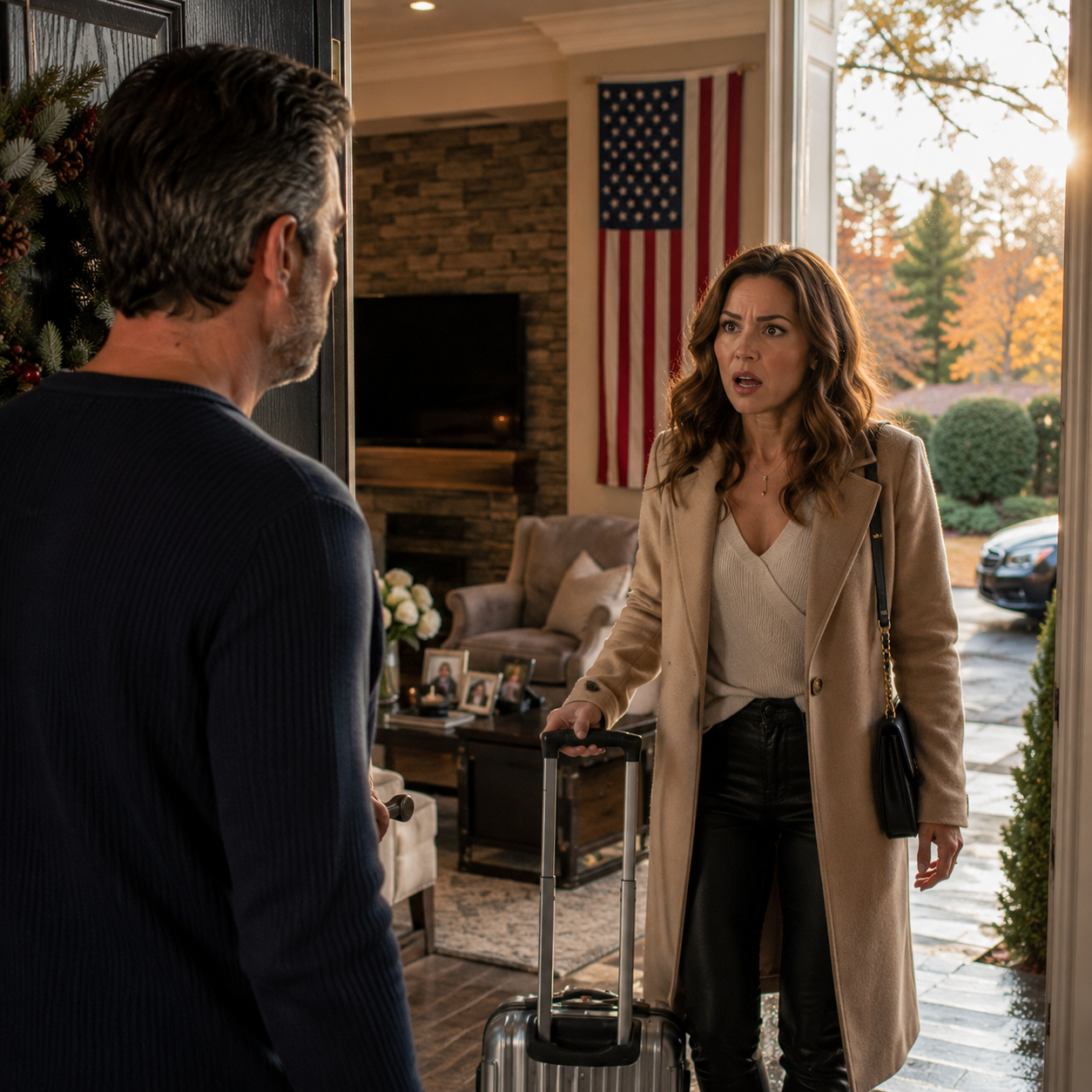
She knocked three times, then called through the door. “Ethan. I know you’re home.”
I opened it but did not invite her in.
She wore the red dress from the engagement party under a beige coat, which told me everything. She had dressed as a memory, hoping guilt would fill in what love no longer could.
“You shouldn’t be here,” I said.
“I needed to see you.”
“You can text.”
“You don’t answer like you used to.”
“No.”
Her eyes moved past me into the apartment. “Can I come in?”
“No.”
The humiliation hit her immediately. Mara was not used to being denied access to me. My home, my time, my emotional labor, my forgiveness—she had treated them all like rooms where she owned a key.
She swallowed. “I started therapy.”
“I’m glad.”
“I mean it. I’ve gone twice.”
“That’s good.”
“I told her about us.”
I waited.
“She said I have patterns. That I test people. That maybe I push because I’m scared they’ll leave, and then when they don’t, I lose respect for them.”
“That sounds worth exploring.”
Her face twisted. “Don’t talk to me like I’m a coworker.”
“Mara, why are you here?”
The question stripped away whatever script she had prepared. Her eyes filled again.
“Because I miss you,” she said. “Because the apartment feels awful without you. Because I keep expecting to hear your keys. Because I made coffee yesterday and poured two cups without thinking. Because I found your gray sweater in the closet and sat on the floor with it like a pathetic person. Because I know I hurt you and I hate that I didn’t understand how much until you stopped letting me.”
For one dangerous second, my chest softened.
Then she stepped closer.
“And because I know you still love me.”
There it was.
Not a question. A claim.
I looked at her carefully. “Do you?”
She blinked. “What?”
“Do you know that? Or are you counting on it?”
Her silence answered before she could.
I nodded slowly. “That’s the problem.”
She shook her head. “No, Ethan, don’t twist this.”
“I’m not.”
“I’m trying to fight for us.”
“No. You’re trying to get back what made you feel safe after you spent years making it unsafe for me.”
She flinched.
I did not raise my voice. I did not need to.
“I hope therapy helps you. I hope you become someone who doesn’t confuse love with permission to be cruel. But you are not entitled to my return as proof that you’re changing.”
Her tears spilled freely now. “So that’s it? Six years and you just shut the door?”
I thought about the thousands of little doors she had shut in my face every time I asked to be treated gently. Every apology she demanded from me for being wounded. Every dinner where I laughed at my own humiliation to keep peace. Every night I lay beside her feeling lonelier than I had ever felt alone.
“Yes,” I said.
Then I closed the door.
I leaned my forehead against it after, breathing hard, because strength does not always feel strong while you are using it. Sometimes it feels like breaking your own heart with clean hands.
Winter came early that year. Not dramatically, just with cold rain and gray mornings. I settled into my new life. I reconnected with friends I had neglected because Mara disliked them. I went hiking with Daniel. I started running again. I bought a couch that was ugly in a comfortable way and loved it immediately. I took a pottery class on a whim and made a bowl so lopsided it looked emotionally unstable. I kept it anyway.
There was no grand reinvention. I did not become rich overnight or start dating a supermodel or post cryptic photos about peace. I just became myself again in quiet increments.
That was enough.
Three months after I left, I ran into Mara at a grocery store.
It was the kind of moment movies make glamorous and real life makes awkward. I was holding a bag of apples. She was comparing pasta sauces. We saw each other at the same time.
She looked different. Less polished, but not worse. Her hair was shorter. Her face had lost some of its defensive sharpness. She looked tired, but present.
“Hi,” she said.
“Hi.”
For once, she did not rush to fill the silence.
“How are you?” she asked.
“I’m good.”
She nodded. “You look good.”
“Thank you.”
Another silence. Then she said, “I moved out of the apartment.”
“I heard.”
“Tessa?”
“Daniel. He heard from Tessa.”
A small smile passed over her face, then faded. “I couldn’t afford it alone. And honestly, I hated being there.”
I nodded.
“I’m staying with my cousin for now,” she continued. “It’s humbling.”
“That’s not always bad.”
“No,” she said quietly. “It’s not.”
I expected a plea. A dramatic confession. A hand on my arm. But Mara only looked down at her basket.
“I’m sorry,” she said.
I had heard those words before, but they sounded different this time. Less like a key she was trying in a lock. More like something she had carried until it became heavy enough to set down.
“I know I said it before,” she continued. “But I don’t think I understood it then. I was still trying to get you back. I’m not saying it for that now.”
I believed her. That was new.
“I treated you like your love made you less valuable,” she said. “Like because you stayed, you were weak. That was cruel. And stupid. And I’m sorry.”
I felt the words enter me without reopening the wound.
“Thank you,” I said.
Her eyes shone, but she did not cry. “Are you happy?”
I thought about lying to spare her, then decided we had done enough pretending.
“Yes.”
She nodded, absorbing it like a deserved consequence.
“I’m glad,” she said, and I could tell it cost her something to mean it.
We parted in the pasta aisle. No hug. No promise. No cinematic closure. Just two people who had once built a life together walking in opposite directions with groceries in their hands.
A year later, Tessa married her fiancé in the same renovated warehouse where Mara had humiliated me. I almost did not go, but Tessa insisted, and by then the place no longer had power over me. I went with Daniel as my plus-one because he promised free food and emotional support in that order.
The room looked the same. Exposed brick, gold lighting, beautiful people pretending not to watch each other. For a moment, standing near the bar, I remembered Mara’s red dress, Julian’s smirk, the balcony glass, the sentence that had ended us before either of us knew it.
No matter how mad you get, you don’t leave.
I looked around and realized the memory did not hurt the same way anymore. It felt like touching an old bruise and finding only skin.
Mara was there.
I saw her across the room in a dark green dress, speaking to Tessa’s mother. She saw me too. For a second, the past stood between us. Then she smiled softly and raised her glass a little. Not flirtation. Not invitation. Just acknowledgment.
I raised mine back.
Later that night, as Daniel and I stood outside waiting for our ride, he nudged me.
“You okay?”
I looked through the warehouse windows at the party glowing behind us.
“Yeah,” I said. “I am.”
He studied me. “You ever think about what would’ve happened if she’d changed sooner?”
I considered it.
The old version of me would have built a cathedral out of that question and lived inside it. What if she had listened? What if I had spoken louder? What if we had gone to therapy earlier? What if love had been enough?
But love had been there. That was the point. Love had been there for years, patient and willing and bruised. It had not saved us because love without respect becomes a place where one person heals and the other disappears.
“Sometimes,” I said. “But not in a way that makes me want to go back.”
Daniel nodded.
Our ride pulled up. Before getting in, I looked once more at the balcony where I had finally heard the truth. Back then, I thought Mara’s mistake was underestimating me. But that was not exactly right.
Her biggest mistake was believing love could survive forever without care.
Mine was believing the same thing.
I know better now. Love is not proven by how much mistreatment you can endure. Loyalty is not measured by how long you stand still while someone takes you apart. And forgiveness does not require you to return to the place where you had to become smaller to be accepted.
Mara thought I would keep loving her no matter how badly she treated me.
For a long time, I thought so too.
Then one morning, I woke up beside her, looked at the woman I had loved more than myself, and finally chose myself instead.


![[FULL STORY] My fiancée texted me at 2 a.m. saying she was at her ex's house and told me to come pick her up](https://social-media.rabedo.com/thumbnails/1776958431_34.png)