
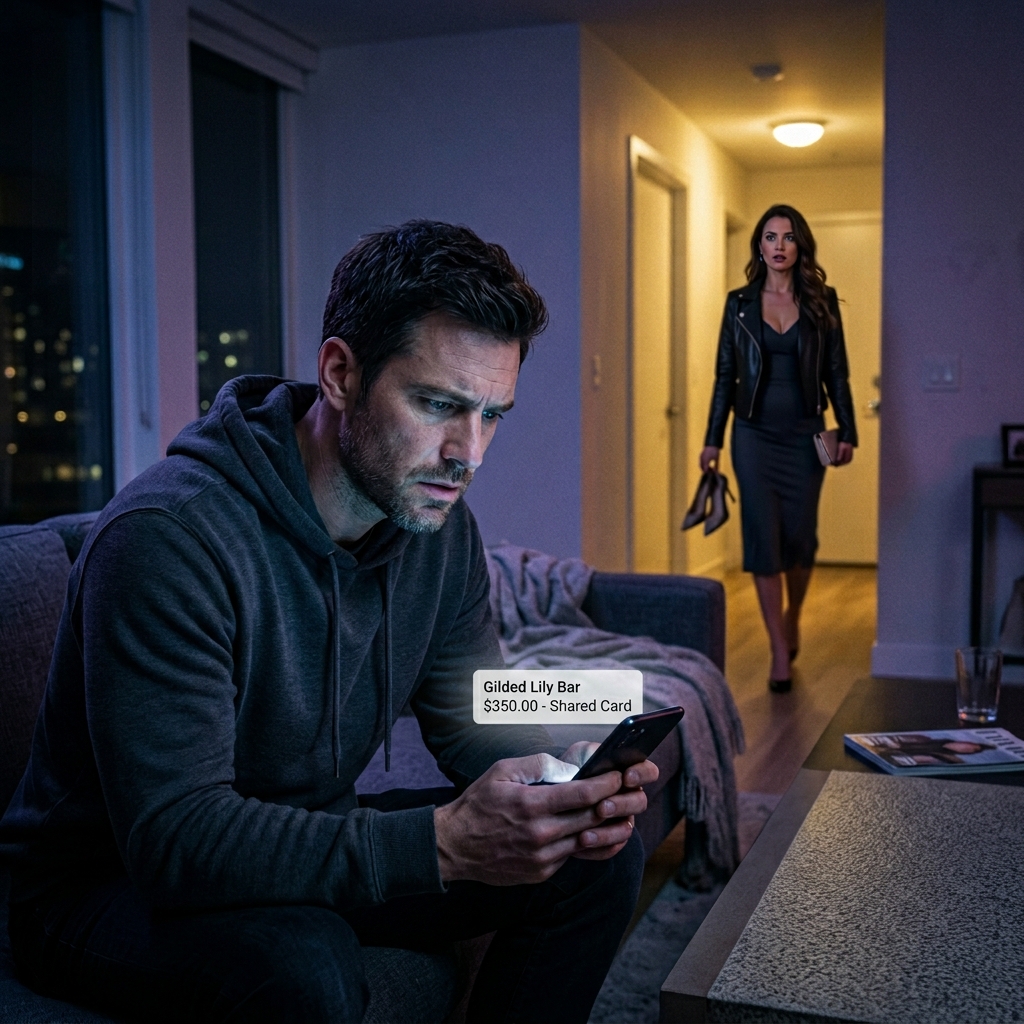
My name is Nathan Cole, and for almost three years, I thought I knew the woman sleeping beside me. Claire came into my life at a mutual friend’s wedding, one of those warm outdoor receptions where everyone drinks too much champagne and pretends not to care when the bouquet gets thrown. She caught it by accident, laughing with both hands in the air, and when the garter toss came next, she looked across the crowd at me and said I should have caught it so we could save everyone time. It was a stupid joke, but it worked. I got her number before the night was over. A month later, we were dating. A year after that, she moved into my apartment. It all felt natural, almost boring in the best possible way. We were not dramatic people. We did not break up every other weekend or post cryptic quotes online. We cooked dinner, split groceries, watched shows on the couch, and talked about maybe buying a place together when the timing felt right.
That was what made the change so hard to admit. It did not happen like it does in movies, with lipstick on a collar or a hotel receipt falling out of a purse. It happened slowly, in ways small enough for me to excuse. Claire started going out more with work friends. At first, it was once every few weeks. Then every Friday. Then random Thursdays. Girls’ nights, birthdays, coworker celebrations, quick drinks that became late nights. She would come home after midnight smelling like perfume and alcohol, still cheerful but strangely unreachable, like part of her was still in another room I was not allowed to enter. Her phone became an extension of her hand. She took it to the bathroom. Kept it face down on the table. Angled the screen away when she texted. If it buzzed while we were watching TV, her body reacted before her face did.
I noticed. Of course I noticed. Men notice more than we admit. We just learn to question ourselves before we question the person we love.
When I brought it up, Claire always turned it back on me. She never exploded at first. She was too smart for that. She would sigh, soften her voice, and make me feel as if I had dragged something ugly into the room.
“You’re being paranoid, Nathan.”
“I’m allowed to have friends.”
“Why are you keeping tabs on me?”
And the worst part was that some of what she said sounded reasonable. I did not want to be that guy. The insecure boyfriend. The man who needed a timestamp, a location, a full report of every conversation. I had seen men like that, men who called control concern and jealousy love. I hated the idea of becoming one of them. So I backed off. I told myself trust meant discomfort sometimes. I told myself privacy was healthy. I told myself my gut was only fear wearing a useful disguise. I told myself a lot of things because the alternative was admitting that the woman I loved might already be living a life I was not part of.
Last Friday, Claire told me she was going out again. A coworker’s birthday, she said, at some bar downtown. She stood in front of the bathroom mirror putting on earrings, her phone glowing beside the sink, her expression practiced and light.
“I won’t be late,” she said. “Midnight at the latest.”
“Have fun,” I told her. “Be safe.”
She kissed my cheek, quick and distracted, then left around eight.
At first, I did what I always did. I tried to act normal. I put on a game I did not care about. Scrolled through my phone. Cleaned the kitchen. Sat on the couch. Checked the clock too often. At 11:30, I texted, Having fun?
She replied seventeen minutes later.
Yes, so loud in here. Can barely hear anything lol.
Something about that message bothered me. Maybe it was the delay. Maybe it was the wording. Maybe it was the way she answered without telling me anything at all. By one in the morning, she still was not home. I waited five more minutes because I did not want to be unreasonable. Then I texted again.
You good? You said you’d be back by midnight.
She called at 1:15. There was music behind her, voices, laughter, noise that could have belonged anywhere.
“Hey,” she said, too bright. “Sorry, we’re having such a good time. Probably going to be another hour.”
“Where are you?”
“Same place. Why?”
“Just wondering. It’s late.”
Her tone changed immediately. “Are you checking up on me?”
“No. I’m just asking.”
“Because it feels like you’re checking up on me.”
“I’m not. You said midnight. It’s after one.”
“Well, it feels like you don’t trust me,” she said, sharper now. “I’m out with friends. I’m allowed to stay out late. I’m a grown woman.”
I sat there in the dim light of our living room, listening to the background noise swallow her breathing between words. My chest felt tight, but my voice stayed steady.
“If you don’t trust me, that’s your problem,” she said.
And that was when something inside me went still.
Not angry. Not yet. Just still.
I smiled, even though she could not see me.
“Fair,” I said.
“I’ll be home when I’m home. Don’t wait up.”
Then she hung up.
For a few minutes, I just stared at the phone in my hand. It would have been easy to follow her. Easy to get in my car, drive downtown, walk into the bar she had named, and either find her or not find her. It would have been easy to check her location, except she had turned that off months earlier because, in her words, it made her feel surveilled. It would have been easy to call again and demand answers, but I already knew how that conversation would go. She would become offended. I would become defensive. The focus would shift from her behavior to my mistrust. By morning, somehow, I would be apologizing.
So I did not chase her.
I checked the one thing Claire had never thought about.
Our shared credit card.
We had opened it about a year earlier for household expenses. Groceries, utilities, gas, date nights, online orders, the kind of practical things couples combine when they believe they are building something stable. Claire used it sometimes for personal expenses too, but she always transferred her share later, so I never cared. The banking app loaded slowly, as if the universe wanted to stretch the moment. I tapped recent transactions.
The last charge was at 9:47 p.m.
A bar.
But not the bar downtown she had named.
This one was in a completely different neighborhood, twenty minutes in the opposite direction, tucked into a quieter part of town where people went when they did not want to run into anyone they knew. The charge was not large. Twenty-eight dollars. Two drinks, maybe three if it was happy hour. A small number. A tiny detail. But the truth often begins that way. Not with a dramatic confession, but with something ordinary sitting in the wrong place.
I refreshed the app.
The charge remained.
Claire had lied about where she was.
I did not call her. I did not text. I just sat there while the shape of the night rearranged itself in my mind. If she lied about the bar, then the music on the phone could have been staged. If she lied about the location, then the coworker birthday could have been fake. If she lied this easily while accusing me of mistrust, then maybe my gut had never been paranoia. Maybe it had been the last honest thing in the relationship.
I scrolled back through previous statements. Same bar. Different nights. Always on evenings when she had claimed to be somewhere else. A girls’ dinner downtown. A late work drink near the office. A birthday at a rooftop place she said was too loud to send pictures. Again and again, the card placed her somewhere different from the story she gave me. I took screenshots of every charge and saved them in a folder on my phone. My hands were cold, but steady.
Then I did something I will not pretend was noble.
I went to her laptop.
It sat open on the kitchen counter, still logged in. Her messages were visible. I know what people will say. Invasion of privacy. Toxic. Unhealthy. Maybe they are right in normal relationships, but normal relationships are built on honesty, and mine had already been poisoned by lies. I was not searching for control. I was searching for the truth she kept using my trust to hide.
The newest thread was from someone saved as “Trainer.”
Claire did not have a trainer. She had canceled her gym membership months ago.
The first message I saw was enough to make my stomach turn.
Can’t wait to see you tonight.
Her reply was time-stamped 7:36 p.m., twenty minutes before she kissed my cheek and left.
Same. I told him it’s a coworker birthday. We’re good.
I stared at those words until they stopped feeling like language and started feeling like evidence.
The conversation went back weeks. Then months. His name was Evan. He was not a trainer. He was a bartender at the quiet neighborhood place where the charges kept appearing. Their messages were intimate, careless, and confident in the way people become when they believe the person being betrayed is too decent to suspect them. They joked about me. Not often, but enough. She told him I was “sweet but exhausting.” She said I asked too many questions lately. He told her I sounded insecure. She responded with a laughing emoji and wrote, He is, but I know how to handle him.
That line did something to me.
Not the flirting. Not even the affair itself. It was the contempt. The private amusement at my confusion. The way she had weaponized my fear of being controlling so she could keep lying without consequences. I had spent months trying to be fair to her, and she had spent those same months teaching another man how easy I was to manage.
I took photos of the messages with my phone. I emailed screenshots to myself. I copied dates. Times. Charges. Locations. By the time I finished, it was almost three in the morning. Claire still was not home.
She walked in at 3:22.
I was sitting at the kitchen table with one lamp on, a glass of water in front of me, and the credit card app open on my phone. She froze when she saw me.
“You’re awake,” she said.
“I didn’t wait up,” I replied. “I was busy.”
Her eyes moved to my phone. “Busy doing what?”
“Learning.”
She kicked off her heels near the door, trying to recover her confidence. “Nathan, I’m tired. Can we not do this right now?”
“Sure,” I said. “We can do it now, or we can do it when Evan is available to join.”
All the color left her face.
It was almost impressive how quickly she tried to rebuild herself.
“Who?”
I smiled faintly. “Don’t.”
Her mouth opened, then closed. She looked at the counter, at the laptop, at me, and I watched the calculation happen. Deny? Cry? Attack? Deflect? She chose anger first.
“You went through my laptop?”
“You lied about where you were.”
“That doesn’t give you the right to invade my privacy.”
“No,” I said calmly. “But it gave me the answer to why you were protecting it so hard.”
She folded her arms. “This is exactly what I mean. You don’t trust me. You never trusted me.”
I almost laughed, but there was nothing funny left.
“Claire,” I said, “you told another man you lied to me about a coworker birthday. You used our shared credit card at his bar. You mocked me for asking questions. Don’t stand in my kitchen at three in the morning and tell me trust is the problem.”
Her eyes filled with tears then, not because she was sorry, but because the first strategy had failed.
“It didn’t mean anything,” she whispered.
That sentence has probably been spoken in more dying relationships than any confession in history. It never means what people think it means. It is supposed to reduce the damage, but it actually makes everything worse. If it meant nothing, then our relationship meant less than nothing, because she risked it anyway.
“How long?” I asked.
She looked away.
“How long, Claire?”
“A few months.”
“How many?”
She swallowed. “Four.”
Six months of distance. Four months of cheating. The math lined up almost perfectly.
I nodded once. “Pack a bag.”
Her head snapped up. “What?”
“Pack a bag. You’re not sleeping here tonight.”
“This is my home too.”
“No,” I said. “This is my apartment. You live here because I trusted you. That arrangement ended tonight.”
She started crying harder. “You can’t just throw me out in the middle of the night.”
“I’m not throwing you into the street. You can call one of your work friends. Or Evan. Since he apparently understands you so well.”
“That’s cruel.”
“No,” I said. “Cruel was lying beside me for four months while making me feel guilty for noticing you had changed.”
For a moment, she looked like she might scream. Then something in her face broke, and she walked to the bedroom. I followed only as far as the doorway and watched while she shoved clothes into an overnight bag with trembling hands. She kept talking, cycling through every possible excuse. She was lonely. I had been distant. Evan made her feel seen. She did not know how to tell me she was unhappy. She never meant for it to go this far. She still loved me. She was confused. She wanted therapy. She wanted a chance.
I listened without interrupting because every sentence made my decision easier.
When she reached for the framed photo of us from my sister’s wedding, I stopped her.
“That stays.”
She looked at it, then at me. “Why? You don’t want me, but you want the picture?”
“No,” I said. “I want to throw it away myself.”
She flinched like I had slapped her, but I did not apologize.
By 4:10 a.m., she was gone. Evan did not come get her. That detail told me more than I needed to know. She called a coworker instead.
The apartment after she left felt unreal. Her shoes were still by the door. Her shampoo was still in the shower. A sweater hung over the back of a chair. Her life was everywhere, but she was not. I walked through each room slowly, not touching anything at first. I expected to fall apart. Maybe punch a wall. Maybe cry. But instead I felt the strange calm that comes when the thing you feared finally becomes visible. The monster under the bed is always worse before you turn on the light.
I did not sleep. At eight, I called my friend Marcus, who had been through a brutal breakup the year before and had warned me once, gently, that Claire’s defensiveness sounded familiar. He answered on the second ring.
“You okay?”
“No,” I said. “But I know everything now.”
By nine, he was at my door with coffee and boxes. He did not ask for the dramatic version. He let me speak in fragments while he packed her books from the shelf and labeled the box with black marker. Clothes. Bathroom. Desk. Random. Evidence stayed untouched on my laptop. I changed passwords. Removed her access to shared accounts. Locked the credit card. Transferred my part of the balance and sent her a factual message.
Your belongings will be boxed and ready for pickup by Sunday at noon. Do not come alone. Bring someone with you. Do not enter without my permission. We are done.
She replied almost immediately.
Please don’t do this. We need to talk.
I did not answer.
Then came the long messages. Apologies. Explanations. Accusations. Memories. Photos. Voice notes. She said I had violated her privacy. She said I had no right to kick her out. She said if I had trusted her more, maybe she would not have felt so judged. That one almost got a response. Almost. Instead, I took a screenshot and added it to the folder.
At noon, Evan messaged me from Claire’s phone. Or maybe from his own account; I do not remember because by then the details had begun to blur.
Man, I didn’t know it was serious between you two.
I stared at that sentence for a long time.
Then I replied once.
You knew enough.
He did not answer.
Sunday arrived with rain, as if the universe enjoyed symbolism more than I did. Claire came with her friend Jenna to collect her things. She looked smaller than she had two nights earlier, face pale, hair pulled back, eyes swollen. Jenna glared at me as if I had created the situation out of thin air. Marcus stood beside me because he had insisted on being there, arms crossed, silent.
Claire looked at the boxes stacked near the door and began crying.
“Three years,” she said. “You’re really ending three years like this?”
“No,” I said. “You ended it over four months. I found out in one night.”
Jenna muttered something under her breath about me being cold.
I looked at her. “Cold is telling someone they’re paranoid while you’re cheating on them.”
That ended her commentary.
Claire signed a simple written acknowledgment that she had picked up her belongings. Marcus had suggested it, and I was grateful. She hated the formality of it. I could see that. It made the breakup feel less like a tragic misunderstanding and more like a consequence.
Before she left, she looked at me one last time.
“If you had just trusted me…”
I held up a hand. “No. Don’t insult both of us with that.”
Her mouth trembled.
“I did trust you,” I said. “That was the problem. You used it as cover.”
She had no answer.
After she left, I changed the locks.
The following weeks were not clean or easy. Betrayal leaves residue. I would open a cabinet and find her favorite tea. I would hear a song she liked at a store and feel anger rise so fast it embarrassed me. At night, I replayed the messages until they became less like wounds and more like facts. My mind kept circling the same question: how had I not known? But the deeper answer was that I had known. I just let her convince me that knowing made me wrong.
That was the part I had to heal from. Not just losing Claire. Losing trust in myself.
I started therapy three weeks later, not because I wanted to forgive her, but because I wanted to stop carrying her voice in my head. The therapist, a calm woman with silver hair and very direct eyes, asked me what hurt most. I expected to say the cheating. Instead, I said, “She made me feel ashamed of noticing.”
The therapist nodded like she had heard that sentence before.
“Being deceived is painful,” she said. “Being trained to doubt your own perception is its own kind of damage.”
That stayed with me.
Claire tried to come back twice. The first time was through messages, saying Evan was nothing, that it had ended, that she realized I was the person she wanted. The second time was in person, two months later, outside my building. She looked better by then, composed, almost elegant, which somehow made it worse because it reminded me of the woman I had once loved. She said she had been lost. She said she had confused excitement with connection. She said she missed our life.
I listened.
Then I said, “I miss who I thought you were.”
She cried quietly.
“I’m sorry,” she said.
“I believe you,” I replied. “But sorry doesn’t rebuild trust. It only admits there was something to break.”
She asked if there was any chance for us in the future.
I thought of the credit card charge. The bar in the wrong neighborhood. The message to Evan. I know how to handle him. I thought of every time I apologized for asking reasonable questions. Every time I let her protect her lie by accusing me of mistrust.
“No,” I said.
She nodded like she had expected it and walked away.
Six months later, my life looked smaller from the outside but felt larger from within. The apartment was mine again, not physically, but emotionally. I bought a new couch because the old one held too many memories. I changed the art on the walls. I started hosting friends on Friday nights instead of waiting alone for someone who might or might not come home. Marcus joked that I had become aggressively peaceful. He was right. Peace can feel aggressive after years of quiet anxiety.
I dated a little, but not desperately. Coffee here, dinner there, nothing serious at first. I learned to enjoy coming home to silence. I learned that privacy and secrecy are not the same thing. I learned that trust does not mean ignoring your instincts to prove you are mature. Real trust makes room for reasonable questions. It does not punish them.
One night, almost a year after that Friday, I ran into Claire at a grocery store. She was near the produce section, holding a bag of apples, and for a moment we both froze like actors who had forgotten their lines. She looked healthy. Sadder maybe, but healthy. We spoke politely. She asked how I was. I said I was good. She told me she had changed jobs and moved into her own place. Then, after a pause, she said, “You were right to leave.”
I did not know what to say to that.
“I hated you for checking,” she admitted. “For a while, I told everyone that was the real betrayal. But it wasn’t. I know that now.”
I looked at the woman who had once shared my bed, my mornings, my plans for the future. I felt no desire to hurt her. That surprised me. For months, I had imagined some perfect sentence that would make her understand exactly what she had done. But standing there under fluorescent grocery store lights, I no longer needed revenge. The truth had already done its work.
“I hope you don’t do that to someone else,” I said.
Her eyes filled, but she nodded. “Me too.”
We went our separate ways. I paid for my groceries, walked to my car, and sat for a moment before starting the engine. The memory of that night came back, but softer now. The phone call. Her sharp voice. If you don’t trust me, that’s your problem. The banking app. The charge. The messages. The hollow quiet before she came home. It had once felt like the night my life collapsed. Now I understood it differently. It was the night my life stopped lying to me.
Claire had been right about one thing, though not in the way she meant it.
Trust was my problem.
I had trusted her more than I trusted myself.
And once I fixed that, everything else became clear.

![[FULL STORY] My Girlfriend Called Me Her Roommate—So I Left Her to Live Like One](https://social-media.rabedo.com/thumbnails/1777361341_ef41470e-abb3-4850-86e1-418712828dc1 (1).png)